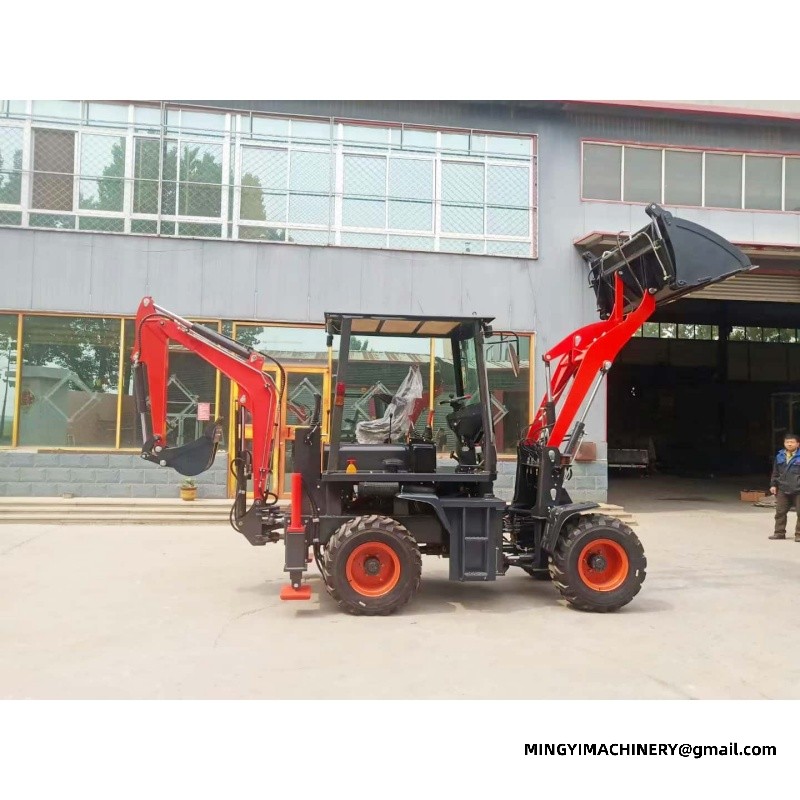
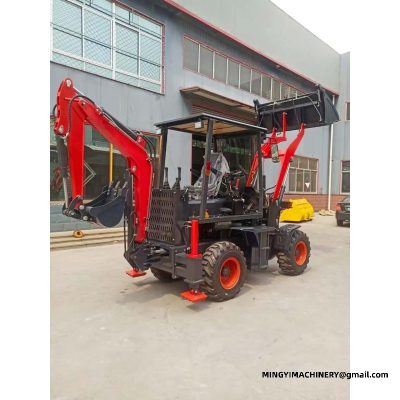
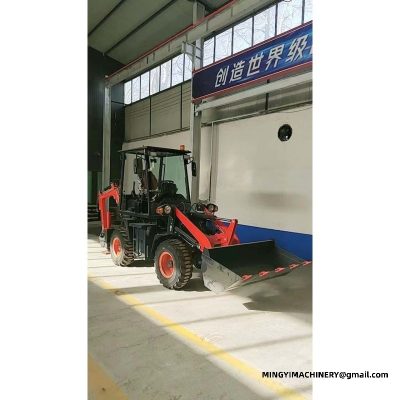
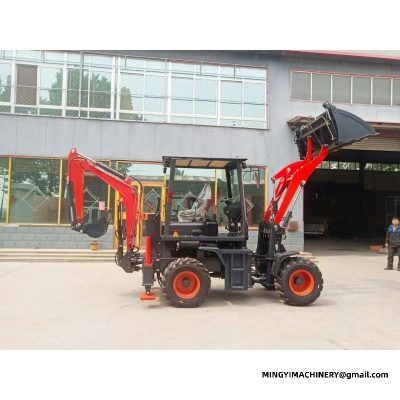
Two machines share this chassis: a 0.5 m³ wheeled loader in front and a 2,140 mm trench digger behind. The published table below is the whole specification — 3,500 kg working weight, a Yunnei 490 diesel at 37 kW, and an arm that offsets 240/460 mm to work true beside walls. This page reads those figures the way a contractor meets them: digging first, loading second, and the travel that connects the two.
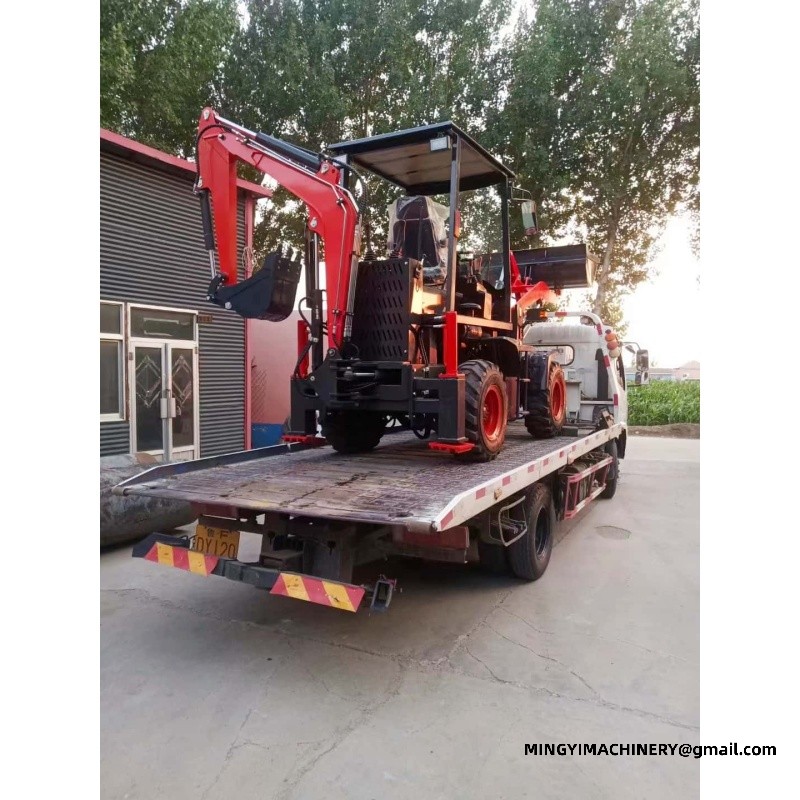
A backhoe loader is two machines sharing one chassis and one engine: a wheeled loader at the front, a digging arm behind. The loader end carries a 0.5 m³ bucket 1,500 mm wide for loading, backfilling and levelling; the rear end carries a boom-and-arm assembly with a 0.04 m³ trenching bucket for digging, and it swings on its own turntable to place the spoil beside the trench. Between the two, the machine covers the whole small-scale earthmoving loop — dig the trench, load the spoil, backfill, level — without a second machine and without a second operator.
The design exists for work that alternates between digging and loading: service trenches, drainage lines, footings, small foundations, roadside culverts and compound drainage. A site that hires a loader and an excavator together pays two mobilisations, two operators and two sets of standing time; the backhoe loader replaces both with one 4,500 x 1,550 x 2,600 mm machine that travels between jobs under its own power at 25 to 35 km/h. On dispersed rural work — septic pits, water lines, culvert heads — the saving is not marginal; it is the whole economics of the job.
| Reference specification — 20L backhoe loader (busy at both ends) | |
|---|---|
| Model | 20L |
| Overall dimensions (L x W x H) | 4,500 x 1,550 x 2,600 mm |
| Working weight | 3,500 kg |
| Ground pressure | 38 kPa |
| Tyres | 12-16.5 |
| Maximum lifting height | 3,500 - 3,900 mm |
| Maximum loading height | 2,400 - 2,800 mm |
| Gradeability | 25° |
| Travel speed | 25 - 35 km/h |
| Loader bucket capacity | 0.5 m³ |
| Loader bucket width | 1,500 mm |
| Engine | Yunnei 490 diesel / 37 kW at 2,400 r/min |
| Backhoe bucket capacity | 0.04 m³ |
| Backhoe bucket width | 450 mm |
| Boom length | 1,823 mm |
| Arm length | 1,130 mm |
| Swing speed | 10 r/min |
| Bucket digging force | 15.2 kN |
| Arm digging force | 8.7 kN |
| Maximum traction | 12.5 kN |
| Maximum digging radius | 3,920 mm |
| Digging radius at ground level | 3,820 mm |
| Maximum digging depth | 2,140 mm |
| Maximum digging height | 3,330 mm |
| Maximum discharge height | 2,440 mm |
| Offset, left / right | 240 / 460 mm |
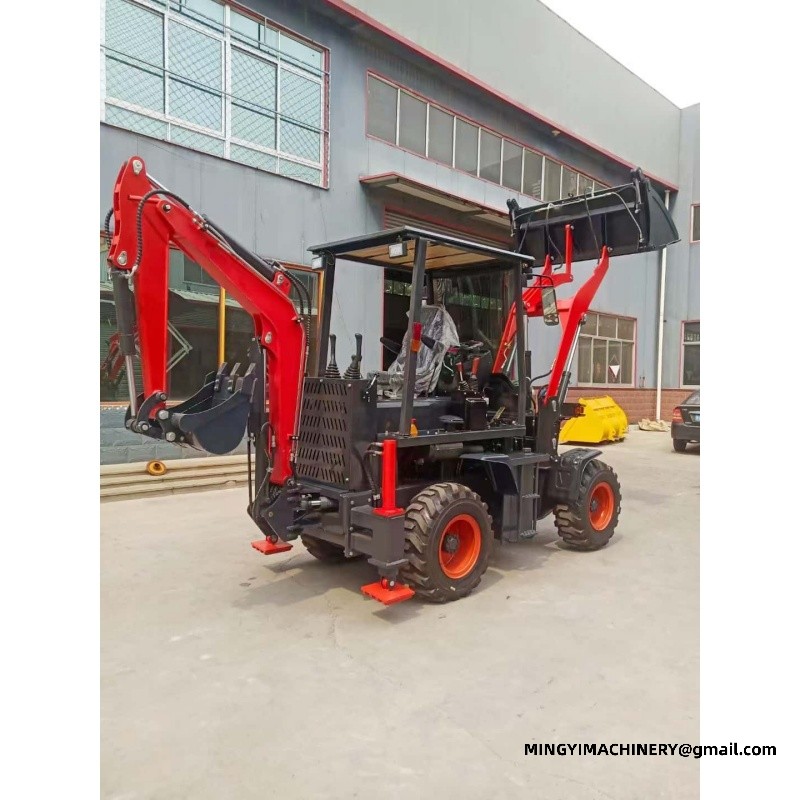
The front bucket takes 0.5 m³ per pass at 1,500 mm wide — a bucket sized for loading ditches, spreading gravel and backfilling the trench the rear end just cut. Maximum lifting height runs 3,500 to 3,900 mm and maximum loading height 2,400 to 2,800 mm, which clears a small truck's side rail and most site dumpers comfortably. Working weight is 3,500 kg, carried on 12-16.5 tyres at a ground pressure of 38 kPa — low enough for soft agricultural ground and finished subgrades where a heavier machine would start to rut.
The rear assembly is a full digging arm, not a token one. With a 1,823 mm boom and a 1,130 mm arm it reaches a maximum digging radius of 3,920 mm and cuts to 2,140 mm deep — water and cable trench depth in a single pass — while throwing the bucket 3,330 mm high at maximum and discharging at up to 2,440 mm. The 450 mm trenching bucket takes 0.04 m³ per bite, and the swing turns at 10 r/min, which is quick enough to keep the spoil pile moving without making the arm hard to place precisely.
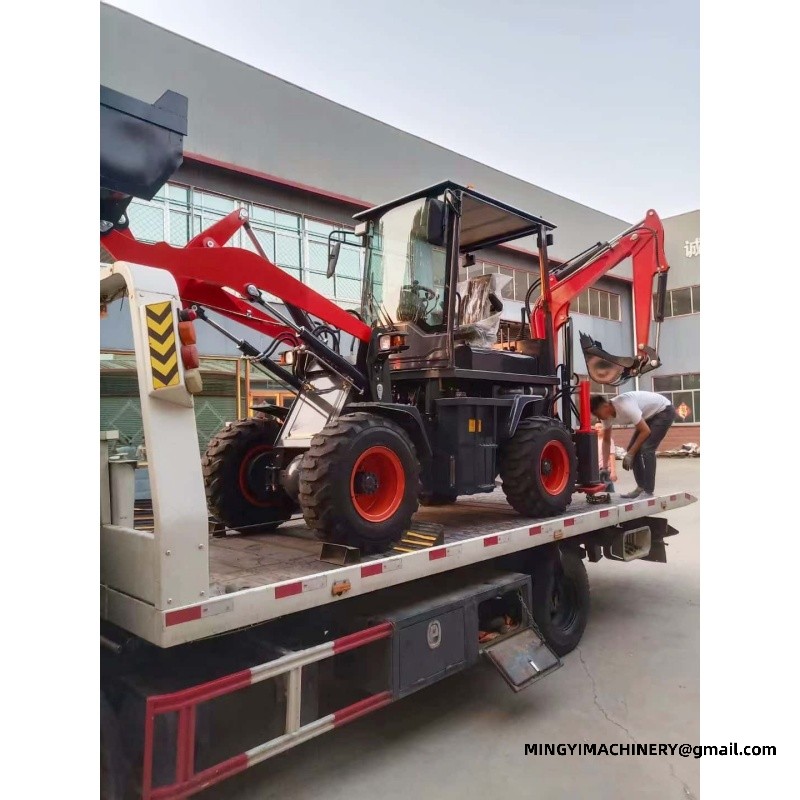
The published forces tell the honest story: 15.2 kN of bucket digging force breaks ground that lighter mini-diggers bounce off, 8.7 kN of arm force drags the loaded bucket back to the crowd, and 12.5 kN of traction pulls the machine through the side-loading that digging always generates. None of these figures make it a rock machine — but for soil, clay, loose fill and weathered ground, the arm digs confidently and the chassis holds its line at a 25° gradeability.
One figure on the table changes the machine's working envelope more than buyers expect: the offset. With 240 mm of offset to one side and 460 mm to the other, the arm digs true to a wall line, a fence line or an existing service without the machine standing in the flow of traffic. Combined with the 3,820 mm ground-level digging radius, the operator covers a working window nearly four metres across from one parked position — and repositioning a 3,500 kg wheeled machine takes seconds, not minutes.
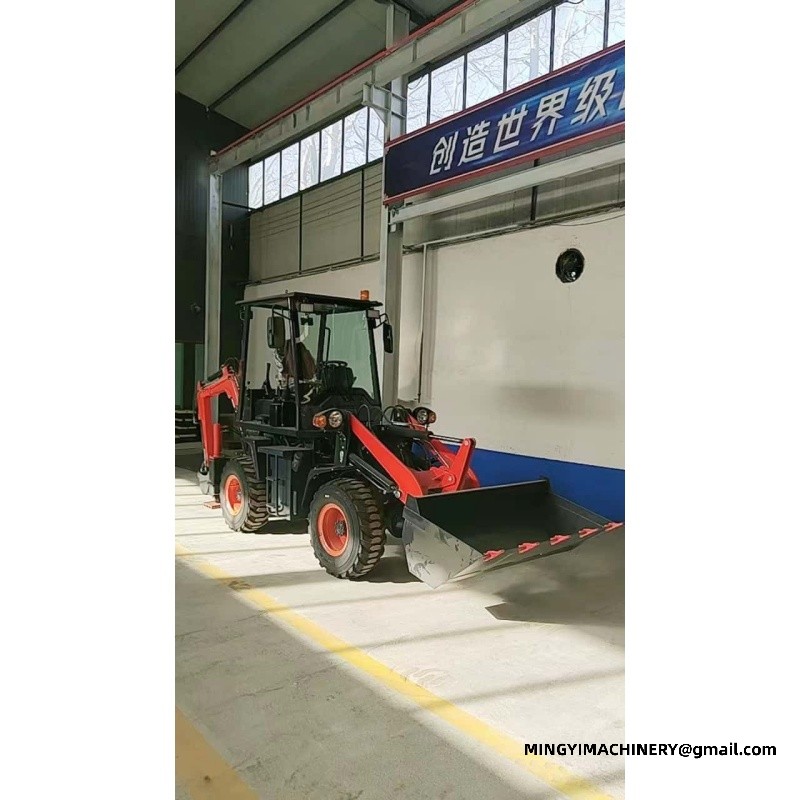
Power comes from a Yunnei 490 four-cylinder diesel rated 37 kW at 2,400 r/min. The 490 pattern is one of the most widespread small-truck engines in production, which matters on the kind of sites a backhoe loader works: parts and mechanics exist everywhere, service is a filter-and-oil routine a general workshop handles, and the engine's character — torque low in the range, no electronics to strand the machine — suits digging and loading cycles that never see a highway.
Watch the machine through one cycle and the design explains itself. The operator parks beside the trench line, lowers the stabilising weight of the front bucket, and digs with the rear arm — bucket force of 15.2 kN cutting the first lift, the 10 r/min swing placing spoil neatly beside the cut rather than along it. When the trench reaches grade, the machine turns on its own footprint, the front bucket takes over, and the same operator backfills and levels with 0.5 m³ passes. No second machine arrives, no second operator is briefed, and the spoil nobody wanted back never gets moved twice.
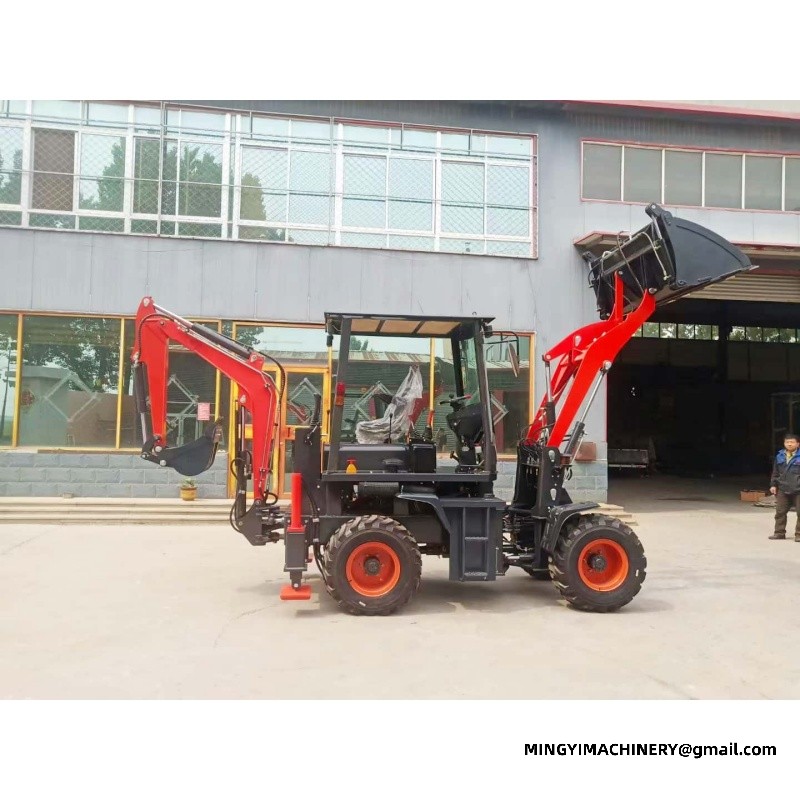
The 12-16.5 industrial tyres carry 3,500 kg at just 38 kPa of ground pressure, and that single figure qualifies the machine for more sites than any other on its page: soft farm ground after rain, finished subgrades that a steel-tracked machine would churn, and compound surfaces where rutting is a defect to be repaired. The tyres also make the machine kind to the ground it must cross between jobs — verge, field headland, finished driveway — which is exactly the travel a two-end machine spends its life doing.
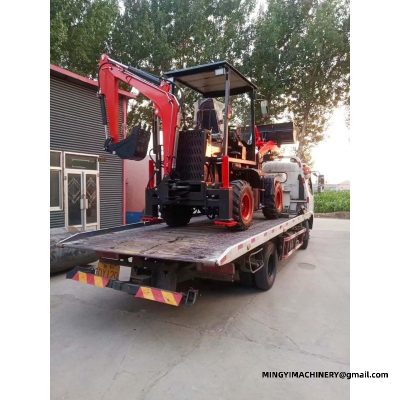
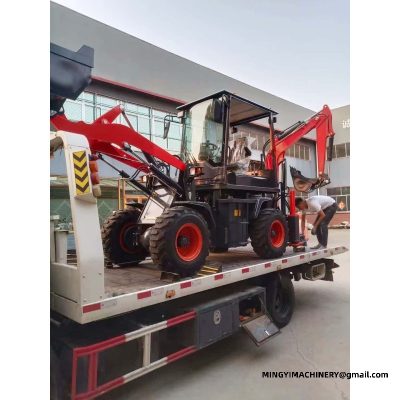
At 4,500 mm long and 1,550 mm wide, the machine travels behind a plant trailer where road moves are needed and works between sites on its own wheels at 25 to 35 km/h where they are not. Servicing is deliberately ordinary: the Yunnei 490 takes standard filters, the arm takes grease, the tyres are a stock size, and the whole machine is reachable with the hand tools that travel in its own toolbox. For contractors running one or two machines in scattered locations, that serviceability — not any single specification figure — is what keeps the machine earning across a season.
Digging puts a side load on a wheeled chassis, and the backhoe loader manages it with geometry rather than heroics: the front bucket lowers to the ground as a stabiliser before the rear arm works, widening the machine's effective stance and taking the rock out of the swing. The rules that follow are short and permanent — bucket down before the arm moves, no one inside the swing radius, spoil kept back from the trench edge, and the machine worked square to the cut wherever the 240/460 mm offset allows it. Travelling is the other half of the discipline: boom folded and low, bucket carried near the ground, and the 25 to 35 km/h range treated as the road figure it is.
The honest comparison is with the two machines it replaces. Against a dedicated excavator, the backhoe digs slower and shallower; against a dedicated loader, it loads smaller buckets. But both of those machines travel on trailers, and neither backfills its own trench. For the contractor whose week is six small trenches in five different places, one machine that digs, loads, carries and levels — worked from one seat, maintained as one machine, insured as one asset — is the correct answer, and this page's specification is the whole of the case.
What can the backhoe loader dig and load?
Both ends work at once in sequence: the rear arm digs to 2,140 mm with a 0.04 m³ bucket, and the front 0.5 m³ bucket loads the spoil or backfills when the trench is finished.
How deep can the backhoe loader excavate?
Maximum digging depth is 2,140 mm, with a 3,920 mm maximum radius and 3,820 mm at ground level — water-line and cable-trench depth in a single pass.
What engine does the backhoe loader use?
A Yunnei 490 four-cylinder diesel rated 37 kW at 2,400 r/min — a widespread small-truck pattern whose parts and service exist in most rural markets.
How much does the backhoe loader weigh, and what ground does it suit?
Working weight is 3,500 kg on 12-16.5 tyres at 38 kPa of ground pressure — soft enough on agricultural ground and finished subgrades to avoid rutting.
Can the backhoe loader load a truck?
Yes. Maximum loading height is 2,400 to 2,800 mm and lifting height 3,500 to 3,900 mm, which clears small truck side rails and site dumpers.
What swing and offset does the backhoe loader arm have?
The turntable swings at 10 r/min, and the arm offsets 240 mm to one side and 460 mm to the other for digging true to walls, fences and existing services.
How fast does the backhoe loader travel between jobs?
25 to 35 km/h under its own power — fast enough to move between nearby jobs without a trailer, and the reason one machine can serve scattered small sites.
How do I get a specification for this backhoe loader?
E-mail sales@mingycn.com or add LINE (ID): mingyicnwith your market and the work you intend it for; the reply covers specification, freight and a formal specification.
One machine, two ends, and a specification short enough to read in a minute: 0.5 m³ front, 2,140 mm of reach behind, 3,500 kg on 12-16.5 tyres. Where the work alternates between digging and loading — trenches, culverts, footings, drainage — this is the size of machine that finishes the job without a second mobilisation.
Packing, loading and shipment of Backhoe Loader: Two Ends, One Machine, 0.5 m³ and 0.04 m³
Container loading is a planning exercise. The overall dimensions and the operating weight of Backhoe Loader: Two Ends, One Machine, 0.5 m³ and 0.04 m³ decide whether it ships whole, partly disassembled or with the attachment removed, and that decision is made before the booking.
Reading the early symptoms on Backhoe Loader: Two Ends, One Machine, 0.5 m³ and 0.04 m³
Temperature and pressure are the two things worth watching. A Backhoe Loader: Two Ends, One Machine, 0.5 m³ and 0.04 m³ that runs hotter than it used to, or whose pressure has drifted, is reporting a problem that is still simple to fix.
Pre-delivery inspection before Backhoe Loader: Two Ends, One Machine, 0.5 m³ and 0.04 m³ leaves the shop
A machine should be inspected while it is still on our floor rather than after it lands. For Backhoe Loader: Two Ends, One Machine, 0.5 m³ and 0.04 m³ that means the engine is run to temperature, the hydraulics are cycled through full travel, and every function is checked against the build sheet before the crate is closed.
Wear items and spares worth holding for Backhoe Loader: Two Ends, One Machine, 0.5 m³ and 0.04 m³
Wear items are predictable once the machine has settled in. After the first service interval the pattern on Backhoe Loader: Two Ends, One Machine, 0.5 m³ and 0.04 m³ is visible, and the parts that were replaced become the parts that are kept.
Keeping a service record for Backhoe Loader: Two Ends, One Machine, 0.5 m³ and 0.04 m³
Service history also protects the warranty position. Evidence that Backhoe Loader: Two Ends, One Machine, 0.5 m³ and 0.04 m³ was maintained at the specified intervals and with the specified fluids settles questions that would otherwise be argued.
Contact MINGYI Machinery for the current backhoe loader specification, export packing and a formal specification for your market. E-mail: sales@mingycn.com | LINE (ID): mingyicn
mini excavator for digging trenches · Backhoe Loader (busy at both ends)
