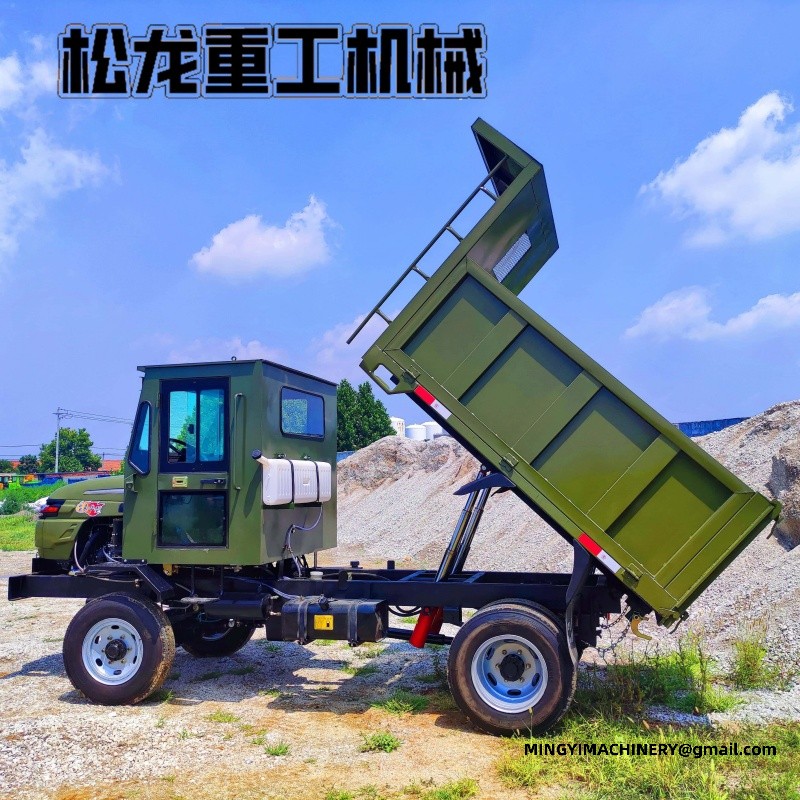
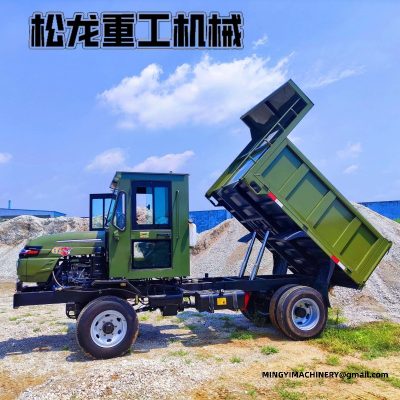
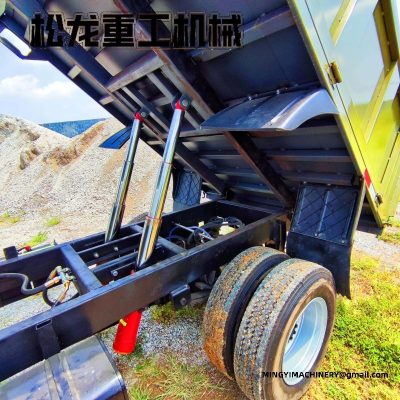
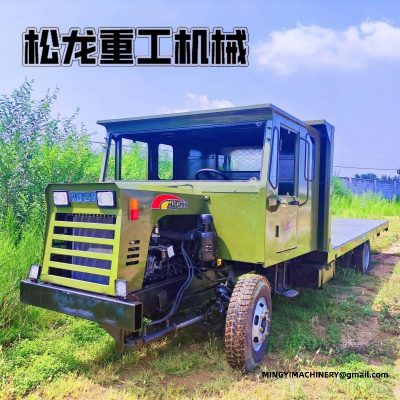
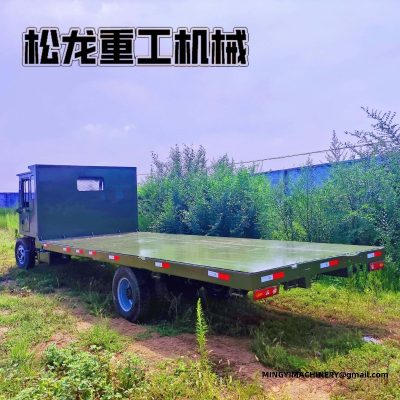
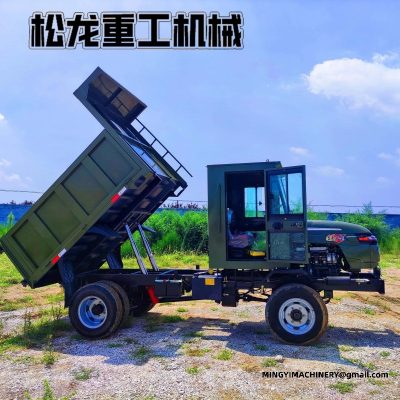
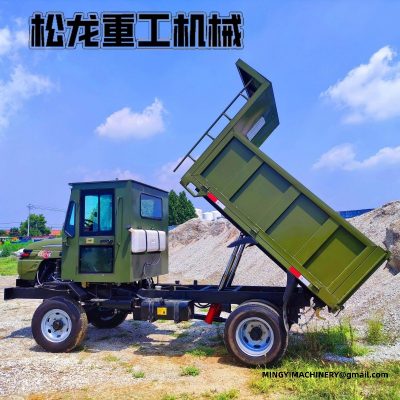
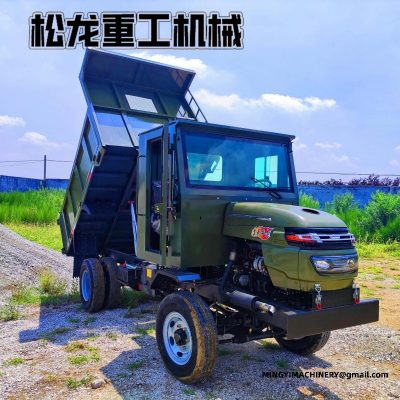
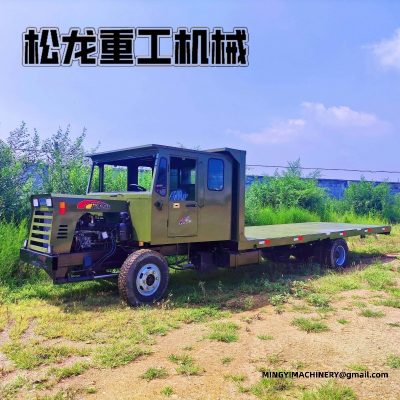
A hillside farm dumper works on ground a site machine never sees: grass rather than graded fill, and a slope that does not go away. The jobs change with the season, the tracks are narrow, and the machine is usually driven by the person who owns it rather than by a hired operator. This page covers the four configurations that are built and shipped, what slope work asks of the machine, and the questions worth settling before an order is placed.
Working across the slope
On a hillside the machine spends its day crossing the gradient rather than climbing it. That is the condition which decides the specification: a dumper that is stable climbing a ramp can still be unstable traversing a wet slope, because the weight sits on the downhill wheels and the ground under them is rarely uniform. Four-wheel drive, a low centre of gravity and a body that is not overloaded are what make crossing safe, and the driver's habit of turning uphill rather than downhill when anything feels wrong is what makes it routine.
The crawler gear fitted to all four configurations is what makes this work possible at low speed. Crossing a slope in a low range keeps the machine under control without riding the brakes, and it is the gear to use when moving a loaded body across wet grass rather than the gear that finishes the job fastest.
Wet grass, mud and traction
Grass over clay is the difficult surface, because it is slippery in a way gravel is not and it becomes more slippery the more it is worked. Tyre choice follows from that: the 18.Standard and the 7.Upgraded run 700-16 mountain tyres, which clear mud and cut through a wet surface to whatever is firm underneath. The 21.Upgraded and the 22.Luxury run six 825R16 steel-belted radial tyres, which suit a farm with maintained tracks where the machine also covers distance on firmer ground.
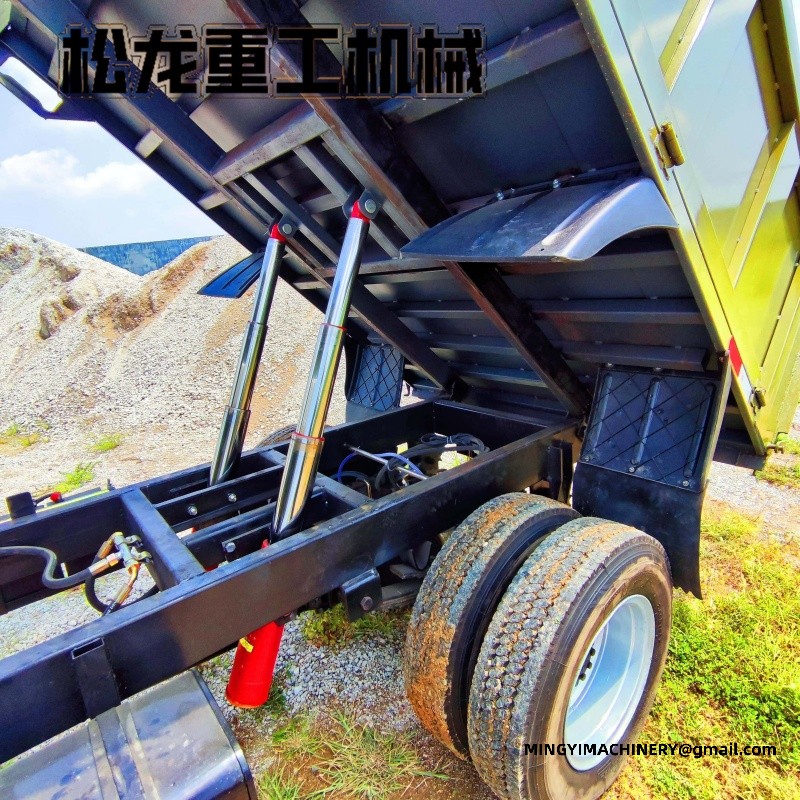
Tyre count matters on grassland as well. The 7.Upgraded runs four tyres and the other three run six, and six contact patches spread the machine's weight across more ground, which is what limits the damage to a field being worked wet. Where the ground is soft in spring, that difference is the one the farmer notices first.
The seasonal round
A farm dumper is bought for the year, not for one job. Spring work is muck and fertiliser, which is slow travel and repeated stopping. Summer brings silage and hay, where the machine works alongside a harvester and the cycle is set by something else. Autumn is harvest carting on ground that gets wetter each week, and winter is feed, bedding and access work. Specifying for the whole round means choosing the engine and the body for the busiest season rather than for the easiest one.
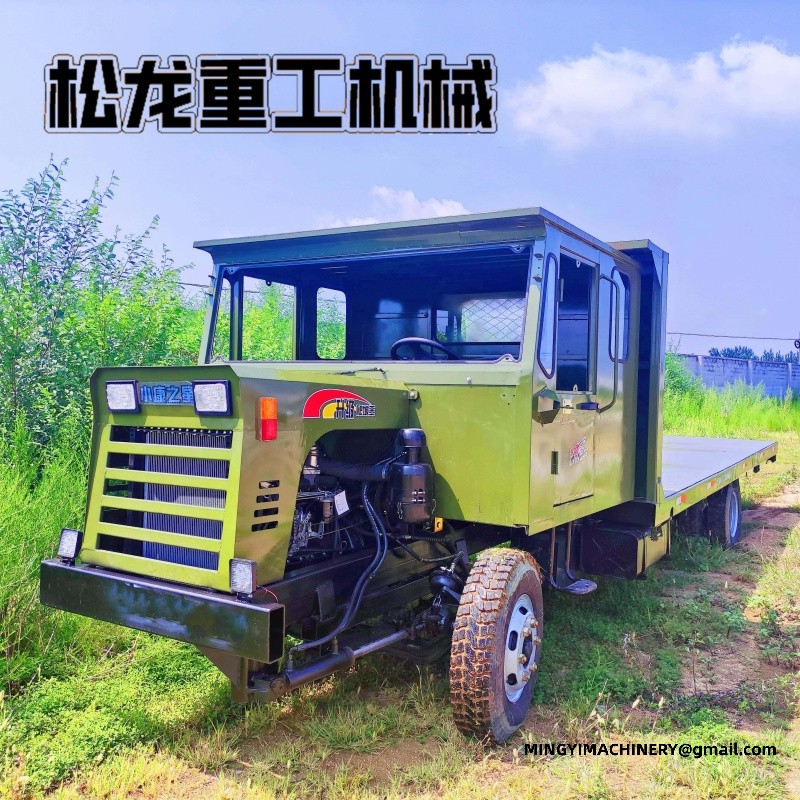
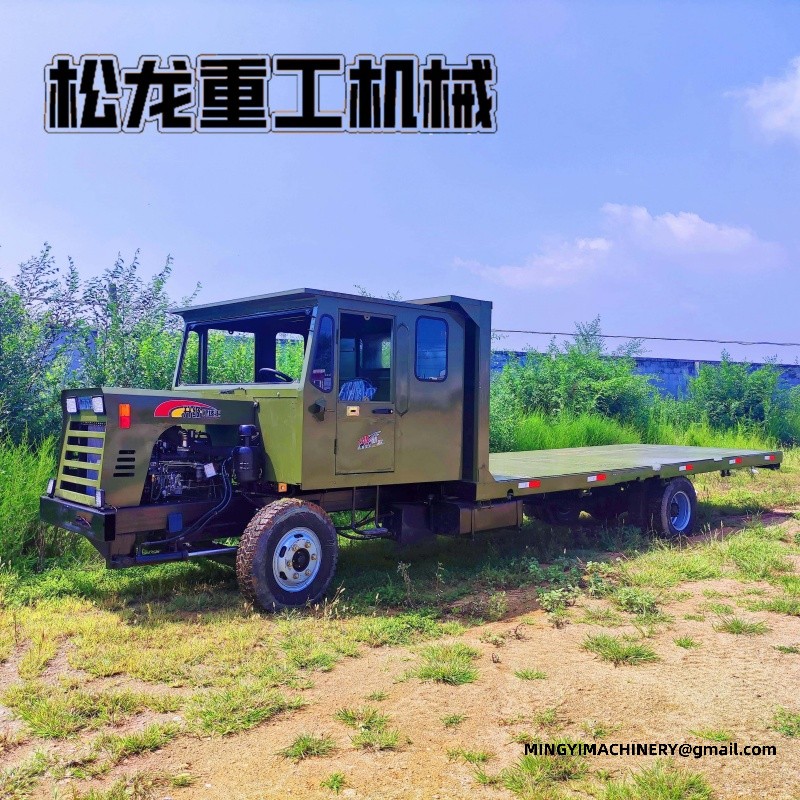
It also means the cab matters more than a farm buyer sometimes expects. The 22.Luxury and the 7.Upgraded leave the factory with a fully enclosed cab and the 18.Standard and the 21.Upgraded with a simple cab. A driver moving bedding or feed in February is working rather than commuting, and the enclosure is part of getting through the day.
Gates, tracks and the width of the machine
Farm access is fixed and cannot be widened. Body width is the dimension to check against the narrowest gate and the tightest hedged track on the route, because it is easier to change the specification than to change the farm. The 7.Upgraded carries the narrowest body at 2.2 m long by 1.5 m wide, the 18.Standard a body of the same length but 2.1 m wide, and the 21.Upgraded and the 22.Luxury a 3.0 m by 2.2 m body. All four are 0.45 m deep.
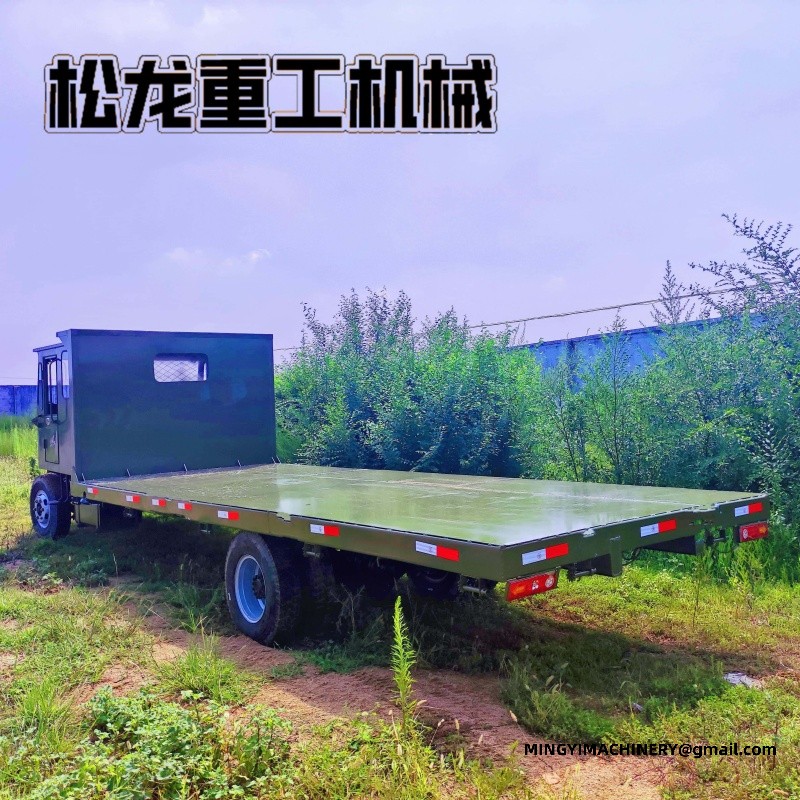
Length matters as much as width. The 3.0 m body carries more per trip, which is what a long run from a distant field wants; the shorter bodies turn in a farmyard and reverse into a shed, which is what a small holding wants.
Engines and gearboxes on the four configurations
Three of the four run a turbocharged four-cylinder: the 4102 on the 18.Standard and the 4105 on the 21.Upgraded and the 22.Luxury. The 7.Upgraded runs a single-cylinder 28 hp diesel. The turbocharged engines suit a farm where the machine works a long day in the busiest season and covers distance between fields; the single-cylinder suits smaller holdings where the runs are short and the machine shares the work with other equipment.
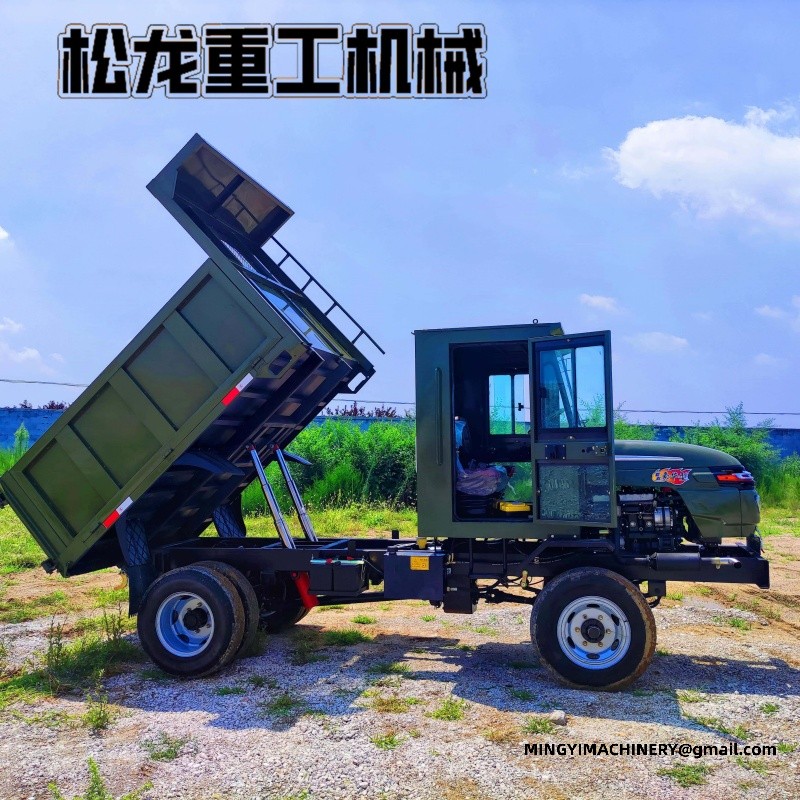
Drive arrangement differs as well. The 7.Upgraded uses a full-time gearbox with four-wheel drive, which is the arrangement for a machine on soft or slippery ground all day. The 18.Standard and the 21.Upgraded use the Model 140 part-time gearbox with four-wheel drive and the 22.Luxury the Model 145, all with high and low range and a crawler gear. The 7.Upgraded also has a front axle clutch, which lets the driver disengage the front axle on firmer ground and saves tyre and driveline wear on the road sections.
Tipping on a slope
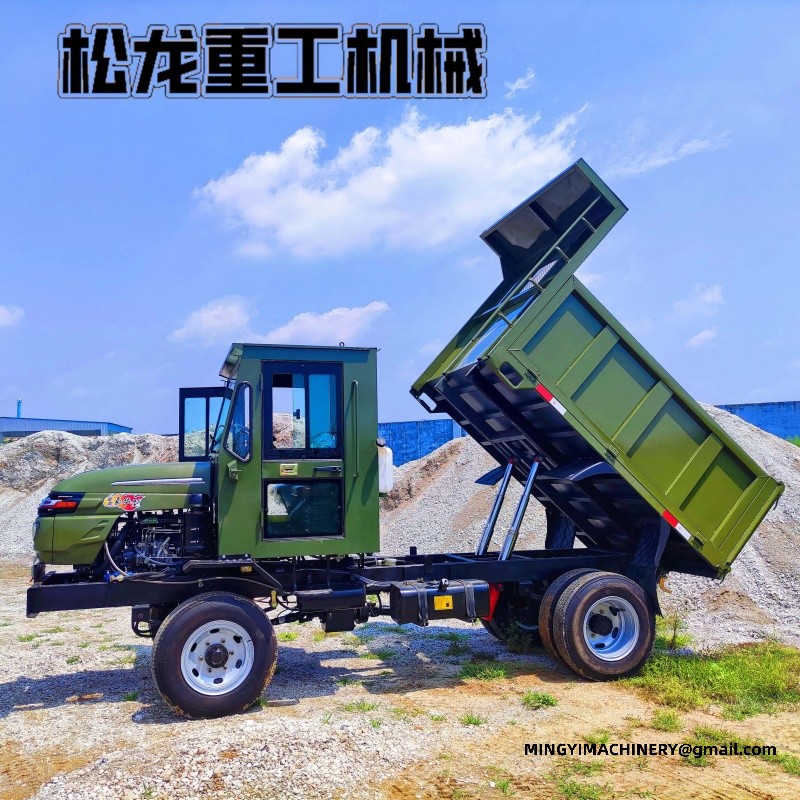
Tipping on hillside ground is the operation that deserves the most thought. The safe habit is to position the machine pointing uphill or downhill rather than across the slope, because a body raised on a camber puts the weight onto the downhill side and the margin on grass is small. Every configuration here has a tailgate with a self-dumping function, which starts the load leaving before the body reaches full height and shortens the time the machine spends raised.
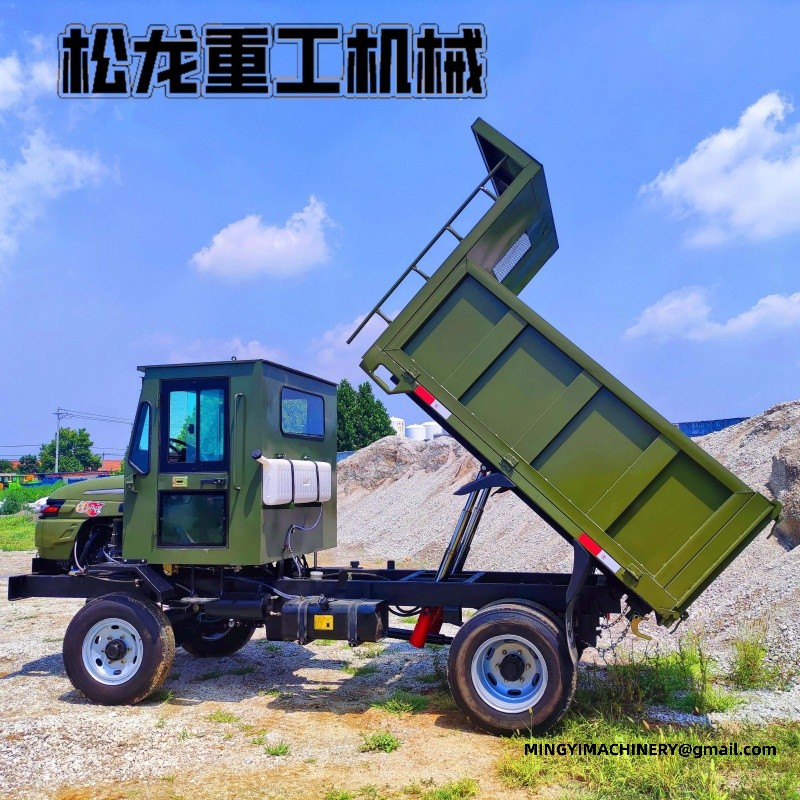
The 22.Luxury adds a side-opening rear body tailgate with a cab ladder. On farm work that is useful for placing material along a run rather than in one heap, and for the driver who needs to look into the body several times a day.
Brakes and holding a load on a gradient
The 21.Upgraded and the 22.Luxury leave the factory with air cut-off brakes, and the 21.Upgraded pairs them with a reinforced 1080 rear axle with air cut-off brake. The 18.Standard and the 7.Upgraded use oil brakes. What matters on a hillside is that the driver knows which system the machine has before the first loaded descent, and plans the descent before the load goes in: choose the gear on the way up and use the engine and the crawler gear on the way down.
Frame, axles and suspension
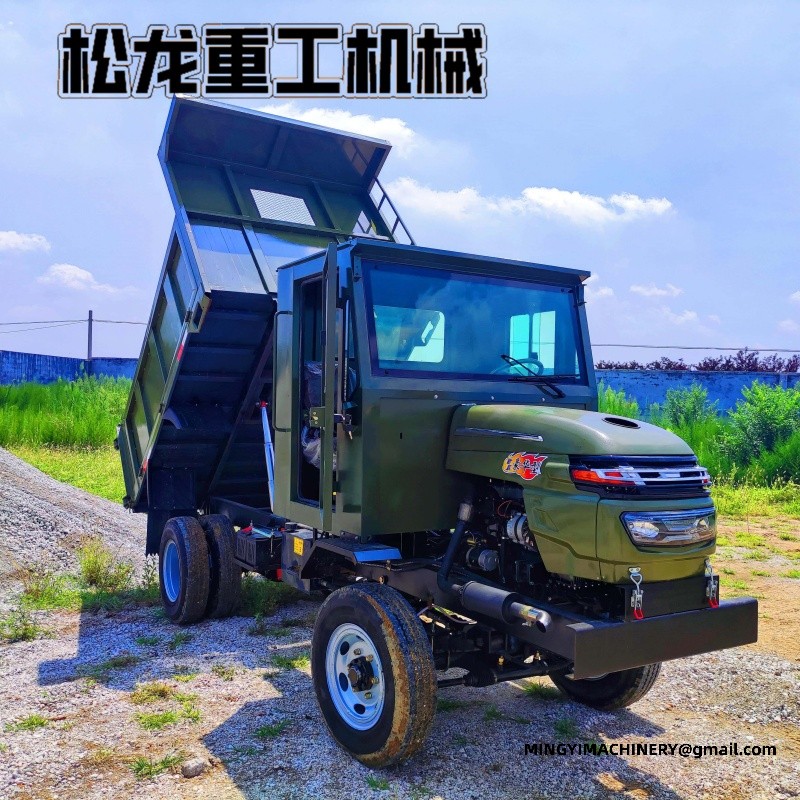
Three of the four sit on the reinforced 80 x 180 mm square tube frame; the 7.Upgraded uses the reinforced 60 x 140 mm frame. Axle specification follows the same split: reinforced ISUZU-pattern front axles on the three larger machines, with a reinforced 1061 rear axle on the 18.Standard and reinforced 1080 rear axles on the other two, against the front axle 212 and rear axle 130 on the 7.Upgraded. Heavy-duty leaf springs are specified on the 21.Upgraded and the 22.Luxury, which is where the larger body and the longer day are carried.
Working alongside other machines
On a farm the dumper rarely works alone. During silage and harvest it works to the pace of a harvester or a loader, and the cycle is set by that machine rather than by the dumper. Specifying from that relationship means matching the body to the loader bucket rather than picking the largest body available, because a body that takes four buckets to fill is a body that keeps the loader waiting, and the loader is the expensive half of the pair.
Looking after the machine in a farm workshop
Most of these machines are maintained by the owner rather than under a service contract, and the jobs that matter are the ones that can be done in a shed. A walk-around at the start of the day should cover the body and ram mountings, the hoses, tyre condition and pressures, brake response and fluid levels, and the tailgate latch. Air filtration needs more attention during harvest dust, and the body floor should be cleaned out rather than left carrying a skin of material into the next season.
Keeping the oil clean and the greasing done on schedule is most of what keeps a hydraulic tipping system working. Twin-battery electric start is fitted to all four configurations, which is what makes a cold morning start dependable rather than hopeful.
Parts, service and the local network
Parts availability usually decides the engine and the axle pattern. A machine built around components the local network already carries is serviced from stock, which is the difference between a day lost and a week lost, and on a farm a day lost in the wrong week is the difference between a job done and a job missed. Remote diagnosis shortens most faults: a walk-around on video with the panels open usually identifies the cause without waiting for a visit, and avoids ordering a part that turns out not to be needed.
Export packing and documentation
For export orders, packed dimensions, securing points and any dismantling required are settled before the machine leaves the factory. The commercial invoice, the packing list and any certificate the destination requires are agreed at order stage, because missing papers delay clearance longer than the voyage takes. Where several machines ship together, confirming how many units fit a container is part of that planning.
What is confirmed before the machine is built
Every machine is inspected on our floor before it is crated: the engine is run to temperature, the hydraulics are cycled, the brakes are tested with a load, and each function is checked against the build sheet. The sheet that travels with the machine records the configuration as delivered, which is what a workshop needs when a part is replaced several years later and what supports the resale value at replacement time. Every line above is a build item rather than an optional extra, and the final sheet is confirmed against the destination, the ground and the duty before production starts.
| # | 18.Standard | 21.Upgraded | 22.Luxury | 7.Upgraded |
|---|---|---|---|---|
| 1 | Four-cylinder 4102 turbocharged diesel engine | Four-cylinder 4105 turbocharged diesel engine | Four-cylinder 4105 turbocharged diesel engine | Single-cylinder diesel engine, 28 hp |
| 2 | Model 140 part-time gearbox with four-wheel drive | Model 140 part-time gearbox with four-wheel drive | Model 145 part-time gearbox with four-wheel drive | Full-time gearbox with four-wheel drive |
| 3 | High/low range with crawler gear | High/low range with crawler gear | High/low range with crawler gear | High/low range with crawler gear |
| 4 | Simple cab | Simple cab | Fully enclosed cab | Front axle clutch |
| 5 | Oil brakes | Six 825R16 steel-belted radial tyres | Six 825R16 steel-belted radial tyres | Fully enclosed cab |
| 6 | Six 700-16 mountain tyres | Reinforced ISUZU-pattern front axle | Reinforced ISUZU-pattern front axle | Oil brakes |
| 7 | Reinforced ISUZU-pattern front axle | Reinforced 1080 rear axle with air cut-off brake | Reinforced 1080 rear axle | Four 700-16 mountain tyres |
| 8 | Reinforced 1061 rear axle | Air cut-off brakes | Air cut-off brakes | Front axle 212 |
| 9 | Reinforced 80 x 180 mm square tube frame | Reinforced 80 x 180 mm square tube frame | Reinforced 80 x 180 mm square tube frame | Rear axle 130 |
| 10 | Rear body 2.2 m long x 2.1 m wide x 0.45 m high | Rear body 3.0 m long x 2.2 m wide x 0.45 m high | Rear body 3.0 m long x 2.2 m wide x 0.45 m high | Reinforced 60 x 140 mm square tube frame |
| 11 | Tailgate with self-dumping function | Tailgate with self-dumping function | Tailgate with self-dumping function | Rear body 2.2 m long x 1.5 m wide x 0.45 m high |
| 12 | Hydraulic power steering | Hydraulic power steering | Side-opening rear body tailgate with cab ladder | Tailgate with self-dumping function |
| 13 | Twin hydraulic rams | Twin hydraulic rams | Hydraulic power steering | Hydraulic power steering |
| 14 | Two-person comfort seat | Two-person comfort seat | Twin hydraulic rams | Twin hydraulic rams |
| 15 | Twin-battery electric start | Heavy-duty leaf springs | Two-person comfort seat | Two-person comfort seat |
| 16 | Square-nose bonnet | Twin-battery electric start | Heavy-duty leaf springs | Twin-battery electric start |
| 17 | — | Square-nose bonnet | Twin-battery electric start | Square-nose bonnet |
| 18 | — | — | Square-nose bonnet | — |
For a specification discussion or a build sheet for this hillside farm dumper, contact sales@mingycn.com or reach us on LINE (ID: mingyicn).









