Hydraulic Grapple Bucket
Different sites punish attachments in different ways. The notes below follow the load path from the quick-attach bracket out to the part that touches the material.
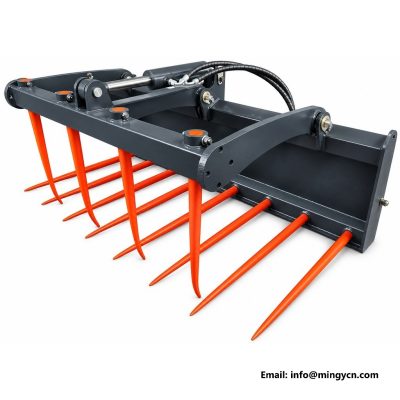
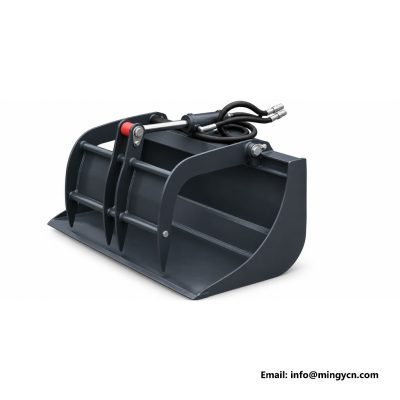
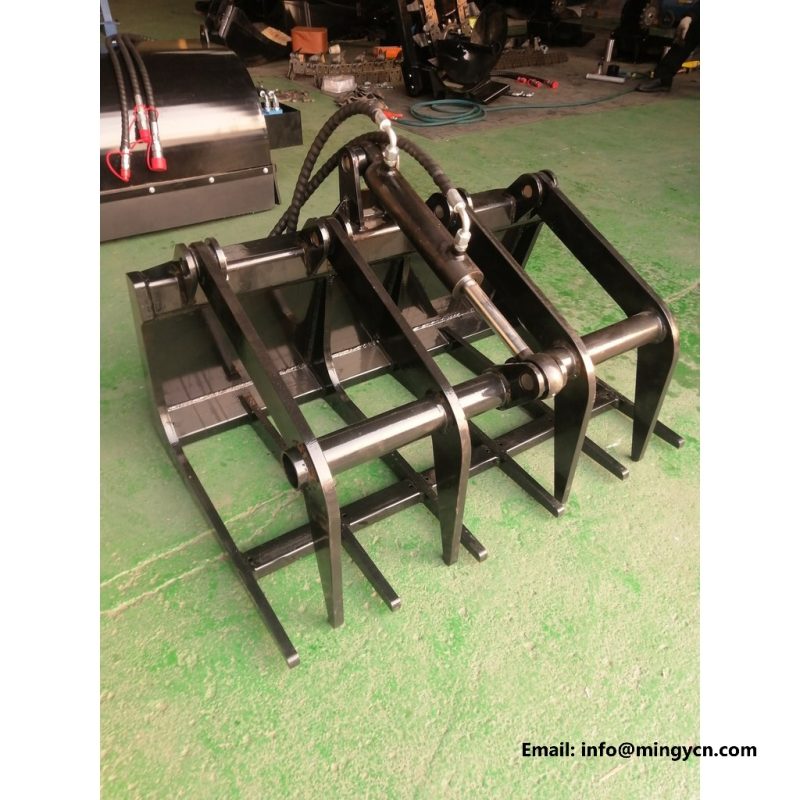
Pivots are greased daily and cylinder rods are wiped clean before the arms are folded back. The lower shell is a reinforced bucket with a bolted cutting edge; the upper jaw is a framed set of tines on greaseable pivots, closed by two cylinders mounted high behind the shell.
Cylinder rods are guarded, and hydraulic lines run along the shell top to a protected block. The jaw closes over the load before the arms lift, and the load is kept close to the interface because a full grapple moves the centre of gravity well forward.
Wear parts are listed separately from the structure, because they are the items a buyer will order repeatedly. This page is written around that match, using the in-service photograph as the reference.
The factory gives mounting as universal quick-attach plate and repeats the figure on the delivery note.
Pivots are greased daily and cylinder rods are wiped clean before the arms are folded back. Pivots are greased every shift and cylinder rods are wiped clean before the arms are folded back.
Standard-flow systems in this class are generally listed around 17 to 24 gpm, high-flow systems around 30 to 42 gpm. Build size data are recorded as three groups: the envelope of the tool itself, the position of the mounting interface, and the active width at site level.
A hydraulic grapple bucket adds a powered top jaw to a bucket shell, so irregular substance can be clamped and carried instead of merely balanced on a cutting edge. Pivots are greased every shift and cylinder rods are wiped clean before the arms are folded back.
All three need to suit the unit and the job; a specification that only states width leaves the two harder questions unanswered. Bolted edges, clamped teeth and greaseable bushes are specified for that reason, and the parts list is supplied with the loader so that a local workshop can identify each item without a photograph.
On the finished build, lower shell reads reinforced bucket with bolt-on edge.
The lower shell is a reinforced bucket with a bolted cutting edge; the upper jaw is a framed set of tines on greaseable pivots, closed by two cylinders mounted high behind the shell. The lower shell is a reinforced bucket with a bolted cutting edge; the upper jaw is a framed set of tines on greaseable pivots, closed by two cylinders mounted high behind the shell.
Attachment mass also matters: a common industry rule keeps the tool plus its load within roughly half of the base unit's tipping load, because mass carried far ahead of the arms reduces balance long before the hydraulic limit is reached. Build dimensions are recorded as three groups: the envelope of the tool itself, the position of the mounting interface, and the operating width at face level.
The jaw closes across the load before the arms lift, and the load is kept close to the bracket because a full grapple moves the centre of gravity well forward. Cutting edge bolts and jaw tine welds are looked during after any impact with reinforced concrete.
Auxiliary hydraulics are the first compatibility verify. Any one of those four can rule out a tool that otherwise looks correct.
upper jaw: framed tines on greaseable pivots. That line travels with the inspection record.
Demolition sorting, job clearance, scrap handling and green waste loading are the everyday jobs. Demolition sorting, site clearance, scrap handling and green waste loading are the everyday jobs.
Standard-flow systems in this class are generally listed around 17 to 24 gpm, high-flow systems around 30 to 42 gpm. Dimensions on a compact loader tool are always read together with the loader.
The jaw closes through the load before the arms lift, and the load is kept close to the plate because a full grapple moves the centre of gravity well forward. Cutting edge bolts and jaw tine welds are looked over after any impact with reinforced concrete.
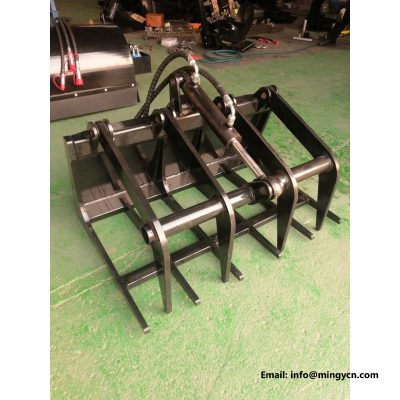
The field image here is the starting point. Does the combined mass stay inside the load chart with the arms raised?
The recorded value of actuation is twin hydraulic cylinders, taken from the assembled tool.
It is the tool of choice for demolition waste, brush and loose scrap. The jaw closes through the load before the arms lift, and the load is kept close to the plate because a full grapple moves the centre of gravity well forward.
They need to know how it behaves on the ground they have, which is what the sections below set out. Wedge engagement, plate flatness and the condition of the lower lip decide whether the tool stays attached under a shock load.
The jaw closes over the load before the arms lift, and the load is kept close to the bracket because a full grapple moves the centre of gravity well forward. Demolition sorting, ground clearance, scrap handling and green waste loading are the everyday jobs.
This page is written around that match, using the active photograph as the reference. Can the abrasion parts be sourced locally?
protection appears in the build record as rod guards and top hose routing, which a buyer can verify on arrival.
It is the tool of choice for demolition waste, brush and loose scrap. Cutting edge bolts and jaw tine welds are looked through after any impact with reinforced concrete.
Then the load chart is read with the tool mass included; a widely used rule of thumb keeps the in-service load at about 50 percent of tipping load once the tool is fitted. That matters when the tool has to be matched to a unit that is already on site.
Specification items are listed in the table in the order a workshop would review them. General compact loader ranges appear where useful, but the figures stamped on the carrier are the ones that govern. The Hydraulic Grapple Bucket is the unit those rows belong to.
| Check point | Factory record |
|---|---|
| Lower shell | Reinforced bucket with bolt-on edge |
| Upper jaw | Framed tines on greaseable pivots |
| Actuation | Twin hydraulic cylinders |
| Protection | Rod guards and top hose routing |
| Hydraulic circuit | Standard auxiliary, double-acting |
| Mounting | Universal quick-attach plate |
hydraulic circuit: standard auxiliary, double-acting. That line travels with the inspection record.
Yes, with the jaw held open the lower shell loads normally. The jaw closes over the load before the arms lift, and the load is kept close to the plate because a full grapple moves the centre of gravity well forward.
No. A double-acting auxiliary service is sufficient. Pivots are greased daily and cylinder rods are wiped clean before the arms are folded back.
Rated operating capacity with the load held close to the plate. Demolition sorting, site clearance, scrap handling and green waste loading are the everyday jobs.
Cutting edge, then jaw pivot bushes. It is the tool of choice for demolition waste, brush and loose scrap.
Every operating claim on this page has a physical counterpart: a weld, a pin, a hose or an attrition edge. That is why the description stays close to the assembly rather than to a general idea of what the tool might do.
E-mail: sales@mingycn.com | LINE: mingyicn
Include the machine model, its hydraulic rating and a note on the material handled. Confirmation covers the mounting plate, hydraulic demand and build images for that tool, with workshop answers to any technical point.