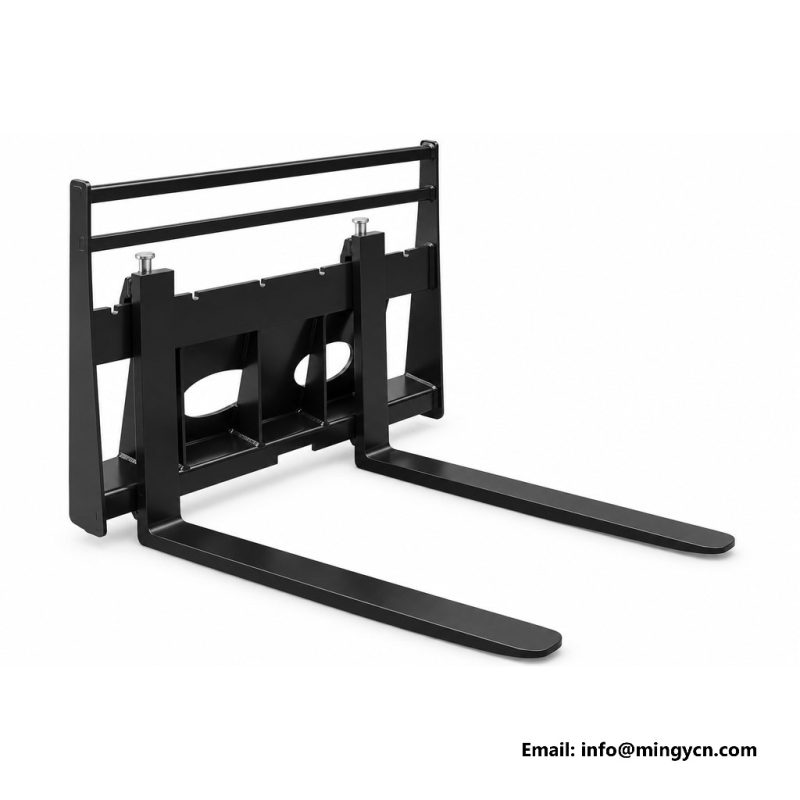
Pallet Fork Frame
This page sets out the specification of the attachment in a form that can be set against a carrier's data plate. Dimensions, hydraulic interfaces, wear parts and mounting geometry are treated as separate items rather than as one general description.
The interface drawing for the pallet fork frame states backrest as load guard grille for the standard build. In the build record, hydraulic circuit for the pallet fork frame is entered as none required, passive tool, and that entry is repeatable at goods-in.
The fork carriage, pallet forks, fork attachment carries its identification mark on the mounting frame, where it stays legible after repainting. A second movement on this pallet fork frame requires a second auxiliary service, which is noted on the interface sheet.
Working width of the pallet fork frame is set against gate openings and transport limits before it is set against machine power. Inspectors record tines as sliding, position-locking forged tines once the fork carriage, pallet forks, fork attachment has been assembled and painted.
The pallet fork frame carries mounting = universal quick-attach plate, and that pair is the reference used during commissioning.
Pin diameters and bush sizes for the pallet fork frame are itemised individually, which is what a local workshop needs to order replacements. In the build record, mounting for the pallet fork frame is entered as universal quick-attach plate, and that entry is repeatable at goods-in.
For procurement, the pallet fork frame is set out by measurable fields rather than by a general description of what it can do. For the pallet fork frame, the backrest line reads load guard grille and is verified with a tape or gauge at goods-in.
Overall height of the pallet fork frame is read with the tool parked level, not with the arms raised. The interface drawing for the pallet fork frame states levelling as manual or hydraulic on some frames for the standard build.
The fork carriage, pallet forks, fork attachment is designed around a replaceable working edge, so the structure is inspected individually from the consumable components. For the pallet fork frame, the levelling line reads manual or hydraulic on some frames and is verified with a tape or gauge at goods-in.
For the pallet fork frame, the carriage line reads welded frame with walk-through opening and is verified with a tape or gauge at goods-in.
If a variant is requested, the hydraulic circuit line for this fork carriage, pallet forks, fork attachment is reissued; the standard value here is none required, passive tool. The carriage row for this pallet fork frame is welded frame with walk-through opening; it is a measured value, not an estimate.
The fork carriage, pallet forks, fork attachment is signed off against a list that an operator can repeat at handover with a tape and a pressure gauge. The hydraulic circuit figure of none required, passive tool is written against this pallet fork frame and repeated on the parts list.
The inspection record for the pallet fork frame names the coupler type, the hose size and the number of independent hydraulic services. Flow demand for rotating versions of the pallet fork frame is read at full engine speed rather than from pump displacement.
This pallet fork frame is selected only after the carrier plate has been read, because auxiliary output decides how fast the working element can turn. For the pallet fork frame, the mounting line reads universal quick-attach plate and is verified with a tape or gauge at goods-in.
Read tines as sliding, position-locking forged tines on the fork carriage, pallet forks, fork attachment: it is a build dimension, not a class average.
Procurement uses the tines figure of sliding, position-locking forged tines to identify this fork carriage, pallet forks, fork attachment against other builds. Procurement uses the backrest figure of load guard grille to identify this fork carriage, pallet forks, fork attachment against other builds.
A fork carriage, pallet forks, fork attachment intended for continuous duty is specified with a case-drain path, since a blocked drain shortens motor life sharply. Inspectors record carriage as welded frame with walk-through opening once the fork carriage, pallet forks, fork attachment has been assembled and painted.
The mounting row for this pallet fork frame is universal quick-attach plate; it is a measured value, not an estimate. Where the host machine differs, the interface rows for the fork carriage, pallet forks, fork attachment are reissued before fabrication begins.
Hydraulic supply for the pallet fork frame is read at rated engine speed, because a nominal pump figure says little about the flow at the coupler. A buyer comparing carriers will find tines entered as sliding, position-locking forged tines for this pallet fork frame.
A buyer comparing carriers will find backrest entered as load guard grille for this pallet fork frame.
The pallet fork frame is supplied with tines recorded as sliding, position-locking forged tines rather than as a class average. Spare parts for the fork carriage, pallet forks, fork attachment are picked out by the entries on the sheet rather than by a photograph.
For procurement, the pallet fork frame is set out by measurable fields rather than by a general description of what it can do. On the comparison sheet, backrest appears as load guard grille, which is the value measured after assembly of the fork carriage, pallet forks, fork attachment.
Transport width of the fork carriage, pallet forks, fork attachment is entered separately from working width, because the two rarely coincide. The pallet fork frame is captured as one build configuration, and any option that changes the interface is issued as a separate row.
A technician comparing two pallet fork frame builds in most builds starts with the wear parts list rather than with the overall width. Read levelling as manual or hydraulic on some frames on the fork carriage, pallet forks, fork attachment: it is a build dimension, not a class average.
The pallet fork frame carries levelling = manual or hydraulic on some frames, and that pair is the reference used during commissioning.
Spare edges and pins for the pallet fork frame are chosen from the dimensions above, not from a generic catalogue. Plate flatness and wedge engagement on the pallet fork frame are verified with a straightedge before the coupler is accepted.
The fork carriage, pallet forks, fork attachment is delivered with its parts list, so each consumable can be picked out without referring back to a photograph. The pallet fork frame carries hydraulic circuit = none required, passive tool, and that pair is the reference used during commissioning.
The table below lists the build and interface items that are established with the machine. Figures shown as ranges are industry reference values for compact loaders rather than claims about a particular carrier; the carrier data plate always takes precedence. The Pallet Fork Frame is the unit those rows belong to.
| Specification row | Works entry | Verification method |
|---|---|---|
| Carriage | Welded frame with walk-through opening | Compared with the load chart |
| Tines | Sliding, position-locking forged tines | Checked at goods-in |
| Backrest | Load guard grille | Measured with a tape |
| Levelling | Manual or hydraulic on some frames | Measured with a tape |
| Hydraulic circuit | None required, passive tool | Confirmed on the interface drawing |
| Mounting | Universal quick-attach plate | Checked at goods-in |
If the carrier differs, the hydraulic circuit row for the pallet fork frame is reissued; the standard entry here is none required, passive tool.
Only the standard build is described here: for the fork carriage, pallet forks, fork attachment, levelling reads manual or hydraulic on some frames and any change to the interface is issued as a separate row. If a variant is requested, the carriage line for this fork carriage, pallet forks, fork attachment is reissued; the standard value here is welded frame with walk-through opening.
Start with rated operating capacity and the hydraulic circuit entry of none required, passive tool; both are recorded for this pallet fork frame and both can be rechecked on arrival. The interface drawing for the pallet fork frame states levelling as manual or hydraulic on some frames for the standard build.
The interface sheet lists the coupler size, the number of services and mounting as universal quick-attach plate for the fork carriage, pallet forks, fork attachment, so the answer is written down before dispatch. The interface drawing for the pallet fork frame states backrest as load guard grille for the standard build.
For this pallet fork frame the receiving workshop measures carriage against the stated welded frame with walk-through opening with a tape or gauge; no special equipment is needed. In the build record, hydraulic circuit for the pallet fork frame is entered as none required, passive tool, and that entry is repeatable at goods-in.
Every line in the table has a physical counterpart on the tool. That is the point of publishing a specification in this form: the reader can verify it at delivery with ordinary measuring equipment.
E-mail: sales@mingycn.com | LINE: mingyicn
A short note with the carrier model, flow figure and working material is enough to start. Confirmation covers the mounting plate, hydraulic demand and build images for that tool, with workshop answers to any technical point.