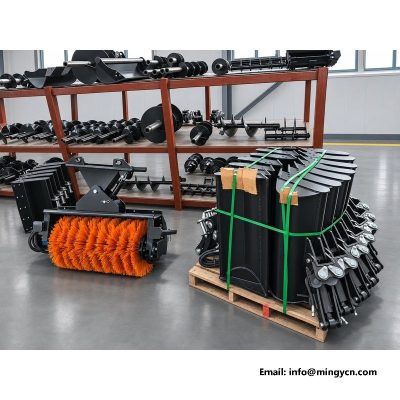
skid steer attachment export packing and crating
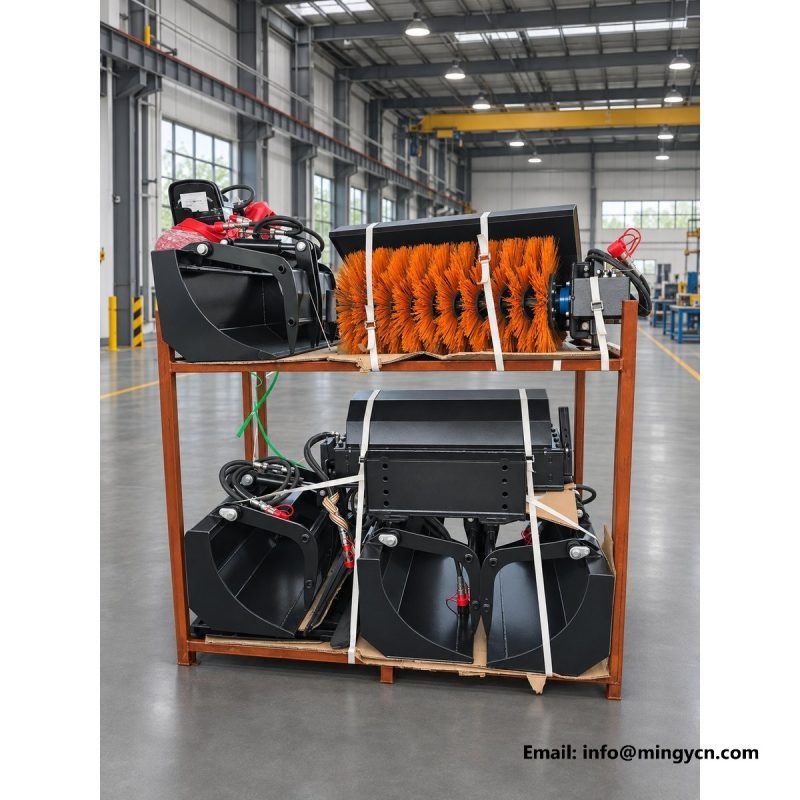
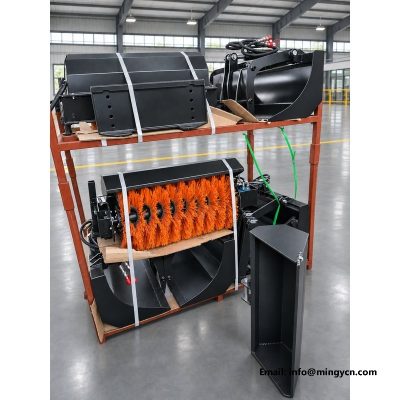
These workshop photographs show how skid steer attachments are prepared for export: a snow blower with its orange brush bristles and a black hydraulic grapple, each fixed to a steel frame or timber pallet and secured with green lashing straps. Export packing is a separate skill from manufacturing, because a unit that leaves the factory must survive a crane lift, an ocean voyage and a warehouse fork and still arrive clean, straight and ready to mount. The text below explains how each attachment is fastened to its base, how the hydraulic ends are protected, how several attachments share one container, and what a buyer should check while unpacking.
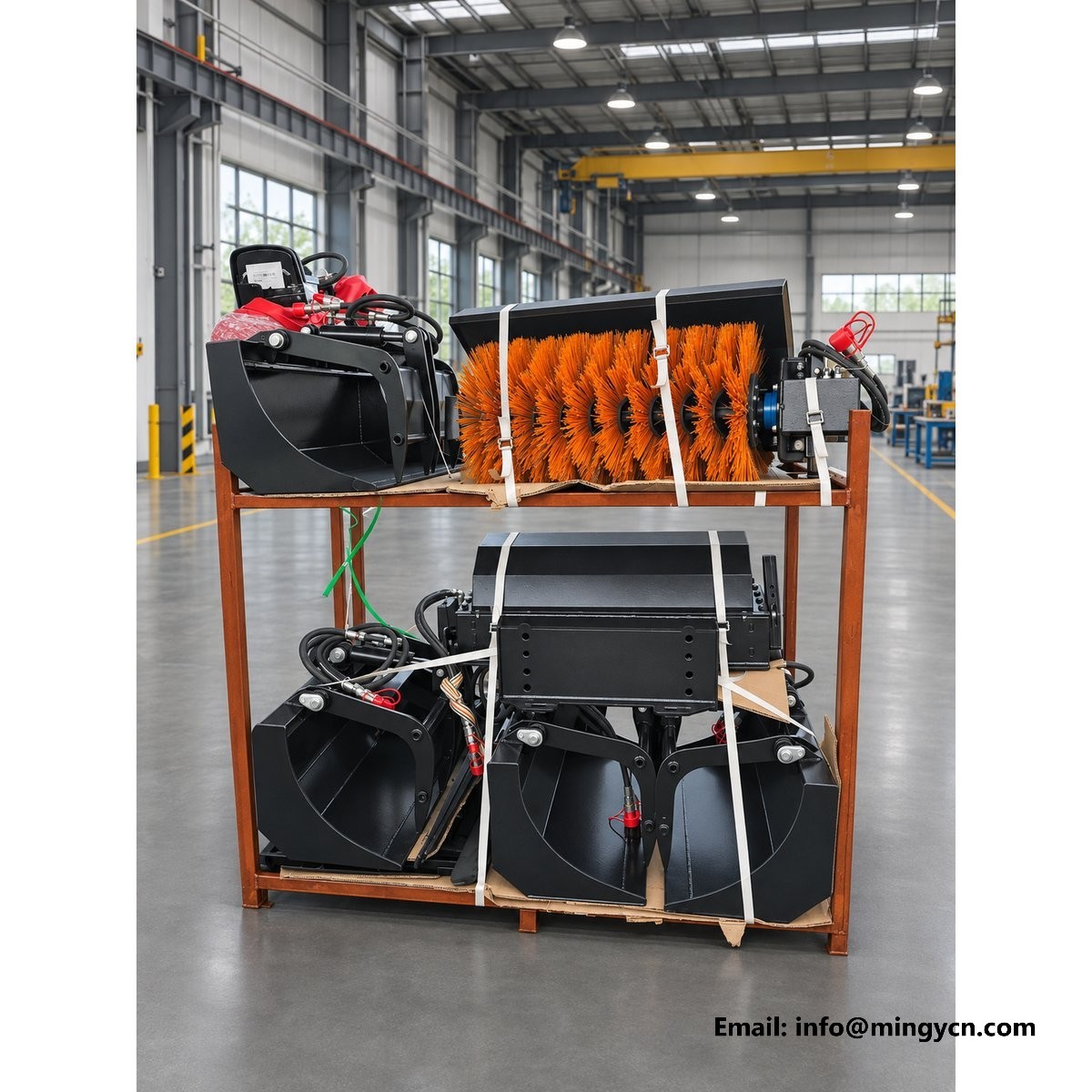
The base under each attachment is the foundation of the whole packing job. Heavy attachments such as the grapple and the snow blower are bolted to a fabricated steel frame or a reinforced timber pallet, never simply placed on the floor of the container. The attachment's own mounting plate and lower mounting points are used as the fastening positions, so the same holes and pins that hold it on a loader also hold it in the crate. Bolting through the quick-coupler plate puts the load through the strongest part of the machine rather than wrapping straps around a painted panel. This keeps the unit upright, keeps the weight low and stops it shifting when the container is tilted during crane handling. A buyer should look for bolts through load-bearing points and blocking under the heavy end, not just straps over the top.
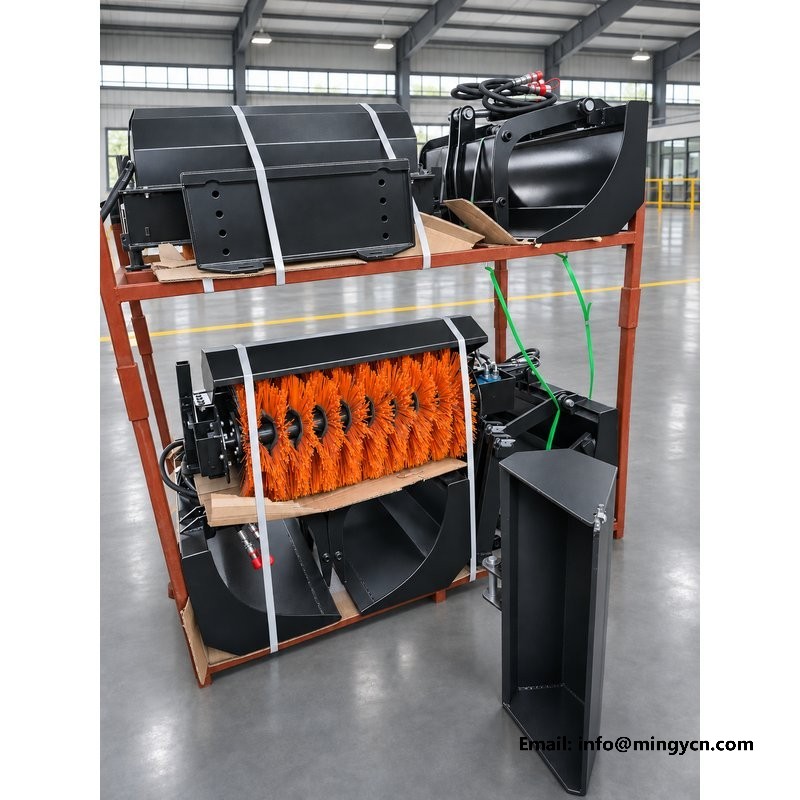
The green lashing straps are tensioned over the attachment in opposing directions so that the unit is pulled down onto the base and cannot rock. Straps work with the bolts rather than instead of them: the bolts carry the weight and set the position, the straps stop vibration and small movements that would wear the paint. Rust is controlled before the straps go on. Exposed machined surfaces, such as the coupling pins and cylinder rods, are coated with grease or a rust-preventive film, and bare edges are touched with paint. The buyer should expect no bare metal showing on any surface that will face weeks of humid sea air. The colour and tension of the straps in the photographs are worth noting, because a strap that is slack or twisted applies no real force no matter how many are fitted.
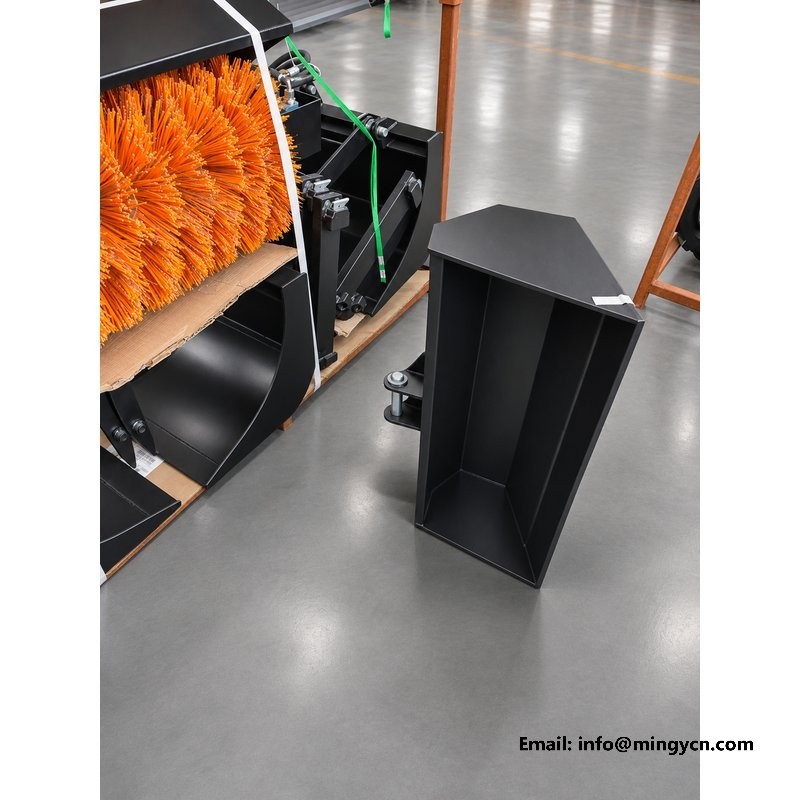
The hydraulic couplers and hose ends are the most fragile parts of an attachment and the most expensive to put right after delivery. Before packing, every open coupler is capped with a dust plug or a threaded cap, and the hose ends are tied up and supported so they cannot drag, kink or be crushed against the frame. On the photographs this shows as clean, capped fittings rather than open metal mouths. Contamination is the real danger: a coupler that ships open collects grit and salt, and that grit is pushed straight into the loader's hydraulic system the first time the attachment is connected. Protecting the couplers is therefore cheap insurance that protects not only the attachment but also the machine it will be fitted to. Buyers should check every open port is capped before accepting a delivery.
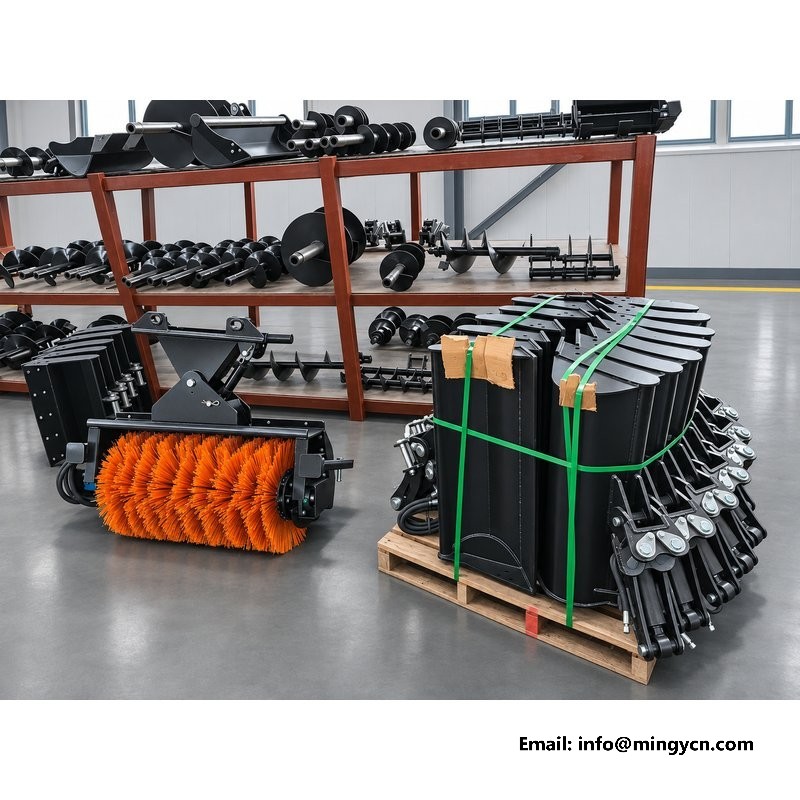
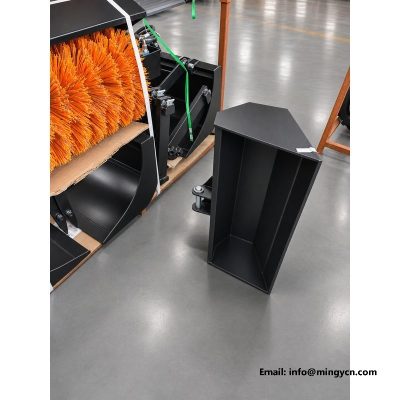
Several attachments are usually packed into a single container to keep freight sensible, and the packing is planned so that each unit can be lifted out in the order it is needed without disturbing the others. Heavy units sit on the floor at the door end or over the axle points, and lighter items are positioned above or between them, each on its own base. Timber dunnage separates stacked units and spreads the load, and every unit is independently strapped so that removing one does not loosen another. The workshop photographs show this staging: attachments already on their bases, waiting to be lifted into the container. A good packing plan reads like a route map, and a buyer who plans to resell or fit the attachments should find each one complete, protected and identifiable without cutting straps on the rest.
Shipping treats a crate badly: it is lifted, tilted, set down hard and shaken through a long sea passage, then handled again by forklifts at the port. Packing is the difference between an attachment that arrives as it left and one that arrives with bent guards, chipped paint and fittings full of salt. The frame or pallet gives the crane and fork a single, strong lifting point, so the load is never slung by the hydraulic hoses or the sheet metal. The bolts and straps keep the unit from walking across the floor, and the rust protection keeps the machined surfaces bright. When a buyer unpacks a well-packed unit, the first impression is that the factory thought about the journey, not just the product. That impression is usually correct, and it predicts how the attachment will be treated through the rest of its working life.
Unpacking is part of acceptance, and it should be done in a fixed order so that any damage can be attributed correctly. The buyer should photograph the container door before opening, then check each attachment against the packing list before cutting any strap. Bolts and straps are removed only when the unit is on the ground and stable, and the coupler caps stay in place until the attachment is about to be mounted. The checks are simple: no loose parts, no crushed hose, no bare metal, no bent guard, and every coupler capped. Any mark that the straps have slipped, or a base that has moved against the floor, tells the buyer the load took a hard knock somewhere. Those photographs and notes are the basis of any claim, so they are worth taking before the attachment disappears into service.
Fixing the load inside the container is a separate step from packing the individual attachment. Once the bases are in position, the whole group is braced so that it behaves as one solid block rather than a row of loose items. Timber or steel bracing is cut to fill the gaps between the bases and the container walls, and the outer units are tied to the lashing points so the load cannot slide toward the doors. The aim is that nothing moves even if the container is rolled or tilted on the way to the vessel. The green straps and the blocking visible in the workshop photographs are the same system used inside the box. A buyer receiving a mixed consignment can tell good loading from bad in seconds: in a good load nothing rattles, and the doors open onto a solid, level face.
The snow blower carries the most delicate feature in the consignment: the orange brush bristles. These are long and flexible, and they will take a permanent set or get crushed if the weight of the machine rests on them. Packing therefore keeps the brush clear of the floor and of any neighbouring unit, supported on its frame with the bristles overhanging a clear space. The auger and the chute are checked, and any part that could catch a strap or a fork tine is protected or removed. The snow blower is also one of the heavier attachments, so its base and bolts carry a full share of the load. The photographs show the brush standing free of the ground, which is exactly what a buyer wants to see: bristles that arrive straight throw snow properly, while crushed bristles throw it badly from the first hour.
The grapple packs differently from the snow blower because its value is in the moving parts: the black tines, the hinge pins and the cylinder. The tines are heavy and sharp, so they are blocked rather than wrapped, with the weight taken on the frame and the tips kept off the floor. The cylinder rod is the critical surface; it is greased and protected so that salt air cannot pit the chrome, because a pitted rod tears the seals the first time the grapple closes. The hinge area is also blocked so the jaws cannot swing or clatter against the frame during the voyage. A grapple that ships with its jaws free will arrive with the paint knocked off the tine edges. Blocking the moving parts is the whole point: a grapple should be rigid and immovable inside its crate, not free to work.
The photographs taken in the workshop show the packing work as a routine, not a special event. Each attachment is cleaned, its machined surfaces are protected, and it is placed on its base in a staged line before the container arrives. This staging lets the packing team check that every unit is complete and that the lifting points are correct before anything is lifted. The workshop floor itself is part of the story: a clean, level floor with lifting gear and a clear route to the loading bay means the attachments are handled by machine, not dragged. A buyer reading these photographs should treat the packing area the same way they treat the welding bay, because a factory that is careful at the end of the line is usually careful at the start of it.
Straps alone let a heavy attachment rock and walk under vibration. Bolting through the unit's own quick-coupler plate puts the load through its strongest point and holds the position fixed, while the straps only stop small movements. The frame also gives the crane and fork a single lifting point, so the attachment is never slung by its hoses or sheet metal.
Photograph the doors before opening, check each unit against the packing list, and confirm every hydraulic coupler is still capped. Look for loose parts, crushed hoses, bare metal or a base that has moved against the floor. Remove bolts and straps only after the attachment is on stable ground, and keep the coupler caps on until you are ready to mount it.
For the current specification, build options and a formal quotation for your market, contact MINGYI Machinery. E-mail: sales@mingycn.com | LINE (ID): mingyicn
Skid Steer Snow Blower: Auger, Impeller and Chute Specification · Skid Steer Hydraulic Grapple Bucket: Jaw, Cylinder and Shell Data · Skid Steer Angle Broom: Drum Width, Bristle and Hydraulic Interface