Log Grapple
Buyers who already run a loader rarely need a definition of the tool. They need to know how it behaves on the ground they have, which is what the sections below set out.
Bush play at the pivots is measured with the jaws unloaded, and any cracked weld at a tine root is repaired before the next lift. Bush play at the pivots is measured with the jaws unloaded, and any cracked weld at a tine root is repaired before the next lift.
The grip comes from hydraulic cylinders acting through a linkage, so the tines keep their clamping force even when the load shifts. Check cylinder rod finishes weekly, because a scored rod tears the seal and the grapple then creeps open.
Standard-flow systems in this class are generally listed around 17 to 24 gpm, high-flow systems around 30 to 42 gpm. Attachment mass also matters: a common industry rule keeps the tool plus its load within roughly half of the piece of equipment's tipping load, because mass carried far ahead of the arms reduces balance long before the hydraulic limit is reached.
hydraulic circuit is specified as standard auxiliary, double-acting on the unit photographed here.
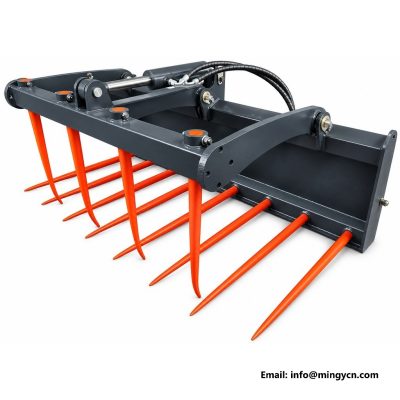
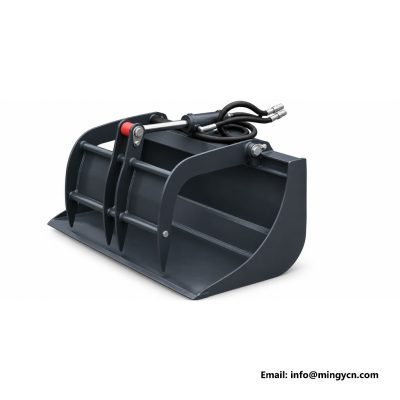
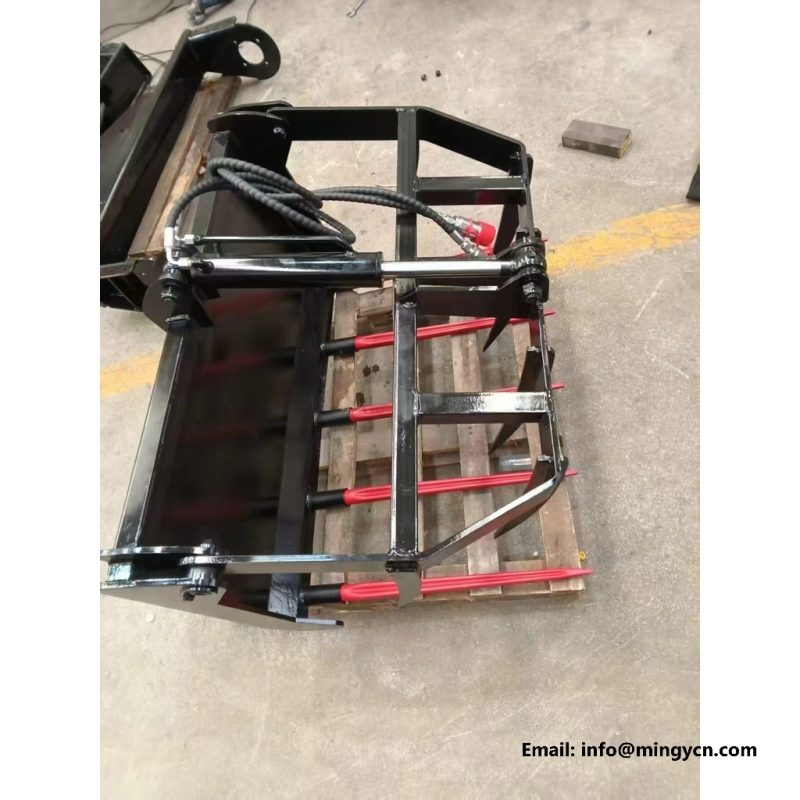
The person at the controls approaches a stem with the tines open, lowers until the lower set is under the load, then closes before lifting; dragging a log with the jaws only half shut wears the tips. The frame is a tall welded cage rather than a solid shell, which keeps weight down and lets soil fall through.
Safe working discipline are mostly about position. Wedge engagement, mount flatness and the condition of the lower lip decide whether the tool stays attached under a shock load.
Bush play at the pivots is measured with the jaws unloaded, and any cracked weld at a tine root is repaired before the next lift. The driver approaches a stem with the tines open, lowers until the lower set is under the load, then closes before lifting; dragging a log with the jaws only half shut wears the tips.
A wider tool is not automatically a better tool on a narrow job area. Width is then checked against gate openings, transport limits and the unit's own track.
The recorded value of mounting is universal quick-attach plate, taken from the assembled tool.
Check cylinder rod finishes weekly, because a scored rod tears the seal and the grapple then creeps open. The person at the controls approaches a stem with the tines open, lowers until the lower set is under the load, then closes before lifting; dragging a log with the jaws only half shut wears the tips.
Bolted edges, clamped teeth and greaseable bushes are specified for that reason, and the parts list is supplied with the unit so that a local workshop can identify each item without a photograph. Industry guidance places a usual-flow line in the region of 17 to 24 gallons per minute at roughly 3000 psi, while high-flow circuits run around 30 to 42 gallons per minute at similar pressure.
A log grapple closes two curved tine sets around timber, brush or root balls and holds them against the loader frame while the loader manoeuvres. Tine tips are tapered to enter a pile, the pivot bosses are bushed and greaseable, and a guarded hose route runs along the top member away from the load.
Does the combined mass stay inside the load chart with the arms raised? Compatibility is established on paper before the tool is ever connected.
jaw type: twin curved tine sets. That line travels with the inspection record.
Tine tips are tapered to enter a pile, the pivot bosses are bushed and greaseable, and a guarded hose route runs along the top member away from the load. Bush play at the pivots is measured with the jaws unloaded, and any cracked weld at a tine root is repaired before the next lift.
Is the implement delivery within the tool's stated range? A standard implement line is commonly rated around 17 to 24 gpm, a high-flow line around 30 to 42 gpm, and relief settings near 3000 to 3500 psi are typical across the industry.
A log grapple closes two curved tine sets around timber, brush or root balls and holds them against the loader frame while the unit manoeuvres. Bush play at the pivots is measured with the jaws unloaded, and any cracked weld at a tine root is repaired before the next lift.
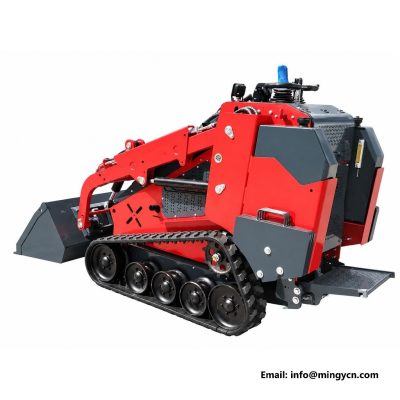
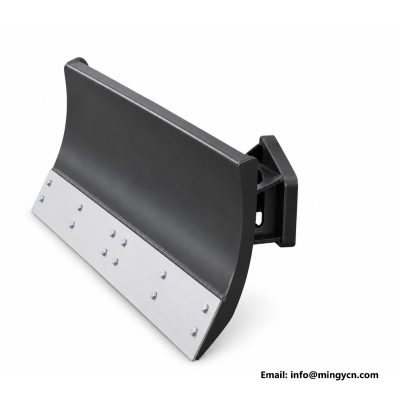
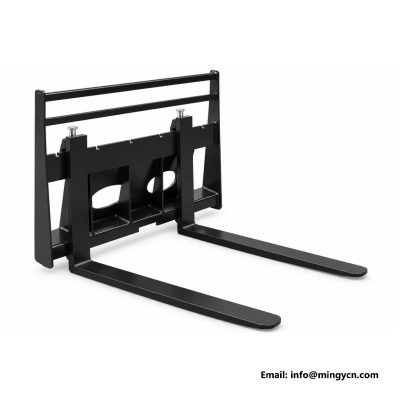
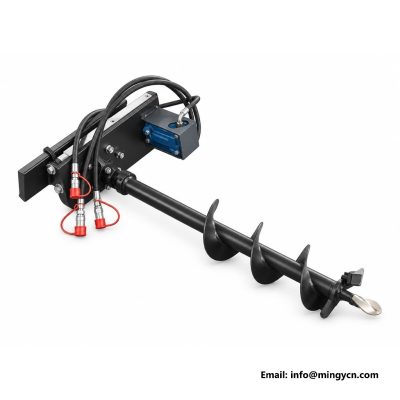
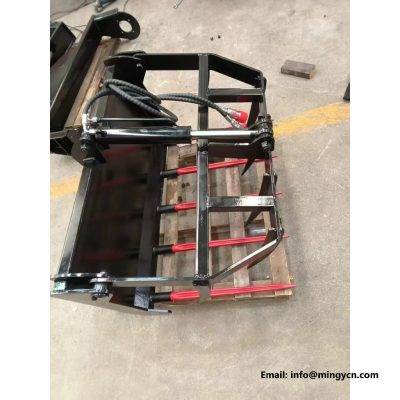
The frames on this page show the tool as it is built and used, not a styled render. That distance multiplies every kilogram of load, so a compact construction with the mass held close to the bracket often outperforms a heavier tool with a longer reach.
actuation appears in the build record as hydraulic cylinders through linkage, which a buyer can verify on arrival.
Check cylinder rod finishes weekly, because a scored rod tears the seal and the grapple then creeps open. The person at the controls approaches a stem with the tines open, lowers until the lower set is under the load, then closes before lifting; dragging a log with the jaws only half shut wears the tips.
Buyers who already run a loader rarely need a definition of the tool. Standard-flow systems in this class are generally listed around 17 to 24 gpm, high-flow systems around 30 to 42 gpm.
The grip comes from hydraulic cylinders acting through a linkage, so the tines keep their clamping force even when the load shifts. The frame is a tall welded cage rather than a solid shell, which keeps weight down and lets soil fall through.
Carrier allowable load, hydraulic output, mounting proportions and service parts availability are the four columns of the inspect, and a missing answer in any column is a reason to pause rather than to improvise. Any one of those four can rule out a tool that otherwise looks correct.
On the finished build, frame reads open welded cage.
The operator approaches a stem with the tines open, lowers until the lower set is under the load, then closes before lifting; dragging a log with the jaws only half shut wears the tips. Forestry thinning, storm cleanup, land clearing and sawmill yards are the normal settings.
Buyers who already run a loader rarely need a definition of the tool. A maintainable attachment is one where the wearing surfaces can be changed with standard tools.
The table below lists the build and interface items that are confirmed with the piece of equipment. Figures shown as ranges are industry reference values for compact loaders rather than claims about a particular piece of equipment; the piece of equipment data mount always takes precedence. The Log Grapple is the unit those rows belong to.
| Parameter | Value on the finished tool |
|---|---|
| Jaw type | Twin curved tine sets |
| Actuation | Hydraulic cylinders through linkage |
| Frame | Open welded cage |
| Pivot | Bushed and greaseable bosses |
| Hydraulic circuit | Standard auxiliary, double-acting |
| Mounting | Universal quick-attach plate |
pivot appears in the build record as bushed and greaseable bosses, which a buyer can verify on arrival.
Only within the carrier rated capacity and with the load held close to the plate. Tine tips are tapered to enter a pile, the pivot bosses are bushed and greaseable, and a guarded hose route runs along the top member away from the load.
It sheds soil and keeps attachment mass ahead of the arms as low as the structure allows. Forestry thinning, storm cleanup, land clearing and sawmill yards are the normal settings.
No. Clamping is a low-flow, high-force function. A log grapple closes two curved tine sets around timber, brush or root balls and holds them against the loader frame while the machine manoeuvres.
Tine tips, then pivot bushes and cylinder seals. Bush play at the pivots is measured with the jaws unloaded, and any cracked weld at a tine root is repaired before the next lift.
The piece of equipment that reaches the site is the piece of equipment in the photographs. Build images, the parts list and the walk-round record are assembled before dispatch so that a buyer can compare the delivered unit with the description above.
E-mail: sales@mingycn.com | LINE: mingyicn
Send the carrier model, auxiliary flow and the material you work with. Mounting geometry, hydraulic requirement and the build photographs for that exact tool are confirmed in the reply, with technical questions answered directly.