Ripper, Tow Hitch and Lifting Hook Combination
The images on this page show the attachment as it is built and used, not a styled render. That matters when the tool has to be matched to a machine that is already on operation area.
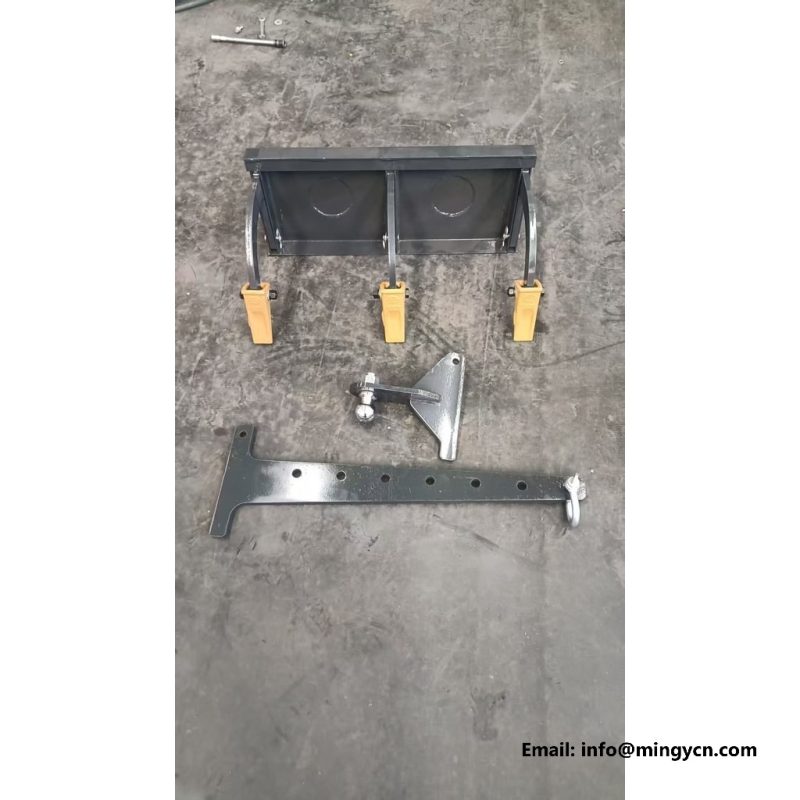
This combination frame carries scarifier shanks, a rear tow hitch and a lifting hook on one quick-attach plate, so a small loader can rip, tow and lift without returning to the yard for a tool change. The central beam carries removable shank holders, the upper plate carries a rated lifting eye, and the rear bar carries a pin-type hitch.
The central beam carries removable shank holders, the upper plate carries a rated lifting eye, and the rear bar carries a pin-type hitch. The hook throat, hitch pin and shank clamps are checked for deformation rather than just for cracks, because overload shows as a stretched throat or a bent pin.
A standard auxiliary line is commonly rated around 17 to 24 gpm, a high-flow line around 30 to 42 gpm, and relief settings near 3000 to 3500 psi are typical across the industry. A clear answer to all four is the whole specification exercise.
tow: pin-type rear hitch. That line travels with the inspection record.
The hook throat, hitch pin and shank clamps are checked for deformation rather than just for cracks, because overload shows as a stretched throat or a bent pin. Grease points on the removable holders are serviced whenever the tool is changed through.
Industry guidance places a baseline-flow supply in the region of 17 to 24 gallons per minute at roughly 3000 psi, while high-flow circuits run around 30 to 42 gallons per minute at similar pressure. Bolted edges, clamped teeth and greaseable bushes are specified for that reason, and the parts list is supplied with the loader so that a local workshop can identify each item without a photograph.
It is a farm and estate maintenance tool rather than a production earthmover. Fence operation, moving trailers around a yard, lifting gates or pumps and opening a compacted track all happen on the same job.
Compatibility is partly geometry and partly arithmetic. Width is then checked against gate openings, transport limits and the piece of equipment's own track.
The works sheet lists lift as rated upper lifting eye for this particular implement.
Only one function is loaded at a time, and the tow pin and hook are looked during before each lift or pull. Grease points on the removable holders are serviced whenever the tool is changed across.
These are short checks, but they decide the operating life of the tool. Loads stay low during travel, the attachment is kept close to the machine, and turns are made gently on slopes.
It is a farm and estate maintenance tool rather than a production earthmover. This combination frame carries scarifier shanks, a rear tow hitch and a lifting hook on one quick-attach plate, so a small loader can rip, tow and lift without returning to the yard for a tool change.
The quick coupler accepts a typical plate, but the locking wedges must seat fully and the plate must not be bent from a previous impact. Any one of those four can rule out a tool that otherwise looks correct.
Inspectors compare the shipped unit with the load rule figure of one function loaded at a time.
Grease points on the removable holders are serviced whenever the tool is changed during. Grease points on the removable holders are serviced whenever the tool is changed during.
The images on this page show the assembly as it is built and used, not a styled render. The selection procedure is short: settle the base unit's rated operating working limit, read the ancillary flow and pressure from its data plate, measure the mounting plate, then settle that the working width suits the job area.
Only one function is loaded at a time, and the tow pin and hook are examined before each lift or pull. Only one function is loaded at a time, and the tow pin and hook are looked through before each lift or pull.
Compatibility is partly spatial arrangement and partly arithmetic. Flat-face couplers are wiped before connection, and a tool is set on level finish before anyone walks in front of it.
The works sheet lists mounting as universal quick-attach plate for this particular implement.
Only one function is loaded at a time, and the tow pin and hook are looked through before each lift or pull. The central beam carries removable shank holders, the upper interface carries a rated lifting eye, and the rear bar carries a pin-type hitch.
The photographs on this page show the attachment as it is built and used, not a styled render. A standard auxiliary system is commonly rated around 17 to 24 gpm, a high-flow system around 30 to 42 gpm, and relief settings near 3000 to 3500 psi are typical across the industry.
It is a farm and estate maintenance tool rather than a production earthmover. Grease points on the removable holders are serviced whenever the tool is changed over.
Published industry ranges put baseline auxiliary flow near 17 to 24 gpm and high flow near 30 to 42 gpm, with main relief commonly around 3000 to 3500 psi. The hydraulic question is a flow question before it is a pressure question.
functions: rip, tow, lift on one frame. That line travels with the inspection record.
Grease points on the removable holders are serviced whenever the tool is changed during. Each function has its own load path into the main frame, which is why the weld junctions at the tower are the most heavily detailed part of the fabrication.
Published industry ranges put standard auxiliary flow near 17 to 24 gpm and high flow near 30 to 42 gpm, with main relief commonly around 3000 to 3500 psi. A useful checklist asks four questions in order.
The following rows collect everything that can be measured or named on this tool. Industry ranges are included for orientation only; the unit nameplate, not a catalogue range, decides the final match. Read each line as a property of this Ripper, Tow Hitch and Lifting Hook Combination.
| Check point | Factory record |
|---|---|
| Functions | Rip, tow, lift on one frame |
| Shanks | Removable clamped holders |
| Tow | Pin-type rear hitch |
| Lift | Rated upper lifting eye |
| Load rule | One function loaded at a time |
| Mounting | Universal quick-attach plate |
shanks is specified as removable clamped holders on the unit photographed here.
No. The frame is rated for one function at a time. It is a farm and estate maintenance tool rather than a production earthmover.
It is a rated eye; the marked working limit is read from the frame plate. Each function has its own load path into the main frame, which is why the weld junctions at the tower are the most heavily detailed part of the build.
No. All three functions are passive. Each function has its own load path into the main frame, which is why the weld junctions at the tower are the most heavily detailed part of the build.
The hook throat, tow pin and shank clamp bolts. This combination frame carries scarifier shanks, a rear tow hitch and a lifting hook on one quick-attach plate, so a small loader can rip, tow and lift without returning to the yard for a tool change.
The machine that reaches the job is the machine in the frames. Build images, the parts list and the inspection record are assembled before dispatch so that a buyer can compare the delivered unit with the description above.
E-mail: sales@mingycn.com | LINE: mingyicn
A short note with the carrier model, flow figure and working material is enough to start. Confirmation covers the mounting plate, hydraulic demand and build images for that tool, with workshop answers to any technical point.