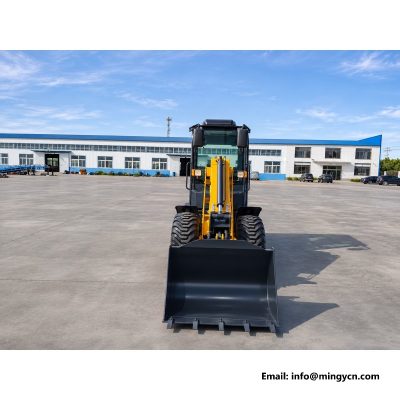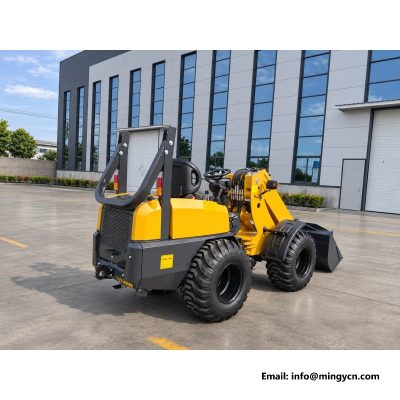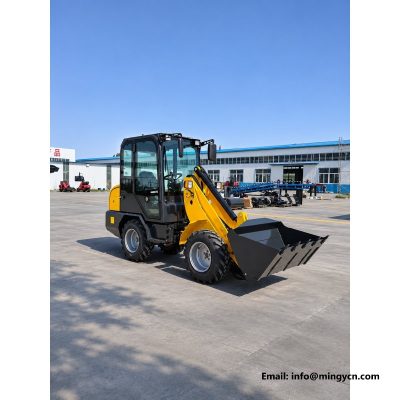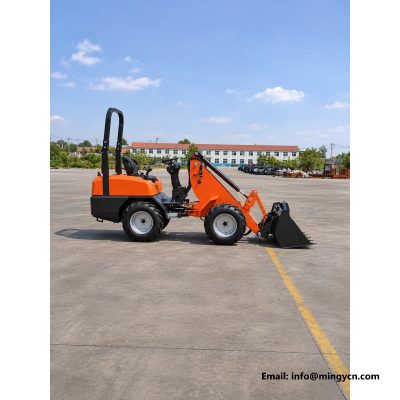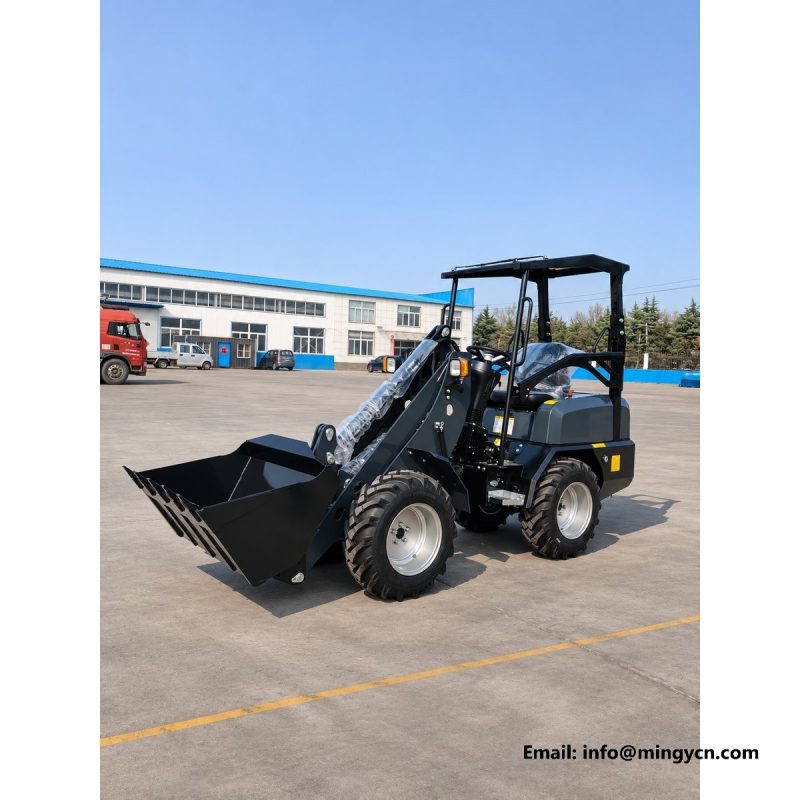
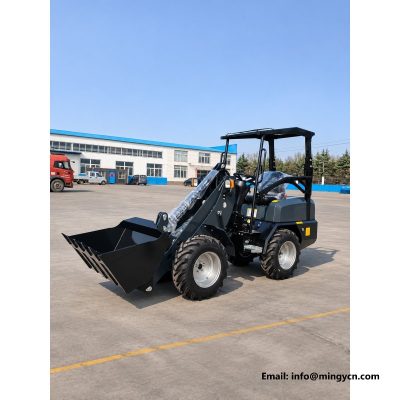
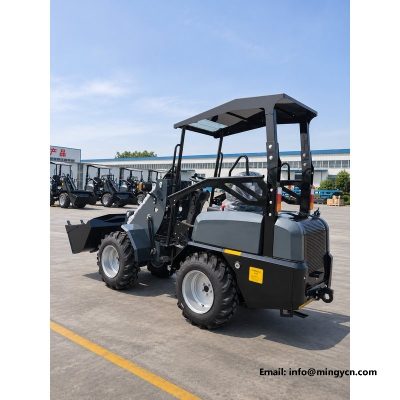
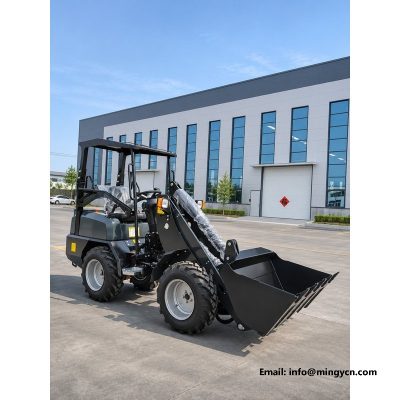
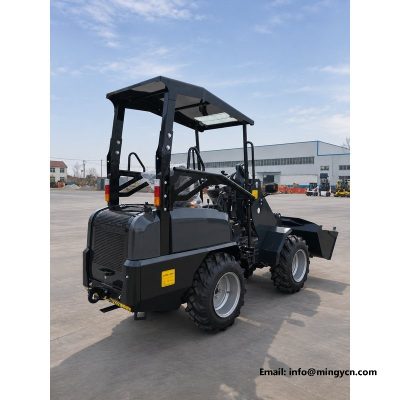
MY180D mini articulated wheel loader with hydrostatic drive axle and a canopy roof.
The MY180D is a compact articulated wheel loader with a canopy roof, a standard boom and a general-purpose bucket. The four photographs on this page show the black machine from the front, the side and both rear quarters, which is enough to read the steering joint, the boom pivots and the hose routing across the frame. The page explains why an articulated frame turns so tightly, how the hydrostatic axle and orbit motor drive replace a mechanical gearbox, what the PWG closed-circuit piston pump contributes, and which tyre and operator station suit which site. The notes are written for buyers who will compare this machine with others in its class before ordering.
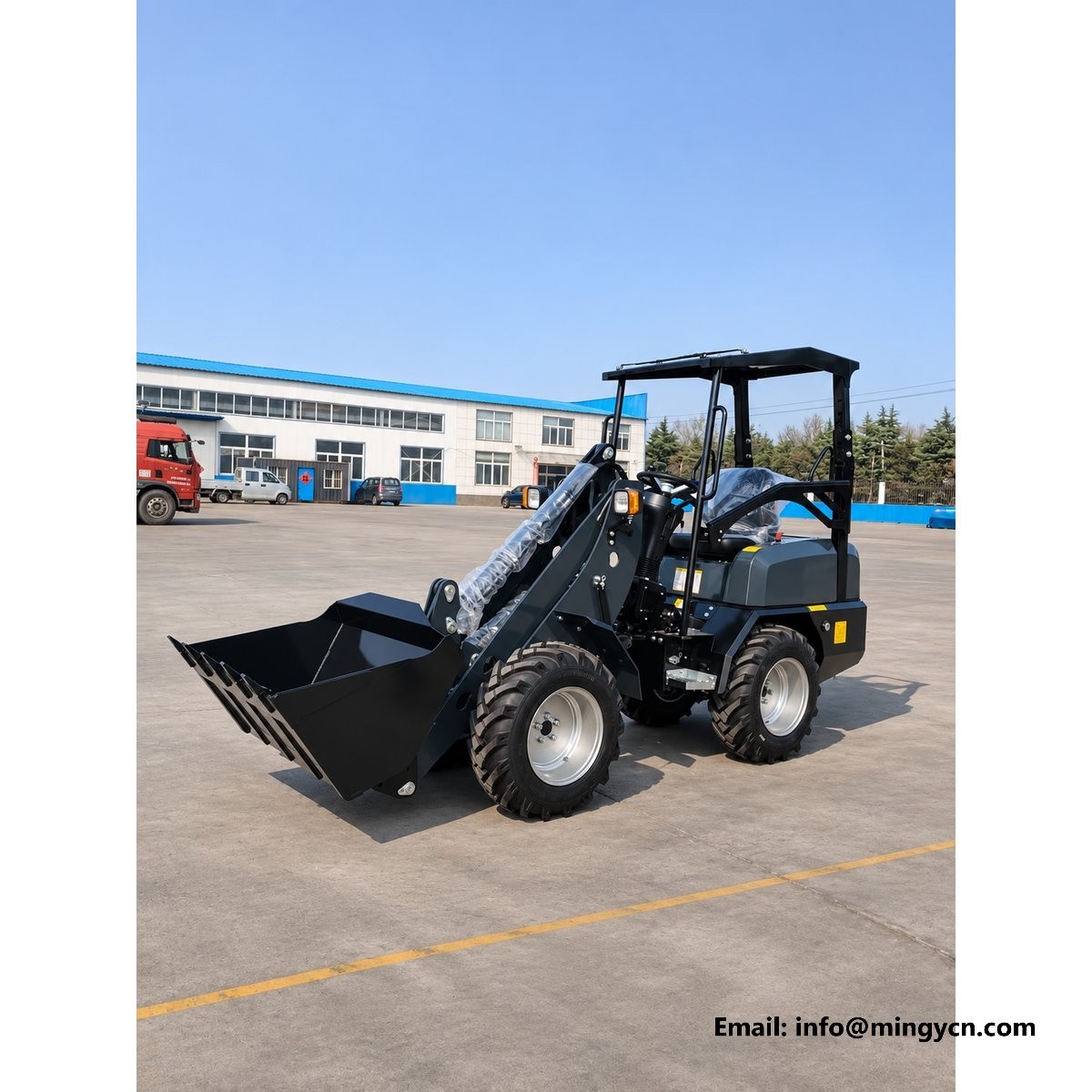
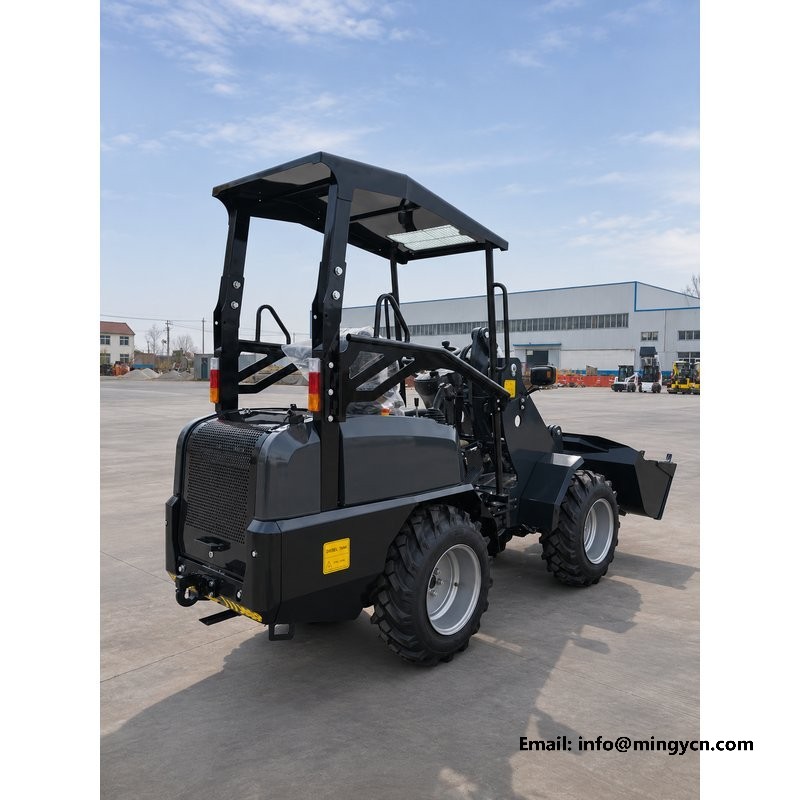
The photographs show the MY180D, a black mini articulated wheel loader with a canopy roof, a general-purpose bucket on a standard boom, and four wheels of equal size. The images are taken on the factory apron from the front, the side and both rear quarters, which is the right set for judging an articulated machine, because the steering joint between the front and rear frames is visible from the side and the hose routing across that joint can be followed in the three-quarter views. The canopy is a simple steel roof on four posts rather than a glazed cab, and that single choice defines the version: lower cost, better all-round visibility, and a machine intended for mild weather and lighter duty. This page explains the articulation, the hydrostatic drive, the pump and the tyres, then sets out what to check at acceptance.
On an articulated loader, the machine bends in the middle. A hydraulic steering cylinder pushes the front frame away from the rear frame about a vertical pivot, and the bucket swings on an arc rather than tracking behind the operator. That geometry is why an articulated machine can work in a yard where a rigid-frame loader of similar size would need several attempts: the rear wheels follow a tighter path than the front, and the bucket can be placed against a wall or a heap with the machine still at an angle to it. It is a geometry that rewards an operator who plans the approach before entering a gateway. The operator steers with a wheel or a joystick, and because the frames move rather than the wheels, there is no tyre scrub on the surface. On paving, that is the difference between a clean job and a set of black marks.
| Model | MY180D (standard boom) / MY180T (telescopic boom) |
| Hydraulic pump | Closed-circuit piston pump, PWG (Italy) |
| Axles | Hydrostatic drive axle, orbit (gerotor) motor drive |
| Control | Pilot hydraulic operation |
| Standard tyres | 10.0/75-15.3 (optional 400/60-15.5) |
| Engine options | Xinchai Euro 5 3B11 (standard) / Kubota D1105 / Kubota V1505 |
| Seat | Deluxe seat |
| Hose | Qingdao Xiangliu hose assemblies |
| Options | Canopy, hydraulic quick coupler, enclosed cab, high/low speed |
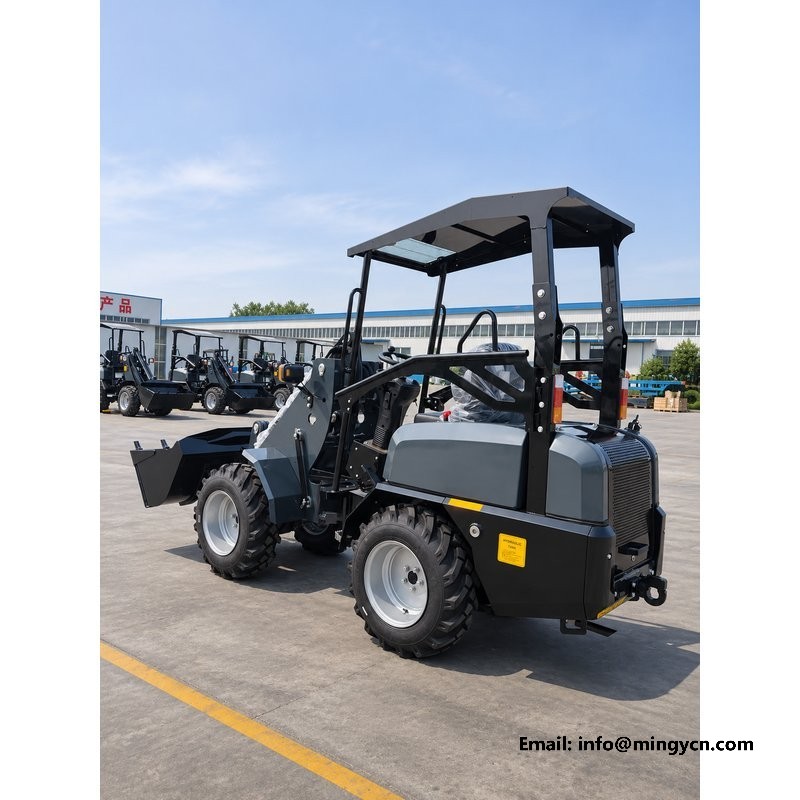
The MY180D does not use a mechanical gearbox in the usual sense. Drive comes from a hydrostatic axle with orbit motor drive, fed by the closed-circuit pump, so the machine's speed is set by the volume of oil the pump delivers rather than by the gear ratio selected. The consequences are worth spelling out. There is no clutch to slip and wear, no gear change to jolt the load, and no need to build up engine speed before the machine will move. The operator pushes the control and the machine creeps forward; push further and it goes faster, in a continuous range rather than in steps. For work against a pile, or for positioning a bucket beside a kerb, that stepless control is more useful than a higher top speed would be. The same arrangement also removes the wear parts that a mechanical transmission would need over the life of the machine.
The pump at the centre of the drive system is a closed-circuit piston pump from PWG in Italy. Closed circuit means the oil leaving the pump to drive the motor returns to the pump inlet rather than to a tank, so the loop is short, the oil is not exposed to the atmosphere on every pass, and the pump can reverse flow simply by changing its swashplate angle. In practice that gives the machine smooth direction changes and dynamic braking, because the pump itself can absorb energy rather than relying only on a brake. The piston design also holds pressure better than a gear pump at low speed, which is why the machine can creep under load without the drive fading. The pump is a service item that deserves clean oil and a changed filter on schedule. Keeping that oil clean is therefore the single most valuable maintenance habit on this loader.
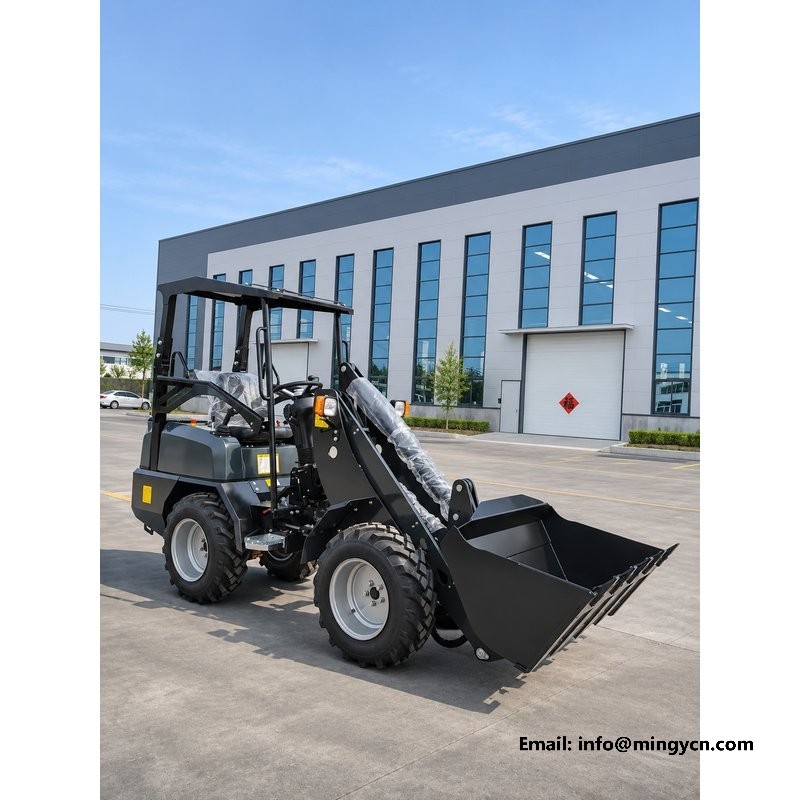
The MY180D is fitted as standard with 10.0/75-15.3 tyres, a size that suits a compact articulated loader working on mixed ground: wide enough to float over a yard that has been rained on, narrow enough to keep the machine stable and the steering light. For buyers who work mostly on soft ground, an optional 400/60-15.5 tyre is available, which presents a wider footprint and lowers the pressure the machine puts on the surface. The choice should follow the site, not the brochure. A wider tyre on hard ground increases steering effort and can rub on full lock; a narrow tyre on wet soil digs in. Check the tyre fitted to the machine you are buying against the work you have planned, and confirm the rim and the wheel offset that come with it. All four tyres should match in size and tread pattern, because a mixed set makes the machine pull and wears the axle.
The canopy is the simplest operator station in the range, and it is a deliberate choice rather than a compromise. Four steel posts carry a roof plate, the operator sits on a deluxe seat, and there is nothing between the driver and the view except the loader arms. That gives the best visibility of the bucket edge and the near-side wheel of any version, which is exactly what a landscaper or a yard operator needs when placing a bucket close to a wall. It also keeps the purchase cost below the cab version and removes glass, wipers and a heater from the maintenance list. The limitation is weather and debris. In a cold, wet or dusty environment, or where falling material is a risk, the enclosed cab is the better buy. For a buyer in a mild climate, that is usually the correct compromise.
Pilot hydraulic operation means the joystick or lever does not act directly on the main valve spools. Instead it moves a small pilot valve, and the resulting pressure signal shifts the main spool. The benefit is a light, short-throw control that gives the operator a sense of proportion: a small movement produces a slow lift, a larger one a fast lift, with no need to fight a stiff lever. On a compact loader this matters most in the last few centimetres of a movement, when the bucket is being levelled on a kerb or lowered onto a pallet. Pilot control also lets the valve block be mounted where it is protected rather than under the operator's hand. The system is sensitive to dirty oil, so the breather and the filter are maintenance items, not afterthoughts. Ask for the pilot pressure setting and the filter part number with the machine.
The standard engine for the MY180D is the Xinchai 3B11, a three-cylinder diesel built to Euro 5, and it is the specification most buyers in price-sensitive markets will be quoted. Kubota D1105 and V1505 engines are offered as alternatives, and the reason to choose one is usually familiarity: a buyer whose workshop already services Kubota engines, or whose market expects that name, will pay the difference. In practice the choice is usually settled by what the local workshop can support, not by the brochure. All three are conventional water-cooled industrial diesels with mechanical or electronically governed fuel systems, and all three sit in the same bay behind the articulation joint, so access for filters and belts is similar. Ask which engine is actually fitted to the machine being offered, and ask for the emission document that goes with it.
An articulated loader has two structural zones, and the joint between them is the one that deserves attention. The rear frame carries the engine, the cooling pack and the counterweight; the front frame carries the boom, the bucket and the steering cylinder mounts. Every load the bucket picks up passes through the boom pivots, into the front frame, and then through the articulation bearings into the rear frame. That is why the joint is built as a pair of heavy vertical pins with tapered or spherical bearings, lubricated through grease points that must be reached on every service. Wear shows first as play when the machine is rocked with the bucket down, then as a shimmy in the steering. Checking for play at handover is quick and tells you a lot. Any play here is felt through the steering long before it is visible from outside.
Run the machine on a hard surface before accepting it. Steer from lock to lock and watch the articulation joint for smooth movement without a catch; listen for a knock that would suggest bearing play. Raise the boom through its full stroke with a loaded bucket and hold it, then check that it neither drifts down nor judders. Operate the tilt to full dump and full crowd. Check every hose that crosses the joint for rubbing and every grease point for a fresh charge of grease. Confirm the tyre size fitted against the order, the engine model against the emission document, and that the quick coupler operates with the bucket you have bought. Photograph the hour meter and the machine's serial plate on the day of handover. A machine that passes these checks on the day will not need a second visit from the dealer in its first month of work.
A skid steer turns by driving its two sides at different speeds, so its tyres scrub sideways. An articulated loader bends at a joint between the front and rear frames, so its wheels roll along their own paths and the bucket swings clear. The articulated machine is gentler on surfaces, more stable with a raised load, and easier to place precisely along a wall or a kerb.
A closed-circuit piston pump keeps the oil in a short loop between pump and motor, so it can reverse flow and brake the machine by changing its swashplate angle rather than relying on a gearbox or a brake. The piston design holds pressure well at low speed, which is why the loader can creep under load. It also runs cooler and cleaner than an open-circuit arrangement.
Ordering and technical support
Email: sales@mingycn.com
LINE (ID): mingyicn
Tell us your working width, ground conditions and the attachment you need, and we will confirm the right configuration and shipping details.