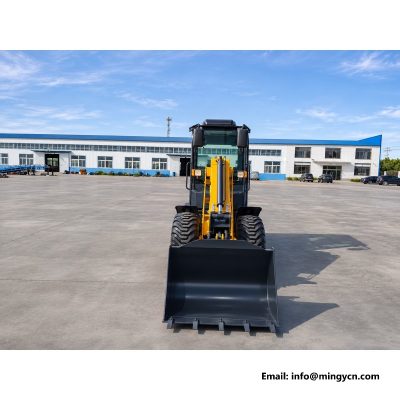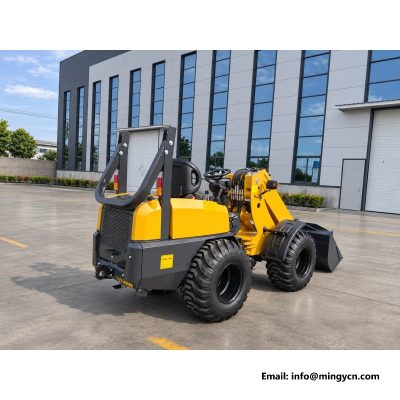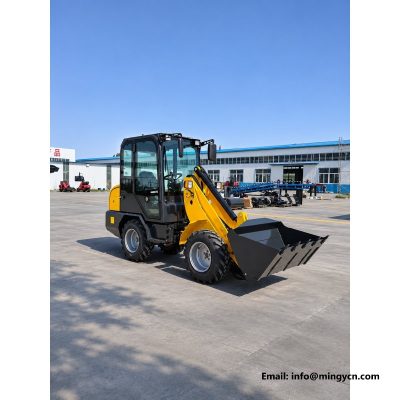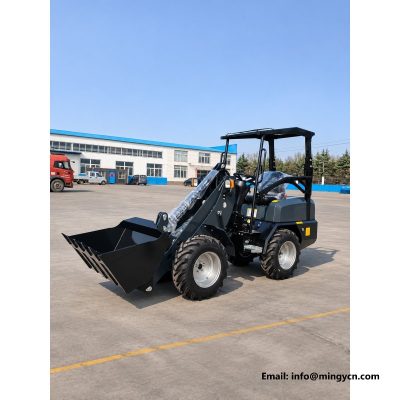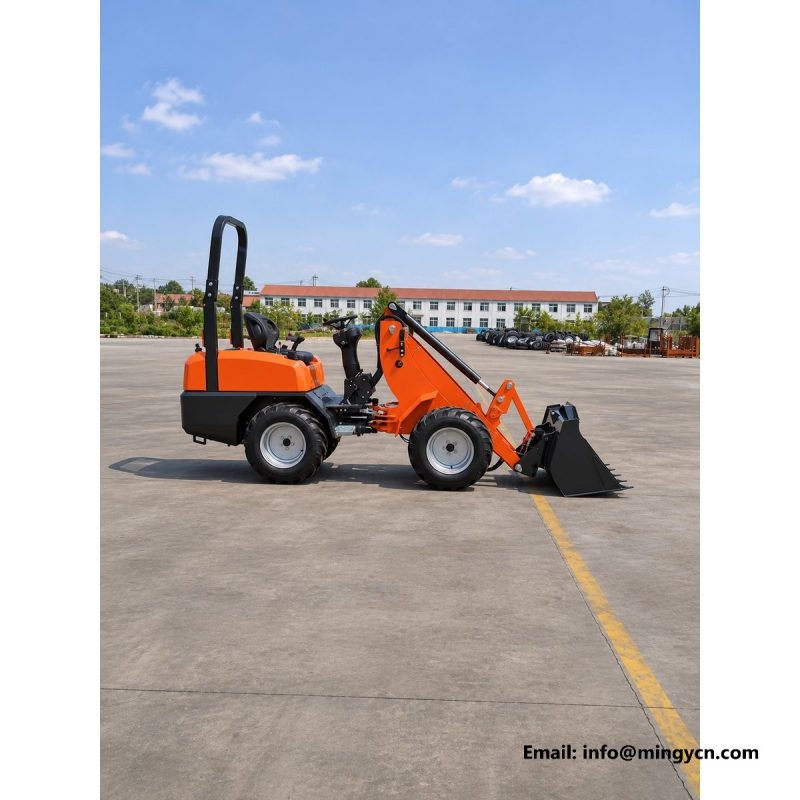
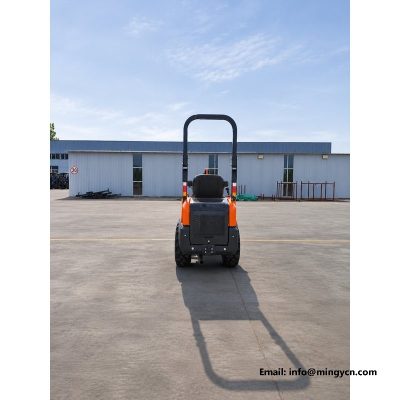
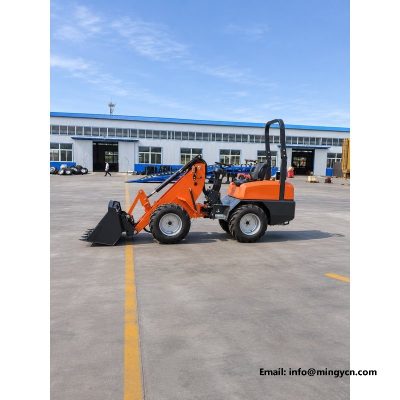
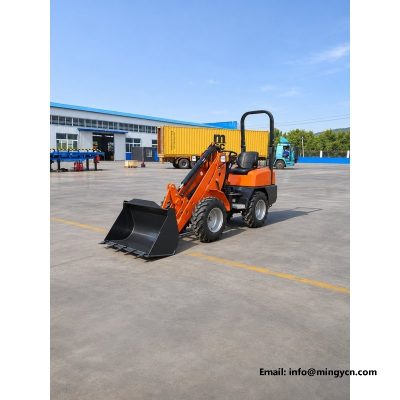
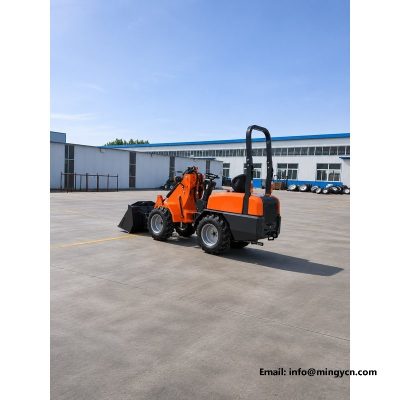
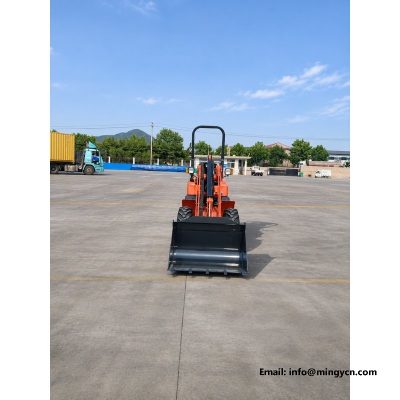
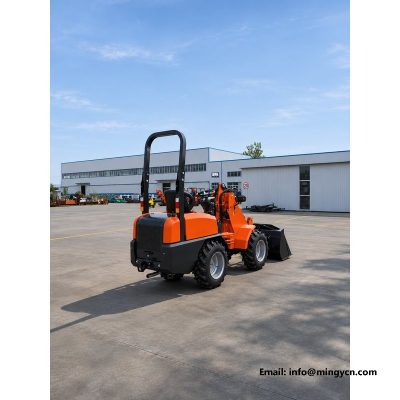
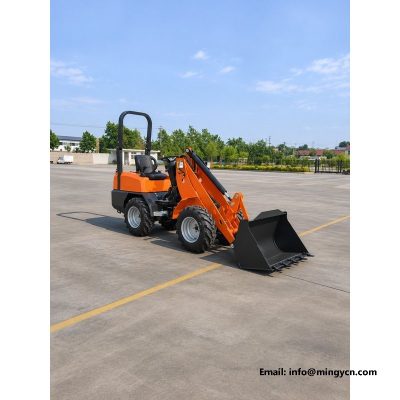
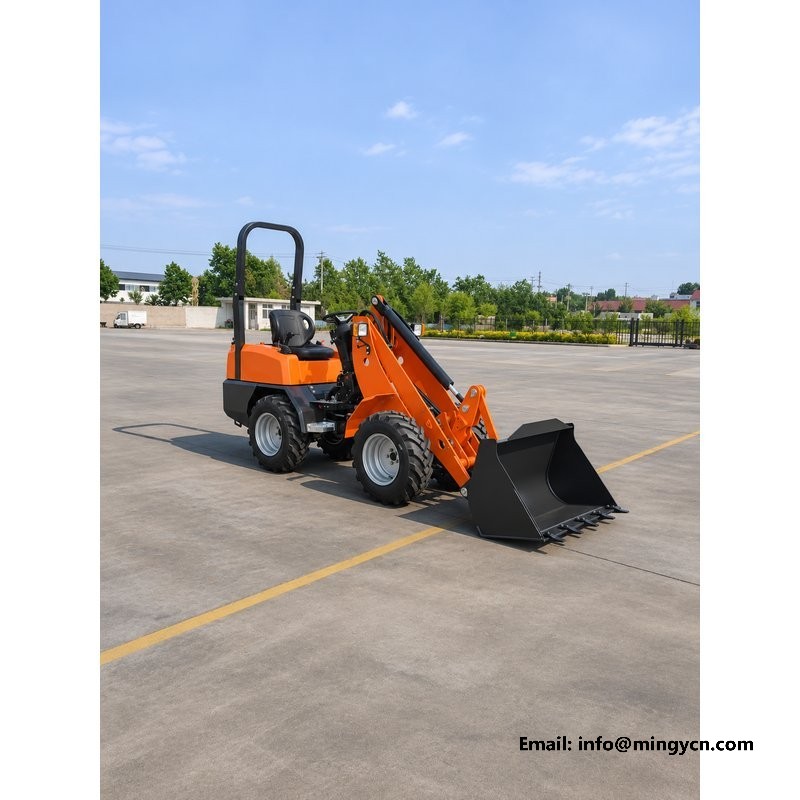
MY180D mini articulated wheel loader fitted with a ROPS frame for roll-over protection.
This version of the MY180D carries a ROPS frame instead of a canopy, and the eight photographs on the page include views from both sides, both rear quarters and with the boom raised. The orange body makes the frame, the articulation joint and the lift arm structure easy to follow, which is useful for a buyer inspecting a machine from images alone. The page covers what a roll-over protective structure does, how it changes height and transport, how the load travels from the bucket to the rear frame, and where the maintenance points are on this configuration. Nothing in the description depends on a dimension that cannot be measured on the machine itself.
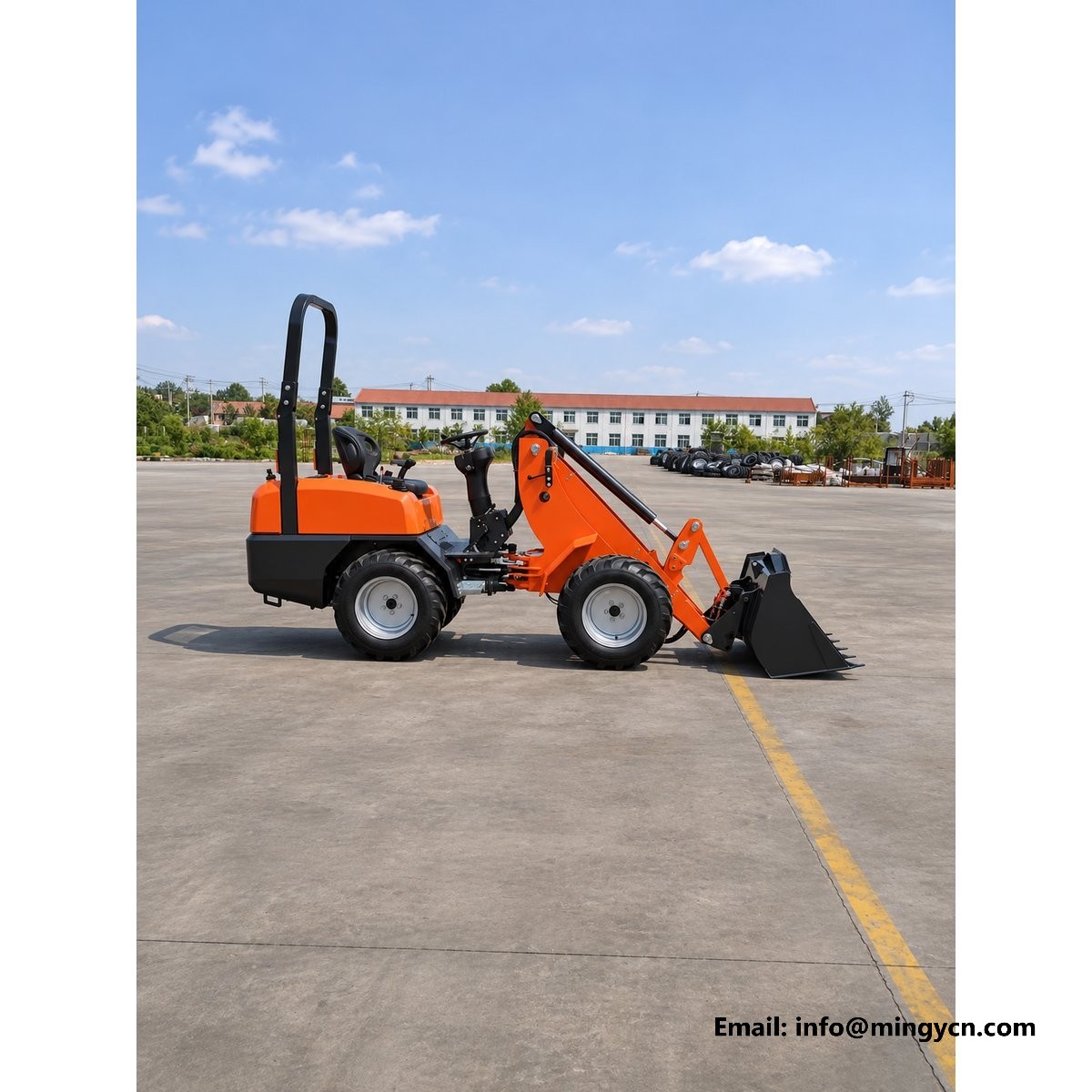
Eight photographs show this version of the MY180D from the front, both sides, both rear quarters and with the boom raised, and the orange paint makes the structure easier to read than a dark machine would. What distinguishes it from the canopy version is the frame around the operator: a fabricated roll-over protective structure rather than a simple roof on four posts. Everything else is familiar from the MY180D platform, including the articulation joint, the standard boom, the hydrostatic axle drive and the bucket on a quick coupler. This page looks at what the ROPS frame adds, how it affects the machine's height and transport, how the orange body reads on a site, and how the structure carries the loads that a loader generates. It closes with the maintenance points that decide how long the machine stays tight.
A roll-over protective structure is a tested, engineered frame whose job is to preserve a space around the operator if the machine turns over. It is not a sunshade and it is not a lifting point. The frame is designed to absorb energy as it deforms and to keep that deformation away from the seat area, which is why it is built from formed sections with reinforced corners rather than tube bent for appearance. It only works as a system: the frame, the mounting points to the chassis, the seat and the seat belt together. An operator who stands or leans out of the frame defeats the protection entirely. Buyers in markets where ROPS is expected on site, or where insurers ask for it, treat the frame as a requirement rather than an option.
| Model | MY180D (standard boom) / MY180T (telescopic boom) |
| Hydraulic pump | Closed-circuit piston pump, PWG (Italy) |
| Axles | Hydrostatic drive axle, orbit (gerotor) motor drive |
| Control | Pilot hydraulic operation |
| Standard tyres | 10.0/75-15.3 (optional 400/60-15.5) |
| Engine options | Xinchai Euro 5 3B11 (standard) / Kubota D1105 / Kubota V1505 |
| Seat | Deluxe seat |
| Hose | Qingdao Xiangliu hose assemblies |
| Options | Canopy, hydraulic quick coupler, enclosed cab, high/low speed |
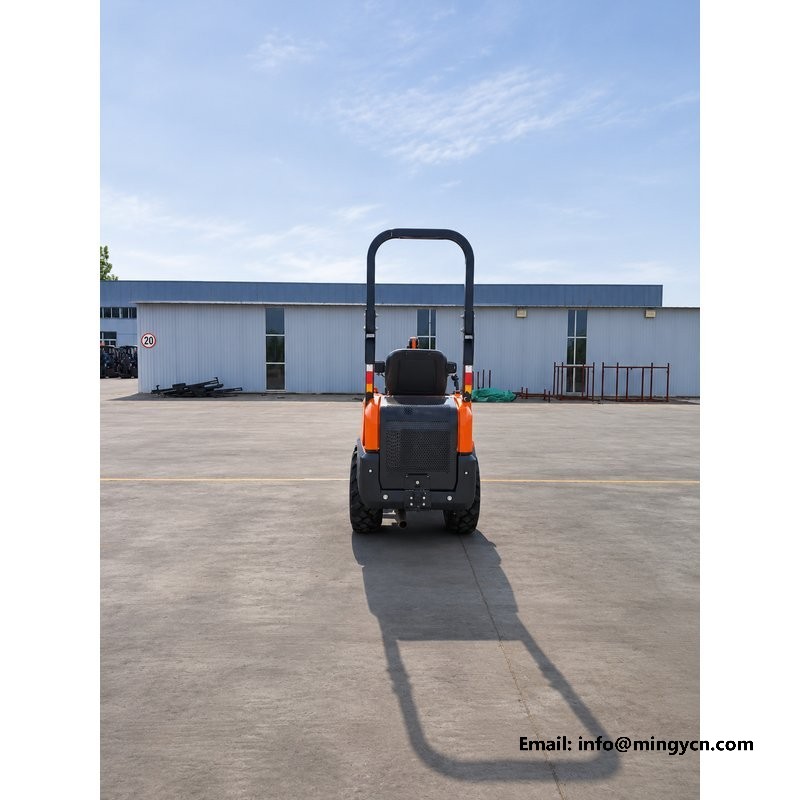
Adding a ROPS frame raises the highest point of the machine, and that has practical consequences beyond the obvious. Transport becomes a question of clearance: a machine that fits under a container door or on a flatbed without a permit is easier and cheaper to move, and a taller frame can turn a simple load into an oversized one. The frame also changes the centre of gravity, because the mass sits high on the chassis, which is one reason the structure is built from sections rather than heavy plate. Before ordering, measure the machine as configured against the transport you intend to use, and ask for the height with the boom lowered and the bucket flat on the ground. If height is critical, the canopy version may be the better fit.
Orange is not a decorative choice on a machine that works around people. A loader spends much of its life in a yard, a farm or a roadworks compound where pedestrians, delivery vehicles and other plant are moving at the same time, and the machine's own bulk hides the operator's view of the near side. A high-visibility body colour gives the people on the ground a better chance of seeing the machine before it moves. The effect is strongest in low light, in rain and in the dust of a demolition or bulk handling job, where a dark machine blends into the background. Paint quality matters as much as colour: ask how many coats are applied and whether the frame interiors are primed, because a machine that works outside will be judged on how it looks after two winters.
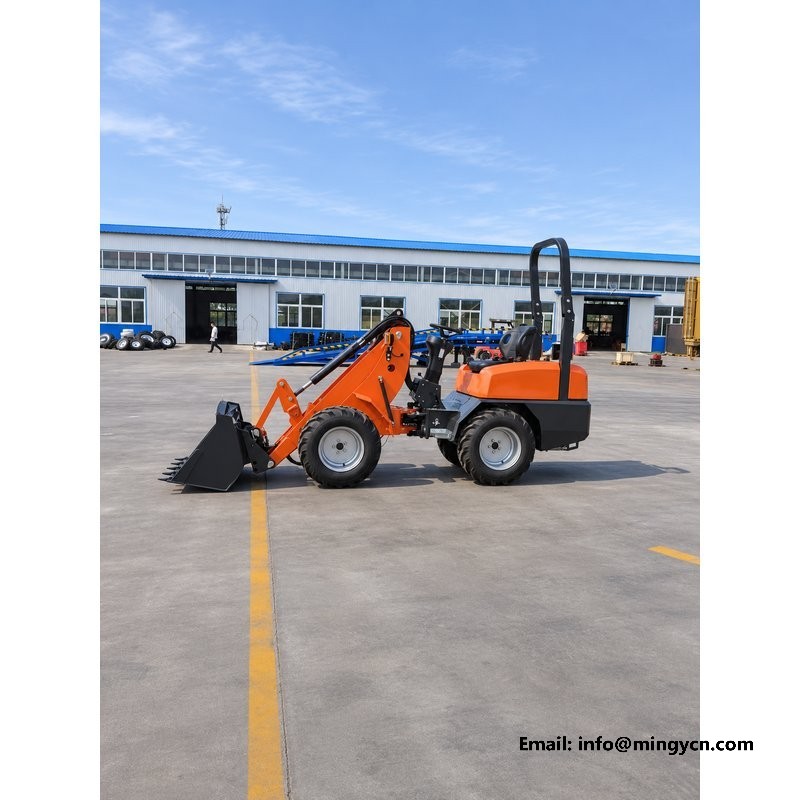
Follow a bucketful of gravel through the machine and the structure makes sense. The bucket edge takes the digging force and passes it into the quick coupler, then into the boom, then through the boom pivot pins into the front frame. From there the load crosses the articulation joint through the vertical pins and bearings, and finally reaches the rear frame, the axle and the ground. Each of those joints is a bearing surface that wears, and each is a place where a crack would begin if the structure were under-built. That is why the boom pivots on this machine are carried in fabricated bosses rather than in plate thickness alone, and why the articulation pins are large relative to the size of the loader. When inspecting a used machine, start at these points.
The combination of a closed-circuit piston pump and a hydrostatic axle gives this loader something a geared machine cannot offer: genuinely slow, controlled movement under load. For a paver's gang, that means carrying a bucket of asphalt along a kerb line at walking pace without lurching. For a landscaper, it means placing a pallet of turf on prepared ground without breaking the edge. For a livestock farmer, it means scraping a passage floor without gouging the concrete or frightening the animals. In each case the operator is working with centimetres, not metres, and the machine's ability to divide its speed finely is the whole point. A geared transmission with a fixed first ratio cannot do this, no matter how skilled the operator. It is also the reason the machine is popular with contractors who must work next to buildings, fences and stock, where a sudden lurch costs money.
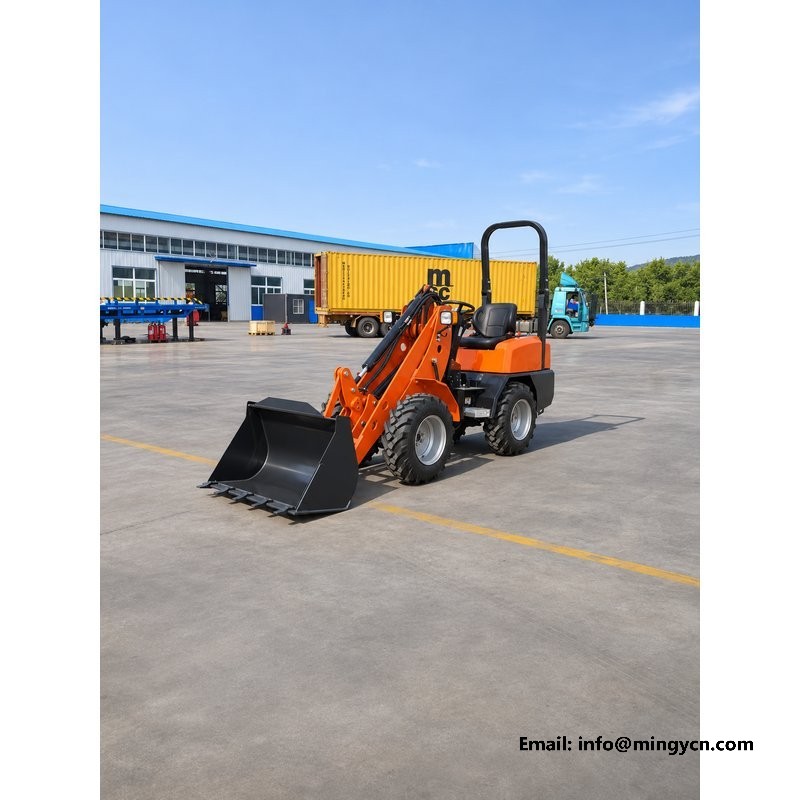
The stance of an articulated loader is set by its axles and the offset of its wheels, and on this machine the standard tyre is the 10.0/75-15.3, with the wider 400/60-15.5 available as an option. Track width matters for two reasons: stability when the bucket is raised and turned, and the ability to work between rows, along a wall or through a gateway. A wider setting is more stable but less manoeuvrable in tight spaces; a narrower one gets through gaps at the cost of some side-to-side firmness. Tyre construction matters too, because an agricultural tread cleans itself in mud while an industrial tread lasts longer on abrasive concrete. Match the tyre to the surface the machine will spend most of its hours on, and check that all four are the same size and type.
The service routine on an articulated loader is dominated by pivots. There are the boom pivot pins, the bucket and quick coupler pins, the articulation joint, the steering cylinder ends and the rear frame oscillation point if fitted. Each needs grease at the stated interval, and each should be checked for play at the same time by rocking the component with the engine off. The hydraulic cylinders should be inspected for scoring on the rod, weeping at the gland and damage to the chrome, because a scored rod will destroy the seal. Hoses that cross the articulation joint flex every time the machine steers, so they are the first to chafe; check them for rubbing against the frame and for cracks near the crimp. A ten-minute inspection after washing finds most of these.
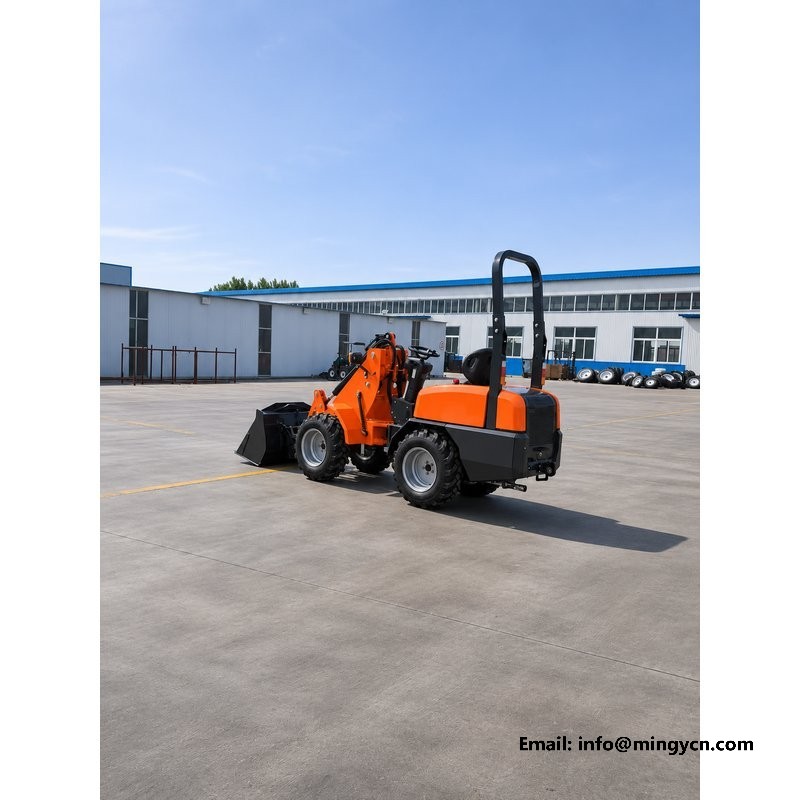
Three operator stations are offered across the MY180D range, and the choice is a straightforward trade between cost, protection and comfort. The canopy is the cheapest and gives the best visibility, but it offers no protection from falling objects and little from weather. The ROPS frame adds roll-over protection while keeping the machine open, which suits markets where the frame is expected and where the climate is mild. The enclosed cab adds glass, weather protection and, depending on specification, heating, at the highest cost and with the greatest height. Buyers should choose on the basis of the site rules they must satisfy and the weather the machine will work in, not on the cost of the option alone. A cab that is never needed is money wasted; a frame that is required is not optional.
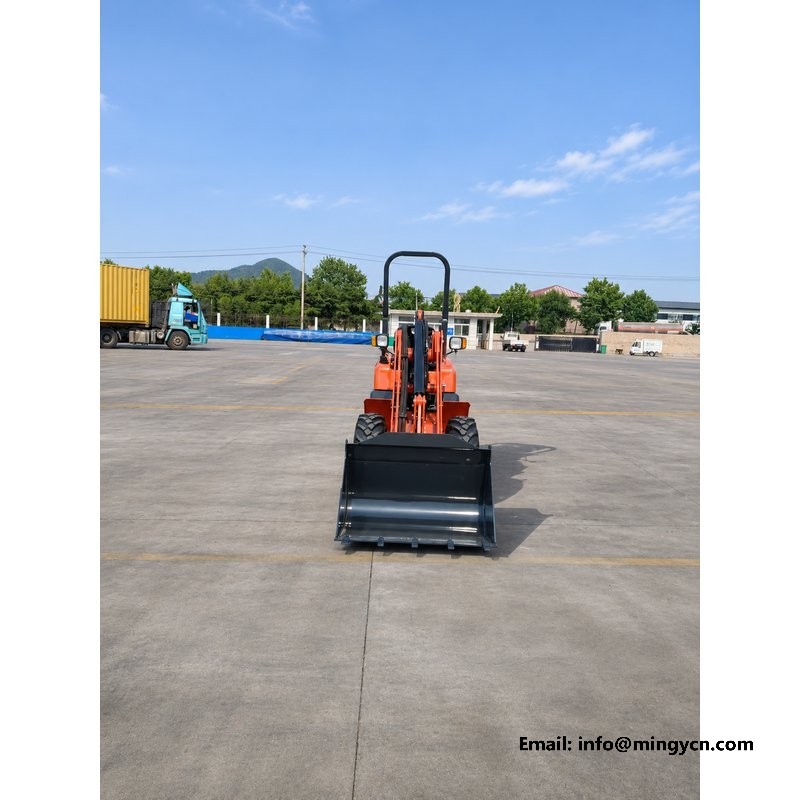
The bucket in the photographs is a general-purpose unit with a bolt-on cutting edge, mounted on a hydraulic quick coupler. That combination is the right starting point for most buyers, because the coupler lets one machine carry a bucket, forks, a grapple or a blade, and the bolt-on edge can be replaced when it wears rather than rebuilding the whole bucket. Bucket width should follow the tyres: a bucket appreciably wider than the machine leaves the edges outside the wheel tracks and makes the loader work at an angle. For grading work, a bucket with a longer floor and a straight edge is easier to level than a deep digging bucket. Confirm the coupler plate pattern before buying attachments, and check that the auxiliary hydraulic couplers match the attachment's requirements.
A loader that works in a yard or on a farm spends much of its life in dust, and the cooling pack and the air cleaner are where that dust collects. The radiator and oil cooler should be blown out with compressed air from the fan side at the end of a dusty shift, not washed from the outside, which drives debris further into the fins. The air cleaner should be checked at the same time, and the pre-cleaner emptied before it fills. On a machine with a canopy rather than a cab, the operator is exposed to the same dust, so a respirator is a reasonable addition for demolition or bulk handling work. Overheating in summer is almost always a blocked radiator rather than a failed water pump, and the check takes a few minutes.
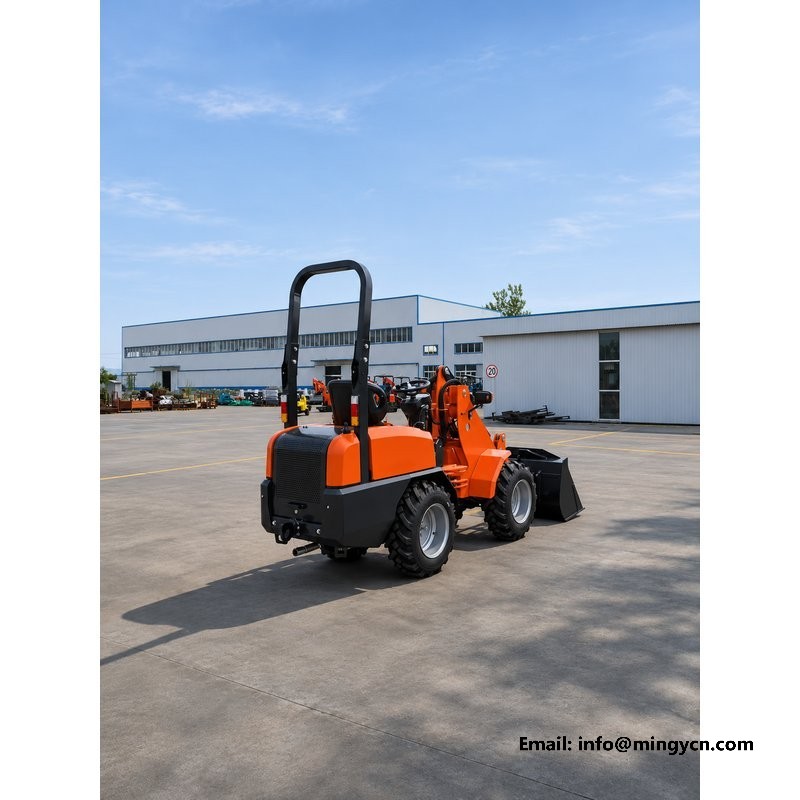
This version tends to go to three kinds of buyer: contractors who must satisfy a site rule that requires roll-over protection, farmers and estate owners who want the protection without the cost and height of a cab, and export customers in markets where a ROPS frame is the expected specification. For all three, the points to confirm before the order are the same. That the frame is a genuine protective structure rather than a cosmetic hoop. That the seat belt is fitted and anchored to the frame or the seat base as designed. That the machine's height as configured suits the transport and the doorways it must pass. And that the engine, tyre size and coupler on the order match what will actually be shipped. Ask for the frame drawing if the machine must satisfy a particular site standard, and keep the serial number with the delivery documents.
No. A ROPS frame is a structural hoop designed to protect the operator if the machine rolls over, and it leaves the operator station open to the weather. A cab adds glass, doors, a roof and often heating, at higher cost and greater height. The frame gives protection without enclosure, which suits mild climates and sites where a cab is not required.
That depends on the machine's height as configured, so ask the supplier for the exact transport dimensions before booking freight. A ROPS frame is taller than a simple canopy, and height, not length, is usually what decides whether a machine ships in a container or on a flat rack. Measure the machine with the boom lowered and the bucket flat.
Ordering and technical support
Email: sales@mingycn.com
LINE (ID): mingyicn
Tell us your working width, ground conditions and the attachment you need, and we will confirm the right configuration and shipping details.