Wood Chipper Attachment
Buyers who already run a loader rarely need a definition of the tool. They need to know how it behaves on the site they have, which is what the sections below set out.
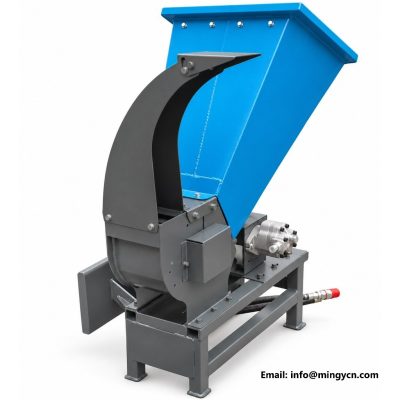
The discharge chute is rotatable, and the hopper is deep enough that the operator never reaches toward the rollers. The discharge chute is rotatable, and the hopper is deep enough that the operator never reaches toward the rollers.
Knives are sharpened or rotated as a matched set so the rotor stays balanced, and the anvil gap is reset after each change. Branches are fed butt-first, the infeed is allowed to pull at its own speed, and the discharge is aimed into a container or a defined area.
Published industry ranges put baseline ancillary flow near 17 to 24 gpm and high flow near 30 to 42 gpm, with main relief commonly around 3000 to 3500 psi. A normal secondary line is commonly rated around 17 to 24 gpm, a high-flow line around 30 to 42 gpm, and relief settings near 3000 to 3500 psi are typical across the industry.
The factory build sheet records safety as deep hopper and emergency stop bar.
The discharge chute is rotatable, and the hopper is deep enough that the operator never reaches toward the rollers. Knives are sharpened or rotated as a matched set so the rotor stays balanced, and the anvil gap is reset after each change.
A wider tool is not automatically a better tool on a narrow site. Service timing follow the wear history.
Branches are fed butt-first, the infeed is allowed to pull at its own speed, and the discharge is aimed into a container or a defined area. Orchard pruning, storm clearance, roadside vegetation and estate maintenance are the normal uses.
Build measurements are recorded as three groups: the envelope of the tool itself, the position of the mounting interface, and the in-service width at terrain level. Before any hose is connected, the host unit's rated auxiliary output is read from the specification plate and compared with the tool's requirement.
hydraulic circuit is specified as standard to higher auxiliary flow on the unit photographed here.
Knives are sharpened or rotated as a matched set so the rotor stays balanced, and the anvil gap is reset after each change. The discharge chute is rotatable, and the hopper is deep enough that the person at the controls never reaches toward the rollers.
Attachment mass also matters: a common industry rule keeps the tool plus its load within roughly half of the piece of equipment's tipping load, because mass carried far ahead of the arms reduces steadiness long before the hydraulic limit is reached. Dimensions on a compact loader implement are always read together with the loader.
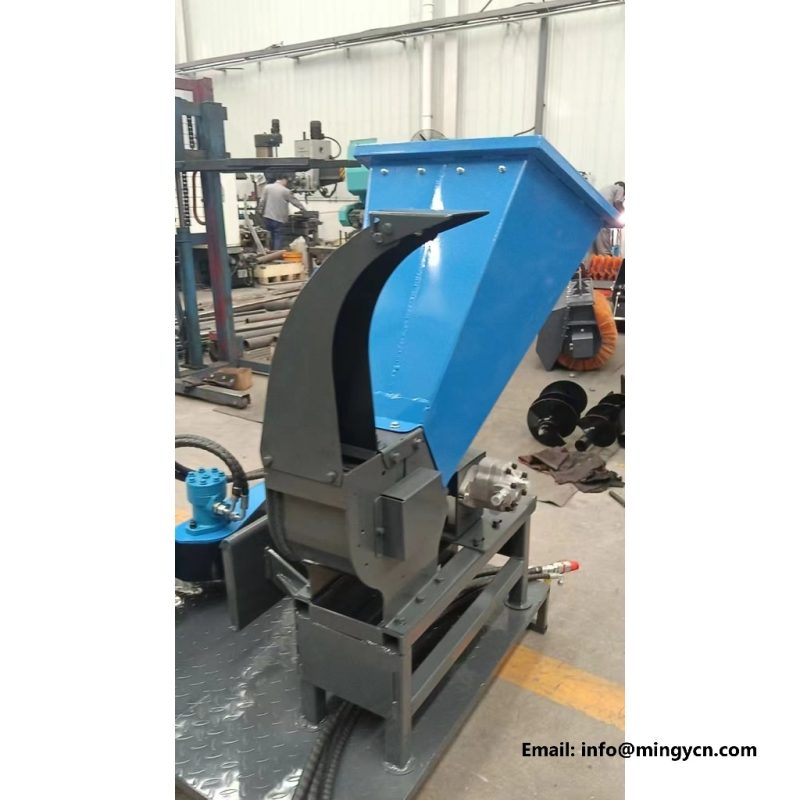
Knives are sharpened or rotated as a matched set so the rotor stays balanced, and the anvil gap is reset after each change. A wood chipper reduces branches and brush to chips with a powered rotor or disc, fed through a guarded hopper.
Safe working routines are mostly about position. Pins and bushes are greased on a daily cycle in dusty conditions, cutting edges are reversed before the parent mount is exposed, and hoses are inspected where they flex across a pivot.
The recorded value of mounting is universal quick-attach plate, taken from the assembled tool.
The discharge chute is rotatable, and the hopper is deep enough that the person at the controls never reaches toward the rollers. The cutting chamber holds a rotor with replaceable knives against a fixed anvil, and an infeed roller pulls substance in at a controlled rate.
Working width, overall height and the distance from the quick-attach plate to the working edge all affect what the machine can see, where it can turn and how much load it can carry with the arms raised. Compatibility is partly layout and partly arithmetic.
Branches are fed butt-first, the infeed is allowed to pull at its own speed, and the discharge is aimed into a container or a defined area. The cutting chamber holds a rotor with replaceable knives against a fixed anvil, and an infeed roller pulls matter in at a controlled rate.
This is an operating description rather than a catalogue summary. Loads stay low during travel, the unit is kept close to the loader, and turns are made gently on slopes.
The factory gives cutting as rotor or disc with replaceable knives and repeats the figure on the delivery note.
It turns a clearing job into a single pass where the material would otherwise be stacked and hauled away. A wood chipper reduces branches and brush to chips with a powered rotor or disc, fed through a guarded hopper.
All three need to suit the base unit and the task area; a specification that only states width leaves the two harder questions unanswered. Attachment mass also matters: a common industry rule keeps the tool plus its load within roughly half of the carrier's tipping load, because mass carried far ahead of the arms reduces balance long before the hydraulic limit is reached.
Branches are fed butt-first, the infeed is allowed to pull at its own speed, and the discharge is aimed into a container or a defined area. A wood chipper reduces branches and brush to chips with a powered rotor or disc, fed through a guarded hopper.
No adjustment, clearing or greasing is attempted with the circuit pressurised, and flexible lines are relieved before a coupler is disconnected. Does the coupler match?
infeed is specified as hydraulic feed roller on the unit photographed here.
The discharge chute is rotatable, and the hopper is deep enough that the crew member never reaches toward the rollers. A wood chipper reduces branches and brush to chips with a powered rotor or disc, fed through a guarded hopper.
Everything that follows describes what an operator will see, hear and review during a normal working day with this implement. A compact loader only earns its keep when the tool in front of it suits the plane.
Build and interface items are set out row by row below. Where a range appears it describes published compact loader practice rather than a promise about one piece of equipment, and the loader specification bracket is read first. Those entries are taken from the Wood Chipper Attachment on this page.
| Parameter | Value on the finished tool |
|---|---|
| Cutting | Rotor or disc with replaceable knives |
| Infeed | Hydraulic feed roller |
| Discharge | Rotatable chute |
| Safety | Deep hopper and emergency stop bar |
| Hydraulic circuit | Standard to higher auxiliary flow |
| Mounting | Universal quick-attach plate |
For discharge the data sheet states rotatable chute; the same entry is read again at handover.
The thick end enters squarely and the roller gets a positive grip. A wood chipper reduces branches and brush to chips with a powered rotor or disc, fed through a guarded hopper.
Continuous chipping of larger diameters benefits from the higher-flow circuit. Branches are fed butt-first, the infeed is allowed to pull at its own speed, and the discharge is aimed into a container or a defined area.
Only branch material within the rated infeed size. Orchard pruning, storm clearance, roadside vegetation and estate maintenance are the normal uses.
Knives, then the anvil and infeed roller bearings. It turns a clearing job into a single pass where the material would otherwise be stacked and hauled away.
What a buyer receives is a working implement plus the record of how it was put together. Both are useful when the tool is later serviced by a local workshop.
E-mail: sales@mingycn.com | LINE: mingyicn
A short note with the carrier model, flow figure and working material is enough to start. Mounting geometry, hydraulic requirement and the build photographs for that exact tool are confirmed in the reply, with technical questions answered directly.