Ask a buyer whether they want tracks or tyres and the answer usually comes back as a preference: "tracks, because they look serious" or "wheels, because I have to move it around". Neither is a reason. The right undercarriage follows from three things — the ground the machine stands on, the distance it travels under its own power, and the surfaces it has to cross without damaging them. Get those three right and the choice usually makes itself. Get them wrong and you own a machine that is either stuck or destructive.
Start With Ground Pressure
Every discussion about tracks versus tyres is really a discussion about ground pressure. A machine's weight spread over a larger contact area presses less on each square centimetre of ground. Reduce pressure below what the surface can carry and the machine floats; exceed it and the machine sinks, ruts, or shears the surface apart.
Rubber-tracked compact machines typically work in the range of 0.2 to 0.4 kilograms per square centimetre. A wheeled machine on the same footprint concentrates the same weight into four or fewer contact patches and can be several times higher. That single difference explains most of the practical behaviour: why tracked machines work on wet ground that stops a wheeled machine, why a wheeled machine is faster on a hard surface, and why the same job done in a field and done in a yard can justify different machines.
What Tracks Give You
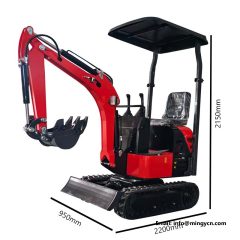
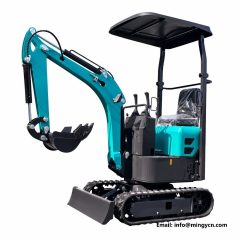
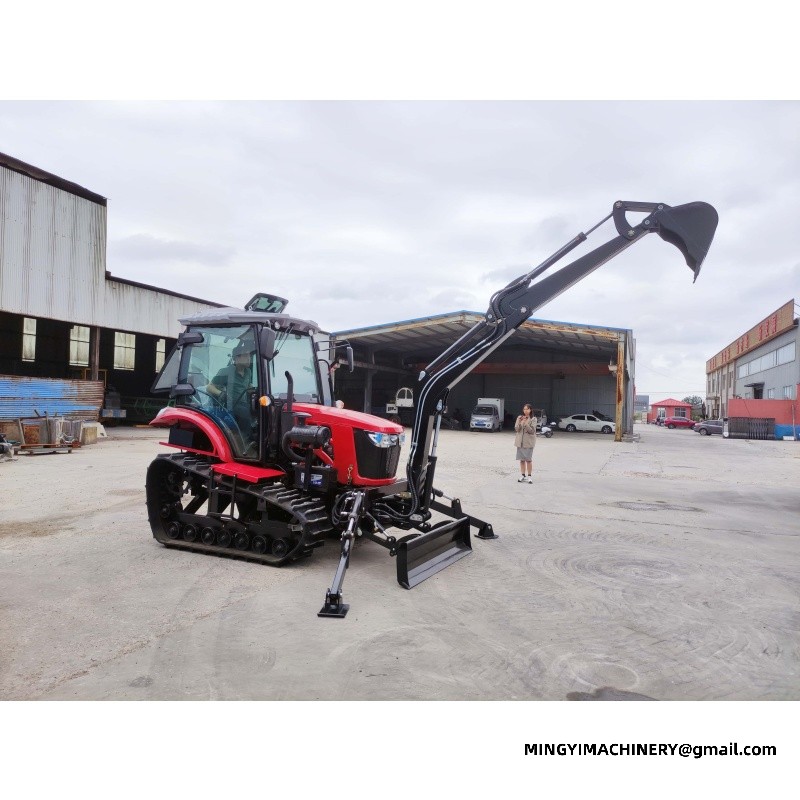
Tracks give flotation, traction on loose or wet surfaces, and stability on slopes because the machine sits lower and wider relative to its height. They also let a machine turn within its own length, which matters in orchards, between buildings, and in trench work. A tracked machine can work on a slope across the contour where a wheeled machine would slide, and it will typically push and dig with more authority because the whole track resists the reaction force rather than a tyre contact patch.
The trade-offs are real. Tracks are slower on the road, they damage paved and tarmac surfaces, they need transport between sites rather than being driven there, and the undercarriage is a wear system with many parts — chain, shoes, rollers, idlers, sprockets — that eventually needs replacing as a set. On abrasive ground or on road-running, track wear accelerates sharply.
What Wheels Give You
Wheels give speed, range, and surface tolerance. A wheeled machine drives between sites, works on tarmac and concrete without protection, and is simpler and cheaper to keep. Tyres absorb shock better than a rigid track frame, which makes long travel less fatiguing for the operator and for the machine. Servicing is familiar to any mechanic, and a puncture is a roadside job rather than a workshop job.
The trade-offs mirror the tracked list. Wheels concentrate weight, so on soft, wet, or loose ground a wheeled machine ruts and can become immobile. Traction depends on tyre type, tread, pressure, and ballast; on a greasy surface no amount of power helps if the contact patch cannot grip. Side-slope stability needs more care because the machine sits higher and the tyre contact patches are narrow. And aggressive tyres that grip in mud will tear turf just as effectively as tracks will.
The Ground You Will Damage
This is the criterion buyers most often skip, and it decides more purchases than any other. If a machine will cross a customer's lawn, a finished surface, a buried service run, or a compacted yard, ground pressure and tyre aggressiveness are the specification, not an afterthought. Turf tyres, flotation tyres, rubber tracks, and track pads exist precisely for this: they trade a little traction for a large reduction in damage.
Ask what the surface is worth, and who pays to put it right. Repairing a rutted lawn or a cracked apron after the job is a real outlay that often exceeds the difference between choosing carefully and choosing quickly, and it is the kind of item that never appears in a machine comparison. On the orchard and vineyard guide the same logic appears as row width and root damage; it is the same physics applied to a more sensitive surface.
How Far and How Fast It Travels
Distance decides more than buyers expect. If a machine travels more than a few kilometres a day under its own power, wheels are usually correct, because tracked travel is slow, wears the undercarriage, and needs a transporter for anything beyond a short hop. If the machine works in one place for days and moves by trailer, tracks give up nothing in mobility and give you everything in traction.
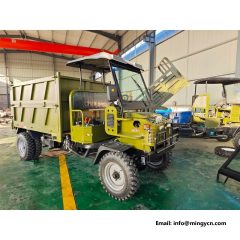
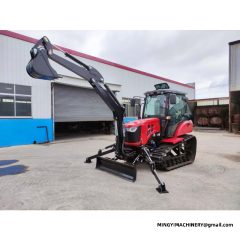
Also count the crossings. A machine that works in a field but crosses a road twice a day needs a solution for both: rubber tracks or track pads, or a wheeled machine with the right tyres and a plan for the soft section. Machines like the crawler carriers in our crawler transport range exist exactly for the case where ground is bad every day and road travel is not part of the job.
Slopes, Turning, and Stability
On a slope, the questions are whether the machine will hold position and whether it will tip. Tracked machines resist sliding because the whole track length is in contact, and they resist tipping because of a low centre of gravity and wide stance. Wheeled machines need their brakes, their diff lock, and the operator's judgement, and they are more sensitive to the direction of travel relative to the contour.
Turning is the other half. Skid-steered tracked machines turn in their own length but scuff the surface while doing it; that scuffing is what damages turf. Wheeled machines need room to turn, and articulated wheeled machines turn by bending in the middle, which is gentler on the ground but needs a wider working corridor. In tight orchards and vineyards, that corridor is often the deciding constraint.
Wear, Service, and What You Maintain
A tracked undercarriage is a system of consumables. Rollers, idlers, sprockets, chains, and shoes all wear, and they wear faster in sand, gravel, and on hard surfaces. Track tension matters: too tight accelerates wear and loads the drive; too loose risks derailment. Daily cleaning of the track frame is not cosmetic — packed material is a leading cause of derailment and of premature roller failure.
Wheeled machines ask for tyre pressure checks, tread and sidewall inspection, and attention to steering and axle play. Tyres are a consumable too, and a set on a compact machine is a meaningful purchase, but the pattern of wear is slower and more predictable than a track chain on abrasive ground. Both are covered in the daily routine set out in the maintenance guide.
Middle Answers
The choice is not binary. Rubber tracks over tyres convert a wheeled machine to a tracked one for sensitive surfaces. Track pads do the reverse for steel tracks on pavement. Flotation and turf tyres lower pressure without going to tracks. Bogie axles spread load on a wheeled machine. Dual wheels add contact area where width allows. And some machines are offered in both formats, which is worth asking about before you compromise: the excavator sizing guide and the wheel loader guide both cover formats where the same work is done either way.
The Spec Inside the Spec: Tyres and Track Shoes
Choosing tracks or wheels is only the first decision; the second one decides how the machine behaves on your ground. Track shoe width, shoe pattern, and shoe material change ground pressure and damage. A narrow shoe grips and cleans well but concentrates load; a wide shoe floats but packs with material in clay. Rubber shoes protect pavement; steel shoes last on rock. A blocked or smooth-shoed track has poor traction no matter how much power the machine has.
Tyres work the same way. Tread pattern decides grip versus damage, ply rating decides puncture resistance, and pressure decides contact area — which means pressure is a free adjustment you can make on site. Lowering pressure within the manufacturer's range increases flotation and reduces rutting; running too low overheats the sidewall and destroys the tyre. On machines that alternate between road and soft ground, carrying a compressor and using the pressure range properly is often the most effective tool available.
What Each Machine Family Usually Does
Excavators appear in both formats, and the split is clean: tracked machines dominate where the machine digs in one place and the ground is poor; wheeled excavators exist for road-side work, urban jobs, and sites where the machine has to reposition itself repeatedly on hard surfaces. Loaders are mostly wheeled because their job is travel and loading; compact tracked loaders appear where ground is soft or surfaces are delicate, which is also why the choice is discussed in the wheel loader guide in terms of material and surface rather than only bucket size.
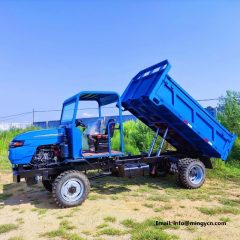
Tractors are wheeled by default, with tracks and half-tracks as options for wet fields and for reducing compaction — the reason is that a tractor's job includes road travel and implement work, both of which suit wheels. Dumpers split by ground: wheeled machines for hard, long haul roads, tracked and crawler carriers for soft, steep, or freshly stripped sites. And compact utility machines, the tracked carriers and tractors in our crawler equipment range, exist precisely where a wheeled machine would not finish the day.
When the Ground Changes During the Year
Ground is not a fixed input. A site that carries a wheeled machine in August may stop one in February, and a field that is firm after a dry week may rut badly after rain. Buyers who only specify for the best weeks end up with a machine that is idle in the seasons when work is most urgent. The practical answer is to specify for the worst month you expect to work in, not the average one, and to treat tyre choice, pressure, and track shoes as seasonal adjustments rather than fixed settings.
Common Mistakes
Buying tracks because the ground is bad for two weeks a year, then paying for track wear all year. Buying wheels because the machine has to cross a road, then losing days to a soft section that a tracked machine would have crossed. Ignoring surface damage until a customer complains. And choosing the undercarriage before defining the ground, which puts the decision in the wrong order.
Undercarriage Selection Table
| Condition | Favours | Why |
|---|---|---|
| Soft, wet, or loose ground, every day | Tracks | Low ground pressure and continuous contact |
| Daily travel of several kilometres | Wheels | Speed, and no undercarriage wear from road running |
| Finished surfaces, turf, or buried services | Wheels with flotation or turf tyres, or rubber tracks | Damage is the constraint, not traction |
| Slopes worked across the contour | Tracks | Resists sliding and tipping |
| Tight rows, buildings, or trench work | Tracks (skid-steer) | Turns within its own length |
| Hard, abrasive surfaces | Wheels | Track wear on abrasive ground is expensive |
| Mixed: soft site, road crossing | Rubber tracks or pads, plus transport plan | One compromise rarely covers both |
| Machine moves by trailer between jobs | Tracks | Road mobility no longer matters |
Write down the ground, the distance, and the surface you must not damage before you look at machines. Those three lines decide the undercarriage, and the undercarriage decides most of what the machine will be able to do. If you want a second opinion, send us the site conditions — a description of the ground and the distances is usually enough to narrow it to one answer.