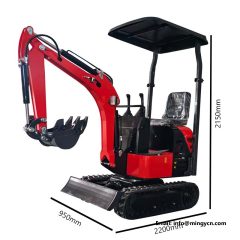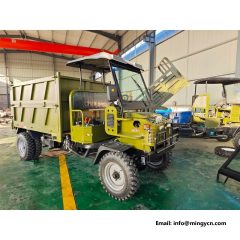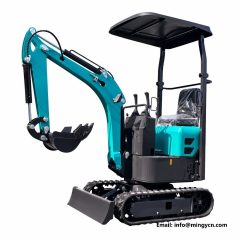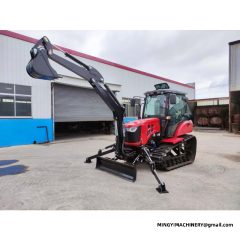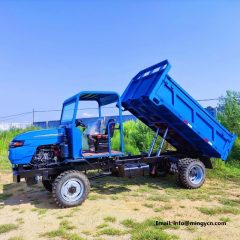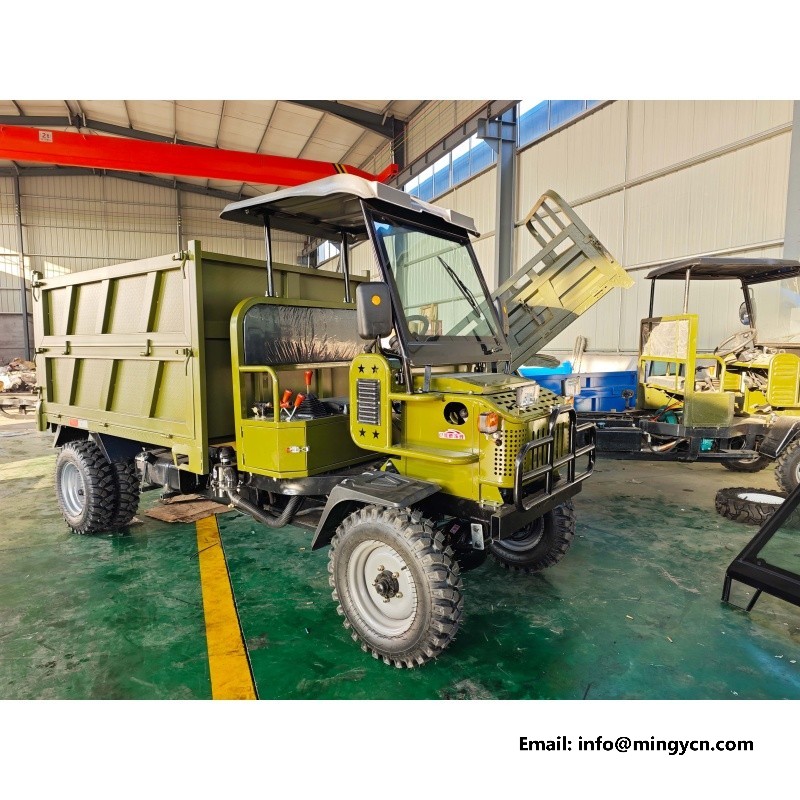
A dumper looks like a simple machine: a skip on a chassis that tips. That simplicity is why they are bought carelessly, and why so many of them end up stuck, overloaded, or tipping on ground they were never specified for. The decisions that matter are the ones that look boring — how much the load weighs rather than how much it measures, how steep the haul road is, whether the machine turns in the space available, and whether the operator is protected if it goes wrong.
Weight Before Volume
The most common buying mistake is choosing a dumper by skip volume. Volume tells you how much a load measures; weight tells you whether the machine can carry it safely. Wet sand, concrete, clay, and rock differ enormously in density, and a skip filled to the brim with heavy material can put far more weight on the chassis than the rating allows.
Work it out before ordering. Estimate the densest material you will carry, multiply by the skip volume in cubic metres, and compare the result with the rated payload. If they are close, buy the next size up. An overloaded dumper brakes poorly, tips unstably, wears its tyres and axles quickly, and puts the operator at risk on any gradient.
| Material | Approximate density (tonnes per cubic metre) | What it means |
|---|---|---|
| Topsoil, dry | 1.2 to 1.4 | Volume and weight roughly align |
| Sand, wet | 1.8 to 2.0 | Heavy; a heaped skip easily exceeds rating |
| Gravel | 1.6 to 1.8 | Plan by weight, not by bucket count |
| Clay, wet | 1.8 to 2.1 | Heaviest common site material |
| Concrete, broken | 1.6 to 2.0 | Dense and abrasive on the skip floor |
| Rock, broken | 1.5 to 1.9 | Impact loads as well as weight |
Drive Configuration
Three configurations cover most work. A two-wheel-drive dumper suits firm, level ground and short runs, and is the simplest to maintain. A four-wheel-drive dumper is the default for anything off made-up ground, because it puts power at both axles where grip exists. An articulated four-wheel-drive machine adds steering by bending in the middle, which keeps all four wheels on uneven ground and gives a tighter turn than a rigid machine of the same size.
Tracked carriers and crawler dumpers serve the ground that stops tyres: soft, wet, freshly stripped, or steep sites. They trade speed for traction and flotation, exactly as described in the undercarriage guide, and they are the right answer when the haul road is the problem rather than the distance.
Gradient, Braking, and the Worst Case
Haul roads are rarely flat, and a dumper is at its most dangerous loaded and descending. Check the gradient the machine is rated for when loaded, and check the braking system: whether it acts on all wheels, whether there is engine or hydraulic retarding to hold speed on a long descent, and whether a parking brake will hold a loaded machine on the steepest section you work on.
Water and mud change everything. A gradient that is safe on a dry morning becomes a slide in the afternoon. Specify for the worst condition you will work in, and be conservative about running loaded down a slope that is steeper than the machine's rated figure.
Turning Circle and Site Layout
Dumpers spend a surprising amount of their time turning, reversing, and waiting. Measure the space at the loading point and at the discharge point before choosing machine size. A dumper that cannot turn at the face needs a turning bay, and working around one takes time out of every day. Articulated machines turn tighter than rigid ones of the same capacity, and compact machines turn tighter than large ones — which is sometimes the argument for two smaller machines rather than one large one.
Reversing deserves its own thought. Visibility behind a loaded skip is limited on any dumper, so check the mirror package, the camera option, and whether a reversing alarm is fitted and audible over site noise.
Skip Types and Discharge
How the load leaves the skip decides where the machine can work. A front-tip skip discharges ahead of the operator, which suits trench filling and forward discharge into a stockpile. A swivel skip rotates so the machine can discharge to the side without repositioning, which is a large time saver in trenches and narrow sites. A high-discharge skip lifts the load high enough to tip into a skip or hopper, which matters when material is being transferred rather than stockpiled.
Check discharge height against what the machine has to tip into, and check that the skip floor is thick enough for the material — abrasive rock destroys a light skip floor quickly.
Operator Protection
Roll-over protection is the specification that matters most and the one buyers are most tempted to treat as optional. A dumper working on uneven ground, on slopes, or near edges can roll; a roll-over protective structure and a seat belt are what keep that event survivable. Falling-object protection matters where loading is done by an excavator working above the dumper.
Check the seat, the access steps and grab handles, the guards around moving parts, and whether the controls are laid out so an operator wearing gloves can use them. Most dumper incidents involve mounting, dismounting, or a tip-over, and both are addressed by specification rather than by care.
Matching the Dumper to the Loading Machine
A dumper is one half of a cycle. If the excavator loads it in four passes, a larger dumper waits longer but makes fewer trips; if it loads in twelve, the dumper size may be the bottleneck. Balance the pair: the number of passes to fill should be reasonable, and the dumper's round trip should roughly match the excavator's loading time so that neither machine waits on the other.
The sizing logic is the same as in the excavator sizing guide: start from the material, the distance, and the cycle, then choose the machine. Our off-road transport range covers wheeled machines for hard haul roads, and the crawler carriers cover the soft and steep cases.
Engine, Emissions, and Site Rules
Sites increasingly restrict engine emissions, particularly for indoor or enclosed work. Confirm the emissions standard required on your sites and whether the engine needs diesel particulate equipment, and plan for the fuel quality and service intervals that come with it. Check fuel capacity against a shift, because refuelling on a large site is time lost.
Maintenance Access
Dumpers work in mud, dust, and water, and they are maintained by whoever is available. Check that daily checks are reachable without tools: oil level, coolant, hydraulic level, air filter indicator, tyre condition, and grease points. Check that the skip pivot and the tipping rams can be greased without contortion, because a grease point nobody can reach is a grease point that is skipped.
The daily discipline in the maintenance guide applies directly, and the wear parts you should hold in stock are covered in the spare parts guide.
Rigid or Articulated
A rigid dumper steers by its front wheels or by skid-steering, and its chassis keeps all wheels in a fixed relationship to the frame. That makes it predictable, simple, and easy to repair. On uneven ground, however, a rigid chassis lifts wheels off the surface, and a wheel in the air contributes nothing to traction or braking.
An articulated machine bends in the middle, which keeps all four wheels following the ground and gives a much tighter turning circle for the same capacity. The trade-off is a centre joint that wears, needs greasing, and should be checked for play during any inspection. For tight or rough sites, articulation usually wins. For long, firm haul roads, a rigid machine is often the simpler machine to keep.
Tyres, Flotation, and Ground Care
Dumpers work on ground that is often the worst on the site, and tyre choice decides whether they leave ruts that then need repairing. Wide flotation tyres spread load and reduce rutting; deep aggressive tread grips in mud and tears the surface at the same time. Pressure should be set for the load and the surface within the manufacturer's range, and checked daily, because a soft tyre on a loaded dumper overheats and fails.
Where the haul road crosses finished surfaces or soft landscaping, plan the route as well as the machine: matting, a designated crossing, and a speed limit protect ground far more effectively than any tyre choice. The same principle appears in the orchard and vineyard guide, where the route matters as much as the machine.
Working in Confined or Enclosed Sites
Tunnels, basements, and indoor demolition bring three extra constraints: height, ventilation, and visibility. Check overall height against the lowest obstruction on the route, including with the skip raised if the machine will discharge under a low structure. Confirm the emissions standard and whether additional ventilation is required, because diesel equipment in an enclosed space is a health question and not only a compliance one. And check lighting, because a dumper reversing in a dim enclosure is working with the least information and the most consequence.
In these conditions, smaller machines often work better than larger ones even when the larger machine has the capacity on paper, and a camera plus a banksman is worth more than another tonne of payload.
How the Machine Is Loaded
Loading practice decides how long a dumper lasts. An excavator dropping material from height into the skip shocks the chassis, the skip floor, and the suspension or axles, and it throws material at the operator's position. Loading from a sensible height, into the centre of the skip, and without swinging the bucket over the cab is faster as well as safer, because material placed centrally does not need re-levelling.
Level the load before moving. A skip loaded higher on one side is the starting point for a tip-over on a side slope, and it is the most common cause of dumper roll-overs that do not involve a gradient at all. Matching the number of passes to fill, and agreeing the loading signals with the excavator operator before work starts, removes most of this.
Common Mistakes
Buying by skip volume and overloading by weight. Choosing two-wheel drive for ground that needs four. Ignoring gradient rating until the first loaded descent. Skipping roll-over protection. Specifying a machine that cannot turn at the face. And buying one large dumper when the site layout favours two smaller ones.
Dumper Selection Checklist
| Item | What to confirm |
|---|---|
| Payload by weight | Heaviest material × volume, with margin above the rating |
| Drive | Two-wheel, four-wheel, articulated, or tracked by ground |
| Gradient | Rated loaded gradient exceeds your steepest section |
| Braking | All-wheel service brake, retarding, parking brake holds loaded |
| Turning | Turns at the loading point and at the discharge point |
| Skip | Type and discharge height match where material goes |
| Protection | Roll-over and falling-object structure fitted; seat belt used |
| Visibility | Mirrors, camera, alarm; reversing route checked |
| Cycle match | Passes to fill and round trip balanced with the loader |
| Emissions | Meets the standard required on your sites |
| Service | Daily points reachable; filters and wear parts stocked |
Write down the material, the weight, the gradient, and the turning space before looking at machines, and the field narrows quickly. If you want help sizing a dumper to a job — or deciding between a wheeled machine and a crawler carrier — send us the material, the haul distance, and the ground and we will work through it with you.