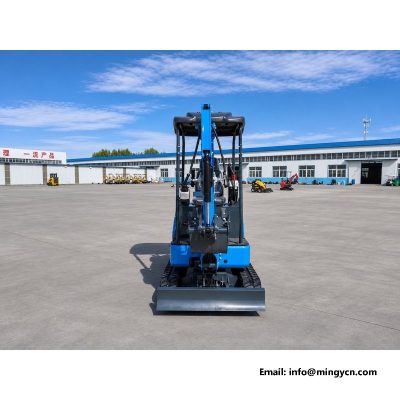
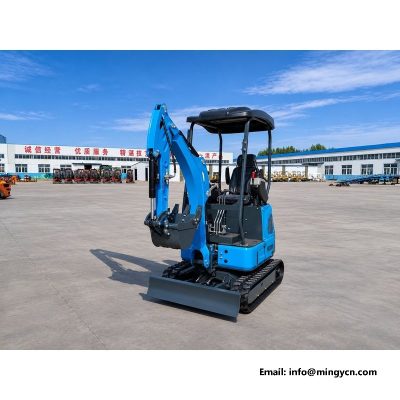
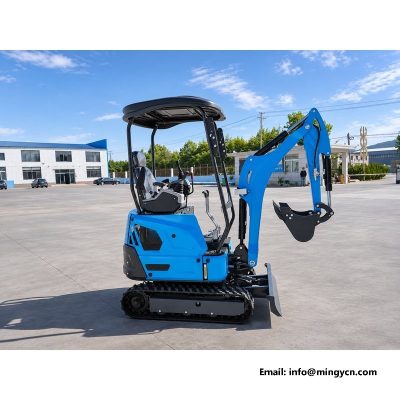
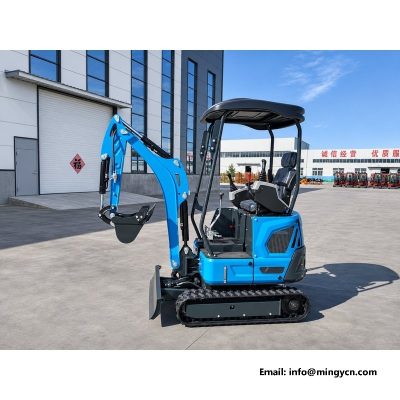
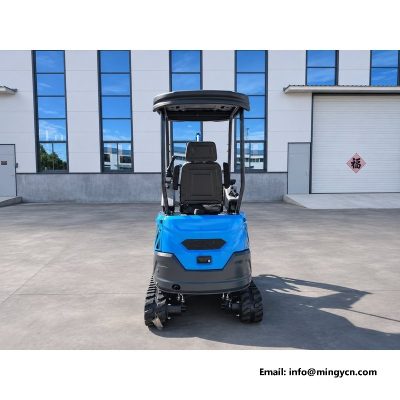
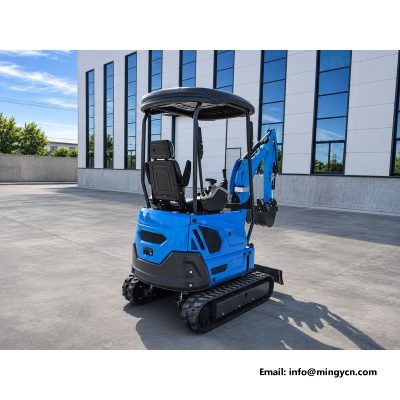
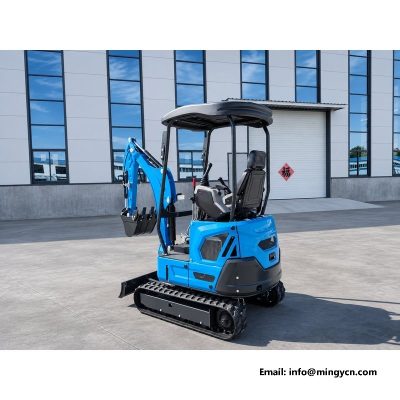
Pilot joystick control, 1,260 kg operating weight and a 2,100 mm digging depth.
The MY20 is a 1,260 kg rubber-tracked mini excavator with pilot joystick control, a front dozer blade and a canopy in place of a cab. It measures 2,550 x 1,150 x 2,200 mm and is offered with three engine options: Kubota D722, Laidong 385 and Kubota D902. This page works through the machine as a buyer sees it in the yard photographs, covering the control layout, the working envelope, the undercarriage and the blade, then sets out an arrival inspection and a transport procedure that can be used on the day of delivery. Every figure quoted here comes from the manufacturer's specification sheet for this model.
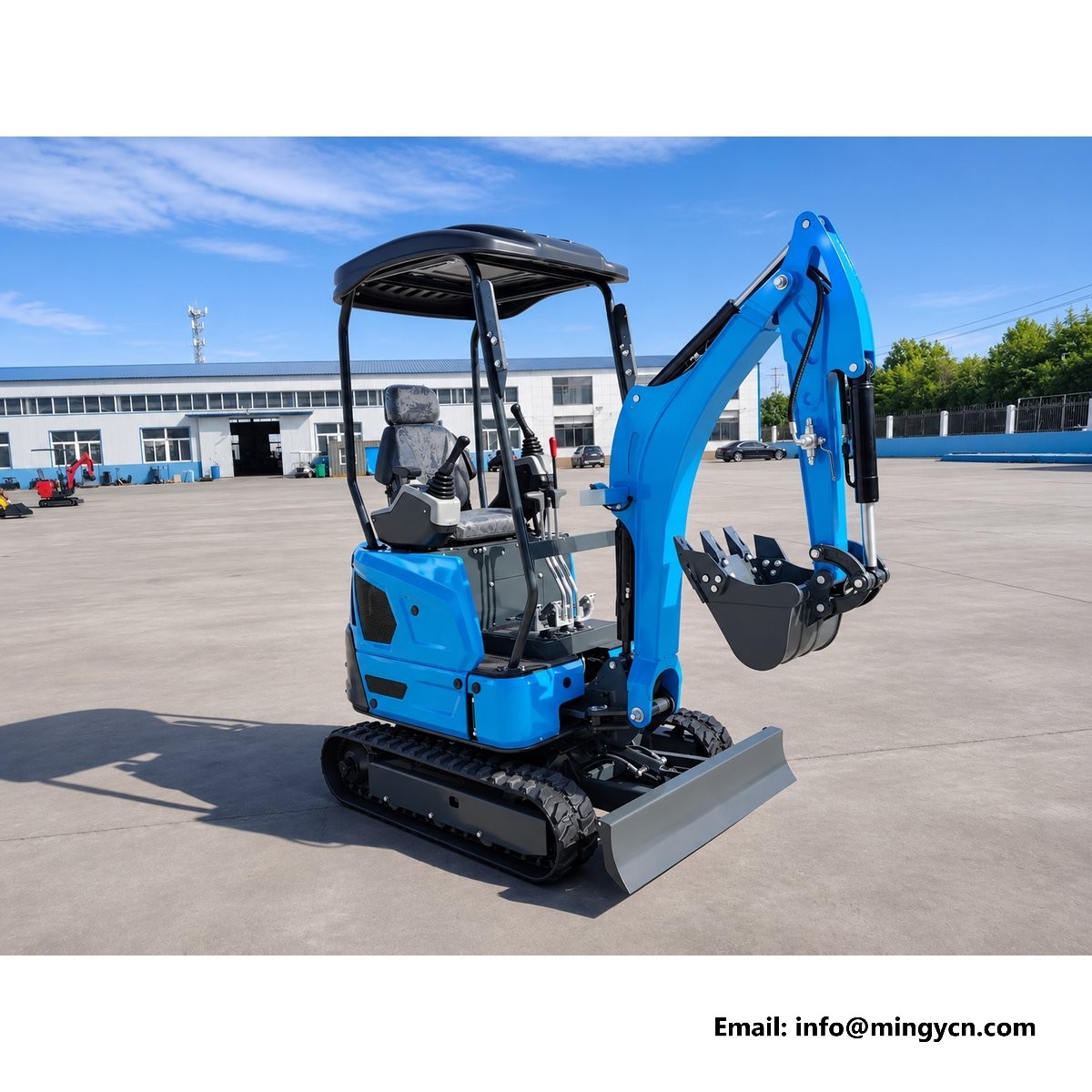
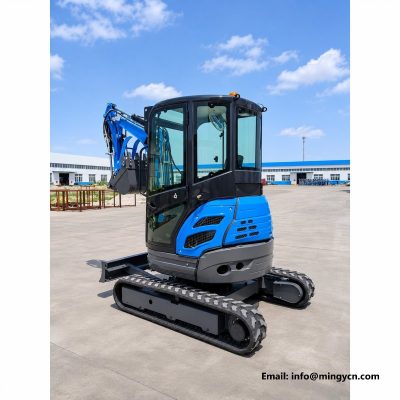
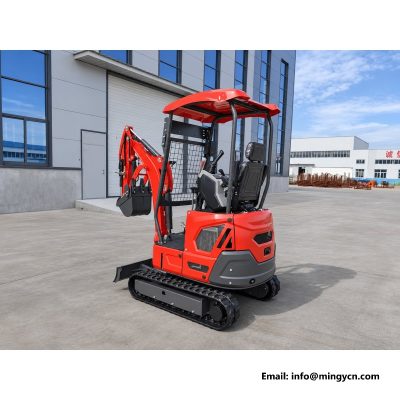
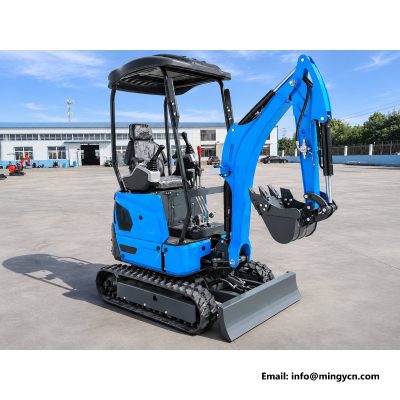
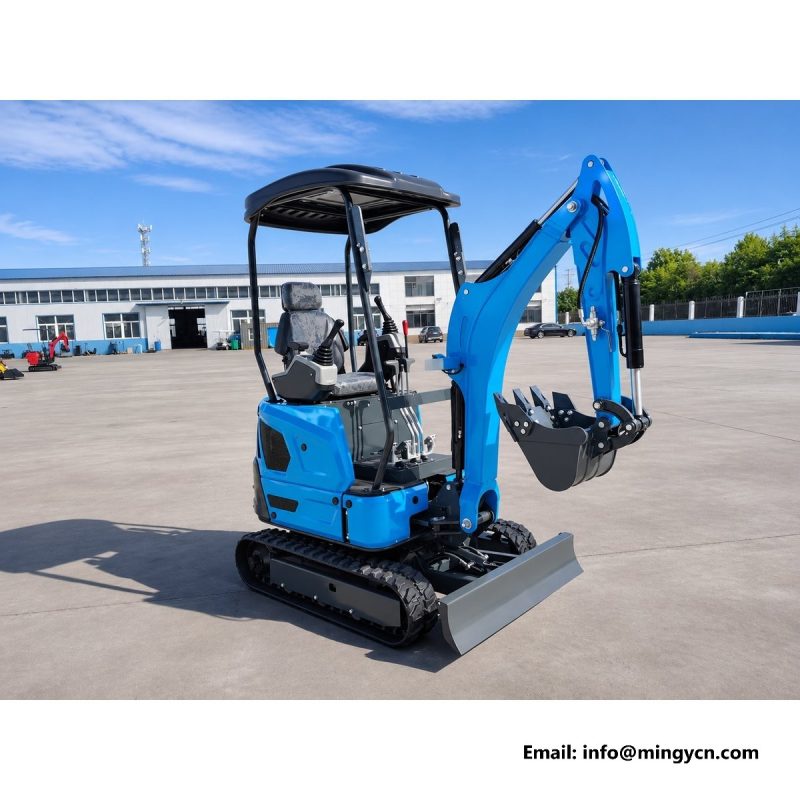
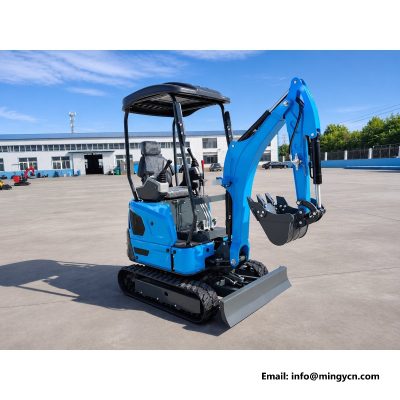
The MY20 is a 1,260 kg crawler excavator built on a 200 x 41 x 72 mm rubber track undercarriage, and the machine measures 2,550 x 1,150 x 2,200 mm over the canopy. Three engine options are offered: Kubota D722, Laidong 385 and Kubota D902, so a dealer can hold one chassis and stock two or three power units for different customer groups. Every version uses pilot joystick control, a front dozer blade, and a boom that reaches 2,100 mm below grade. The photographs in this set show the blue canopy machine standing on concrete in the factory yard, which is where a buyer can judge paint, hose routing and panel alignment before a single unit is crated. Nothing on the base machine is decorative; each item has a job in the working cycle. Every unit leaves the line with the same base specification.
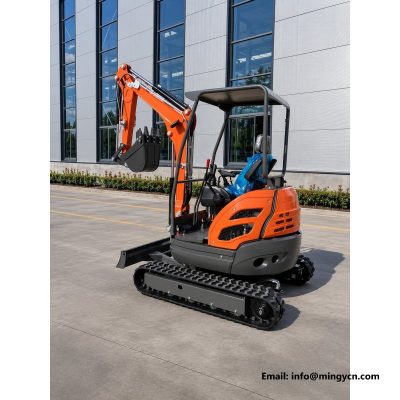
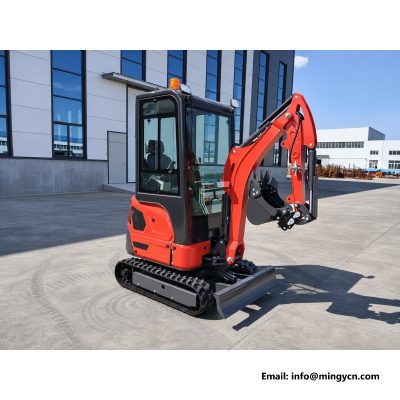
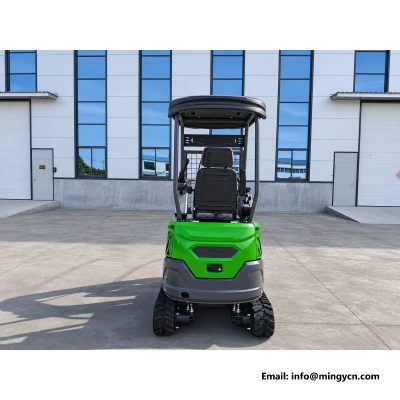
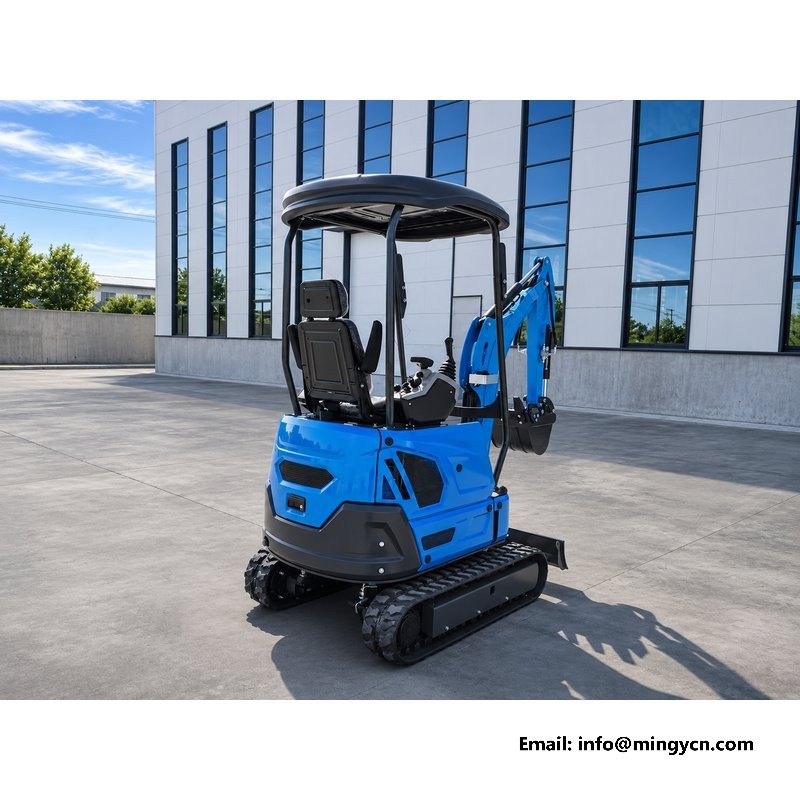
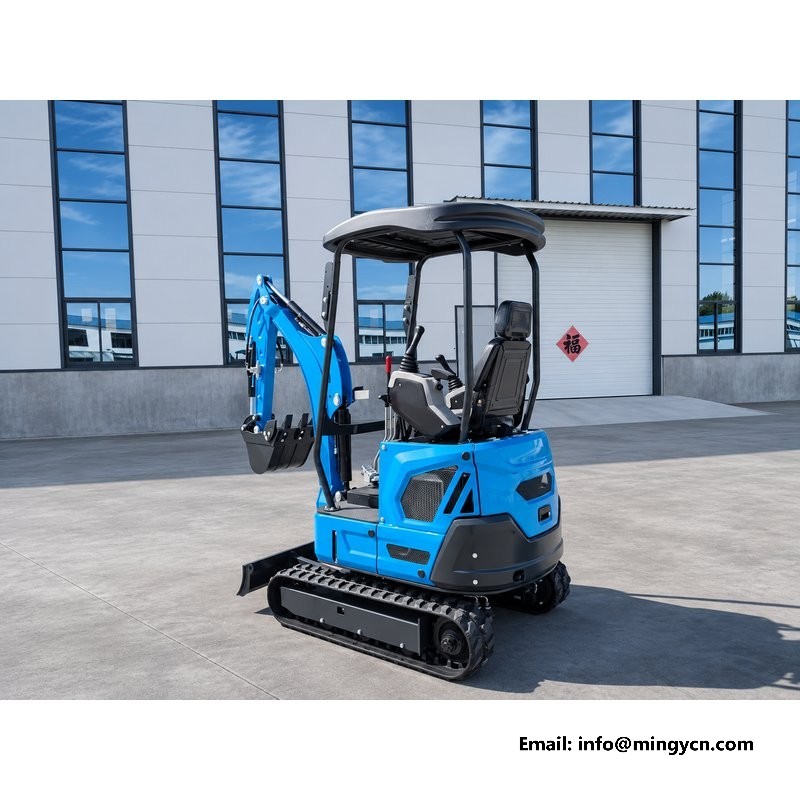
Factory yard photographs are taken quickly, but they still answer questions a specification table cannot. Start with the paint: it should be even on the boom, the canopy frame and the counterweight, with no sanding marks or thin patches at the panel edges. Then follow the hydraulic hoses from the control valve out to the boom, arm and blade cylinder. They should run in a consistent bundle, clipped at regular intervals, with no hose crossing a sharp edge or resting on a weld. Look at the joints where the boom foot meets the turret and where the blade arms meet the undercarriage frame. Finally, check that the rubber tracks sit square on the idlers and that the blade is level with the ground. Take your time over the undercarriage, because that is where a machine's history shows first.
| Model | MY20 |
| Operating weight | 1,260 kg |
| Overall dimensions (L x W x H) | 2,550 x 1,150 x 2,200 mm |
| Engine options | Kubota D722 / Laidong 385 / Kubota D902 |
| Rated power | 10.2 kW / 29 kW / 11.8 kW |
| Rated speed | 2,500 / 2,350 / 2,300 rpm |
| Max digging depth | 2,100 mm |
| Max digging height | 2,820 mm |
| Max dump height | 2,050 mm |
| Max digging radius | 3,050 mm |
| Min swing radius | 1,450 mm |
| Max digging distance | 2,300 mm |
| Dozer blade lift / drop | 180 mm / 210 mm |
| Hydraulic tank | 18 L |
| Fuel tank | 16 L |
| Rubber track size | 200 x 41 x 72 mm |
| Gradeability | 30 degrees |
| Travel speed | 2 km/h |
| Control type | Pilot (joystick) hydraulic |
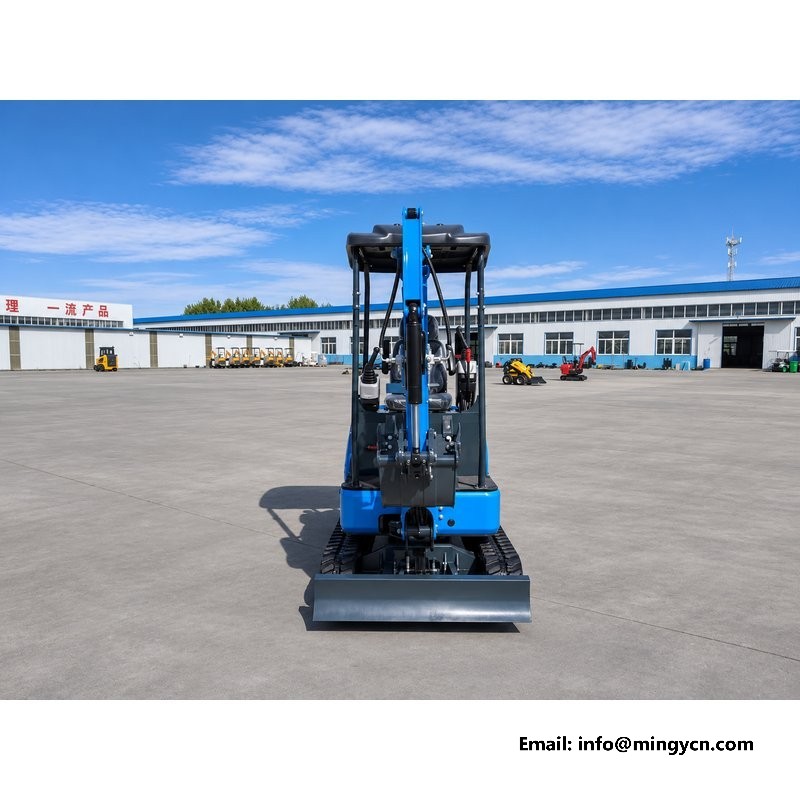
Pilot control means the levers do not pull rods; they send small pilot pressure signals that operate the main valve. In practice the layout is the familiar two-lever pattern. The left lever controls the arm and the upper structure swing, and the right lever controls the boom and the bucket. Travel is handled separately, by two levers or pedals at the front of the floor, one for each track, so the machine is steered by moving one track faster than the other. An operator coming from a three-lever machine needs a short adjustment period, mostly because the left hand no longer holds a swing lever while the right works the boom. Once the pattern is learned, both hands work independently and the bucket can be levelled while the house is swinging.
The advantage of pilot control is not a larger number on a sheet; it is the way the lever responds. Movement is proportional, so a small lever travel gives a slow, controlled bucket movement and a full stroke gives full flow. That range is what lets an operator trim a trench floor or shake soil from a bucket without stopping the function and starting again. Lever effort stays low through a long shift because the operator is moving a valve spool through pressure rather than fighting a stiff linkage. There is also less to wear: no bell cranks, no clevis pins and no rod ends under the floor to develop play. The trade is that pilot hoses and fittings must stay clean and leak-free, because a small air leak changes the feel at the lever long before it becomes a visible fault.
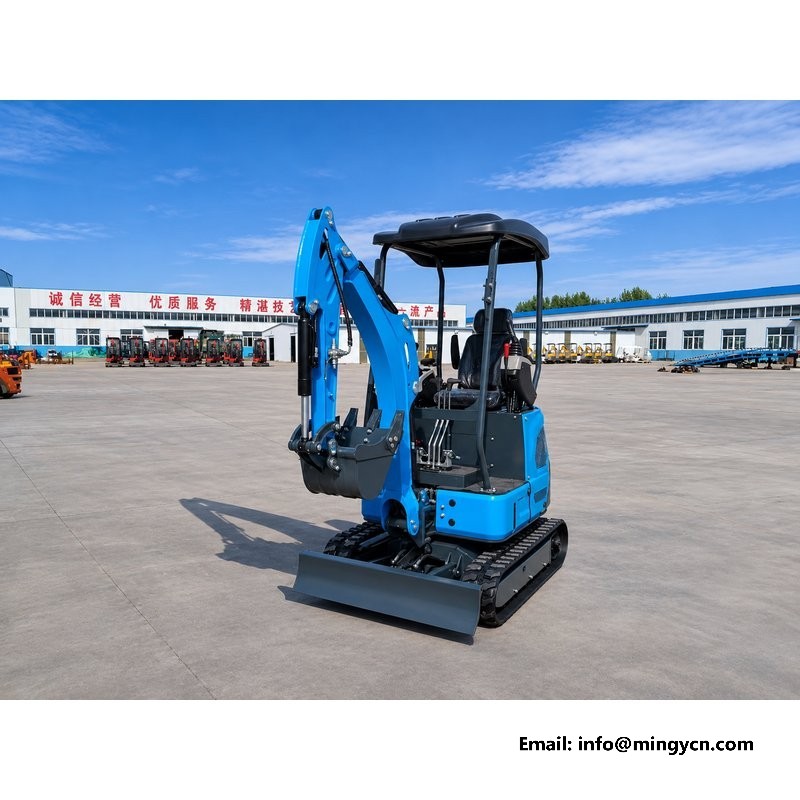
At 1,260 kg the MY20 sits in the bracket rental yards and landscapers ask for most often, because it is heavy enough to dig real trenches and light enough to move without a low-loader. A 1,150 mm body width lets it pass through a garden gate, work between fence posts and track along a finished path without breaking the edges. Farms use it for drainage, fence lines, feed aprons and building work where a backhoe is clumsy and a shovel is slow. On renovation sites it fits inside a building shell and can work under a first-floor slab. The limit is equally clear: this is not a machine for mass excavation or for lifting, and a buyer should match it to the trench metres and the access width, not to the largest job on the schedule. Most of the machines in this class never leave a single town.
The 200 x 41 x 72 mm rubber track is the reason the machine can cross paving, driveways and turf without leaving the marks a steel track makes. Rubber spreads load over the full shoe and rolls instead of scrubbing, so a contractor can track across a finished driveway and repair the damage with a rake rather than a paving crew. Gradeability is listed at 30 degrees, which covers most ramps into excavations, trailer loading banks and farm ditches; that figure assumes dry ground and a straight approach, and it falls quickly on wet clay or loose gravel. Travel speed is 2 km/h, a working speed rather than a road speed, so plan to move the machine on a trailer between sites instead of tracking it along a highway shoulder.
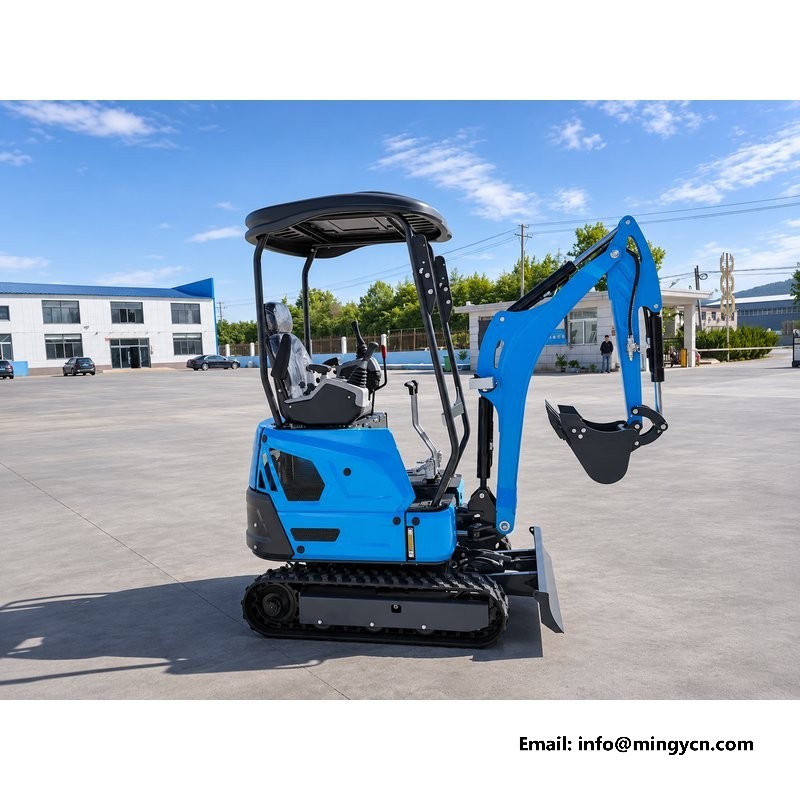
The front blade is often described as a stabiliser, which undersells it. It lifts 180 mm and drops 210 mm, enough to cut a shallow grade, push spoil back into a trench, strip turf ahead of a dig or clean a concrete slab after demolition. With the blade down and the machine facing the cut, it also adds a third contact point that steadies the chassis while the boom works at full reach. On backfill the usual sequence is to push the spoil in with the blade, track over it to compact, then trim with the bucket. The blade arms and cylinder are exposed, so a buyer should look at the pins and hose guards in the photographs, and should expect to grease the blade pivots on the same interval as the boom. It is also the first thing to wear on a machine that does a lot of backfill.
The working envelope is set by five numbers. Maximum digging depth is 2,100 mm, maximum digging height 2,820 mm, maximum dump height 2,050 mm, maximum digging radius 3,050 mm and maximum digging distance 2,300 mm. Read together, they describe a machine that can open a trench deeper than a person is tall, load a small tipper or a trailer side without a ramp, and reach across a ditch from a stable bank. Minimum swing radius is 1,450 mm, the figure that matters in a narrow street or a courtyard, because it sets how close a wall can be to the tail before the counterweight touches it. Ask for the drawing that shows these figures with the bucket fitted, since bucket type changes the working envelope. Those five figures are the ones to compare between models.
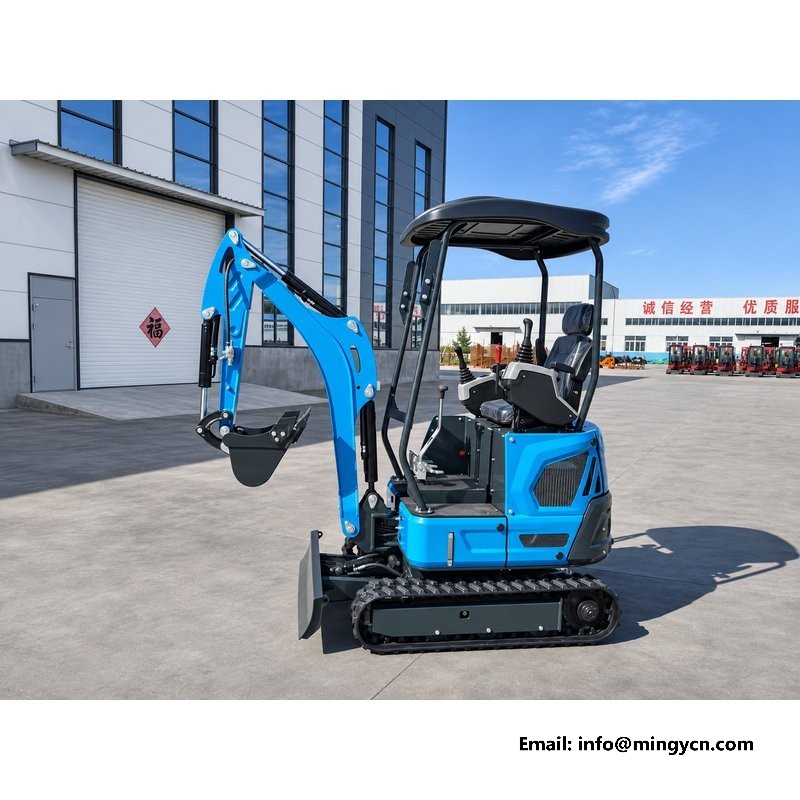
An arriving machine should be inspected before it is unloaded, while the container or trailer floor still gives a clean view of the underside. Work from the outside in. Check the paint on the counterweight corners, the boom top and the blade edge, since these surfaces touch first in transit. Look along every hose for chafe where it passes a bracket, and check the fittings for oil weeping rather than a dry film. Test the canopy bolts and the handrail fixings with a spanner, not by hand. Then look at the undercarriage: the rubber tracks should sit centred on the idlers, the rollers should turn freely, and the blade should be parallel to the frame. Photograph anything you intend to claim, with the serial plate in the same frame. Do the same check on both sides of the machine.
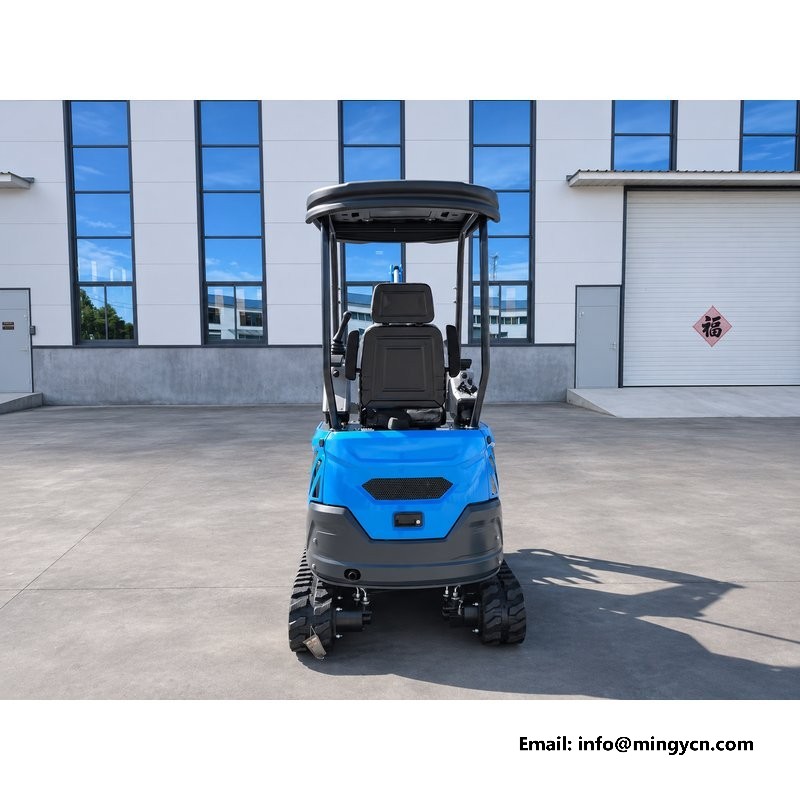
Rubber tracks settle in the first hours of work, so a tension check belongs in the handover rather than the first service. With the machine raised on the blade and a block, measure the sag on the longest unsupported run; the track should hang with a small, even gap, not a deep loop and not a drum-tight line. Over-tight tracks cost power and wear the idler bearings; loose tracks can climb off the sprocket in a turn. While the machine is up, take hold of each bucket pin and boom pin and try to rock it. A new machine should show almost no movement. Any pin that clicks or shows rust streaks at the joint is worth raising immediately, because a dry pin wears quickly and the repair becomes a bushing job.
At 2,550 mm long and 1,150 mm wide the MY20 fits a small flatbed or a plant trailer, but the securing method decides whether it arrives straight. Lower the blade and the boom first, so the centre of gravity is as low as the machine allows, and set the bucket flat on the deck. Use four chains or straps at the designated points on the undercarriage frame, not around the tracks and not over the hydraulic hoses. Cross the front pair and the rear pair so the machine cannot walk sideways under braking. Chock the tracks as a backup, fit the travel lock if one is provided, and check the load height against the trailer envelope. A machine that has moved on the deck usually shows it as a bent blade arm or a crushed hose. Photograph the loaded machine before the trailer leaves the yard.
The last page of a negotiation should list what is actually in the crate. Confirm the engine option by name, since the Kubota D722, Laidong 385 and Kubota D902 differ in mounting and service parts, and a mixed fleet needs the right filters on the shelf. Confirm the control pattern the factory sets, and whether travel is configured as levers or pedals. Ask for the hydraulic and fuel tank capacities on the invoice, 18 L and 16 L respectively, so the first service fill is correct. List the documents: operator manual, parts book, engine manual and hydraulic schematic. Finally, agree a spare parts starter kit; a track, a filter set, a pilot hose and a bucket pin set cover most of what a rental fleet needs in its first season.
At 1,260 kg, with a 2,550 mm body length and a 1,150 mm width, the machine fits a small flatbed or plant trailer. Confirm the trailer capacity with the machine fuelled and any bucket loaded separately. Lower the boom and the blade before securing, use four tie-down points on the undercarriage frame, and check total height against the route. A machine of this size is normally moved between sites, not tracked on the road.
The sheet lists three options: Kubota D722, Laidong 385 and Kubota D902. They differ in mounting, service parts and rated output, so the right choice usually follows the local service network and the customer's parts supply rather than the badge alone. Stock the engine your workshop can support, order the matching filter set with each unit, and confirm the engine by name on the order confirmation. A mixed fleet should keep the manual for each variant on the shelf.
Ordering and technical support
Email: sales@mingycn.com
LINE (ID): mingyicn
Tell us your working width, ground conditions and the attachment you need, and we will confirm the right configuration and shipping details.