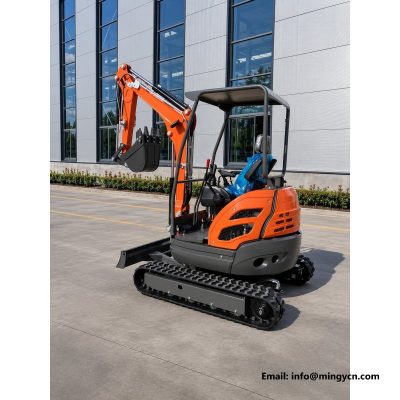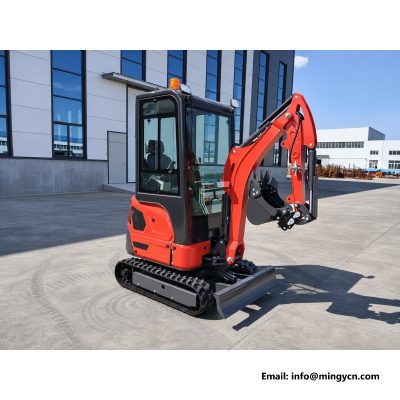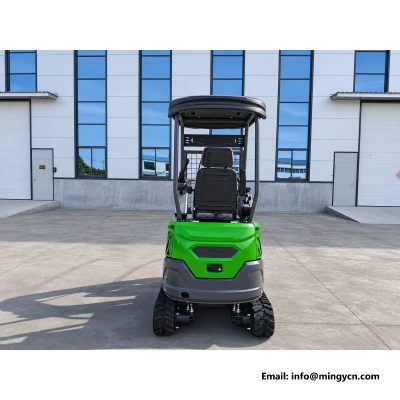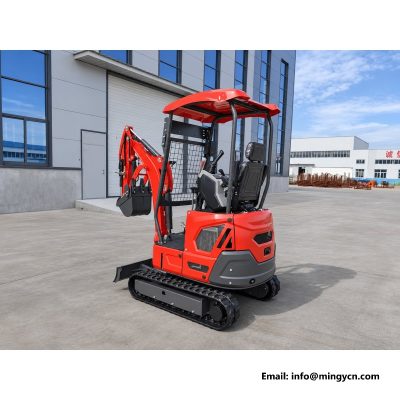
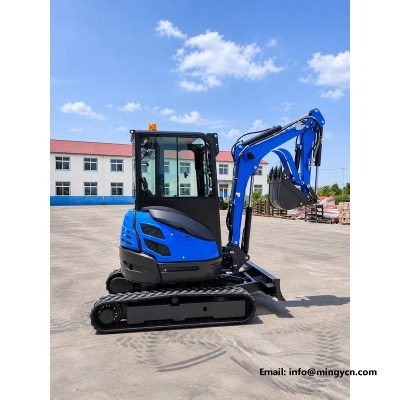
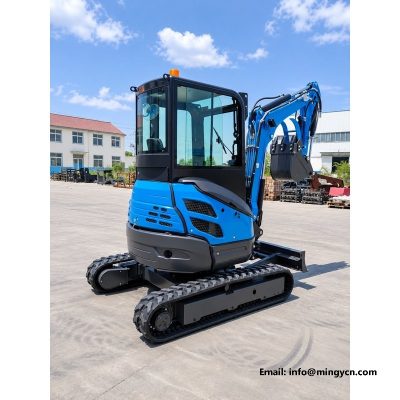
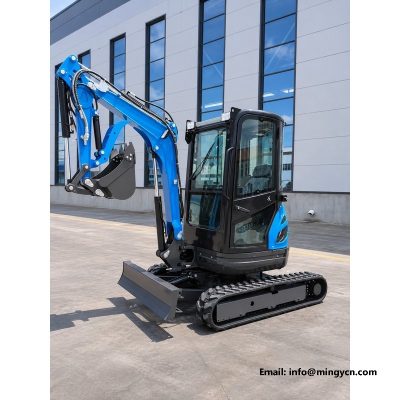
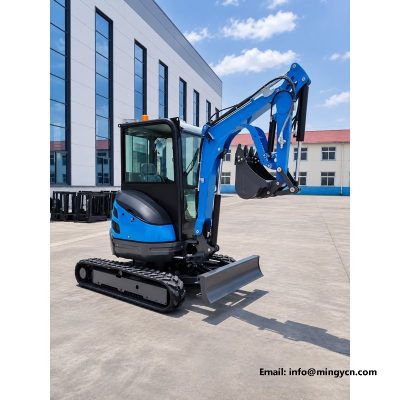
MY30 mini excavator with an enclosed cab and pilot controls for full-day operation.
The MY30 with an enclosed cab is the same machine described on the canopy page, with the operator moved indoors. The Kubota D1105, the 0.075 m3 bucket, the 2,660 mm digging depth and the two-speed travel are unchanged. What changes is the working environment, and what the buyer has to plan for. This page covers the enclosure itself: how pilot controls and seat position work together, what the operator can see, how glass and door hardware are maintained, how the cab affects transport, and when a cab is worth more than a canopy in bad weather. It also explains how to judge an enclosure from photographs before travelling to see one.
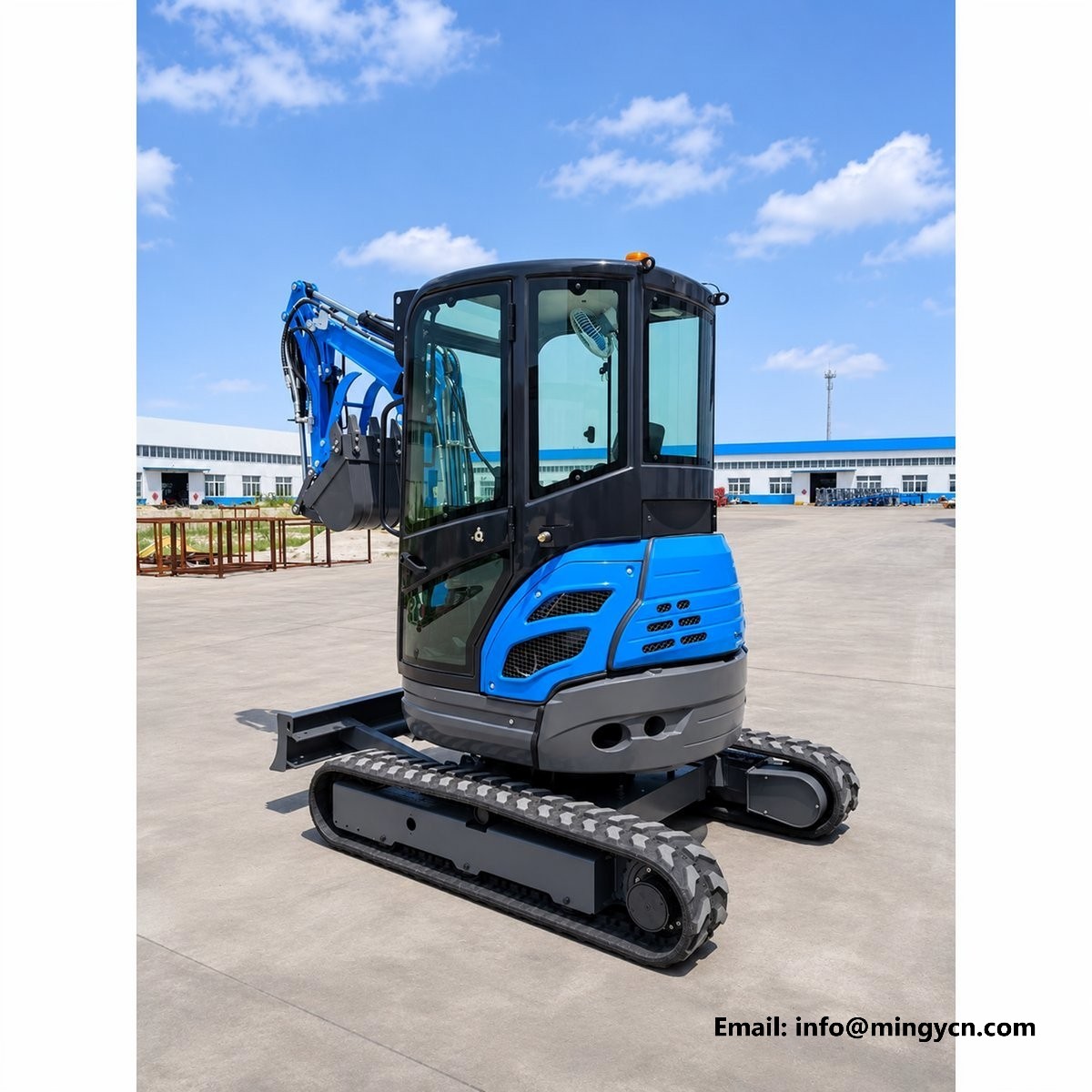
On a machine of this size the operator spends the whole shift in the seat, and the enclosure around that seat decides whether the shift ends in good condition. A canopy keeps the rain off the operator's head and nothing else. A cab closes the operator away from wind, dust, diesel haze and the noise of an engine sitting directly behind the backrest. That matters most in the seasons when work does not stop: a drainage job in late autumn, a yard clearance in February, a hire machine sent out in whatever weather the customer has booked. Rental companies notice it too. A machine an operator will accept at seven in the morning in the rain is a machine that earns, and the enclosure is usually the reason. It also keeps the seat, harness and switches out of the weather, where most long-term wear begins.
Pilot control means the joysticks send a hydraulic signal to the main valve instead of moving the spools through a mechanical linkage. The result is short, light lever travel with no lost motion and no rods to adjust as the machine ages. Inside a cab this matters more than on an open machine, because the operator's forearms rest on the armrests and the wrists do the work. The layout has to support that: joysticks placed so the forearms are carried, a console that does not force the elbows outward, and enough seat adjustment that a tall operator and a short one both reach the levers without stretching. When those three things line up, a level pass can be held for its full length without the corrections that come from fatigue. That is the difference between a machine run all day and one that tires its operator by lunch.
| Model | MY30 |
| Operating weight | 2,510 kg |
| Overall dimensions (L x W) | 3,850 x 2,280 mm |
| Engine | Kubota D1105, water-cooled in-line 3-cylinder diesel |
| Rated power / speed | 14 kW at 2,200 rpm |
| Bucket capacity | 0.075 m3 |
| Max digging depth | 2,660 mm |
| Bucket digging force | 22.8 kN |
| Swing speed | 9.5 rpm |
| Hydraulic system pressure | 22.5 MPa |
| Ground pressure | 32 kPa |
| Vertical lifting force | 800 kg |
| Horizontal pulling force | 520 kg |
| Rubber track width / length | 250 mm / 1,860 mm |
| Fuel tank | 28 L |
| Travel speed (low / high) | 2.6 / 4.5 km/h |
| Gradeability | 30 degrees |
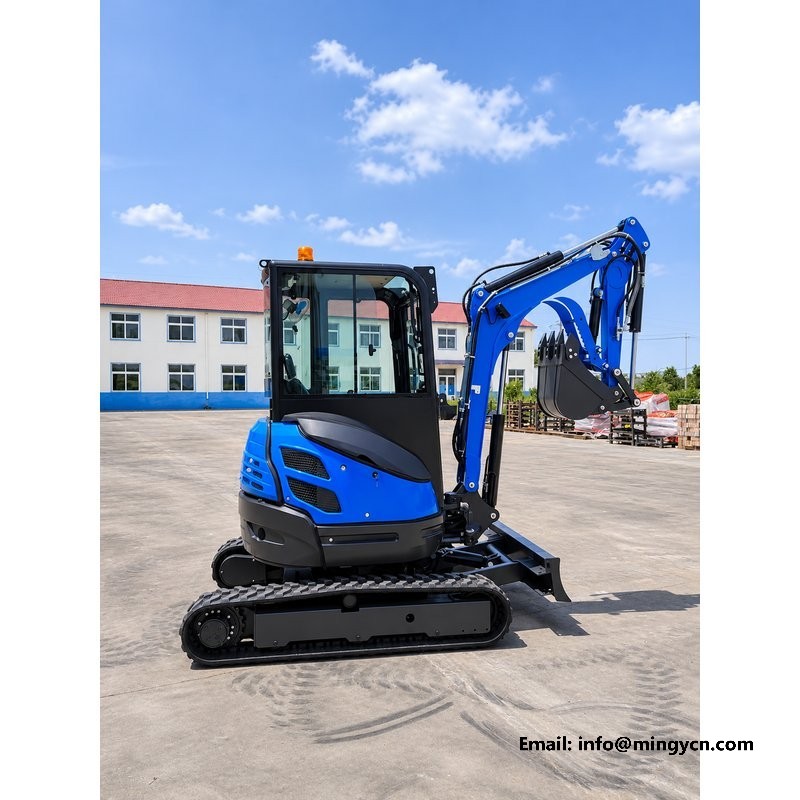
A cab is only useful if it does not blind the person inside. The critical views on a mini excavator are down the left side of the arm to the bucket teeth, the right-hand track edge when working against a wall, and the ground directly behind the machine before it tracks backwards. Large glass and a narrow pillar between windscreen and door help with the first two. The third is the one buyers forget. Check whether the rear of the cab has glass low enough to see the ground, whether a mirror is fitted on each side, and whether the operator has to twist out of the seat to look back. A machine with good forward glass and a blind rear quarter will eventually reverse into something. Mirrors help, but they are no substitute for a window the operator can actually use.
The parts of a cab that fail are rarely the structure. They are the fittings: the wiper motor, the washer jet, the door latch, the gas strut on the front window where one is fitted, and the rubber seals around the glass. These are cheap parts that stop a machine working when they fail in the rain. A buyer should look at how the door latches, whether it can be held open on a slope, and whether the hinges are protected from the dust that comes off the tracks. Seals should sit flat against the frame with no gaps at the corners. Ask what glass is used and whether replacements are cut locally or shipped, because a broken side window should not take a machine out of service for a month. Ask whether the door can be removed in summer, since some operators prefer to work that way on short hires.
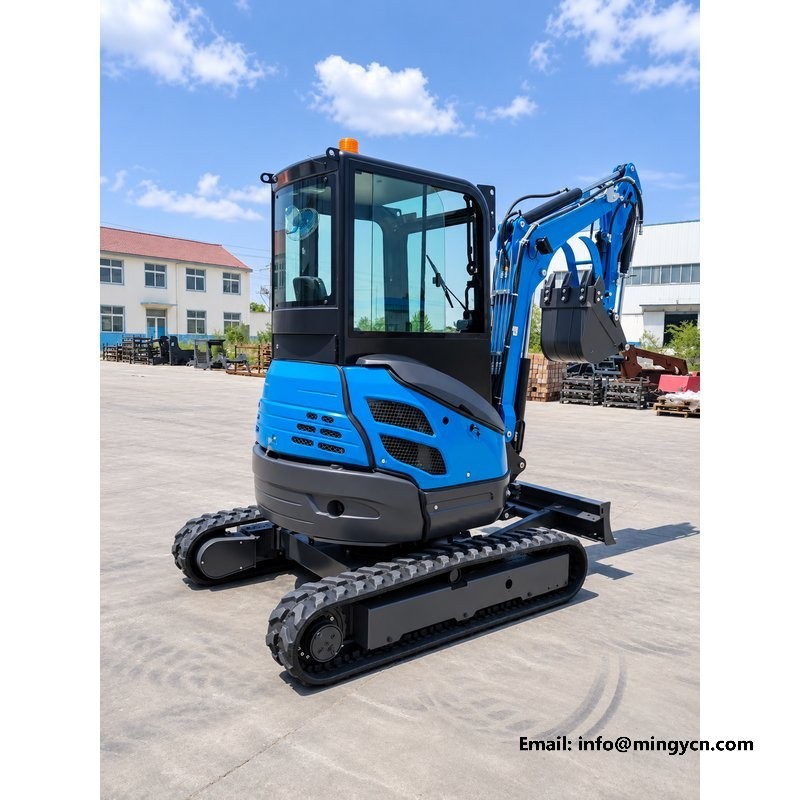
An enclosed cab raises the highest point of the machine, and that affects two things a buyer should settle before the unit is shipped. The first is the trailer or low-bed used for delivery: the machine has to pass under bridges, cables and the door of the workshop where it will live, and transport height is measured to the top of the cab, not to the top of the boom. The second is site access. Car parks with height barriers, basement ramps and covered passages between buildings all impose limits that a canopy machine clears easily and a cab machine may not. Ask for the transport height in writing, with the boom folded as it will travel, before booking the trailer. Measure the real machine, not the catalogue drawing, and include any beacon or aerial on the roof. A tape measure and one call to the transport company settle it faster than a brochure.
Heating and cooling are specified at the factory rather than added later, and the difference shows in how the system is integrated. A factory heater draws on engine coolant and uses a blower built into the cab structure, with ducts aimed at the windscreen and the operator's feet. Air conditioning adds a compressor, a condenser mounted where it can get airflow, and a second heat exchanger inside the cab. Both are far easier to specify with the machine than to retrofit, because the mounting points, wiring and belt drive are designed in from the start. In cold or humid markets the heater is close to essential. In hot climates the cooling matters more, and it also keeps the glass clear when humidity rises. Ask which compressor and refrigerant are used, because service support for those parts varies by market. A dealer who stocks filters but not compressors is a warning sign in a hot climate.
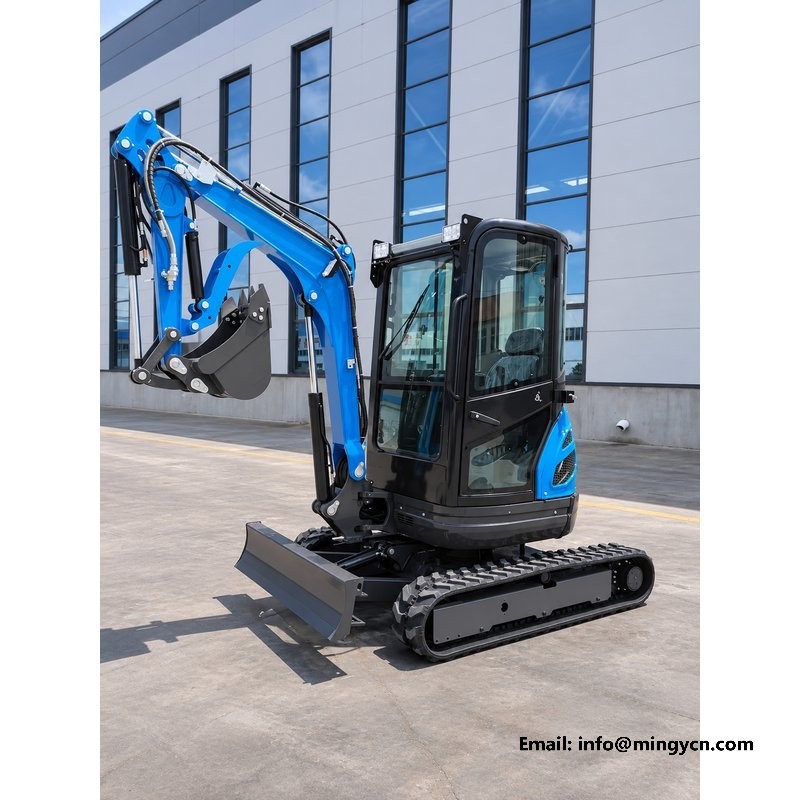
Fleets face a straightforward question: does the extra cost of a cab come back in utilisation? In a mild climate with short hire periods and customers who supply their own operator, a canopy machine is lighter, simpler and cheaper to repair, and it fits where a taller machine cannot go. In a market where machines are hired with an operator, or where the season brings rain, cold and dust, the cab tends to pay for itself because the machine stays bookable. The decision is rarely about the machine and usually about the customer. Look at what competitors send out, what rates the local market accepts, and how many weeks a year the unit would sit idle without an enclosure. Then compare the difference across the whole service life. Resale values in the same market usually settle the question faster than a spreadsheet.
Most mini excavators work close to people: a pavement repair outside a shop, a garden behind a house, a trench along a school fence. In those places the cab does more than protect the operator. It contains engine noise that would otherwise carry into neighbouring properties, and it keeps dust off the person who has to work beside a breaker or a cutting disc. The seals and the door fit make most of that difference, together with the lining behind the panels. A well-sealed cab also stays cleaner, which means the operator can still see through the glass at the end of a dusty day and the controls stay free of grit. For municipal and utility contractors, those points often appear in the tender. They also make the machine easier to hire to clients who care how their site looks. That matters on sites where the neighbours are close enough to complain.
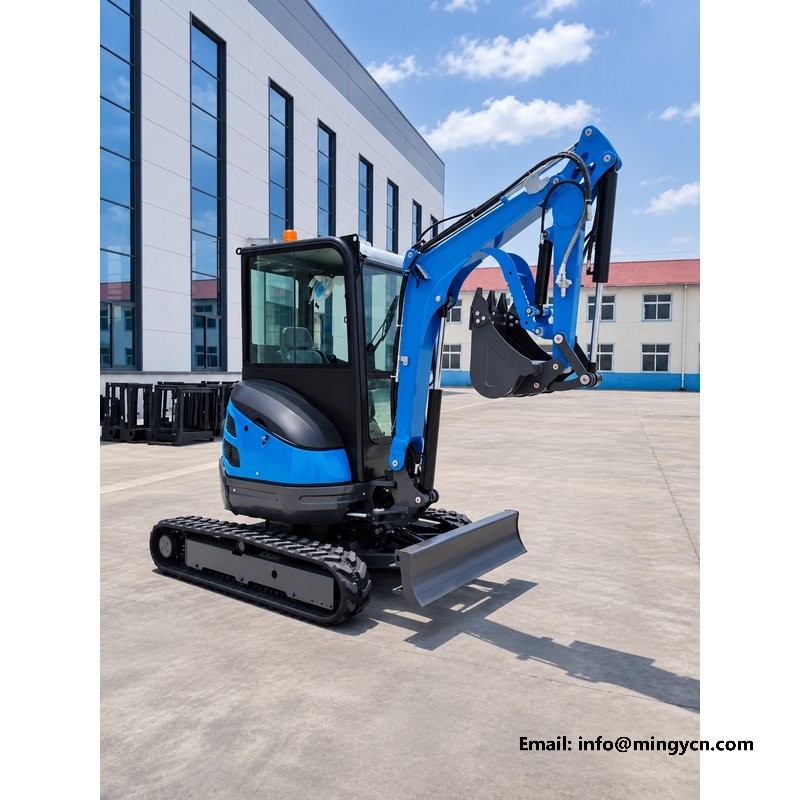
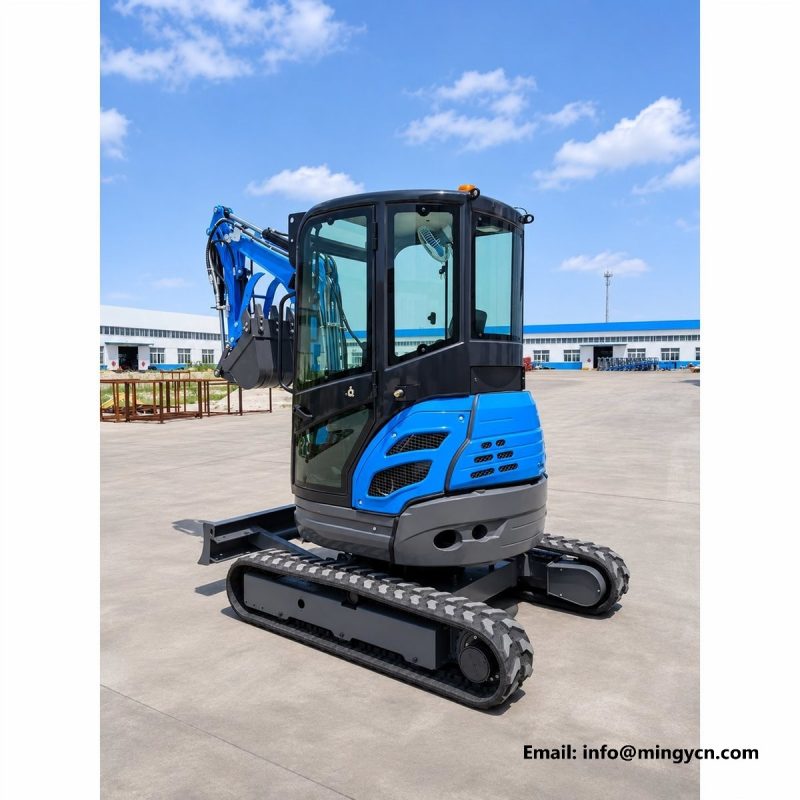
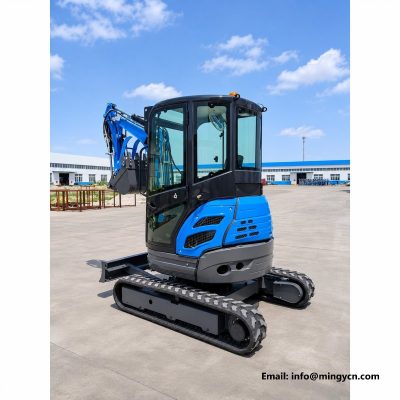
Five photographs taken around the machine answer most of the questions a buyer would otherwise send by email. The front three-quarter view shows pillar width, door opening and how far the glass wraps around the corner. The straight rear view shows the engine cover, the counterweight and whether the rear window is low enough to see the ground behind the tracks. The right side view reveals the step into the cab, the grab handle and the hose routing along the boom. The rear three-quarter and left side views complete the circuit and show the stance of the machine on level ground. Taken together, they let a buyer judge build quality without travelling to the factory. If a seller cannot supply this set of views, that is worth noting before a deposit is paid. Ask when the images were taken, too, since a set from two seasons ago proves little.
The seat is where the money is made or lost, and it deserves more attention than the paint. Check that the seat slides fore and aft and that the backrest adjusts, because a machine shared between two operators will be adjusted twice a day. Look at the pedals for the dozer blade and travel: they should fall under the foot without the operator lifting the heel. The console should be narrow enough to step past on the way to the door, and the armrests should carry the joysticks at a height that keeps the wrists straight. A simple test is to sit in the machine and reach every control without looking down. If that is uncomfortable on the first day, it will be unbearable by the end of the season. Ask whether the seat has a lap belt, because it is required in some markets and forgotten in others.
A cab machine has a longer handover list than a canopy one, and most of it concerns the enclosure. Open and close the door several times and check the latch and the catch. Run the wiper and the washer, and confirm the blade parks clear of the glass. Check every seal by looking for daylight at the corners. Test the heater blower at each speed, and the air conditioning if fitted, letting the system run long enough for the vents to warm or cool. Confirm that the mirrors are fitted and adjusted, and that the rear window opens and latches where it is designed to. Finally, inspect the glass for chips, record the hour meter and photograph the cab interior. Record any defect with a photograph, and agree in writing who fixes it before the unit is loaded. A cab that arrives with a misted window and a slack door leaves a poor first impression.
The enclosure adds structure and glass, so operating weight is not identical, but the machine keeps the same undercarriage, the Kubota D1105 rated at 14 kW, the 0.075 m3 bucket and the two-speed travel of 2.6 and 4.5 km/h. Digging performance is unchanged. The practical differences are transport height and access under height barriers, and buyers should confirm both figures in writing before booking a trailer.
Factory fit is the better route. Mounting points, wiring, belt drive and ducting are designed into the cab when the machine is built, so the system is integrated rather than hung on afterwards. A retrofitted unit can work, but it usually means a separate compressor bracket, non-standard hoses and wiring routed through the cab structure, which creates leak points and makes future service harder. If the climate demands heating or cooling, specify it with the order.
Ordering and technical support
Email: sales@mingycn.com
LINE (ID): mingyicn
Tell us your working width, ground conditions and the attachment you need, and we will confirm the right configuration and shipping details.