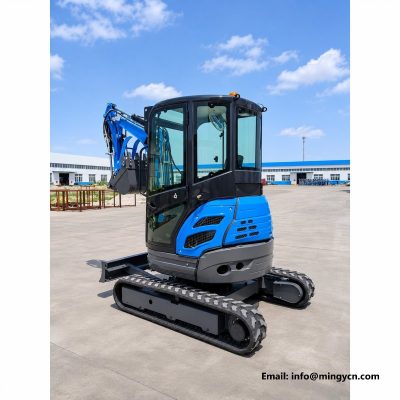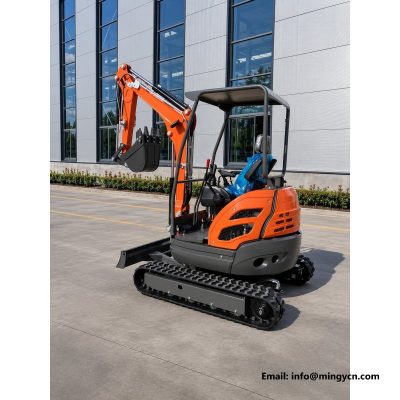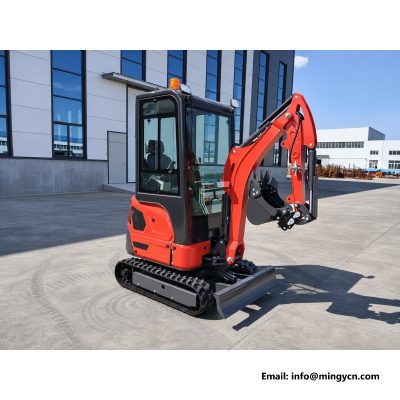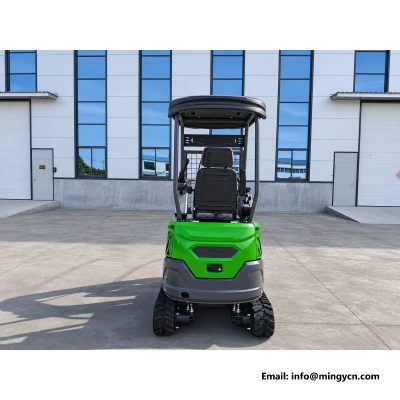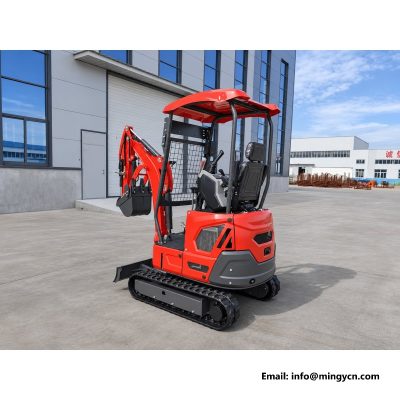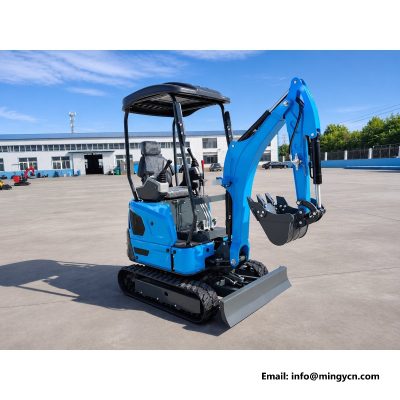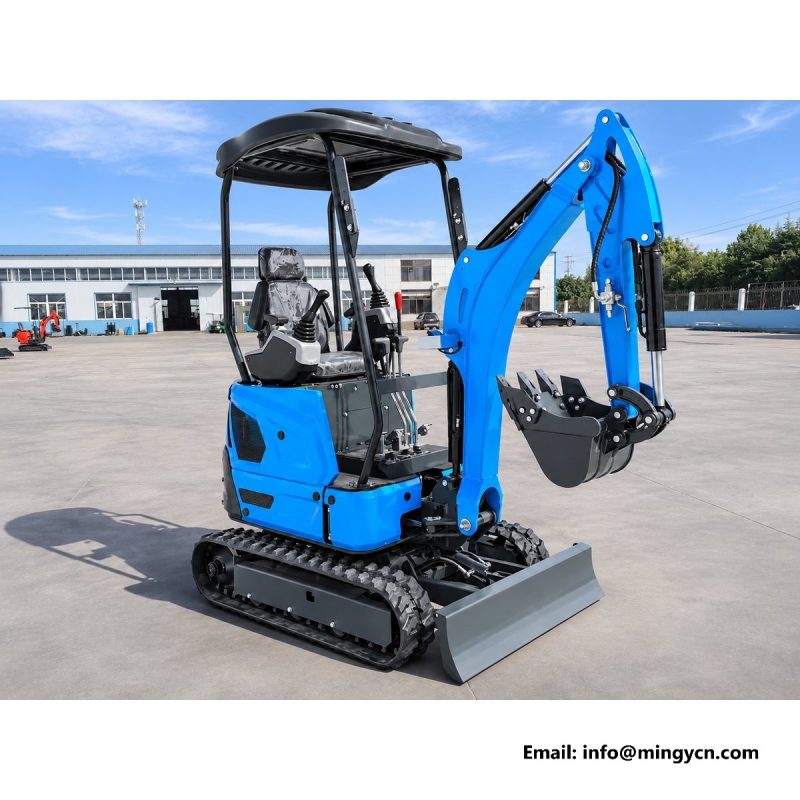
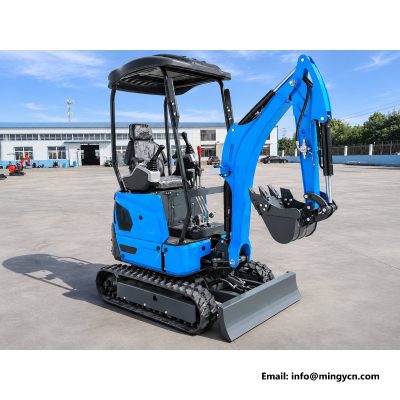
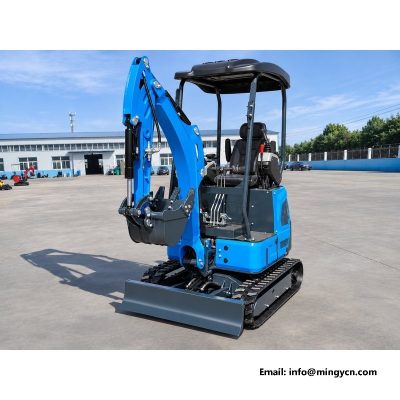
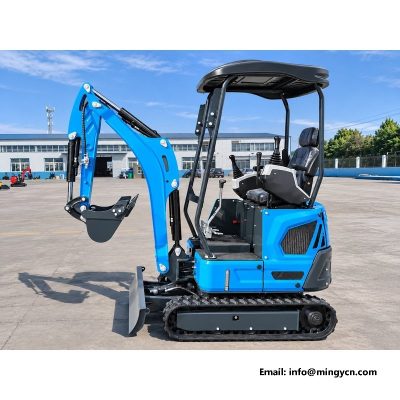
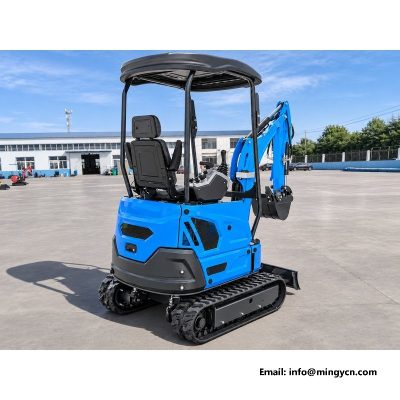
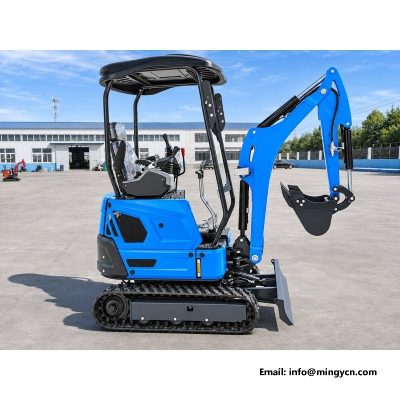
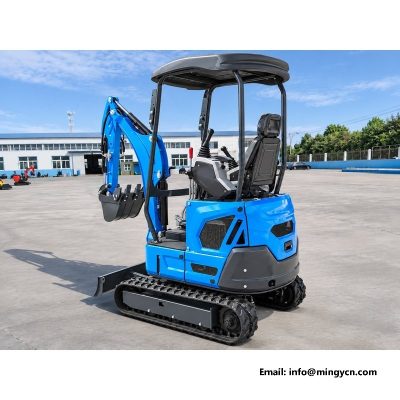
Studio photos of the MY20 mini excavator, useful for checking overall proportions before ordering.
These six photographs were taken on a white background for one purpose: to let a buyer judge the shape and the dimensions of the MY20 without the distractions of a working yard. The machine is the same 1,260 kg, 2,550 x 1,150 x 2,200 mm unit shown elsewhere on this site, photographed from a fixed distance at a fixed height so the views can be compared with each other. This page explains how to read those images, how to check the envelope against a trailer or a container, how to use the files in a quotation, and which angles are still missing when six views are all a supplier will send.
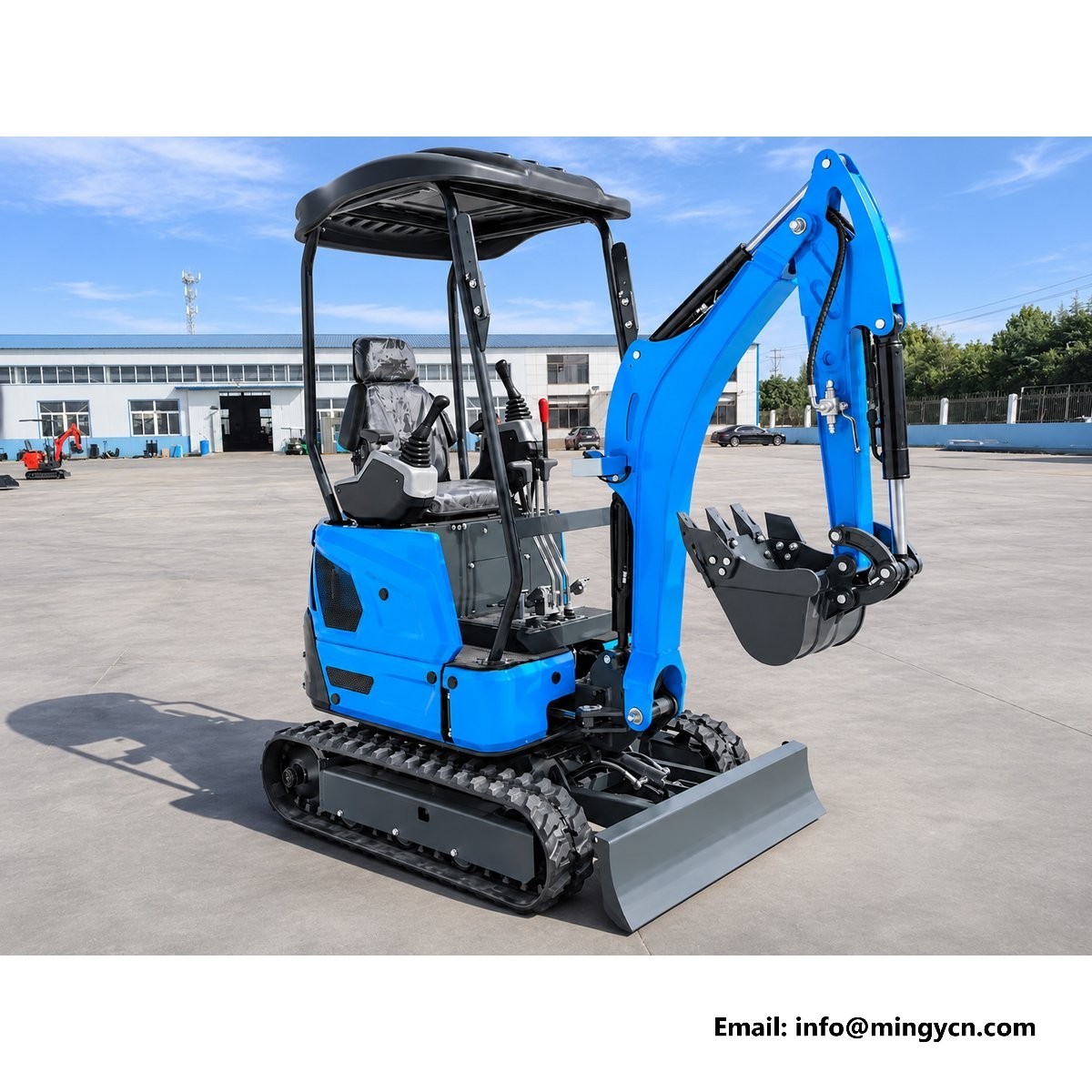
A studio photograph removes the two things that mislead a remote buyer: clutter and shadow. On a white sweep the machine appears as a clean silhouette, so the relationship between the boom, the canopy and the undercarriage can be judged without a background of stacked pallets, other machines and yard fencing. That matters when the buyer is a dealer several thousand kilometres away and the only inspection will happen after the container is opened. A white background also makes colour and finish comparable between production batches: a blue that has drifted toward purple, or a panel that has been repainted, shows up at once. The images on this page were taken as a reference set rather than a sales illustration, and they are most useful beside the yard photographs of the same model. Ask for the raw files, not screenshots of a web page.
The overall dimensions are given as 2,550 mm long, 1,150 mm wide and 2,200 mm high, and a studio side view lets a buyer check those figures against the machine rather than accepting them. Print the image, draw a horizontal line along the track base and a vertical at the counterweight, then measure the ratio of length to height. On a true side elevation taken square to the machine, that ratio should sit close to 2,550 against 2,200. If the photograph was shot with a wide lens from a low angle, the boom looks longer and the canopy shorter, and the ratio will not close. That is why a buyer should ask for the shooting distance and the lens, and compare two views taken from the same position. Two views from the same spot will agree with each other; one view on its own will not.
| Model | MY20 |
| Operating weight | 1,260 kg |
| Overall dimensions (L x W x H) | 2,550 x 1,150 x 2,200 mm |
| Engine options | Kubota D722 / Laidong 385 / Kubota D902 |
| Rated power | 10.2 kW / 29 kW / 11.8 kW |
| Rated speed | 2,500 / 2,350 / 2,300 rpm |
| Max digging depth | 2,100 mm |
| Max digging height | 2,820 mm |
| Max dump height | 2,050 mm |
| Max digging radius | 3,050 mm |
| Min swing radius | 1,450 mm |
| Max digging distance | 2,300 mm |
| Dozer blade lift / drop | 180 mm / 210 mm |
| Hydraulic tank | 18 L |
| Fuel tank | 16 L |
| Rubber track size | 200 x 41 x 72 mm |
| Gradeability | 30 degrees |
| Travel speed | 2 km/h |
| Control type | Pilot (joystick) hydraulic |
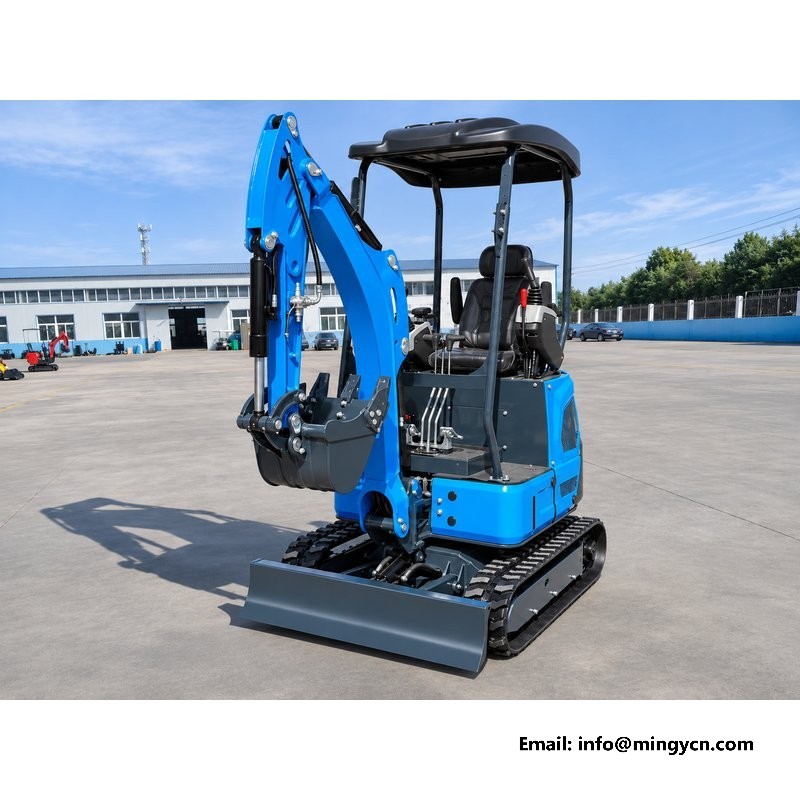
Proportions do work that numbers cannot. A buyer can see whether the canopy sits over the operator's feet or behind them, whether the blade arms are long enough to keep the blade clear of the tracks in a turn, and whether the boom pivot is set forward enough to leave foot room on the deck. On a 1,260 kg machine these proportions decide how the machine feels in a trench: a boom foot set well back and a long arm give reach but cost stability, while the opposite gives a stiff, safe machine with a smaller envelope. Because the studio set is shot from the same distance at the same height, the six views compare with each other without correcting for perspective, which is what a dealer needs when explaining a model to a customer who will never visit the factory.
The two kinds of image answer different questions and neither replaces the other. A studio view proves shape, proportion and completeness: that the machine has its guards, its decals, its blade and its canopy, and that nothing was left off for the photograph. A site photograph proves condition and detail: paint thickness at an edge, the way a hose is clipped, whether welds have been dressed, whether the undercarriage has been used. A supplier who will only show studio images is hiding the workshop; one who will only show yard snapshots is hiding the finish. Ask for both from the same production batch, and compare the serial plate in each set. Where the two disagree, the yard photograph is usually the more honest document. Keep the two sets in separate folders so a quotation never picks up a workshop shot by mistake.
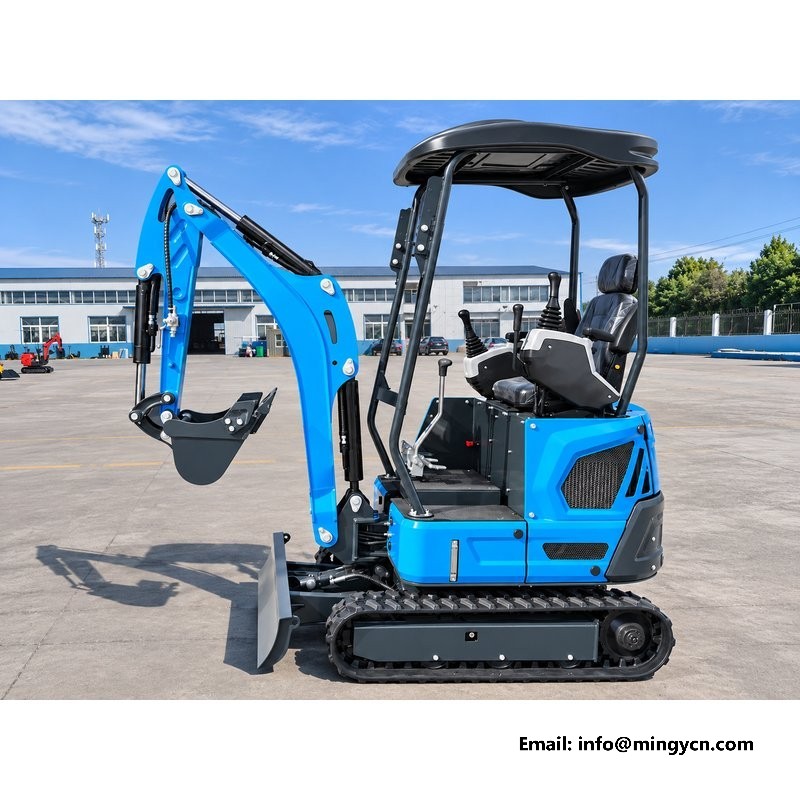
Dealers rarely have their own photographer, so a clean set of cut-outs is a practical asset. On a white background the machine can be dropped into a quotation template, a one-page specification sheet or a trade-show panel without masking, and the same file will print acceptably at A4 and at poster size if the resolution is high enough. Keep the set consistent: same angle, same lighting, same colour balance, so a catalogue showing three models looks like one range rather than three suppliers. Ask the factory for the files at full resolution with the background already removed, and confirm in writing that the images may be used in your own marketing. Written permission costs nothing at the ordering stage and prevents an argument later. A consistent set also saves money, because one shoot covers the range instead of one shoot per model.
A six-view set is only useful if the six views are the right ones. Start with a true side elevation from the track line, because that is the view used for dimension checks and for comparing boom geometry between models. Add a front view with the blade down, a rear view showing the counterweight and the engine access, and a three-quarter front view that shows the canopy, the boom foot and the hose run in one frame. A view from the operator's side with the door or canopy opening visible answers questions about access, and a low rear three-quarter view shows the undercarriage, the final drives and the blade linkage. If a set has four near-identical three-quarter shots and no side elevation, it was taken for advertising, not inspection. Ask the supplier to label each file with the angle, so the set can be checked off.
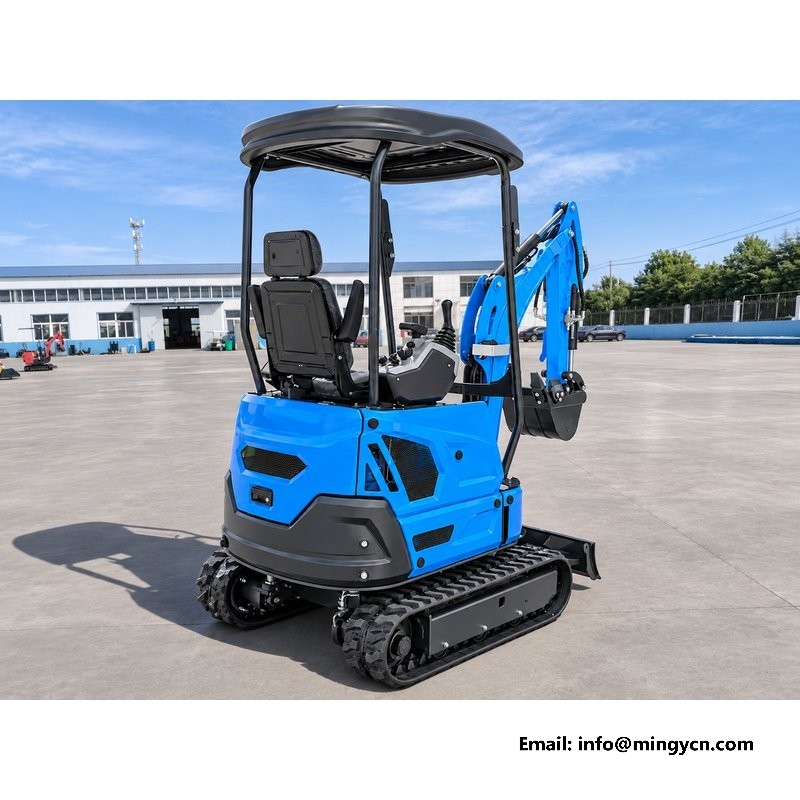
Studio images are only comparable if the conditions are stated. These were shot on a white sweep with the machine parked on its own tracks, camera at roughly mid-body height, at a distance long enough to keep the perspective close to a true elevation. Lighting was set to show panel edges without blowing out the highlights, which is why the boom and the counterweight still read as separate volumes rather than one blue shape. No wide-angle lens was used, so the tracks do not curve away at the ends. Colour was balanced against a neutral reference, so the blue in the file is the paint colour and not the lighting. A supplier who can describe these conditions understands why the images are being used. Ask for the date of the shoot as well; a three-year-old studio set describes a machine that may no longer be built.
Six views cover the outside of the machine but leave the working details unseen. Ask for a low shot looking up at the undercarriage, showing the track frame, the rollers and the blade pivot. Ask for a view into the engine compartment with the cover open, so the engine mounting, the battery position and the filter access can be judged. Ask for a close view of the control valve and the pilot hose manifold under the floor plate, and one of the boom foot pins with the boom raised. Finally, ask for a photograph of the machine with the bucket curled and the arm fully extended, because that is the position in which hose length and guard clearance are actually tested on site. Those six extra frames answer most of the questions that a specification sheet leaves open.
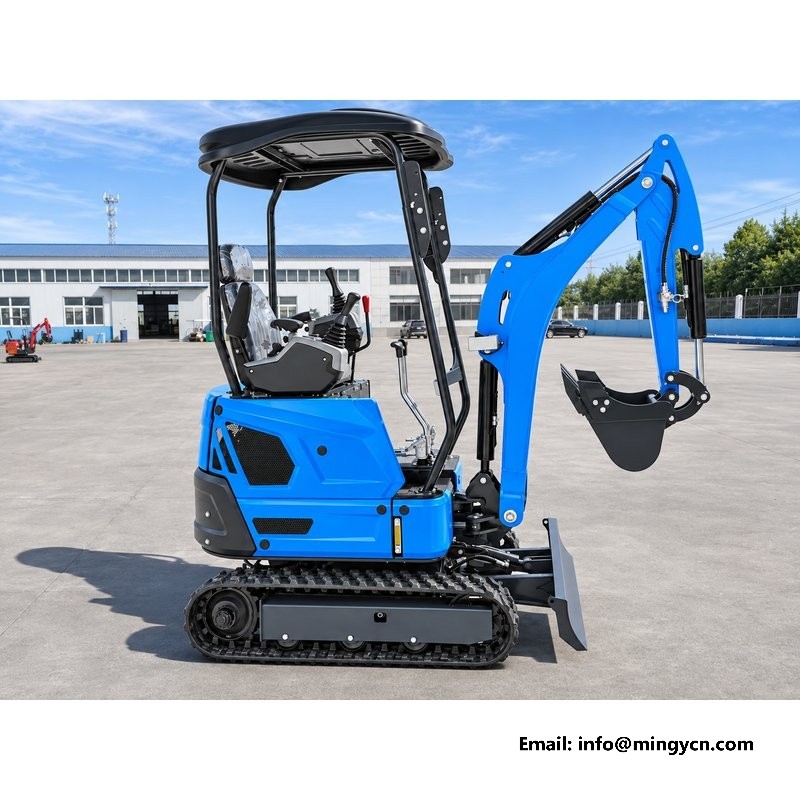
A studio image is a second opinion on the specification sheet, and the two should agree line for line. The sheet gives 1,260 kg, 2,550 x 1,150 x 2,200 mm, a 200 x 41 x 72 mm rubber track, 2,100 mm digging depth, and a blade that lifts 180 mm and drops 210 mm. In the side view, the track should look narrow relative to the body, the blade should sit low and forward of the track line, and the canopy should end above the operator's head rather than behind the seat. If the image shows a wider track or a different blade linkage from the sheet, stop and ask which configuration was photographed. Mixing images from two builds is the most common way a buyer ends up comparing the wrong machine.
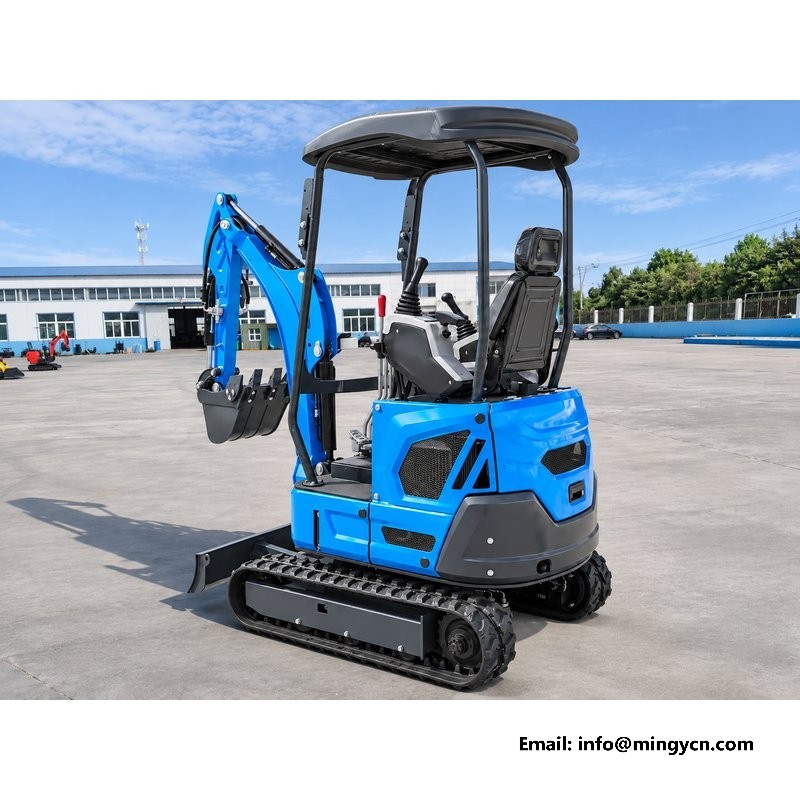
A white background hides more than it shows, and a buyer should know the limits. It cannot tell you whether the paint is thick enough at the edges, whether a weld has been ground smooth to look better, whether a hose is chafing behind the boom, or whether the hydraulic system weeps at a fitting after an hour of work. It cannot show track tension under load, pin play, or the sound of the engine. Those questions need a yard photograph, a video of the machine working, and ideally a third-party inspection before shipment. Treat the studio set as a map and the site evidence as the ground: the map is useful, but nobody should buy a machine on the map alone. The same applies to paint: a studio image can show a colour, never a thickness.
No. A white background image confirms shape, completeness and proportion, but it cannot show paint thickness, weld quality, hose chafe or a hydraulic weep that appears only when the machine is warm. Use the studio set to check the machine against the specification sheet, then ask for yard photographs, a short video of the machine working, and an inspection report before the container is sealed. The images are a map of the machine, not evidence of its condition.
Yes, with written permission from the manufacturer, and that permission should be requested when the order is placed rather than after the catalogue is printed. Ask for full-resolution files with the background already removed, and keep the set consistent across models so a range page looks like one supplier. Do not alter the machine in the image or remove decals, because a customer who receives a machine that differs from the catalogue will treat it as a misdescription.
Ordering and technical support
Email: sales@mingycn.com
LINE (ID): mingyicn
Tell us your working width, ground conditions and the attachment you need, and we will confirm the right configuration and shipping details.