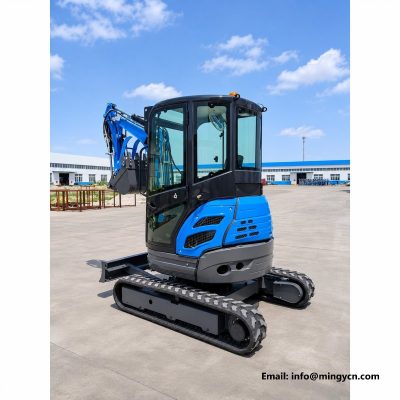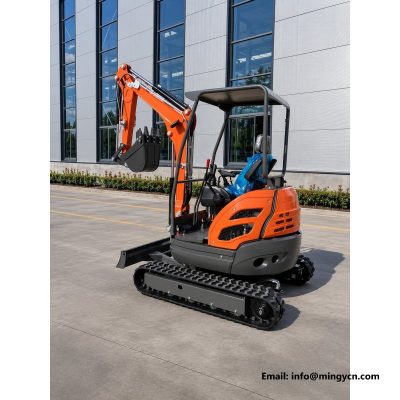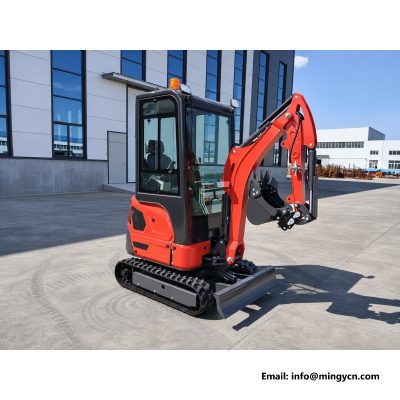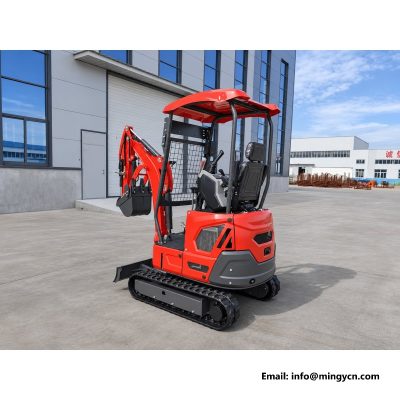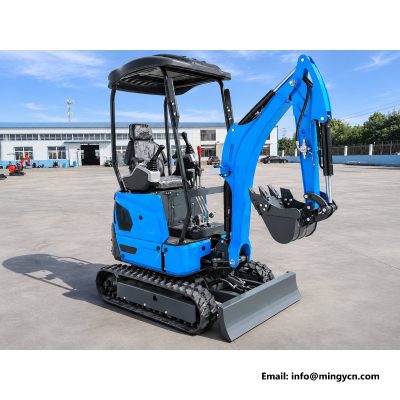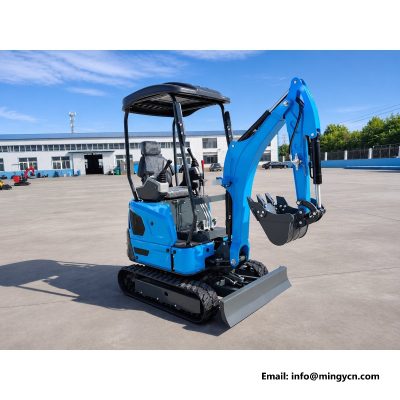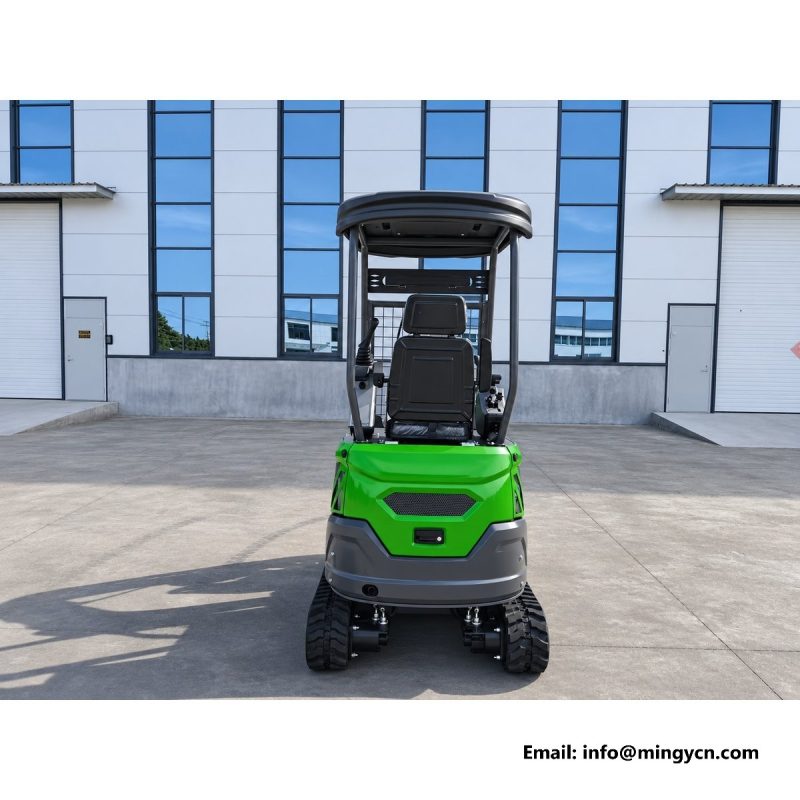
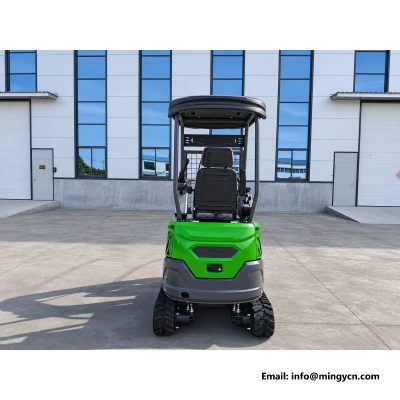
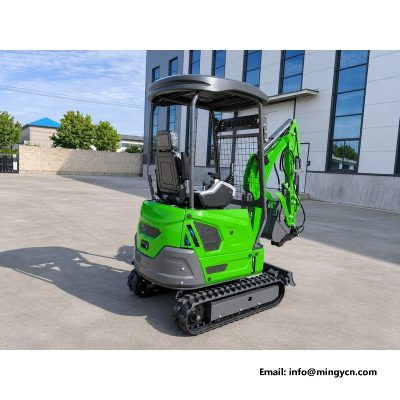
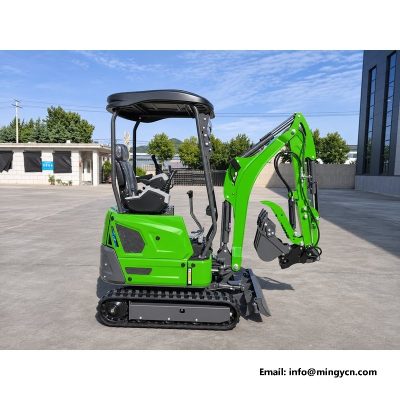
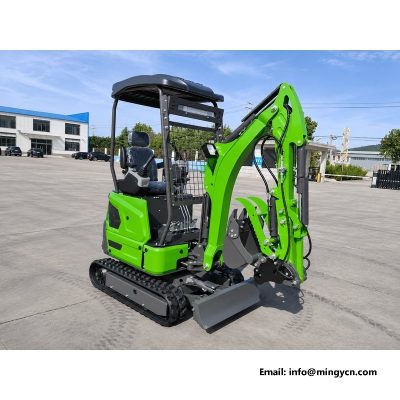
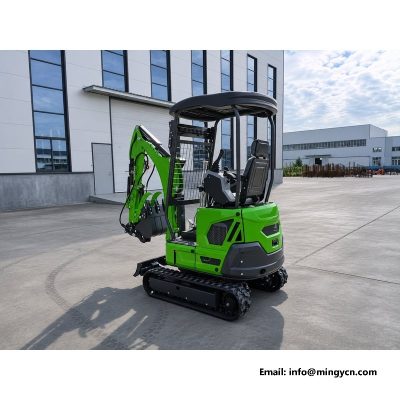
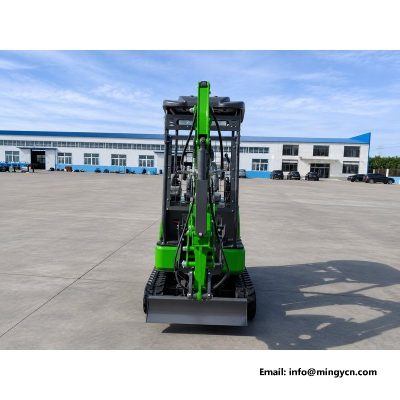
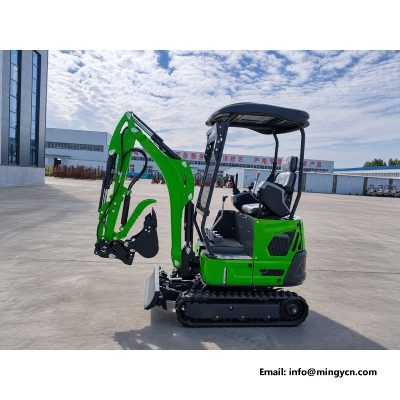
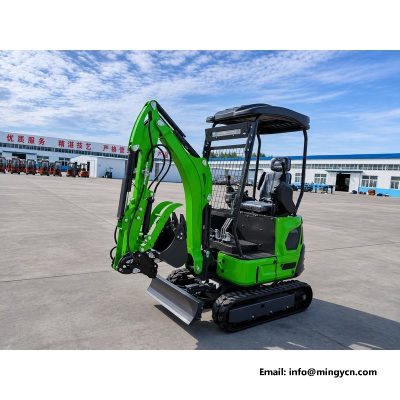
Long arm and guard rails fitted to the MY20 for ditch, dredging and orchard work.
This machine is the MY20 carrier fitted with a long arm and a set of guard rails, finished in green and photographed in the factory yard. The standard model reaches 2,100 mm below grade; the long arm version is built for buyers who need more working radius without moving up to a heavier class of machine. Extra reach is never free, and this page is written around that trade: what the arm adds to a ditch, a pond or an orchard row, what it takes away in stability and lifting capacity, and how to grease, inspect and transport a machine whose pins carry more load than the standard build.
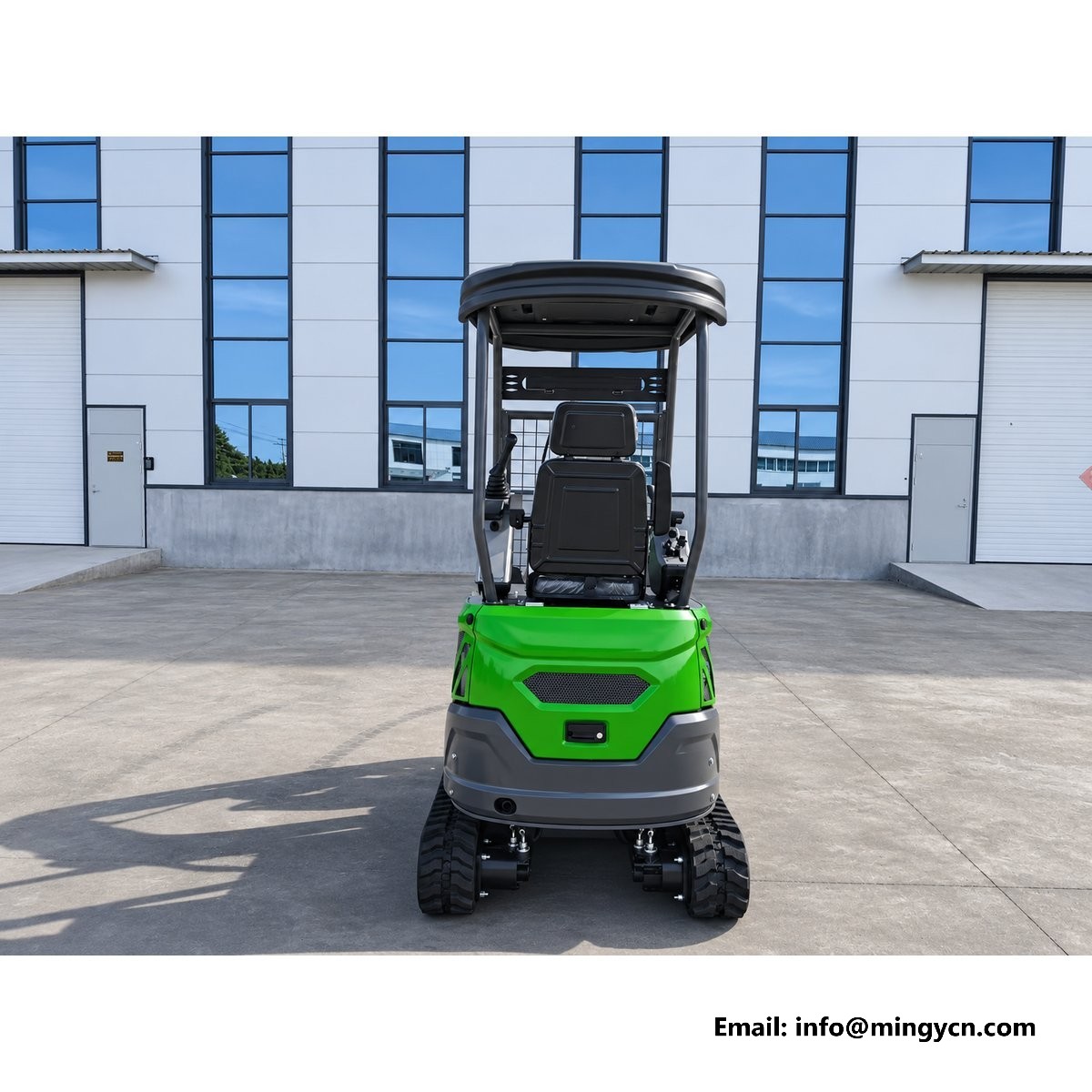
The standard MY20 reaches 2,100 mm below grade, and the long arm version on this page is built for buyers who need that working envelope extended without moving to a larger, heavier carrier. A longer arm changes the geometry of the whole machine: the bucket travels further from the house, the boom carries more weight further out, and the operator gains reach at the cost of lifting capacity at the same radius. The change is not a bolt-on. The arm, the bucket linkage and the hydraulic plumbing are matched as a set, and the stability of the machine has to be considered with the arm fully extended. This page explains what the extra reach buys, where it costs, and how to work the machine without abusing it. The yard photographs on this page show how much machine sits ahead of the tracks.
The specification table lists 2,100 mm maximum digging depth, 2,820 mm maximum digging height, 2,050 mm dump height, 3,050 mm digging radius and 2,300 mm digging distance. Those figures describe the configuration on the sheet, and a long arm machine should be quoted with its own drawing rather than with the standard numbers carried over. The practical effect of a longer arm is a wider arc: the bucket can reach further across a ditch, load a trailer from the bank instead of the bottom, and trim a slope the standard machine would have to track along. The buyer's job is to ask for depth, radius and dump height with the long arm fitted, in writing, and with the bucket that will actually be supplied. A drawing is the only document that settles the argument later.
| Model | MY20 |
| Operating weight | 1,260 kg |
| Overall dimensions (L x W x H) | 2,550 x 1,150 x 2,200 mm |
| Engine options | Kubota D722 / Laidong 385 / Kubota D902 |
| Rated power | 10.2 kW / 29 kW / 11.8 kW |
| Rated speed | 2,500 / 2,350 / 2,300 rpm |
| Max digging depth | 2,100 mm |
| Max digging height | 2,820 mm |
| Max dump height | 2,050 mm |
| Max digging radius | 3,050 mm |
| Min swing radius | 1,450 mm |
| Max digging distance | 2,300 mm |
| Dozer blade lift / drop | 180 mm / 210 mm |
| Hydraulic tank | 18 L |
| Fuel tank | 16 L |
| Rubber track size | 200 x 41 x 72 mm |
| Gradeability | 30 degrees |
| Travel speed | 2 km/h |
| Control type | Pilot (joystick) hydraulic |
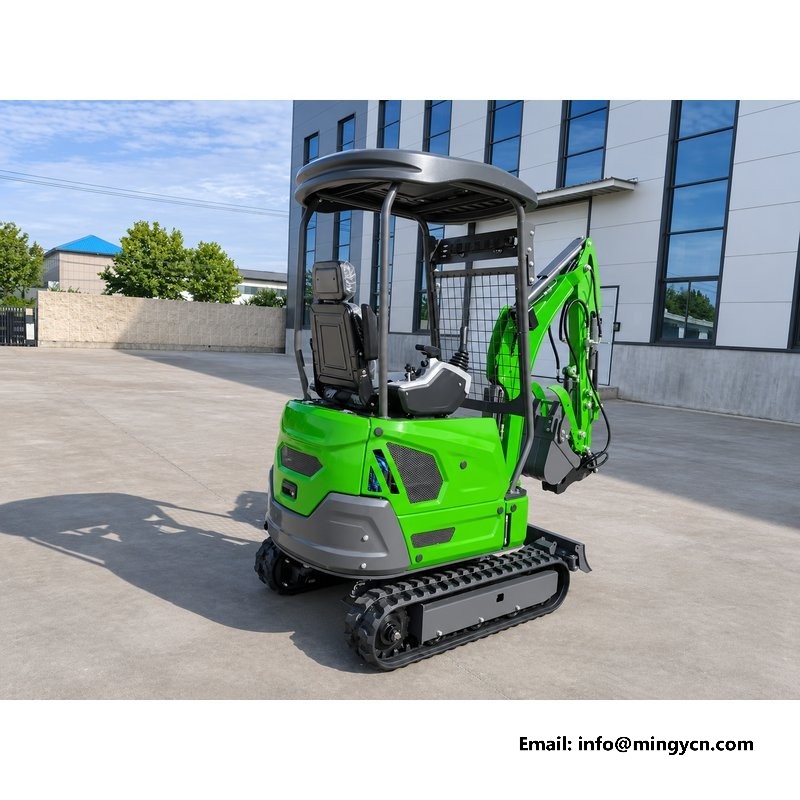
Every millimetre of extra reach moves the centre of gravity of the loaded machine further from the tracks. With the arm extended and the bucket full, the load on the front idlers rises and the machine becomes more likely to tip forward, particularly on soft ground or with the blade raised. The answer is not a larger counterweight alone; it is a working method. Keep the blade down and facing the cut when reaching far, track so the load is over the front of the undercarriage rather than the side, and keep the bucket close to the ground when swinging. With a minimum swing radius of 1,450 mm the tail still clears a wall, but the operator must allow for the longer front end when judging clearance. The blade is the cheapest counterweight on the machine, and it is already fitted.
The guard rails on this machine are mounted around the canopy and along the boom side, and their job is to take the first contact from branches, debris and the edge of a trench. They protect the operator's space and the glass area from impact, and they give the machine a frame that can be straightened after a knock rather than a panel that has to be replaced. They do not protect the hydraulic hoses that run along the boom, and they do not stop a falling object. A buyer should look at how the rails are fixed: a rail bolted to the canopy frame through a plate is repairable, while a rail welded to thin sheet will tear the sheet on the first hard contact. Ask for the rail diameter and the wall thickness, not just the mesh pattern.
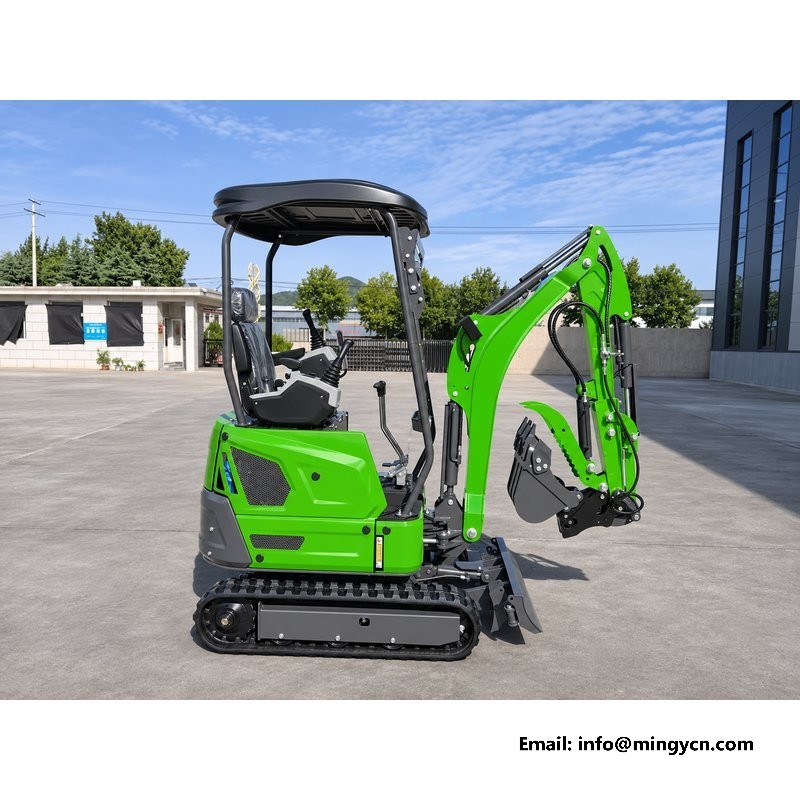
The most natural use of a long arm machine is a ditch wider than the machine can straddle. Standing on one bank, the operator can cut the far slope, clean the bottom and place the spoil behind the machine without tracking into the water. On farm drainage this means a drain can be cleaned from the headland instead of from the wet ground, which is where a standard machine gets stuck. The same reach helps on road works, where the machine can work from the shoulder and keep the carriageway open. The limit is the bank itself: a long arm lets you reach further, but it does not make soft ground stronger, so matting or a blade-down stance stays part of the method. Keep the spoil heap far enough back that the machine is not climbing it at the end of the day.
Cleaning a pond or a canal is a reach job before it is a digging job. The machine has to stand on ground that will carry 1,260 kg, reach over the bank, and pull silt back without the bucket dropping below the wall. The long arm gives the operator the extra distance to work the far side of a narrow channel and to load a trailer parked on the bank. Where the bank is soft, the blade is set down as an anchor and the machine works over the front idlers. Silt is heavy and it sticks in the bucket, so work in short pulls and shake out over the spoil heap rather than carrying a full bucket at full reach. Work from the bank, never from the water, and keep a second person watching the edge.
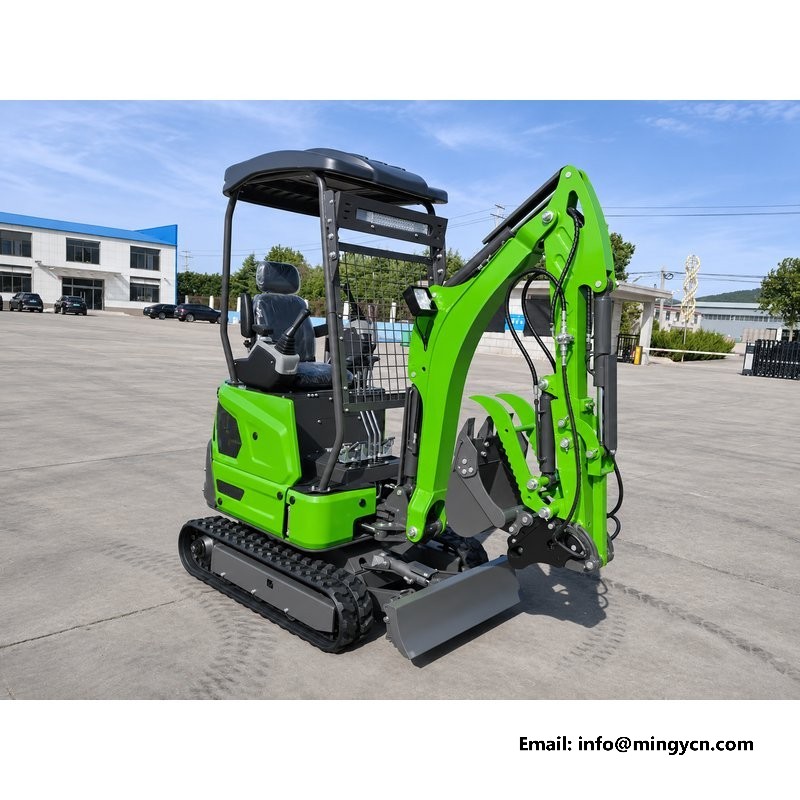
Orchard work rewards a narrow machine with reach. At 1,150 mm wide the MY20 passes between rows and along headlands, and the long arm lets the operator clean a drainage channel or lift a root ball without tracking into the next row. The guard rails matter here too, because branches at head height are the normal condition rather than an accident. The working method is to keep the boom low and the arm tucked while moving along a row, then extend only when the machine is stationary and the blade is down. A long arm swung at head height through an orchard is the fastest way to break a rail or a lamp, and the repair costs more than the time saved. Pruning before digging saves more time than any attachment, because the arm has somewhere to go.
Reach is useful for loading, but it changes the rules. A bucket at full radius carries less than the same bucket tucked in, and the machine's capacity does not increase because the arm is longer. On a tipper or a trailer, position the machine so the load is placed at mid-body rather than at arm's length, and never swing a loaded bucket over the cab of a truck or over a person. When stockpiling, work from the base of the heap outward so the machine is never reaching up a slope with a full bucket. The blade stays down as a stabiliser, and the tracks stay square to the load rather than at an angle. A load chart drawn for the standard arm does not apply to this machine, and the operator should be told so before the first shift.
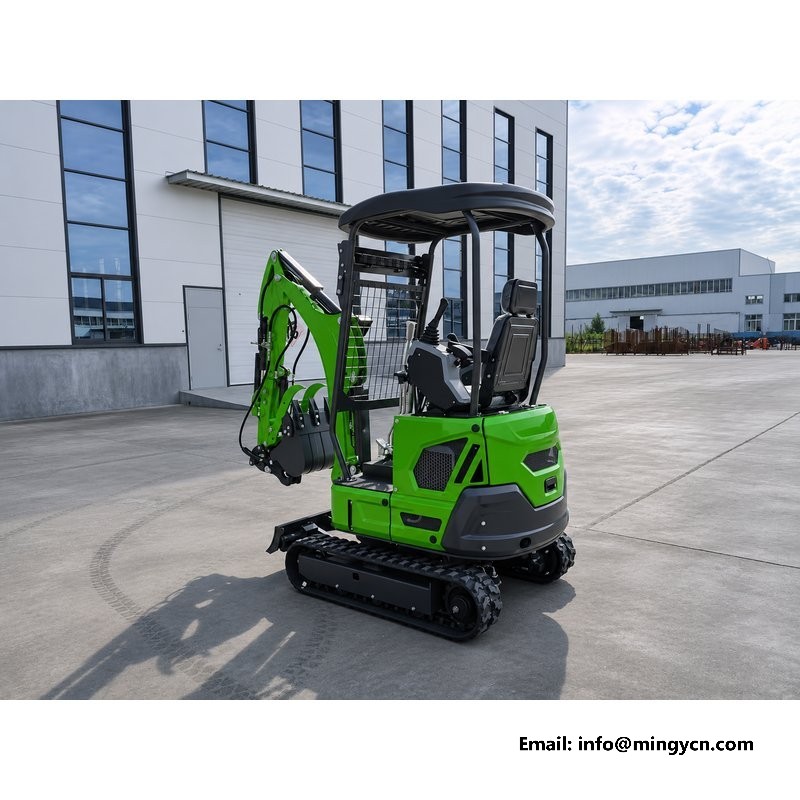
A long arm machine is easy to overload because the extra reach makes light work of positions that would have been out of range on the standard machine. The operator's discipline is to keep the bucket close when the load is heavy, to avoid simultaneous swing and arm-out movements with a full bucket, and to treat any lift that would put the load over the side of the tracks as a two-stage operation. The hydraulic system will not protect the structure from a bad decision; it will simply move the load until the machine tips or a pin bends. A simple rule that works on site: if the machine feels light at the front, the load is too far out. Repositioning the machine costs a minute; straightening a bent arm costs a week and a crane.
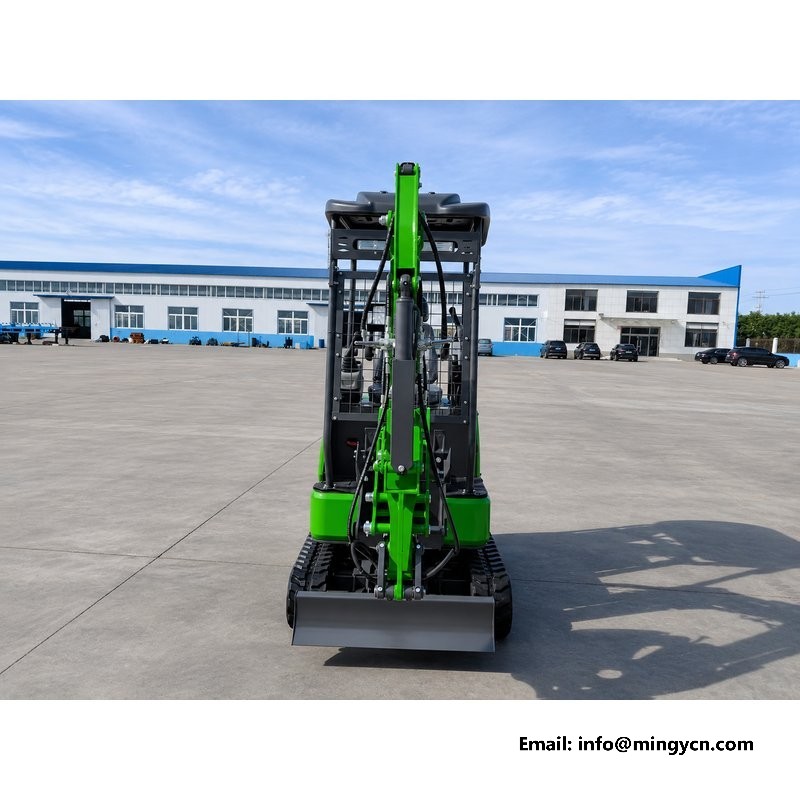
The longer the arm, the greater the leverage on every pin along the linkage, so a long arm machine lives or dies by its greasing routine. The boom foot, the arm pin, the bucket pins and the linkage pins all carry higher loads than on a standard machine, and a dry pin will develop play in a fraction of the time. Grease at the end of each shift while the pins are warm and the old grease is still soft, and watch for grease escaping from a worn bushing rather than being held in the joint. Any pin that takes noticeably more grease than its neighbours, or shows rust at the ends, should be checked before the next shift. A long arm also loads the bucket linkage harder, so check the linkage pins at the same time.
A long arm puts the boom and arm cylinders in positions where the rod is more exposed, and the hose run to the bucket is longer. Check the chrome on each rod for pitting and for a dry ring near the seal, which is the first sign that a wiper is failing. Look at the hoses where they pass the guard rails and the boom foot: chafe shows as a polished patch on the outer cover, and a hose that has worn through the braid will fail without warning. Check the fittings for weeping after the machine has worked, not before, because a cold machine hides small leaks. Replace a hose that shows braid rather than wrapping it. Keep the rods wiped clean at the end of a dusty shift, because grit on the chrome wears the seal.
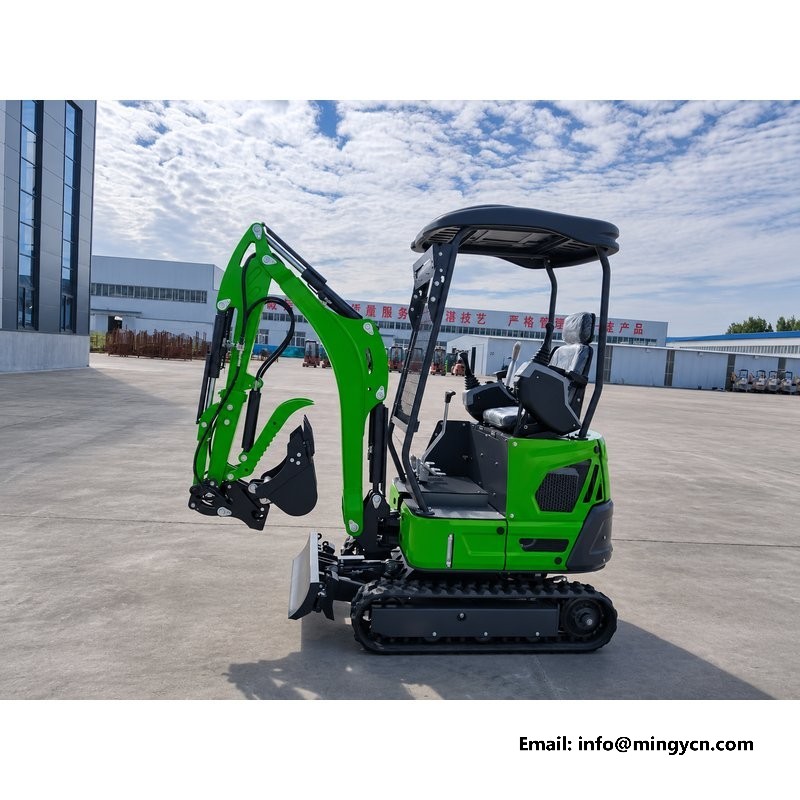
A long arm machine is longer than the standard unit and the extra length has to be planned for. Measure the machine with the arm folded and the bucket curled before booking transport, and confirm the tie-down points on the undercarriage rather than on the arm. On the trailer, the boom should be lowered into its rest and the bucket set on the deck, with the blade down and the machine chained at four points. For storage, keep the arm retracted, the bucket on the ground and the cylinders partly closed so the rods are not exposed to rain. A machine stored with a bare rod will pit at the seal, and that pit becomes a leak on the first day back at work. Check the ramps as carefully as the machine, since a long arm changes the load angle.
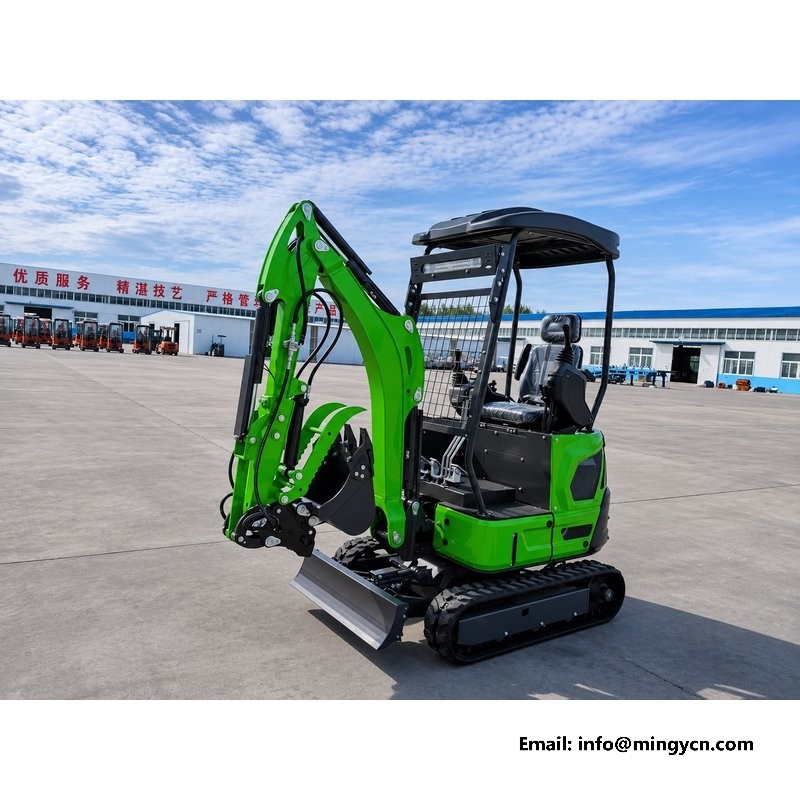
The specification sheet quotes 2,100 mm digging depth, 3,050 mm digging radius and 2,300 mm digging distance for the configuration listed, and a long arm machine should be quoted against its own drawing rather than those figures carried over. Ask the factory for depth, radius and dump height measured with the long arm and the actual bucket fitted, in writing, before you approve the build. Reach is only useful if the number is measured on the machine you will receive.
It is not a field swap. The arm, the bucket linkage and the hydraulic plumbing are matched as a set, and the longer arm changes the load on the boom, the pins and the front of the undercarriage. Fitting one to an existing machine needs the factory's approval, the correct parts and a check of stability with the blade and counterweight as built. If you need the reach, order it with the machine.
Ordering and technical support
Email: sales@mingycn.com
LINE (ID): mingyicn
Tell us your working width, ground conditions and the attachment you need, and we will confirm the right configuration and shipping details.