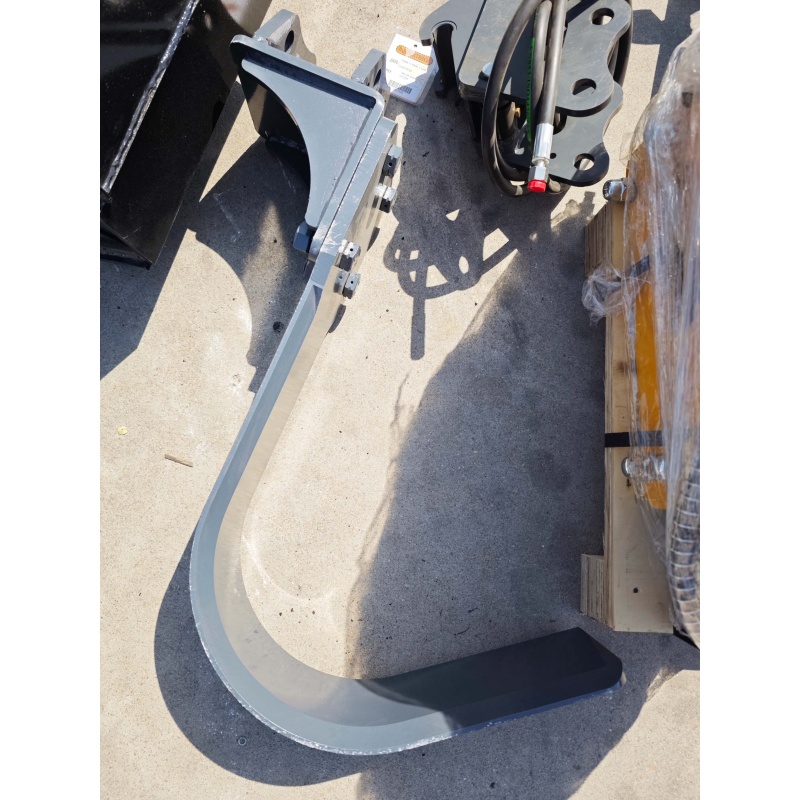
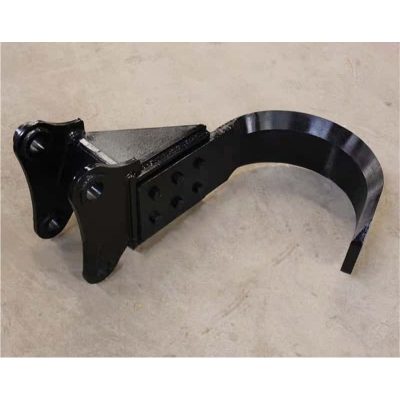
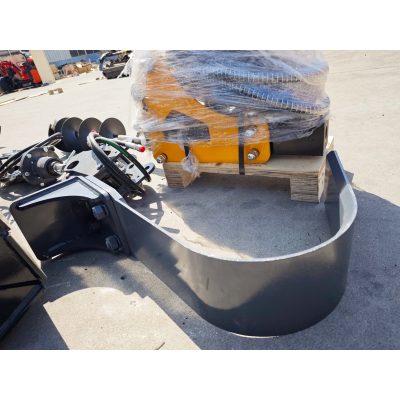
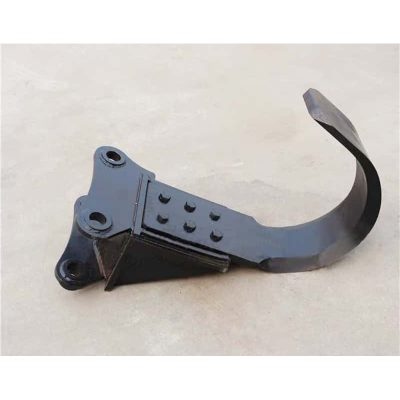
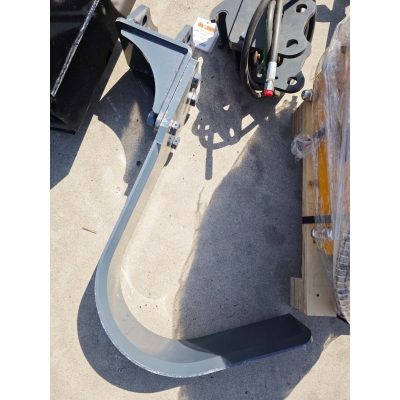
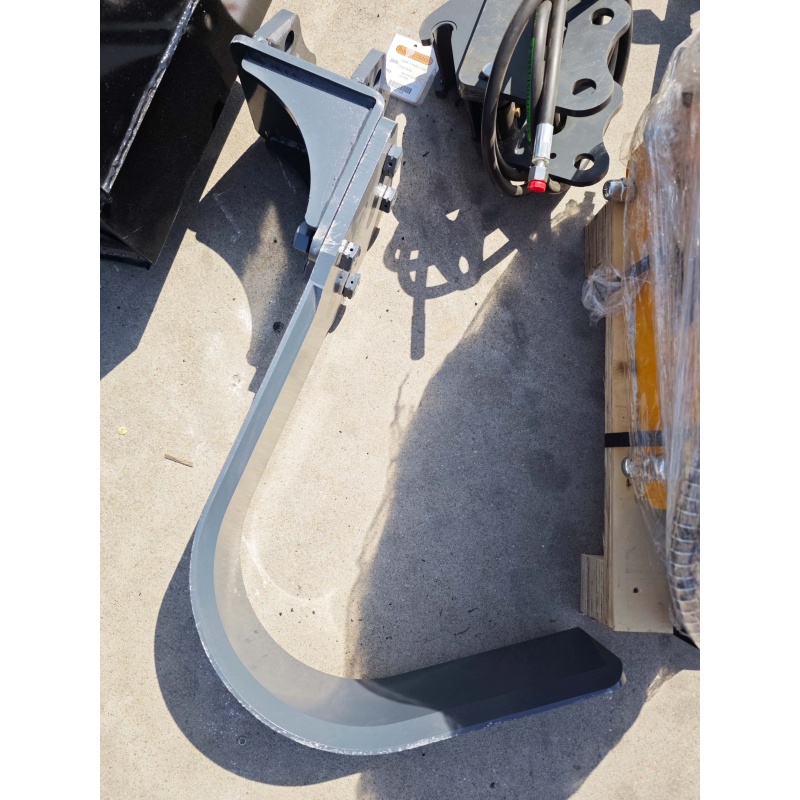
Roots stop buckets. A mini excavator working near established trees hits woody roots within the first spit of soil, and the tree root digger exists to deal with them without abandoning the trench line. MINGYI supplies this tool as part of its attachment range for small crawler excavators.
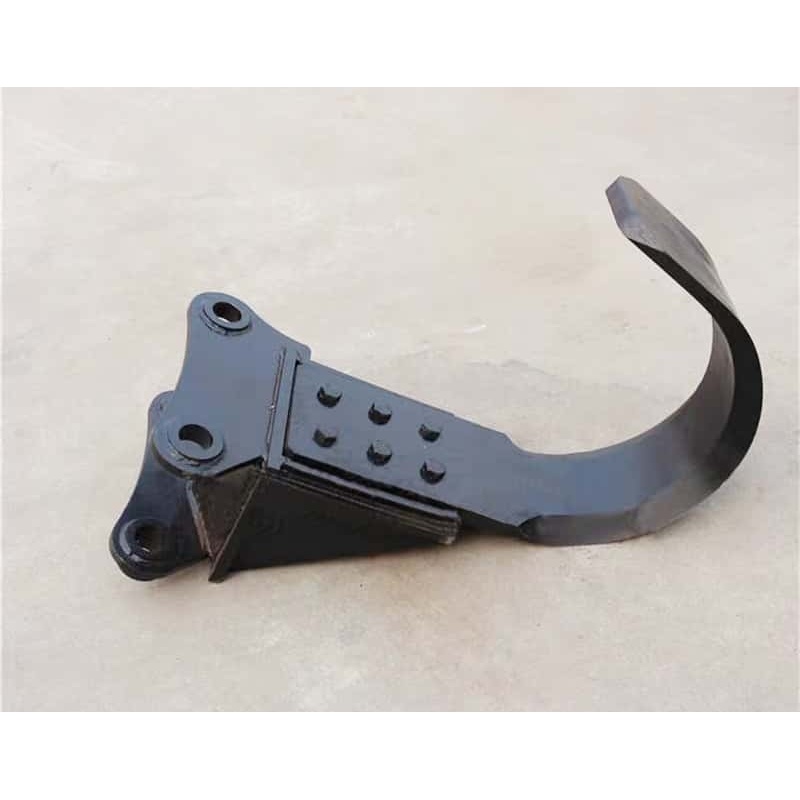
The root digger mounts on the arm in place of the bucket and uses a narrow, hardened profile to loosen, cut and lift root material out of the excavation. Where a bucket bounces off a root plate, the digger gets under it and prises it free.
Root digging work in orchards and gardens
Orchard renewal brings the attachment into its own: old trees come out root and branch, stumps lift with less soil disturbance, and the planting hole for the replacement opens in the same visit.
The digger also clears root mats from land returning to cultivation, where woody material left in the ground invites disease and blocks future drainage runs. Its narrow profile limits the soil opened, which keeps reinstatement simple.
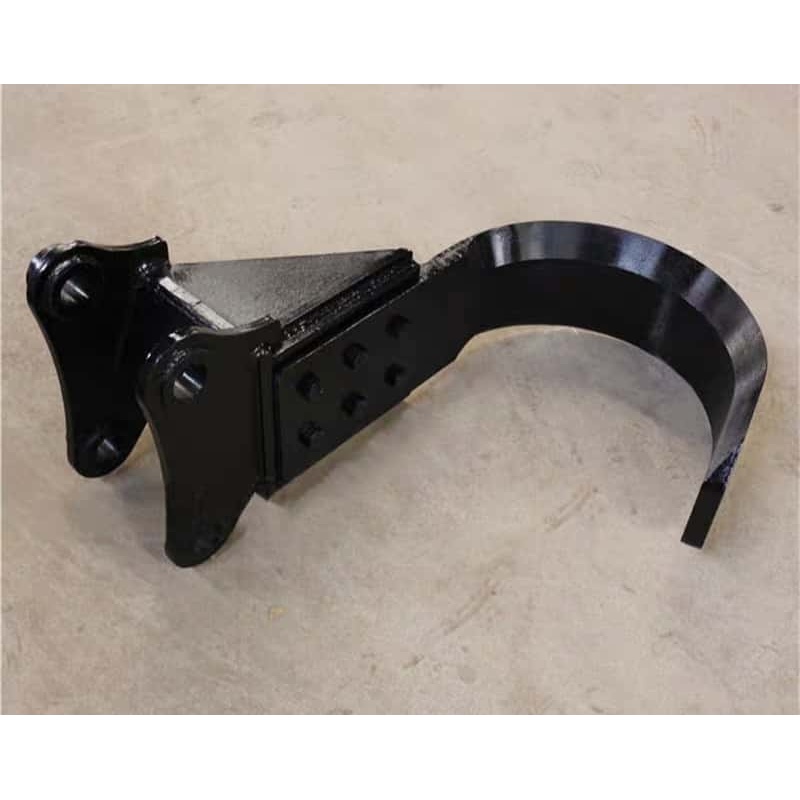
Specifying the root digger with the machine
The tool works through the standard coupler point, so it can join the original machine order and live in the bucket store. The build record lists it against the excavator, so spares and service information cover the attachment as well.
Buyers should describe their typical tree sizes and soil types when ordering, since carrier mass and boom configuration decide how effectively the digger levers heavier root plates.
Roots are the part of tree work that hides below grade, and the root digger is the tool that meets them there. Order it with the excavator, keep it on the coupler shelf, and trench lines near trees stop being a negotiation.
Parts, service and support for tree root digger for mini excavator Support after delivery is a parts question. Wearing items for the excavator - filters, belts, track components, bucket teeth and pins - are the items a buyer should plan to hold before the first service interval. Engine parts availability usually drives the engine choice. This class of machine built with an engine the local network already carries is serviced from stock rather than from an international order. Track choice for tree root digger for mini excavator Rubber tracks suit paved and landscaped ground because they spread the machine weight and leave the surface intact. Steel tracks with rubber blocks are specified where the ground is rougher or the working day is longer, and the choice can be made per machine rather than accepted as a factory default. Undercarriage selection is a ground question, not a preference question. The unit in daily use running on finished paving needs rubber; the same machine on demolition rubble or rock wears rubber quickly, so steel with rubber blocks becomes the better answer over a full season. Interior and light demolition with tree root digger for mini excavator Breaking out a floor slab, a wall footing or a concrete step is routine work for a machine of this size with a breaker. The machine is small enough to work inside and heavy enough to run the tool at a practical rate. Dust, debris clearance and floor loading all argue for a compact machine indoors. The equipment on site spreads its weight over a wider track footprint than a wheeled machine of similar capacity. Running tree root digger for mini excavator in a rental fleet Rental fleets buy for utilisation, not for a single job. The machine itself with a quick coupler and a common attachment standard is hired more often because it suits more of the calls that come in. Fleet buyers also weigh transport. The model in question that a customer can tow on a normal licence and a standard trailer is a hire that does not need a delivery truck, which changes how often it goes out. Canopy or enclosed cab on a tree root digger for mini excavator A canopy keeps the machine light and the operator aware of the surroundings, which suits short jobs in warm weather. A fully enclosed cab is specified where rain, dust or cold are part of the working year, and it can be added to the machine in that duty as a retrofit rather than only at build time. Enclosure also changes noise and dust exposure. A sealed cab on the unit on the job keeps dust out on dry sites and lets the machine work through weather that would otherwise stop a canopy machine for the day. Attachments that turn tree root digger for mini excavator into several machines The base machine is a carrier; the tool on the end of the arm decides the task. A machine built for the work fitted with a toothed bucket digs, and the same machine with a breaker, an auger or a grab does work that would otherwise need a second unit on site. Attachment lists are best written before delivery. Specifying the equipment in service with the tools the job list needs avoids the work and delay of adding hydraulics later, and a quick coupler makes the swap a few minutes instead of a workshop job. Orchard, vineyard and farm use of the excavator Orchard and vineyard work is carried out between rows. This class of machine with a narrow chassis and a swing boom works down the row without damaging the trees, which is the reason a full-size machine is not used at all. Farms also use the unit in daily use for general maintenance - clearing a watercourse, repairing a track, loading a spreader. One carrier with a few attachments covers most of the jobs that would otherwise wait for a contractor. Municipal and public works with a machine of this size Drainage repair, tree planting, footway reconstruction and cemetery work are all within the range of the equipment on site. The jobs are small individually and continuous across the year. Noise and surface protection matter on public work. The machine itself on rubber tracks across paving, with a sealed cab for the operator, suits the conditions better than a larger tracked machine. Quick coupler practice on the model in question A quick coupler is the single option that changes how a machine is used day to day. Fitted to the machine in that duty, it turns an attachment change from a two-person workshop job into a task the operator does alone in minutes. Couplers are specified early because they affect the arm and the hydraulic kit. Adding one to the unit on the job after delivery means new pins, new hoses and a fitment session; adding it at build time is a line on the sheet. Engine options behind a machine built for the work Two buyers can order the same the excavator and receive different engines. The decision is rarely about peak power; it is about which parts counter is closest to the site and which engine the local mechanic already knows. Engine choice is also an emissions and documentation question for some markets. Listing the available units with the equipment in service enquiry lets the factory confirm what can be supplied and documented for the destination country. Getting this class of machine through a narrow gap The first question on most job lists is whether the machine can reach the work at all. The unit in daily use is chosen against the narrowest point on the route - a garden gate, a doorway, a gap between two walls - because a machine that arrives and then cannot pass loses a day, not an hour. Contractors who buy a machine of this size normally have one job in mind that nothing else reaches. The purchase order follows the access measurement, not the other way round, and the build sheet is then settled around it. Specification data for the equipment on site The figures below are the factory figures for the models most often matched to the machine itself. They are the numbers to check against the site: the depth the work needs, the reach from one position, and the width of the narrowest point on the route in. Figures are factory figures and are confirmed on the build sheet for the model in question. Where a job sits between two models, the larger machine usually takes less time than the smaller one spends on rework. Work near housing or occupied premises brings constraints that open sites do not. Start times, exhaust condition and how often the machine in that duty needs to reverse are the practical limits that neighbours notice. Dust control is often part of the same conversation. Water, timing and work sequence reduce what leaves the site, and agreeing them in advance keeps the unit on the job working rather than stopped after a complaint.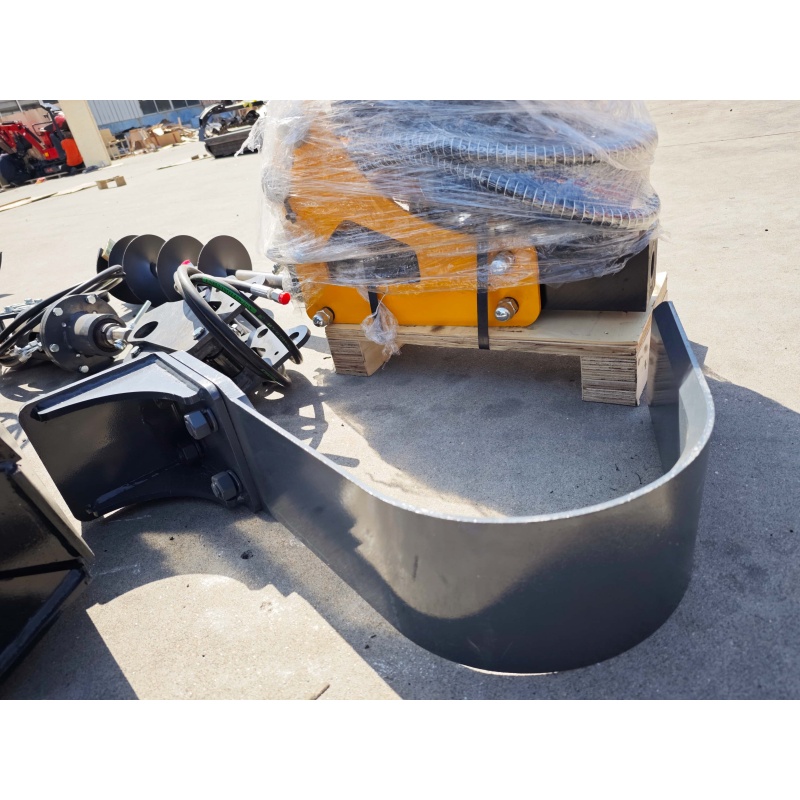
Reference specification — mini excavator range 09W 12L 15L 25L Operating weight 1100 kg (2425.08 lb) 1200 kg (2645.55 lb) 1400 kg (3086.47 lb) 2200 kg (4850.17 lb) Transport size (L×W×H) 1800 × 750 × 1970 mm 2200 × 930 × 2250 mm 2200 × 930 × 2250 mm 3000 × 1300 × 2700 mm Max digging depth 1250 mm (49.21 in) 1700 mm (66.93 in) 1700 mm (66.93 in) 2300 mm (90.55 in) Max digging height 2800 mm (110.24 in) 2600 mm (102.36 in) 2750 mm (108.27 in) 3100 mm (122.05 in) Max dumping height 1700 mm (66.93 in) 1800 mm (70.87 in) 1960 mm (77.17 in) 2050 mm (80.71 in) Max digging radius 2570 mm (101.18 in) 2900 mm (114.17 in) 2900 mm (114.17 in) 3900 mm (153.54 in) Max digging distance 1869 mm (73.58 in) 2300 mm (90.55 in) 2300 mm (90.55 in) 3100 mm (125.05 in) Minimum turning radius 1000 mm (39.37 in) 1450 mm (57.09 in) 1450 mm (57.09 in) 1800 mm (70.87 in) Travel speed 3 km/h (1.86 mph) 3 km/h (1.86 mph) 3 km/h (1.86 mph) 7 km/h (4.35 mph) Gradeability 30° 30° 30° 30° Fuel consumption 1-1.3 L/h (0.264—0.343 gal) 1-1.3 L/h (0.264—0.343 gal) 1-1.3 L/h (0.264—0.343 gal) 2-3 L/h (0.528—0.793 gal) Fuel tank capacity 8 L (2.11 gal) 10 L (2.64 gal) 10 L (2.64 gal) 16 L (4.23 gal) Hydraulic oil tank 16 L (4.23 gal) 16 L (4.23 gal) 16 L (4.23 gal) 18 L (4.76 gal) Dozer blade lift height 180 mm (7.09 in) 180 mm (7.09 in) 180 mm (7.09 in) 230 mm (9.06 in) Dozer blade drop depth 210 mm (8.27 in) 210 mm (8.27 in) 210 mm (8.27 in) 280 mm (11.02 in)
Q. What is a machine built for the work?
A. Compact excavators win work by being there: small enough to reach the job, strong enough to finish it. Trenching on Monday, loading and grading through the week, fence posts and drainage to finish - the attachment set specifications the work. Read the equipment in service together with the engine, track and attachment pages: jobs around mini excavator are decided by how those choices line up, not by any single number on the sheet.
Q. Where does the compact class stop making sense?
A. When the jobs need full-size reach or mass digging for weeks on end - within its envelope, though, the compact machine holds a work rate that surprises first-time buyers.
Q. What support follows the sale?
A. Spare-part kits, wear items and service documentation ship with the programme, and the parts team works from the serial plate to match components exactly. Warranty and support terms for the mini excavator order are confirmed in writing before the machine leaves.
Commissioning the excavator on site
Transport shakes things loose. A short check of this class of machine after the crate is opened, covering the same points the pre-delivery inspection covered, is the most useful insurance available on delivery day.
Reading the early symptoms on the unit in daily use
Operators notice things first because they hear the machine every day. Encouraging the person on a machine of this size to report small changes, and acting on them, is the most effective maintenance programme there is.
E-mail : sales@mingycn.com
LINE ( ID ): mingyicn
Related pages
mini excavator hedge pruner · rotating bucket for mini excavators · Loader Machine for Construction: 0.4 m3 or 0.65 m3 Bucket · Mini Excavators









