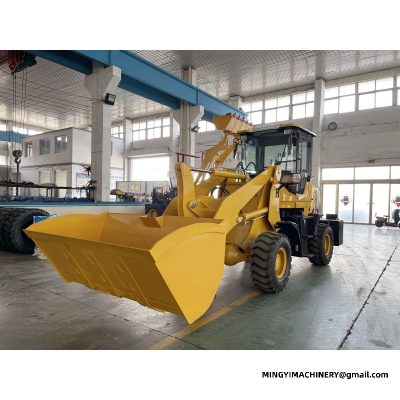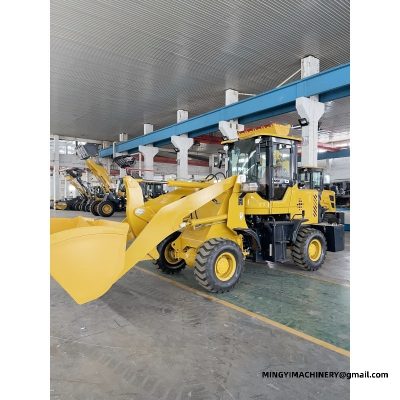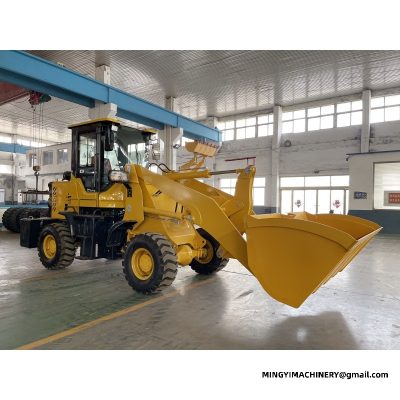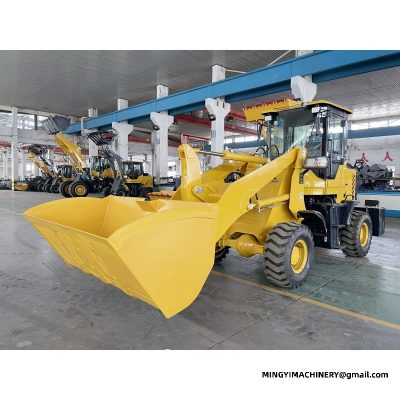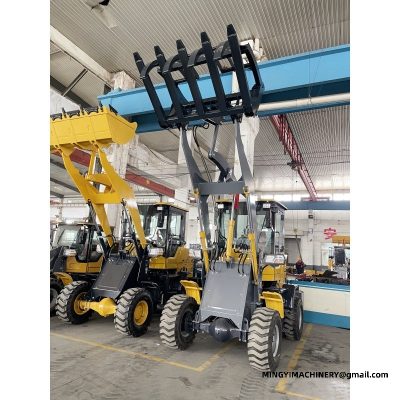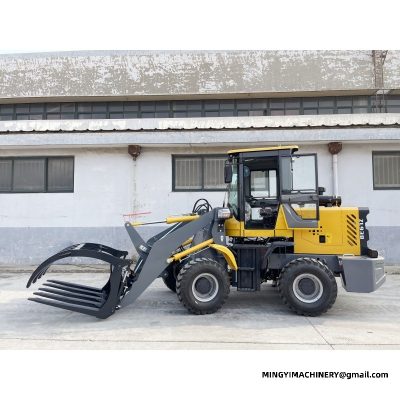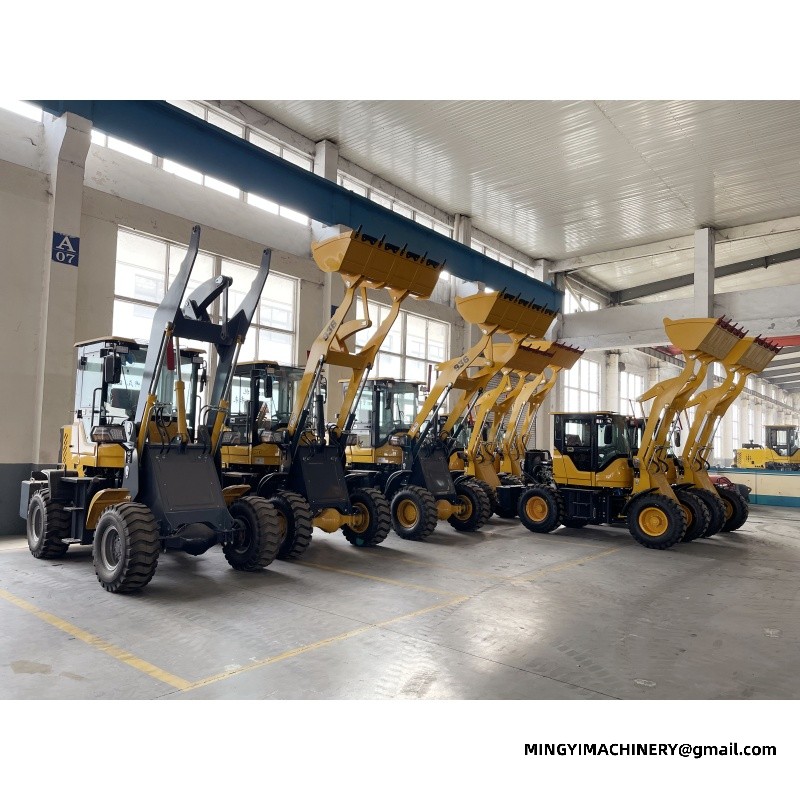
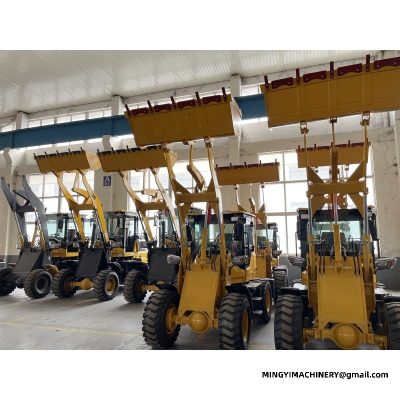
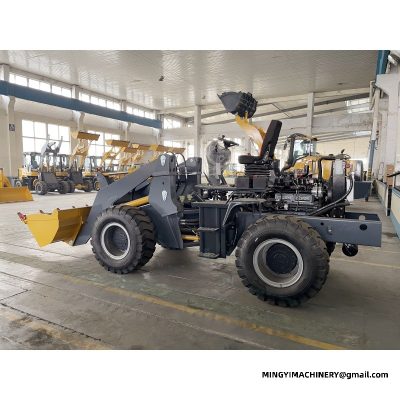
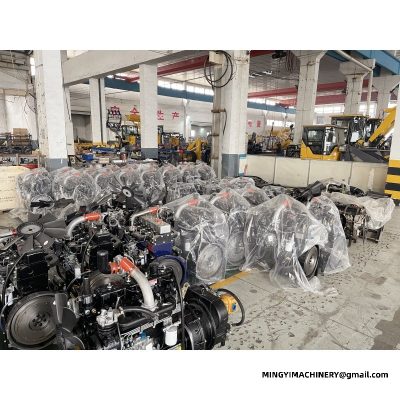
Bucket capacity, dump height and turning circle decide whether a mini loader fits the job.
A mini loader is a small wheel loader built to work in spaces where a full-size machine cannot turn, cannot fit between rows, or cannot be justified on the ticket. The name is used loosely across markets: what is sold as a mini loader in one country is listed as a small wheel loader, a compact loader or a compact wheel loader in another. They describe the same class of machine, and they are judged on the same three figures — bucket capacity, dump height and turning circle.
The two are often compared because both are compact, but they steer differently and that difference decides which one suits a site. A skid steer turns by driving its left and right wheels at different speeds, which scrubs the surface and demands a wide turning area in soft or finished ground. A mini loader steers with an articulated joint in the frame: the machine folds, the rear wheels track inside the front wheels, and the surface is not scrubbed. On turf, gravel or a paved yard that matters, and it is the main reason orchard and greenhouse work tends to favour the loader rather than the skid steer.
Bucket capacity on this class of machine runs from 0.4 m³ on the small frame to 0.52 m³ on the medium frame. The difference sounds small on paper and is not small in practice: at 0.4 m³ a 10-tonne heap of sand takes roughly 18–20 cycles, at 0.52 m³ it takes 14–15. Over a working day that is the difference between finishing a delivery in the morning and finishing it after lunch.
Dump height is the figure most often forgotten at the quotation stage and most often regretted afterwards. The small-frame builds reach 3.5 m; the medium-frame builds reach 4.2 m. If the machine has to load into the side of a tipper truck or over the wall of a feed mixer, 3.5 m may clear it and 4.2 m certainly will. Measure the target before choosing the build, not after the machine arrives.
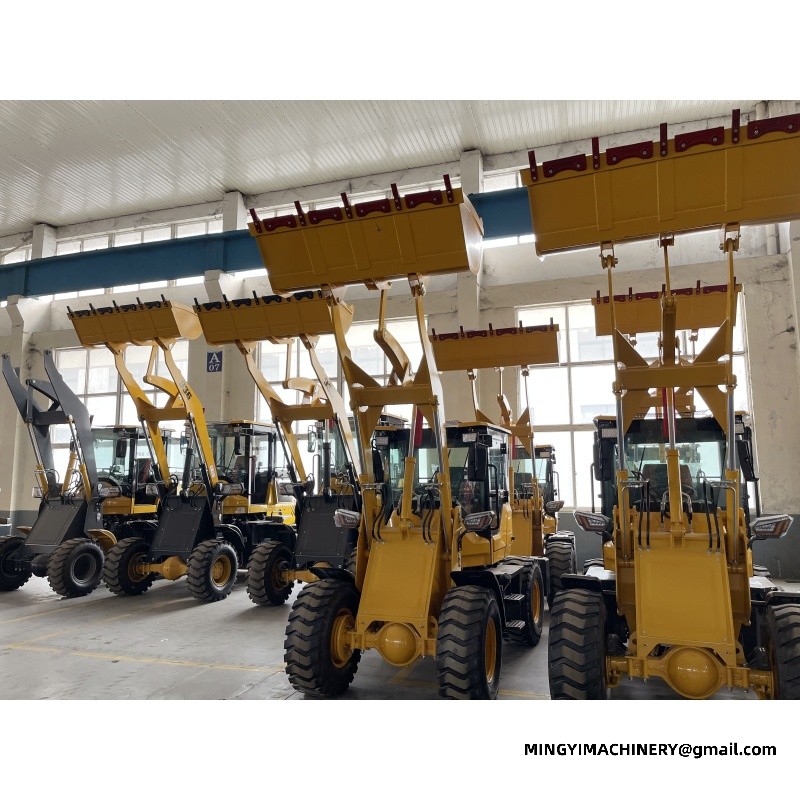
Orchard work sets its own limits. Rows are commonly spaced 3.0–3.5 m apart with a headland at each end, and a machine that cannot pass between two rows without touching the canopy is not usable regardless of its bucket. That is where the compact builds earn their place: a 1.6 m track width passes a 3.0 m row with room to spare, and the articulated steering lets the machine follow the row line rather than cutting across it.
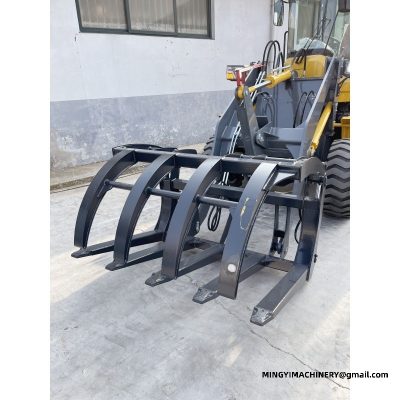
The work itself is rarely digging. It is moving prunings, carrying bins, spreading gravel on the headland, backfilling a drainage trench, or lifting a pallet of posts to where the crew is working. A bucket and a set of pallet forks covers most of that, and the forks are usually the more useful of the two in an orchard.
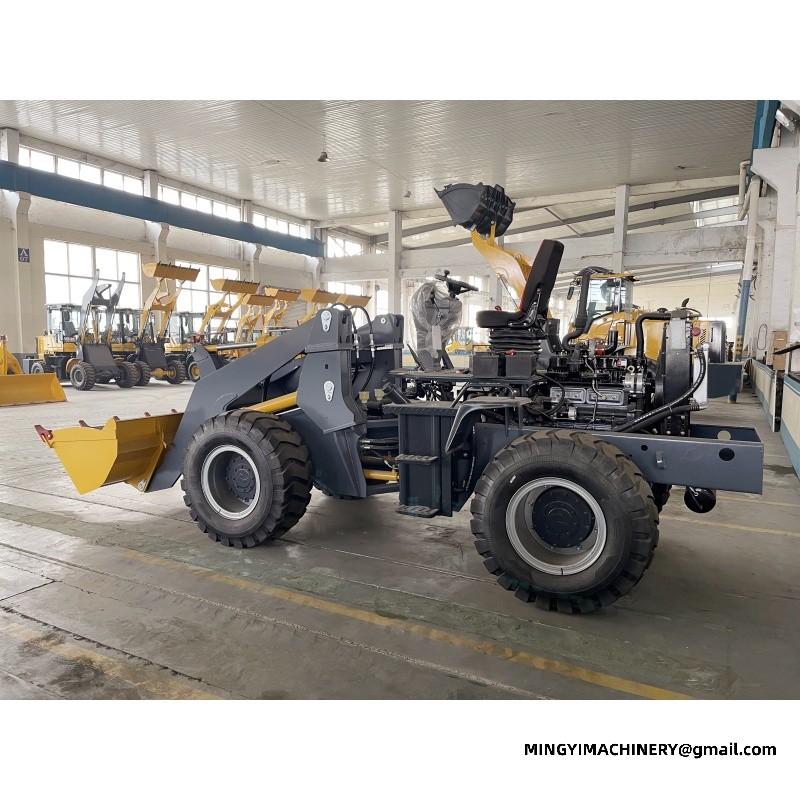
The builds in this range separate on steel rather than on paint. Boom wall runs 25 mm on the light-duty builds and 30 mm on the heavier ones; hinge plate steel runs 20–30 mm against 30–45 mm; cross-members follow the same split. That steel is what resists the fatigue cycle of lifting a loaded bucket several hundred times a day, and it is the first thing to compare when two machines quote the same bucket capacity at different prices.
| Figure | Small frame | Medium frame |
|---|---|---|
| Bucket capacity | 0.4 m³ | 0.52 m³ |
| Dump height | 3.5 m | 4.2 m |
| Boom wall | 25 mm | 30 mm |
| Hinge steel | 20–30 mm | 30–45 mm |
| Track width | 1.6 m | 1.6 m |
| Wheelbase | — | 4.1 m |
Radiator core size is rarely discussed at purchase and frequently the reason a machine overheats in its second summer. The 490 engine runs a 4100 core; the 4102 turbo runs a 4105 raised core. The raised core is the one for hot climates, high altitude and any site where fine material hangs in the air. On a light-duty build the core sits behind a rear frame roughly 300 mm high and 800 mm wide with limited airflow at low engine speed, which is fine for intermittent yard work and marginal for continuous loading in 40 °C heat.
Four things settle a mini loader order: the row or aisle width the machine must pass, the height it must load into, the material it will handle most often, and whether the ground is finished or rough. With those four known, the frame tier, the attachment set and the tyre choice follow. A machine specified this way works for a decade; one bought on bucket capacity alone usually needs replacing or re-tyring within two seasons.
Request a mini loader quotation
Send the aisle width, the load height and the material, and we will confirm the frame tier and attachment set.
Email: sales@mingycn.com | LINE (ID): mingyicn