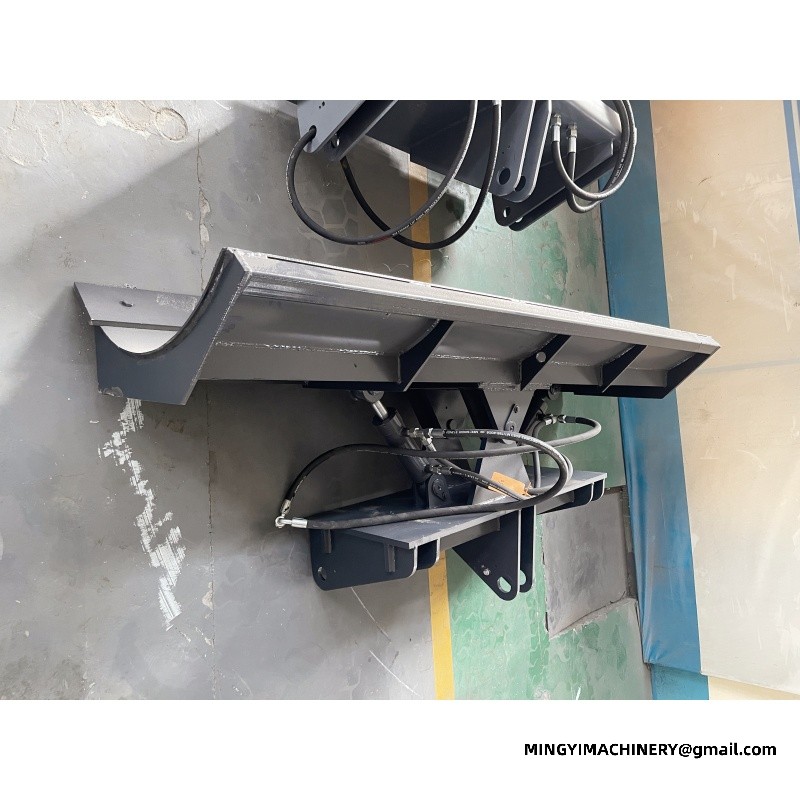
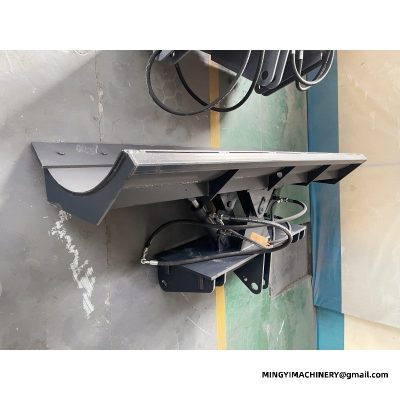
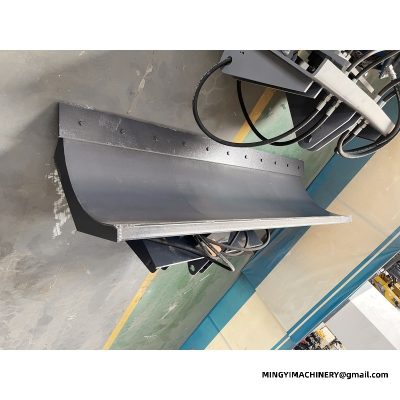
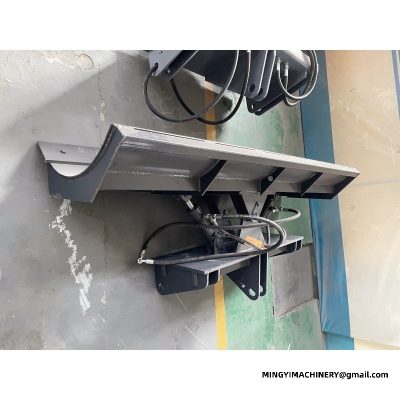
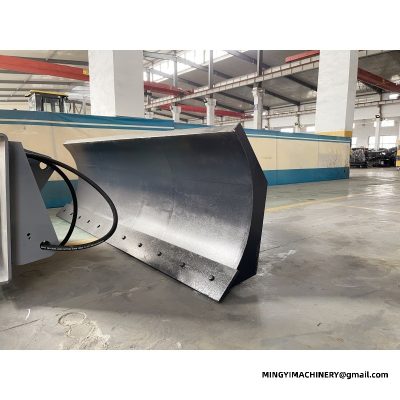
What separates a wheel loader snow pusher that is still tight at year five from one that is loose at year two is visible on the specification sheet, if you know which row to read. It is not the engine and it is not the bucket. It is the rear hinge plate — 30 mm on the light-duty 4.2 m medium-frame wheel-side reduction wheel loader against 30 mm on the light-duty 4.5 m medium-frame wheel-side reduction wheel loader — and the cross-member behind it, 45 mm against 45 mm. Add the boom wall, 30 mm against 30 mm, and you have the frame story. The rest of this page covers the hydraulic, cooling, axle and delivery decisions that follow.
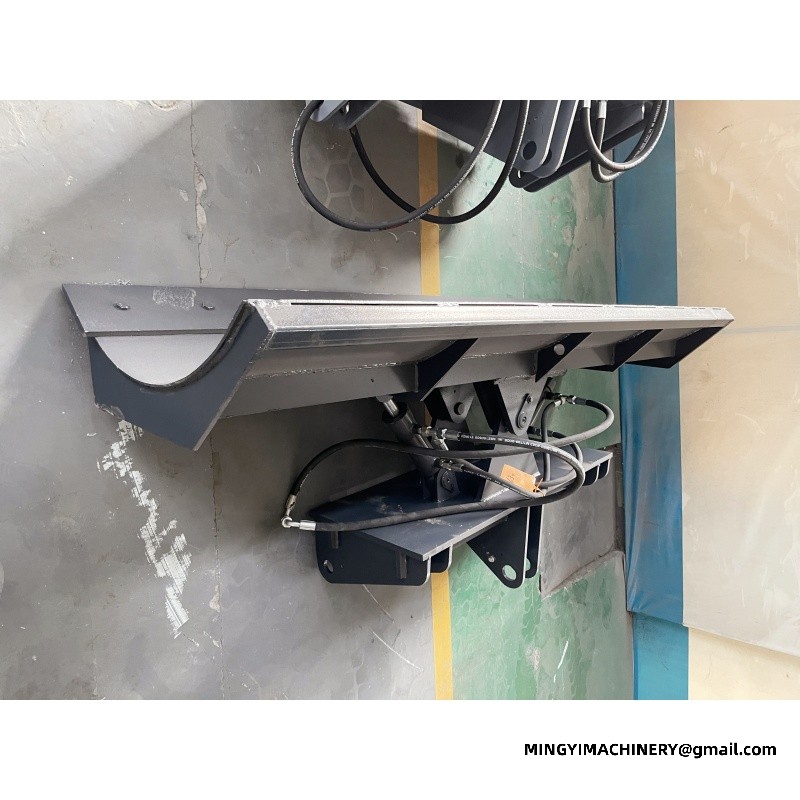
The boom is the part that turns engine power into a loaded bucket at height, and four figures describe it. Length runs 3.15 m on the light-duty 4.2 m small-frame wheel-side reduction wheel loader against 2.9 m on the light-duty 4.2 m medium-frame wheel-side reduction wheel loader; wall thickness 25 mm against 30 mm; section width 370 mm against 450 mm; and the mount spacing — boom centre distance — 890 mm against 900 mm. Read together, those four numbers tell you more about how a machine will behave than bucket capacity ever will.
Length buys reach and takes stability, because every extra millimetre moves the load centre further from the front axle. Wall thickness resists bending; section width resists twisting. Centre distance is the one most buyers never ask about, and it is the one that decides whether the arm takes a side load cleanly or twists the pins — which matters the moment an operator digs one corner of the bucket into a heap instead of squaring up to it. On the light-duty 4.2 m small-frame wheel-side reduction wheel loader the combination of a 3.15 m arm, a 25 mm wall and a 890 mm spacing is matched to a 0.38 m³ bucket, and that match is what keeps the frame tight over a full season.
Bucket capacity is the first figure stated and the last one that should be decided. The light-duty 3.8 m small-frame wheel-side reduction wheel loader carries 0.38 m³; the light-duty 4.2 m medium-frame wheel-side reduction wheel loader carries 0.52 m³. What those volumes mean depends on the material: a heaped bucket of dry sand weighs far less than the same heaped bucket of wet gravel or crushed rock, and the machine's stability, not its volume, sets the real limit.
Match the bucket to the receiving body and the material, in that order. A 0.38 m³ bucket at 3.8 m clearing a low pan mixer is correctly specified; the same bucket feeding a highway truck is a slow day. Against that, a 0.52 m³ bucket at 4.2 m needs the frame behind it — 45 mm front and 30 mm rear hinge plates, a 45 mm cross-member — or it will be a fast machine with a short life.
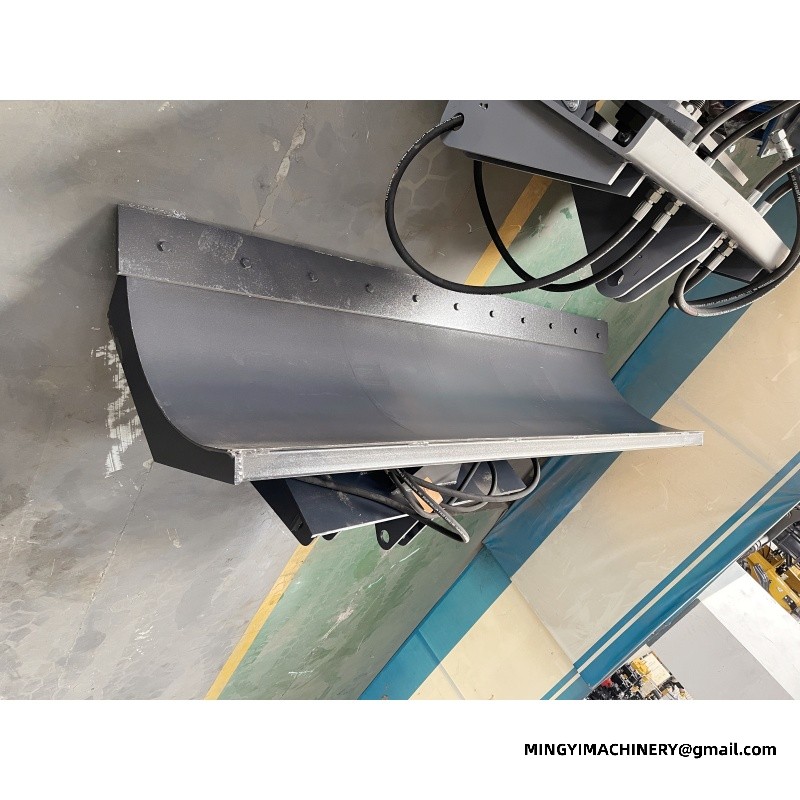
Cooling capacity is sized to the engine's heat rejection, so it appears in the table as a specification rather than a choice: 4100 core (490 engine); 4105 core (4102T engine) on the light-duty 3.2 m low-profile wheel loader, 4100 core (490 engine); 4105 core (4102T engine) on the light-duty 4.2 m small-frame wheel-side reduction wheel loader. Where the build offers two engines — the 490 with a 4100 core, the 4102 turbo with a 4105 raised core — the raised core is the one for hot climates, high altitude and any site where fine material hangs in the air.
Practical advice that takes nothing: blow the core out at the end of every shift in dusty work, in the reverse direction to airflow, and check the cap seat before blaming the radiator. On the light-duty 3.2 m low-profile wheel loader the 4100 core (490 engine); 4105 core (4102T engine) core sits behind a 230 mm high x 800 mm wide rear frame with limited airflow at low engine speed; on the light-duty 4.2 m small-frame wheel-side reduction wheel loader the 4100 core (490 engine); 4105 core (4102T engine) core is served by the same 316 pump driven circuit. Neither is difficult to keep clean, and both will lose a season to neglect.
| Specification extract — light-duty 3.2 m small-frame wheel-side reduction wheel loader | |
|---|---|
| Bucket capacity | 0.38 m³ |
| Dump height | 3.2 m |
| Track width | 1.5 m (wheel-side reduction axle); 1.45 m (Isuzu axle) |
| Boom arm thickness | 25 mm |
| Boom arm width | 370 mm |
| Boom arm length | 2.3 m |
| Boom arm centre distance | 890 mm |
| Cross-member thickness | 25 mm |
| Front hinge plate thickness | 25 mm |
| Rear hinge plate thickness | 14 mm |
| Rear frame section | 280 mm high x 800 mm wide |
| Hydraulic cylinders | centre cylinder 45 / side cylinder 40 |
| Fuel tank | 64.7 L (75# small tank) |
| Battery | 60 Ah (490 engine); 80 Ah (4102 turbo engine) |
| Front wheel to counterweight | 3.8 m |
| Radiator | 4100 core (490 engine); 4105 core (4102T engine) |
| Work pump | 40 pump (490 engine); 1045 pump (4102 turbo engine) |
| Travel pump | 316 pump |
Work out how many passes fill the body, then work backwards. A body that takes four passes from a 0.3 m³ bucket will take three from 0.38 m³, but only if the machine can clear the board, and that is the part people get wrong. The light-duty 3.5 m small-frame wheel-side reduction wheel loader reaches 3.5 m; the standard 2.4 m low-profile wheel loader reaches 2.4 m. If the board sits between those two figures, the capacity comparison is academic.
The second check is whether the machine can dump without striking. Dump height is measured at the bucket edge with the arm at full lift, so the clearance you actually have is that figure less the height of the material crest. On the light-duty 3.5 m small-frame wheel-side reduction wheel loader the arm is 2.62 m and the spacing between the arms is 890 mm; a longer arm with a wider spacing tips a bucket cleanly instead of rolling it off the corner.
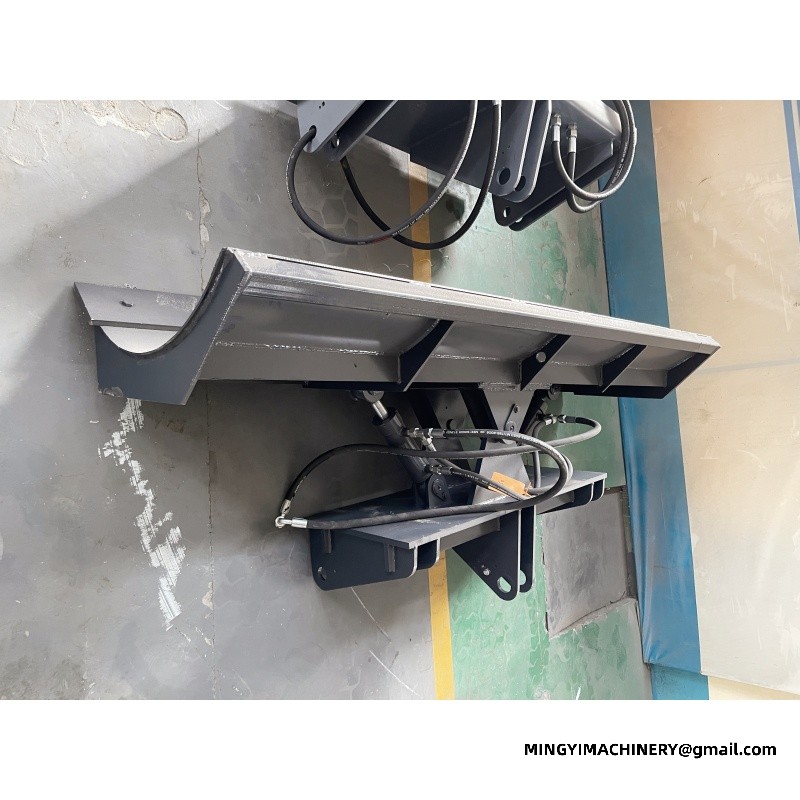
Soft ground punishes driveline parts before it punishes the frame. Sand, clay and loose overburden all increase rolling resistance, which increases torque at the hub, which is exactly where a non-reduction axle is weakest. Where the specification lists two track figures, as it does here at 1.2 m (Isuzu axle); 1.3 m (wheel-side reduction axle), the wider one belongs to the hub-reduction axle and is the specification for that ground.
Hard ground is the opposite case. On concrete, compacted hardstand or a paved yard, rolling resistance is low and sustained travel speed is high, so heat rather than torque becomes the limit. The light-duty 4.2 m small-frame wheel-side reduction wheel loader lists 1.5 m (wheel-side reduction axle); 1.45 m (Isuzu axle), and the narrower figure there is the one for hard standing. Matching axle to surface takes nothing at the order stage and saves a driveline later.
Relief pressure is only half the story; the other half is lever geometry, and lever geometry is decided by the boom and hinge dimensions. The light-duty 4.2 m small-frame wheel-side reduction wheel loader pairs a centre cylinder 45 / side cylinder 40 cylinder set with a 890 mm boom centre distance and a 3.15 m arm; the light-duty 4.2 m medium-frame wheel-side reduction wheel loader pairs centre cylinder 60 / side cylinder 50 with a 900 mm spacing and a 2.9 m arm. Wider spacing means the cylinders work through a better lever, which is how a bigger bucket is lifted without simply raising system pressure and heat.
Pump pairing is the second half. Work pump and travel pump are separate circuits on both machines — 40 pump (490 engine); 1045 pump (4102 turbo engine) and 316 pump on the light-duty 4.2 m small-frame wheel-side reduction wheel loader, 2063 pump and 25 pump on the light-duty 4.2 m medium-frame wheel-side reduction wheel loader — so steering and drive do not steal flow from the boom at the top of a lift. If you intend to run hydraulically actuated attachments, a grapple or a four-in-one bucket, order the third circuit at build time; retrofitting a valve block and plumbing in the field takes far more than specifying it on the order.
Fuel is visible and downtime is not, which is why fleets optimise the wrong one. A machine with a 30.8 L (48# large tank, 20.5/70-16 tyres); 24.6 L (48# small tank, 8.25-16 tyres) tank works a full shift without a refuel stop; that is worth a fraction of what a single day lost to a failed pump takes, and the pump is identified on the sheet as 32 pump.
The parts worth specifying against downtime are the ones that cannot be improvised: the battery rating, 45 Ah (24 V), the radiator, 4100 core, and the cylinders, centre cylinder 40 / side cylinder 40. All three are simple at build and lengthy in a field, and all three are listed. Read them as an availability decision rather than as a comfort one.
A rebuild is worth doing when the frame is sound and the running gear is not. Check the hinge plates, 16 mm and 16 mm, and the cross-member, 16 mm, for movement and cracking. If those are tight, cylinders centre cylinder 40 / side cylinder 40, pump 32 pump and radiator 4100 core are all replaceable items and the machine has years left.
If the frame has gone, it has gone: re-machining pin bores restores geometry for a while and never for long, because the 200 mm high x 750 mm wide section has been flexing the whole time. That is the point to compare against a new build rather than a repair, and it is why the plate figures are worth reading at purchase rather than at disposal.
How do I choose the right dump height for a wheel loader snow pusher?
Measure the receiving body at the front board rather than the side: 3.8 m on the light-duty 3.8 m small-frame wheel-side reduction wheel loader, 4.2 m on the light-duty 4.2 m medium-frame wheel-side reduction wheel loader. Clearance decides whether the pass is possible at all.
What engine options are offered on a wheel loader snow pusher?
Where two are offered, cooling and electrics change with them: 4105 core radiator and 80 Ah battery on the light-duty 4.2 m medium-frame wheel-side reduction wheel loader, with the raised core belonging to the turbo option.
Can a wheel loader snow pusher work indoors?
The low-profile builds can, where height and footprint allow: 4.3 m front-to-counterweight length and 1.6 m track on the light-duty 4.2 m medium-frame wheel-side reduction wheel loader. Ventilation is the other constraint to check.
What separates a light build from a heavy build of a wheel loader snow pusher?
Cross-member and rear hinge plate: 45 mm and 30 mm on the light-duty 4.2 m medium-frame wheel-side reduction wheel loader, against 45 mm and 30 mm on the light-duty 4.5 m medium-frame wheel-side reduction wheel loader. Boom wall and cylinder bore follow.
What radiator comes with this wheel loader snow pusher build?
4105 core on the light-duty 4.2 m medium-frame wheel-side reduction wheel loader and 4105 core on the light-duty 4.5 m medium-frame wheel-side reduction wheel loader. Where a build offers two engines, the raised core serves the turbo and is the one to specify for dusty work.
What is the smallest wheel loader snow pusher in the range?
The entry low-profile builds: a 0.52 m³ bucket at 4.2 m, 1.6 m track and a 4.3 m front-to-counterweight length for indoor and nursery work.
Can a wheel loader snow pusher be used for snow clearance?
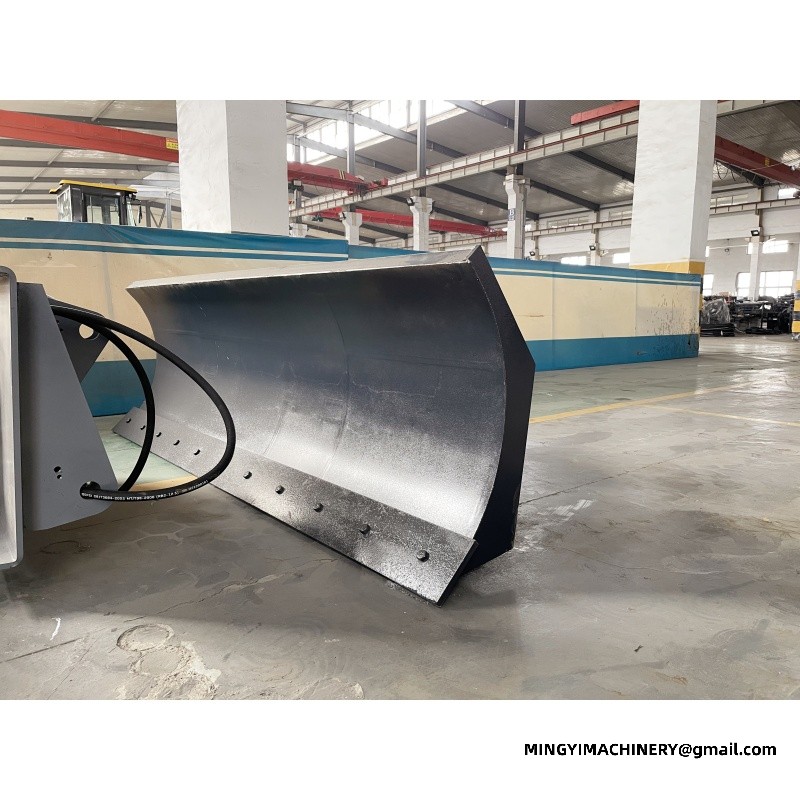
Yes, with a snow tool specified against the boom section — 370 mm on the light-duty 3.8 m small-frame wheel-side reduction wheel loader — and the third circuit ordered if the tool is hydraulically actuated.
Machines ship knock-down with booms and counterweights packed loose, tanks removed and batteries boxed. Allow a day per unit to commission: torque the pins, fill the 70 L (75# large tank) tank and the 4105 core circuit, and check the build figures against the table.
Contact MINGYI Machinery for the current wheel loader lineup, configuration options and a formal specification for your market. E-mail: sales@mingycn.com | LINE (ID): mingyicn
Wheel Loader Log Grapple: Grapple Loads and Hinge Steel · Front End Loader Log Grapple: Section Widths and Pin Geometry · Front Wheel Loader: Steering Feel and Pin Condition · Loaders








