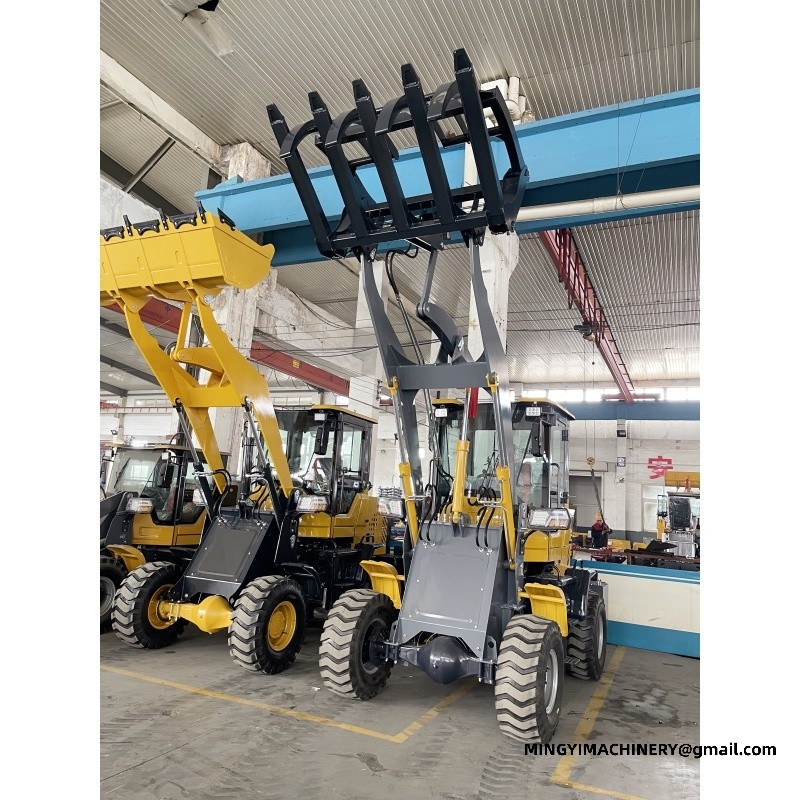
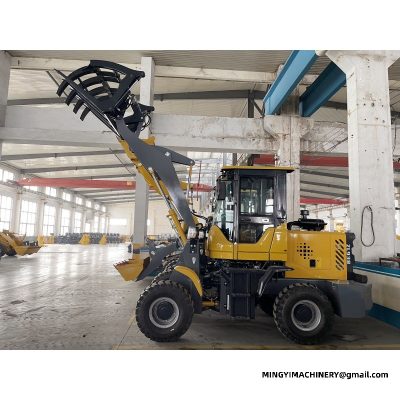
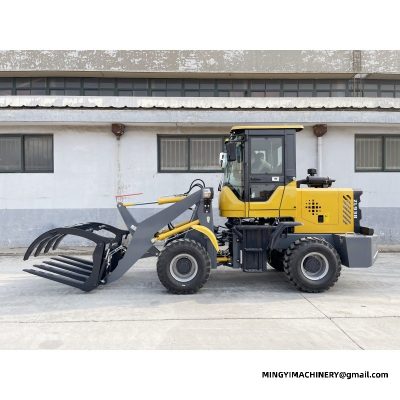
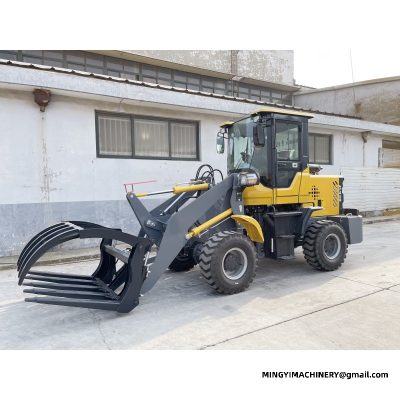
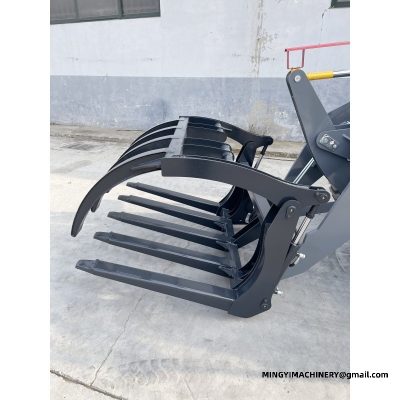
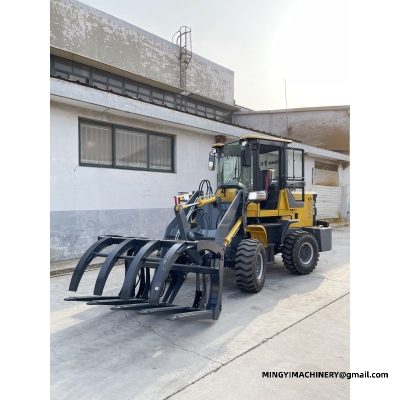
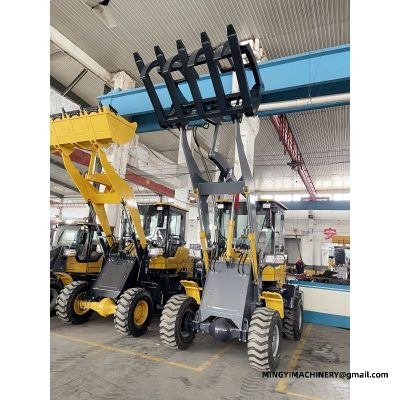
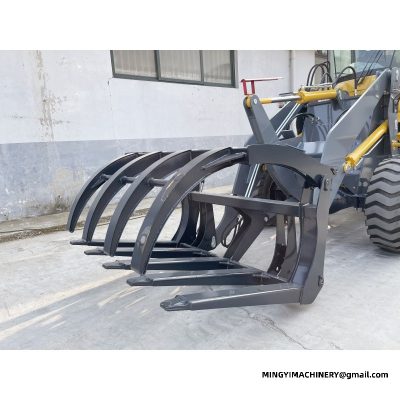
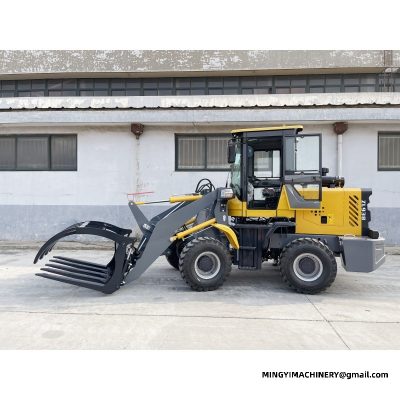
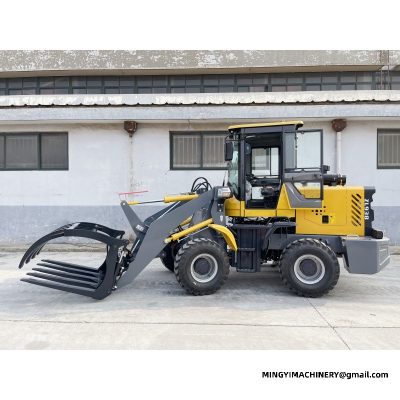
A hydraulic wheel loader log grapple is a frame, a boom and a counterweight arranged around one job: moving material from a heap into something that has to carry it away. Every figure on the sheet serves that job or is decoration. Bucket capacity decides how many passes; dump height decides whether the pass is possible; hinge steel decides whether the machine is still tight in year three. Here the buckets run 0.4 m³ to 0.52 m³ and the dump heights 4.2 m to 3.5 m, with front hinge plates of 45 mm and rear plates of 30 mm on the heavier build. Below: how to read them, and what to specify.
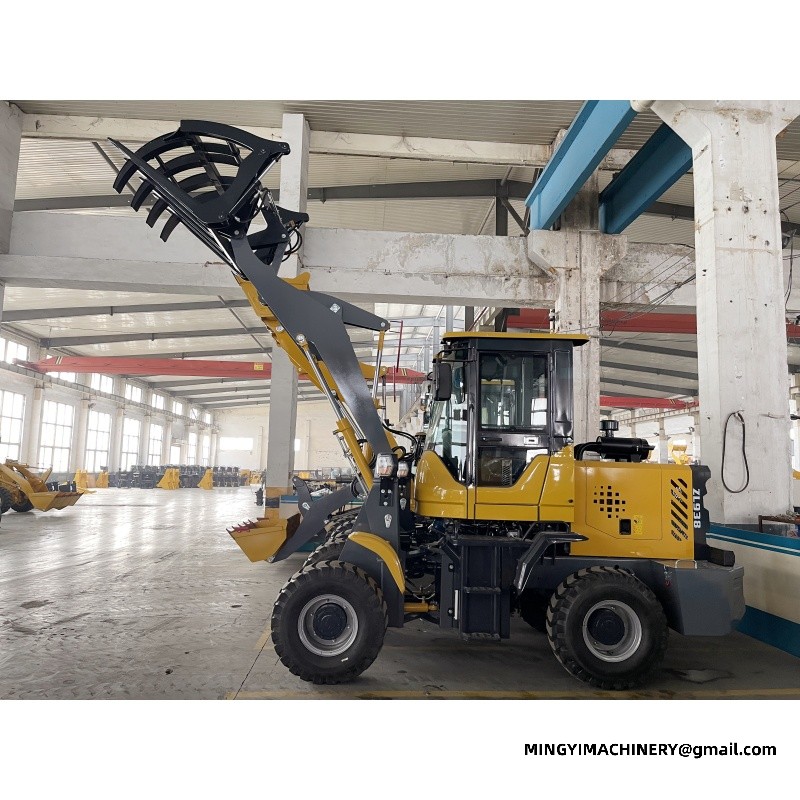
Capacity is bought and rarely used. If the receiving bodies sit below 3.2 m and the material is dense, a 0.38 m³ bucket that fills completely is faster than a 0.3 m³ bucket that fills to two-thirds, and it puts less into the hinge plates doing it.
Size matters twice more. A shorter machine, 3.8 m front wheel to counterweight against 3.5 m, works a tighter bay and turns inside its own length. A narrower one, 1.5 m (wheel-side reduction axle); 1.45 m (Isuzu axle) against 1.2 m (Isuzu axle); 1.3 m (wheel-side reduction axle), passes gates the other cannot. Where the work is confined, buy on dimensions and let capacity follow.
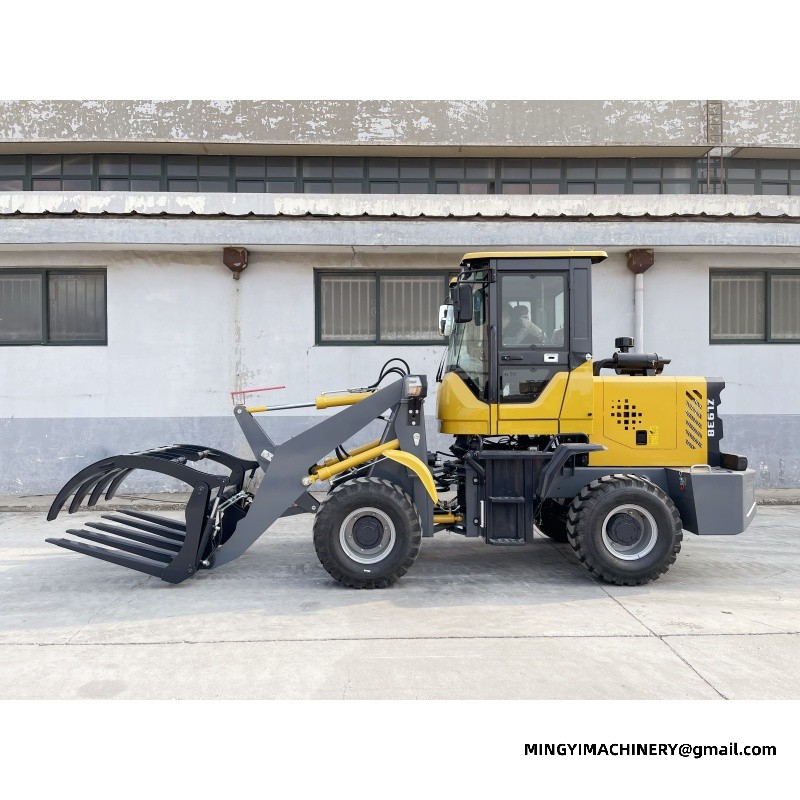
On builds with two engine options the cooling package changes with the engine, which is why the radiator line in the table reads as a pair: 4100 core (490 engine); 4105 core (4102T engine) on the light-duty 3.2 m low-profile wheel loader and 4100 core (490 engine); 4105 core (4102T engine) on the heavy-duty 4.2 m small-frame wheel-side reduction wheel loader. The 4100 core serves the 490 engine; the 4105 raised core serves the 4102 turbo. The raised core is not a marketing variant — it is more core area in the same footprint, and it is the difference between finishing a dusty shift and stopping at noon to blow out the fins.
Where the machine will work is the deciding factor. Grain handling, lime, cement raw meal, crushing and screening all load a radiator with fine material; road building on a wet day does not. If the application is dusty, specify the raised core and a reversible fan if offered. Then check the rest of the package matches: 54 L (50# tank) fuel on the light-duty 3.2 m low-profile wheel loader against 64.7 L (75# small tank) on the heavy-duty 4.2 m small-frame wheel-side reduction wheel loader, and the battery at 60 Ah (490 engine); 80 Ah (4102 turbo engine) against 60 Ah (490 engine); 80 Ah (4102 turbo engine).
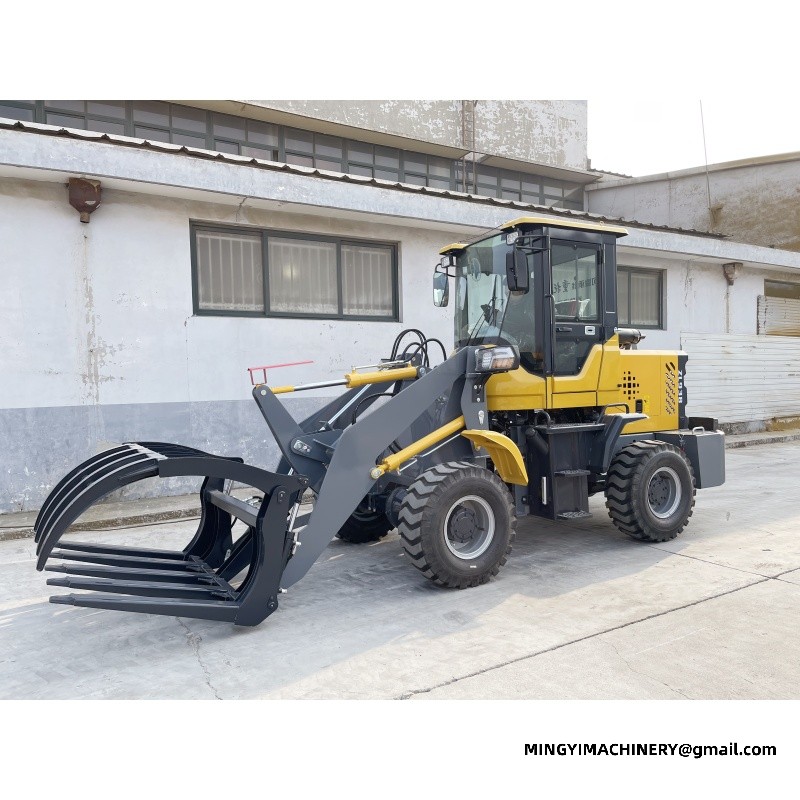
The most lengthy mistake in buying a loader is specifying capacity first. The light-duty 3.2 m low-profile wheel loader and the light-duty 4.2 m medium-frame wheel-side reduction wheel loader differ by 3.2 m against 4.2 m of clearance, and that difference decides which bodies each can fill. Capacity only decides how many passes it takes once clearance exists.
Where clearance is marginal, look at the boom rather than the machine: the light-duty 3.2 m low-profile wheel loader works a 2.3 m arm from a 890 mm centre distance, the light-duty 4.2 m medium-frame wheel-side reduction wheel loader a 2.9 m arm from 900 mm. A longer arm on a lighter frame buys height at the effort of stability, so match the arm to the counterweight — 4 m against 4.3 m — and not to a brochure figure.
| Published build data — light-duty 3.8 m medium-frame wheel-side reduction wheel loader | |
|---|---|
| Bucket capacity | 0.52 m³ |
| Dump height | 3.8 m |
| Track width | 1.6 m |
| Boom arm thickness | 30 mm |
| Boom arm width | 430 mm |
| Boom arm length | 2.9 m |
| Boom arm centre distance | 900 mm |
| Cross-member thickness | 45 mm |
| Front hinge plate thickness | 45 mm |
| Rear hinge plate thickness | 30 mm |
| Rear frame section | 280 mm high x 800 mm wide |
| Hydraulic cylinders | centre cylinder 60 / side cylinder 50 |
| Fuel tank | 70 L (75# large tank) |
| Battery | 80 Ah |
| Front wheel to counterweight | 4.3 m |
| Radiator | 4105 core |
| Work pump | 2063 pump |
| Travel pump | 25 pump |
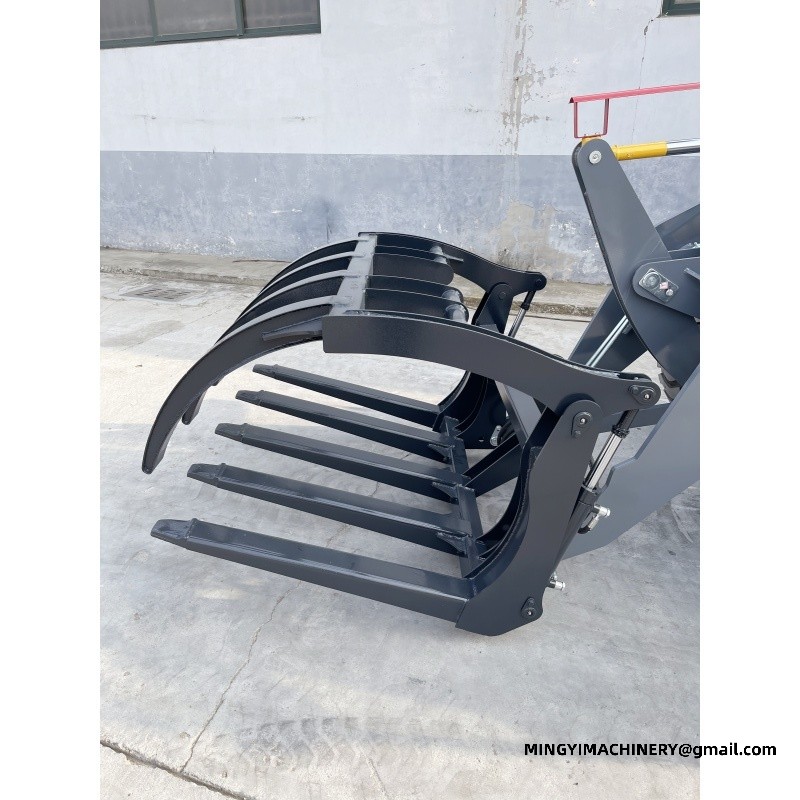
Two figures govern refuelling: tank capacity and consumption per hour, and only the first is published — 64.7 L (75# small tank) on the light-duty 3.2 m small-frame wheel-side reduction wheel loader, 70 L (75# large tank) on the light-duty 3.5 m medium-frame wheel-side reduction wheel loader. Consumption depends on duty, and the duty differences between a 0.38 m³ bucket at 3.2 m and a 0.52 m³ bucket at 3.5 m are mostly about how hard the engine works per cycle.
What you can plan on: a machine working a short, level cycle will finish a shift on one tank; the same machine ripping from a face or loading up a ramp will not. If your site has no refuelling point, size the tank to the worst day rather than the average one, and specify the larger option where a build offers it. The cooling package is the other half of the same calculation — 4100 core (490 engine); 4105 core (4102T engine) on the light-duty 3.2 m small-frame wheel-side reduction wheel loader and 4105 core on the light-duty 3.5 m medium-frame wheel-side reduction wheel loader — because a machine that stops for temperature stops wherever it is.
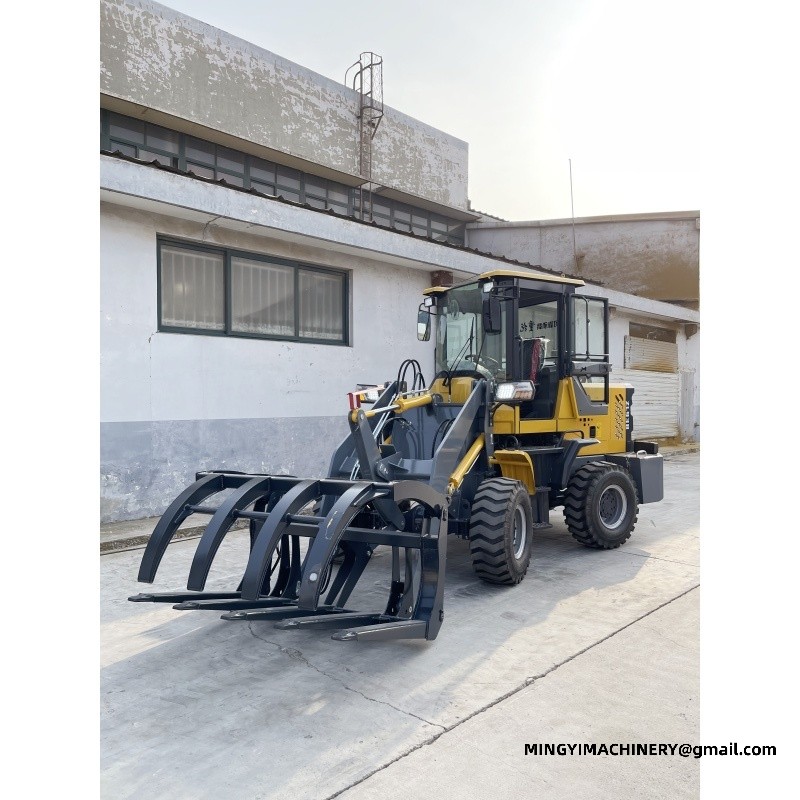
Model names are marketing; build codes are what the shop floor works from. Two machines with the same name can leave the factory with different hinge steel, and the difference is invisible until something wears. On this range the differences are published: 30 mm of cross-member against 45 mm, 30 mm of front hinge plate against 45 mm.
Specify the machine the way you would specify a pump: by the numbers. Bucket 0.4 m³, dump height 4.2 m, cylinders centre cylinder 45 / side cylinder 45, track 1.5 m (wheel-side reduction axle); 1.45 m (Isuzu axle). Write those into the order and the confirmation, and the machine that arrives is the machine you compared. Anything else relies on a name meaning the same thing to two people.
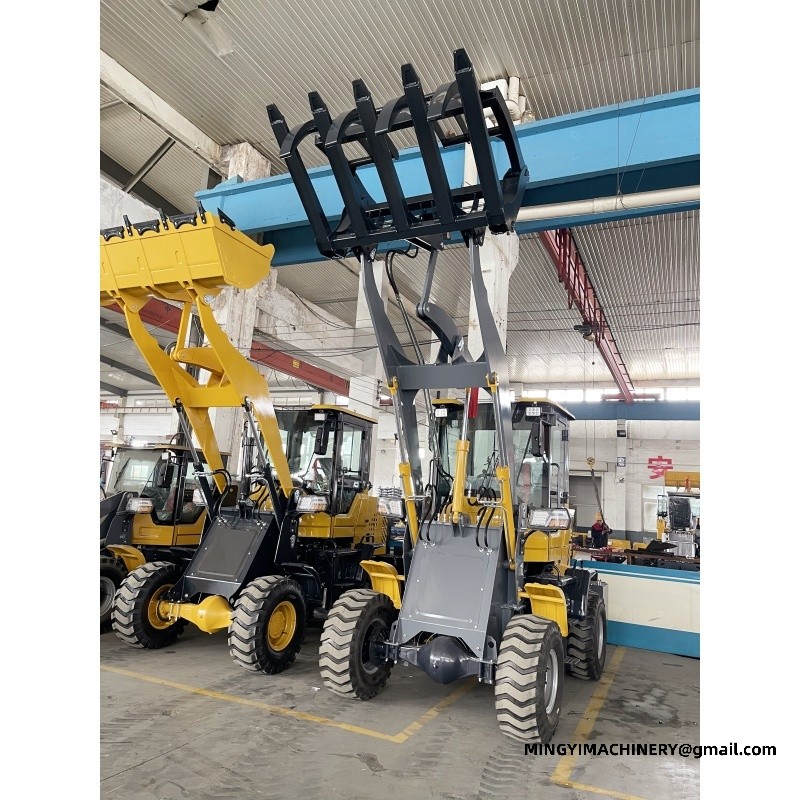
Indoor work changes the priority completely. Height clearance replaces dump height as the first figure, and the machine has to lift its load under a lintel rather than over a truck board. The light-duty 3.2 m low-profile wheel loader reaches 3.2 m, which is the outdoor figure; what matters indoors is whether that height is usable in the space available.
Length and track matter next. 4 m from front wheel to counterweight and 1.5 m (wheel-side reduction axle); 1.45 m (Isuzu axle) of track. Ventilation matters too, which is an engine question rather than a frame one, and the cooling specification is the place it shows: 4100 core (490 engine); 4105 core (4102T engine), sized for air that is not moving. Where the machine works inside, the larger core is the safer specification even in a temperate climate.
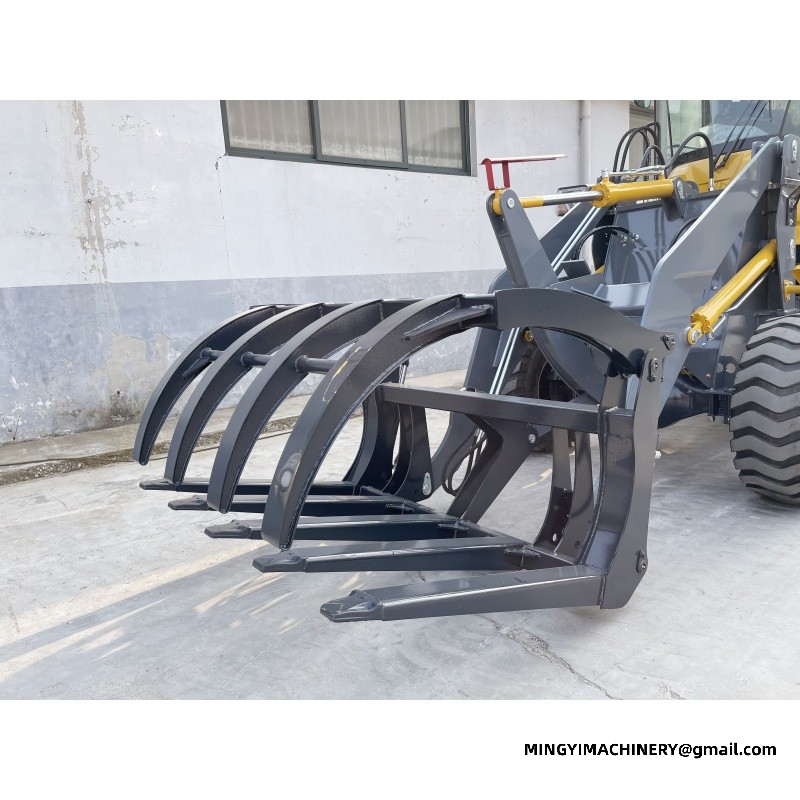
Spares consolidate by frame family rather than by model, which is the point of building a range this way. One cylinder seal kit covers the centre cylinder 45 / side cylinder 40 set across the builds that share it; one pump set covers 40 pump (490 engine); 1045 pump (4102 turbo engine) and 316 pump; pins, bushes and cutting edges are common within a family. On the light-duty 3.2 m small-frame wheel-side reduction wheel loader and the light-duty 4.5 m medium-frame wheel-side reduction wheel loader, where the two share a family, that is four line items.
What to keep on the shelf depends on the duty. A single machine on a farm needs a cutting edge, a hydraulic hose set, filters and a pin and bush kit. A fleet in a quarry needs those plus a cylinder seal kit, a pump, and one spare wheel-end. Because the 25 mm and 45 mm cross-members and the 14 mm and 30 mm hinge plates differ between builds, order wear parts against the model name, not against the frame.
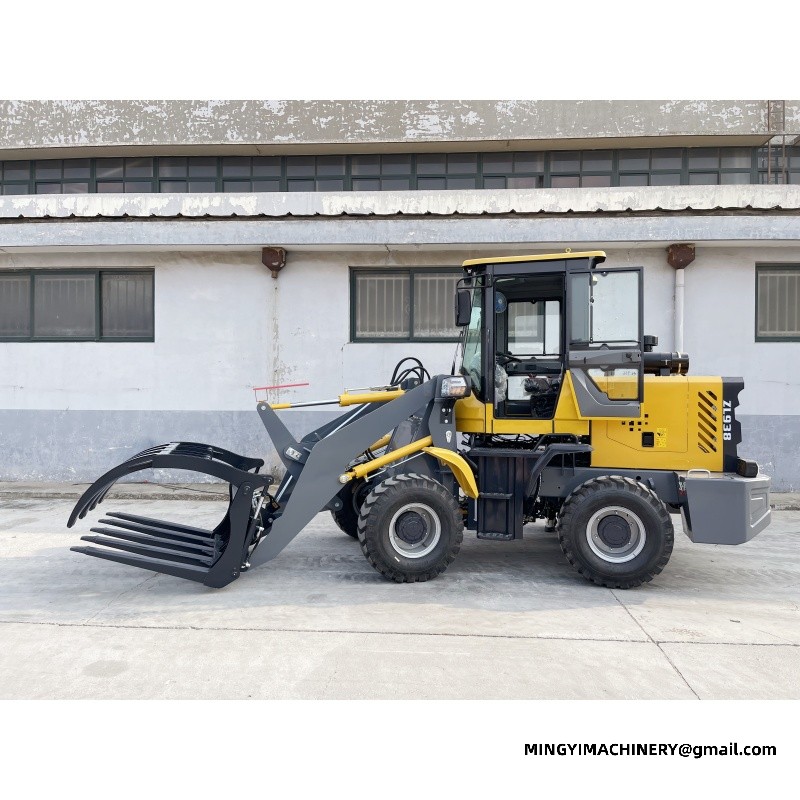
Daily: walk the machine, look at the ground under it, check the coolant level in the 4100 core (490 engine); 4105 core (4102T engine) package, and grease the hinge pins. Weekly: check the cylinder rods for scoring — centre cylinder 45 / side cylinder 40 — and the pins behind the 25 mm front plate for movement. Monthly: check the cross-member and rear frame, 230 mm high x 800 mm wide, for cracks at the weld toes.
None of that needs a workshop, and all of it is what keeps a machine tight. The parts that fail without warning are the ones nobody looks at: the pins, the hoses behind the 40 pump (490 engine); 1045 pump (4102 turbo engine), and the battery terminals on 60 Ah (490 engine); 80 Ah (4102 turbo engine). A ten-minute walk-round finds all three before they stop the machine.
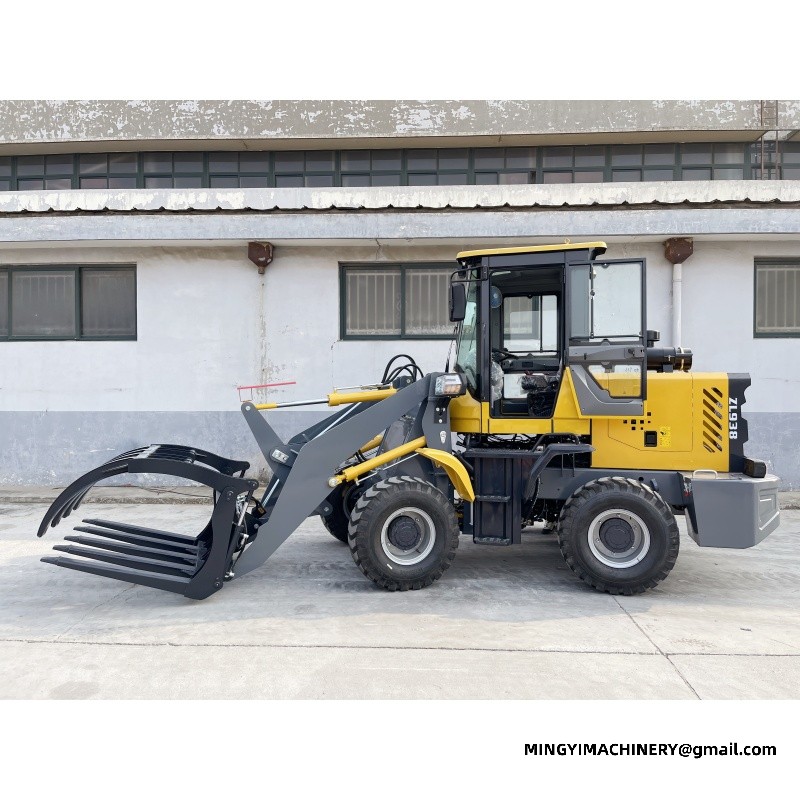
Ask any yard operator which part fails first and the answer is the articulation, not the engine. The rear hinge plate takes every reversing and turning load: 14 mm on the light-duty 3.2 m small-frame wheel-side reduction wheel loader against 30 mm on the light-duty 3.8 m medium-frame wheel-side reduction wheel loader, on cross-members of 25 mm and 45 mm respectively. That pair of figures predicts whether the machine is still tight at year three.
The rest of the specification follows the duty. A 0.38 m³ bucket at 3.2 m with centre cylinder 45 / side cylinder 40 cylinders is right for loose stock and loading out; 0.52 m³ at 3.8 m with centre cylinder 60 / side cylinder 50 is right where the machine has to break out of a face. Ground decides the axle — 1.5 m (wheel-side reduction axle); 1.45 m (Isuzu axle) against 1.6 m — and the material decides the radiator.
Can a hydraulic wheel loader log grapple take a quick coupler?
Yes, if the coupler is built for the boom section and centre distance — 450 mm wide on 900 mm spacing for the light-duty 4.2 m medium-frame wheel-side reduction wheel loader.
How do I choose the right dump height for a hydraulic wheel loader log grapple?
Measure the receiving body at the front board rather than the side: 2.4 m on the standard 2.4 m low-profile wheel loader, 3.5 m on the light-duty 3.5 m medium-frame wheel-side reduction wheel loader. Clearance decides whether the pass is possible at all.
How does a hydraulic wheel loader log grapple cope with dust?
Specify the raised core: 4100 core (490 engine); 4105 core (4102T engine) on the heavy-duty 4.2 m small-frame wheel-side reduction wheel loader against 4105 core on the light-duty 3.5 m medium-frame wheel-side reduction wheel loader, and blow the fins out at the end of every shift in fines or grain.
What is the difference between the two hinge plates on a hydraulic wheel loader log grapple?
The front plate carries boom loads, which are mostly vertical; the rear carries articulation, which is sideways and shock-loaded. Hence 30 mm front against 20 mm rear.
Which figures predict frame life on a hydraulic wheel loader log grapple?
Rear hinge plate and cross-member: 20 mm and 30 mm on the heavy-duty 4.2 m small-frame wheel-side reduction wheel loader, against 30 mm and 45 mm on the light-duty 3.5 m medium-frame wheel-side reduction wheel loader. Those two rows separate light duty from heavy duty.
How does a hydraulic wheel loader log grapple differ from a skid steer?
Articulated steering and a 4.25 m front-to-counterweight length give the loader reach and a smoother ride on rough ground; a skid steer turns in its own length but carries less, higher effort per tonne moved.
Can a hydraulic wheel loader log grapple run a hydraulic attachment?
Yes, provided the third circuit is ordered with the machine. The 40 pump (490 engine); 1045 pump (4102 turbo engine) work pump and 316 pump travel pump are specified per build, and plumbing added later is the usual source of leaks.
Send the application and the receiving body height and we will match a hydraulic wheel loader log grapple to it from the published range — 0.4 m³ bucket at 4.2 m, or 0.52 m³ at 3.5 m — and specification the build, the container plan and the spares package together.
Contact MINGYI Machinery for the current wheel loader lineup, configuration options and a formal specification for your market. E-mail: sales@mingycn.com | LINE (ID): mingyicn
Compact Wheel Loader: Choosing Between the Two Entry Builds · Small Wheel Loader: Light Builds for Farms and Nurseries · Wheel Loader for Agriculture: Gates, Yards and Wagon Sides · Loaders








