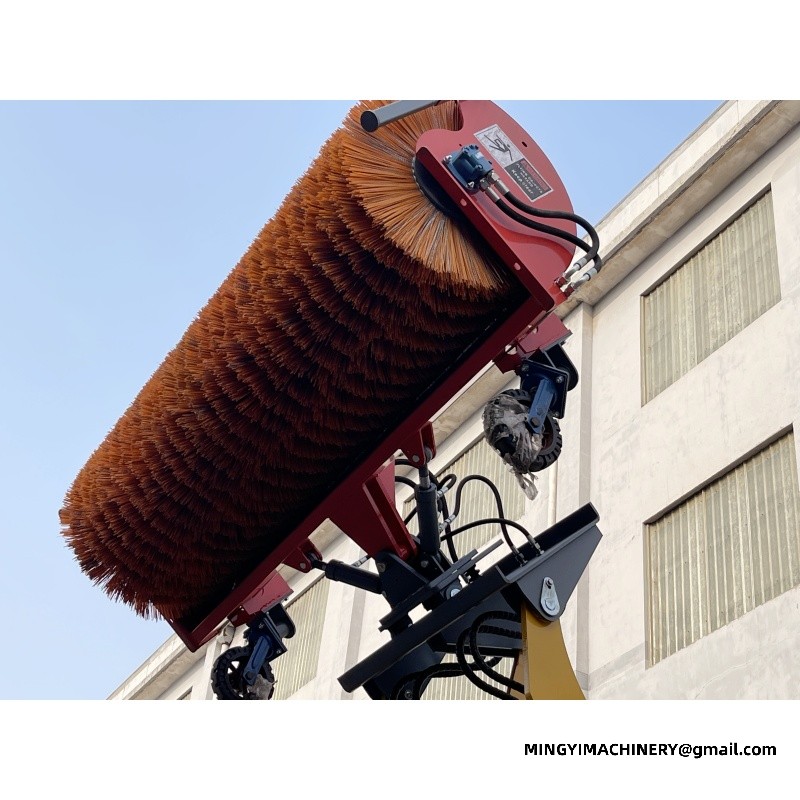
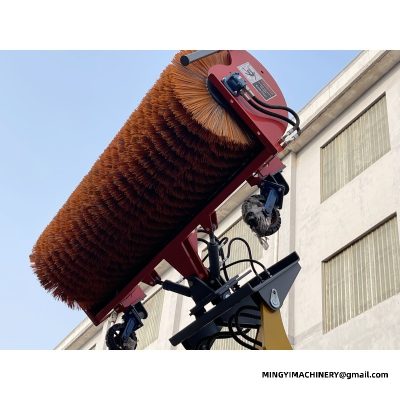
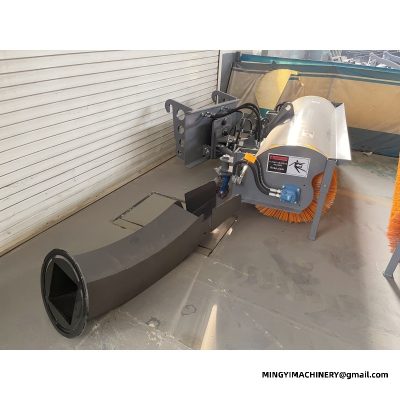
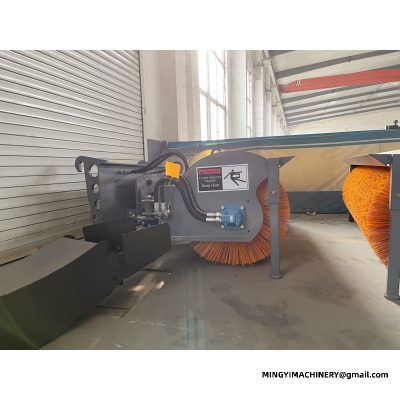
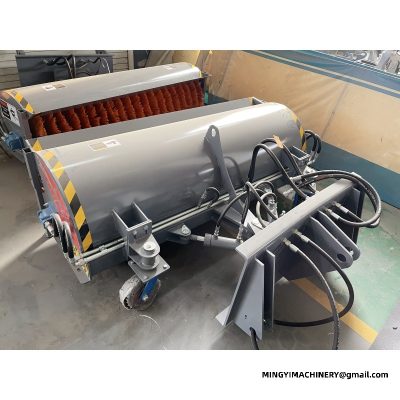
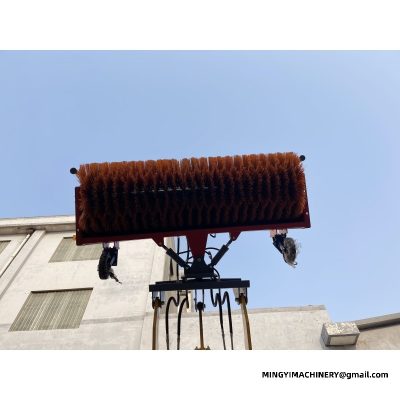
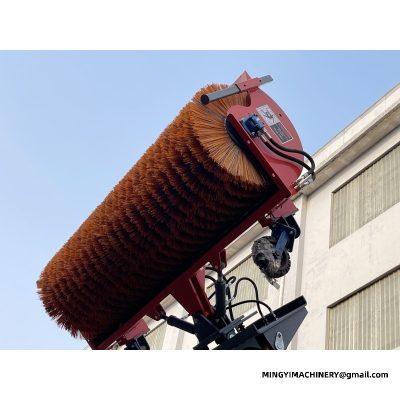
Duty decides the build, and duty is measured in cycles, not in tonnes. A wheel loader snow blower loading twenty trucks a day needs heavier steel than one moving pallets and feed. The figures move together: cross-member 30 mm against 45 mm, rear hinge 20 mm against 30 mm, cylinder set centre cylinder 45 / side cylinder 45 against centre cylinder 60 / side cylinder 50, radiator 4100 core (490 engine); 4105 core (4102T engine) against 4105 core. Buckets are 0.4 m³ and 0.65 m³, dump heights 4.5 m and 3.5 m. This page maps duty to build, with the numbers for each.
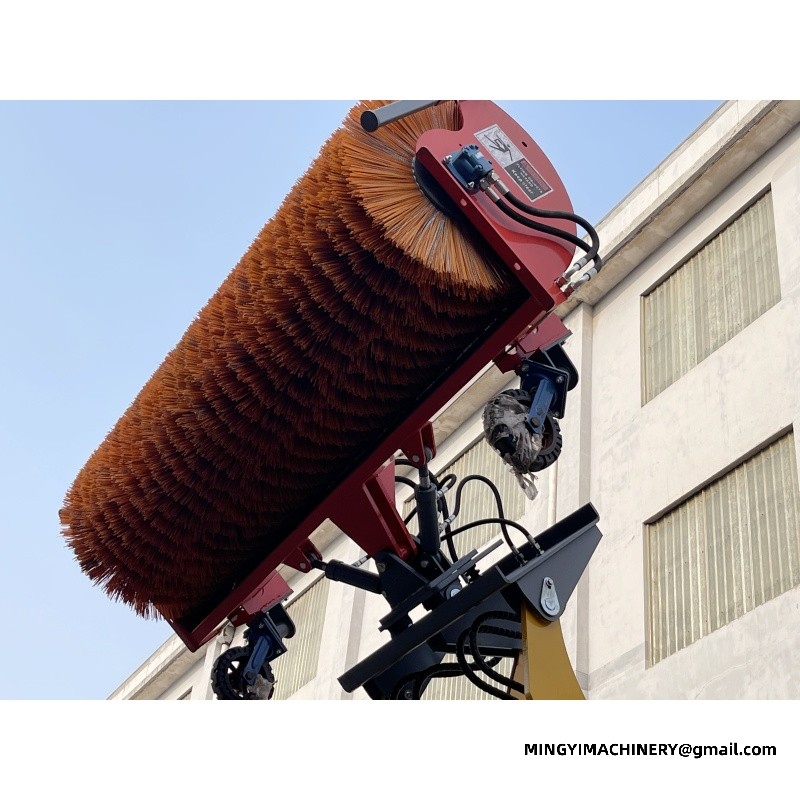
Adding a circuit after delivery is possible and never as good as specifying it at build. The pump is the constraint: 32 pump on this machine, 316 pump alongside it. Flow has to be shared, and a circuit added later shares it through plumbing that was not laid out for it.
The cylinders are less often the limit than people assume. centre cylinder 45 / side cylinder 40 gives the mechanical advantage; the pump gives the speed. If an attachment works but works slowly, look at flow before looking at bore. If it works but the arm twists, look at section instead: 300 mm of width and 680 mm of spacing resist that, and neither can be improved after the frame is welded.
The bucket figures in the table are engineering capacities: 0.4 m³ on the heavy-duty 3.2 m low-profile wheel loader, 0.65 m³ on the heavy-duty 4.2 m medium-frame wheel-side reduction wheel loader. They assume a material density, and the machine is stable with them at full lift because the counterweight and the 4.1 m or 4.55 m footprint were sized around that density.
Change the material and you change the limit, not the machine. Light material — grain, woodchip, compost, snow — lets you run a larger bucket and a higher cycle. Heavy material — wet sand, crushed stone, ore — means the 0.65 m³ bucket needs the 30 mm rear hinge plate and 45 mm cross-member behind it, and the 0.4 m³ bucket on the lighter frame is the honest specification for the lighter material. Tell the factory what you are moving and let them match the bucket to it.
Winter changes three things: the battery has less to give, the oil is thicker, and the operator is working in gloves. The first two are specification questions. 60 Ah (490 engine); 80 Ah (4102 turbo engine) covers the first. The hydraulic side, centre cylinder 45 / side cylinder 45 with a 40 pump (490 engine); 1045 pump (4102 turbo engine), is sized for the loads it will see at working temperature and will simply be slower until it warms.
The third is a machine-layout question and comes down to the rear frame and the tank: 280 mm high x 800 mm wide of rear section and 64.7 L (75# small tank) of fuel. Cold-weather work also means more idling, so tank capacity should be read against winter consumption rather than summer consumption. A machine that needs refuelling at minus ten with an operator standing outside is a specification failure, not a weather problem.
| Published build data — heavy-duty 3.8 m medium-frame wheel-side reduction wheel loader | |
|---|---|
| Bucket capacity | 0.65 m³ |
| Dump height | 3.8 m |
| Track width | 1.6 m |
| Boom arm thickness | 30 mm |
| Boom arm width | 500 mm |
| Boom arm length | 2.9 m |
| Boom arm centre distance | 920 mm |
| Cross-member thickness | 45 mm |
| Front hinge plate thickness | 45 mm |
| Rear hinge plate thickness | 30 mm |
| Rear frame section | 300 mm high x 800 mm wide |
| Hydraulic cylinders | centre cylinder 60 / side cylinder 50 |
| Fuel tank | 70 L (75# large tank) |
| Battery | 80 Ah |
| Front wheel to counterweight | 4.55 m |
| Radiator | 4105 core |
| Work pump | 2063 pump |
| Travel pump | 25 pump |
Every loader purchase starts with the thing being loaded into. On this range the choice runs from 4.5 m on the heavy-duty 4.5 m small-frame wheel-side reduction wheel loader to 3.8 m on the heavy-duty 3.8 m medium-frame wheel-side reduction wheel loader, and the gap between those two figures is the gap between a machine that feeds a small mixer and one that feeds a highway truck.
Take the measurement at the highest point the bucket must clear, on the near side, with the truck loaded — a suspension that settles under load lowers the board. Then add allowance for the operator's approach angle. The heavy-duty 4.5 m small-frame wheel-side reduction wheel loader at 4.5 m with a 0.4 m³ bucket and a 3.15 m arm is a compact answer; the heavy-duty 3.8 m medium-frame wheel-side reduction wheel loader at 3.8 m with 0.65 m³ and a 2.9 m arm is the answer where the board is high.
Battery capacity appears in the table as 60 Ah (490 engine); 80 Ah (4102 turbo engine) for the heavy-duty 3.2 m low-profile wheel loader and 60 Ah (490 engine); 80 Ah (4102 turbo engine) for the heavy-duty 4.5 m small-frame wheel-side reduction wheel loader. On builds with two engine options the two figures track the engines: the naturally aspirated unit cranks on less, the turbo needs more, and the 24 V system exists precisely because cranking a turbo diesel at minus ten needs the extra headroom.
What buyers should confirm before dispatch is not the capacity but the condition and the connections. Machines ship with batteries disconnected and boxed, so the first start is also the first check of every terminal. On the heavy-duty 3.2 m low-profile wheel loader that pack feeds the 4100 core (490 engine); 4105 core (4102T engine) cooling circuit's fan drive and the instrument cluster; on the heavy-duty 4.5 m small-frame wheel-side reduction wheel loader it feeds 4100 core (490 engine); 4105 core (4102T engine) and the same cluster. A marginal earth shows up as a slow crank in winter and as gauge flicker in summer.
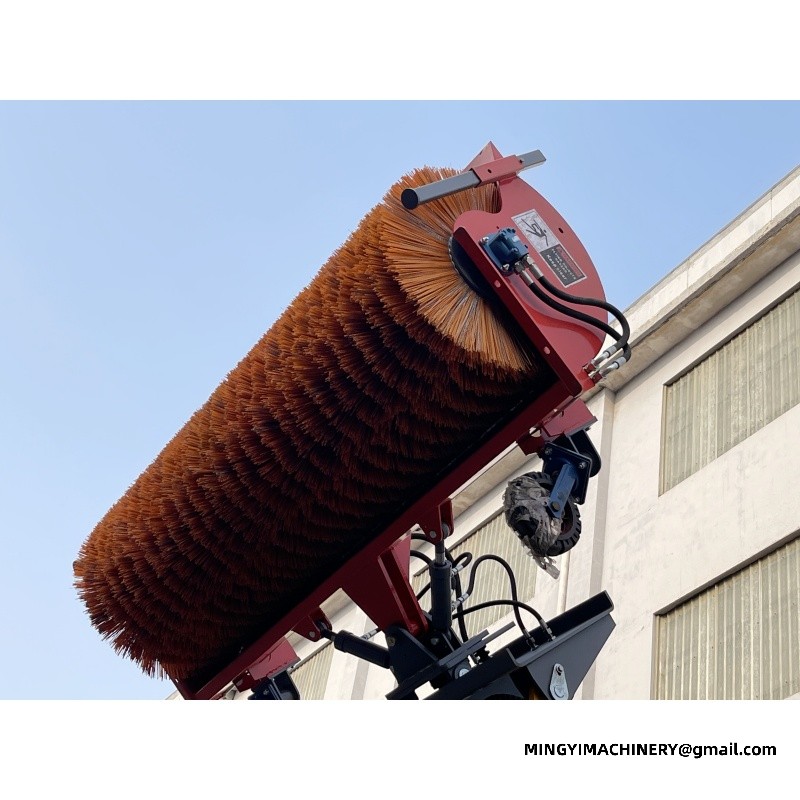
The distance from the front wheel to the rear of the counterweight is a stability specification dressed as a dimension. On the heavy-duty 3.2 m small-frame wheel-side reduction wheel loader it is 4.1 m working with a 0.4 m³ bucket at 3.2 m; on the heavy-duty 3.8 m medium-frame wheel-side reduction wheel loader it is 4.55 m with 0.65 m³ at 3.8 m. Longer means more counterweight leverage, which is what lets a machine carry a full bucket high without lifting the rear wheels.
Longer also means a bigger turning circle, and that is the trade. In an open pit or a wide yard the 4.55 m machine with its 1.6 m track is plainly the better tool. In a livestock shed, a nursery or an indoor renovation job, the 4.1 m machine on 1.5 m (wheel-side reduction axle); 1.45 m (Isuzu axle) will do work the other cannot start. Measure first; the specification only tells you what you are choosing between.
Frames do not usually fail at the boom. They fail at the hinge plates and the cross-member that ties them together, because that is where the articulated joint concentrates every steering and breakout load. On the heavy-duty 3.8 m medium-frame wheel-side reduction wheel loader those figures are 45 mm front, 30 mm rear and 45 mm across; on the heavy-duty 4.5 m medium-frame wheel-side reduction wheel loader they are 45 mm, 30 mm and 45 mm. The rear frame sections are 300 mm high x 800 mm wide and 300 mm high x 800 mm wide.
Why the rear plate is the one to watch even though it is the thinner of the two: the front hinge sees the boom loads, which are predictable and largely vertical; the rear sees articulation loads, which are sideways, repeated and often shock-loaded when an operator turns while breaking out. A machine specified with a 30 mm rear plate and a 45 mm cross-member will still be tight at year three in reverse-loading cycles where a 30 mm plate has started to ovalise its pin bores. If your fleet keeps machines past warranty, this is the row of the table to read twice.
The commercial logic of a family-built range is parts commonality. Within a frame family the centre cylinder 45 / side cylinder 45 cylinder set, the 40 pump (490 engine); 1045 pump (4102 turbo engine) work pump and the 316 pump travel pump are shared, and the boom section — 430 mm on the heavy-duty 3.2 m small-frame wheel-side reduction wheel loader — is the same, so attachments interchange. Across families, as between the heavy-duty 3.2 m small-frame wheel-side reduction wheel loader and the heavy-duty 3.2 m low-profile wheel loader, the cylinder set moves to centre cylinder 45 / side cylinder 45 and the section to 430 mm.
For a distributor that translates into a small, fast-moving inventory: one seal kit per cylinder family, one pump pair per family, pins and bushes per boom section, and cutting edges per bucket. Add the model-specific items — the 30 mm or 30 mm cross-member is not a wear part and does not need stocking — and the whole range is supported from a shelf that fits in a container.
What boom wall thickness does a wheel loader snow blower need?
25 mm on the heavy-duty 4.5 m small-frame wheel-side reduction wheel loader against 30 mm on the heavy-duty 4.2 m medium-frame wheel-side reduction wheel loader. A long arm on a thin wall lifts on paper and feels vague in the yard, so read wall and length together.
Why does boom centre distance matter on a wheel loader snow blower?
It sets how side loads travel into the frame: 890 mm on the heavy-duty 4.5 m small-frame wheel-side reduction wheel loader against 920 mm on the heavy-duty 3.5 m medium-frame wheel-side reduction wheel loader. Wider spacing lets the cylinders work through a better lever.
Can a wheel loader snow blower take a quick coupler?
Yes, if the coupler is built for the boom section and centre distance — 500 mm wide on 890 mm spacing for the heavy-duty 4.5 m small-frame wheel-side reduction wheel loader.
What does the cross-member figure tell me about a wheel loader snow blower?
How well the frame resists the twisting that articulation puts into it: 30 mm on the heavy-duty 3.2 m low-profile wheel loader against 45 mm on the heavy-duty 4.5 m medium-frame wheel-side reduction wheel loader. It is the clearest marker of build class.
Can a wheel loader snow blower be built with a non-standard bucket?
Yes, provided the volume suits the frame: the 0.4 m³ bucket on the heavy-duty 4.5 m small-frame wheel-side reduction wheel loader and the 0.65 m³ bucket on the heavy-duty 3.5 m medium-frame wheel-side reduction wheel loader are the engineered sizes, and heavier material means a smaller bucket.
How many units of a wheel loader snow blower fit one container?
Two to three, loaded knock-down. Rear frame sections stay between 280 mm high x 800 mm wide and 230 mm high x 800 mm wide across the range, so a forty-foot box takes a mixed pair or trio.
Which wheel loader snow blower build suits site work?
The heavier one, because dump height and hinge steel govern the day: 0.65 m³ at 3.8 m with 30 mm rear hinge plates and a 45 mm cross-member.
Specifications are built per order: machine, attachments, spares box and container plan together. Because rear frame sections stay between 280 mm high x 800 mm wide and 300 mm high x 800 mm wide across the wheel loader snow blower range, two to three units ship in one forty-foot box.
Reading the early symptoms on Wheel Loader Snow Blower: Specifying the Third Circuit
The symptom is usually not at the fault. A hydraulic function that has become sluggish on Wheel Loader Snow Blower: Specifying the Third Circuit may point to a filter, a relief setting or a pump, and starting with the simple checks avoids the wrong guess.
Cold weather and winter care for Wheel Loader Snow Blower: Specifying the Third Circuit
Winter is hard on rubber and on seals as much as on the engine. Parking Wheel Loader Snow Blower: Specifying the Third Circuit under cover, keeping the tracks or tyres off standing water and checking the hoses for cracking are all part of the season.
Contact MINGYI Machinery for the current wheel loader lineup, configuration options and a formal specification for your market. E-mail: sales@mingycn.com | LINE (ID): mingyicn
Wheel Loader Snow Pusher: Frame Loads and Cold-Weather Starting · Wheel Loader Log Grapple: Grapple Loads and Hinge Steel · Compact Wheel Loader: Small Builds, Daily Yard Work · Loaders








