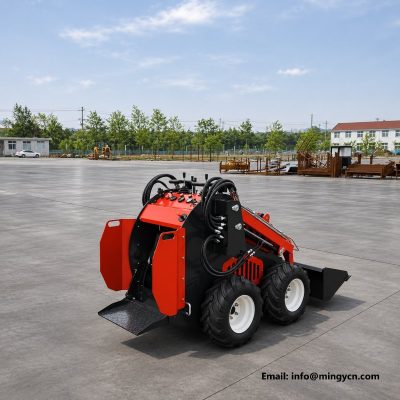
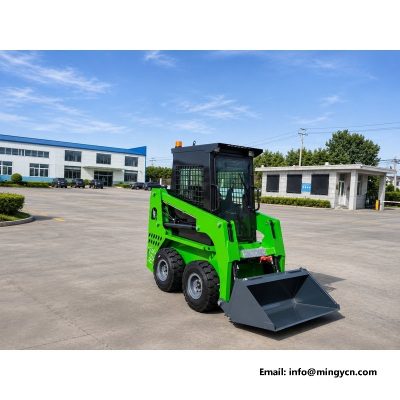
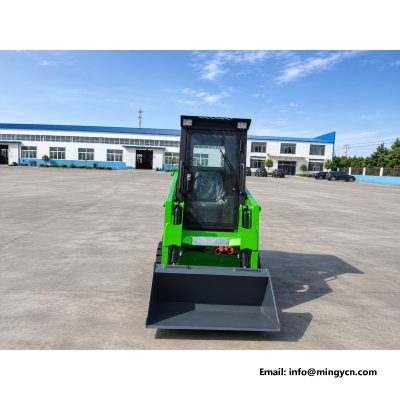
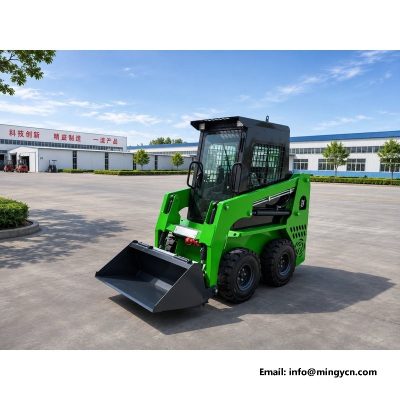
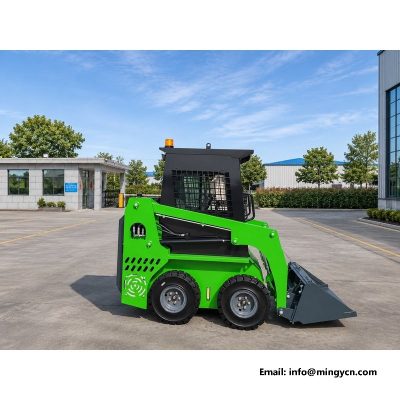
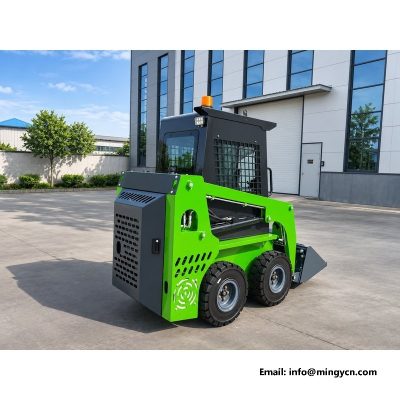
Wheeled version of the MY25 skid steer loader for hard standing and frequent transfers.
The MY25 wheeled skid steer is the hard-ground partner to the crawler version: four wheel motors, an open-circuit load-sensing piston pump, pilot joysticks, a standard quick-attach coupler and the Runtong R999 engine, arranged for yards, driveways, car parks and asphalt. This page explains how the wheeled layout behaves in use, why it turns and travels the way it does, how tyres and hydraulics are maintained, what the workshop photographs show, and how a buyer should choose between wheels and tracks when both machines share the same model name. The photographs are yard shots, so they show the machine much as it will be shipped.
Buyers often ask which version is better, and the honest answer is that they are built for different ground. The wheeled MY25 is the machine for yards, driveways, car parks, warehouses and asphalt. It travels faster between jobs, turns on hard standing without tearing the surface, and costs less to keep in running gear because tyres are simpler than tracks. The crawler version takes over where the ground is soft or the surface must be protected. Many contractors who own both send the wheeled machine to the front of the site and the crawler to the garden behind it. Seeing the division that way is more useful than comparing the two on one specification line, because neither is a compromise: each is right on its own ground. The two share a model name and most of their hydraulics, which is where the confusion starts.
This machine drives through four wheel motors rather than a single hydrostatic transmission feeding an axle. Each wheel carries its own motor, so the drive is direct and there is no differential to spin, no driveshaft to guard and no axle housing hanging below the chassis. The practical benefit is control at low speed: the machine creeps when the levers are barely moved, which is what an operator needs when lining up on a pallet or edging along a kerb. Independent drive also lets the wheels counter-rotate for a tight turn, with the scrub spread across four contact patches instead of concentrated on two. Fewer mechanical parts between pump and ground means fewer things to wear, and easier access when something finally does. It also lets the machine walk out of a soft patch instead of spinning one wheel.
| Model | MY25 |
| Hydraulic system | Open-circuit piston pump, load-sensing |
| Control | Pilot joystick operation |
| Drive | Four wheel-motor travel drive |
| Quick coupler | Standard quick-attach coupler |
| Engine | Runtong R999 (standard) |
Skid steering turns a wheeled machine by forcing the tyres to slide sideways, and concrete or asphalt is exactly where the technique works best. The tyres scrub predictably, the machine pivots about its centre, and the operator can place the bucket within a hand's width of a wall and then turn away without a three-point manoeuvre. On a car park, a loading bay or a factory yard, that saves time on every cycle. The cost is tyre wear at the shoulders, which is why turning style matters so much. A driver who turns on the move, rather than stopping and spinning, gets far more life from a set of tyres and leaves less black rubber on the surface. Watch an operator turn before buying a machine, because the habit costs more than any specification difference.
The working surface tells the story. Concrete yards, asphalt drives, block paving, warehouse floors and compacted hardcore all suit a wheeled machine, because the ground carries the load and the tyres grip without cutting in. Travel between plots on a development is quick, and the machine can cross a road or a yard without the care a track machine demands. Municipal depots like it for the same reasons: a wheeled loader runs from the yard to the pavement and back several times a day without damage to either. The limitation is soft ground. Wet soil, sand, freshly ploughed fields and steep grass will stop a wheeled machine sooner than a tracked one, and no amount of operator skill fully closes that gap. Ask what the machine will stand on for most of its hours.
Tyres are the cheapest maintenance item on the machine and the easiest to neglect. Pressure should be checked cold and set to the figure in the manual, not to what the tyre looks like: a soft tyre squats, heats and fails at the sidewall, while a hard one concentrates wear down the centre of the tread. Read the wear pattern before adjusting anything. Wear on both shoulders points to under-inflation, wear down the middle to over-inflation, and wear on one side only usually means the machine is always turned the same way. Rotating tyres between sides evens out the scrub from skid steering. Note the hours at each change, and replace as a set rather than mixing new and worn tyres. A cheap tyre that fails early costs more than a good one that wears slowly.
The wheeled MY25 uses the same hydraulic philosophy as the crawler version: an open-circuit piston pump with load sensing, and pilot joysticks in place of mechanical linkages. The combination gives the operator a lever that moves a short distance and a machine that answers in proportion. On a wheeled chassis this is felt when the bucket is used for grading, because the machine can be edged forward on the drive while the arm is feathered, and the two motions stay independent. It is felt again with attachments that need steady flow, such as a broom or an auger, where a pump that reacts to load keeps the tool turning at a consistent speed instead of surging. The result is less correction, less heat and longer oil life. That consistency is what gives a broom an even finish.
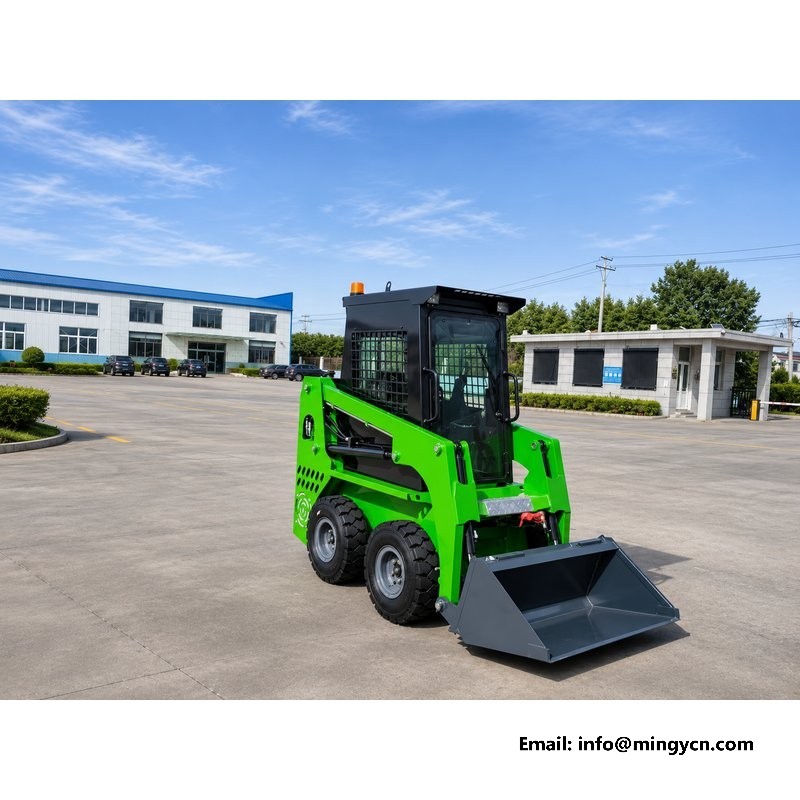
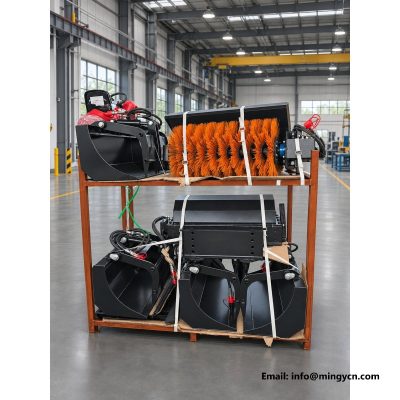
A skid steer is bought as a chassis and then equipped as a tool carrier, so the coupler deserves as much attention as the engine. The standard quick-attach plate lets the operator pick up a bucket, forks, a grapple, a sweeper or a snow blade without leaving the seat, provided the attachment is built to the same pattern. Before ordering, list the attachments the machine will actually run and check two things: that the coupler pattern matches what is available locally, and that the auxiliary circuit can supply them. A coupler that is worn or badly adjusted lets the attachment rock, which sends shock into the loader arms. Grease the locking faces, inspect the pins and confirm the lock engages fully every time. Store spare attachments on a stand, so the faces do not rust.
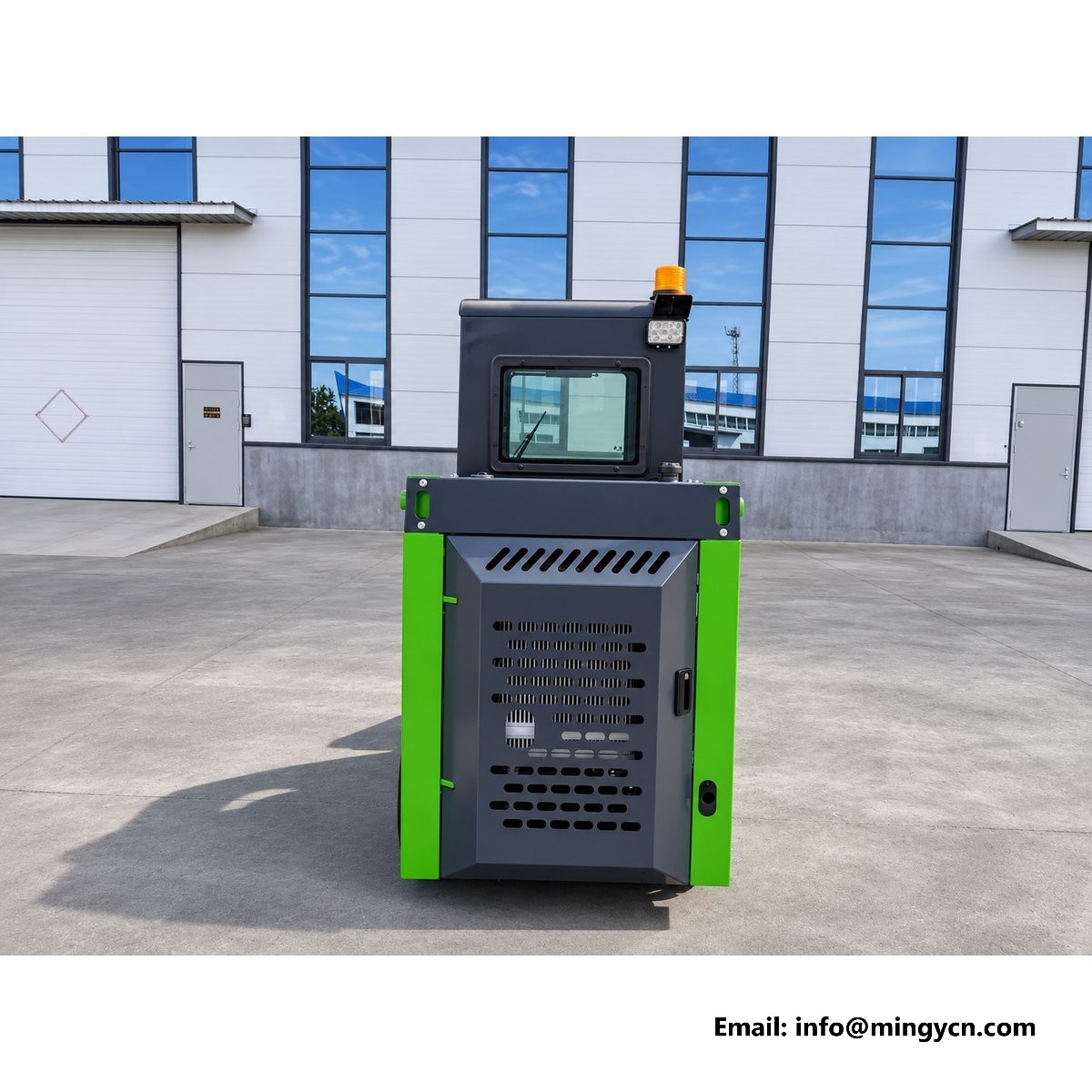
The Runtong R999 is the standard engine in the MY25, and on a wheeled machine the service points are easier to reach than on a tracked one because no undercarriage sits in the way. Open the engine cover and look at what a daily check actually involves. The dipstick, coolant cap and air cleaner should be reachable without tools. The fuel filter should sit where it can be changed without diesel running onto the block, and the battery should be accessible for a jump start in winter. Around the engine, confirm that the radiator core and any oil cooler can be cleaned of dust and chaff, because a blocked core is the most common cause of overheating. Log filter changes by hour reading, not by calendar date, because a machine that works hard for two months and then stands idle will not follow a calendar.
One advantage of a wheeled machine rarely appears on a specification sheet: how it changes the shape of a working day. Moving between two parts of a site takes minutes rather than a loading operation, so the machine can serve several work fronts and return to the yard for fuel or another attachment without a trailer. On a development with a road through it, a wheeled skid steer crosses at a controlled point and carries on, where a tracked machine would need boards or a mat to protect the surface. Contractors allow for this when they cost a job. A machine that repositions itself quickly is a machine that spends more of the day working, and the gain lies in interruptions avoided rather than in top speed. On a large site that saving is measured in hours each month.
Winter work is where the wheeled skid steer is often at its most valuable, because the surfaces that need clearing are the ones it handles best. Car parks, pavements, depot yards and access roads are hard standing, and a wheeled machine with a snow blade or a rotary broom clears them at a working pace without damaging what lies underneath. The tyres grip on cold asphalt, and the machine turns at the end of a run without leaving ruts. Municipal buyers also value the attachment range: the chassis that clears snow in January can sweep a market square in April and move pallets in between. That year-round utilisation is the argument for buying a carrier rather than a single-purpose machine. Blades and brooms change in minutes with the quick coupler.
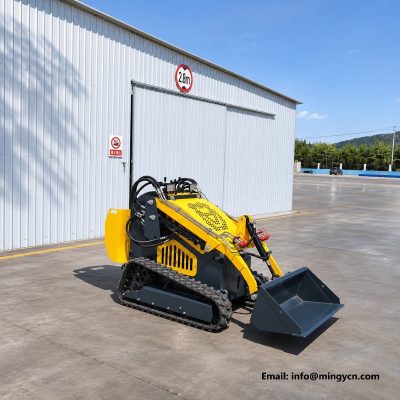
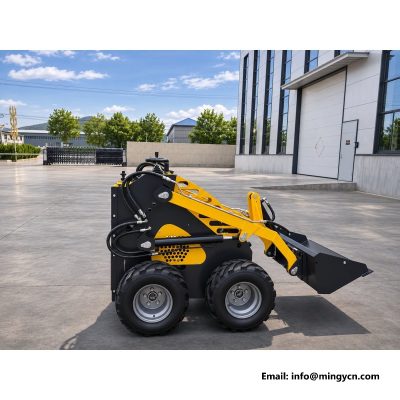
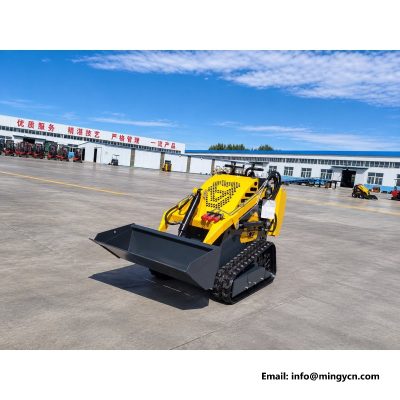
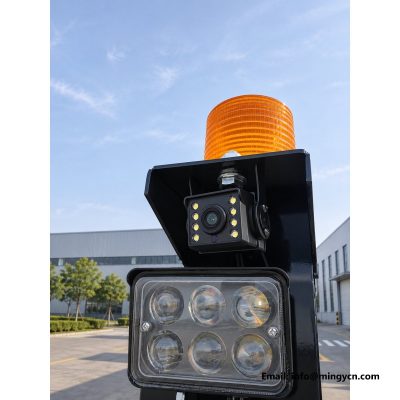
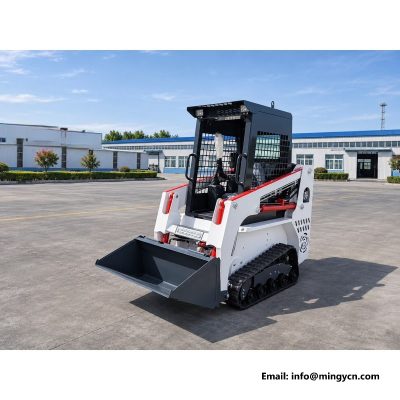
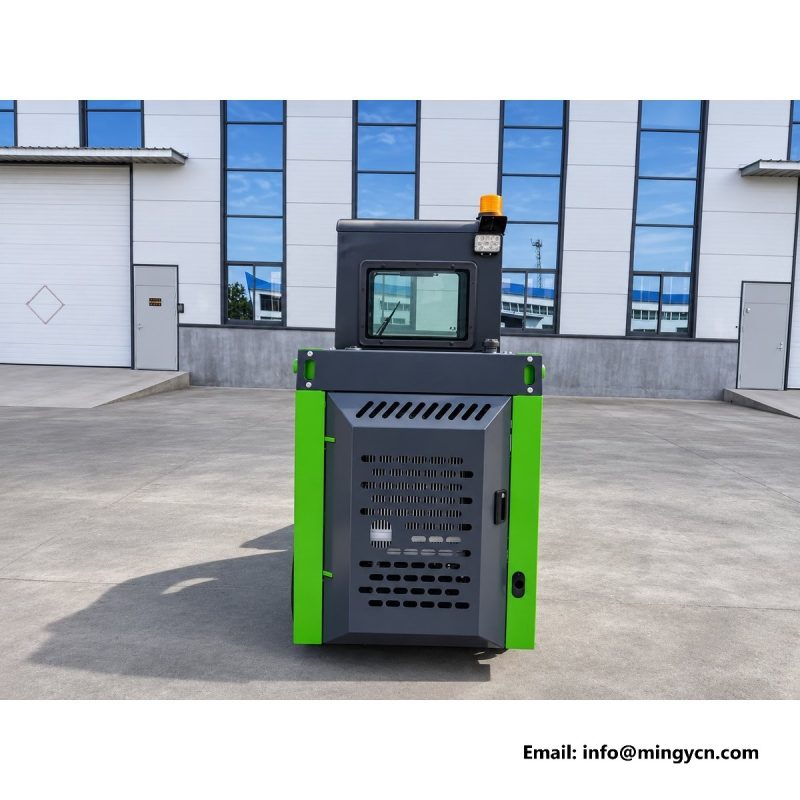
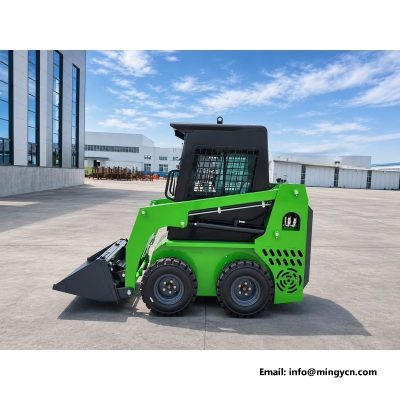
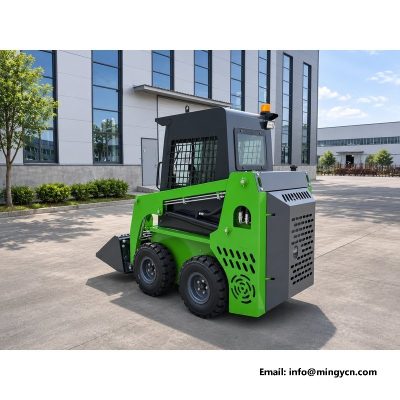
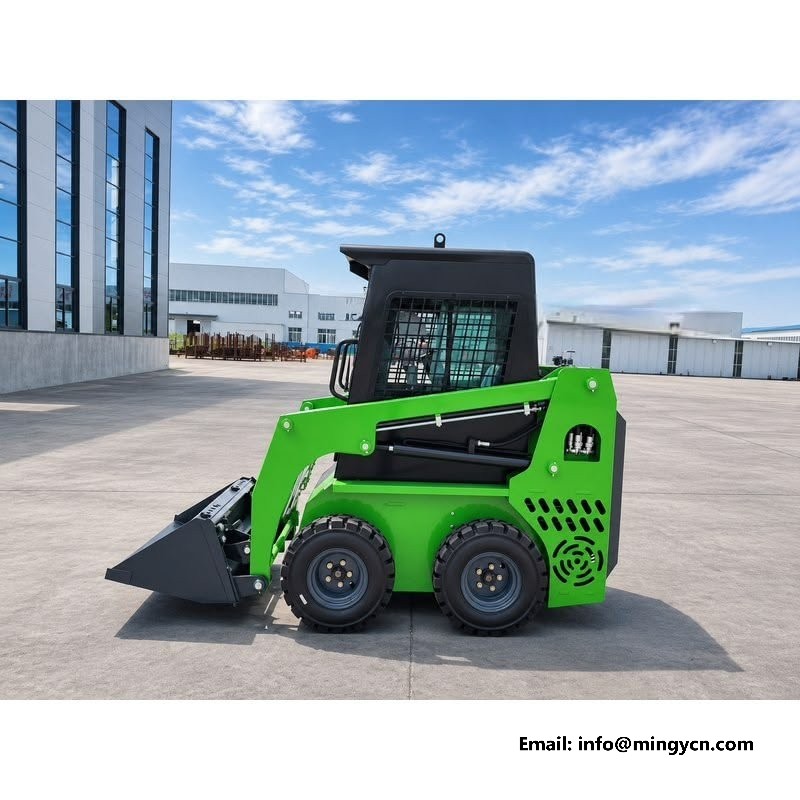
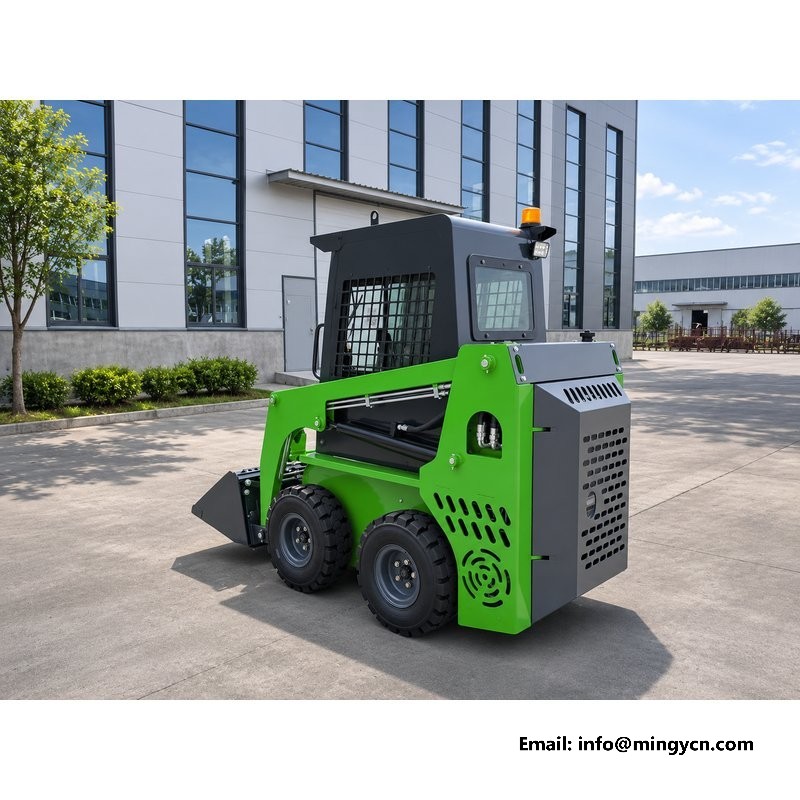
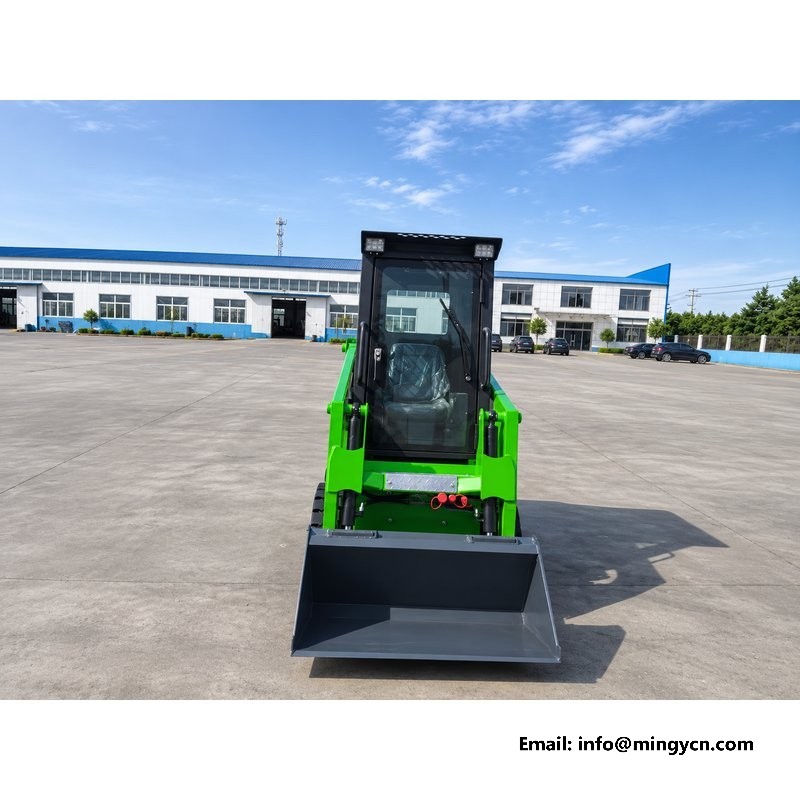
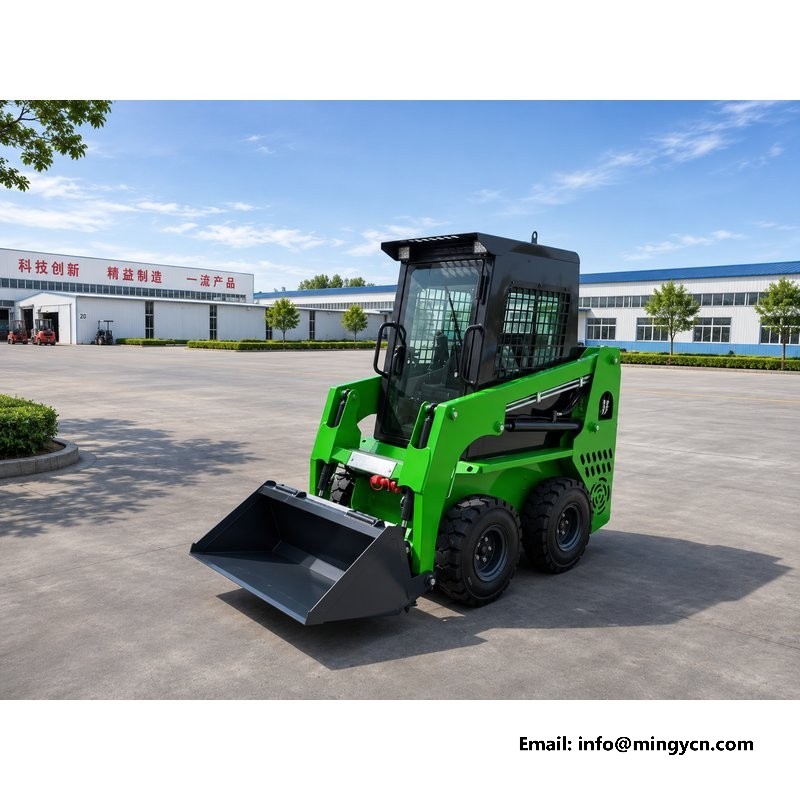
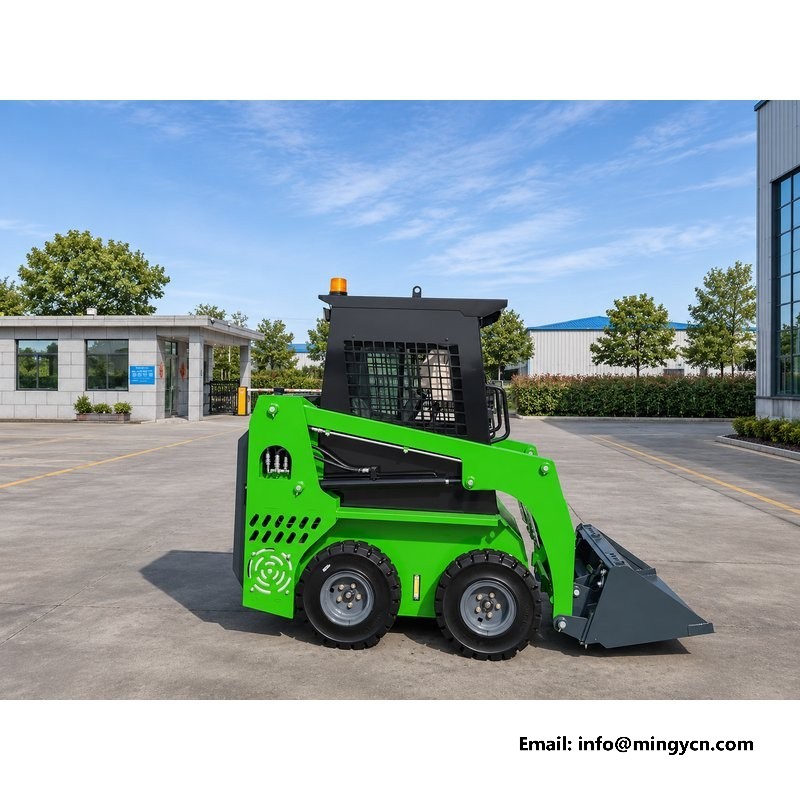
The photographs on this page were taken in the yard rather than a studio, which makes them useful for different reasons. The three-quarter views show the loader arms, the quick-attach plate and the way the bucket sits on the ground. The side view shows the wheelbase, the step into the operator position and the clearance under the chassis. The rear view shows the engine cover, the counterweight and the access panel. Look closely at the paint on the wheel rims and the condition of the tyres, because these are the parts that reveal how a machine has been stored and moved. A machine photographed from several angles, with nothing hidden, is usually one the builder is willing to stand behind. If a choice of tyres is offered, ask which set is fitted here.
The decision comes down to the ground the machine will work on and the surface it must not damage. Choose the wheeled version when most work is on concrete, asphalt, paving or compacted hardcore, when the machine has to move between sites on its own, and when tyre running costs are easier to budget than track replacement. Choose the crawler when the ground is soft, when lawns and verges must be protected, or when the machine will spend its time on soil and gravel. If the work is genuinely mixed, the answer is usually one of each, with the wheeled machine handling the front of the site. Buyers who cannot run two machines should count the days spent on each surface first, and write the split down. Revisit it after the first season, when the real pattern of work is known.
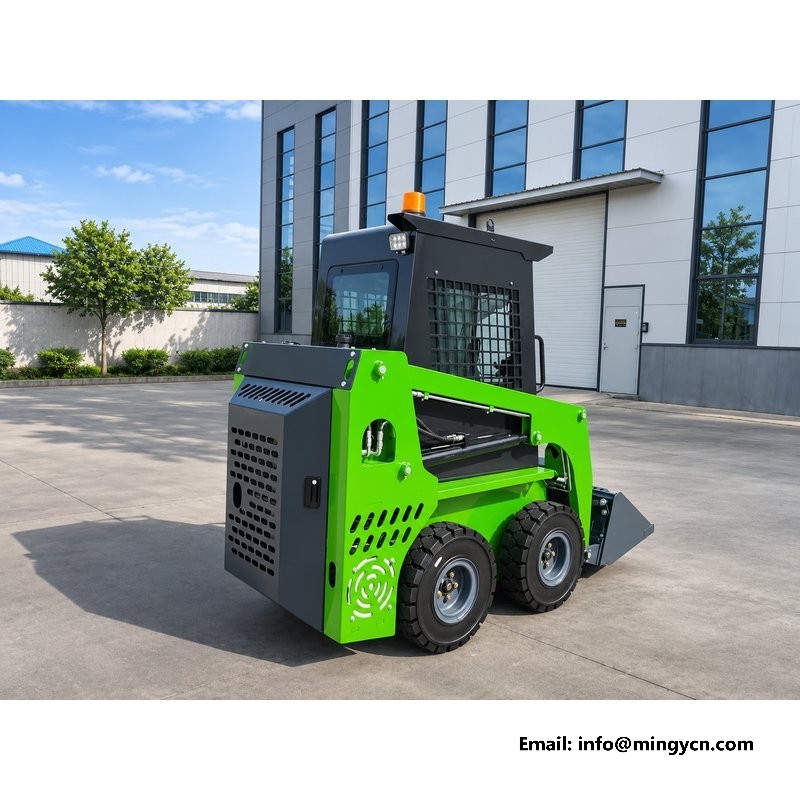
When most work is on concrete, asphalt, paving or compacted hardcore, when the machine has to move between sites or across a road under its own power, and when tyre costs are easier to budget than track replacement. A wheeled machine also turns on hard standing without tearing the surface. On soft soil, sand or steep wet grass, the crawler version will keep working long after the wheeled machine has stopped.
Life depends far more on how the machine is turned than on the tyre itself, because skid steering scrubs the shoulders on every tight turn. Operators who turn on the move and avoid spinning on the spot get substantially more hours from a set. Correct cold pressure, rotation between sides and prompt replacement of damaged tyres all help. Keep a written record at each change so the next set can be planned rather than bought in a hurry.
Ordering and technical support
Email: sales@mingycn.com
LINE (ID): mingyicn
Tell us your working width, ground conditions and the attachment you need, and we will confirm the right configuration and shipping details.