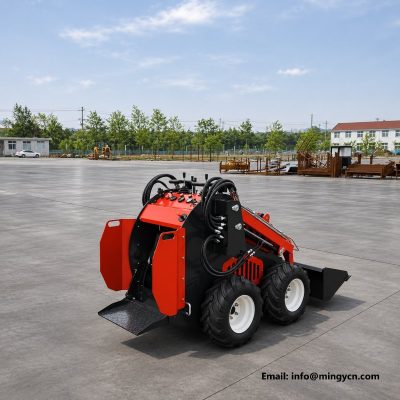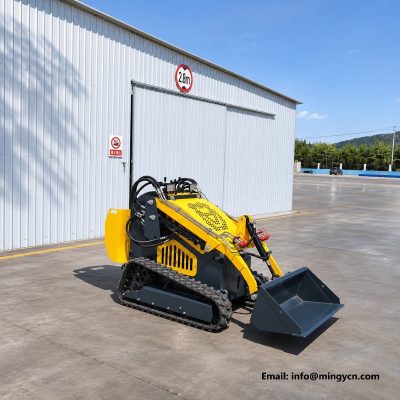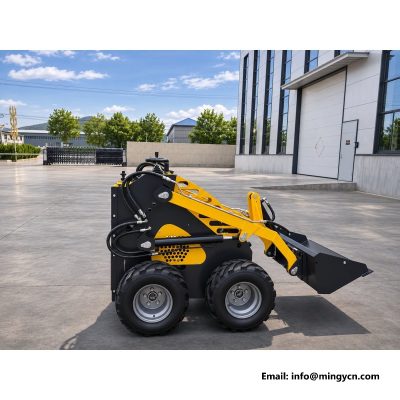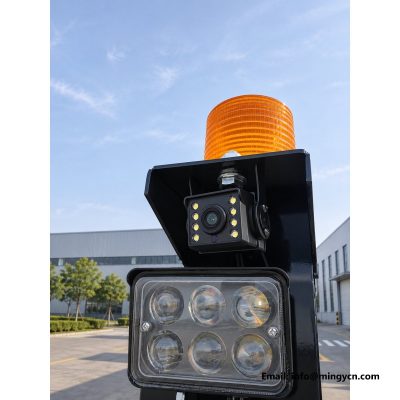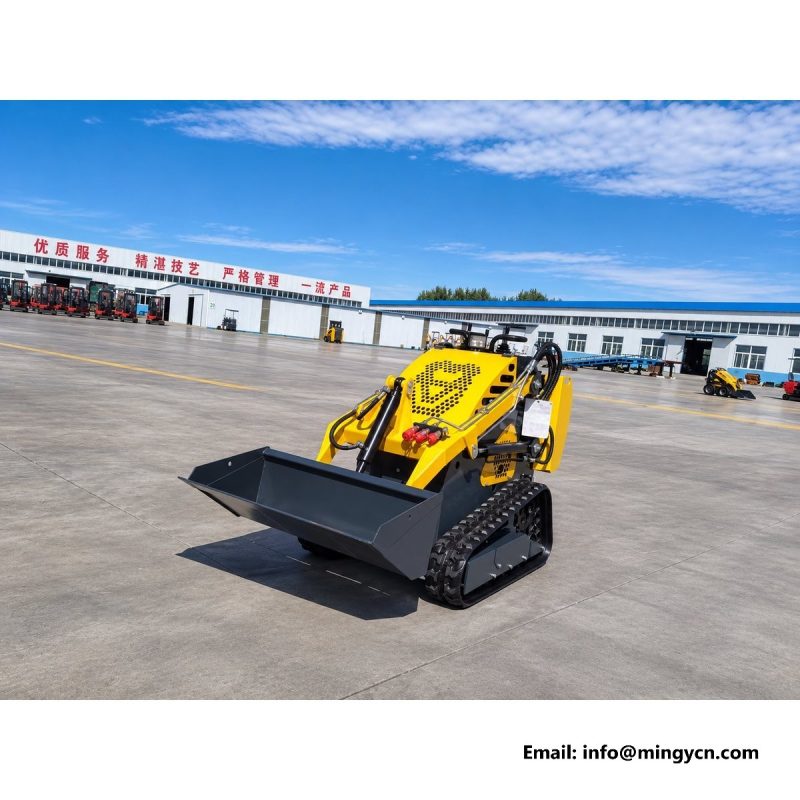
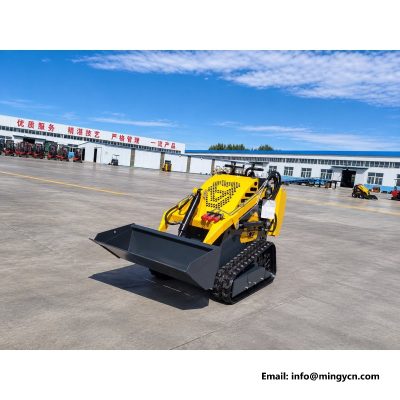
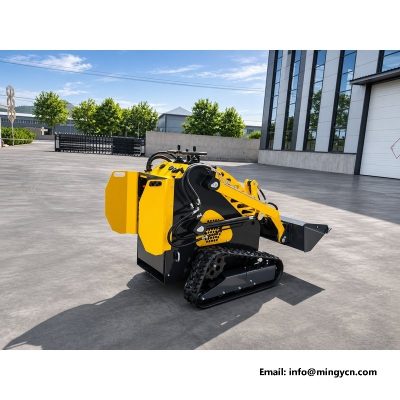
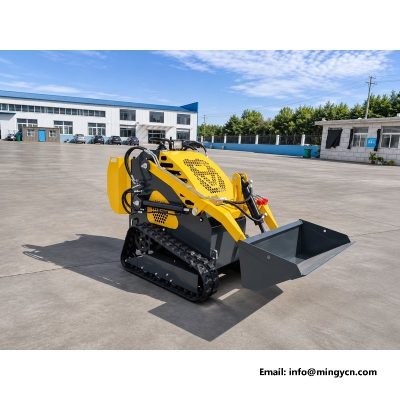
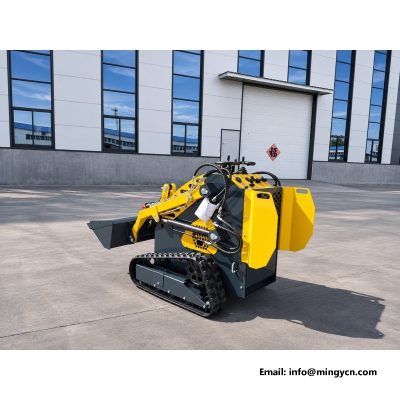
MY320 crawler skid steer loader with a 200 kg rated load and a 0.06 m3 bucket.
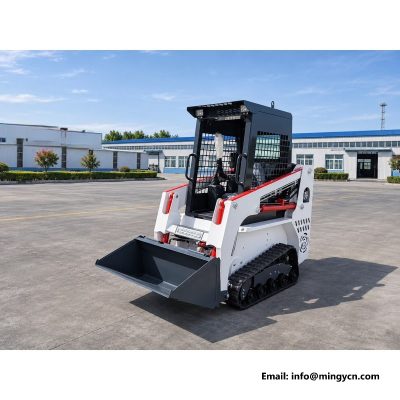
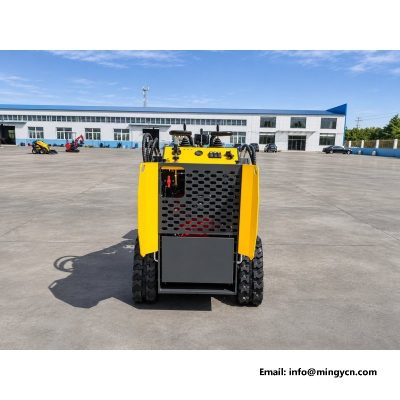
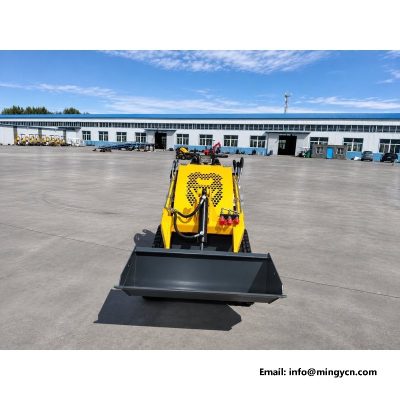
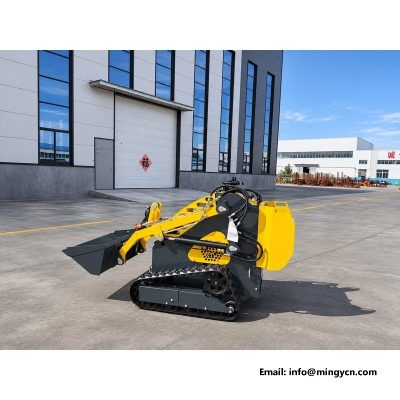
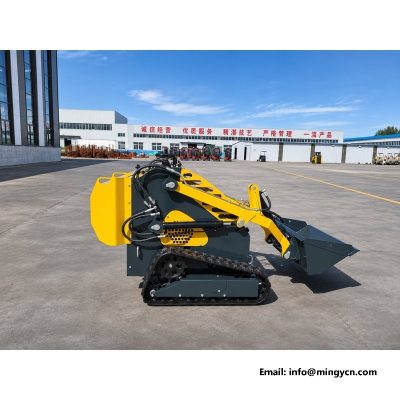
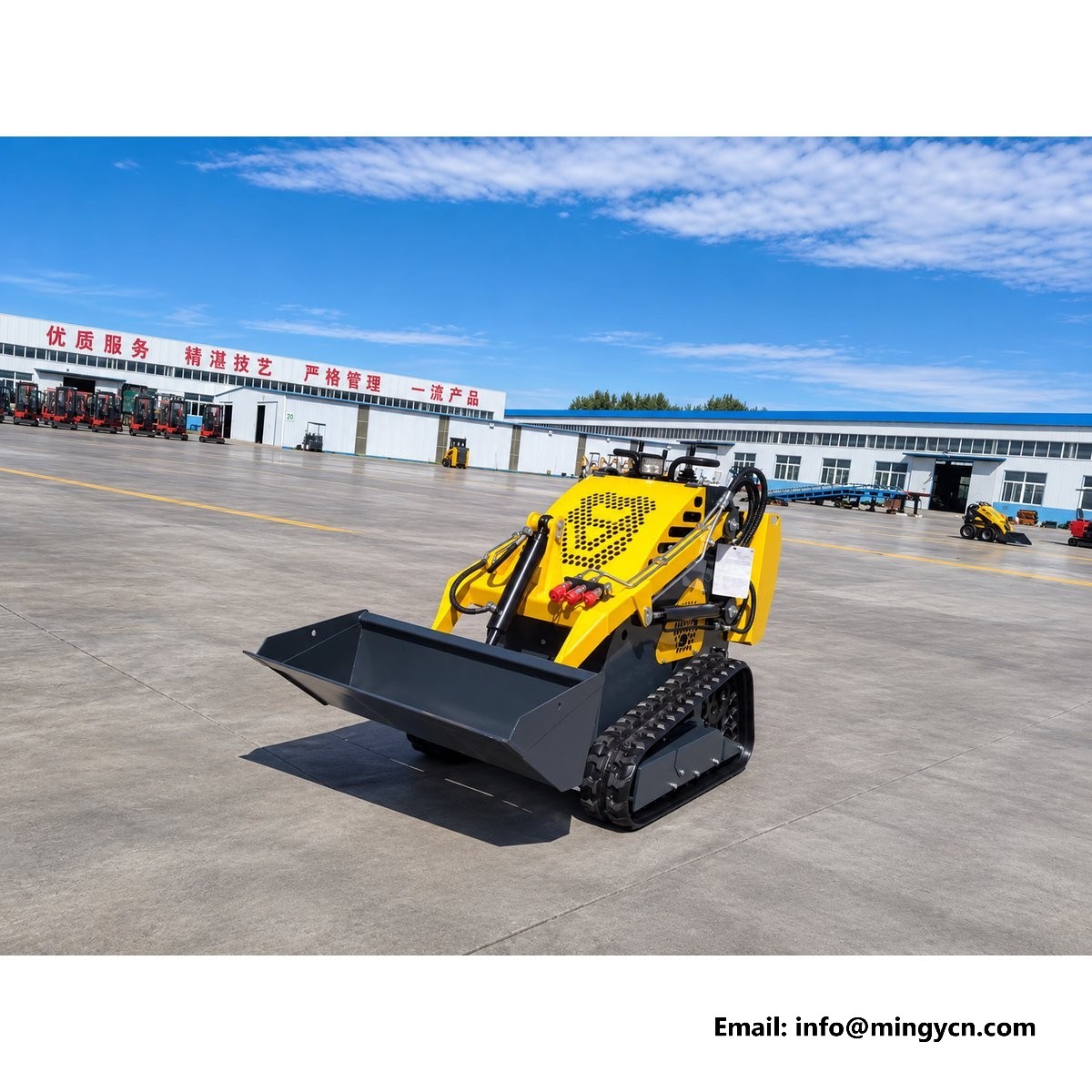
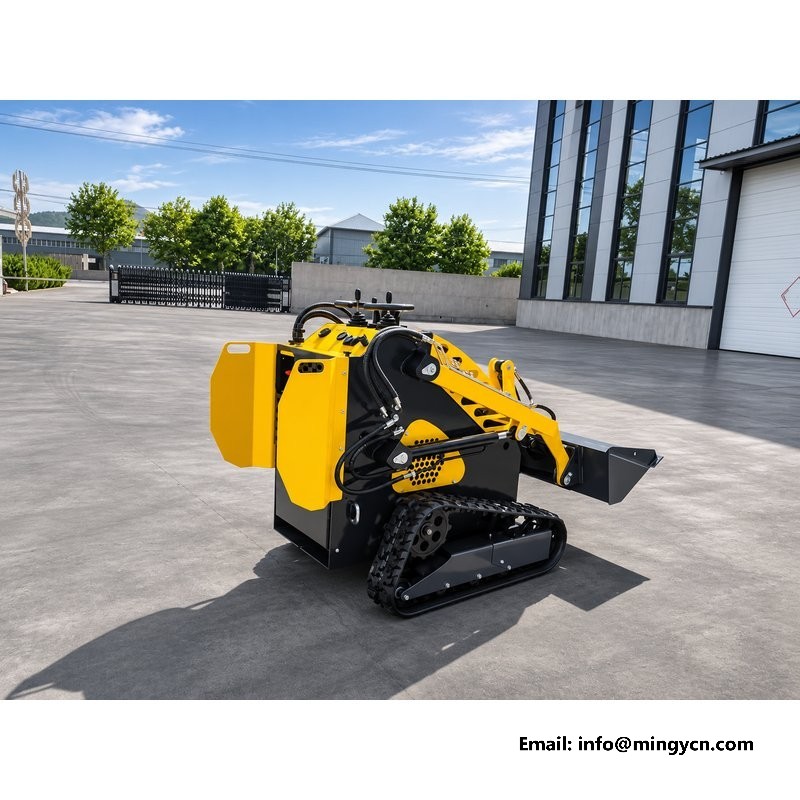
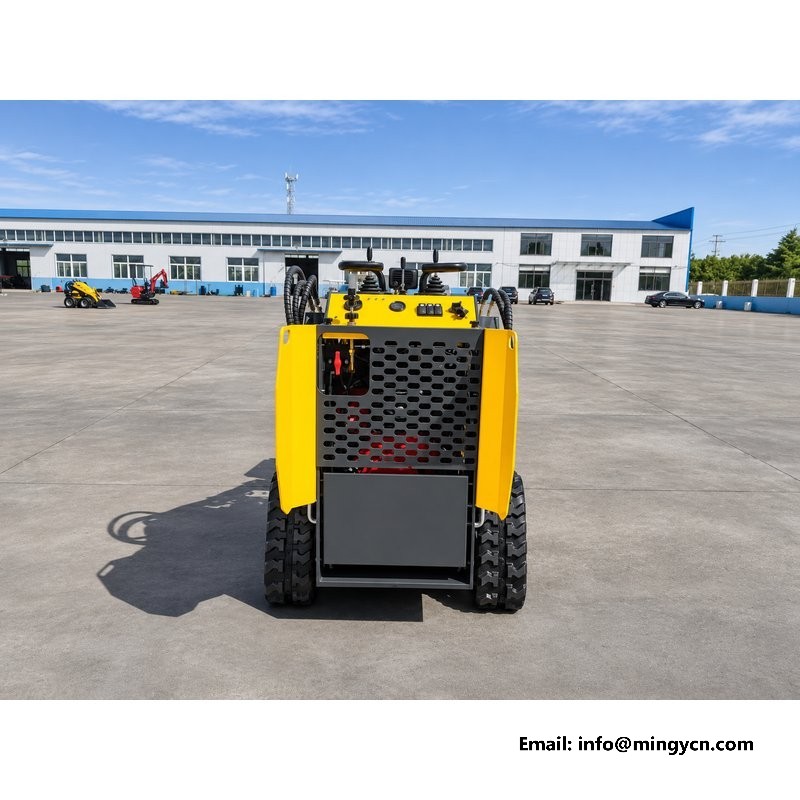
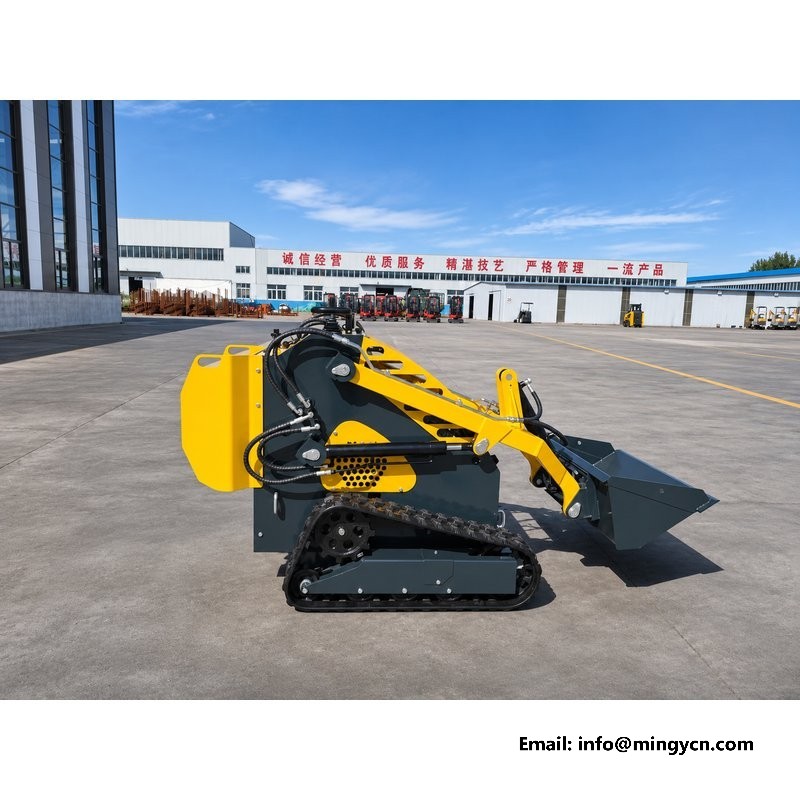
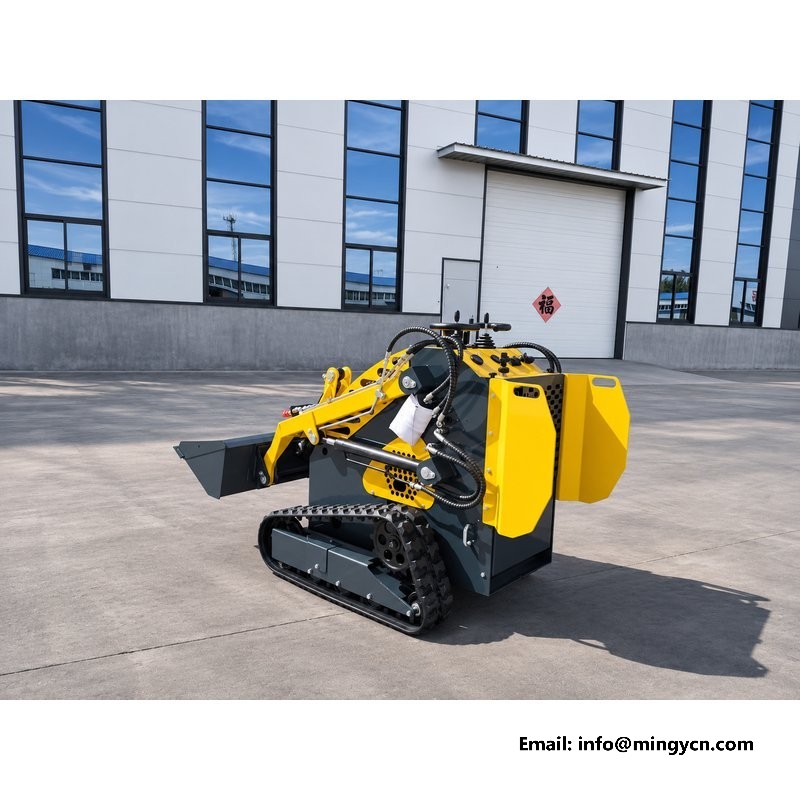
The MY320 is a compact crawler loader with a 200 kg rated load, and these eight photographs were taken in the factory yard before the machine had done any work. Yellow paint, an open stand-on platform inside a roll bar, a standard bucket on the front, rubber tracks underneath: the layout is simple, and the detail is what a buyer should study. The sections below work through the load ratings, the 0.06 m3 bucket, the 420 cc engine, the track dimensions and the lift geometry, then move to the structure, the hydraulics and the practical business of loading the machine onto a trailer. Every figure quoted comes from the specification sheet.
The two load figures on this machine are often read as one, and they should not be. The rated load of 200 kg is the weight the loader is designed to carry repeatedly, through a full lift and travel cycle, with the machine still stable and the structure still inside its design margin. The maximum load of 300 kg is the ceiling, the figure that applies to an occasional lift on flat ground with the arms low. Confusing the two is how small loaders get damaged. A 200 kg rated machine that spends its life at 300 kg will show it first in the lift arm pins and then in the track frames. Treated as intended, with the rated figure as the working number, the same machine gives years of steady service.
Bucket capacity on this loader is 0.06 m3, and the figure only means something once the material is named. A bucket of dry sand, a bucket of wet gravel and a bucket of screened topsoil are three different loads, and the heaviest of them is the one that decides how the machine should be run. The 0.06 m3 bucket is sized to sit inside the rated load with the common materials a compact loader handles, which is why the machine is sold with it as standard rather than with a larger shell. A bigger bucket would fill faster in light material and then tempt the operator to overload it in heavy material. For a buyer, the practical question is what the machine will carry most days, and whether the standard bucket matches it.
| Model | MY320 |
| Rated load | 200 kg |
| Max load | 300 kg |
| Operating weight | 630 kg |
| Bucket capacity | 0.06 m3 |
| Engine options | Runtong R420D / Briggs XR2100 / Kopu 192 / Kubota D722 |
| Rated power | 13.5 HP / 13.5 HP / 11 HP / 10.2 kW |
| Rated speed | 3,600 / 3,600 / 3,000 / 2,500 rpm |
| Displacement / cylinders | 420 cc / 1 |
| Aspiration | Naturally aspirated |
| Emission | Euro 5 / EPA |
| Travel speed | 0-6 km/h |
| Max operating height | 2,490 mm |
| Dump height | 1,564 mm |
| Dump reach | 446 mm |
| Overall height | 1,390 mm |
| Length without attachment | 1,540 mm |
| Length with standard bucket | 2,160 mm |
| Bucket roll-back at ground / at top | 25 / 115 degrees |
| Fuel tank | 5 L |
| Undercarriage | Rubber track 150 x 36 x 72 mm (crawler) / 23 x 8.5 x 12 tyre (wheeled) |
A 420 cc single-cylinder engine is the right size for a loader of this class, and the reason is hydraulic rather than road performance. The machine does not need to climb hills at speed; it needs enough torque at modest engine speed to drive the pump through a full bucket lift, and it needs to do that all day on a small tank. The engine here is naturally aspirated and available in several builds, with a 5 L fuel tank mounted close to it. Fuel use is modest in the way small industrial singles usually are: the tank lasts a working shift in normal yard duty, and refuelling is a can rather than a bowser. Noise is the trade. A single cylinder has a hard note, and ear protection is sensible for long shifts.
The track on this crawler measures 150 x 36 x 72 mm, which reads as a 150 mm wide belt, a 36 mm pitch and 72 links around the loop. Each part of that has a job. Width spreads the machine's weight over more ground, which is what keeps a 630 kg loader on top of damp turf instead of cutting through it. Pitch decides how the belt wraps the sprocket and how smoothly it rolls. Link count sets the length of the footprint under the machine. The open pattern between the lugs is the part that matters on a muddy site: as the belt turns, soil packed into the gaps is pushed out again rather than carried around the sprocket. A track that cannot clear itself will tighten, jump and wear at the edges.
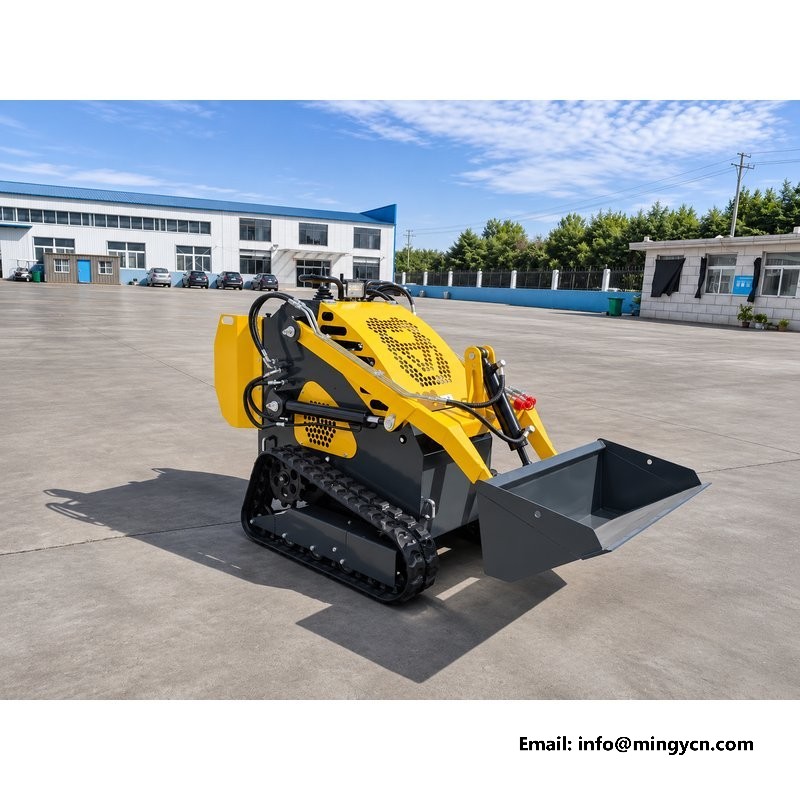
Two heights decide what this loader can load. The maximum operating height of 2,490 mm is how high the bucket can be raised, and the dump height of 1,564 mm is how far the bucket lip sits above the ground when it is tipped. The second figure is the working one. It is enough to clear the side of a small tipper body or a farm trailer and to reach over a low wall into a skip, and it is not enough to fill a high-sided container or a full-size lorry. Buyers who plan to load into tall bodies should measure the side height before ordering, then compare it with 1,564 mm and accept the answer. A loader used at the top of its reach all day is slower and less stable than one working comfortably below it.
Dump reach is the figure buyers forget, and it is the one that decides whether a bucket empties into the target or onto its edge. At 446 mm, the bucket lip travels forward past the front of the tracks as it tips, so the load falls clear of the machine rather than back against the undercarriage. That matters when filling a raised planter, a skip with a lip, a feed trough or the bed of a small trailer parked close to a wall. Combined with the 1,564 mm dump height, it gives a working envelope that suits yard and farm jobs without asking the operator to reverse and reposition for every bucket. When a machine cannot reach, operators improvise by tipping early, and that is when material spills where it should not.
Travel speed on this loader runs from zero to 6 km/h, which is a site speed rather than a road speed, and that is the correct way to read it. The machine is meant to shuttle between a pile and a truck over short distances, and the useful quality is control at the low end, not the top figure. The bucket geometry supports the same idea. Roll-back at ground level is 25 degrees, enough to keep a load from spilling on the approach and to let the edge scrape and carry. At the top of the lift the roll-back reaches 115 degrees, which holds a heaped bucket back over the machine instead of letting it dribble forward. Both angles are stable working positions. Loading at full roll-back and full height at once is how small loaders tip.
The engine in this machine is listed as Euro 5 and EPA compliant, and for an export buyer that line on the sheet does more work than it appears to. It tells a dealer in Europe that the engine family is intended for a regulated market, and it tells a buyer in North America that the same build has a route into a market with its own rules. What it does not do is replace paperwork. Before shipping, the importer should confirm which certificate applies to the exact engine option ordered, because this model is offered with more than one build. The practical benefits of a regulated engine are quieter running, cleaner exhaust and better parts support, since the same engine family is sold where service networks already exist. Ask the dealer for the certificate reference in writing, and match it to the engine serial number on the plate.
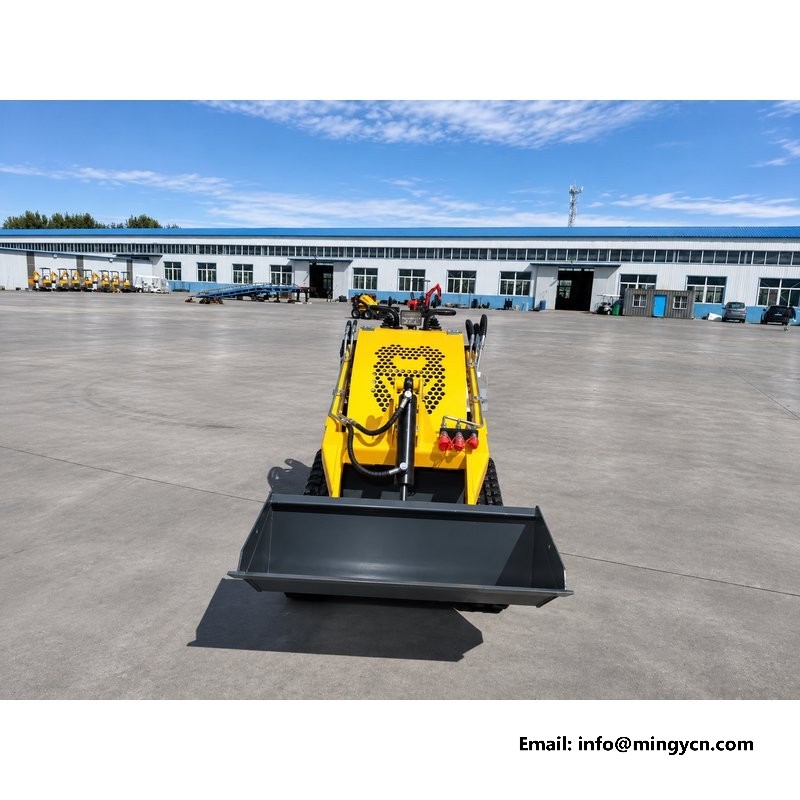
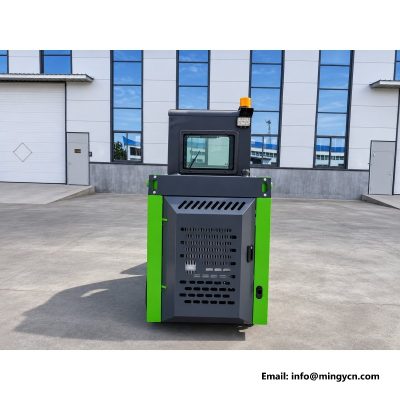
The photographs of this machine were taken in the factory yard, which is useful because the paint is fresh and nothing has been cleaned up for a brochure. Look at the lift arm pivots first. The bosses should be machined, greased and fitted with a replaceable bush, and the weld that holds them to the arm should run continuously around the boss rather than in short stitches. Then follow the arm back to the tower: the pivot pins should sit square in their plates, with no gap that suggests a misaligned bore. On the chassis, check that the cross members meet the side plates through a gusset rather than a butt joint. Paint should be even inside the corners, because a thin coat there is where rust starts in the first winter.
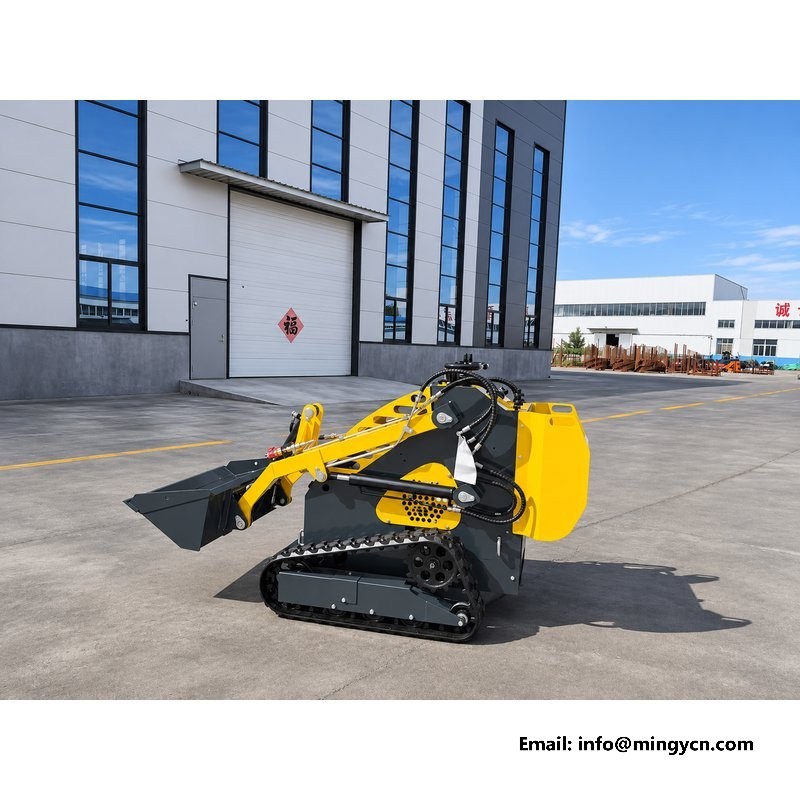
A compact loader packs its hydraulic system into a small space, and the routing matters as much as the components. On this machine the lift and tilt cylinders sit inside the arm structure, with hoses running along the arm to the valve block behind the operator. Look for a hose that is clipped at intervals, sleeved where it passes a steel edge, and given enough slack to follow the arm through its full arc without pulling tight at the top of the lift. A hose that is too short will fail at the fitting; one that is too long will rub somewhere out of sight. At handover, raise and lower the arms slowly and watch each hose along its length. Any spot where the outer cover is already polished is a chafe point that will become a leak.
At 630 kg operating weight, this loader travels on a car trailer or a small flatbed rather than a low-loader, which is one of the quiet advantages of the class. The dimensions help with the planning: 1,390 mm overall height, 1,540 mm long without an attachment and 2,160 mm with the standard bucket fitted. That last figure is the one to use when measuring a trailer bed, because the machine is normally moved with its bucket on. Load on a ramp long enough to stop the machine scraping, keep the bucket low and forward, and lower it to the deck once aboard. Lash to the chassis at four points, not to the lift arms, and chock the tracks. Check the load height against any bridge or ferry limit before you leave.
This machine carries its operator on an open platform at the rear, inside a roll bar, with no glass and no door between him and the work. That arrangement has real advantages on a compact site. Visibility is direct rather than through a windscreen, stepping off takes a second, and there is nothing to fog up on a cold morning or scratch in a yard full of branches. The trade is exposure: dust, rain, sun and noise all reach the operator, and the platform has to be kept clear of tools, rags and anything that can slide underfoot. Before each shift, check the handholds, the platform surface and the pins that hold the roll bar. A stand-on machine is only as safe as the space it is standing in. Keep the step and the platform edge free of mud, because a boot that slips there is the most common injury on this type of loader.
No. The 300 kg figure is the maximum, an occasional lift on flat ground with the arms low. The rated load is 200 kg, and that is the number to plan around for repeated work through a full lift and travel cycle. Running at the maximum all day puts loads into the arm pins and track frames that the machine was not designed to carry continuously, and the first symptoms are play in the pivots and cracking at the weld toes.
Plan from the dimensions rather than a trailer class. The loader weighs 630 kg, stands 1,390 mm high, measures 1,540 mm long without an attachment and 2,160 mm with the standard bucket. A flatbed that takes a 2,160 mm load with a little margin, rated for the weight, is enough. Load on a long ramp, keep the bucket low, lash to the chassis at four points and chock the tracks.
Ordering and technical support
Email: sales@mingycn.com
LINE (ID): mingyicn
Tell us your working width, ground conditions and the attachment you need, and we will confirm the right configuration and shipping details.