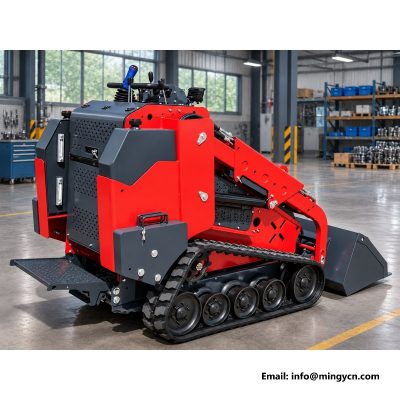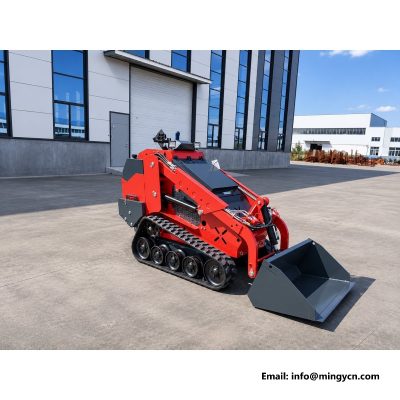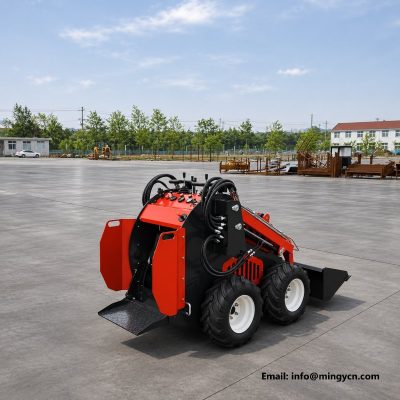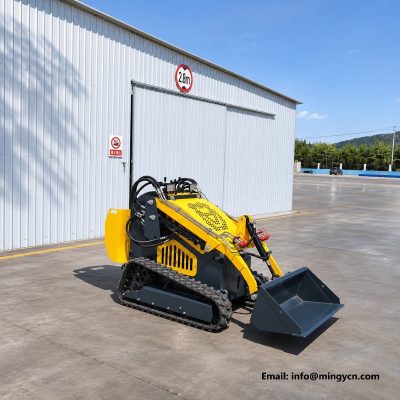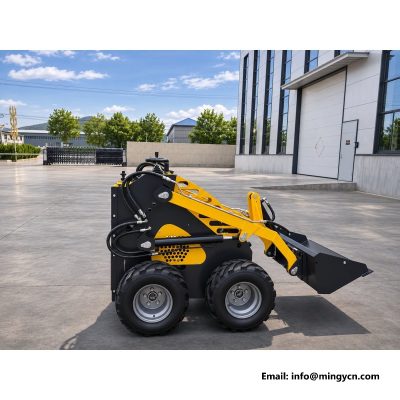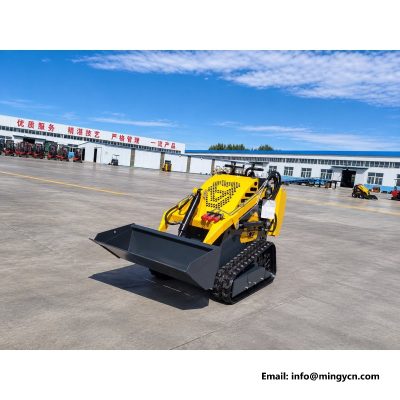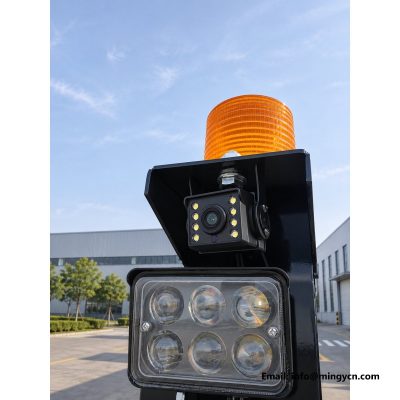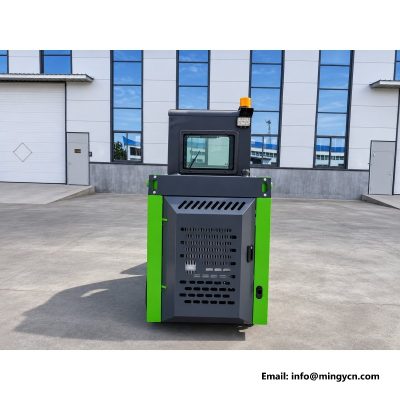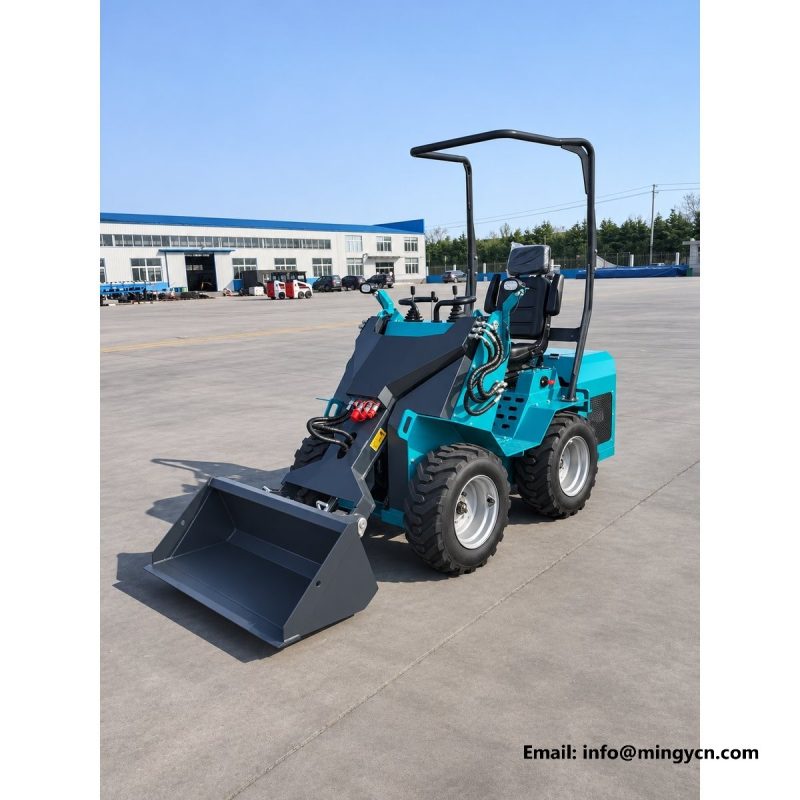
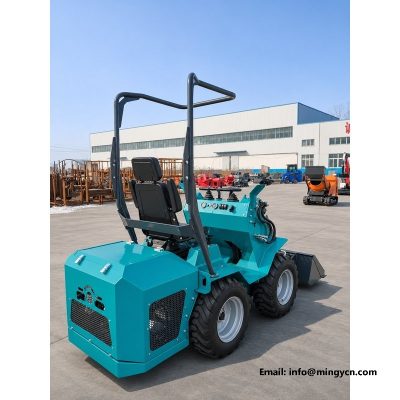
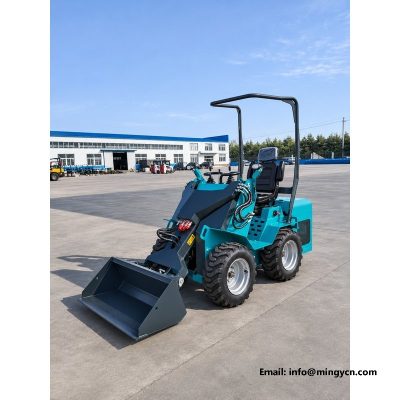
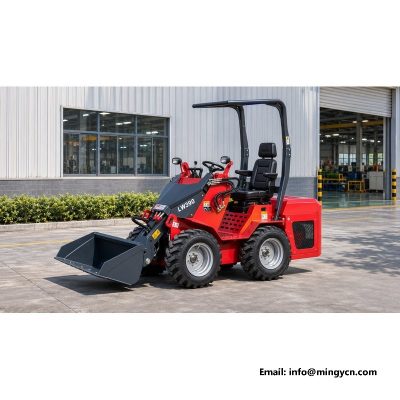
Additional studio and yard views of the MY400 seated wheeled skid steer loader.
This page collects the remaining studio and yard views of the MY400 seated wheeled skid steer loader. The main product page covers the specification and the working arguments; what follows is for buyers who want to look at the machine itself before they commit to a container. Each view is described so that it can be checked against a quotation, and each shows a detail that a specification table cannot convey: how the axle is built, how the lift arms are fabricated, how the bucket is attached and what the operator actually sits in.
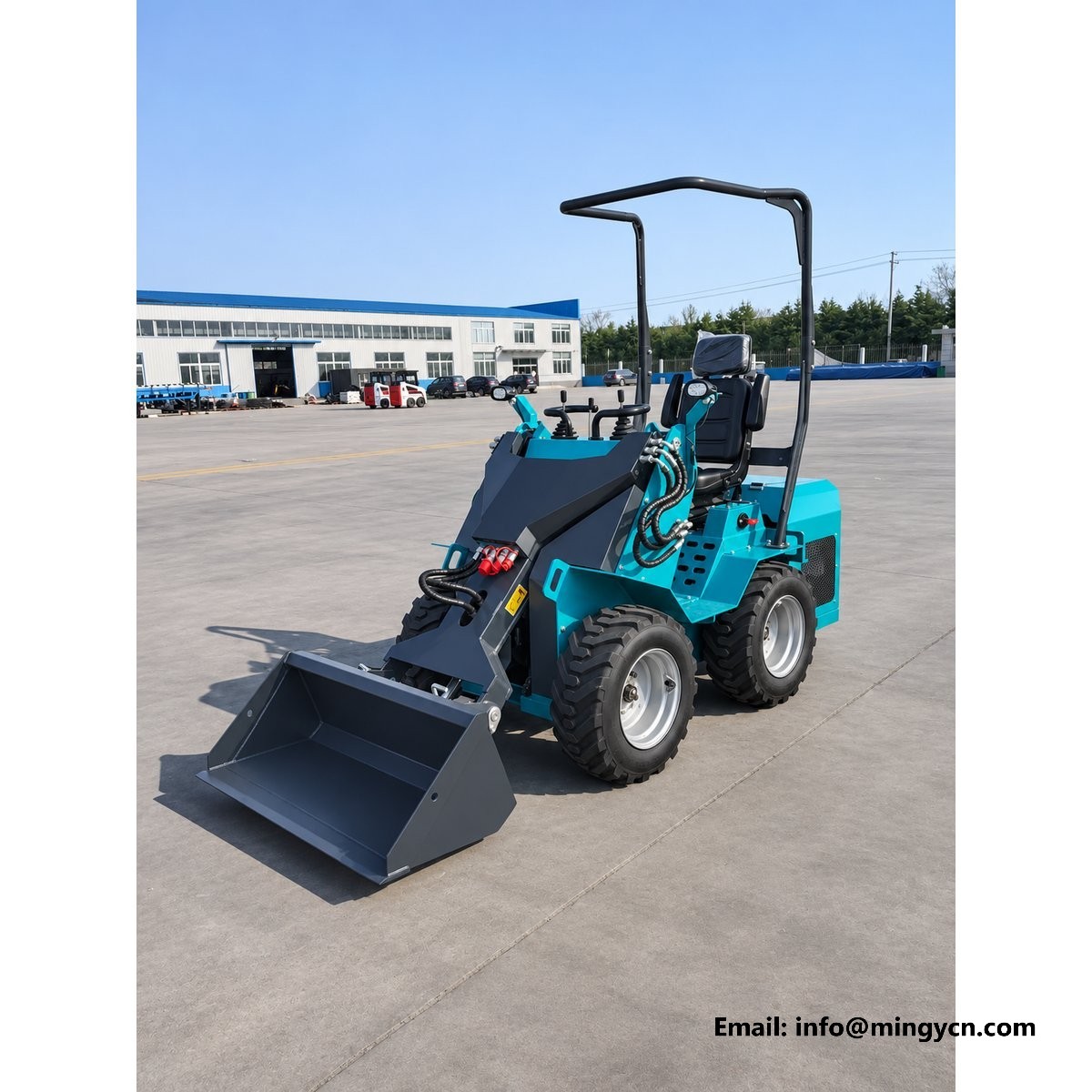
Four things are worth checking in any loader photograph. First, the weld quality on the lift arm: a fabricated arm should show consistent beads at the pivot bosses and no gaps at the corners. Second, the hydraulic hose routing: hoses should be clamped and kept away from sharp edges, not simply run loose along the arm. Third, the axle and wheel mounting: look for a proper hub with a visible bearing arrangement rather than a wheel bolted directly to a shaft. Fourth, the paint on the inside of the frame, which tells you whether the machine was painted assembled or painted before assembly.
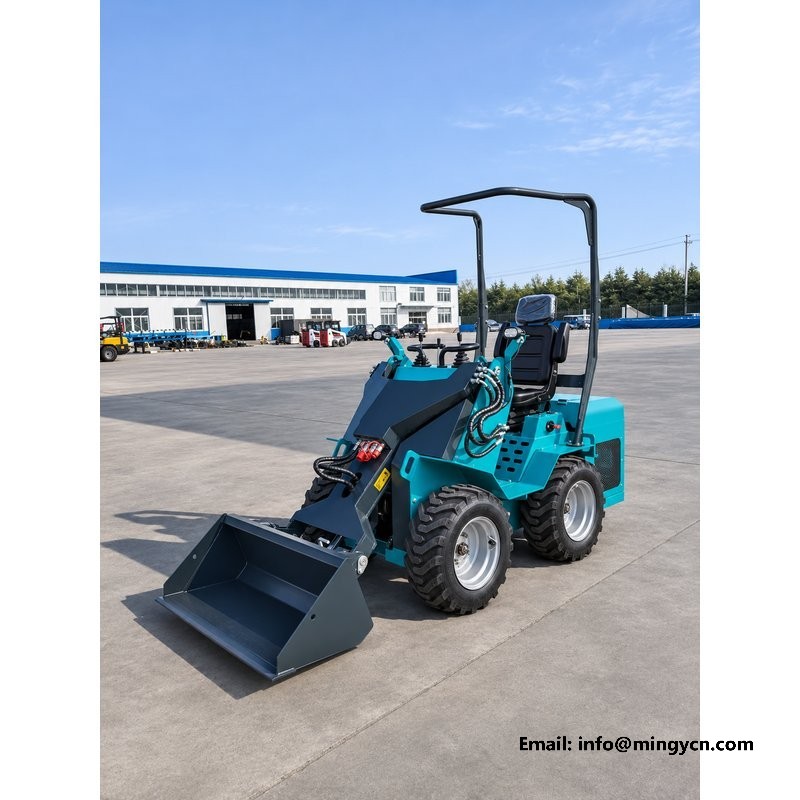
The standard bucket holds 0.06 m3 and rolls back 20 degrees at ground level and 120 degrees at full height. In the photographs, check how the bucket attaches: the pin arrangement and the plate thickness at the mounting ears decide how the machine behaves when the bucket is worked against resistance. A thin mounting plate distorts, and once it distorts the bucket no longer sits square. Check also whether a quick coupler is fitted or whether buckets are pinned directly, because that changes the attachment range available afterwards.
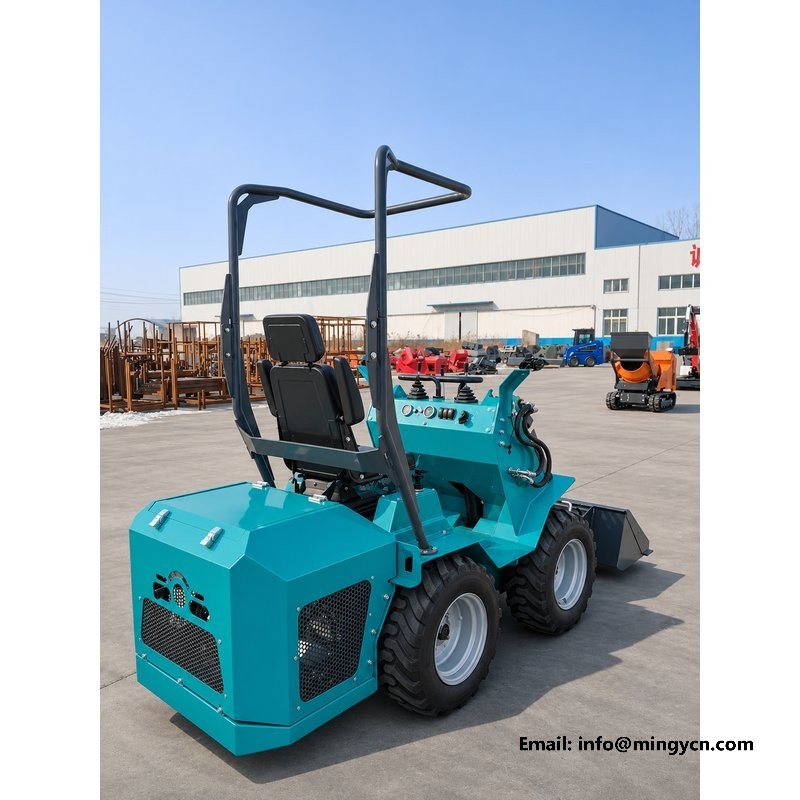
The machine runs on 23 x 8.5-12 tyres with all four wheels driven. In the views, look at the axle ends and confirm there is a proper bearing housing rather than a stub shaft, and check the clearance between the tyre and the frame at full articulation. Tyres are the cheapest wear item on a wheeled skid steer, and the tread pattern fitted at the factory should match the surface the machine will work on: a turf pattern for landscaped ground, a lug pattern for yards and gravel.
A seated skid steer puts the operator between the lift arms, close to the work. In the photographs, check the seat adjustment range, the position of the control levers relative to the the hands of the operator, and the footwell space. Confirm the ROPS frame is bolted to the chassis rather than to the body panels, and look at the step and grab handle arrangement, since climbing in and out happens many times a day. These details decide whether a crew accepts the machine or quietly avoids it.
| Model | MY400 |
| Configuration | Seated wheeled skid steer loader, four-wheel drive |
| Rated operating capacity | 300 kg |
| Maximum load | 400 kg |
| Bucket capacity | 0.06 m3 |
| Operating weight | 874 kg |
| Travel speed | 0-6 km/h |
| Dump height | 1,650 mm |
| Dump reach | 650 mm |
| Tyres | 23 x 8.5-12 |
| Engine options | Runtong R420D, Briggs & Stratton X2100, Kepu 192 |
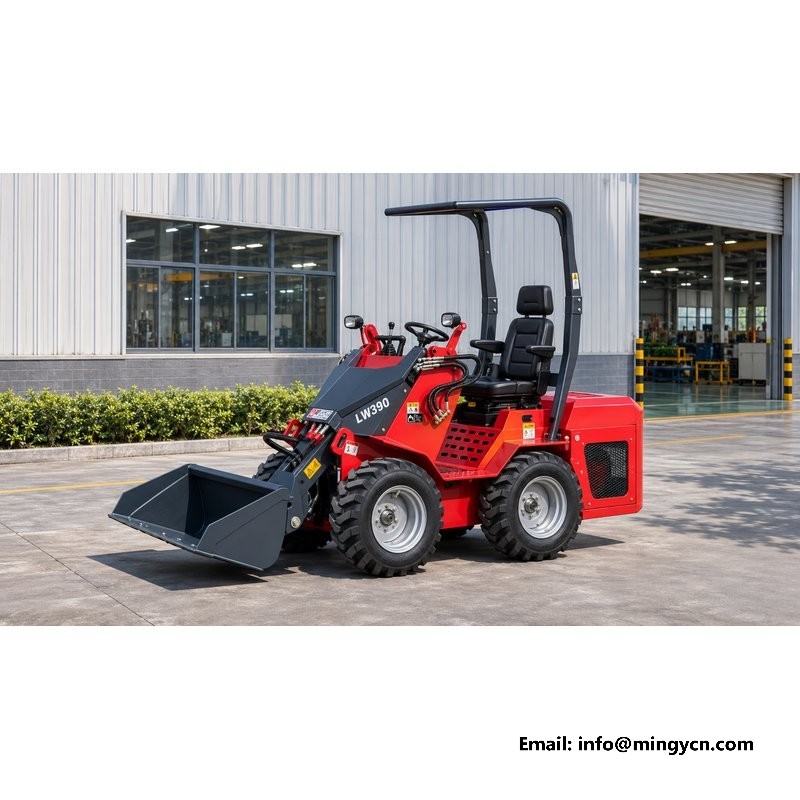
Ask which tyre pattern is fitted and what the alternative costs. Ask whether a quick coupler is included and which attachment interface it uses. Ask whether a canopy or any weather protection is available for the operator station. Ask for the hydraulic schematic and confirm the auxiliary circuit flow, because attachments such as a breaker or an auger depend on it. Finally, ask for the packed dimensions and weight, since several machines may be shipped together and the loading plan depends on those figures.
Confirm that the crate contains the operator manual in English, the parts list with filter part numbers, and the engine emission certificate where applicable. Ask whether the machine ships with the bucket fitted or separately, because that changes the packed dimensions. For buyers ordering several units, ask for a loading plan with the machines arranged nose to tail and the attachments crated separately, which is usually the arrangement that uses container space most efficiently.
Ordering and technical support
Email: sales@mingycn.com
LINE (ID): mingyicn
Tell us the trench width, ground conditions and attachments you need, and we will confirm the right configuration and shipping details.