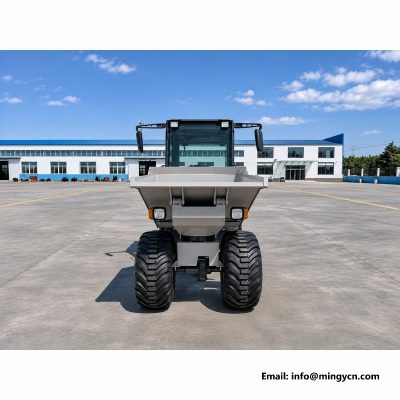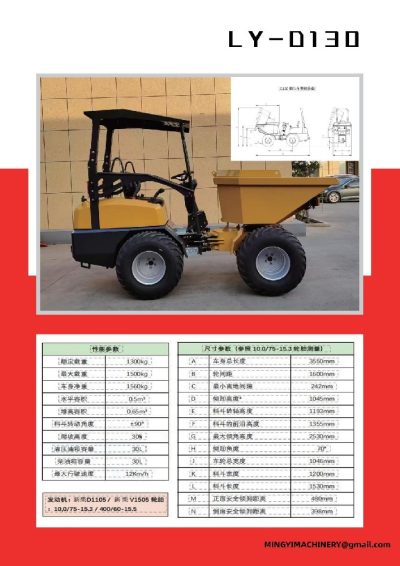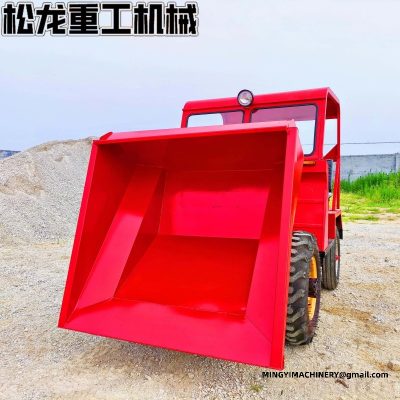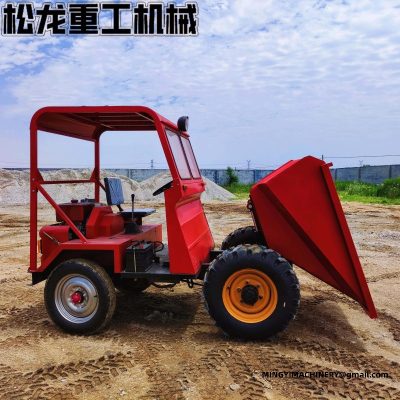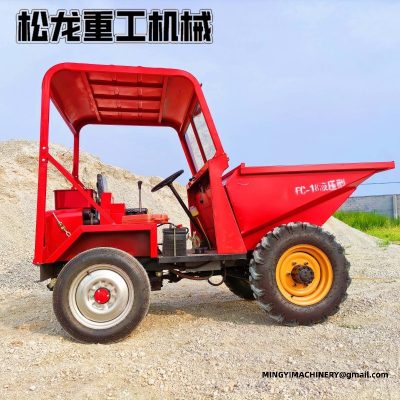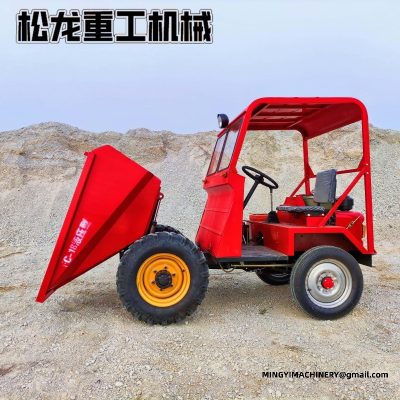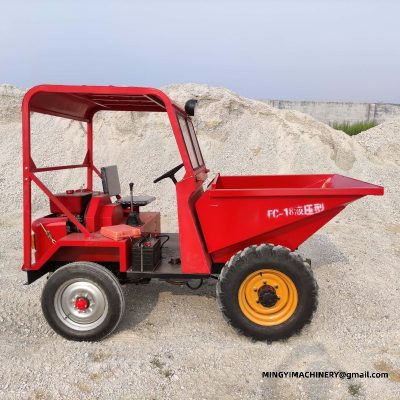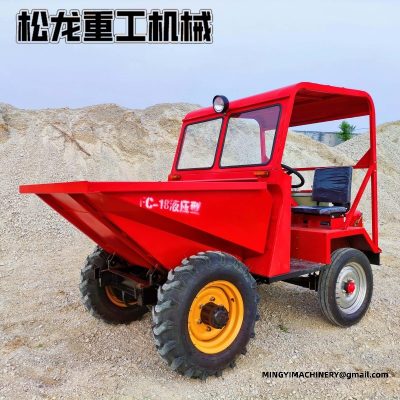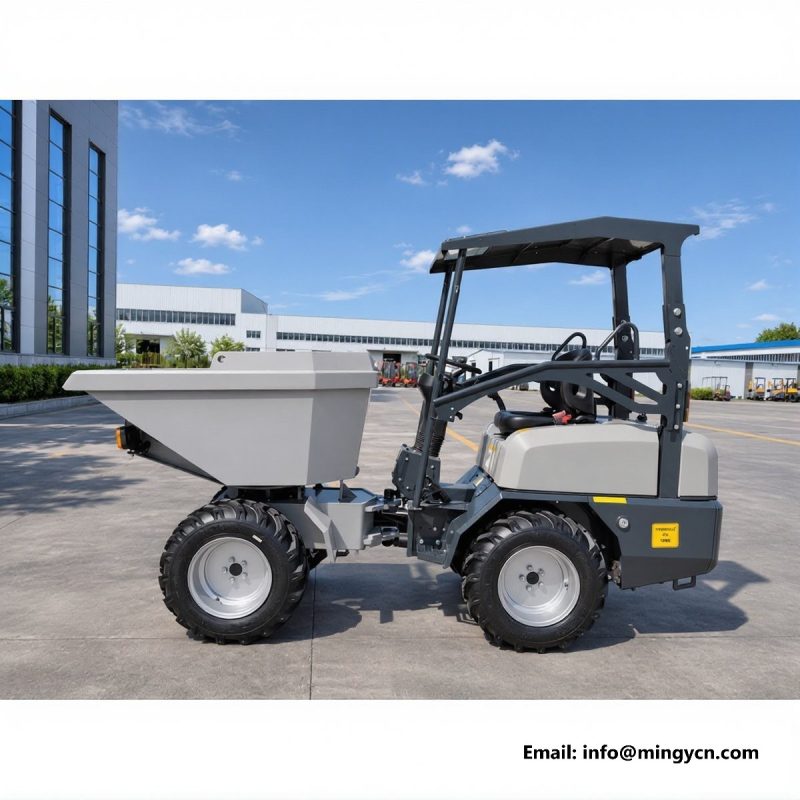
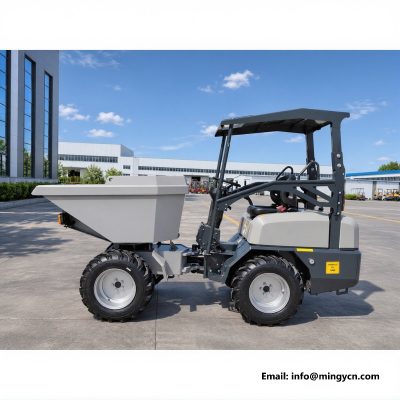
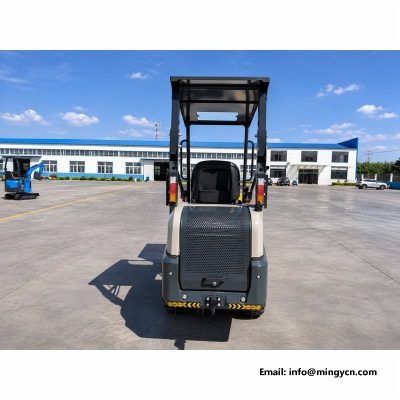
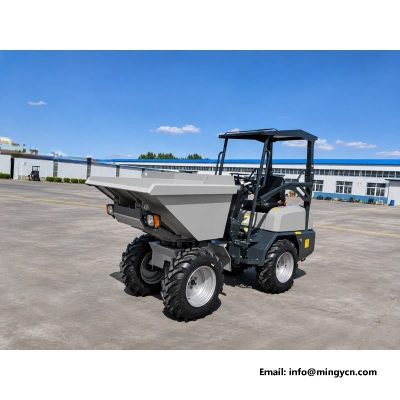
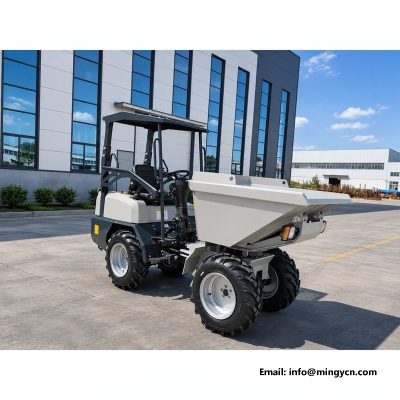
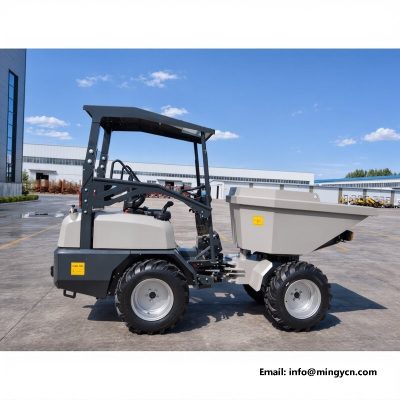
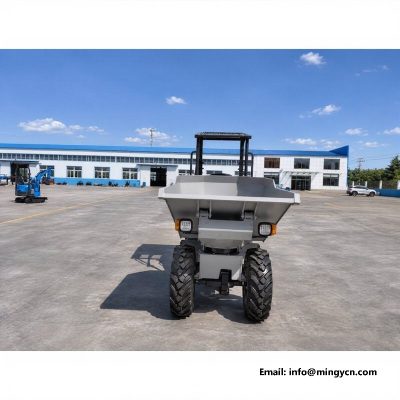
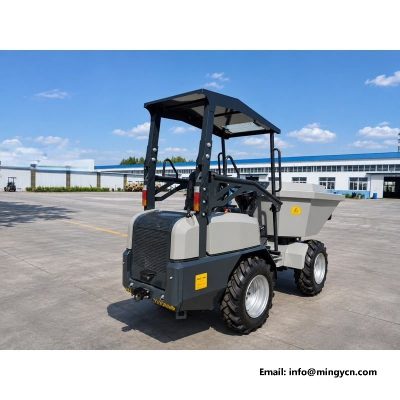
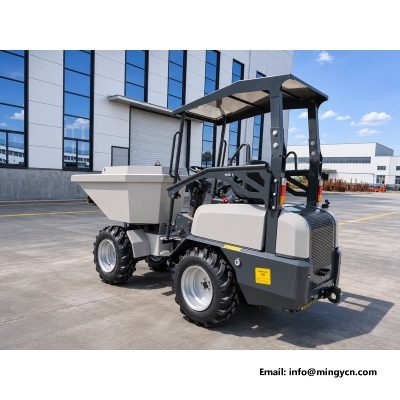
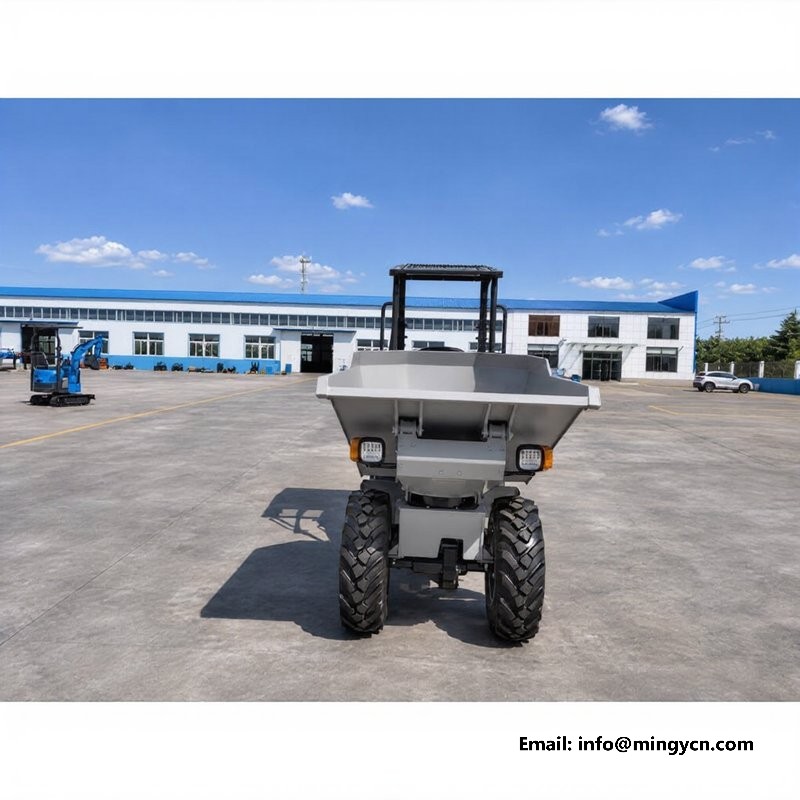
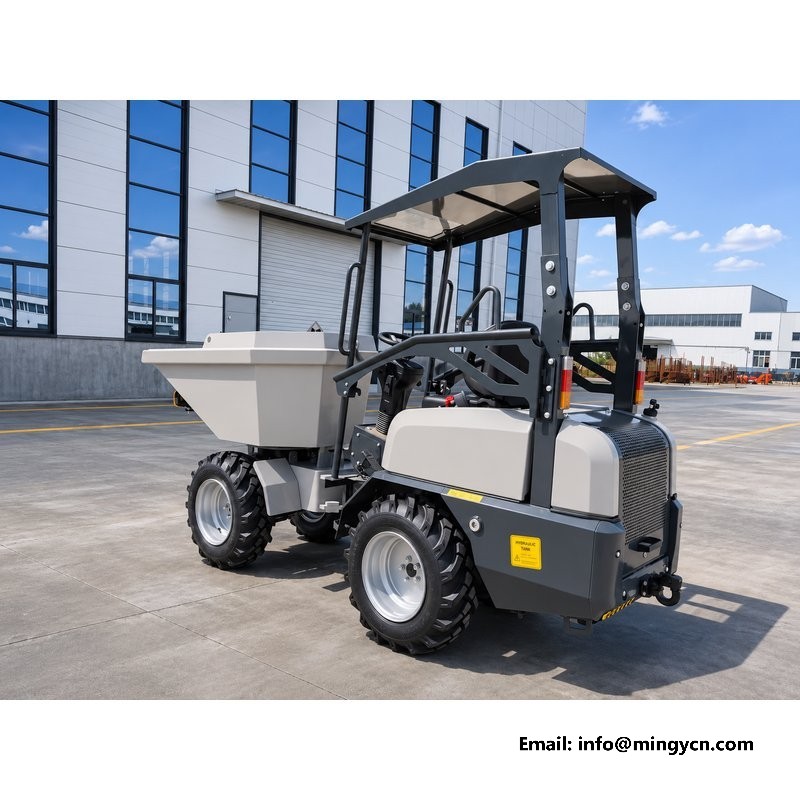
MY180D site dumper with a rear tipping body, hydrostatic drive axle and canopy roof.
This page covers the MY180D site dumper in its canopy configuration: a four-wheel articulated machine with a rear-tipping skip, built for moving material inside a site rather than along a road. The photographs follow a single unit around the yard, with the skip both lowered and raised. The sections below deal with the articulated chassis and its steering, the hydrostatic driveline, stability on ramps, the tipping body, the canopy itself, tyre behaviour on soft ground, loading practice, daily inspection and acceptance. The specification table lists the confirmed configuration. Skip capacity is not quoted here; buyers should request the figures that apply to the body they intend to order.
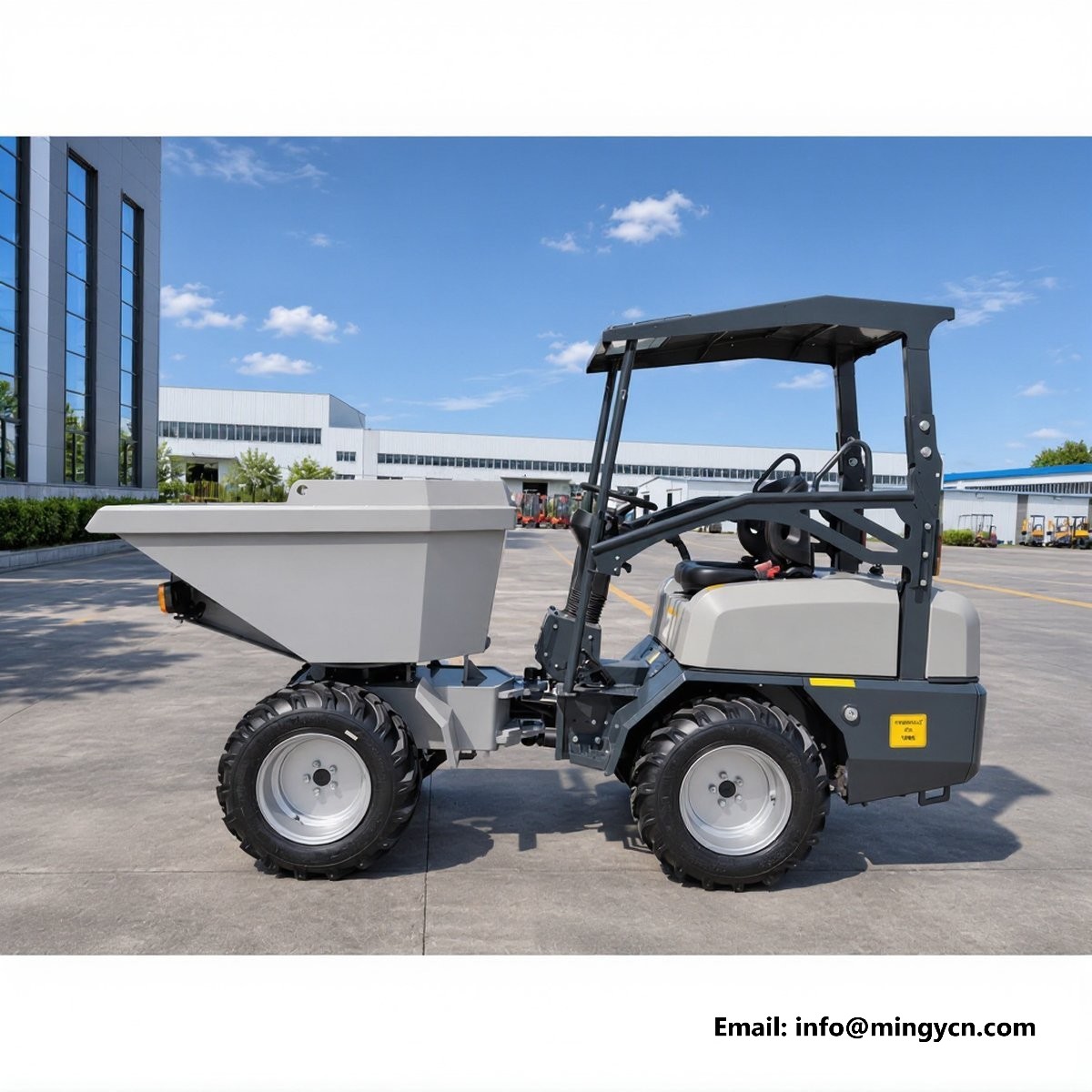
A site dumper is not a scaled-down tipper truck, and treating it as one is where most of the damage on a construction site begins. The tipper truck is a road vehicle that delivers material to the gate; the dumper is the machine that moves it from the gate to the trench, the mixer, the scaffold foot or the back of a half-finished building. That difference in duty explains the proportions of this MY180D: a short wheelbase, a chassis jointed in the middle, and a skip that sits low and tips backwards rather than a body that lifts on a long ram. Nothing here is designed for highway speed. Everything is designed for repeated short runs over unfinished ground, with a driver who climbs on and off many times in a shift.
The frame on this machine is jointed in the middle, and that joint does more for site work than any other single feature. When the steering wheel turns, a hydraulic ram pushes the front and rear halves of the chassis out of line, so the machine bends rather than swinging its tail. On a dumper this matters because the operator is usually aiming at a gap barely wider than the machine: a doorway in a block wall, a gap between scaffolding standards, a track between two stacks of bricks. A rigid truck has to swing wide and reverse to line up. An articulated machine folds into the turn, keeps all four wheels inside the same swept path, and arrives at the tip point already square to it. The joint also lets the halves move independently over uneven ground.
| Model | MY180D (standard boom) / MY180T (telescopic boom) |
| Hydraulic pump | Closed-circuit piston pump, PWG (Italy) |
| Axles | Hydrostatic drive axle, orbit (gerotor) motor drive |
| Control | Pilot hydraulic operation |
| Standard tyres | 10.0/75-15.3 (optional 400/60-15.5) |
| Engine options | Xinchai Euro 5 3B11 (standard) / Kubota D1105 / Kubota V1505 |
| Seat | Deluxe seat |
| Hose | Qingdao Xiangliu hose assemblies |
| Options | Canopy, hydraulic quick coupler, enclosed cab, high/low speed |
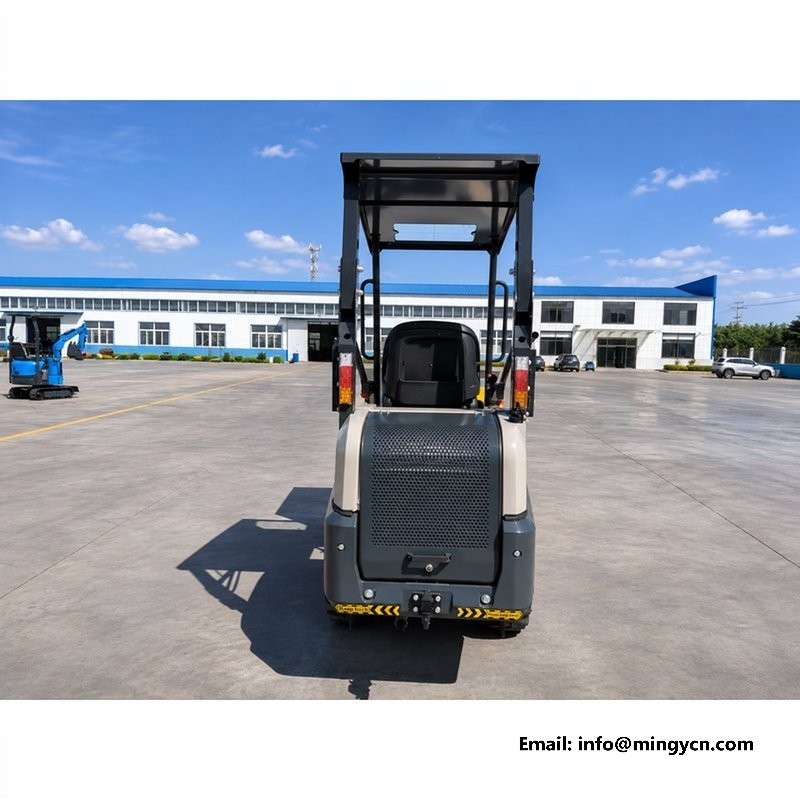
Drive reaches the wheels through a closed-circuit piston pump made by PWG in Italy, feeding orbit motors at the axles. What that arrangement gives the operator is control rather than speed. There is no clutch to slip and no gear to select in the middle of a manoeuvre; the machine creeps, stops and reverses in proportion to pedal or lever movement, and it holds itself on a ramp when the control returns to neutral. Positioning under a hopper or beside a trench becomes a matter of centimetres instead of guesswork. The same circuit provides much of the braking effort in normal use, with the service brakes there for stopping and for parking. Because pump and motors share one oil supply, filtration and oil condition deserve attention. A dirty charge filter starves the pump long before the gauge shows anything.
Stability on a dumper is mostly a question of where the centre of gravity sits at any given moment, and the operator controls that more directly than on a truck. A loaded skip raised at the top of a ramp moves the mass up and back, and the machine becomes far less tolerant of side slope. The safe habit is to travel with the skip down and to raise it only on ground that has been checked and is close to level. Where a ramp must be used, approach it square rather than at an angle, keep the load low, and avoid turning while the machine is on the incline. The articulation joint lets the axles follow uneven ground, which helps traction, but it cannot correct a badly built ramp.
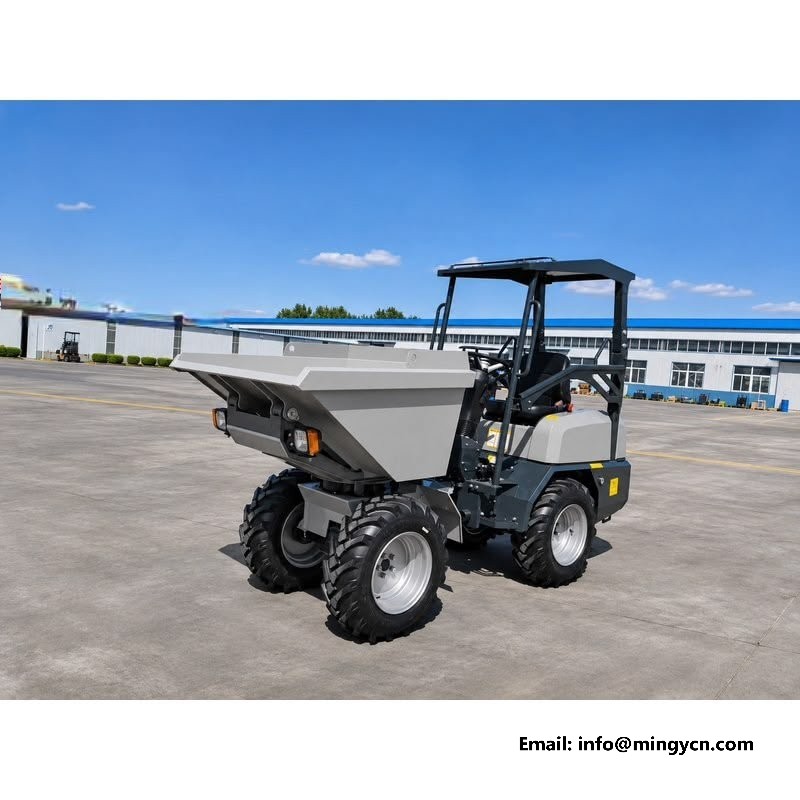
The skip pivots on hinges at the rear of the chassis and lifts on two hydraulic rams mounted underneath. Discharge is by gravity: the body rises, the tailgate swings free or is released, and the load slides out as the angle increases. The operator controls the rate by how far the ram is extended, which matters when material has to be placed along a trench rather than dumped in one heap. Wet sand and gravel flow quickly; clay needs a steeper angle and sometimes a short forward creep to break the bond. The worst practice is to raise the body fully and then drive or shake the machine to clear a sticky load, because that shock goes straight into the hinge bosses. Lower the body slightly, let the load settle, then raise again, and keep hands clear of the tailgate while it swings.
The canopy build carries a steel frame with a roof above the seat and no glass, and that open-sided arrangement suits particular conditions better than a sealed cab. In hot, humid weather it allows air to move across the operator, which matters more than protection from dust. On sites where the machine is washed down daily or works around wet concrete, there is no glass to scratch and no seals to fail. It also keeps the machine lighter and lower, which helps where headroom is limited, such as inside sheds or under partly completed structures. The trade is obvious: rain blows in, cold is felt directly, and dust reaches the operator. For northern buyers the canopy is usually a summer machine; in tropical markets it is often the standard choice.
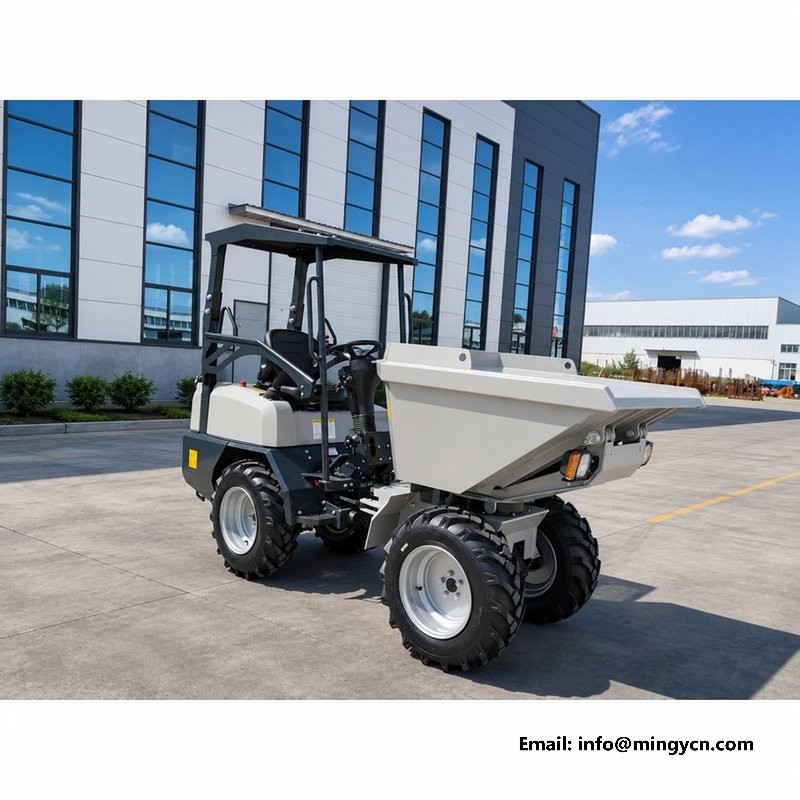
Tyres decide how much of the machine's effort reaches the ground. The 10.0/75-15.3 fitted as standard is a wide, comparatively tall tyre with a broad footprint, and that shape is chosen for flotation rather than for road speed. On soft ground the load is spread over a larger contact patch, so the machine sits on the surface instead of cutting into it. In mud the tread clears as the wheel turns, and the large diameter rolls over ruts and rubble rather than dropping into them. On wet clay the limit is lateral grip, and no tread pattern compensates for a worn casing, so pairs should be kept matched and inflated to the pressure in the manual. A wider 400/60-15.5 option is available for very soft conditions. Pressure should be checked cold, with the machine standing on level ground and the valve caps refitted afterwards.
Most injuries around a dumper happen during loading and tipping, and almost all of them are avoidable by agreeing where people stand. The loader operator should place material into the skip from a height that does not drop it, working from the side where the bucket can see the body, and should never pass the bucket over the dumper's operating position. The dumper driver stays in the seat with the machine stopped and the brake applied. Ground crew stay outside the swing area of the loader and behind the tipping line, never beside the skip as it rises. When tipping into an excavation, stop short of the edge, check the ground for undercut, and use a spotter. When the machine must reverse to the edge, do it with the skip down and the wheels straight, and agree a hand signal with the spotter before the first pass.
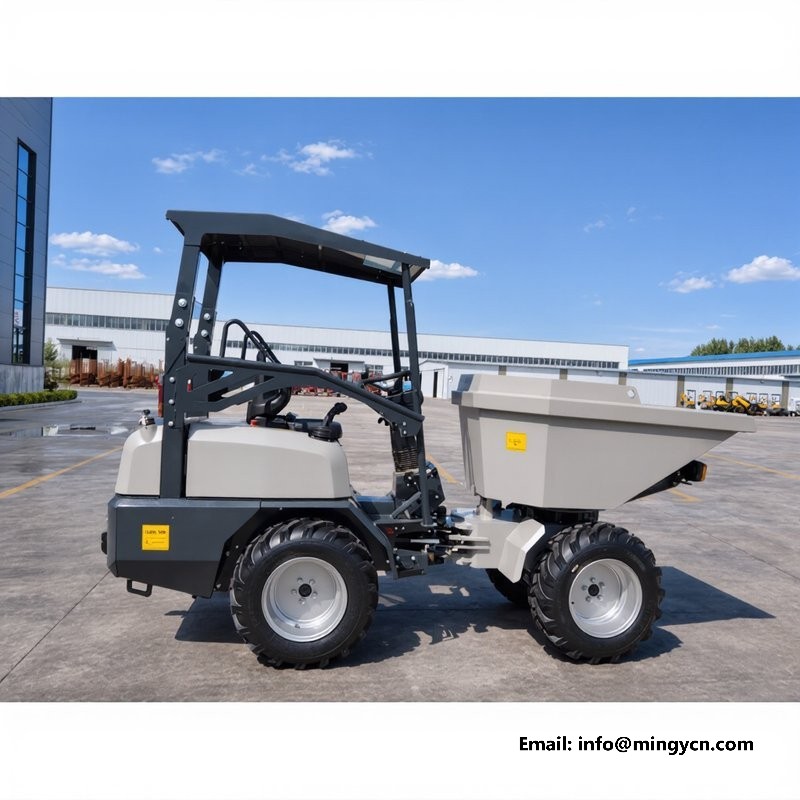
The skip and its rams take the hardest duty on the machine, so they deserve a look at the start of every shift rather than at the end of the month. Check the hinge pins and their retaining plates for movement, and grease the nipples on the hinge and the ram eyes. Look along the chrome of each ram rod for scoring or a dry patch, and at the barrel end for weeping seals. Hoses that run to the ram should be checked where they pass a frame edge, since chafe shows there first. Inspect the welds around the hinge bosses for hairline cracks in the paint. Confirm the tailgate latch releases and re-latches, and that any body prop is stowed, not left hanging. A prop that swings loose can catch on a ramp and bend, and the repair is never cheap.
Three engines are offered. The standard unit is the Xinchai 3B11, a three-cylinder diesel built to Euro 5, which is the sensible choice where the machine works in a market that regulates emissions and where dealer support for that brand exists. The Kubota D1105 and V1505 are the alternatives, familiar in rental fleets and in markets where parts for that family are already on the shelf. All three drive the same hydraulic package, so the choice is really about service network, fuel quality and cold starting rather than about performance. The PWG pump and the orbit motors are matched to each other, and the hose assemblies come from Qingdao Xiangliu. Buyers should confirm which engine is quoted and ask for the parts list. Ask also whether the machine is supplied with a diagnostic list of fault codes, since that saves hours in the field.
Acceptance is cheaper than a claim. Ask for a video of the machine cold starting, then running every function: articulation to both locks, skip raising and lowering through the full stroke, tailgate release, steering, brakes and parking brake. Watch how the ram rods move and whether the skip descends smoothly or judders. Photographs should show the hinge area, the ram mounts, the pump and the hose routing clearly enough to judge weld quality. Check that fasteners carry torque marks, that the battery is secured and isolated, and that the machine comes with manuals, a spare parts list and the hydraulic schematic. Confirm the lashing points and the shipping height, because a machine that cannot be secured properly will arrive damaged. Photograph the machine during lashing if the shipper allows it, and keep the images with the shipping documents for any later claim.
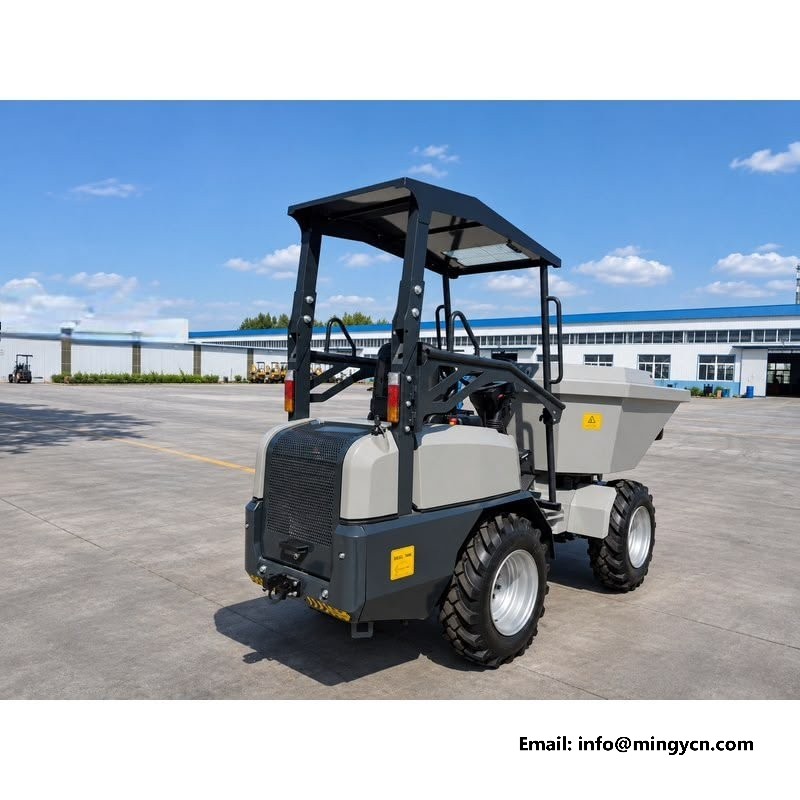
A tipper truck is a road vehicle that carries material to the site gate and tips it in one place. A site dumper is an off-road machine that moves material inside the site, between the stockpile, the mixer and the work face. It is shorter, narrower, articulates in the middle for tight turns, and runs at low speed with a hydrostatic driveline. It is not registered for road use and is not intended for long distances.
It can work on soft ground within limits. The standard 10.0/75-15.3 tyres are wide and provide flotation, and the articulated chassis keeps the wheels loaded on uneven surfaces. Traction still depends on the surface: on wet clay the machine will slide before it spins, and in deep mud it will sink regardless of tread. Keep the skip low, avoid side slopes, and check the ground before tipping near an edge.
Ordering and technical support
Email: sales@mingycn.com
LINE (ID): mingyicn
Tell us your working width, ground conditions and the attachment you need, and we will confirm the right configuration and shipping details.