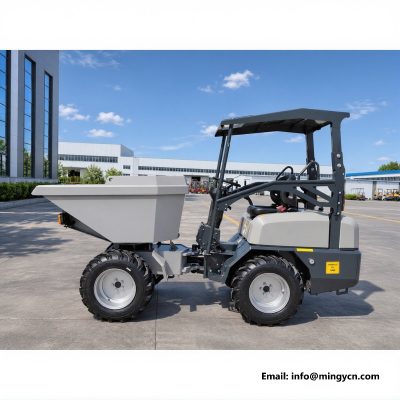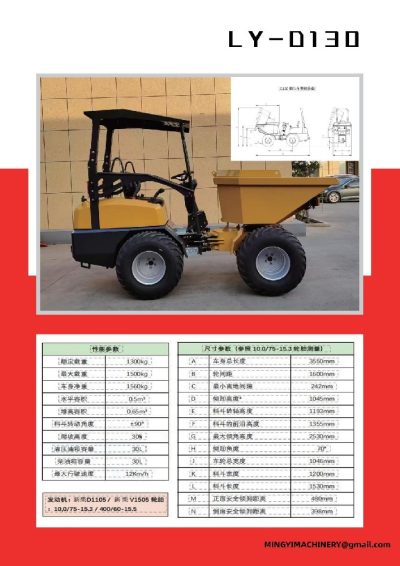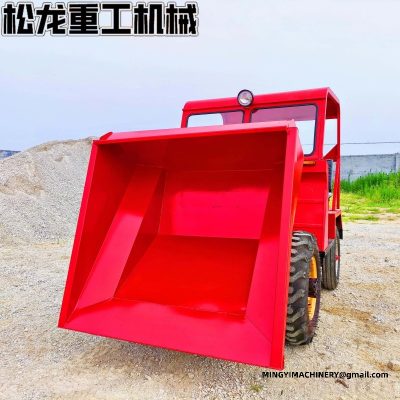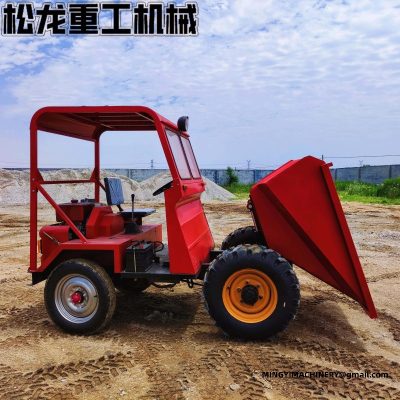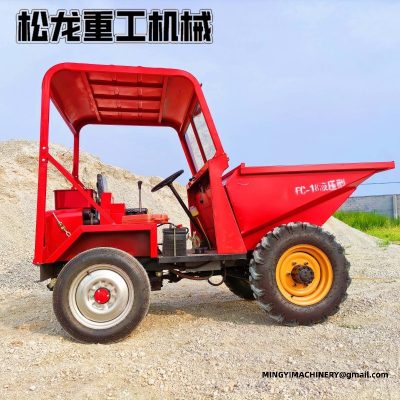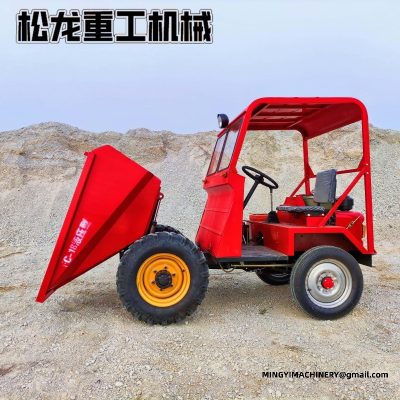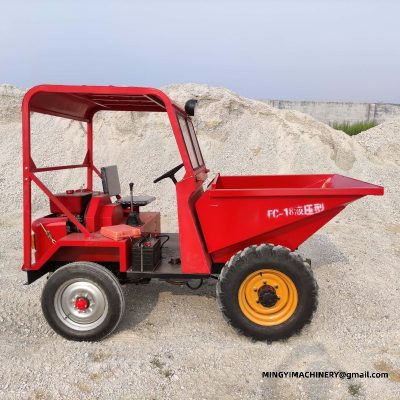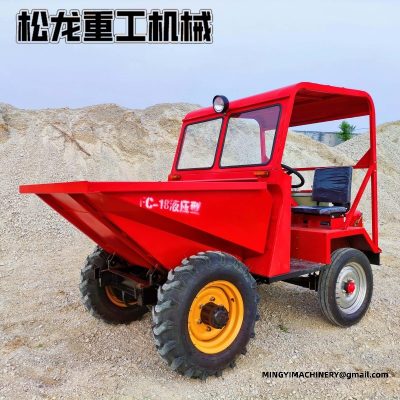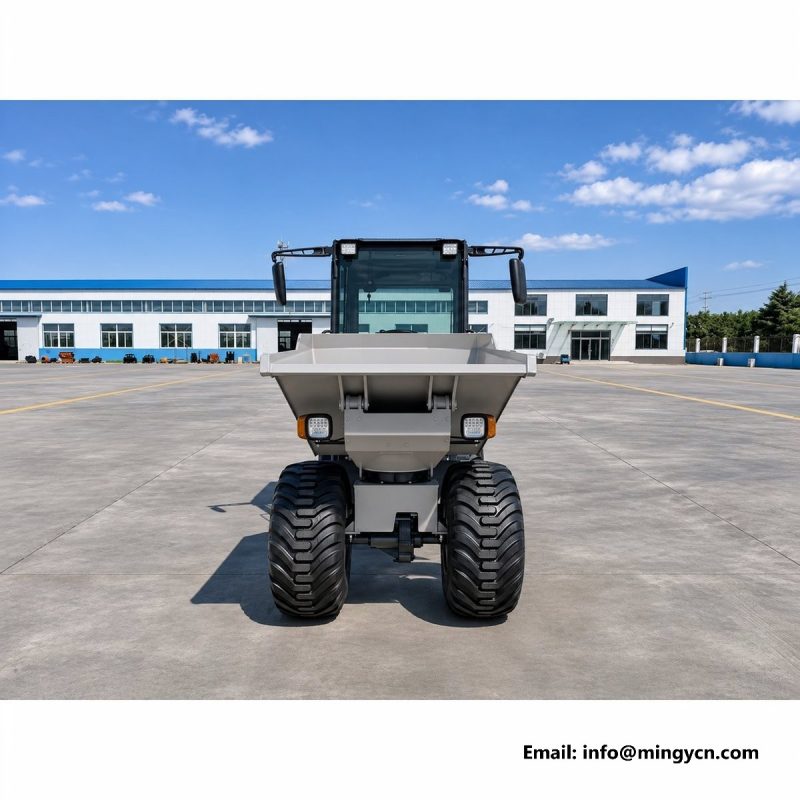
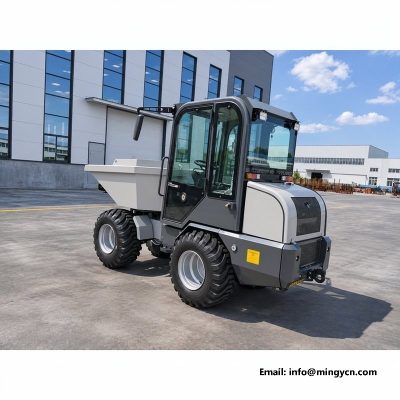
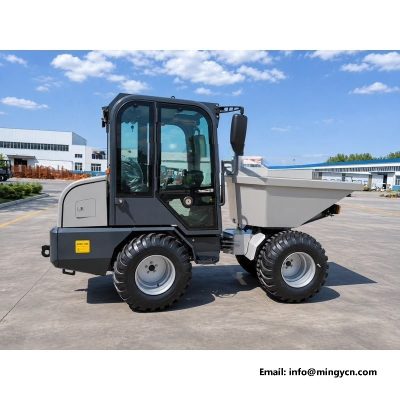
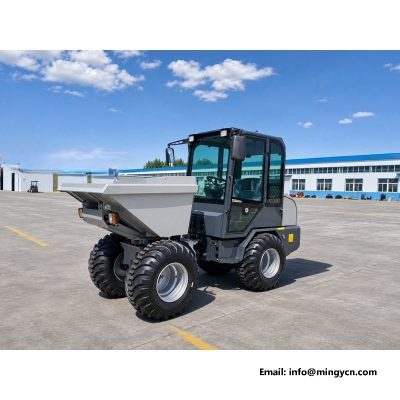
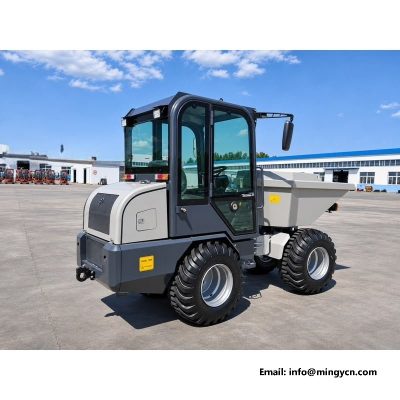
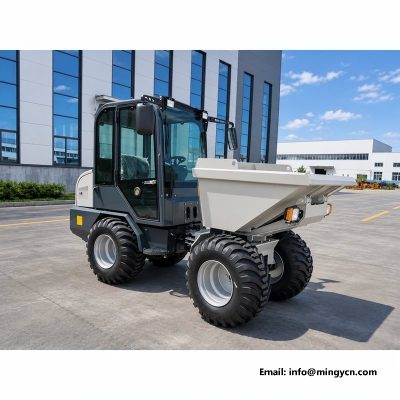
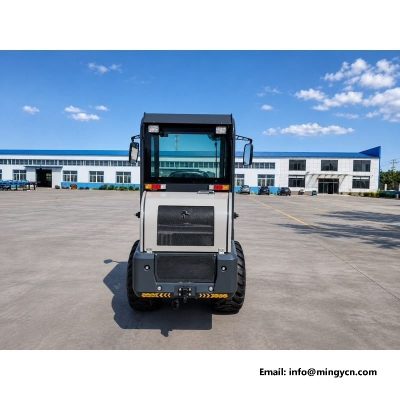
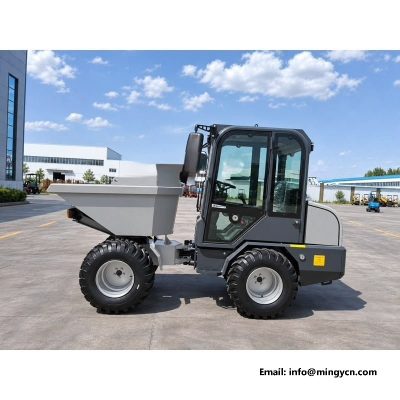
MY180D site dumper with a rear tipping body and an enclosed cab for wet or dusty sites.
The MY180D is also built with a sealed cab, and this page deals with that version. The chassis, the driveline and the rear-tipping skip are shared with the canopy model; what changes is the operator station and, with it, the machine's working height, its weather envelope and its place in a rental fleet. The pictures track the cab build from the front quarter round to the tailgate. The sections below cover what a cab changes in daily use, its effect on transport height, glass and wiper care, the control layout, sight lines with the skip raised, the choice between the two builds, fleet expectations, ventilation, seal maintenance and acceptance.
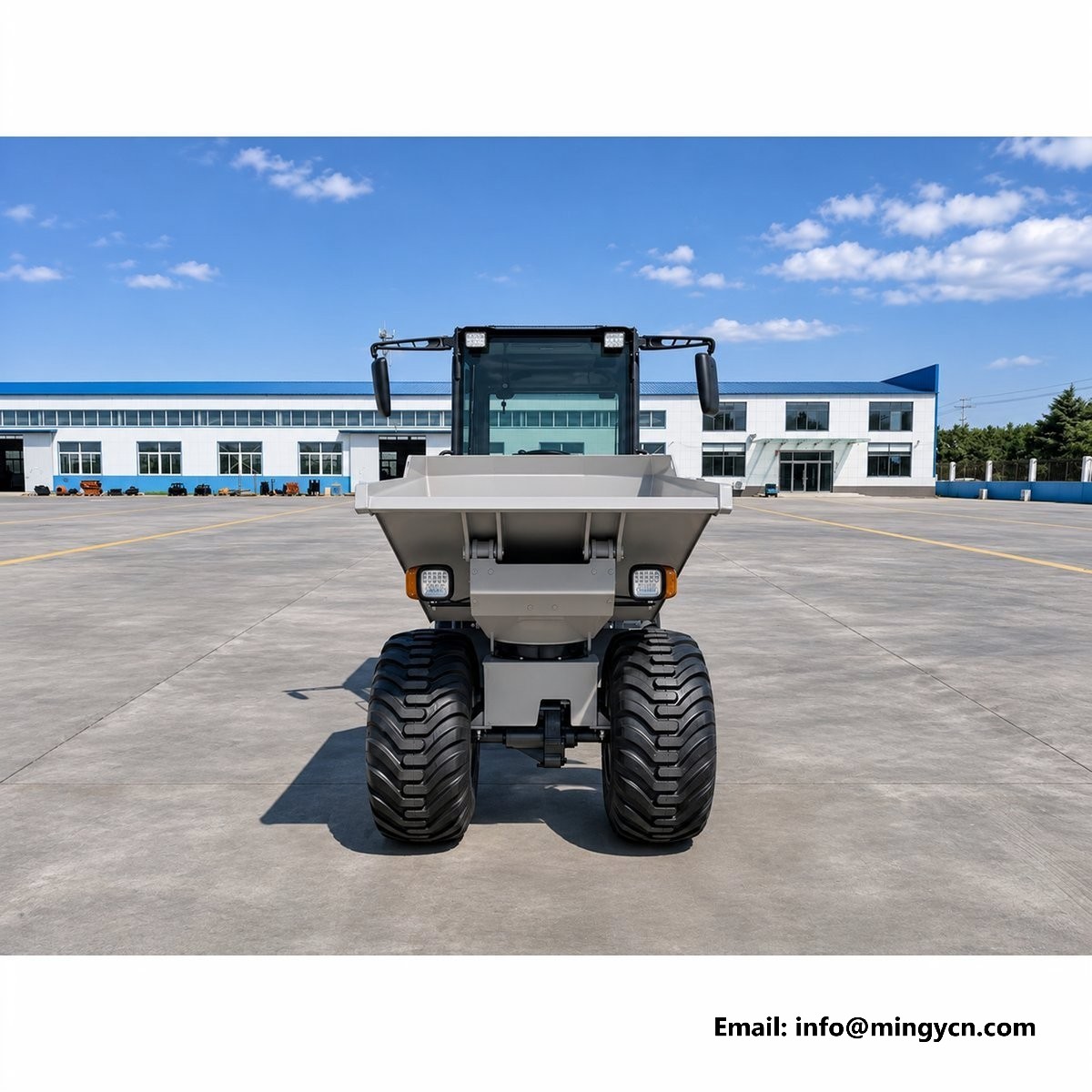
A cab is often treated as a comfort item on a compact machine, and on a dumper that reading is wrong. The operator of this class of machine spends the shift in a cloud of dust from the load, the ground and the loader bucket, and works in whatever weather the site is having. A sealed station with a roof, glass and a door changes how long that person can stay effective, and it changes what the machine can be asked to do in rain and in winter. It also changes who will operate it. Fleets that struggle to keep drivers on open machines usually find the argument easier when the machine has a door that closes. The cost is real, but it is spread over the years the machine stays in service.
An open platform exposes the operator to three things that a cab addresses directly. The first is airborne dust, which on a demolition or road job includes fine material better kept out of the lungs; a sealed station with a filtered air supply reduces exposure without relying on the operator's mask. The second is rain, which does not stop a programme and turns an open seat into a wet one within minutes, with the controls becoming slippery and visibility dropping. The third is cold, which slows hands and judgement long before the body complains. None of these are comfort arguments in the narrow sense. They are arguments about productive hours in a shift, and about the error rate of a tired operator. In markets where operators are scarce, retention is a cost item in its own right, and a cab is one of the cheaper ways to improve it.
| Model | MY180D (standard boom) / MY180T (telescopic boom) |
| Hydraulic pump | Closed-circuit piston pump, PWG (Italy) |
| Axles | Hydrostatic drive axle, orbit (gerotor) motor drive |
| Control | Pilot hydraulic operation |
| Standard tyres | 10.0/75-15.3 (optional 400/60-15.5) |
| Engine options | Xinchai Euro 5 3B11 (standard) / Kubota D1105 / Kubota V1505 |
| Seat | Deluxe seat |
| Hose | Qingdao Xiangliu hose assemblies |
| Options | Canopy, hydraulic quick coupler, enclosed cab, high/low speed |
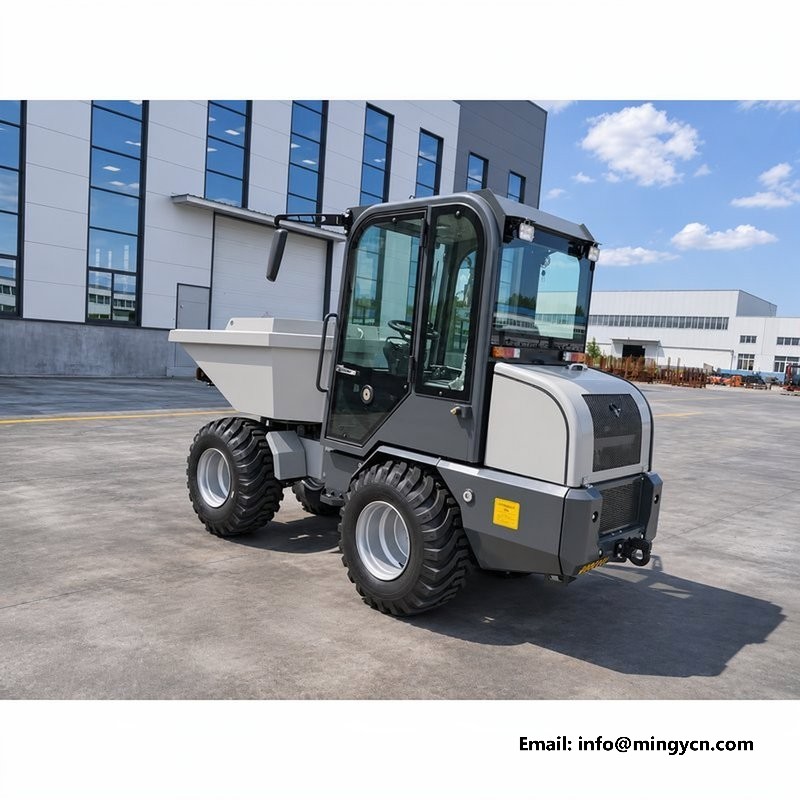
The cab build is taller than the canopy version, and that difference has practical consequences before the machine ever reaches the site. Shipping quotes are based on the height that has to fit under a container corner casting or onto a flat rack, so the transport height must be confirmed with the factory, not assumed from the working height. Some cabs are shipped with the roof or the beacon removed and refitted at destination; others cannot be reduced without work. On site the extra height matters at low bridges, in sheds, under pipe racks and beneath scaffolding, and it changes the clearance the driver must judge. Ask for both figures in writing, and check the route from the port. If the machine will travel on a lowbed between sites, measure the height with the beacon and mirrors fitted, not stripped.
The glass on a working dumper takes punishment from stones thrown by the wheels and from the loader bucket. The front screen is usually laminated so that a chip does not become a hole, while the side and rear panes are tempered and fail completely when struck hard. Wiper blades harden in sunlight and smear long before they tear, so they belong on the weekly check rather than the annual service. Washer jets block with dust, and the reservoir should be filled with clean water and a proper additive, not with site water. Condensation inside the cab is a visibility problem in its own right, and it is controlled by ventilation rather than by wiping. Spare panes are worth stocking where the machine works near blasting. Keep a note of the pane dimensions, because a local glazier can often cut a flat side window faster than a factory order arrives.
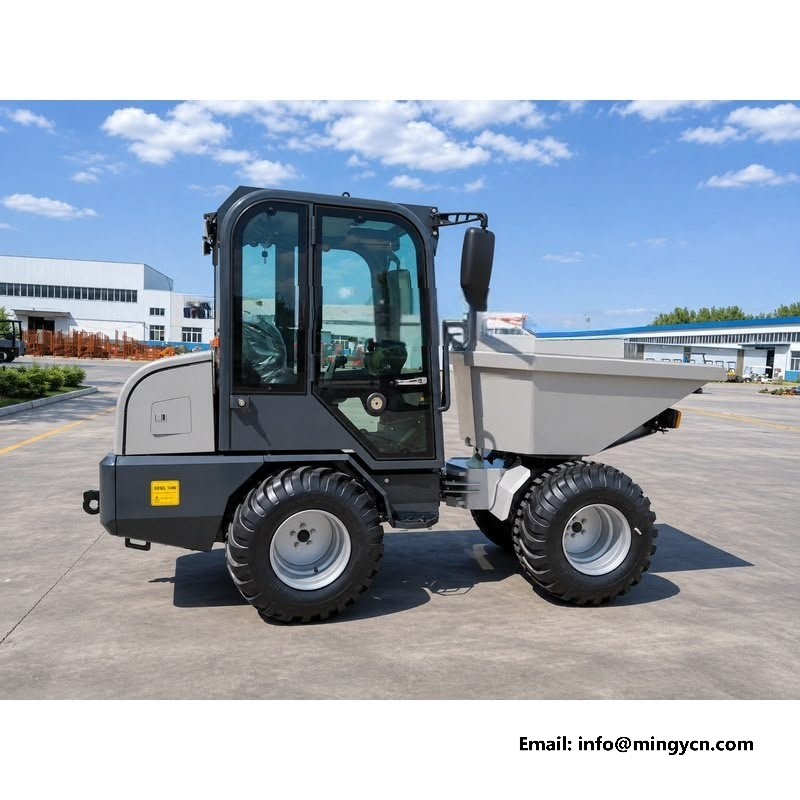
Inside the cab the layout should let the operator work without leaving the seat or looking away from the skip. Pilot levers sit where the hands fall naturally, the throttle and the forward-reverse control are separated enough that neither is moved by accident, and the dashboard keeps the temperature gauge, the hour meter and the warning lamps in one line of sight. The steering column should not obscure the lower edge of the screen, because that edge is where the near wheel and the ground beside it are seen. Controls that must be reached with gloves on should be large and detented rather than small and smooth. A deluxe seat with adjustment for reach and weight is not a luxury here. Ask for the seat to be adjusted before the machine leaves the factory, and check that the pedals fall naturally under the foot.
Raising the skip changes what the operator can see, and the change is not always obvious to someone who has only driven the machine empty. With the body up, the load and the tailgate occupy the space behind the cab, so the mirrors have to be set for that condition as well as for travel. The driver should raise the body, stop, and check both mirrors before reversing or moving off, because a person who was visible a moment ago may not be. Mirrors mounted on the cab frame are more stable than those on canopy legs and can be adjusted from the seat. Where the machine works in crowded yards, a reversing camera is a reasonable addition, and pillar blind spots should be learned on the first day. Mark the pillar edges with a strip of reflective tape if the site is dark.
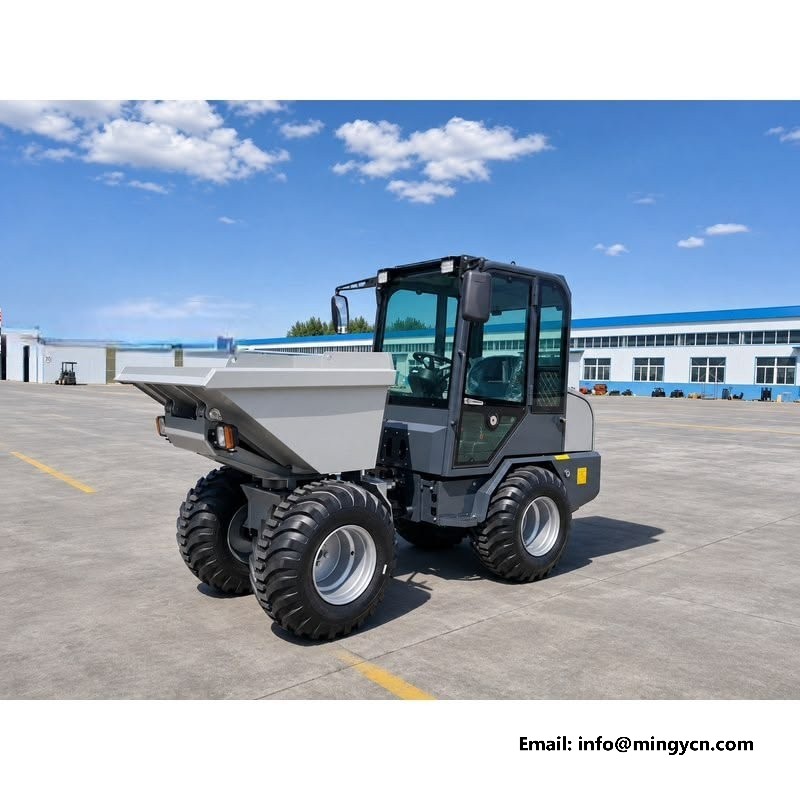
The two builds share a chassis, a driveline and a skip, so the choice is genuinely about the station rather than about capability. Take the canopy where the climate is hot and humid for most of the year, where it is hosed down often, where headroom is tight, and where the purchase price has to be held down. Take the cab where the machine works in dust, rain or cold, where shifts are long, where the operator is an employee who has to be retained, or where the machine will be rented to customers who expect a door. Neither choice is wrong in the abstract. Fleets that own both tend to put the cab on the longest daily duty. Whichever way the order is placed, keep the same specification across the fleet so that a driver moving between machines finds the controls where they were.
Rental and municipal buyers read a dumper differently from a contractor. They ask who will operate it, how quickly a replacement driver can be trained, and how much damage an inexperienced hand can do in a week. A cab answers the first two questions, because a sealed station is familiar and because the controls are visible and labelled. For the third, the cab adds parts that can be broken: glass, mirrors, wipers, door handles and latches, so the machine should be supplied with these as service items and with a simple daily checklist laminated inside the door. Municipal work also means street fronts, parks and footpaths, where noise and dust are noticed by residents. A machine that keeps its operator clean and quiet is easier to justify. Ask also how the machine is cleaned between hires, because a cab full of dust from the last job is a complaint waiting to happen.
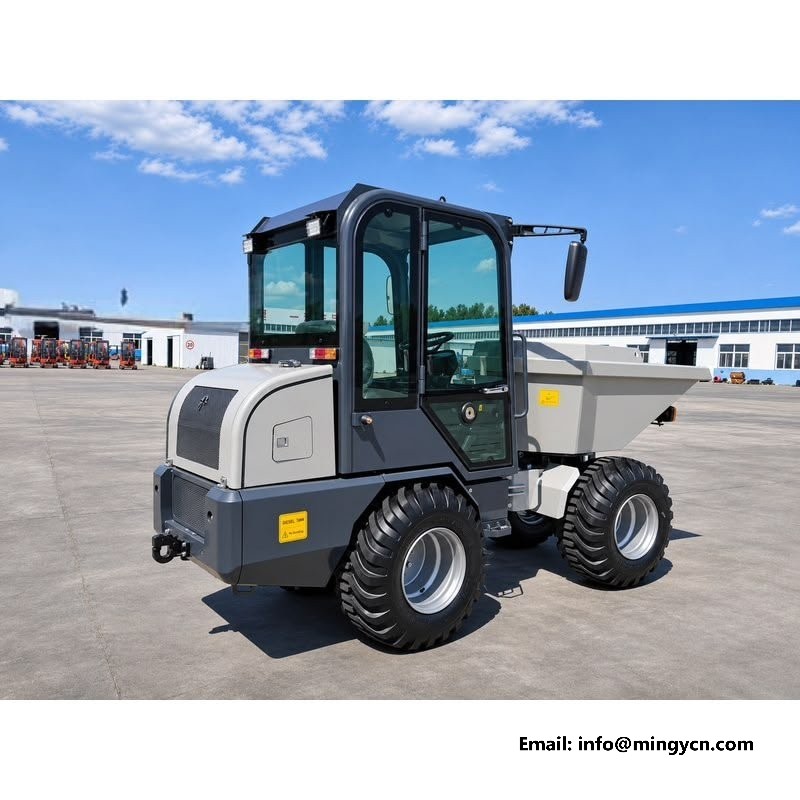
A sealed cab solves the dust problem only if it is ventilated properly. Air has to come in through a filter, not through gaps around the door, and the filter has to be cleaned on a schedule that matches the site rather than the calendar. In cold weather a heater with a demist outlet keeps the screen clear and the operator's hands working; without it the cab fogs as soon as the machine stops moving. In hot weather, shade alone is not enough and forced ventilation is worth having. The cab should not be sealed so tightly that the operator props the door open to breathe, because that defeats the purpose. Ask how the air enters, where it is filtered, and how the screen stays clear. A recirculation setting helps the heater in winter but does nothing for dust, so the two functions should be understood separately.
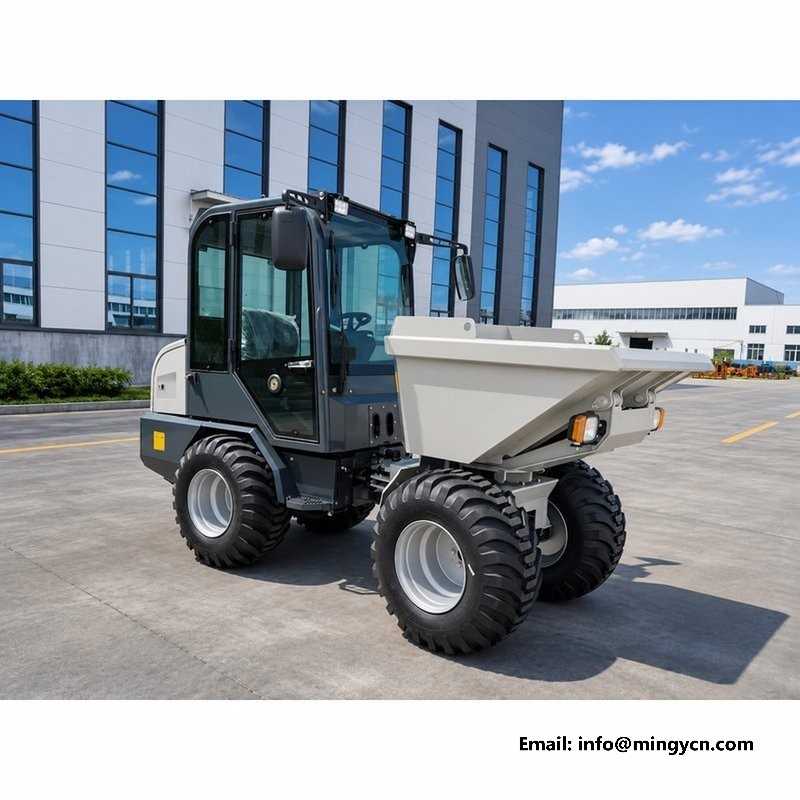
A cab is only as good as its seals after a year of work. The cab sits on rubber mounts that isolate vibration from the chassis, and those mounts compress and crack with age; when they do, the cab moves against the frame and the door alignment changes. Door seals flatten at the hinge side first, which is where water enters and where wind noise starts. Latches need adjustment rather than force, and a door that has to be slammed is a door that is out of line. Wiring that passes into the cab should go through grommets that are still seated, because a chafed loom behind a trim panel is expensive to trace. A water test with a hose once a quarter will show more than a visual inspection.
Beyond the mechanical checks that apply to any dumper, the cab build needs its own list. Open and close both doors slowly and listen for a scrape; check that the latch catches on the first stage and the second without force. Look at the gap around each pane and at the seal under the roof. Run the wiper through its full arc and confirm the washer sprays where the blade will pass. Start the engine and check the heater fan, the demist outlet, the interior light, the horn and every lamp. Sit in the seat and confirm the mirrors can be adjusted to show the ground behind the skip, in both the travel position and the raised position. Finally, ask for the glass and wiper part numbers. Photograph the door gaps and the glass markings before the machine is loaded, so that a later dispute has a reference point.
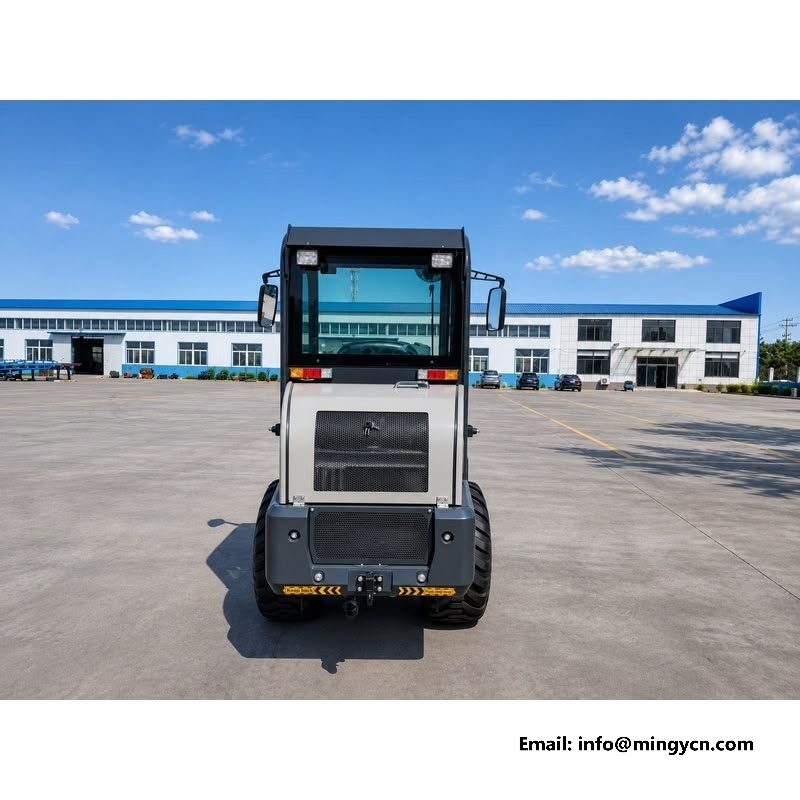
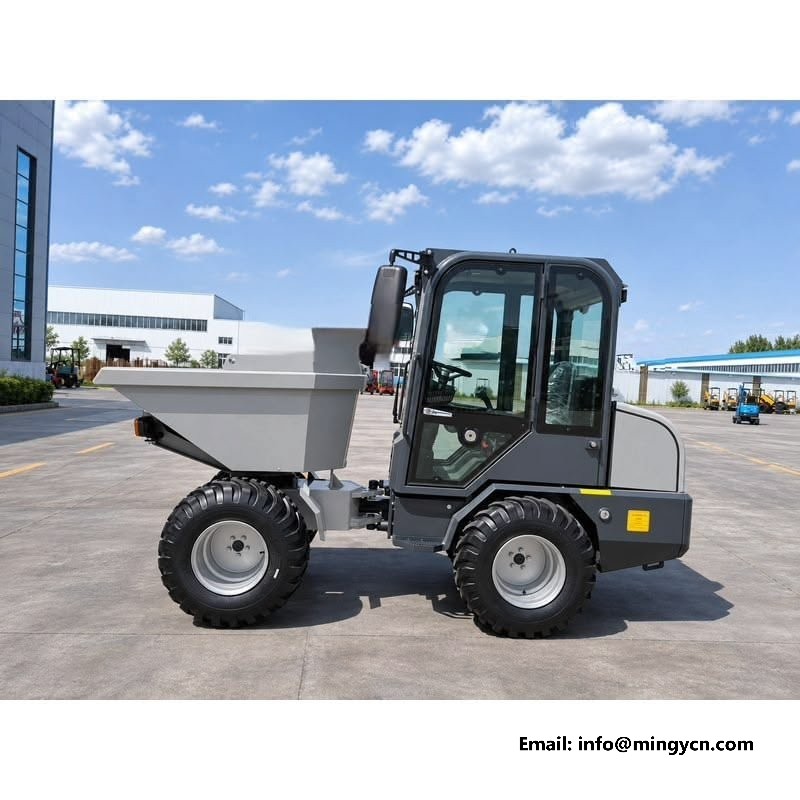
It can. The cab build is taller than the canopy version, so the transport height has to be confirmed with the factory before a container or flat rack is booked. Some builds ship with the roof or the beacon removed and refitted at destination, and others do not. Ask for the working height and the transport height in writing, then check the clearance on the route from the port to your yard.
It depends on duty and climate. If the machine works long shifts in dust, rain or cold, or if it is rented to operators you do not employ, the cab usually pays for itself in retained operators and productive hours. If it works short cycles in hot, dry weather and is washed down daily, the canopy is simpler and cheaper to keep. Fleets often run both and put the cab on the longest duty.
Ordering and technical support
Email: sales@mingycn.com
LINE (ID): mingyicn
Tell us your working width, ground conditions and the attachment you need, and we will confirm the right configuration and shipping details.