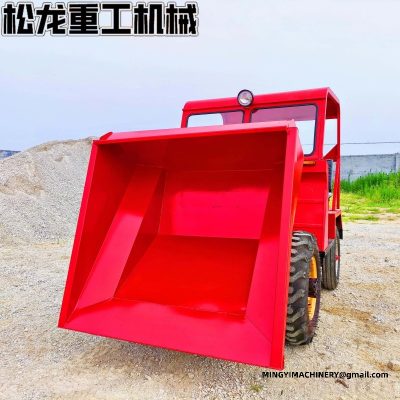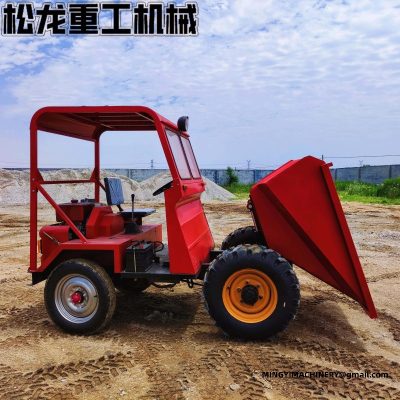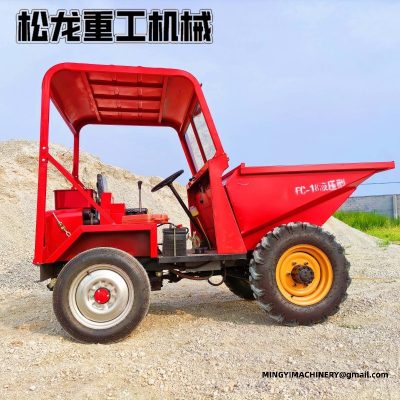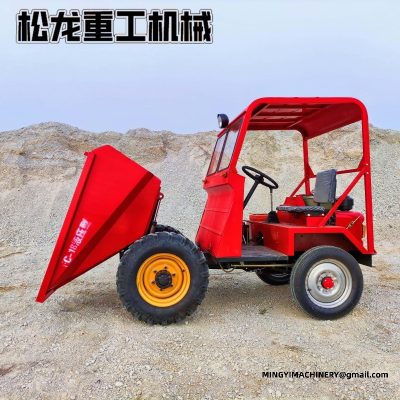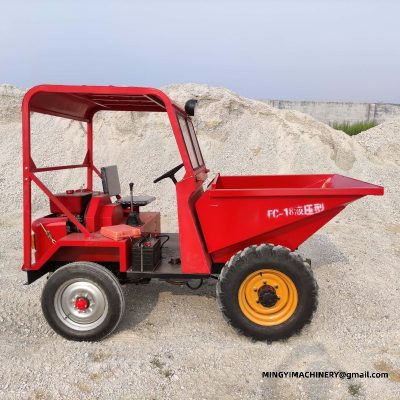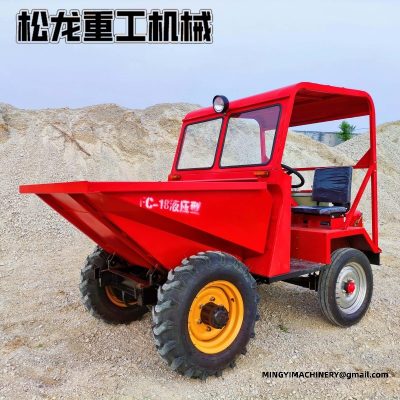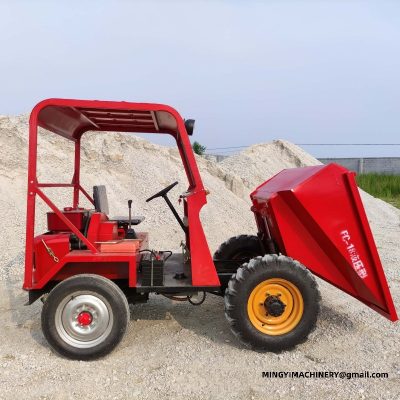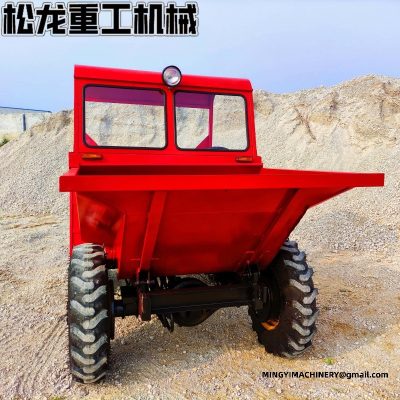
Two figures decide how much work a static hydraulic front dump truck does in a day: 1,000 kg of rated load and 0.5 m³ of bucket capacity. Everything else — 390 mm of discharge height, 200 mm of clearance, 21% of gradeability — decides whether that load can actually be moved on the ground on a building site. This page works through both groups.
The FC10 drives its front axle and steers at the rear — a front-axle drive with rear-axle steering (two-wheel drive). That is right for firm ground and grades to 21%. The point at which it stops being right is when traction rather than payload becomes the limit on a building site.
Soft ground, persistent mud or a route across broken surfaces all shift the balance toward the four-wheel-drive FC15/FC18/FC20/FC25/FC30 models in the range, which are hydraulic tippers with electric start, lighting, signal lamps and an optional canopy. The decision is made by the site, not by the specification sheet — but it is only makeable if the two-wheel-drive baseline is known, which is why the FC10's figures are published in full.
The FC10 is offered with the equipment a site machine needs and no more; the FC15/FC18/FC20/FC25/FC30 models above it add four-wheel drive and, in the document's own words, electric starting, lighting, signal lamps and a canopy as optional equipment.
What the FC10 publishes as standard is what decides whether it can work at all on a building site: CG25M diesel with 12 V DC electric motor starting, hydraulic tipping with powered return, 390 mm of forward discharge, and a 1,000 kg rating. Everything beyond that is site preference.
Rear-mounted diesel, front-axle drive, rear-axle steering: the FC10's layout is a set of connected decisions. The engine at the rear counterweights the box ahead of the front axle, so the machine carries 1,000 kg without needing a slab of ballast, and the 1,230 mm wheelbase keeps the whole thing 2,700 x 1,600 x 2,000 overall.
Building site work punishes a badly balanced machine on every ramp. With the weight spread between a driven front axle and a steering rear axle, the FC10 keeps traction while loaded and keeps steering while empty — the two conditions that catch out machines which put all their weight at one end.
| Reference specification — FC10 front tipper (1,000 kg class) | |
|---|---|
| Rated load | 1,000 kg |
| Rated bucket capacity | 0.5 m³ |
| Discharge height | 390 mm |
| Maximum gradeability | 21% |
| Bucket width | 1,580 mm |
| Travel speed, 1st gear | 6.8 km/h |
| Travel speed, 2nd gear | 22 km/h |
| Travel speed, reverse | 7.5 km/h |
| Minimum turning radius | 4,500 mm |
| Overall dimensions (L x W x H) | 2,700 x 1,600 x 2,000 |
| Track | 1,500 mm |
| Wheelbase | 1,230 mm |
| Minimum ground clearance | 200 mm |
| Diesel engine model | CG25M |
| Rated engine power | 17.3 kW |
| Rated engine speed | 2,200 r/min |
| Starting method | 12 V DC electric motor |
Ask for the specification sheet for the exact build you are buying, not for the model name. The FC10 figures published here describe the standard machine: 17.3 kW at 2,200 r/min, 0.5 m³ and 1,000 kg, with 12 V DC electric motor.
Ask also what is optional. On the wider FC15-FC30 four-wheel-drive machines the lighting, signal and cab options are listed explicitly; knowing which of them are fitted is the difference between a machine that suits your job and one that nearly does.
Choosing inside the range starts with the route rather than the model. Measure the narrowest passage, the steepest ramp and the worst ground on a building site moving concrete between the batch point and the pour; compare them against the FC10's 2,700 x 1,600 x 2,000, 21% gradeability and 200 mm clearance. If all three fit, the 1,000 kg machine is the answer.
If the ground does not fit, the four-wheel-drive FC15/FC18/FC20/FC25/FC30 models are the step up — hydraulic tipping, electric start, lighting and signals, optional canopy. The FC10's published table exists so that the baseline is known before that comparison starts, which is exactly why full figures matter on the entry model.
A 1,580 mm box on a 2,700 x 1,600 x 2,000 machine can be loaded three ways: from a heap by hand, from a heap by machine, or from a hopper. On a building site, all three happen on the same site in the same week, and the box is proportioned to suit all of them.
0.5 m³ is small enough to fill by hand from a pile of concrete and large enough that filling it mechanically is not wasted effort. That range is deliberate: the machine is bought by sites that cannot guarantee a loading method, so it works with whichever is available.
The safety case for a small front tipper is largely the safety case for not needing a larger machine. 2,700 x 1,600 x 2,000 overall and 4,500 mm of turning radius mean fewer blind reversing movements on a building site, and forward tipping at 390 mm means nobody has to stand behind a raised box.
Gradeability of 21% and clearance of 200 mm define the safe envelope. Worked inside those figures, on the firm ground the two-wheel-drive layout is specified for, the machine is predictable. The specification sheet is also, read properly, the operating manual.
The FC10 reverses at 7.5 km/h, which is slow enough that a banksman walking beside it can keep up. That is deliberate on a machine used on a building site, where the route behind is often occupied by people who cannot hear it coming over the general noise.
Ask any site that runs small tippers and the same three controls come back: a speed limit for reversing, a rule that the person on the ground has the right of way, and nobody standing inside the turning circle. At 4,500 mm, the FC10 turns inside a space narrower than most expectations, which reduces but does not remove the need for those rules.
Top speed sells machines; cycle time pays for them. At 6.8 km/h loaded and 22 km/h empty, the FC10 is geared for the run between stockpile and discharge point on a building site moving concrete between the batch point and the pour — short enough that acceleration and manoeuvring matter more than maximum speed.
That is also why reverse is geared at 7.5 km/h rather than as an afterthought. On a site where the machine works back and forth all day, the return leg is half the cycle, and gearing it properly is worth more than a higher number on the specification sheet.
The FC10 runs a CG25M diesel rated at 17.3 kW at 2,200 r/min, and the matching is the point: a 1,000 kg machine with 21% gradeability needs torque in the working band rather than a big headline figure. on a building site moving concrete between the batch point and the pour, that is load-lugging at low speed rather than sprinting.
Starting is by 12 V DC electric motor, which means the machine starts from the key rather than from a handle — worth more than it sounds on a site where the operator gets in and out twenty times a shift. The rear-mounted position keeps the engine away from the load and makes the routine checks straightforward.
At 2,700 x 1,600 x 2,000 the FC10 is small enough to be moved without a low-loader, which is one of its less obvious advantages. A machine that can be carried on a standard trailer behind a light truck changes how a contractor deploys it between jobs.
The same dimensions, seen from the other side, decide whether it fits through the gateway on a building site. On a building site the first question is always access, and a machine that is 2,700 x 1,600 x 2,000 with a 4,500 mm turning radius answers it before any conversation about capacity begins.
What is the wheelbase of a static hydraulic front dump truck and why does it matter?
1,230 mm, with a 4,500 mm turning radius. A short wheelbase plus rear-axle steering is what produces the tight radius, and that is what lets the machine work in confined areas on a building site.
Is the static hydraulic front dump truck available with a canopy or cab?
The four-wheel-drive models in the range — FC15/FC18/FC20/FC25/FC30 — list a canopy as optional equipment, together with electric start, lighting and signal lamps. The FC10 itself is the simple, low machine described by its published table.
How often should hydraulic hoses be replaced on a static hydraulic front dump truck?
On condition rather than on a calendar. The box cycles continuously on a building site, so inspect for cracking, rubbing and weeping at the crimps, and replace before a failure stops the machine.
How do I match a static hydraulic front dump truck to a mixer or hopper?
By discharge height and cycle count. 390 mm of discharge height has to clear the receiving opening, and the 0.5 m³ box sets how many trips are needed. Check both before deciding on the build on a building site.
How much does a static hydraulic front dump truck weigh when loaded?
1,000 kg of load plus the machine itself, spread across a 1,500 mm track and a 1,230 mm wheelbase. The published load figure is the one to work from: the machine is balanced by the rear-mounted engine so that the rated load needs no ballast.
What does the operator need to know before using a static hydraulic front dump truck?
The four working limits: 1,000 kg of load, 21% of gradeability, 200 mm of ground clearance and 390 mm of discharge height. Everything else about operating the machine follows from staying inside those.
How high does a static hydraulic front dump truck discharge?
Discharge height is 390 mm, measured at the box with it tipped forward over the front axle. Check it against the pile, trench or skip that receives the load on a building site.
Can a static hydraulic front dump truck work in a narrow space?
That is what it is for. At 2,700 x 1,600 x 2,000 overall with a 4,500 mm turning radius, it passes through openings and turns inside its own footprint, and forward tipping means it empties ahead of itself rather than needing clear space behind.
Full specifications for the FC10 and for the four-wheel-drive models above it are available on request, along with the optional equipment list: electric start, lighting, signal lamps and canopy.
Hot, humid and dusty conditions around Static Hydraulic Front Dump Truck: Site Transport Duties
Heat and dust shorten service intervals rather than machine life. In these conditions the filters on Static Hydraulic Front Dump Truck: Site Transport Duties need attention more often, and the cooling surfaces need to be kept clear to hold the working temperature.
Documents that travel with Static Hydraulic Front Dump Truck: Site Transport Duties
The machine is only half of what arrives. The parts book, the service schedule and the declarations that come with Static Hydraulic Front Dump Truck: Site Transport Duties are what let the owner register, insure and maintain it without a second round of emails.
Packing, loading and shipment of Static Hydraulic Front Dump Truck: Site Transport Duties
Container loading is a planning exercise. The overall dimensions and the operating weight of Static Hydraulic Front Dump Truck: Site Transport Duties decide whether it ships whole, partly disassembled or with the attachment removed, and that decision is made before the booking.
A second operator for Static Hydraulic Front Dump Truck: Site Transport Duties
Different operators suit different work. The person who is quickest with Static Hydraulic Front Dump Truck: Site Transport Duties on open ground is not always the one who is safest in a confined space, and having both available is a genuine advantage.
Contact MINGYI Machinery for the current front tipper range, the four-wheel-drive models above the FC10, and a formal specification for your market. E-mail: sales@mingycn.com | LINE (ID): mingyicn
Front Tipping Dumper Manufacturer: The FC10 Build · Front Tipping Dumper Factory China: FC10 and the Range · 4x4 dumper for mining and quarry work · Front Tipper Truck