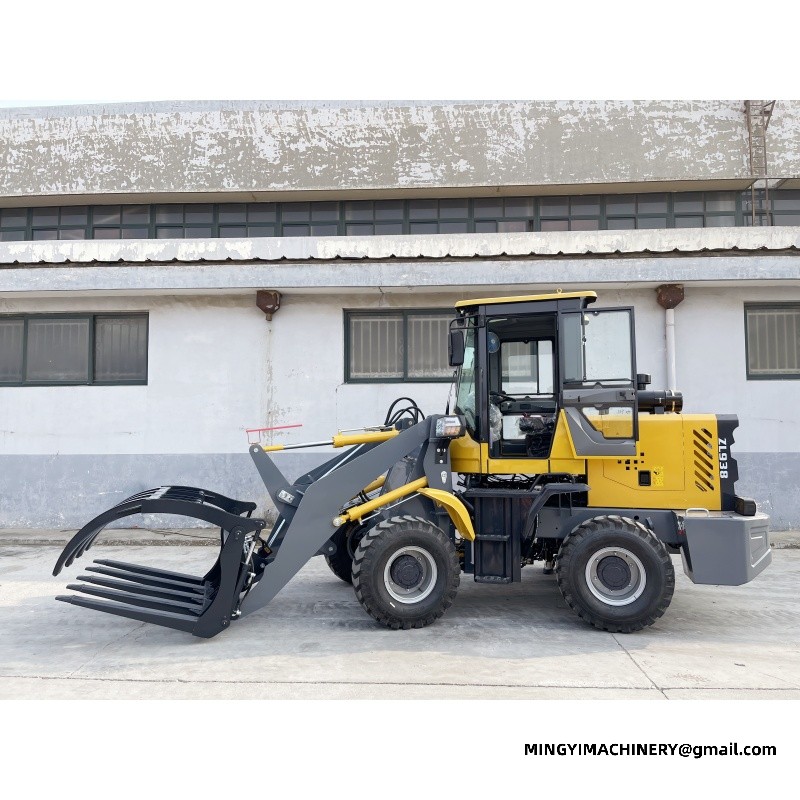
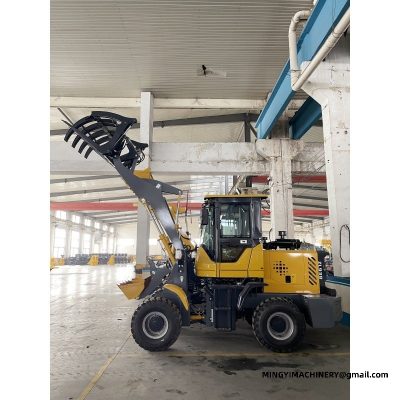
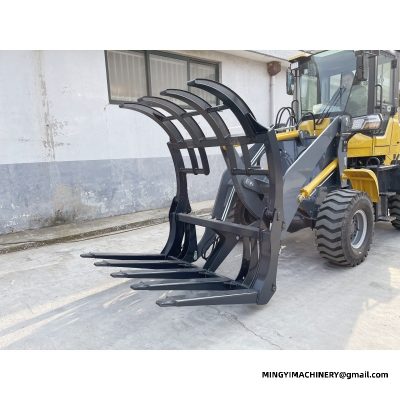
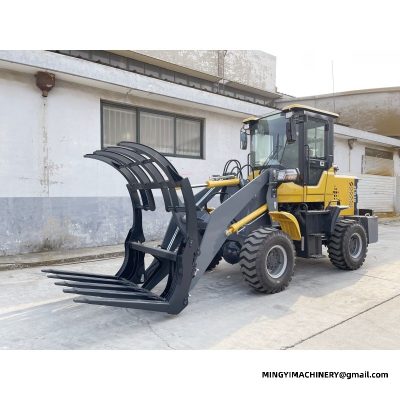
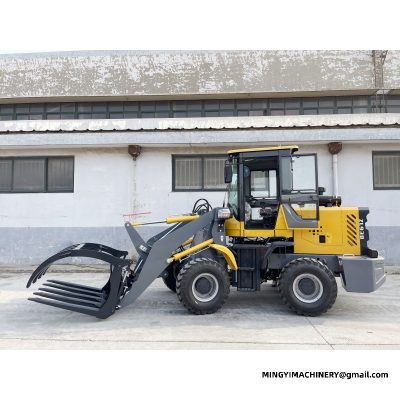
Most front end loader log grapple problems are decided before the machine arrives. A bucket that is too big for the material, a dump height that misses the board by a hand's width, a hinge plate thinner than the duty needs — none of those can be fixed afterwards, and all of them are printed on the sheet. This page walks the figures in the order an owner meets them: what the machine carries, where it puts it, what wears first, and what to check before it leaves the factory. Two builds run through the comparisons, the heavy-duty 3.8 m small-frame wheel-side reduction wheel loader at 3.8 m and the heavy-duty 4.2 m small-frame wheel-side reduction wheel loader at 4.2 m.
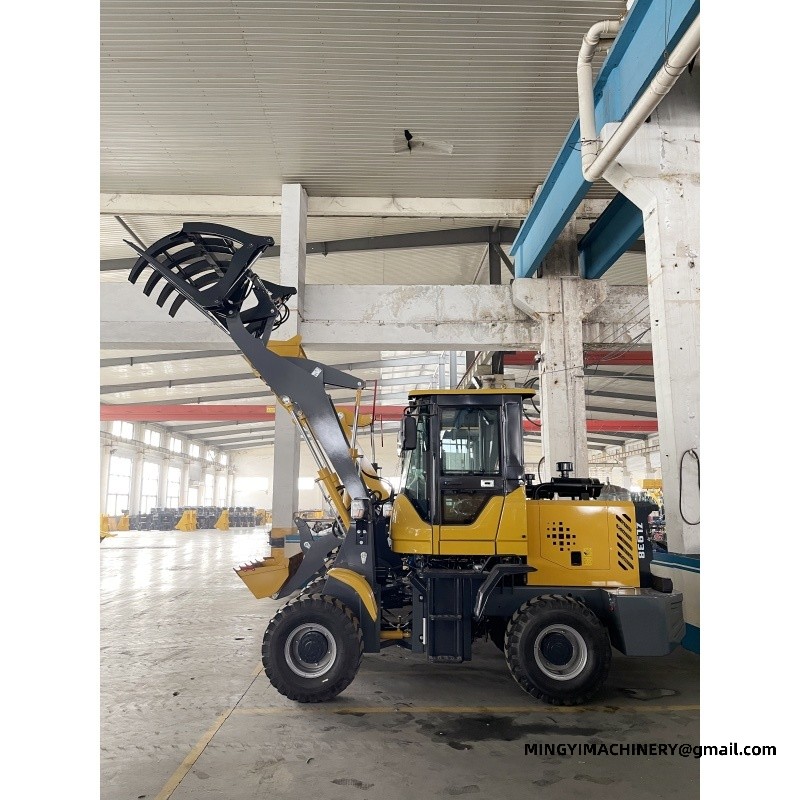
The standard bucket on this build is 0.3 m³, and it is the right tool for loose material moved from a heap to a body. Everything else is a compromise in one direction or another: forks give precision and lose volume, grapples give grip and lose speed, a snow blower gives reach and needs flow the bucket never asked for.
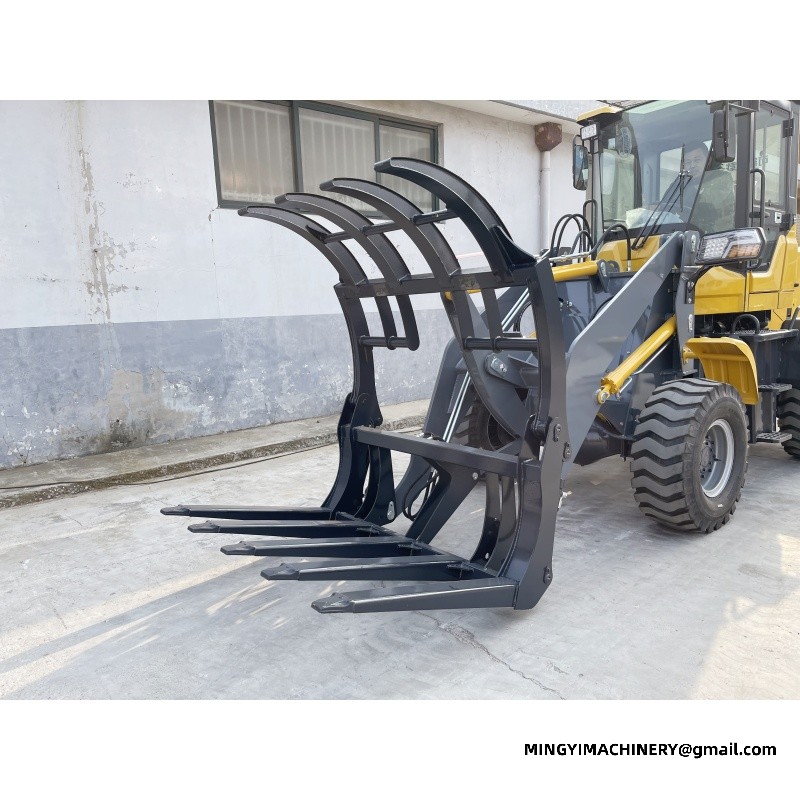
What makes attachments practical is whether the machine can lift them. Boom wall 20 mm and section 280 mm decide how much side load the arm takes, and the hinge plates — 16 mm at the front, 16 mm at the rear — decide how long the frame takes it. A grapple hanging off the end of a long arm is a side load the bucket never produces.
The battery is specified against the engine it has to crank: 60 Ah (490 engine); 80 Ah (4102 turbo engine) on the heavy-duty 3.8 m small-frame wheel-side reduction wheel loader and 60 Ah (490 engine); 80 Ah (4102 turbo engine) on the heavy-duty 4.2 m small-frame wheel-side reduction wheel loader. Where a build lists two figures, they belong to two engine options — a smaller capacity for the naturally aspirated unit, a larger one for the turbo — and the difference is starting torque in cold weather rather than anything you would notice in July.
For fleets shipping to cold markets, specify the larger capacity and a battery isolator; machines shipped knock-down arrive with batteries boxed and disconnected, and a machine that has sat for six weeks at anchor will not crank on a marginal battery. Check the rest of the electrical package at the same time — the 40 pump (490 engine); 1045 pump (4102 turbo engine) and 316 pump circuits on the heavy-duty 3.8 m small-frame wheel-side reduction wheel loader share the same harness, and a poor earth there presents as slow hydraulics rather than as an electrical fault.
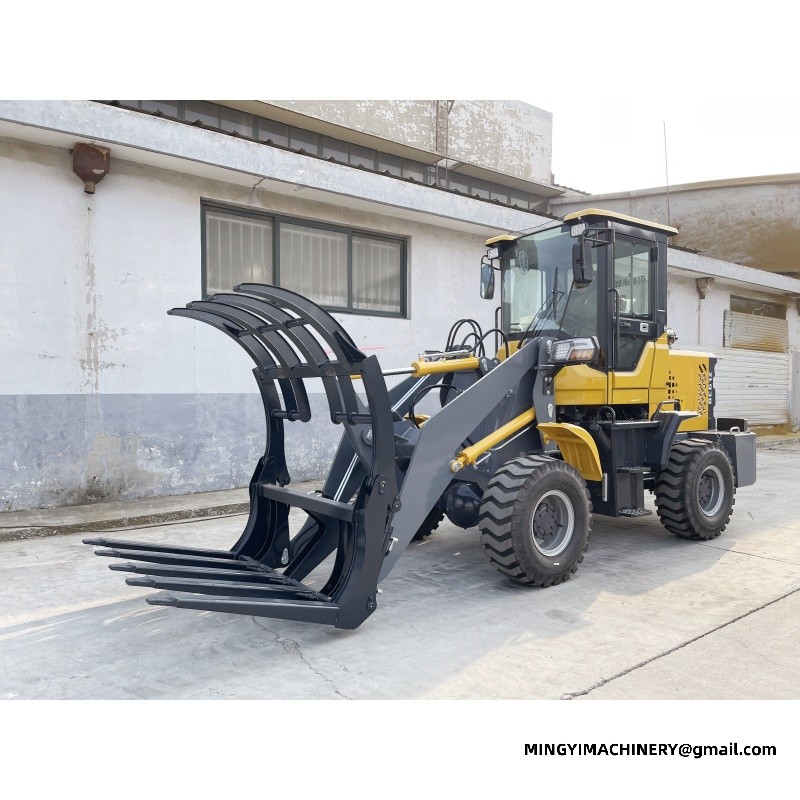
Farm work is governed by access and by the height of the things being filled. The heavy-duty 3.8 m small-frame wheel-side reduction wheel loader carries 0.4 m³ to 3.8 m on a 1.5 m (wheel-side reduction axle); 1.45 m (Isuzu axle) track with a 4.2 m footprint; the heavy-duty 4.2 m small-frame wheel-side reduction wheel loader carries 0.4 m³ to 4.2 m on 1.5 m (wheel-side reduction axle); 1.45 m (Isuzu axle) with 4.25 m. Gate widths, shed doors and feed-wagon sides are the constraints, and they are all fixed dimensions.
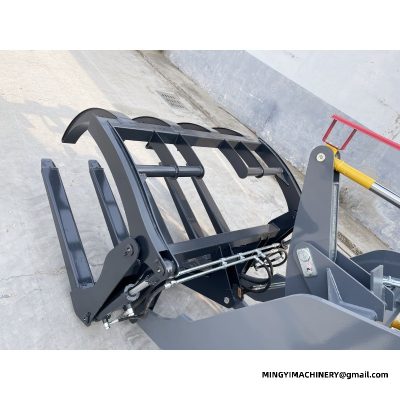
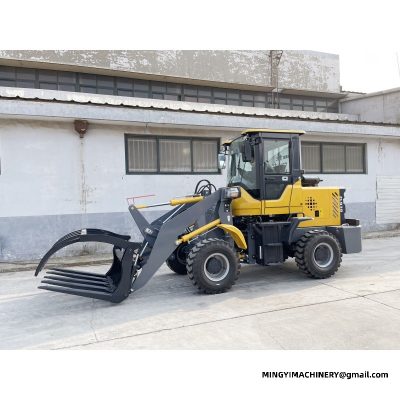
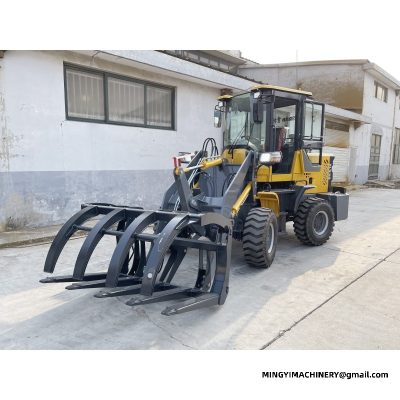
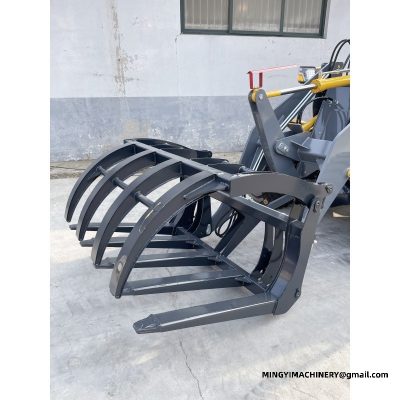
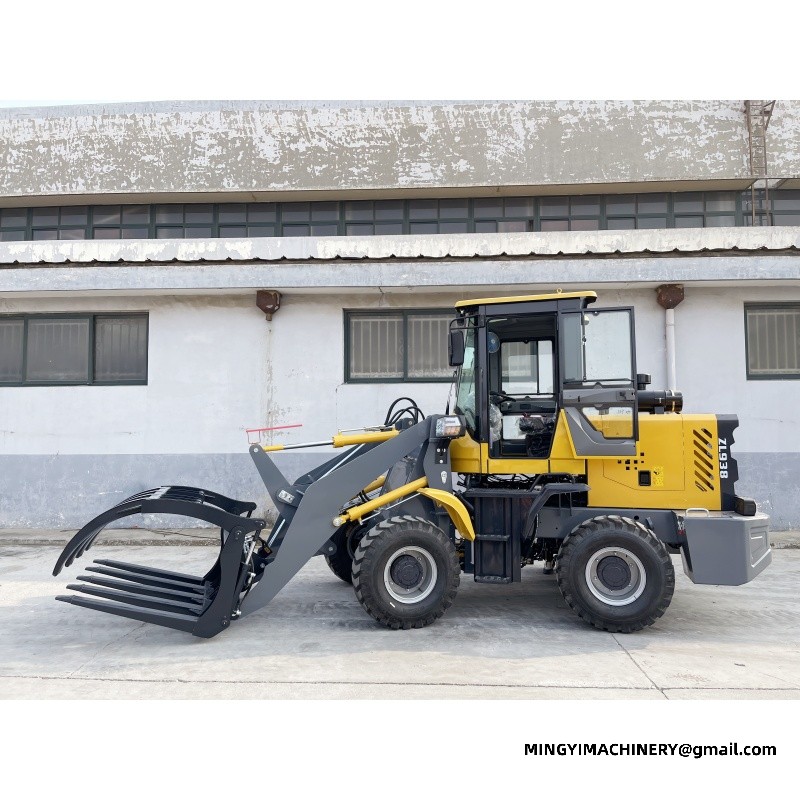
Attachments are where a farm loader earns its second life. Forks for bagged feed and pallets, a bale spear, a grapple for silage, a snow tool for the winter lane. They specification against the boom section, so check 430 mm on the heavy-duty 3.8 m small-frame wheel-side reduction wheel loader against 500 mm on the heavy-duty 4.2 m small-frame wheel-side reduction wheel loader before ordering, and specify the hydraulic circuit at build time if any of them is hydraulically actuated.
| Published build data — heavy-duty 4.2 m small-frame wheel-side reduction wheel loader | |
|---|---|
| Bucket capacity | 0.4 m³ |
| Dump height | 4.2 m |
| Track width | 1.5 m (wheel-side reduction axle); 1.45 m (Isuzu axle) |
| Boom arm thickness | 25 mm |
| Boom arm width | 500 mm |
| Boom arm length | 3.15 m |
| Boom arm centre distance | 890 mm |
| Cross-member thickness | 30 mm |
| Front hinge plate thickness | 30 mm |
| Rear hinge plate thickness | 20 mm |
| Rear frame section | 280 mm high x 800 mm wide |
| Hydraulic cylinders | centre cylinder 45 / side cylinder 45 |
| Fuel tank | 64.7 L (75# small tank) |
| Battery | 60 Ah (490 engine); 80 Ah (4102 turbo engine) |
| Front wheel to counterweight | 4.25 m |
| Radiator | 4100 core (490 engine); 4105 core (4102T engine) |
| Work pump | 40 pump (490 engine); 1045 pump (4102 turbo engine) |
| Travel pump | 316 pump |
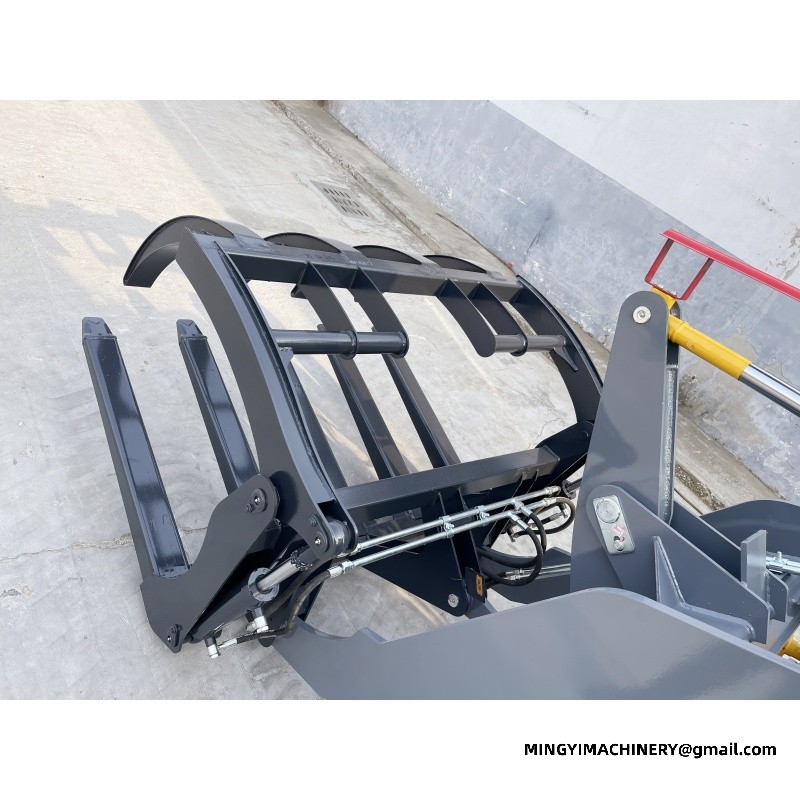
The distance from the front wheel to the rear of the counterweight is a stability specification dressed as a dimension. On the heavy-duty 3.8 m small-frame wheel-side reduction wheel loader it is 4.2 m working with a 0.4 m³ bucket at 3.8 m; on the heavy-duty 4.2 m small-frame wheel-side reduction wheel loader it is 4.25 m with 0.4 m³ at 4.2 m. Longer means more counterweight leverage, which is what lets a machine carry a full bucket high without lifting the rear wheels.
Longer also means a bigger turning circle, and that is the trade. In an open pit or a wide yard the 4.25 m machine with its 1.5 m (wheel-side reduction axle); 1.45 m (Isuzu axle) track is plainly the better tool. In a livestock shed, a nursery or an indoor renovation job, the 4.2 m machine on 1.5 m (wheel-side reduction axle); 1.45 m (Isuzu axle) will do work the other cannot start. Measure first; the specification only tells you what you are choosing between.
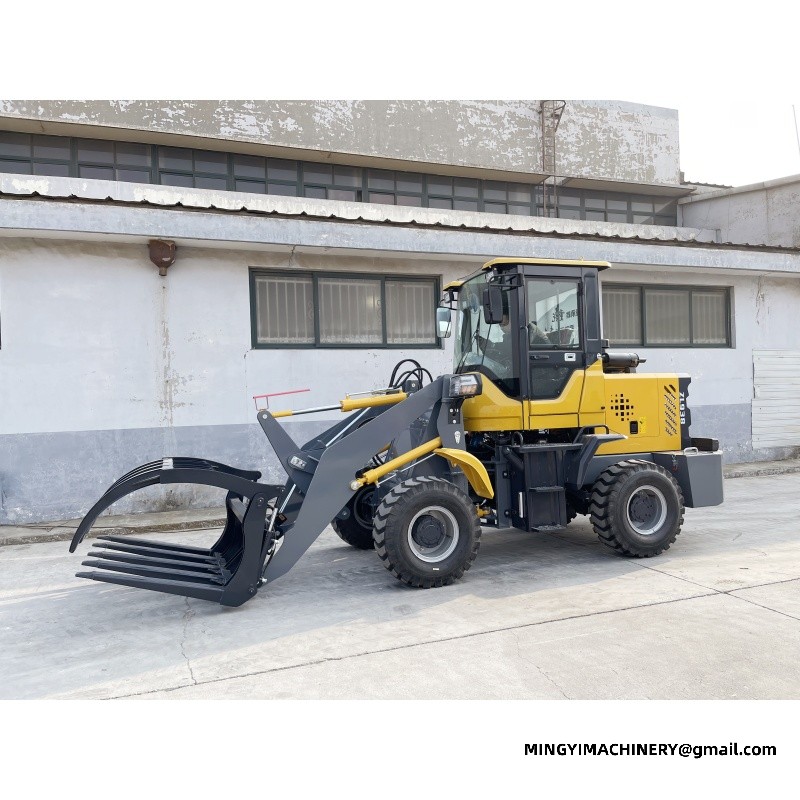
Soft ground punishes driveline parts before it punishes the frame. Sand, clay and loose overburden all increase rolling resistance, which increases torque at the hub, which is exactly where a non-reduction axle is weakest. Where the specification lists two track figures, as it does here at 1.2 m (Isuzu axle); 1.3 m (wheel-side reduction axle), the wider one belongs to the hub-reduction axle and is the specification for that ground.
Hard ground is the opposite case. On concrete, compacted hardstand or a paved yard, rolling resistance is low and sustained travel speed is high, so heat rather than torque becomes the limit. The light-duty 3.5 m medium-frame wheel-side reduction wheel loader lists 1.6 m, and the narrower figure there is the one for hard standing. Matching axle to surface takes nothing at the order stage and saves a driveline later.
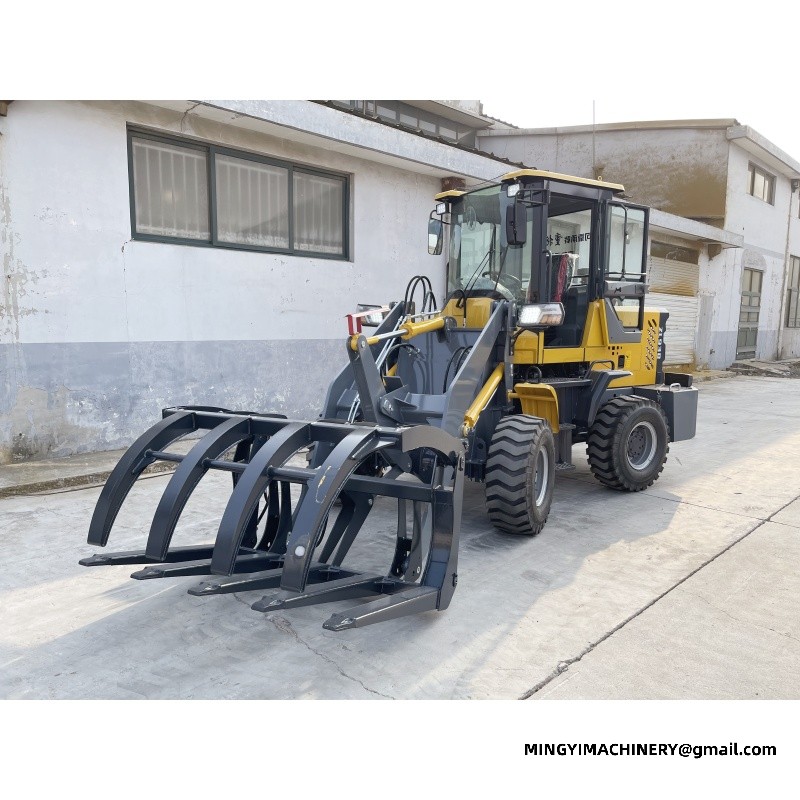
An articulated loader turns by bending in the middle, and the hinge is where that bending happens. Front plate 25 mm, rear plate 14 mm. The front is the thicker of the two on every build in the range, because it carries the boom and the payload directly, while the rear carries the engine and the counterweight through every steering movement and is sized for the twisting those movements produce rather than for the weight alone.
Pin wear is how hinges fail, and it shows up as a machine that wanders and a steering that feels vague. The cross-member is what prevents it: 25 mm holding the two sides of the frame at a fixed distance so the pins stay square. Compare 30 mm on the heavy-duty 3.8 m small-frame wheel-side reduction wheel loader and the difference in plate thickness starts to make sense — they are specified together, not separately.
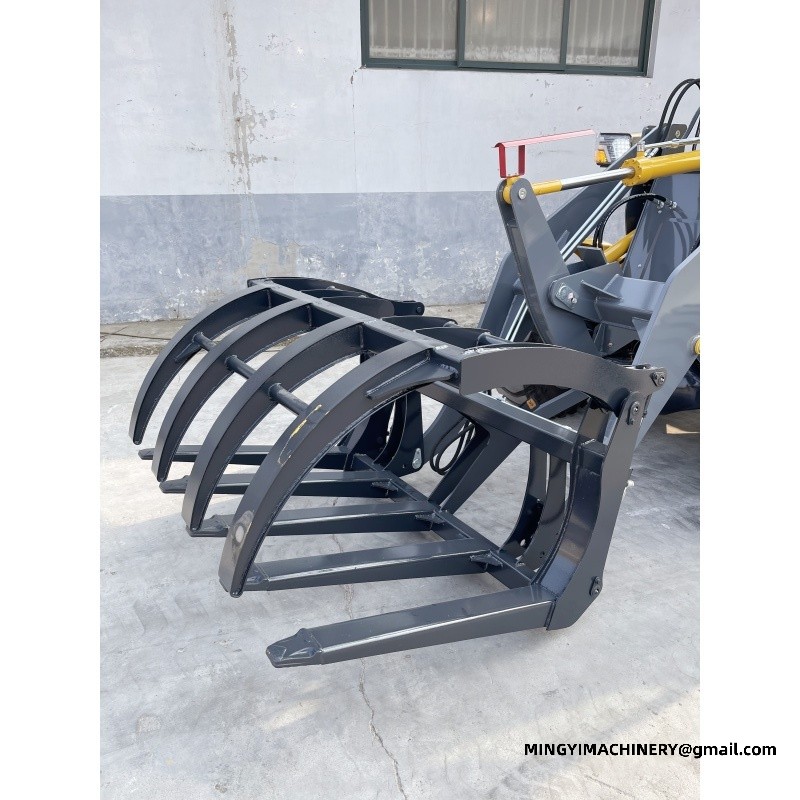
Shipping is a dimensions problem before it is a freight problem. Front wheel to counterweight is 4 m on this build and 4.3 m on the light-duty 3.8 m medium-frame wheel-side reduction wheel loader; track is 1.5 m (wheel-side reduction axle); 1.45 m (Isuzu axle). Those two figures, plus the bucket, decide how many units fit a container and whether the machine travels assembled.
Dump height matters here for a reason that surprises people: a machine shipped with the arm raised will not fit under a container door. At 3.2 m of lift height the arm has to be strapped down, and the securing points are on the frame — the 230 mm high x 800 mm wide rear section and the cross-member behind it, not the cylinders.
Indoor work changes the priority completely. Height clearance replaces dump height as the first figure, and the machine has to lift its load under a lintel rather than over a truck board. The standard 2.4 m low-profile wheel loader reaches 2.4 m, which is the outdoor figure; what matters indoors is whether that height is usable in the space available.
Length and track matter next. 3.5 m from front wheel to counterweight and 1.2 m (Isuzu axle); 1.3 m (wheel-side reduction axle) of track. Ventilation matters too, which is an engine question rather than a frame one, and the cooling specification is the place it shows: 4100 core, sized for air that is not moving. Where the machine works inside, the larger core is the safer specification even in a temperate climate.
What does a daily check on a front end loader log grapple actually consist of?
Look at the ground under the machine, check coolant and oil, grease the hinge pins behind the 30 mm front and 20 mm rear plates, and glance at the cylinder rods. Ten minutes, every shift.
How is a front end loader log grapple transported between sites?
On a low-loader, arm strapped down, secured to the frame rather than the cylinders. Front wheel to counterweight is 3.5 m and track is 1.2 m (Isuzu axle); 1.3 m (wheel-side reduction axle), which is what the haulier needs.
How is dump height on a front end loader log grapple measured?
At the bucket edge, arm at full lift, machine level. The heavy-duty 4.2 m small-frame wheel-side reduction wheel loader publishes 4.2 m and the light-duty 3.8 m medium-frame wheel-side reduction wheel loader publishes 3.8 m, measured the same way, so the two can be compared directly.
Which engine option should a front end loader log grapple be ordered with?
It follows the duty. The engine drags three rows with it: pump 40 pump (490 engine); 1045 pump (4102 turbo engine), core 4100 core (490 engine); 4105 core (4102T engine) and battery 60 Ah (490 engine); 80 Ah (4102 turbo engine). Choose it early rather than accepting whatever is in stock.
What paperwork should come with a front end loader log grapple?
A specification listing bucket 0.4 m³, lift 4.2 m, cylinders centre cylinder 45 / side cylinder 45, core 4100 core (490 engine); 4105 core (4102T engine), battery 60 Ah (490 engine); 80 Ah (4102 turbo engine) and track 1.5 m (wheel-side reduction axle); 1.45 m (Isuzu axle). If those six are present, parts and warranty questions are answerable.
Can worn pins on a front end loader log grapple be repaired?
Yes, if the plates are sound. Re-machining restores geometry for a while; once the 30 mm cross-member and 280 mm high x 800 mm wide rear section have been flexing, it will not hold.
What are the signs of a failing pump on a front end loader log grapple?
Slow lift with normal breakout points to flow, which is the 40 pump (490 engine); 1045 pump (4102 turbo engine). Weak lift and weak breakout together point to pressure. Noise under load usually means aeration or a suction leak.
Where the duty is continuous rather than intermittent, the cooling and electrical rows move up the list: 4100 core (490 engine); 4105 core (4102T engine) of core and 60 Ah (490 engine); 80 Ah (4102 turbo engine) of battery on the heavy-duty 3.8 m small-frame wheel-side reduction wheel loader. Where it is intermittent, the frame rows do. Deciding which case you are in is most of the specification.
Handover and getting familiar with Front End Loader Log Grapple: Timber Work and Section Width
Operators who come from a different machine need a short conversion. The controls on Front End Loader Log Grapple: Timber Work and Section Width follow the usual pattern, but the response, the sightlines and the stopping distance are learned by doing rather than by reading.
Storage and long idle periods for Front End Loader Log Grapple: Timber Work and Section Width
Standing still is harder on a machine than working. Preparing Front End Loader Log Grapple: Timber Work and Section Width for a long idle period means clean fluids, a charged battery and protection for the exposed surfaces, because neglect is not the same as rest.
Contact MINGYI Machinery for the current wheel loader lineup, configuration options and a formal specification for your market. E-mail: sales@mingycn.com | LINE (ID): mingyicn
Hydraulic Wheel Loader Log Grapple: Flow and Cylinder Care · Compact Wheel Loader: Choosing Light Builds for Daily Use · Heavy Duty Wheel Loader: Frame Steel, Cylinders and Cooling · Wheel Loader








