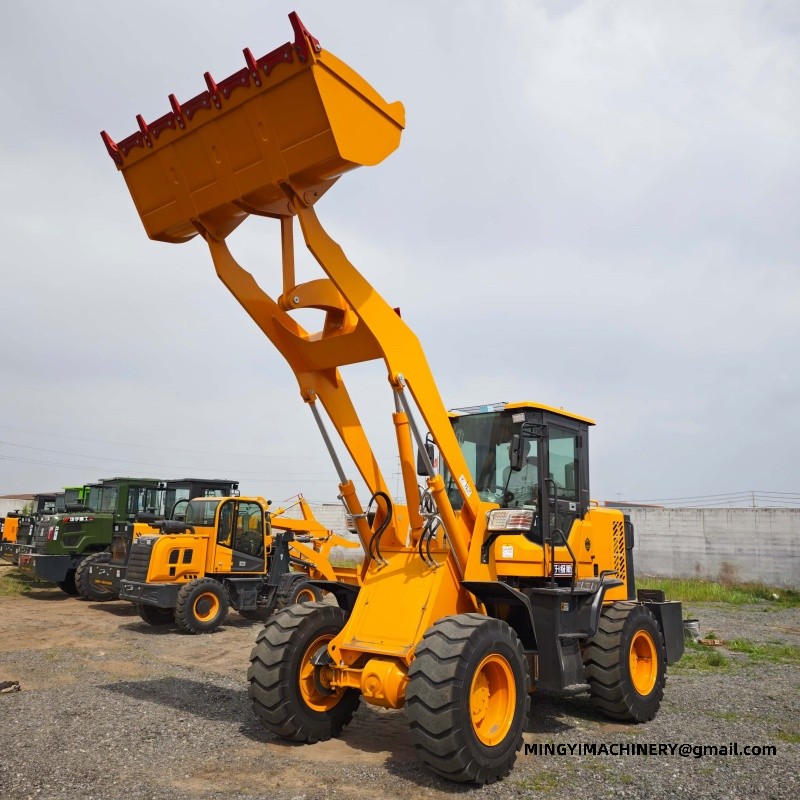
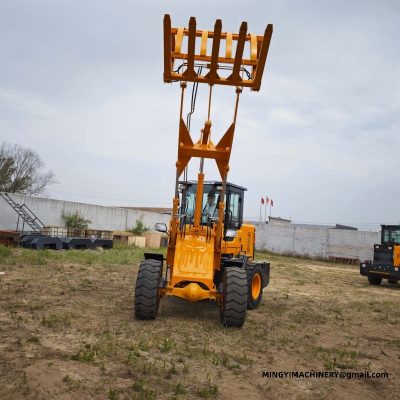
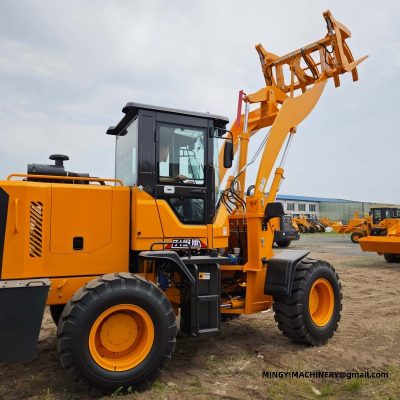
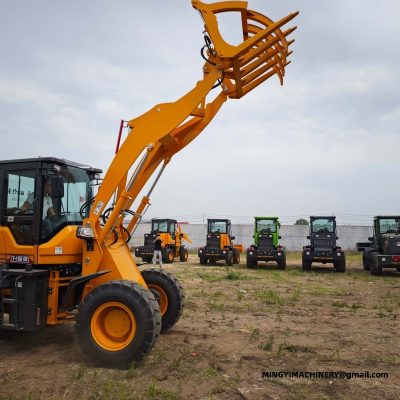
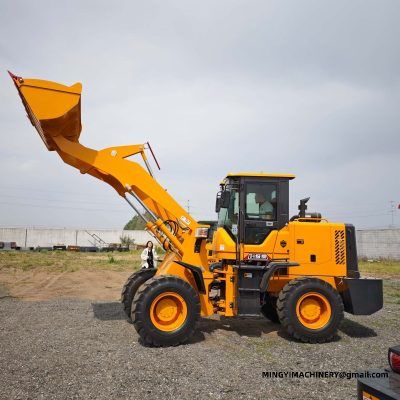
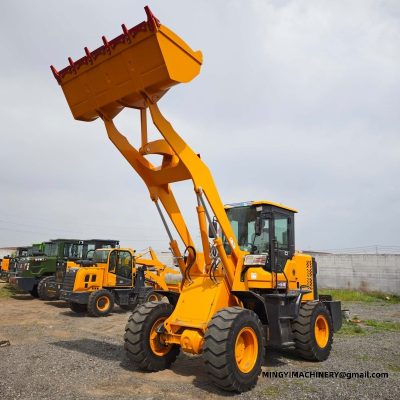
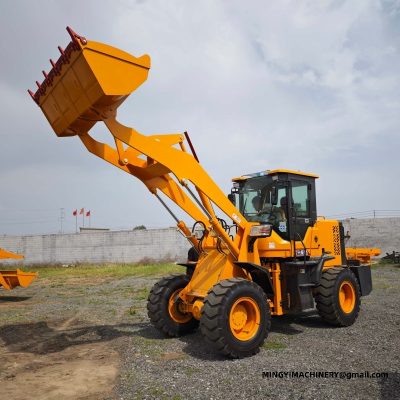
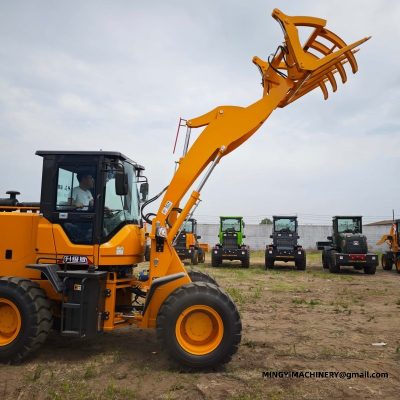
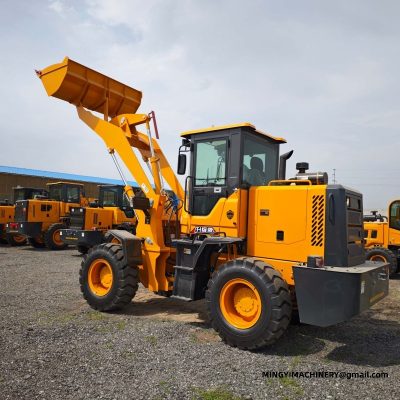
Most heavy duty wheel loader shortlists are decided on the wrong figures. Engine power and bucket volume are stated first because they are easy, but the numbers that predict whether a machine earns its keep are the ones nobody leads with: rear hinge plate thickness, cross-member thickness, boom centre distance and radiator core. On the light-duty 3.2 m small-frame wheel-side reduction wheel loader those read 14 mm, 25 mm, 890 mm and 4100 core (490 engine); 4105 core (4102T engine); on the light-duty 3.5 m small-frame wheel-side reduction wheel loader they read 14 mm, 25 mm, 890 mm and 4100 core (490 engine); 4105 core (4102T engine). This page explains what each one governs.
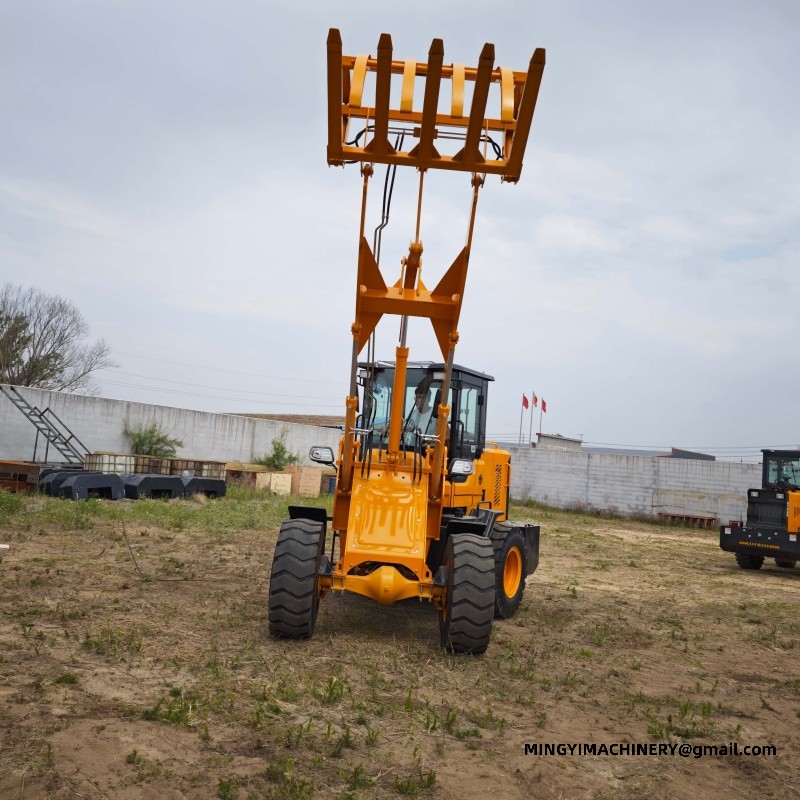
An attachment is only as useful as the hydraulics behind it. This build runs centre cylinder 45 / side cylinder 40 fed by a 40 pump (490 engine); 1045 pump (4102 turbo engine), and those two figures set the force available at the boom and the speed at which it arrives. A grapple, a fork carriage or a snow blower all ask for more flow than a bucket does.
The centre cylinder does the lifting and the side cylinders do the tilting, and they are specified together for a reason. On the heavy-duty 4.2 m medium-frame wheel-side reduction wheel loader the pair is centre cylinder 60 / side cylinder 50. If an attachment needs a third service, the question to ask is whether the pump has the flow to run it without starving the lift circuit, because a machine that lifts slowly with a grapple on is not a machine with a grapple problem. It has a 2063 pump problem.
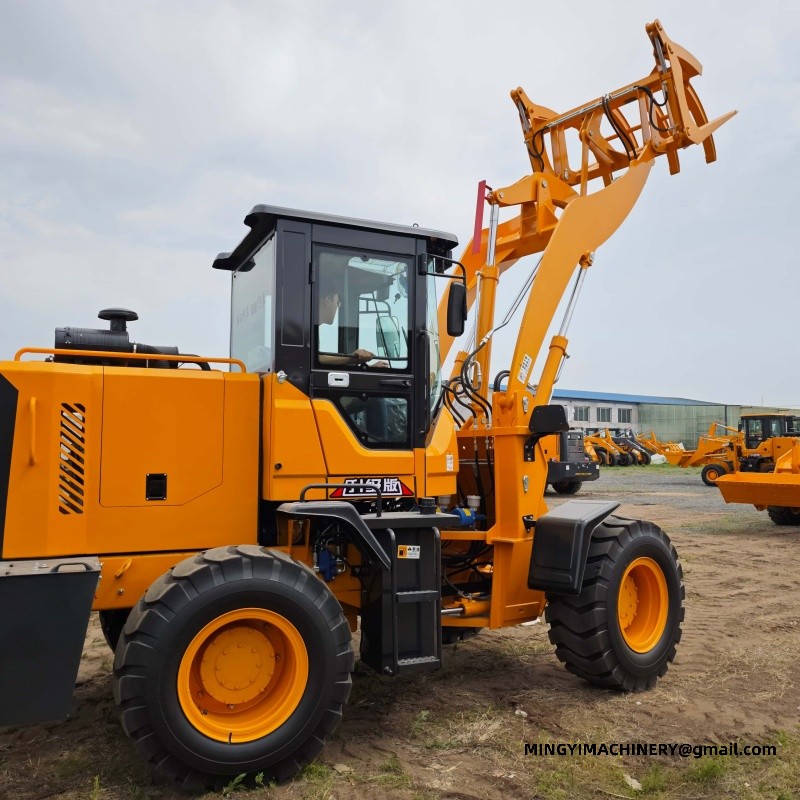
A boom is a beam, and a beam is specified by length, section and material thickness. On the heavy-duty 4.5 m small-frame wheel-side reduction wheel loader that means 3.15 m long, 500 mm wide and 25 mm thick, mounted on a 890 mm centre distance. On the heavy-duty 4.2 m medium-frame wheel-side reduction wheel loader the same three figures are 3.16 m, 520 mm and 30 mm on a 960 mm spacing. Those six numbers decide breakout behaviour, side-load tolerance and how the machine feels on the last metre of lift.
The practical test is simple. If your day is loose material on level ground, a shorter arm on a tight machine will out-cycle a longer one, because every millimetre of reach is travel time. If your day is faces, banks and truck loading, the longer arm of the two — 3.16 m at 4.2 m — earns its keep, provided the 30 mm wall and 520 mm section are there to carry it. Ask which bucket the boom was engineered around — 0.4 m³ on the heavy-duty 4.5 m small-frame wheel-side reduction wheel loader, 0.65 m³ on the heavy-duty 4.2 m medium-frame wheel-side reduction wheel loader — and you will know whether the arm and the frame were designed together.
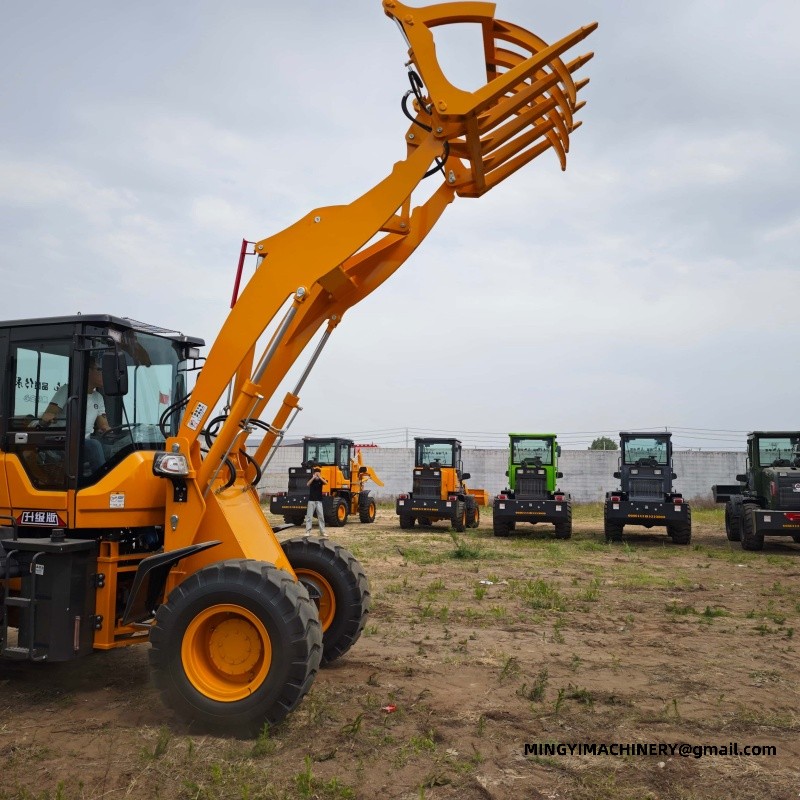
Two figures govern refuelling: tank capacity and consumption per hour, and only the first is published — 64.7 L (75# small tank) on the light-duty 3.2 m small-frame wheel-side reduction wheel loader, 70 L (75# large tank) on the heavy-duty 4.2 m medium-frame wheel-side reduction wheel loader. Consumption depends on duty, and the duty differences between a 0.38 m³ bucket at 3.2 m and a 0.65 m³ bucket at 4.2 m are mostly about how hard the engine works per cycle.
What you can plan on: a machine working a short, level cycle will finish a shift on one tank; the same machine ripping from a face or loading up a ramp will not. If your site has no refuelling point, size the tank to the worst day rather than the average one, and specify the larger option where a build offers it. The cooling package is the other half of the same calculation — 4100 core (490 engine); 4105 core (4102T engine) on the light-duty 3.2 m small-frame wheel-side reduction wheel loader and 4105 core on the heavy-duty 4.2 m medium-frame wheel-side reduction wheel loader — because a machine that stops for temperature stops wherever it is.
| Published build data — light-duty 3.8 m small-frame wheel-side reduction wheel loader | |
|---|---|
| Bucket capacity | 0.38 m³ |
| Dump height | 3.8 m |
| Track width | 1.5 m (wheel-side reduction axle); 1.45 m (Isuzu axle) |
| Boom arm thickness | 25 mm |
| Boom arm width | 370 mm |
| Boom arm length | 2.61 m |
| Boom arm centre distance | 890 mm |
| Cross-member thickness | 25 mm |
| Front hinge plate thickness | 25 mm |
| Rear hinge plate thickness | 14 mm |
| Rear frame section | 280 mm high x 800 mm wide |
| Hydraulic cylinders | centre cylinder 45 / side cylinder 40 |
| Fuel tank | 64.7 L (75# small tank) |
| Battery | 60 Ah (490 engine); 80 Ah (4102 turbo engine) |
| Front wheel to counterweight | 4.1 m |
| Radiator | 4100 core (490 engine); 4105 core (4102T engine) |
| Work pump | 40 pump (490 engine); 1045 pump (4102 turbo engine) |
| Travel pump | 316 pump |
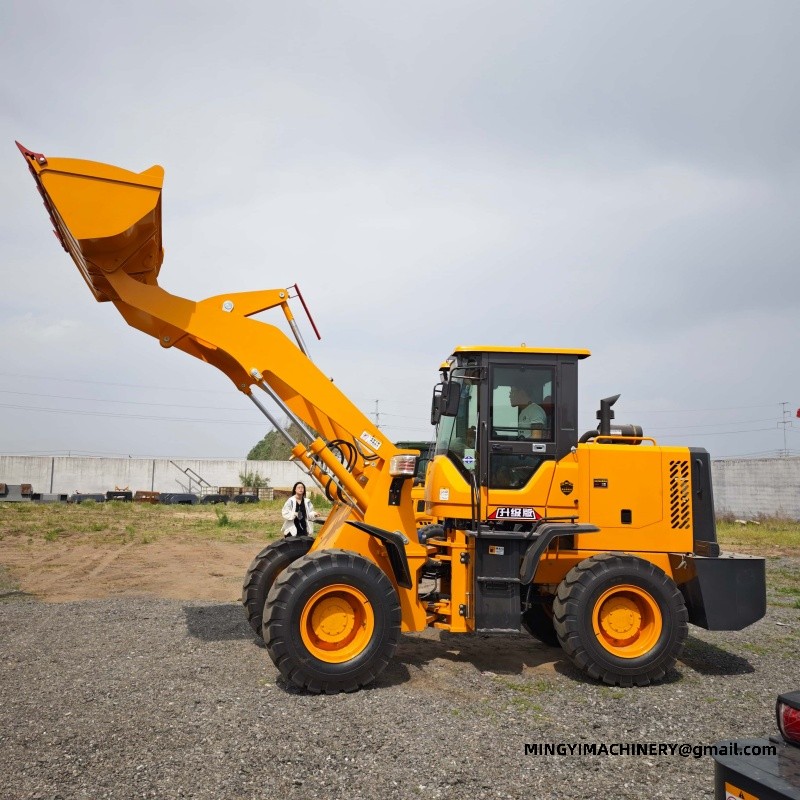
An articulated loader turns by bending in the middle, and the hinge is where that bending happens. Front plate 25 mm, rear plate 14 mm. The front is the thicker of the two on every build in the range, because it carries the boom and the payload directly, while the rear carries the engine and the counterweight through every steering movement and is sized for the twisting those movements produce rather than for the weight alone.
Pin wear is how hinges fail, and it shows up as a machine that wanders and a steering that feels vague. The cross-member is what prevents it: 25 mm holding the two sides of the frame at a fixed distance so the pins stay square. Compare 30 mm on the heavy-duty 4.5 m small-frame wheel-side reduction wheel loader and the difference in plate thickness starts to make sense — they are specified together, not separately.
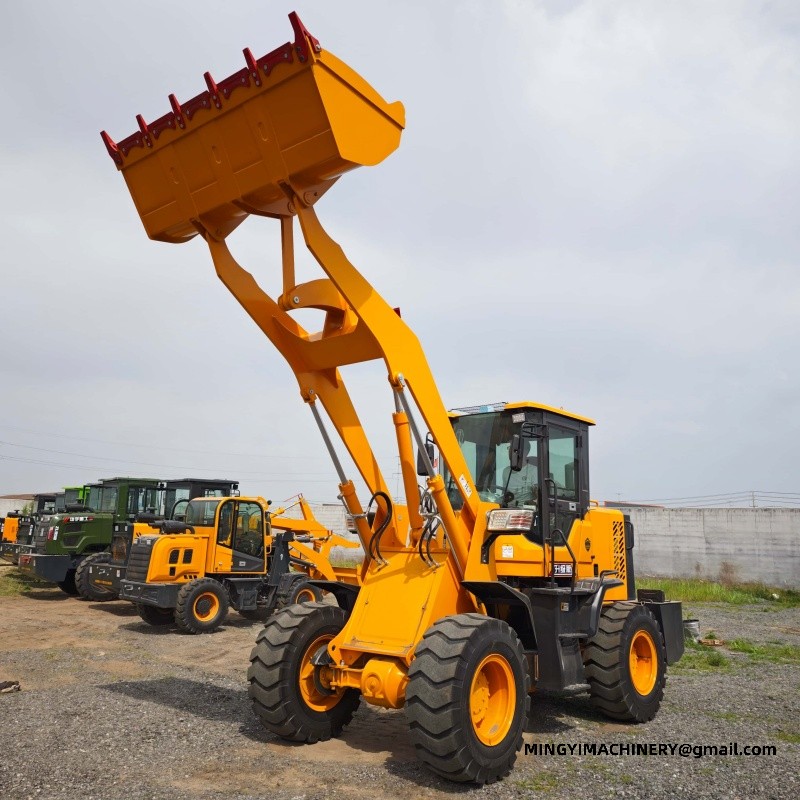
Fuel is visible and downtime is not, which is why fleets optimise the wrong one. A machine with a 64.7 L (75# small tank) tank works a full shift without a refuel stop; that is worth a fraction of what a single day lost to a failed pump takes, and the pump is identified on the sheet as 40 pump (490 engine); 1045 pump (4102 turbo engine).
The parts worth specifying against downtime are the ones that cannot be improvised: the battery rating, 60 Ah (490 engine); 80 Ah (4102 turbo engine), the radiator, 4100 core (490 engine); 4105 core (4102T engine), and the cylinders, centre cylinder 45 / side cylinder 40. All three are simple at build and lengthy in a field, and all three are listed. Read them as an availability decision rather than as a comfort one.
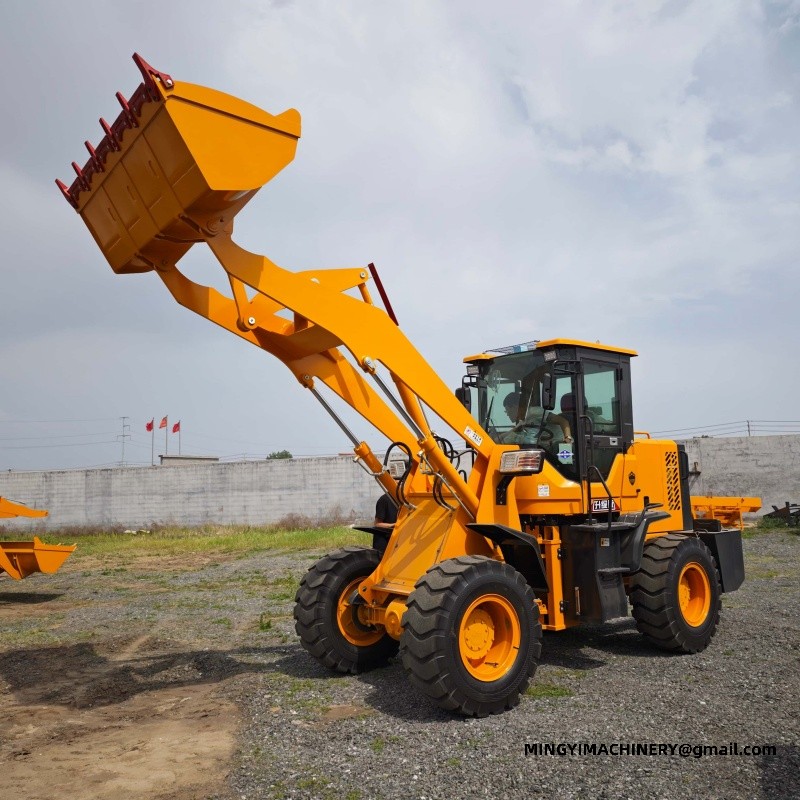
A specification is only as good as the figures on it. Before comparing numbers between suppliers, make sure the same figures appear on both: bucket 0.38 m³, dump height 3.5 m, boom section 370 mm over 25 mm of wall, hinge plates 25 mm front and 14 mm rear, cross-member 25 mm. If a sheet will not give you those five, it is not a specification, it is a description.
The second thing a sheet should let you check is which engine the figures belong to. Where a build offers two engines, the pump and radiator change with it: this one lists 40 pump (490 engine); 1045 pump (4102 turbo engine) and 4100 core (490 engine); 4105 core (4102T engine). Asking for the build by engine, not by model name, is the single change that prevents most delivery disputes.
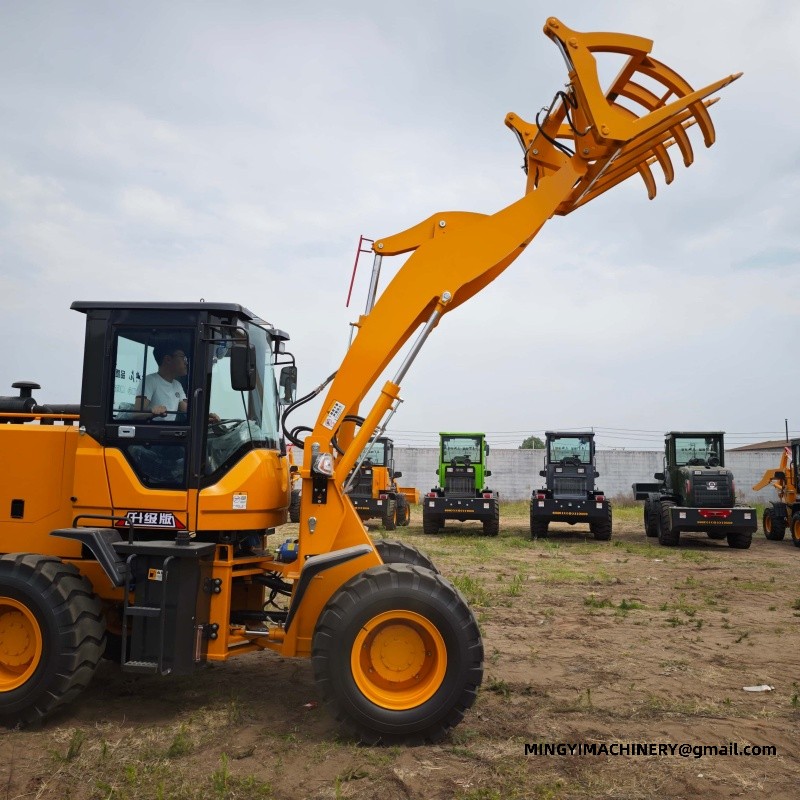
Construction duty is repetitive, dusty and unforgiving of a light frame. Specified for it, the heavy-duty 4.5 m small-frame wheel-side reduction wheel loader carries a 0.4 m³ bucket to 4.5 m on 30 mm front and 20 mm rear hinge plates with a 30 mm cross-member and a 280 mm high x 800 mm wide rear frame. Lighter builds — the light-duty 3.2 m small-frame wheel-side reduction wheel loader at 0.38 m³, 3.2 m, 14 mm and 25 mm — suit smaller sites and lighter material.
Two site conditions change the specification. The first is the board height of the trucks, which fixes dump height and is measured, not guessed. The second is ground: a rough, rutted site with soft spots wants the wheel-side reduction axle at 1.5 m (wheel-side reduction axle); 1.45 m (Isuzu axle) track over the lighter axle, and a site with long internal haul roads wants the opposite. Tell the factory both and the axle choice follows from the site, not from the catalogue.
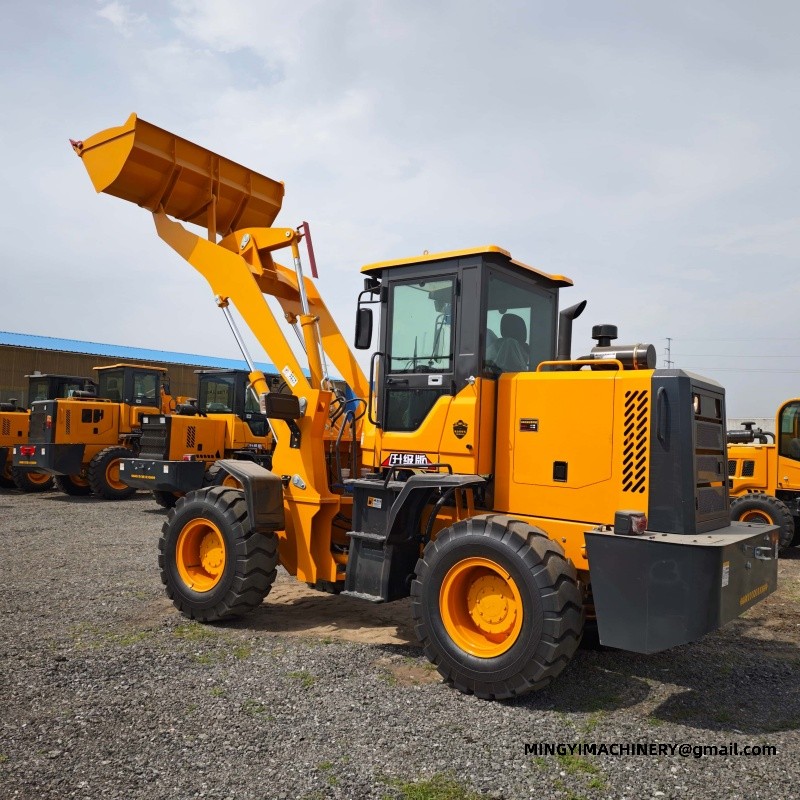
Continuous stockpile duty is where light builds are separated from heavy ones, and the separation is visible in steel. The heavy-duty 3.5 m medium-frame wheel-side reduction wheel loader lists 45 mm front and 30 mm rear hinge plates over a 45 mm cross-member and a 300 mm high x 800 mm wide rear frame, carrying 0.65 m³ to 3.5 m. The heavy-duty 4.5 m small-frame wheel-side reduction wheel loader lists 30 mm, 20 mm, 30 mm and 280 mm high x 800 mm wide, carrying 0.4 m³ to 4.5 m.
Choose by cycle count rather than by material. Below twenty truck loads a day the lighter machine is the better economics; above it, the heavier frame pays for itself in avoided downtime. Then specify the cooling package for the material — 4105 core raised core for fines and dust — and the axle for the floor. Both are simple at order time and neither is simple later.
How do I pick between the frame tiers of a heavy duty wheel loader?
By reach and duty. The light-duty 3.2 m small-frame wheel-side reduction wheel loader carries 0.38 m³ to 3.2 m on a 25 mm cross-member; the light-duty 3.5 m small-frame wheel-side reduction wheel loader carries 0.38 m³ to 3.5 m on 25 mm.
Can a heavy duty wheel loader be built with a non-standard bucket?
Yes, provided the volume suits the frame: the 0.38 m³ bucket on the light-duty 3.2 m small-frame wheel-side reduction wheel loader and the 0.65 m³ bucket on the heavy-duty 3.5 m medium-frame wheel-side reduction wheel loader are the engineered sizes, and heavier material means a smaller bucket.
What engine options are offered on a heavy duty wheel loader?
Where two are offered, cooling and electrics change with them: 4100 core (490 engine); 4105 core (4102T engine) radiator and 60 Ah (490 engine); 80 Ah (4102 turbo engine) battery on the light-duty 4.2 m small-frame wheel-side reduction wheel loader, with the raised core belonging to the turbo option.
How is a heavy duty wheel loader prepared for export?
Knock-down: booms and counterweights packed loose, tanks removed, batteries boxed and disconnected. Rear frame sections stay between 280 mm high x 800 mm wide and 300 mm high x 800 mm wide.
Which heavy duty wheel loader build suits farm work?
The lighter one, for access: a 0.38 m³ bucket at 3.5 m, 1.5 m (wheel-side reduction axle); 1.45 m (Isuzu axle) track and a 4 m footprint that turns between sheds. Gate and door widths decide first.
What should the first service on a heavy duty wheel loader cover?
Torque the hinge pins, grease the 890 mm boom mounts, check the centre cylinder 45 / side cylinder 40 cylinder connections and the 4100 core (490 engine); 4105 core (4102T engine) cooling circuit, then re-check the build figures.
Can a heavy duty wheel loader work indoors?
The low-profile builds can, where height and footprint allow: 4.55 m front-to-counterweight length and 1.6 m track on the heavy-duty 3.5 m medium-frame wheel-side reduction wheel loader. Ventilation is the other constraint to check.
Send the application and the receiving body height and we will match a heavy duty wheel loader to it from the published range — 0.38 m³ bucket at 3.2 m, or 0.38 m³ at 3.5 m — and specification the build, the container plan and the spares package together.
Wear items and spares worth holding for Heavy Duty Wheel Loader: Frame Steel, Cylinders and Cooling
Wear items are predictable once the machine has settled in. After the first service interval the pattern on Heavy Duty Wheel Loader: Frame Steel, Cylinders and Cooling is visible, and the parts that were replaced become the parts that are kept.
Pre-delivery inspection before Heavy Duty Wheel Loader: Frame Steel, Cylinders and Cooling leaves the shop
A machine should be inspected while it is still on our floor rather than after it lands. For Heavy Duty Wheel Loader: Frame Steel, Cylinders and Cooling that means the engine is run to temperature, the hydraulics are cycled through full travel, and every function is checked against the build sheet before the crate is closed.
Contact MINGYI Machinery for the current wheel loader lineup, configuration options and a formal specification for your market. E-mail: sales@mingycn.com | LINE (ID): mingyicn
Compact Wheel Loader: Clearance, Footprint and Low Profile · Front Wheel Loader: Weight Transfer, Boom Length and Axle Choice · Bucket Loader Machine: Filling the Bucket Every Pass · Loaders









