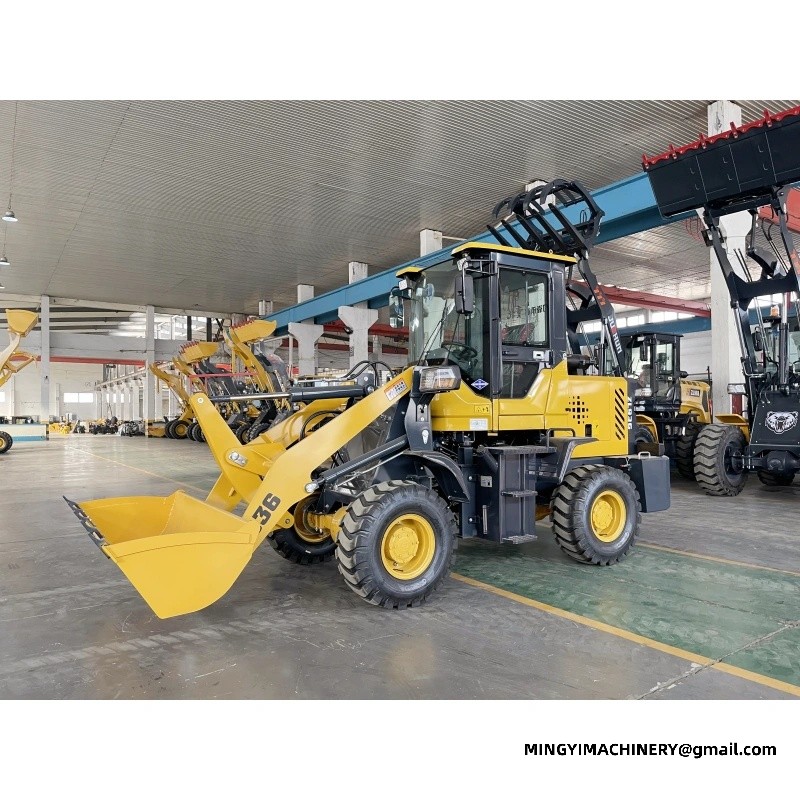
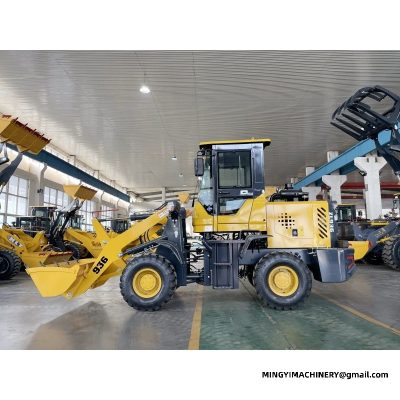
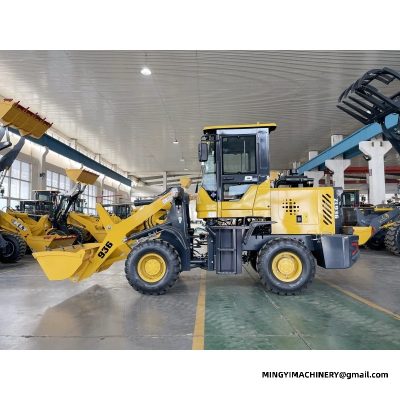
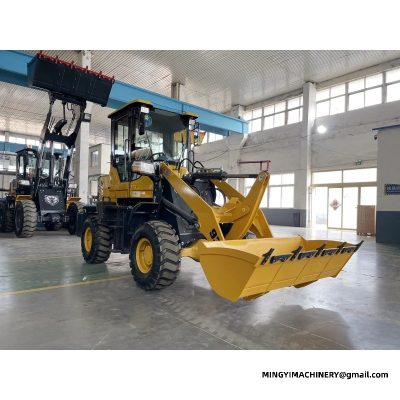
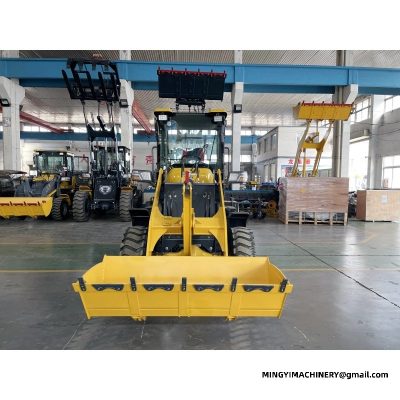
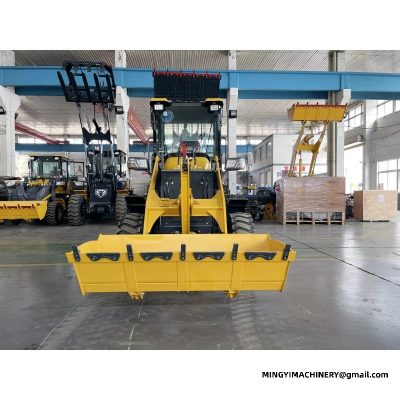
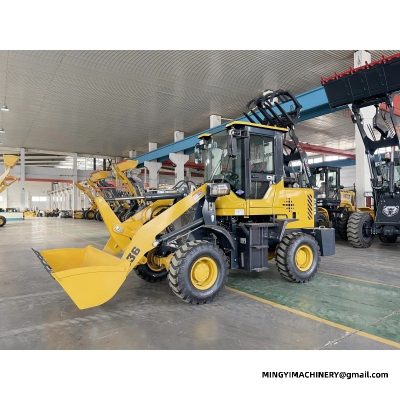
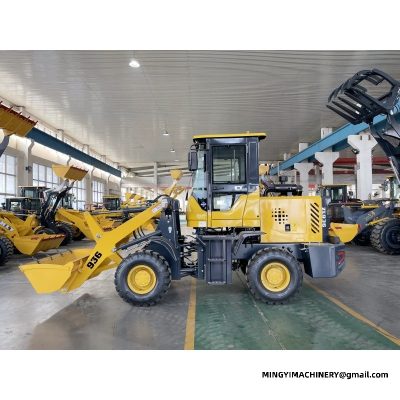
Three frame tiers, twenty-one documented builds, one parts package per tier: that is the whole front wheel loader range in a line. The tiers separate on boom section and hinge steel rather than on paint — 30 mm boom wall and 45 mm cross-member at the bottom, 30 mm and 45 mm on the heavier build — and the builds within a tier share cylinders, pumps and attachments. Buckets run 0.65 m³ to 0.65 m³ and dump heights 3.5 m to 3.8 m. Here is how to place yourself on that ladder.
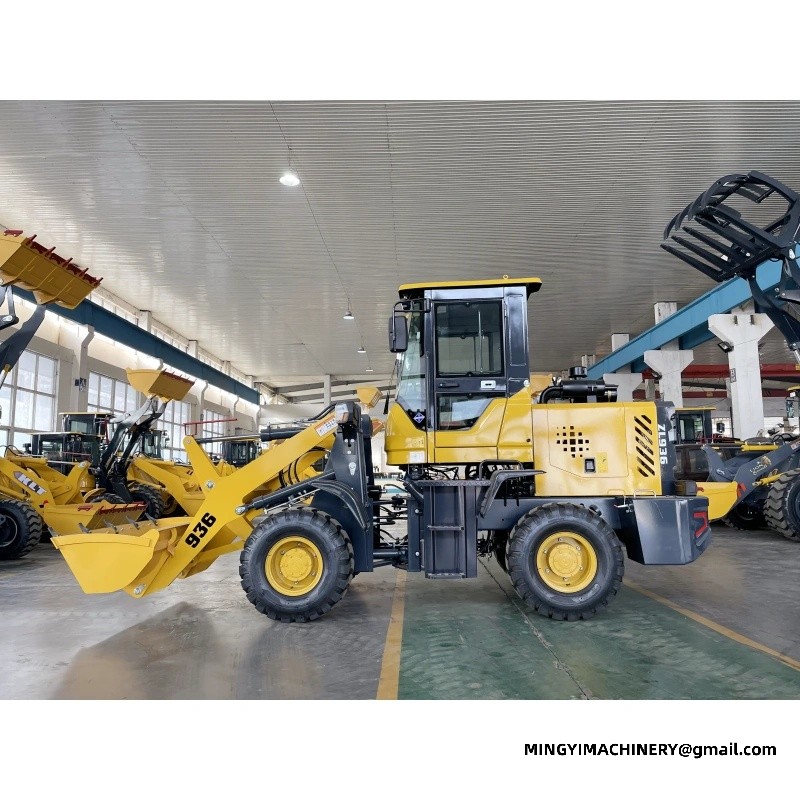
Breakout happens when the bucket is driven into the face and lifted, and it loads the boom in bending. The figures that resist it are wall 25 mm, width 430 mm, and the spacing between the two arms, 890 mm. A wider spacing spreads the load across the pins instead of concentrating it.
Length works against you here. A 2.3 m arm gives reach and height and multiplies the bending moment at the same time, which is why long-arm builds carry thicker walls. On the heavy-duty 3.5 m medium-frame wheel-side reduction wheel loader the same comparison is 3.15 m of length against 30 mm of wall. Where the material is hard to break out, the shorter, thicker combination is usually the better machine.
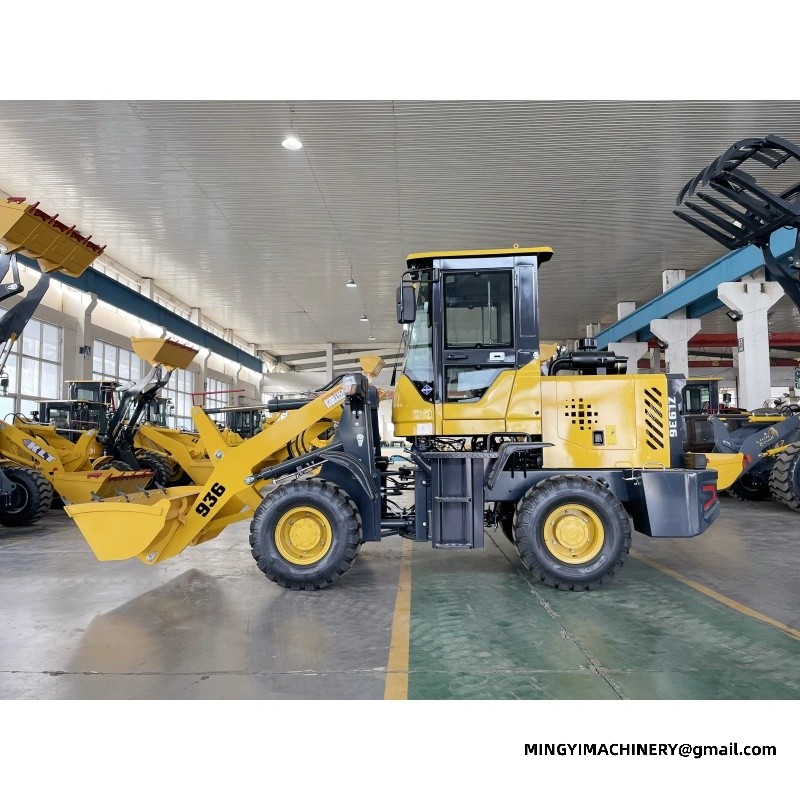
Bucket capacity is the first figure stated and the last one that should be decided. The heavy-duty 3.2 m small-frame wheel-side reduction wheel loader carries 0.4 m³; the heavy-duty 4.2 m medium-frame wheel-side reduction wheel loader carries 0.65 m³. What those volumes mean depends on the material: a heaped bucket of dry sand weighs far less than the same heaped bucket of wet gravel or crushed rock, and the machine's stability, not its volume, sets the real limit.
Match the bucket to the receiving body and the material, in that order. A 0.4 m³ bucket at 3.2 m clearing a low pan mixer is correctly specified; the same bucket feeding a highway truck is a slow day. Against that, a 0.65 m³ bucket at 4.2 m needs the frame behind it — 45 mm front and 30 mm rear hinge plates, a 45 mm cross-member — or it will be a fast machine with a short life.
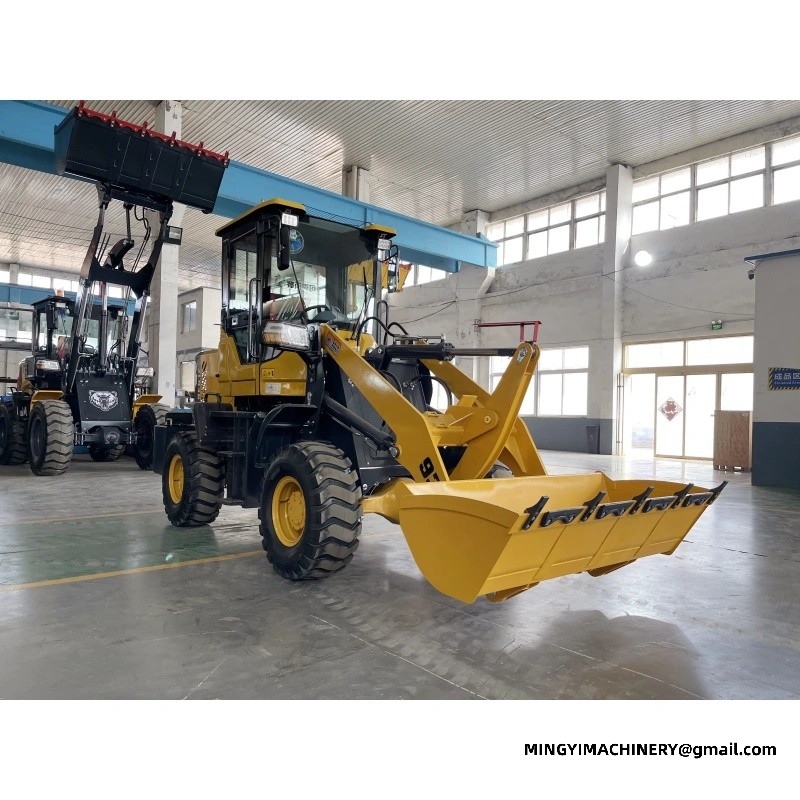
Three things stop a loader mid-shift, and two of them are in the specification. Fuel is the first: 64.7 L (75# small tank) on the heavy-duty 3.5 m small-frame wheel-side reduction wheel loader. Cooling is the second: 4100 core (490 engine); 4105 core (4102T engine), and it is the one that announces itself as a gradual loss of power rather than a stoppage, so it gets ignored until the machine is derating every afternoon.
The third is electrical, and it is specified as well: 60 Ah (490 engine); 80 Ah (4102 turbo engine). Cranking capacity falls with temperature, so a battery that starts a warm engine happily can fail the same engine at dawn in winter. Where the build offers two ratings, the higher one belongs to the turbo option and is worth specifying for cold climates or for machines that start cold and stop often.
| Sample build from the range — heavy-duty 3.2 m small-frame wheel-side reduction wheel loader | |
|---|---|
| Bucket capacity | 0.4 m³ |
| Dump height | 3.2 m |
| Track width | 1.5 m (wheel-side reduction axle); 1.45 m (Isuzu axle) |
| Boom arm thickness | 25 mm |
| Boom arm width | 430 mm |
| Boom arm length | 2.3 m |
| Boom arm centre distance | 890 mm |
| Cross-member thickness | 30 mm |
| Front hinge plate thickness | 30 mm |
| Rear hinge plate thickness | 20 mm |
| Rear frame section | 280 mm high x 800 mm wide |
| Hydraulic cylinders | centre cylinder 45 / side cylinder 45 |
| Fuel tank | 64.7 L (75# small tank) |
| Battery | 60 Ah (490 engine); 80 Ah (4102 turbo engine) |
| Front wheel to counterweight | 4.1 m |
| Radiator | 4100 core (490 engine); 4105 core (4102T engine) |
| Work pump | 40 pump (490 engine); 1045 pump (4102 turbo engine) |
| Travel pump | 316 pump |
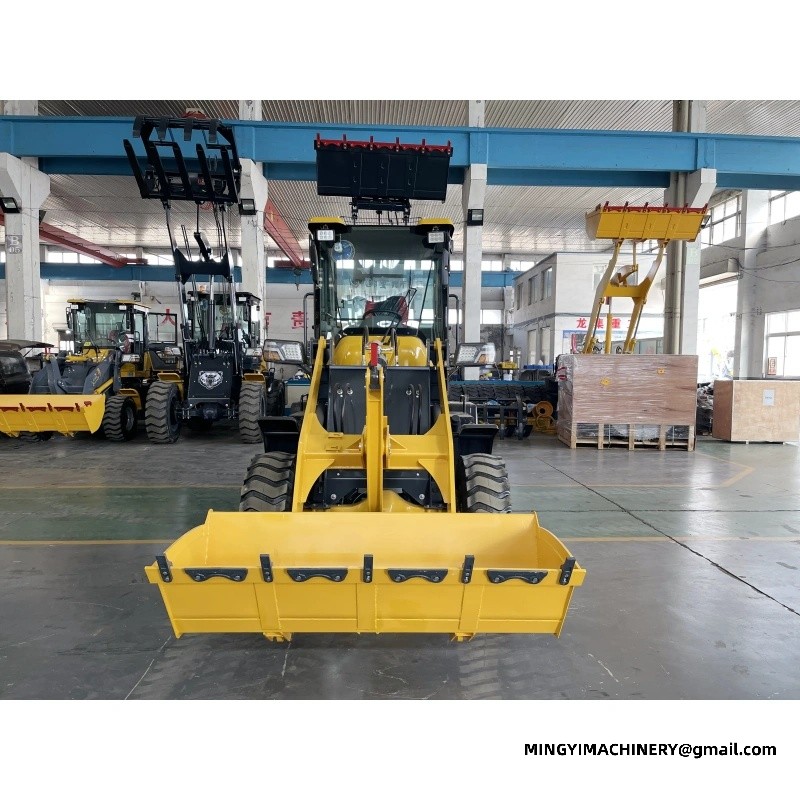
Electrical specification is short but consequential. The standard 2.8 m low-profile wheel loader lists 45 Ah (24 V); the heavy-duty 3.5 m medium-frame wheel-side reduction wheel loader lists 80 Ah. Where a build offers two engines, the higher capacity belongs to the turbo — more compression to turn, more glow-plug load, and in a cold market that difference is the whole of a morning.
Beyond the battery, specify an isolator switch and confirm the alternator output matches the load you intend to add. Work lights, a beacon, a reversing alarm and a hydraulic third-circuit solenoid all draw from the same pack, and the 32 pump driven hydraulics on the standard 2.8 m low-profile wheel loader do not reduce that draw. On the heavy-duty 3.5 m medium-frame wheel-side reduction wheel loader the same applies with 2063 pump. If the machine will sit for more than a month before commissioning, specify the isolator and a maintenance charge interval.
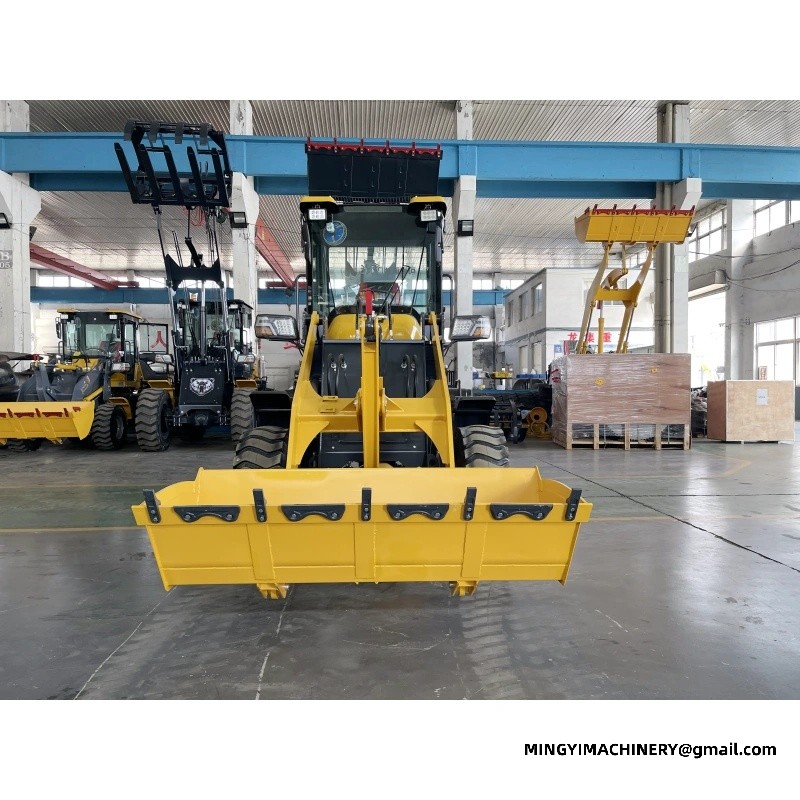
Lift and tilt come from a cylinder set and a pump pair, and both are specified per build. The heavy-duty 3.5 m small-frame wheel-side reduction wheel loader runs centre cylinder 45 / side cylinder 40 with a 40 pump (490 engine); 1045 pump (4102 turbo engine) work pump and a 316 pump travel pump; the heavy-duty 4.5 m medium-frame wheel-side reduction wheel loader runs centre cylinder 60 / side cylinder 50 with a 2063 pump work pump and a 25 pump travel pump. Splitting lift from travel is what keeps boom speed up while the machine is climbing a ramp loaded.
Cycle time is a product, not a published figure: bucket fill, lift height, travel distance and the operator's line all move it. What you can compare honestly is the hardware behind it. A centre cylinder 45 / side cylinder 40 set working a 2.62 m arm to 3.5 m is a different proposition from a centre cylinder 60 / side cylinder 50 set working 3.35 m to 4.5 m. On a short haul the smaller combination wins; over a longer push, or where the bucket is digging rather than shovelling, the larger bore and the 960 mm centre distance earn back the extra seconds of lift.
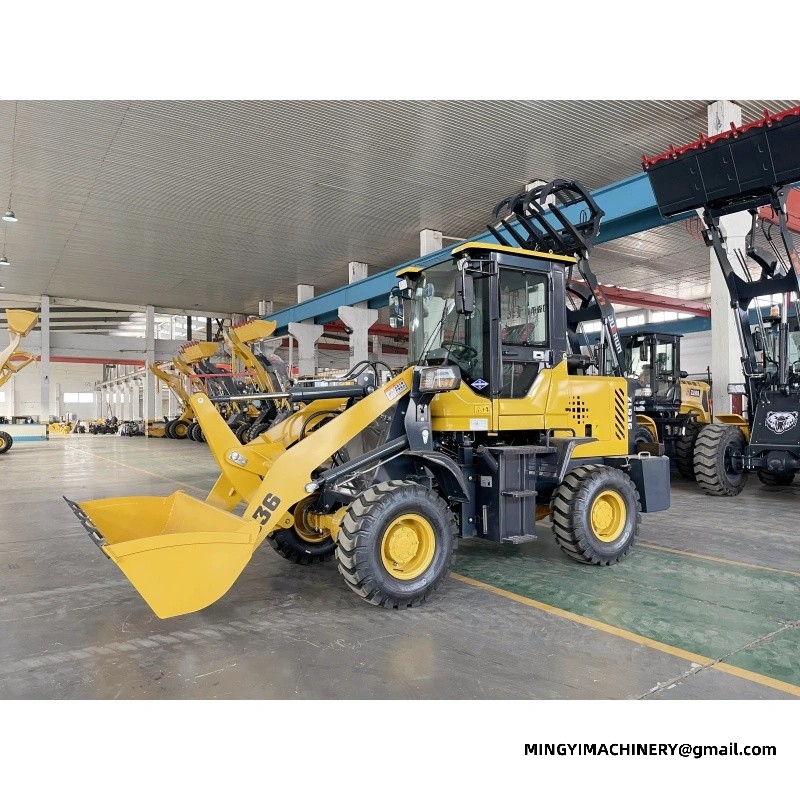
Over a full season, the differences that matter are not the ones on the sales sheet. Two machines, the heavy-duty 3.2 m low-profile wheel loader with 0.4 m³ at 3.2 m and the heavy-duty 4.5 m medium-frame wheel-side reduction wheel loader with 0.65 m³ at 4.5 m, will differ in fuel by less than they differ in uptime, and they will differ in uptime mostly because of the cooling package — 4100 core (490 engine); 4105 core (4102T engine) against 4105 core — and the frame — 20 mm against 30 mm.
plan on the duty, then check the specification supports it. A light build in a quarry is a false economy; a heavy build on a farm is money spent for nothing. Where the duty is mixed, buy the frame for the hardest week of the year and the bucket for the average one — buckets are simple, frames are not, and the 40 pump (490 engine); 1045 pump (4102 turbo engine) and 316 pump on the heavy-duty 3.2 m low-profile wheel loader will run either.
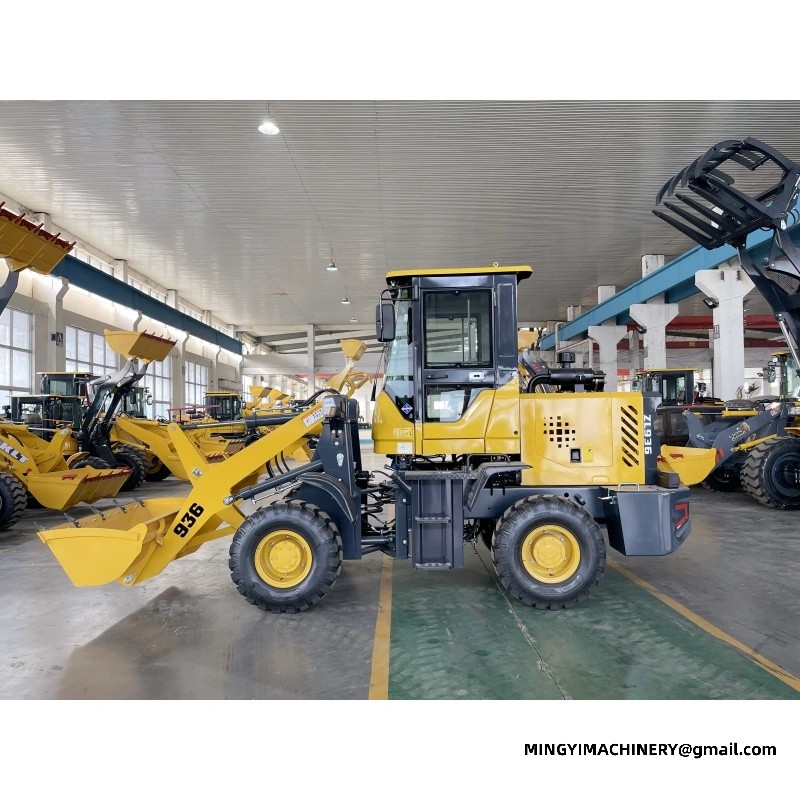
The commercial logic of a family-built range is parts commonality. Within a frame family the centre cylinder 45 / side cylinder 45 cylinder set, the 40 pump (490 engine); 1045 pump (4102 turbo engine) work pump and the 316 pump travel pump are shared, and the boom section — 430 mm on the heavy-duty 3.2 m small-frame wheel-side reduction wheel loader — is the same, so attachments interchange. Across families, as between the heavy-duty 3.2 m small-frame wheel-side reduction wheel loader and the heavy-duty 3.8 m medium-frame wheel-side reduction wheel loader, the cylinder set moves to centre cylinder 60 / side cylinder 50 and the section to 500 mm.
For a distributor that translates into a small, fast-moving inventory: one seal kit per cylinder family, one pump pair per family, pins and bushes per boom section, and cutting edges per bucket. Add the model-specific items — the 30 mm or 45 mm cross-member is not a wear part and does not need stocking — and the whole range is supported from a shelf that fits in a container.
Before specifying anything else, measure the tallest body the loader will ever have to clear, at the front board, loaded, on the worst ground on site. That number decides the machine. The heavy-duty 3.5 m medium-frame wheel-side reduction wheel loader in this comparison dumps at 3.5 m; the heavy-duty 3.5 m medium-frame wheel-side reduction wheel loader at 3.5 m. The difference looks small on paper and is decisive at the face, because a loader that cannot clear the board cannot be worked around.
Once the height is settled, capacity sets the number of passes. 0.3 m³ on the standard 2.8 m low-profile wheel loader against 0.65 m³ on the heavy-duty 3.5 m medium-frame wheel-side reduction wheel loader. Multiply by your material weight per cubic metre and check it against what the chassis is carrying, not what the bucket holds — the frame, at 16 mm across the member, is the limit that arrives first.
What boom wall thickness does a front wheel loader need?
25 mm on the heavy-duty 3.5 m small-frame wheel-side reduction wheel loader against 30 mm on the heavy-duty 3.5 m medium-frame wheel-side reduction wheel loader. A long arm on a thin wall lifts on paper and feels vague in the yard, so read wall and length together.
Why does boom centre distance matter on a front wheel loader?
It sets how side loads travel into the frame: 890 mm on the heavy-duty 3.2 m low-profile wheel loader against 890 mm on the heavy-duty 3.2 m small-frame wheel-side reduction wheel loader. Wider spacing lets the cylinders work through a better lever.
How do I pick between the frame tiers of a front wheel loader?
By reach and duty. The heavy-duty 3.5 m medium-frame wheel-side reduction wheel loader carries 0.65 m³ to 3.5 m on a 45 mm cross-member; the heavy-duty 3.8 m medium-frame wheel-side reduction wheel loader carries 0.65 m³ to 3.8 m on 45 mm.
What does a front wheel loader need to run a grapple?
A grapple sized to the 430 mm boom section and a hydraulic third circuit. The 40 pump (490 engine); 1045 pump (4102 turbo engine) work pump is specified per build, so order the circuit with the machine.
How many hours a day can a front wheel loader run?
As many as the cooling and fuel allow: a 30.8 L (48# large tank, 20.5/70-16 tyres); 24.6 L (48# small tank, 8.25-16 tyres) tank on the standard 2.8 m low-profile wheel loader and a 4100 core radiator. In dusty work the radiator, not the tank, is usually what sets the limit.
Which figures predict frame life on a front wheel loader?
Rear hinge plate and cross-member: 20 mm and 30 mm on the heavy-duty 3.2 m low-profile wheel loader, against 30 mm and 45 mm on the heavy-duty 3.5 m medium-frame wheel-side reduction wheel loader. Those two rows separate light duty from heavy duty.
Can a front wheel loader be used for snow clearance?
Yes, with a snow tool specified against the boom section — 500 mm on the heavy-duty 3.5 m medium-frame wheel-side reduction wheel loader — and the third circuit ordered if the tool is hydraulically actuated.
Models, options and container plans are stated per order against the actual mix. Send the application, the material and the receiving body height, and we will specify the front wheel loader — axle, radiator, bucket and third circuit — in one pass.
Documents that travel with Front Wheel Loader: Weight Transfer, Boom Length and Axle Choice
The machine is only half of what arrives. The parts book, the service schedule and the declarations that come with Front Wheel Loader: Weight Transfer, Boom Length and Axle Choice are what let the owner register, insure and maintain it without a second round of emails.
Packing, loading and shipment of Front Wheel Loader: Weight Transfer, Boom Length and Axle Choice
How a machine travels decides how it starts on arrival. Securing Front Wheel Loader: Weight Transfer, Boom Length and Axle Choice against movement, protecting the exposed cylinders and keeping the battery and fluids in the right state for the voyage all belong to the packing list.
Contact MINGYI Machinery for the current wheel loader lineup, configuration options and a formal specification for your market. E-mail: sales@mingycn.com | LINE (ID): mingyicn
Loader Machine for Construction: 0.4 m3 or 0.65 m3 Bucket · Wheel Loader for Mining: Cooling, Tyres and Abrasive Ground · Earthmoving Wheel Loader: Breaking Out of a Hard Face · Loaders









