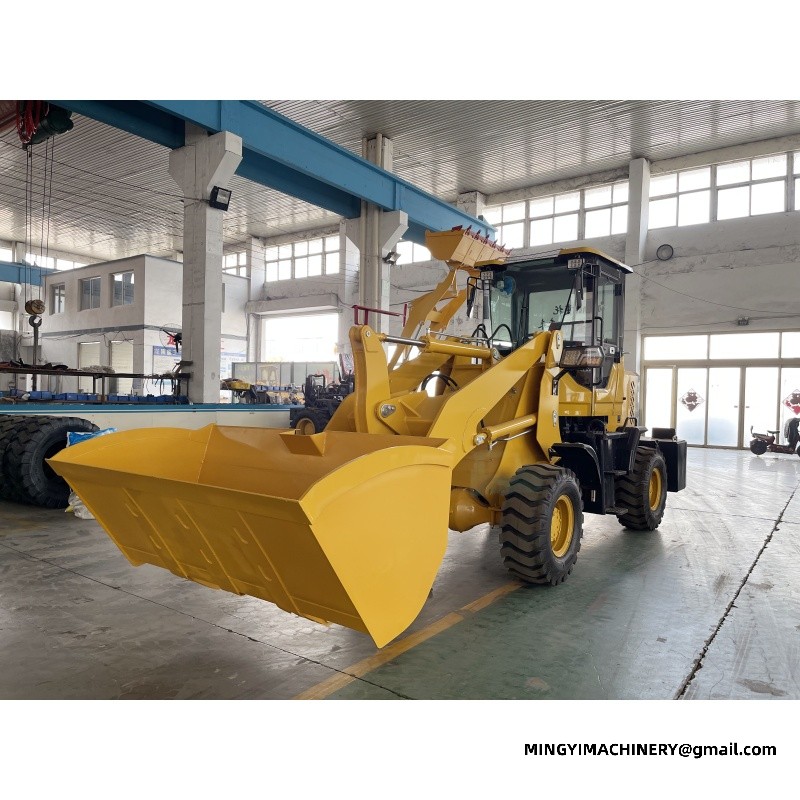
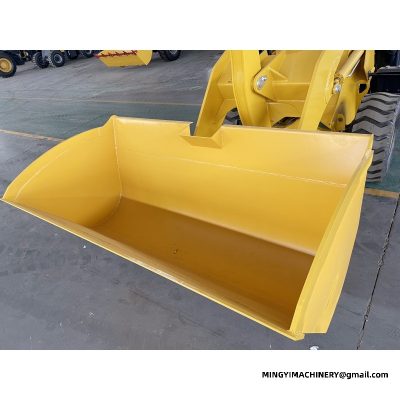
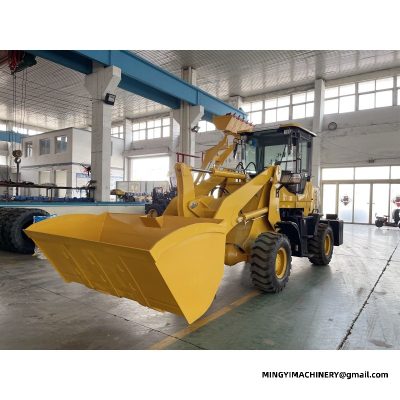
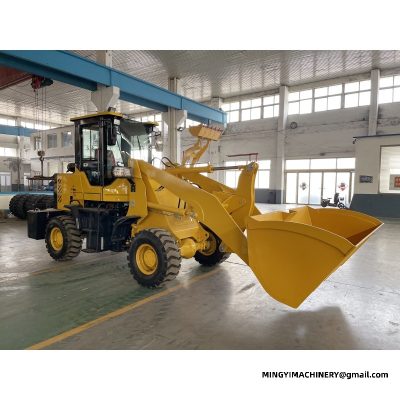
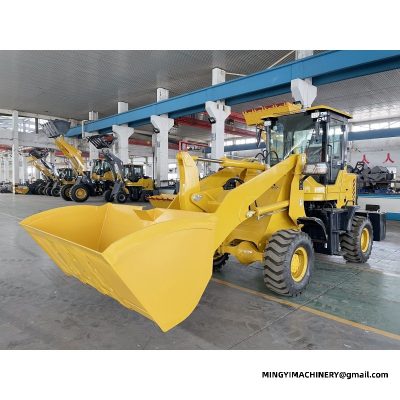
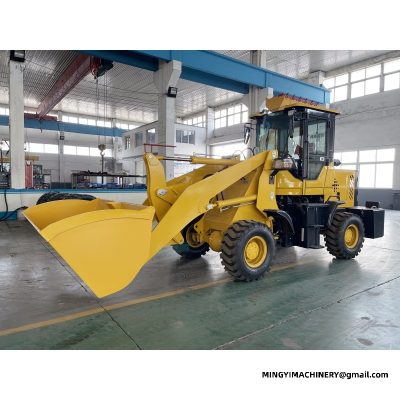
Owners judge a wheel loader manufacturer on things a brochure never lists. Does it start on a cold morning. Does it clear the body it was bought to clear. Does the steering still feel tight after two seasons. Those outcomes are decided by published figures: battery 80 Ah, dump height 3.5 m, hinge plates 45 mm front and 30 mm rear. This page takes each of them in turn, using two builds from the range — the light-duty 3.5 m medium-frame wheel-side reduction wheel loader and the light-duty 3.8 m medium-frame wheel-side reduction wheel loader — to show what the numbers mean once the machine is working.
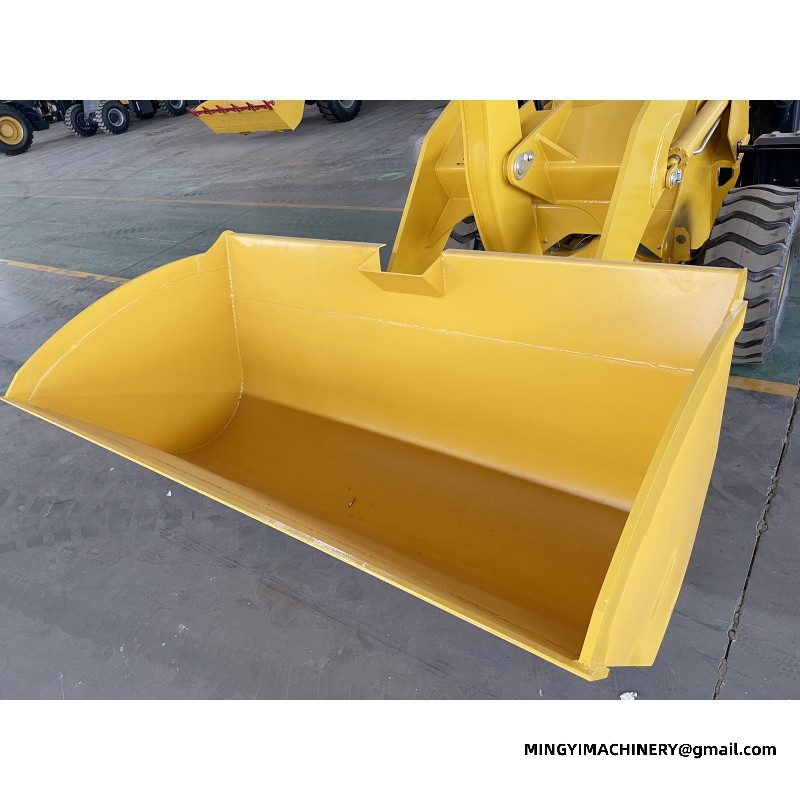
An attachment is only as useful as the hydraulics behind it. This build runs centre cylinder 45 / side cylinder 40 fed by a 40 pump (490 engine); 1045 pump (4102 turbo engine), and those two figures set the force available at the boom and the speed at which it arrives. A grapple, a fork carriage or a snow blower all ask for more flow than a bucket does.
The centre cylinder does the lifting and the side cylinders do the tilting, and they are specified together for a reason. On the light-duty 3.5 m medium-frame wheel-side reduction wheel loader the pair is centre cylinder 60 / side cylinder 50. If an attachment needs a third service, the question to ask is whether the pump has the flow to run it without starving the lift circuit, because a machine that lifts slowly with a grapple on is not a machine with a grapple problem. It has a 2063 pump problem.
Three things stop a loader mid-shift, and two of them are in the specification. Fuel is the first: 64.7 L (75# small tank) on the light-duty 3.5 m small-frame wheel-side reduction wheel loader. Cooling is the second: 4100 core (490 engine); 4105 core (4102T engine), and it is the one that announces itself as a gradual loss of power rather than a stoppage, so it gets ignored until the machine is derating every afternoon.
The third is electrical, and it is specified as well: 60 Ah (490 engine); 80 Ah (4102 turbo engine). Cranking capacity falls with temperature, so a battery that starts a warm engine happily can fail the same engine at dawn in winter. Where the build offers two ratings, the higher one belongs to the turbo option and is worth specifying for cold climates or for machines that start cold and stop often.
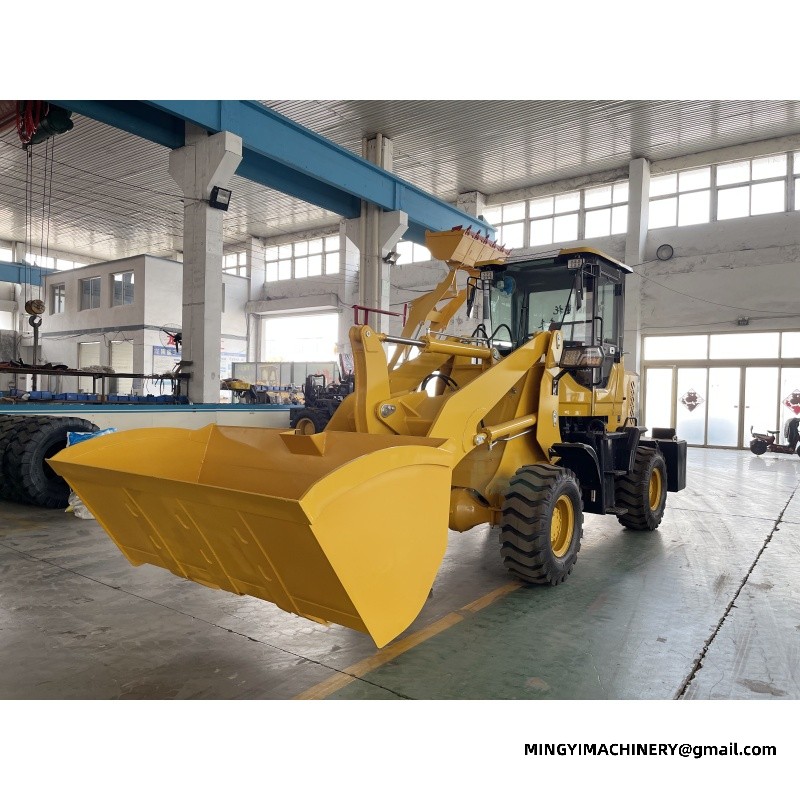
An agricultural loader is a small machine doing varied work, and the specification that matters is the one that lets it into the buildings. Track width 1.6 m on the light-duty 3.5 m medium-frame wheel-side reduction wheel loader against 1.6 m on the light-duty 3.8 m medium-frame wheel-side reduction wheel loader, footprint 4.3 m against 4.3 m, and dump height 3.5 m against 3.8 m for the wagon or hopper it fills.
Duty is seasonal and mostly light, which is why the light builds exist: a 0.52 m³ bucket with 45 mm cross-member and 30 mm rear hinge plates is correctly specified for silage, bagged goods and yard scraping. Where the machine also does heavy work — muck-out with a loaded bucket, or winter snow clearing — step to the heavier build with 45 mm and 30 mm. Over-specifying takes money once; under-specifying takes a frame.
| Specification extract — light-duty 4.5 m medium-frame wheel-side reduction wheel loader | |
|---|---|
| Bucket capacity | 0.52 m³ |
| Dump height | 4.5 m |
| Track width | 1.6 m |
| Boom arm thickness | 30 mm |
| Boom arm width | 450 mm |
| Boom arm length | 3.35 m |
| Boom arm centre distance | 960 mm |
| Cross-member thickness | 45 mm |
| Front hinge plate thickness | 45 mm |
| Rear hinge plate thickness | 30 mm |
| Rear frame section | 300 mm high x 800 mm wide |
| Hydraulic cylinders | centre cylinder 60 / side cylinder 50 |
| Fuel tank | 70 L (75# large tank) |
| Battery | 80 Ah |
| Front wheel to counterweight | 4.7 m |
| Radiator | 4105 core |
| Work pump | 2063 pump |
| Travel pump | 25 pump |
Soft ground punishes driveline parts before it punishes the frame. Sand, clay and loose overburden all increase rolling resistance, which increases torque at the hub, which is exactly where a non-reduction axle is weakest. Where the specification lists two track figures, as it does here at 1.2 m (Isuzu axle); 1.3 m (wheel-side reduction axle), the wider one belongs to the hub-reduction axle and is the specification for that ground.
Hard ground is the opposite case. On concrete, compacted hardstand or a paved yard, rolling resistance is low and sustained travel speed is high, so heat rather than torque becomes the limit. The light-duty 3.5 m small-frame wheel-side reduction wheel loader lists 1.5 m (wheel-side reduction axle); 1.45 m (Isuzu axle), and the narrower figure there is the one for hard standing. Matching axle to surface takes nothing at the order stage and saves a driveline later.
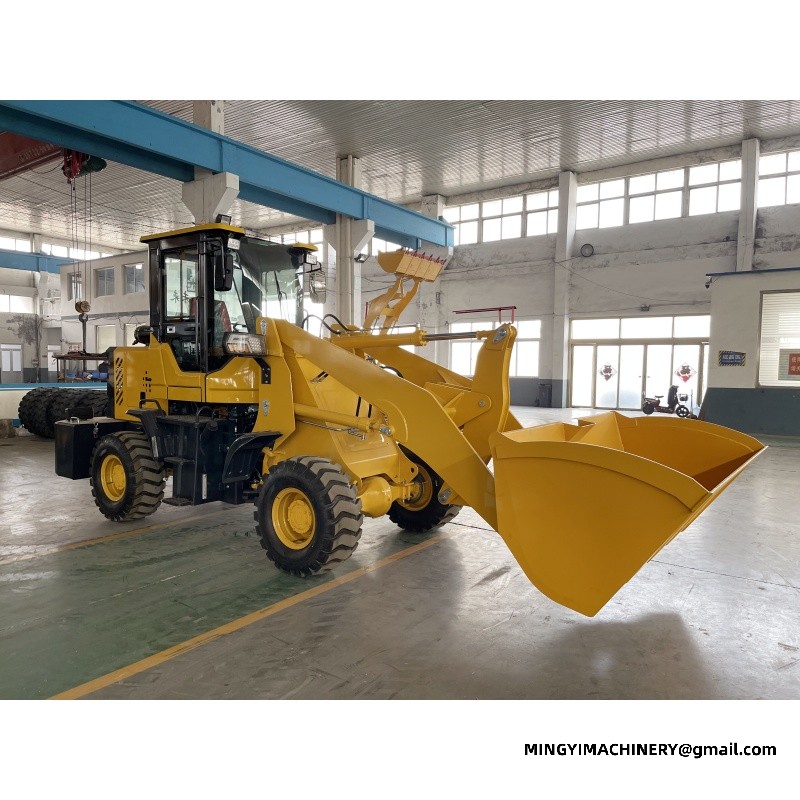
The first hour of running tells you more than the first month of paperwork. Watch the cooling: 4100 core (490 engine); 4105 core (4102T engine) should hold temperature at working load without the fan running continuously. Listen to the hydraulics: centre cylinder 45 / side cylinder 40 on a 40 pump (490 engine); 1045 pump (4102 turbo engine) should lift a full 0.38 m³ bucket to 3.5 m without the relief valve complaining.
Then check the electrical side under load, which is what the 60 Ah (490 engine); 80 Ah (4102 turbo engine) rating exists for. Restart the machine hot, restart it cold, and watch the cranking. A battery that is marginal on day one will fail in the first cold week, and it is far easier to settle at commissioning than six months later.
Fleet effort is driven by the size of the spares bin, and that is decided at purchase. Machines sharing an engine share a pump, 32 pump, a radiator, 4100 core, and a battery rating, 45 Ah (24 V). Machines sharing a frame share cylinder sizes, centre cylinder 40 / side cylinder 40, and hinge geometry. Buy within one frame family and the bin halves.
The figures to compare are the ones that differ: bucket 0.3 m³ against 0.38 m³, dump height 2.4 m against 3.5 m, track 1.2 m (Isuzu axle); 1.3 m (wheel-side reduction axle) against 1.5 m (wheel-side reduction axle); 1.45 m (Isuzu axle). Where those differ, the wearing parts behind them usually differ too. Where they match, one part number covers both machines.
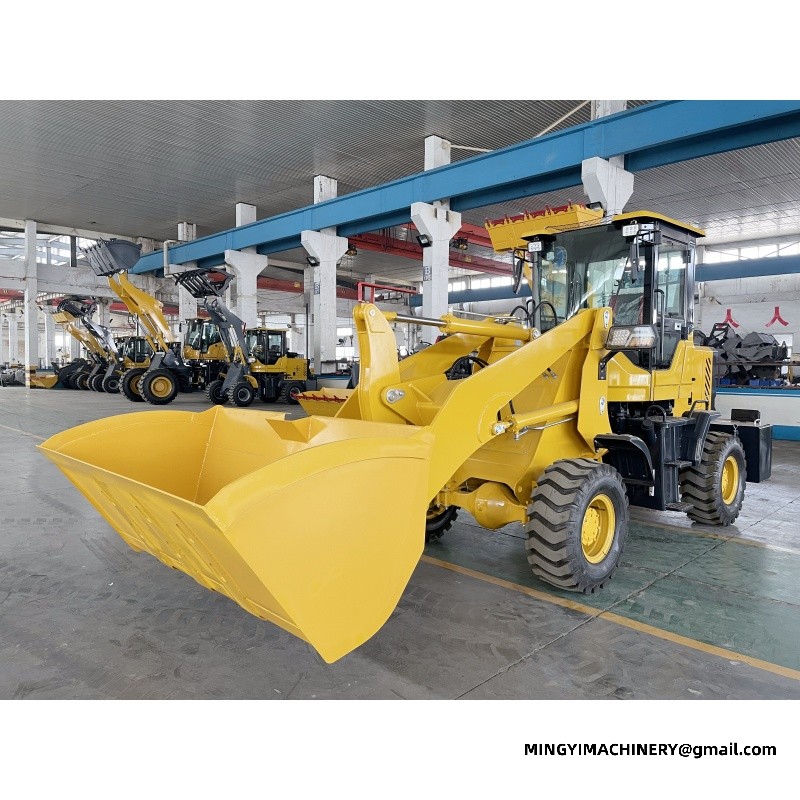
Spares consolidate by frame family rather than by model, which is the point of building a range this way. One cylinder seal kit covers the centre cylinder 60 / side cylinder 50 set across the builds that share it; one pump set covers 2063 pump and 25 pump; pins, bushes and cutting edges are common within a family. On the light-duty 3.5 m medium-frame wheel-side reduction wheel loader and the light-duty 3.8 m medium-frame wheel-side reduction wheel loader, where the two share a family, that is four line items.
What to keep on the shelf depends on the duty. A single machine on a farm needs a cutting edge, a hydraulic hose set, filters and a pin and bush kit. A fleet in a quarry needs those plus a cylinder seal kit, a pump, and one spare wheel-end. Because the 45 mm and 45 mm cross-members and the 30 mm and 30 mm hinge plates differ between builds, order wear parts against the model name, not against the frame.
A machine that wanders on the road and feels vague in the turn has worn hinge pins. The plates are 45 mm front and 30 mm rear over a 45 mm cross-member; when the pin bores ovalise, the geometry the frame was built to hold is gone, and no amount of steering adjustment brings it back.
Check it by loading the bucket, holding the machine on a slope and watching the joint while an operator rocks the steering. Movement there is wear; movement at the rear, over the 300 mm high x 800 mm wide section, is a different and more serious problem. Catching the first case takes a set of pins; missing it takes a frame.
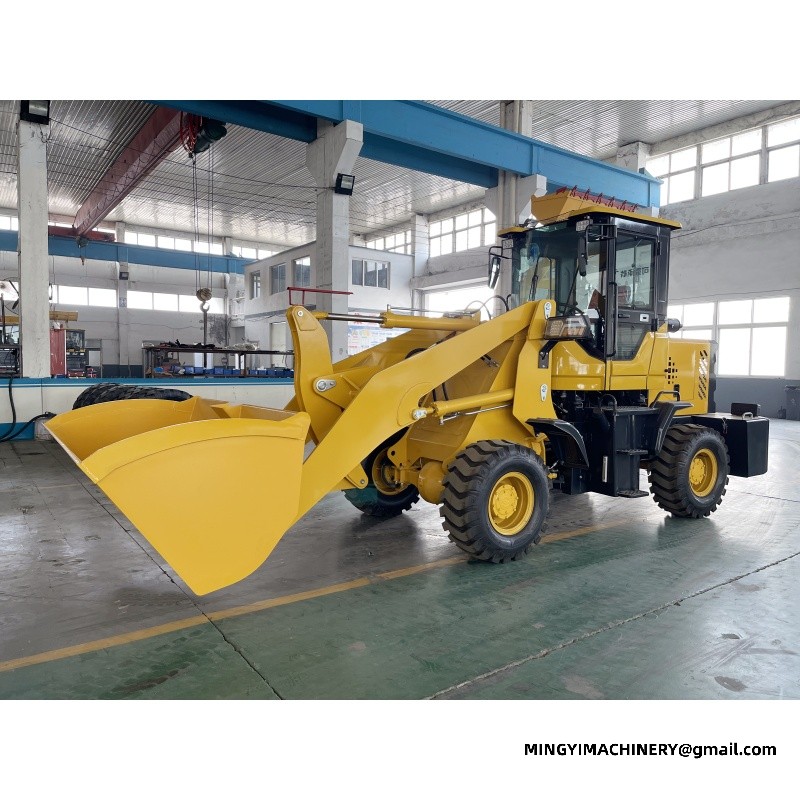
What does a daily check on a wheel loader manufacturer actually consist of?
Look at the ground under the machine, check coolant and oil, grease the hinge pins behind the 25 mm front and 14 mm rear plates, and glance at the cylinder rods. Ten minutes, every shift.
Can a wheel loader manufacturer be used with forks?
Yes, and the load centre moves forward, so capacity drops. Check the boom section, 430 mm wide with 900 mm of spacing, before hanging a long carriage off it.
How often should the hinge pins of a wheel loader manufacturer be greased?
Measured in hours, not weeks, on short-cycle work. The pins behind the 25 mm and 14 mm plates take every steering input; dry pins are how a frame goes loose.
Which spares should I hold for a wheel loader manufacturer?
Hoses and seals for the centre cylinder 60 / side cylinder 50, filters, belts and a battery to the 80 Ah rating. Do not stock welded items; plates at 45 mm and 30 mm are a repair, not a spare.
How many passes will fill a truck with a wheel loader manufacturer?
Divide body volume by bucket volume, then check the height. Against 3.5 m of lift with a 0.38 m³ bucket, a body that is too tall is not a pass-count problem at all.
Can I order the same wheel loader manufacturer build again next year?
Yes, if the order is written by figures rather than by name: bucket 0.38 m³, lift 3.2 m, cylinders centre cylinder 45 / side cylinder 40, pump 40 pump (490 engine); 1045 pump (4102 turbo engine). Names change; rows do not.
Why does my wheel loader manufacturer wander on the road?
Worn hinge pins. Load the bucket, hold the machine on a slope and watch the joint while the steering is rocked; movement there is wear behind the 45 mm and 30 mm plates.
Two builds, light-duty 3.5 m medium-frame wheel-side reduction wheel loader and light-duty 3.8 m medium-frame wheel-side reduction wheel loader, have carried the comparisons on this page. The same rows can be produced for any machine in the range, and for the engine options that change the pump, radiator and battery with them.
Pre-delivery inspection before Wheel Loader Manufacturer: What a Build Sheet Must Show leaves the shop
What the customer sees on arrival is decided before departure. The walk-around given to Wheel Loader Manufacturer: What a Build Sheet Must Show covers the same points the operator will check on day one, so there are no surprises when the crate is opened at the destination.
Moving Wheel Loader Manufacturer: What a Build Sheet Must Show between sites
Securing the load is not optional. Lashing Wheel Loader Manufacturer: What a Build Sheet Must Show at the points intended for it, checking the tension before the vehicle moves and rechecking after the first kilometres is standard practice rather than extra care.
Reading the early symptoms on Wheel Loader Manufacturer: What a Build Sheet Must Show
Temperature and pressure are the two things worth watching. A Wheel Loader Manufacturer: What a Build Sheet Must Show that runs hotter than it used to, or whose pressure has drifted, is reporting a problem that is still simple to fix.
Storage and long idle periods for Wheel Loader Manufacturer: What a Build Sheet Must Show
Rubber, seals and hoses age whether the machine works or not. Keeping Wheel Loader Manufacturer: What a Build Sheet Must Show out of direct sun and off damp ground slows that, and running it briefly at intervals keeps everything moving.
Packing, loading and shipment of Wheel Loader Manufacturer: What a Build Sheet Must Show
Export packing is part of the machine, not an afterthought. Wheel Loader Manufacturer: What a Build Sheet Must Show is blocked and braced inside the container so that it arrives in the same condition it left, and the load plan is decided by the dimensions rather than by what fits loosely.
Contact MINGYI Machinery for the current wheel loader lineup, configuration options and a formal specification for your market. E-mail: sales@mingycn.com | LINE (ID): mingyicn
Compact Wheel Loader: Working Tight Bays and Low Sheds · Small Wheel Loader: Day-to-Day Work on a Light Build · OEM Wheel Loader Manufacturer: Build Options and Labelling · Wheel Loader








