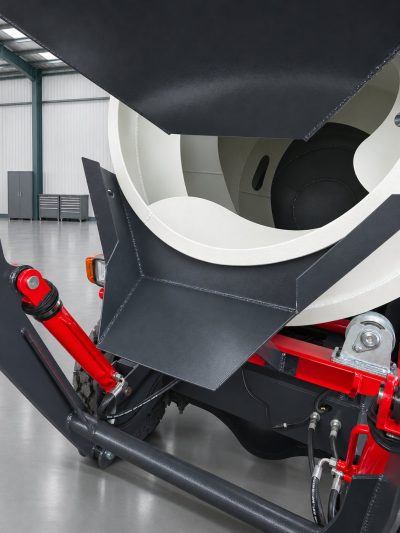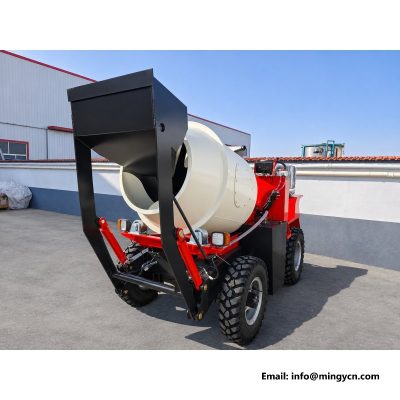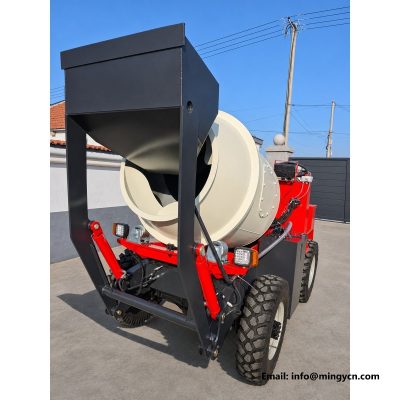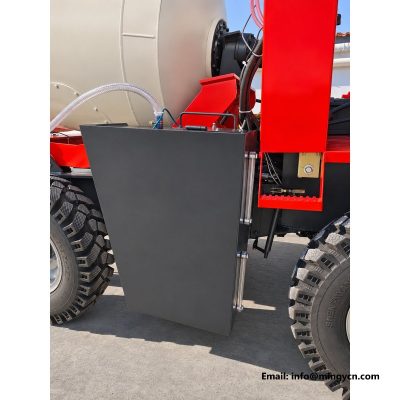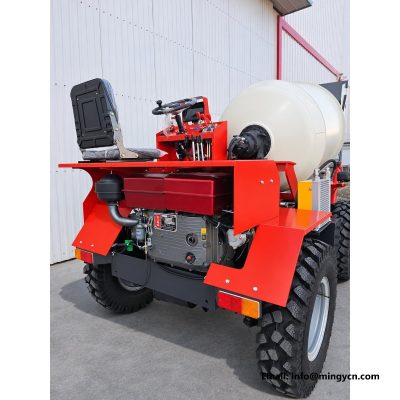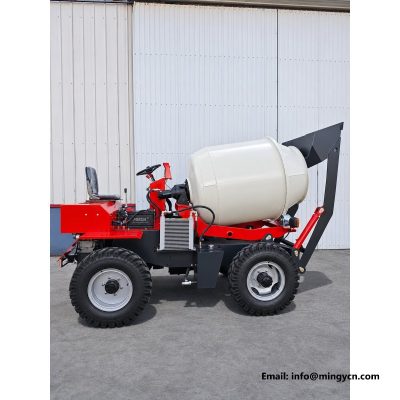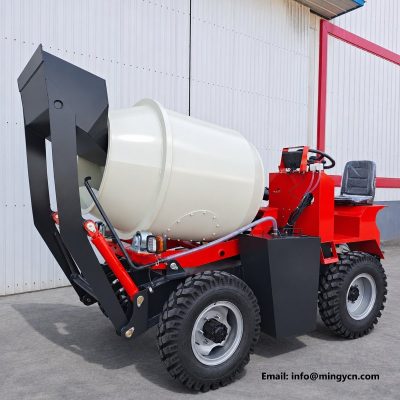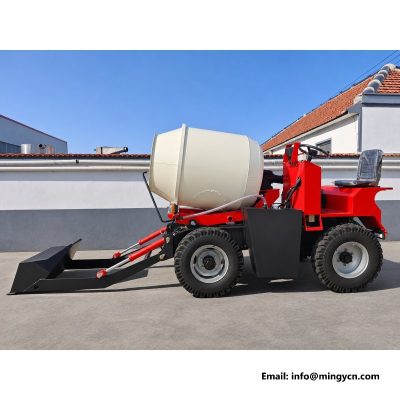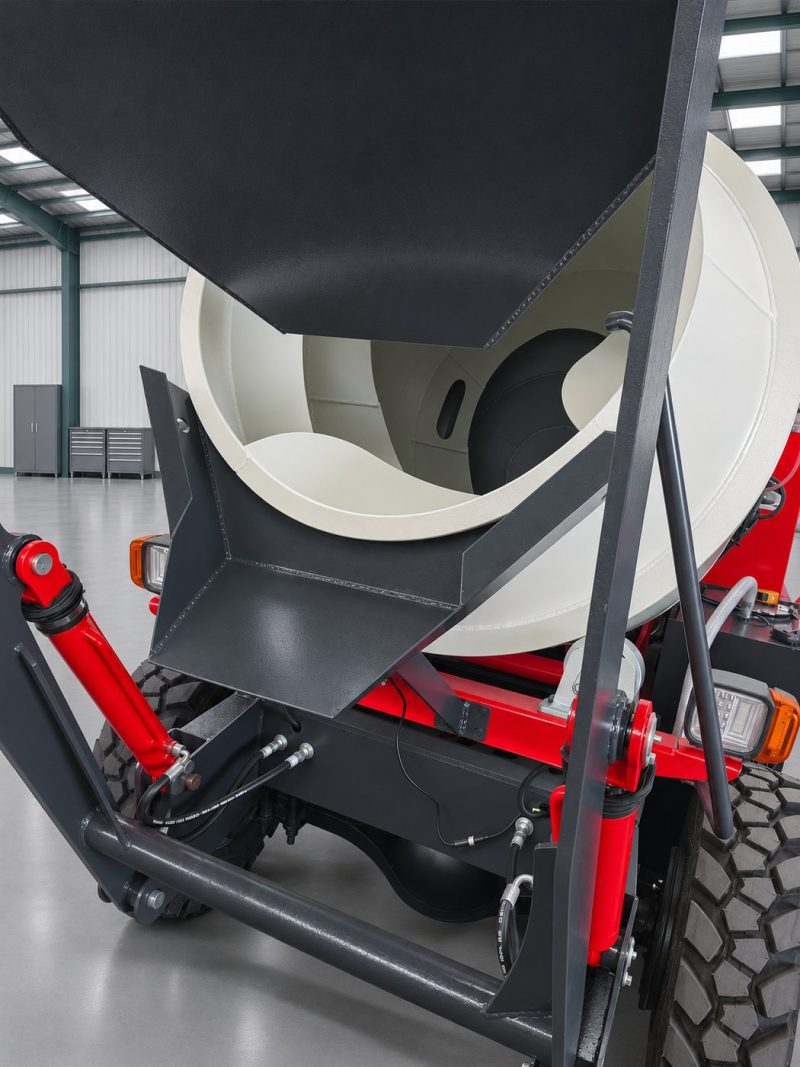
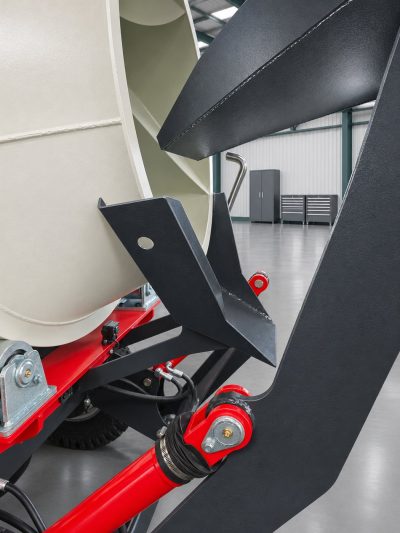
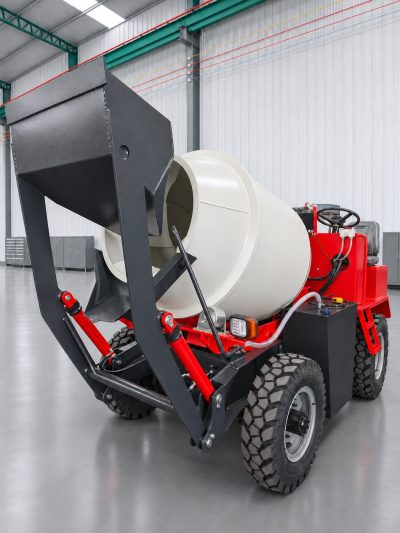
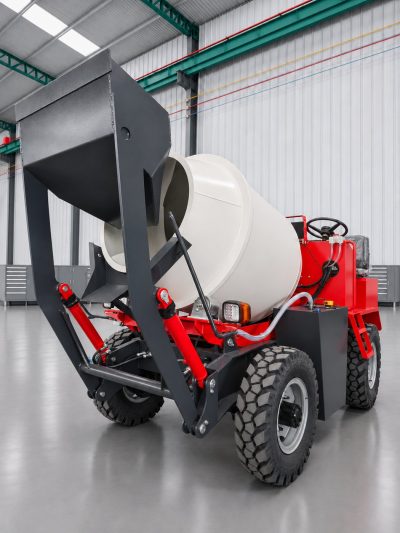
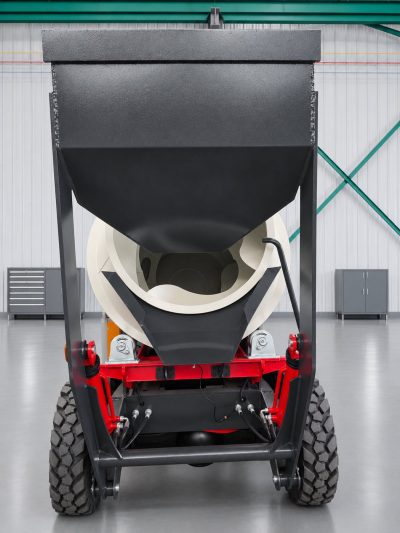
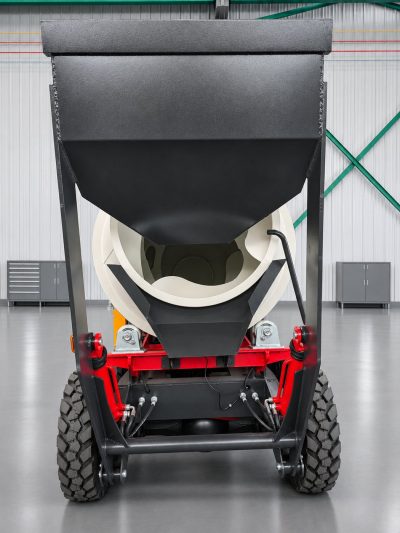
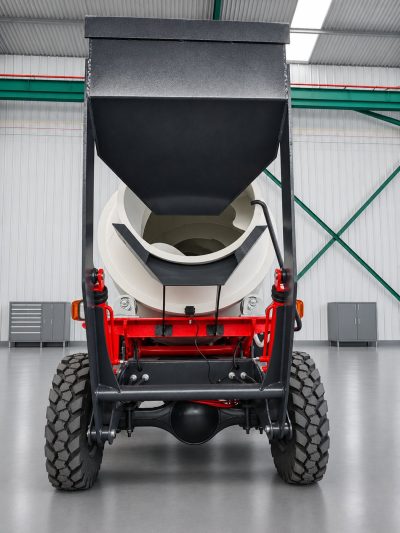
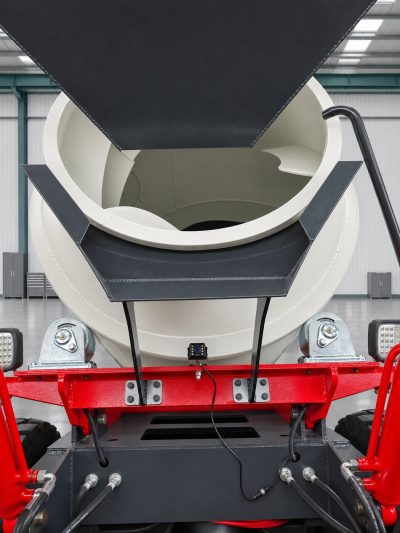
Choosing the hopper opening and chute reach that suit a narrow site, a small batch and a hand-fed drum.
A 0.8 m³ self-loading concrete mixer truck is bought for a different job than the larger machines: narrow gates, short hauls, pours measured in barrows rather than cubic metres. The receiving hopper and the discharge chute are where that job is either met or missed, because they set the two limits that matter on a small site — what can be loaded in one pass, and where the mix can be put without moving the machine.
This page works through those two components as a selection problem on the 0.8 m³ build: which hopper opening suits a loader bucket, how much chute reach a courtyard allows, and what changes if the work grows. The wear and spares side of the same components is covered on the 1.5 m³ chute and hopper wear page, and the hopper’s lift geometry on the loading hopper and lift arm page.
The published reference for the 0.8 m³ four-wheel-drive build. Every figure below is what the hopper and chute have to work within.
| Specification | 0.8 m³ self-loading mixer |
|---|---|
| Drum capacity | 0.8 m³ per batch |
| Rated load | 1,500 kg |
| Overall dimensions | 3,500 × 1,600 × 2,200 mm |
| Turning circle | 2,464 mm at the outer tyre |
| Rear steering angle | 28° |
| Ground clearance | 204 mm |
| Engine | 25 hp single-cylinder diesel |
| Transmission | 4WD, 3 forward + 1 reverse + road gear |
| Travel speed | 24 km/h |
| Axles | 130 front drive, 212 rear steering |
| Tyres | 8.25-16 / 7.50-16 |
Capacity sets the hopper before any other consideration. A 0.8 m³ batch of mixed concrete needs roughly 0.55 to 0.6 m³ of dry aggregate and sand plus the cement, and the hopper is drawn around that volume with enough freeboard that a heaped load does not spill on the lift.
That is a small hopper, and small hoppers have a specific advantage on a tight site: they fill fast and lift fast. Where a larger machine needs a loader or a two-man shovel gang, a 0.8 m³ hopper can be filled by one operator working steadily, which is often the real labour model on rural housing and small paving work.
The trade is cycle count. At 0.8 m³ per batch a 4 m³ pour takes five full cycles; the same pour on a 1.5 m³ machine takes three. The question is not which is faster in theory but whether the site can support the faster cycle — a narrow gate and a tight turning area will erase the advantage of the larger drum entirely.
Most 0.8 m³ machines are fed by a small wheel loader, a mini dumper or a shovel gang. The receiving hopper opening has to accept whichever of those is on site without the loader having to tip short and scrape the last of the load in.
The practical check on a receiving hopper is simple: measure the bucket width of the loader that will feed the machine, then compare it with the hopper mouth. A bucket wider than the receiving hopper opening means every pass leaves material on the ground beside the hopper, and the operator compensates by loading in two arcs instead of one.
Where the loading is by hand, the receiving hopper lip height matters less than the height of the lip. A lip that sits at a comfortable shovel height costs less in labour over a day than a wider opening that has to be reached over.
On a small site the machine often cannot get close to the pour. A courtyard with a wall, a trench line along a boundary, a shed floor behind a doorway — these are the cases where chute reach decides whether the machine is usable at all.
The discharge chute on the 0.8 m³ build is short by design, because a long chute on a light machine cantilevers too much weight off the frame. What the discharge chute gives up in reach it gains in rigidity, and the hydraulic control lets the operator place the end precisely rather than relying on the drum angle alone.
Where reach genuinely falls short, the answer is usually a wheelbarrow line or a short pump run rather than a longer chute. Adding length to a chute on this class of machine is the modification most often regretted, because the frame was never drawn for the moment it creates.
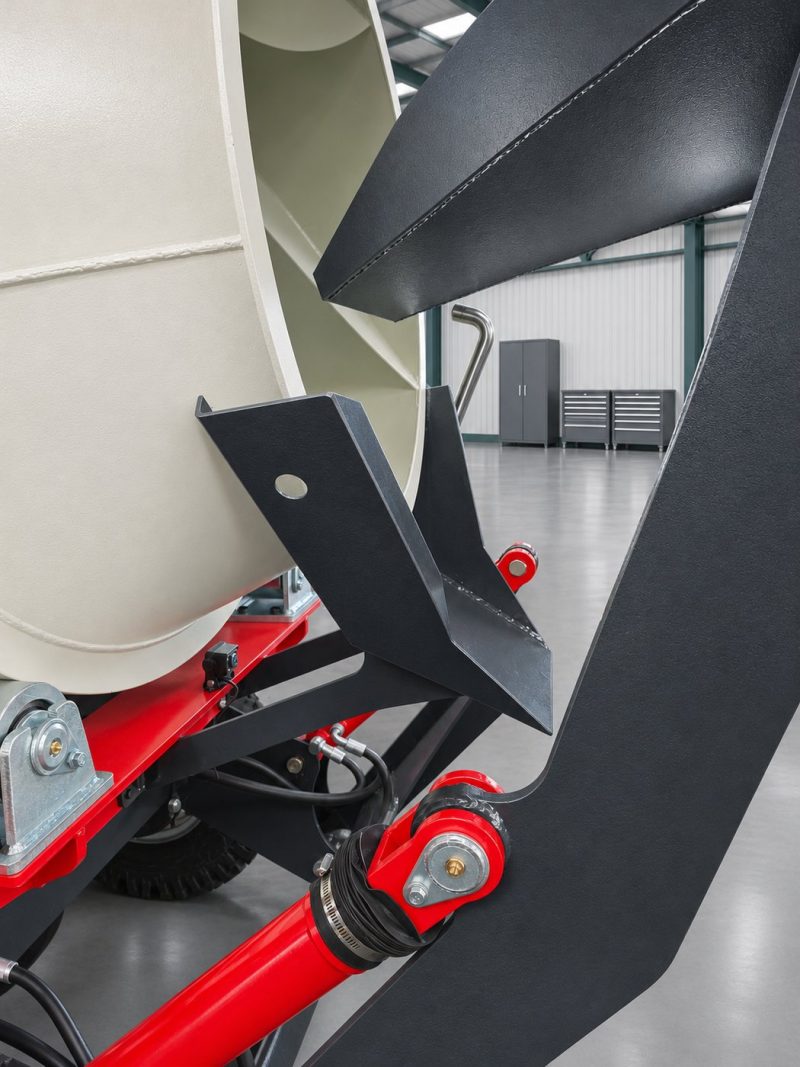
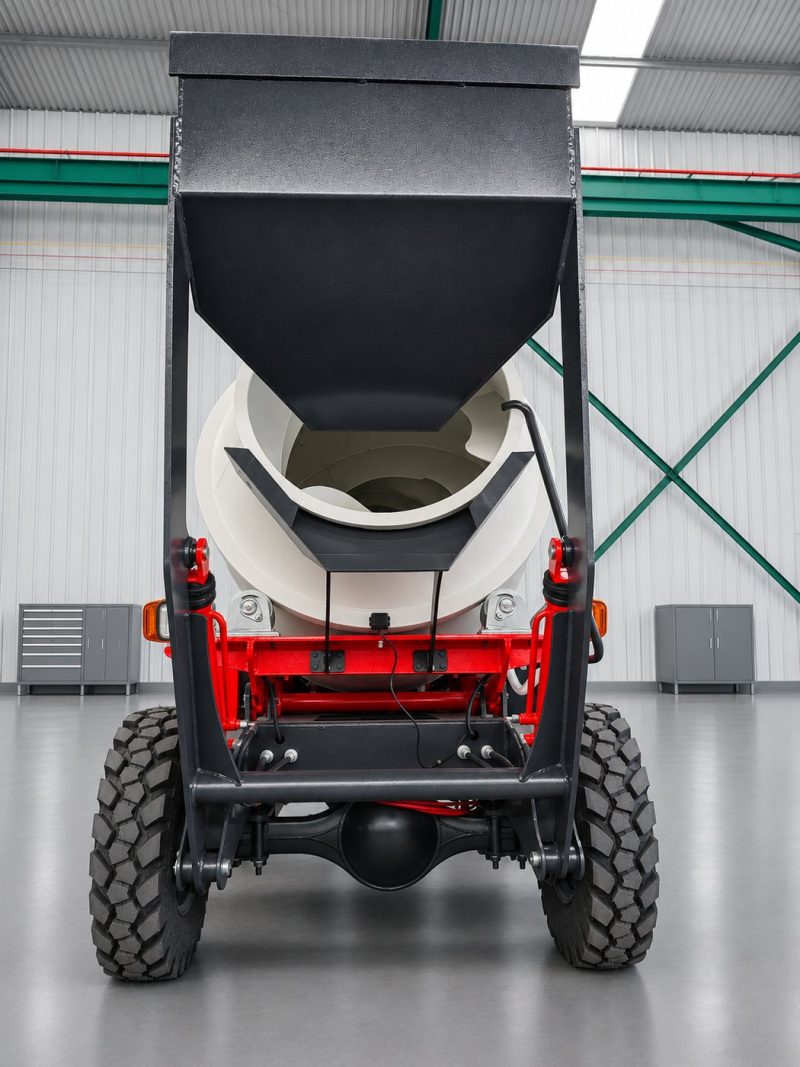
The 1,600 mm overall width is the figure that decides access more often than any other on the sheet. Standard double gates, most farm tracks and the gaps between formwork lines are all comfortably wider, and the machine passes them with a full drum because the drum sits inside the envelope.
What catches people out is the route, not the gate. A track that narrows at a hedge, a scaffold leg that has been left in the gap, a parked trailer — the machine needs the clearance for its widest point at every stage of the journey, not only at the entrance it was measured against.
A cycle is load, lift, mix, travel, discharge. On the 0.8 m³ build the load and lift are short because the hopper and arm are sized to the drum, and the mixing happens on the move at up to 24 km/h.
The variable that surprises buyers is discharge. A small drum empties quickly, and if the chute cannot be aimed at a target large enough to take the flow, the operator ends up interrupting the pour to move the barrow line. Matching the discharge target to the batch is worth more than shaving a minute off the load.
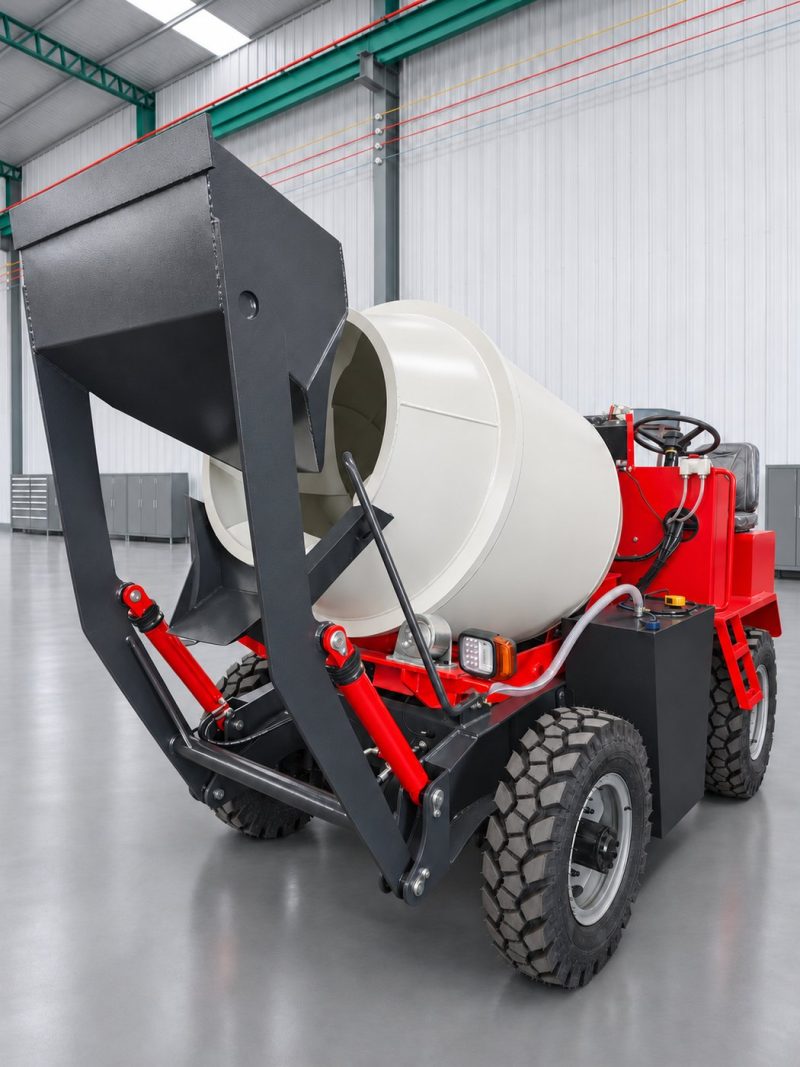
A stockpile two or three metres from the machine is the normal arrangement on a rural site. The hopper faces the pile, the loader or shovel fills it, and the arm lifts. The constraint is the approach: the machine needs room to stand square to the pile, and the arm needs clearance to swing back before it lifts.
On a site where the pile is against a wall or in a corner, the machine has to approach at an angle, and the hopper fills unevenly. That is not a defect in the machine — it is a site layout problem, and the fix is usually to move the pile rather than to change the machine.
A 0.8 m³ batch is roughly the contents of a large skip or eight to ten barrow loads. The chute has to be able to reach the opening of whichever is used, at a height that does not require the operator to hold the drum at an angle that risks segregation.
For skip work the discharge chute is set high and short, and the drum discharge is controlled in bursts. For barrow work the discharge chute is lower and the flow is throttled. Both are hydraulic positions, which is what makes the same machine serve both jobs on the same day.
Paving, kerb and foundation work often leaves the machine working inside formwork with only a narrow corridor to move in. At 1,600 mm wide and 2,464 mm of turning circle, the 0.8 m³ build can be turned inside corridors that stop a truck-mounted mixer, and the 28° rear steering makes the approach line correctable without a shunt.
The discharge chute is what makes the corridor usable: the machine stands in the corridor and the discharge chute reaches out over the formwork to the pour. That is the working pattern this class of machine was drawn for.
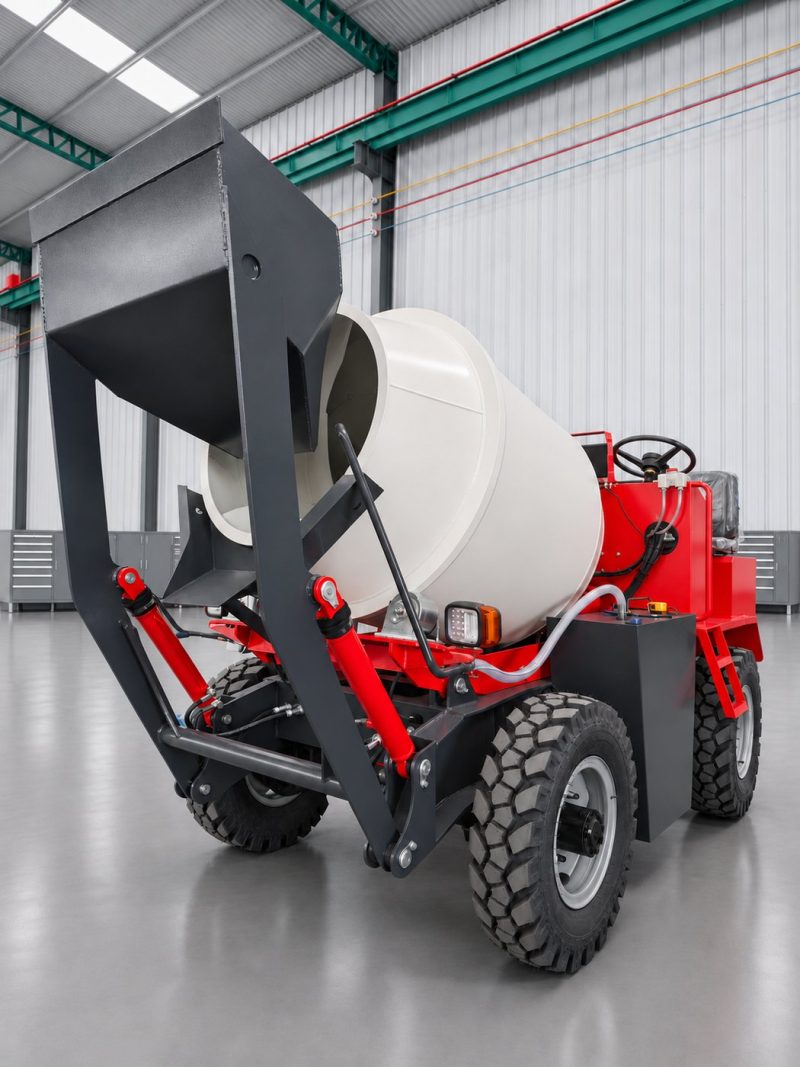
The 0.8 m³ build runs 8.25-16 front and 7.50-16 rear tyres on a 130 front drive axle and a 212 rear steering axle. That combination is chosen for traction at low ground pressure rather than for load carrying, because the machine’s 1,500 kg payload is modest and its real enemy is soft ground.
204 mm of ground clearance is the number to read against the route. It clears a kerb, a trailer ramp and most site debris, and it is the figure that fails first when a route has been cut up by other plant.
The larger build keeps the same 3,500 × 1,600 × 2,200 mm envelope and the same turning circle, which is why buyers sometimes assume it is a straight upgrade. It is not: the drum, hopper and chute are all larger, payload rises to 5,000 kg, and the operating weight goes from roughly 1,900 kg upward.
The practical differences on site are cycle count and loading method. The 1.5 m³ machine wants a loader to fill it at a useful rate; the 0.8 m³ machine can be fed by hand. If the site has a loader and the pour is large, the bigger drum wins. If the site is tight and the pouring is in small increments, the smaller drum with its faster fill is the better match.
Parts are not interchangeable between the two — hopper and chute are drawn to the drum they serve, even where the frame detail looks identical.
Three additions are commonly ordered with a 0.8 m³ machine. A chute extension for the rare long-reach pour, which is best treated as a separate bolt-on rather than a longer welded chute. A discharge hopper or sock for placing into narrow formwork without splashing. And a drum wash-out point, which matters more on a small machine because a small drum left with concrete in it is a drum that has to be broken out by hand.
Two additions are worth resisting on a self-loading concrete mixer truck of this size. A longer welded discharge chute, because the frame was never drawn for the moment it creates at the mounting. And a raised receiving hopper extension to increase batch volume — on a concrete mixer truck of this class it is the drum that sets the batch, not the hopper, so an oversized hopper simply spills material on the lift and adds weight to the arm for nothing.
Four measurements settle the specification: the narrowest gate on the route, the bucket width of whatever will feed the hopper, the height and distance of the discharge target, and the largest single pour the machine will be asked to deliver.
Send those four and the hopper and chute configuration can be confirmed against the actual job rather than against a general description of small-site work.
The machine ships as a complete unit with the hopper and chute fitted. Commissioning is a matter of checking the hydraulic circuits through their full travel, confirming the hopper lip clears the drum mouth at full lift, and running one empty cycle before the first batch.
Crews new to a self-loading mixer usually need one practice cycle to learn the lift timing. The arm is fast on this size of machine, and tipping early spills material that then has to be shovelled back into the hopper.
Q. Can the hopper be filled by hand on a 0.8 m³ machine?
Yes, and that is one of its advantages. The batch is small enough for one operator with a shovel to keep up on short pours.
Q. Is a longer chute available for tight access?
A bolt-on extension is the usual answer. A permanently longer chute loads the frame more than this class of machine is drawn for.
Q. Are the hopper and chute the same as the 1.5 m³ machine?
No. They are sized to their own drum, so quote the capacity when ordering spares.
Request a quotation for a 0.8 m³ self-loading concrete mixer truck
Send the gate width, bucket width, discharge target and largest pour, and we will confirm the hopper and chute configuration.
Email: sales@mingycn.com | LINE (ID): mingyicn