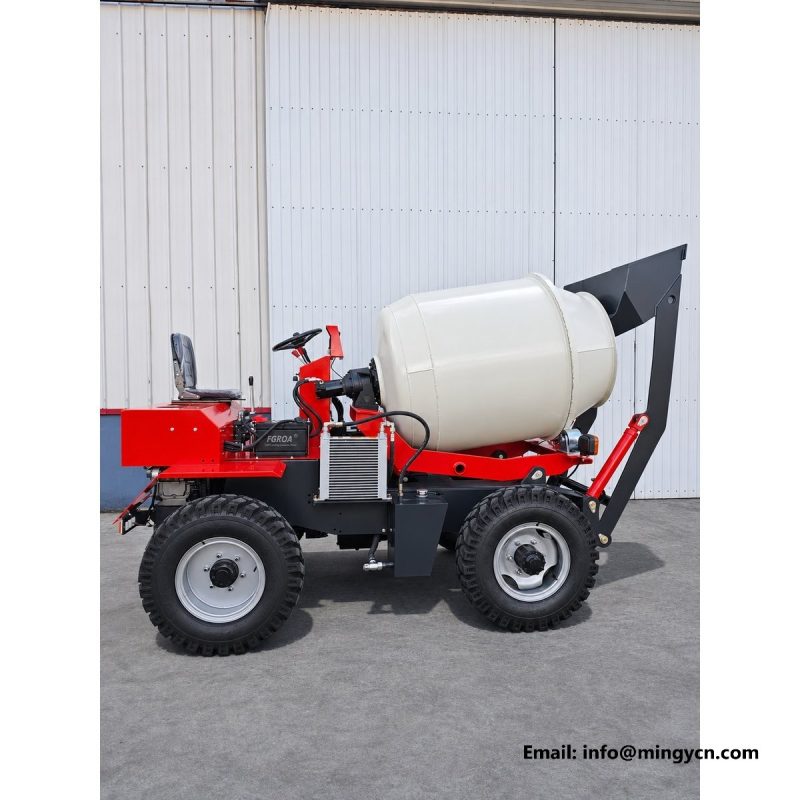

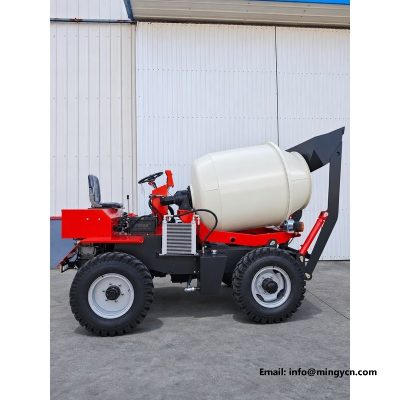
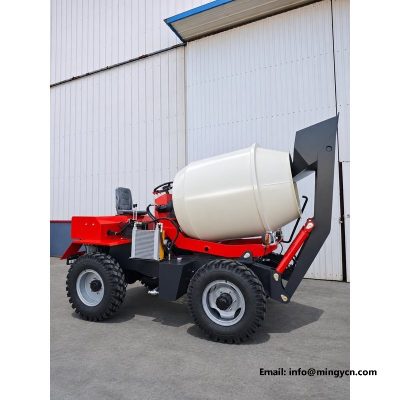
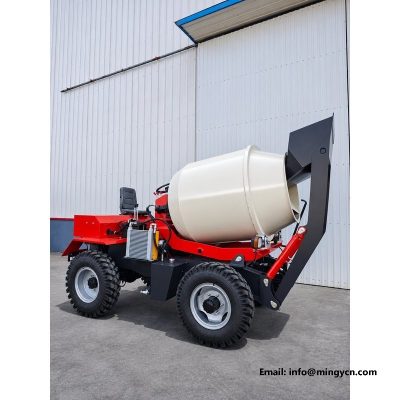
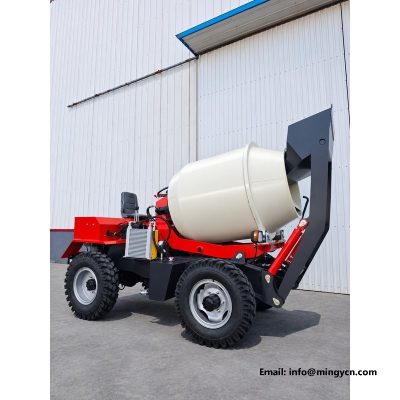
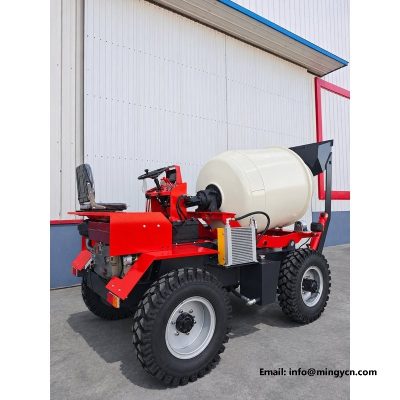
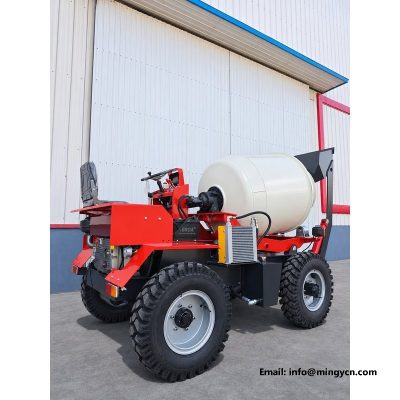
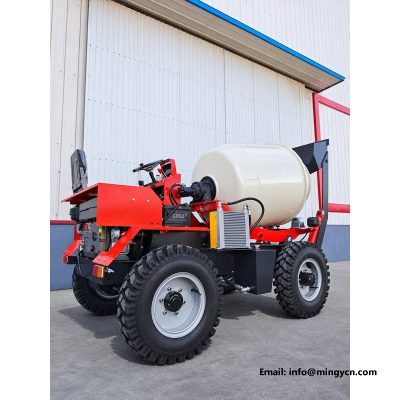
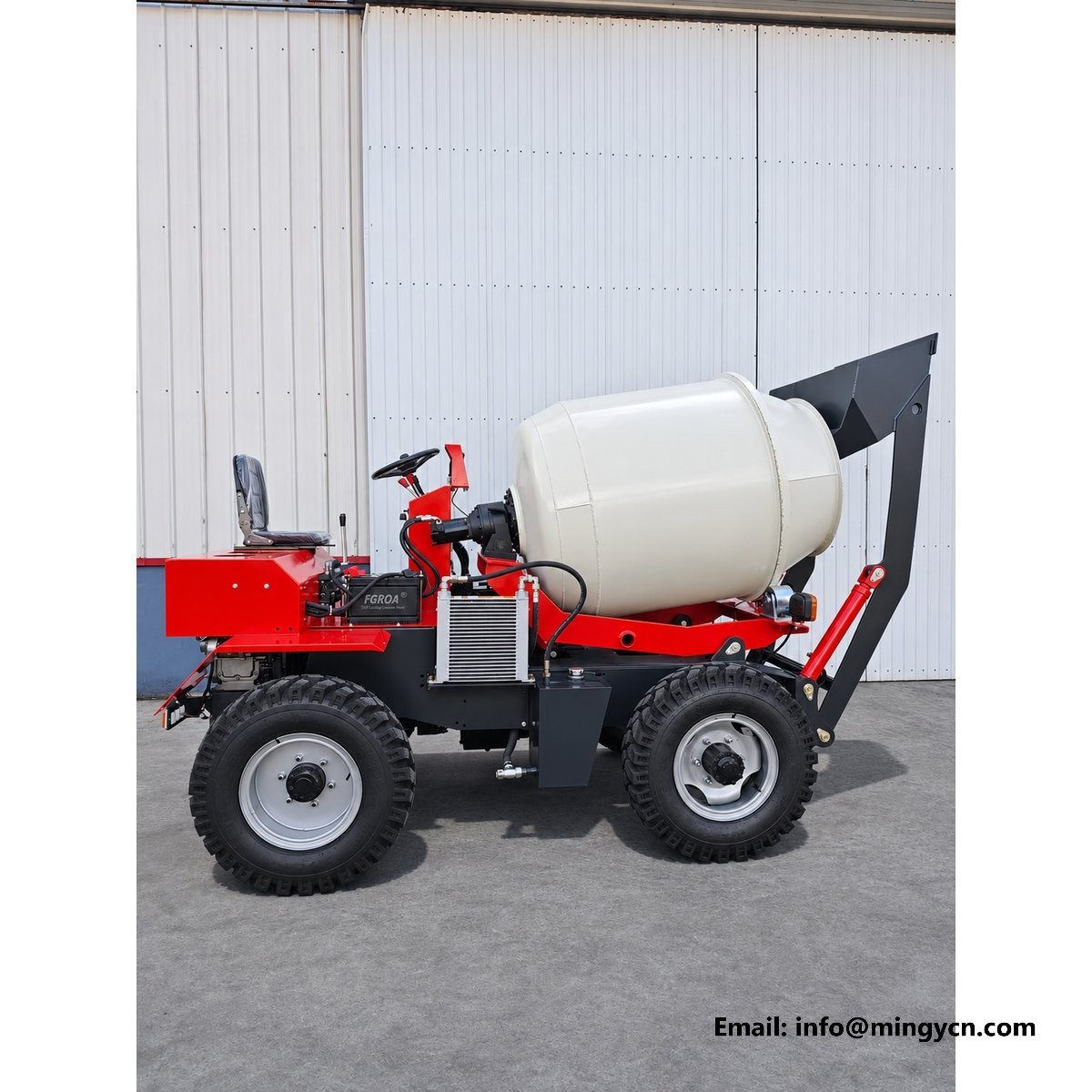
left side against white wall: clean background reference
A machine photographed flat against a white wall is the closest thing to a technical reference that a gallery page can offer. Nothing in the frame competes with the shape of the machine, so outline, proportion and stance can be judged at a glance and compared honestly with another build. This set of eight frames walks the left flank from the front tyre to the rear drum, then ties the view back to the dimensions that matter on site. It explains what each frame is for, what a buyer should measure or ask about, and how to use the same view again on delivery day, when the machine is standing in a yard instead of a studio.
| Specification | 1.5 m³ self loading mixer |
|---|---|
| Operating weight | 1,900 kg |
| Overall dimensions (L x W x H) | 3,500 x 1,600 x 2,200 mm |
| Front tyres | 750-16 |
A machine photographed against a white wall gives the eye nothing else to hold on to, and that is the point. There is no yard clutter to hide a bent panel, no shadow from a neighbouring container to shorten a wheelbase, and no pallet in the foreground to disguise how the machine sits on its tyres. What remains is outline, proportion and stance. Frames like these are the ones a buyer returns to months later, because they can be set beside another machine photographed the same way. They also travel well: a clean flank image can go into a quotation, a drawing pack or a shipping document without a caption explaining what is behind it. Treat this view as the reference against which the other seven frames are read.
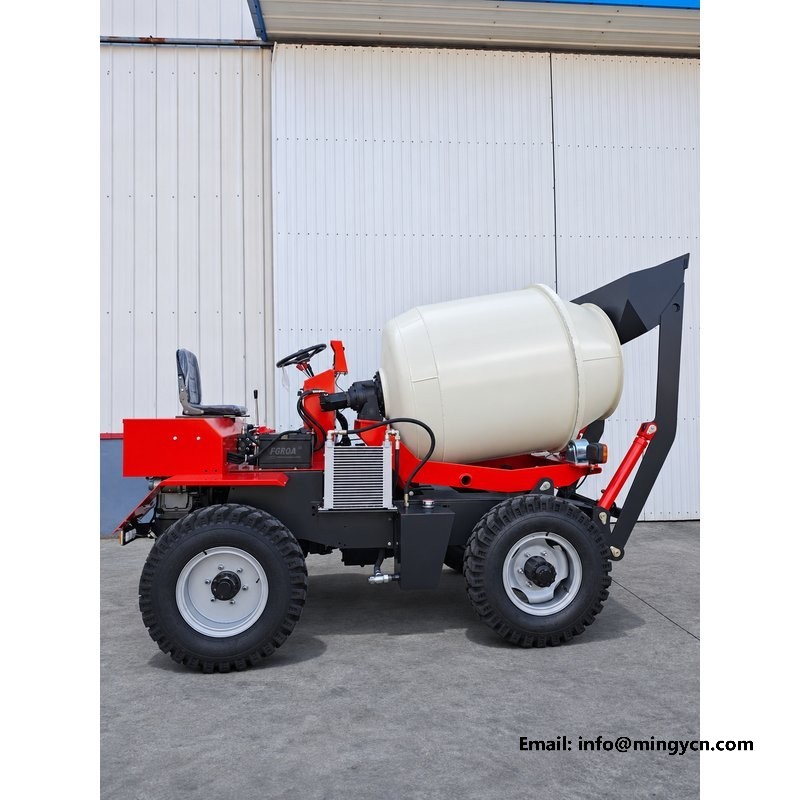
Squint at the flank and the machine resolves into three masses: the drum at the rear, the engine and tank block in the middle, and the arm folded over the front frame. Proportion is not a matter of taste on a machine like this. If the drum looks small against the chassis, the builder has probably pushed the rated load close to the structure's limit. If the front overhang looks long relative to the tyre, the front axle will carry more than its share whenever the hopper comes up loaded. Here the drum fills the rear third and the arm sits low over the rails, so the visual centre stays close to the ground. That is also why the 1,900 kg operating weight reads as settled rather than top-heavy.
A side elevation shows two of the three overall dimensions directly and the third only by implication. Length and height can be checked against the wall: the machine should stand square to the ground line, with the tyres touching and the drum crown level. Width has to be inferred, and the honest way to do it is to ask for a front or rear frame taken from the same distance. What this view does give is the relationship between the three figures. A machine 3,500 mm long and 2,200 mm tall is compact enough for a narrow lane, and the proportions in the photograph should look consistent with those figures rather than stretched along one axis. Measure the tyre diameter in the image and use it as a scale bar for everything else.
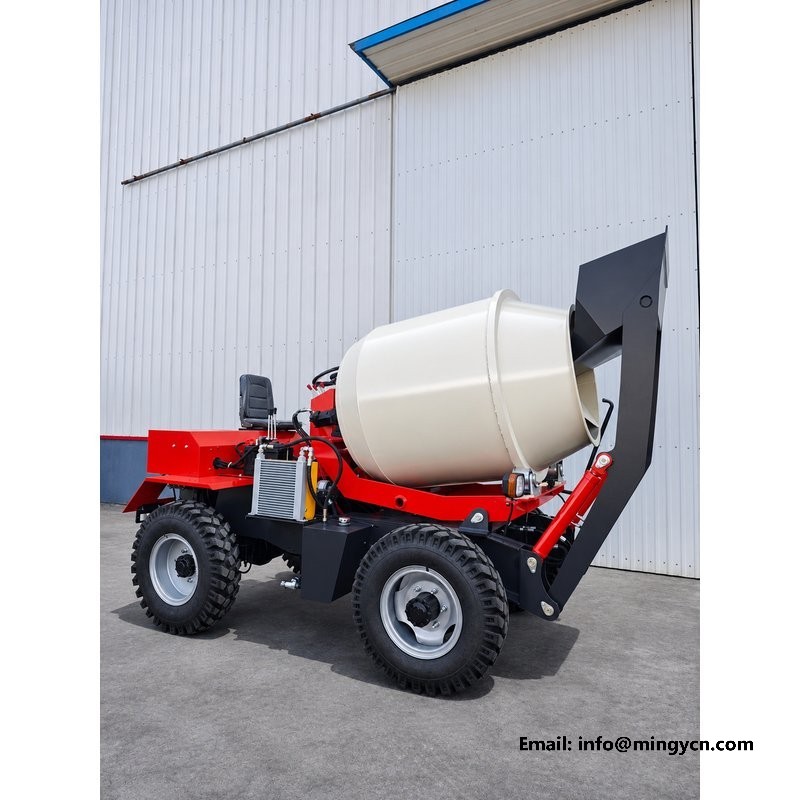
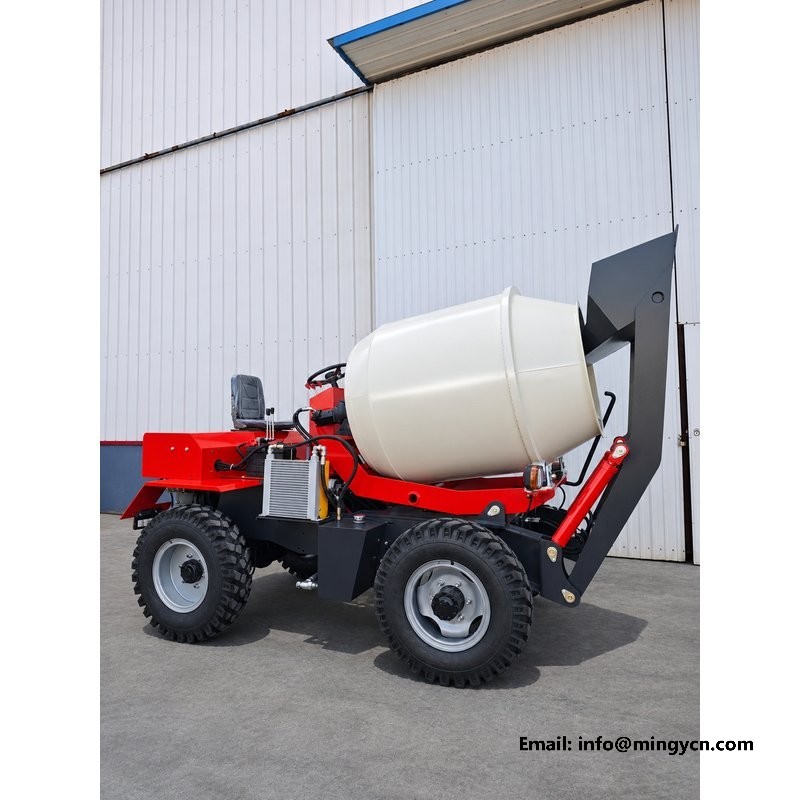
Suppliers usually photograph the side that looks tidiest, and on a self loading mixer the two flanks are not equivalent. The left side tends to carry the hydraulic tank, the valve bank, the filter head and the battery isolator, because that is where the pump and the operator's access sit. That makes it the more informative side for a buyer, and the harder one to make look clean. Look at the hose runs leaving the valve block: they should travel in groups, clipped at intervals, and turn into the frame rather than across it. Look at the filter and the sight glass, where one is fitted, for access with a normal wrench. A left flank where the plumbing disappears behind the structure is a flank laid out by someone who expected to service it.
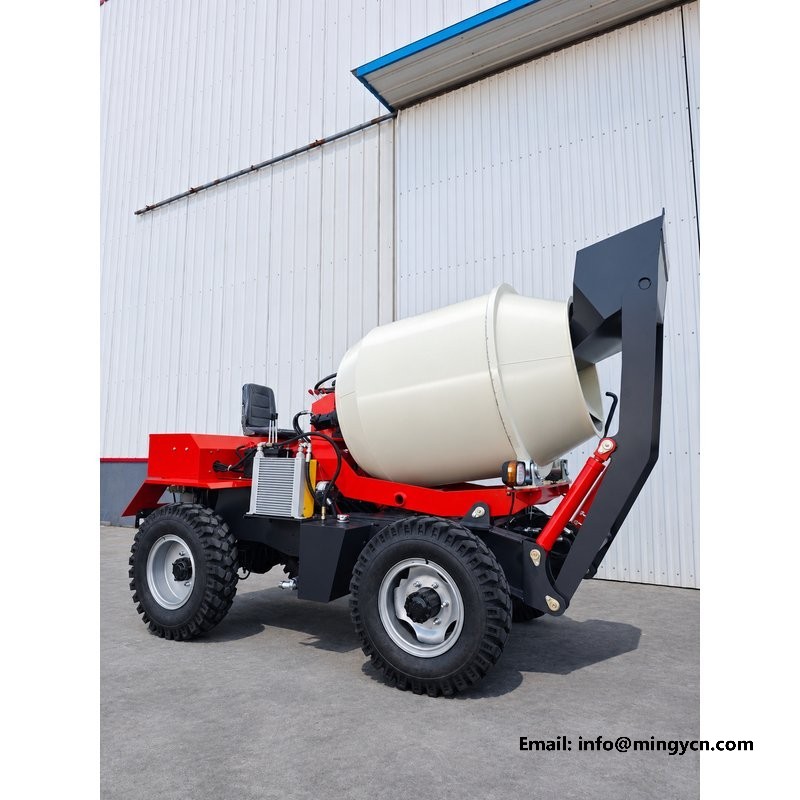
Nothing in a white-wall photograph gives scale except the machine itself, so the 750-16 tyre becomes the ruler. Its sidewall height and loaded footprint let a viewer estimate the drum diameter, the height of the mouth and the step up to the operator's position without a tape measure in the frame. The 204 mm ground clearance is the second reference. Look at the gap under the frame between the axles: it should read as a consistent band, not as a wedge that closes towards the front. A band that closes suggests a bent rail or a sagging mount. The same gap also tells you what the machine can cross. A site with deep ruts or a rough stockpile entrance will test that clearance on every trip, loaded and empty.
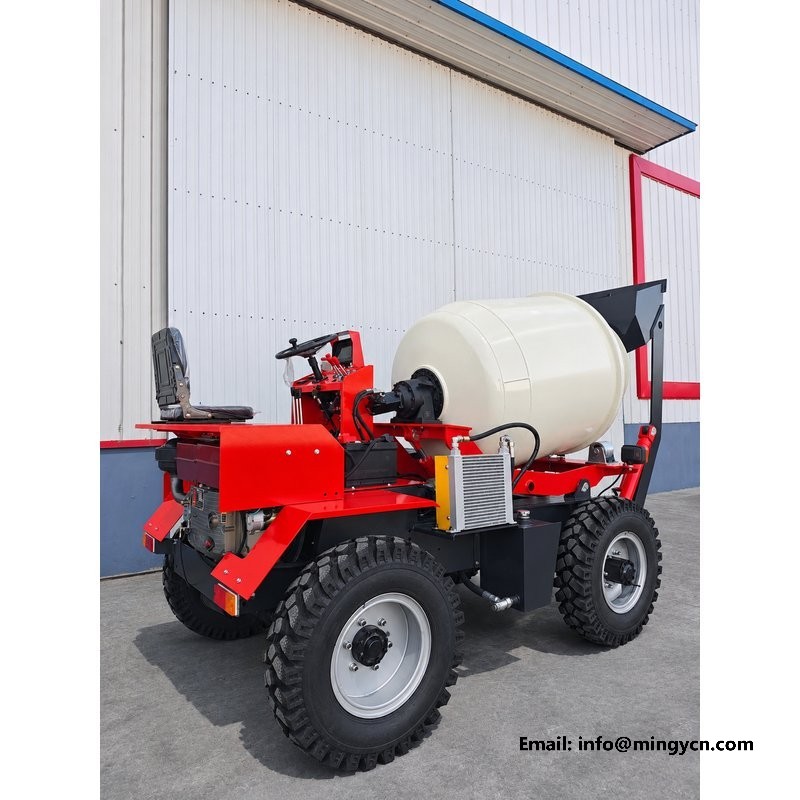
A side view cannot show a turning circle, but it can show the wheelbase that produces one. Note where the front and rear axle centres sit relative to the drum and the arm pivot; the 2,464 mm turning circle follows from that spacing together with the 28 degree steering angle at the front wheels. On this machine the rear axle is a 130 four-wheel steering unit, which shortens the practical arc further because the rear wheels also steer. What to check in the frame is that the steering linkage and the rear steering ram are not hidden behind a guard or a mud flap, since those are the parts that need greasing. Ask for one frame with the wheels at full lock; that single image explains more about site handling than a paragraph of description.
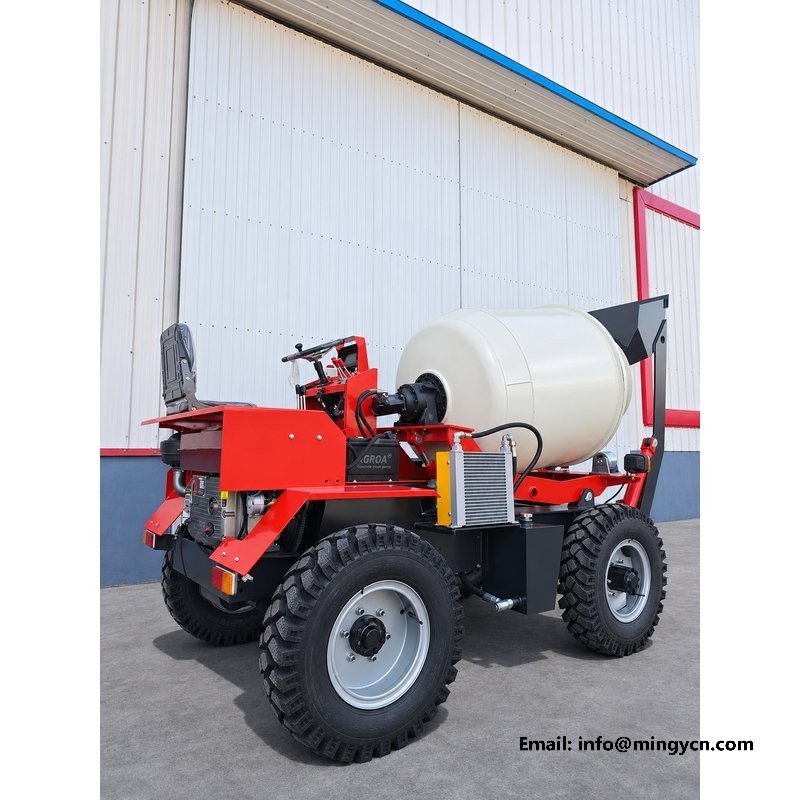
A white wall removes the reflections that make paint look better than it is, which is exactly why these frames are worth keeping. Judge three things. First, colour match between panels: the drum shell, the frame and the hopper should read as one paint system, not three batches. Second, overspray: a fine mist on hoses, tyre sidewalls or chrome is the mark of a machine painted in a hurry after assembly. Third, preparation: look along the frame for filled hollows, sanding marks under the gloss, or a ripple that follows a weld. None of these stops the machine working, and all of them predict how the finish will age outdoors. Photograph the same panel again after a season and the difference will be plain.
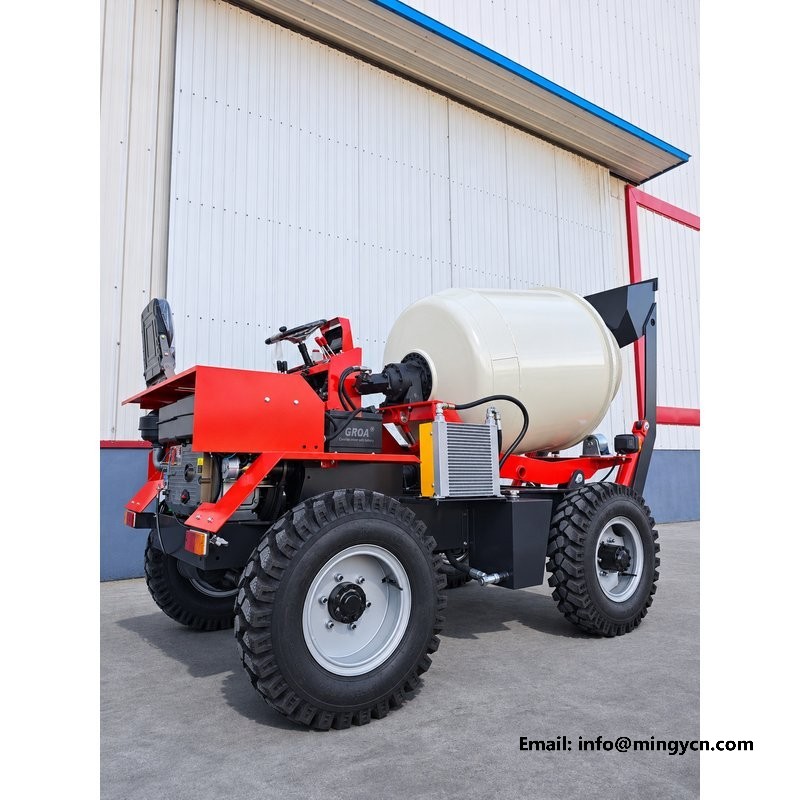
Comparing two flanks is only fair if both were shot the same way. Ask for the same distance, the same height and the same light on each side, otherwise the frame taken closer will always look better detailed. Once the conditions match, asymmetry becomes readable. Some differences are legitimate: a filler neck, a valve block or a step will exist on one side only. Others are not. If the drum bands sit at different heights, or the arm clears the frame by a different amount on each side, the machine has a mounting or alignment problem rather than a design feature. Note those differences on the image itself, with a short line and an arrow, before sending it to anyone. A marked frame argues better than a written description.
A clean flank shot travels well. It can be dropped into a quotation, printed on a single sheet, or overlaid with dimension lines without the background fighting the annotation. What it can support is layout work: whether the machine fits through a gateway, under a low cable or alongside a trench; where the operator steps up; which side the service points face. What it cannot support is anything internal or dynamic. It says nothing about drum speed, mixing performance, hydraulic pressure or the load a hopper will lift. Be explicit about that when forwarding it. A drawing office that treats a photograph as a general arrangement will produce a layout that is right in outline and wrong in the details that matter, such as the swing of the arm.
The conditions behind this set are simple and repeatable. The camera sits near the height of the machine's mid line, square to the flank, far enough back that the whole machine fits with a margin and the lens does not stretch the near end. Light is diffused rather than direct, so there is no hard shadow under the drum and no hotspot on the paint. Nothing is cropped: the tyres touch the bottom of the frame and there is clear space above the drum. To repeat the set on delivery, mark the ground where the machine stood and where the camera stood, then shoot the same frame before anything is unloaded. Those two images, taken months apart from the same spot, are the most useful pair a buyer can own.
Yes, provided the frames are the ones you were sent for that machine and not a library image of a different build. A clean flank shot reproduces well in print and needs no retouching. Keep the file at its original size, do not crop the tyres or the drum, and caption it with the model and the date. If you need a dimensioned version, ask for the same frame with the measuring points marked on it.
The left flank carries the service points, the valve block and most of the plumbing, so it answers more questions than the right. The right side is usually photographed separately, often in the yard. If you are comparing two machines, ask for both flanks against the same background and from the same distance. A set with only one side is still useful, but treat the unseen side as unverified until a frame arrives.
For the current specification, build options and a formal quotation for your market, contact MINGYI Machinery. E-mail: sales@mingycn.com | LINE (ID): mingyicn
1.5 m3 Self Loading Concrete Mixer: Full Specification and Walkaround · 750-16 Tyres and Isuzu Front Axle on the 1.5m3 Mixer · 1.5m3 Self Loading Mixer from Every Angle: A Yard Photo Reference








