750-16 Deep Lug Tyres, Isuzu-Type Reinforced Front Axle and 130 Steering Rear Axle on the 1.5 m3 4WD Self Loading Mixer
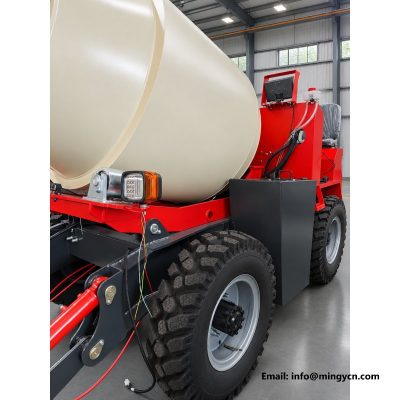
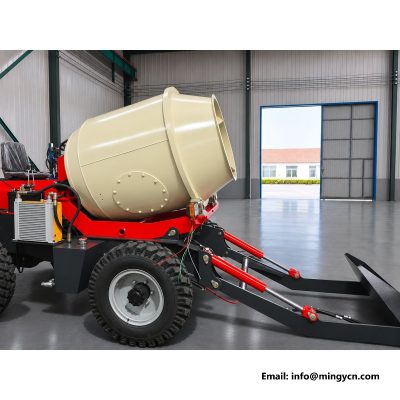
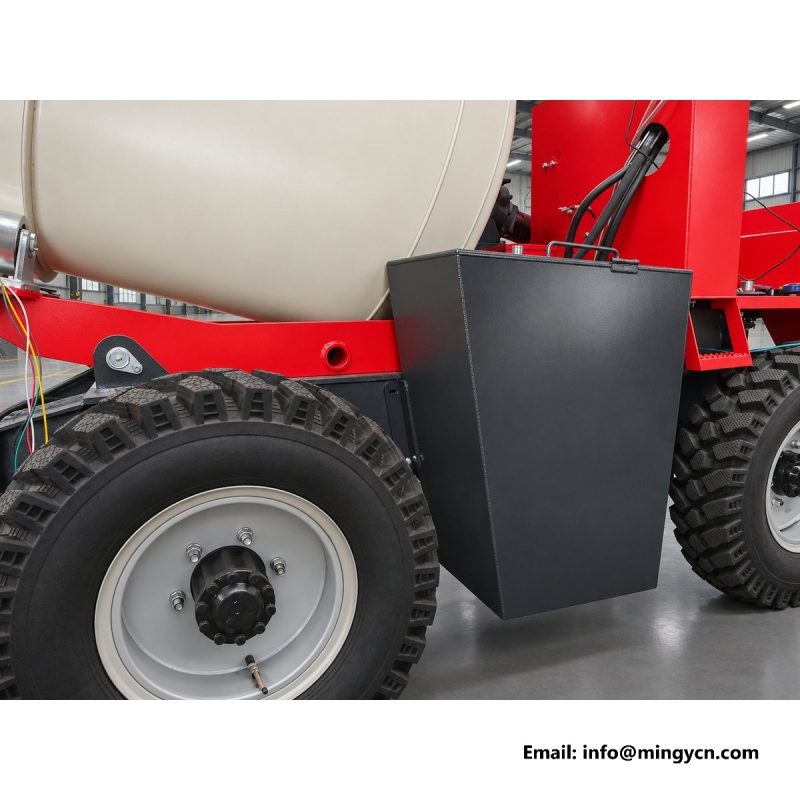
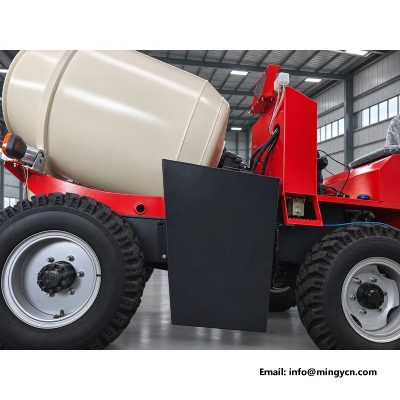
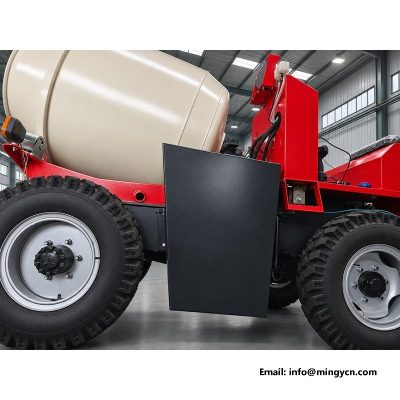
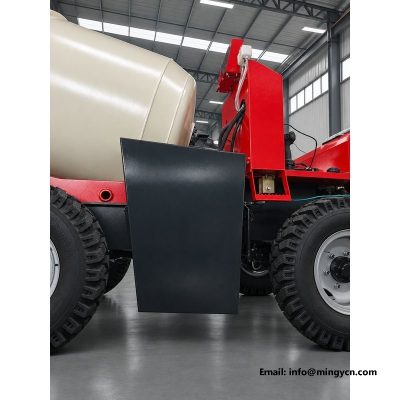
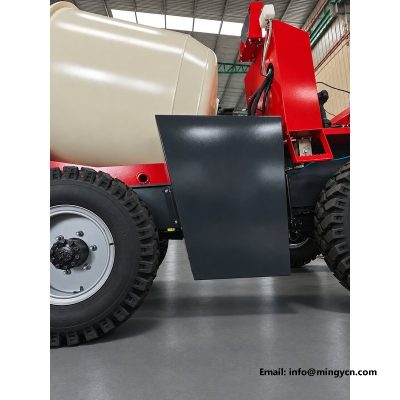
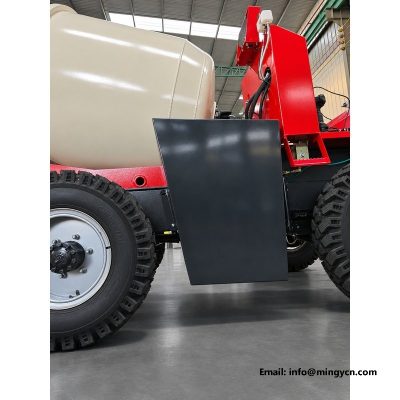
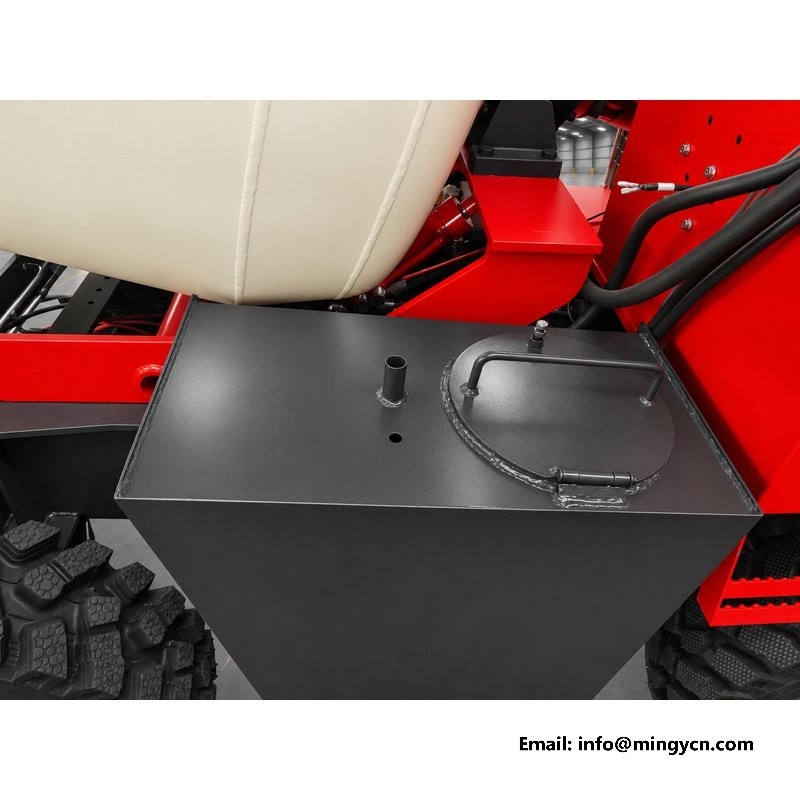
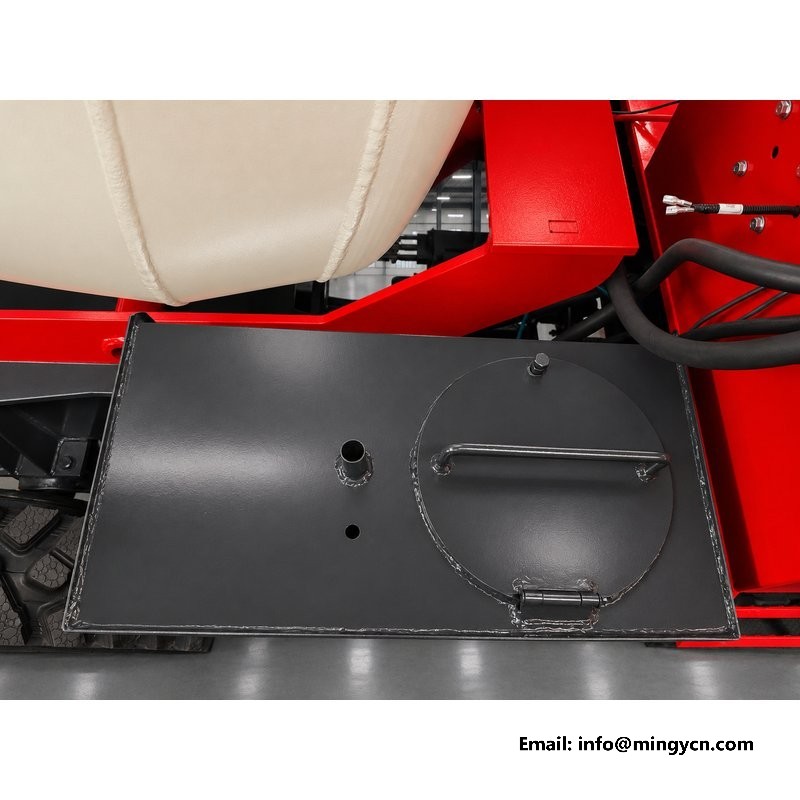
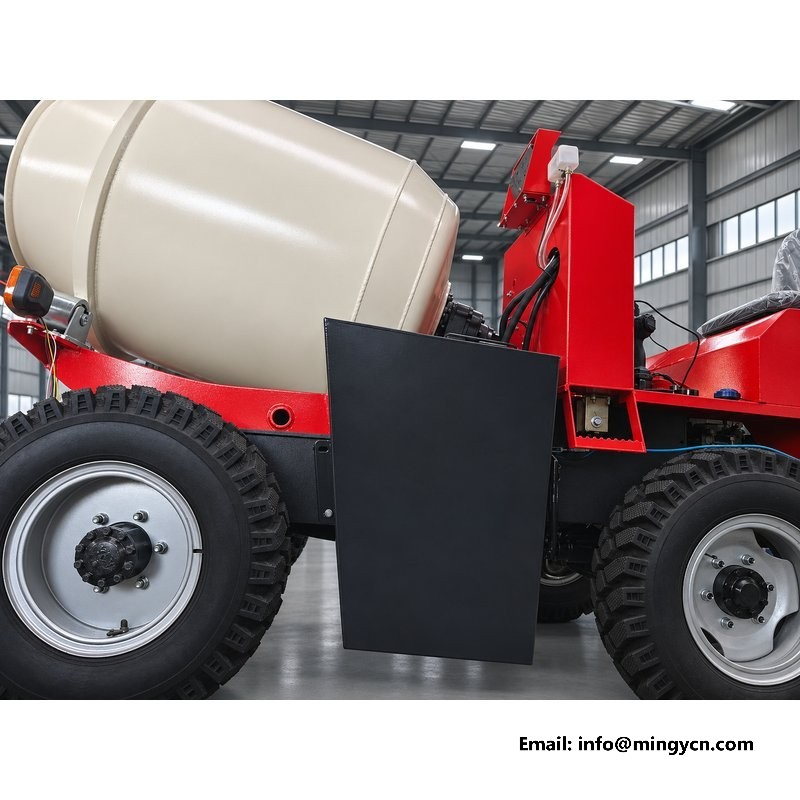
These photographs show the complete 1.5 m3 mixer from the side and three quarter angles, assembled and standing on its own wheels. That matters because the deep lug 750-16 tyres, the white rims, the black hubs, both axle positions, the red lift cylinder and the black water tank can be judged together as one layout rather than as separate catalogue parts. The sections below connect what the images show to how the machine behaves on site: how the tread grips soft ground, how the driven axles and steering rear axle work with the stated steering angle and turning circle, what the ground clearance allows on rutted tracks, and what to check on pressure, wear, steering feel and spare parts.
The 750-16 tyres in the side photographs carry a deep, widely spaced lug pattern, and that shape is chosen for ground that gives way under load. On soft soil, wet clay or a churned yard, the lugs bite below the surface and the gaps between them let mud clear as the wheel turns, so the tread does not polish into a smooth, slipping ring. That matters on a mixer that loads its own shovel and then drives with a full drum, because traction is needed at the moment the machine is heaviest and the ground is worst. The trade-off is on hard road: deep lugs wear faster, hum and transmit more vibration at speed. On mixed sites, keep the work on the soft ground where the tyre is strongest and the road sections short. Confirm the 750-16 moulding on every sidewall at handover, so any replacement matches the tyre already on the driven axles.
The side and three quarter views put the wheel, the axle and the body in one frame. Trace the white rim against the black hub: the rim is the painted steel wheel the tyre is seated on, while the hub belongs to the axle and carries the drive, so look for a clean line between them and an even bead where the tyre meets the rim. Look along the tread for consistent lug depth and for any chunk missing from a shoulder, and along the sidewall for cuts or a bulge. Because the photographs show both ends of the machine, you can confirm the same 750-16 size and the same rim finish at the front and rear. The red lift cylinder and the black water tank behind the wheels also help you fix where each axle sits, so the images work as a map as well as a tyre check.
The data sheet describes a four-wheel-drive gearbox with three forward and one reverse plus road gear, driving both axles, and a rear axle listed as a 130 four-wheel steering unit. In practice that means every wheel can pull, so when the front wheels drop into a wet rut the rear wheels are still pushing rather than spinning freely. The steering rear axle then adds a second effect: the back of the machine is guided into the turn instead of simply following the front, which shortens the arc the body sweeps. On a self loading mixer that has to back away from a stockpile and swing round in its own length, the combination is what makes a narrow yard usable. Check the steering linkages and hub seals for play or leaks during the walkaround, since a worn joint shows up first as vague steering on soft ground.
In the photographs you can read the axle stations by what sits above them: the reinforced Isuzu-type front axle is under the engine and the shovel lift arms, while the steering rear axle sits back under the drum and the black water tank. That split is deliberate. The shovel loads at the front, so the front axle and its housing take the shock of digging and of a loaded scoop being swung up; the rear axle carries the drum and the water, whose weight changes as a batch is mixed and discharged. Watch the gap between the wheels and the frame for signs that a full drum has been sitting low, and check that the red lift cylinder has room to work without fouling a tyre at full lock. The side view is the clearest way to judge that clearance, and it is easier to assess before the machine is dirty.
The stated 28 degree steering angle is the maximum the steered wheels can turn from straight ahead, and it is one of the figures that decides how much space the machine needs to reposition. A larger angle lets the wheels point further into a turn, so the driver can swing the nose round a stockpile or line up with a narrow gate with fewer back-and-forth shuffles. Because a self loading mixer spends as much time manoeuvring as it does travelling, that matters more than the 24 km/h maximum travel speed on most jobs. The figure is a mechanical limit, so at full lock the steering will feel heaviest and the tyres will scrub on hard ground; use it for positioning, not for driving across a yard. Check that both steered ends reach their stops without a hose or a linkage catching, and that the wheels return cleanly to straight ahead.
The 2,464 mm turning circle is measured at the outer tyre edge, which is the point that sweeps the widest path when the machine is at full lock, so it describes the clear space needed rather than the track of the centre of the machine. Read it together with the 28 degree steering angle: one sets how far the wheels turn, the other is the result of that turn combined with the wheelbase and the steering rear axle. For a buyer planning a yard, the practical use is to mark a clear pad that accounts for that swept edge plus the body overhanging behind it, and to check gate widths and stockpile positions against it. The figure follows the supplied data sheet, so confirm its final definition in the technical file before it is used in a site drawing or a tender document.
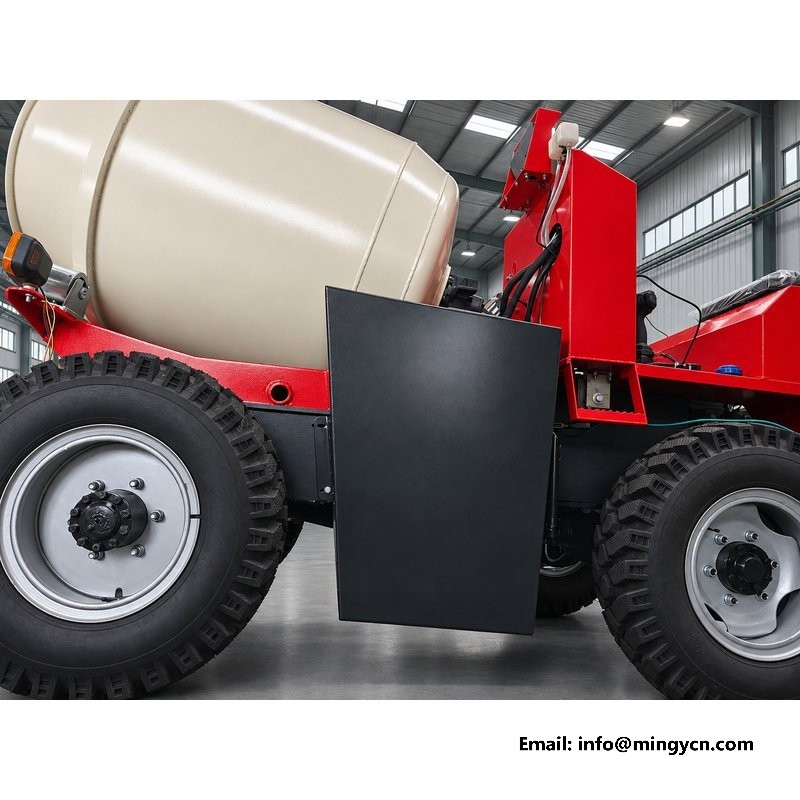
The 204 mm minimum ground clearance is the gap under the lowest fixed point of the machine, and on unmade village tracks it decides whether the mixer crosses a rut or bellies out on the ridge between wheel tracks. It is a static figure, so read it with a full drum in mind: a loaded machine sits lower, and a ramp crest or a loose stone uses up that margin quickly. The clearance also sets the breakover on a loading ramp, where a sharp change of angle can put the frame down between the axles even though each end clears. On site, walk the route before the first trip, fill the worst ruts, and keep the approach to a trailer deck as gradual as the ground allows. Ground clearance is a margin, not a licence to drive over anything, and it shrinks as the suspension works.
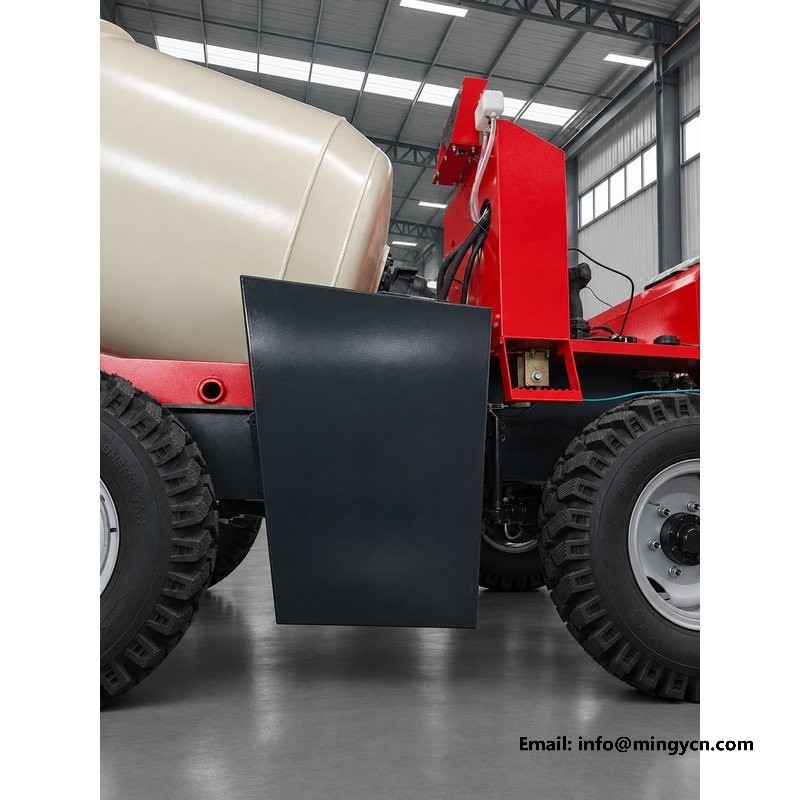
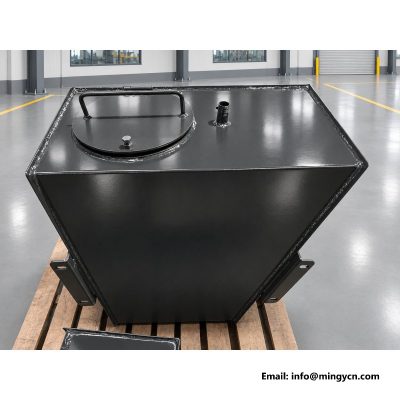
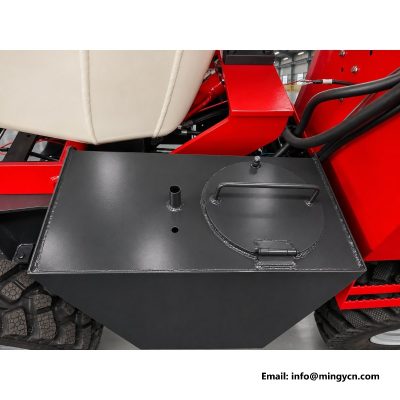
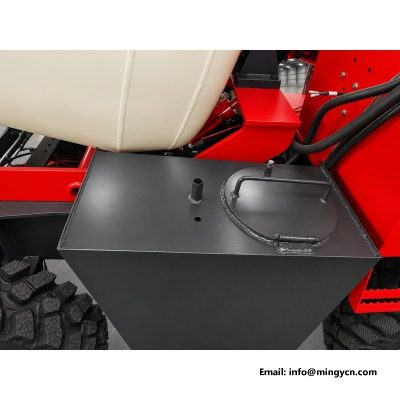
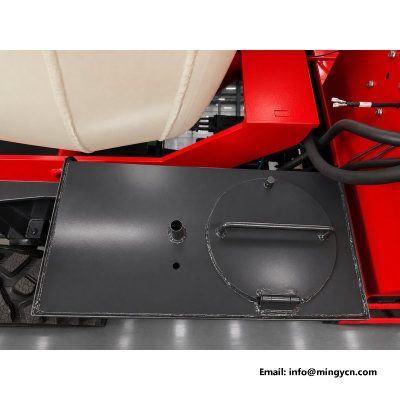
Two components in the side views help a buyer orient the whole machine. The red hydraulic cylinder belongs to the lift mechanism and is the part that raises the shovel through its arc; seeing it in the photograph tells you where the lift loads are fed into the frame and how much room the arms need to swing. The black water tank sits further back, and its position matters because the water is part of every batch and its weight shifts as the tank empties. Check the cylinder rod for scoring and the hoses for chafe where they pass the tyres, and look at the tank straps and filler for a secure mounting. Neither part is a wearing item you replace weekly, but both are worth naming on an inspection sheet so they are not overlooked at handover when attention goes to the drum and the engine.
Tyre checks belong at the start of the shift, before the drum turns, because a soft tyre on a loaded mixer changes the way the machine sits and steers. Check pressure when the tyres are cold, compare all four corners, and look for the cause rather than just topping up: a bead leak at the white rim, a cut between the lugs, or a stone driven into the tread. Read the wear pattern across the width, since wear on one shoulder usually points to pressure or a steering alignment issue rather than a faulty tyre. On hard road the deep lugs scrub down faster than they do on soil, so note the remaining depth before a long run. Keep the checks short and consistent, and record what you find so a slow loss is visible over a week instead of arriving as a flat on a pour.
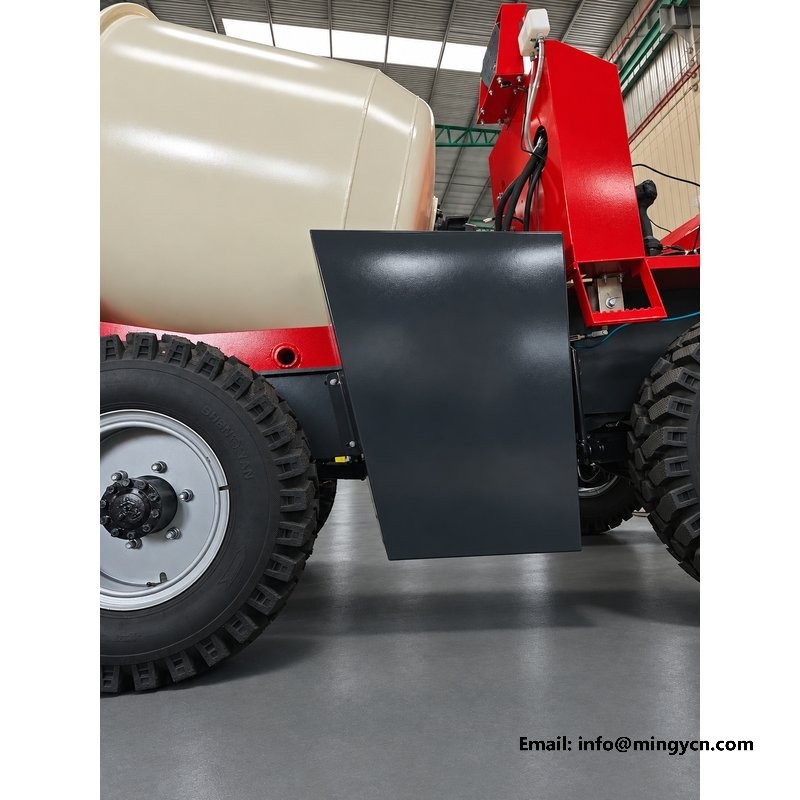
Hydraulic power steering is fitted because a single-cylinder diesel of 25 hp spends most of its working life at low engine speed, exactly where a heavy, loaded machine is hardest to turn by hand. At idle, inching up to a stockpile or lining up with a footing, the assistance should let the driver turn the wheel with one hand and still feel the ground through it. Check for a steady effort in both directions, no dead spot near straight ahead, and no judder or noise when the wheel is held at full lock. Look over the hoses and connections for dampness or a weep, and watch the fluid level as part of the same walkaround. Heavy steering that appears after a few hours of work is usually a supply or air problem, not a worn wheel, so investigate before ordering parts.
Because the front and rear axles both take 750-16 tyres, one spare covers every position on the machine, which simplifies what a remote site has to keep in stock. Fit the replacement with the tread direction matching the other wheels, seat the bead cleanly on the white rim and check the hub faces for rust or burrs before the wheel is tightened. A puncture on a pour is expensive mostly because the batch already in the drum does not wait, so a spare wheel already mounted is worth more than a repair kit in a box. Record the size, the wear depth and the date fitted for each corner when a tyre is changed. Rotate between axles only if the wear pattern justifies it, and recheck the steering afterwards, since a different rolling radius at one end changes the feel.
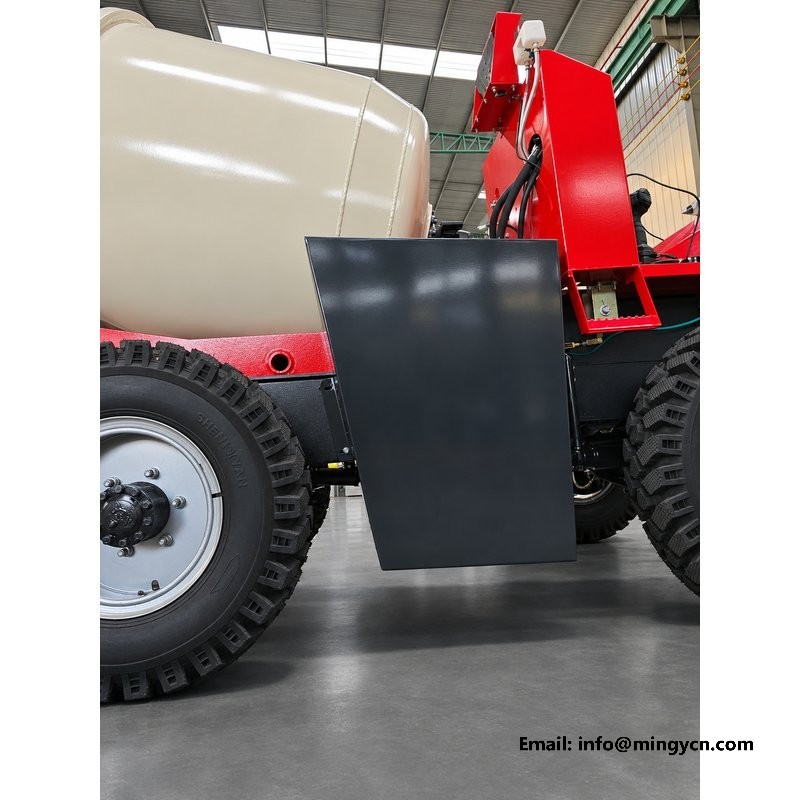
The front axle is listed as an Isuzu-type reinforced unit, and it is the one that takes the digging shock from the shovel as well as the weight of a raised, loaded scoop. On the walkaround, look at the housing and the hub faces for cracks, oil weeps or a bent flange, and check that the mounting to the frame is sound, since a housing that moves will show up as uneven tyre wear and vague steering. The reinforcement is there for the repeated impact of loading, not for carrying a bigger batch than the rated load allows. Confirm the axle designation against the technical file at handover, and ask how the seals and hub bearings are serviced. An axle that is quiet and dry at the end of a season is the result of these small checks, not of a part number.
| 1.5 m³ self loading concrete mixer — tyres, axles, 4WD traction, steering, soft ground | |
|---|---|
| Model | 1.5 m³ 4WD self loading concrete mixer |
| Front / rear tyres | 750-16 / 750-16 |
| Minimum ground clearance | 204 mm |
| Steering angle | 28° |
| Front axle | Isuzu-type reinforced front axle |
| Rear axle | 130 four-wheel steering axle |
| Steering | Hydraulic power steering |
Turning circle and gearbox descriptions follow the supplied data sheet; final definitions should be confirmed in the technical file before order.
Yes, the data sheet lists 750-16 tyres on both the front and the rear axles, which is worth planning around. One spare covers every wheel position, and tyres can be rotated between axles if wear is uneven. In the side photographs you can see the same deep lug pattern and the same white rim at both ends. Confirm the size is moulded on the sidewalls at handover, because a mixed set changes the way four-wheel drive shares traction.
The front axle is the reinforced Isuzu-type unit and the rear is listed as a 130 four-wheel steering axle, with drive going to all four wheels. When the rear wheels steer as well as the front ones, the machine rotates into a turn instead of being pushed around it, and the driven wheels keep pulling where the ground is soft. That is what the stated 28 degree steering angle and the tight turning circle are for. Check the steering linkages for play during the walkaround.
Walk the machine before the first batch and look at pressure, cuts between the lugs, stones lodged in the tread, sidewall damage and the bead where the tyre meets the white rim. Uneven wear across the tread usually points to pressure or a steering alignment problem rather than a bad tyre. On hard road the deep lugs wear faster than they do on soil, so note the depth before a long run. Keep a spare 750-16 on site, since a rural pour rarely stops for a puncture.
For the current 1.5 m³ self loading concrete mixer specification, engine options and a formal quotation for your market, contact MINGYI Machinery. E-mail: sales@mingycn.com | LINE (ID): mingyicn
Wheeled Diesel Self-Loading Mixer: Tyres and Traction · Rough Terrain Concrete Mixer: 4WD and 204 mm Clearance · 4WD Self Loading Concrete Mixer: 130 Axle, 212 Steering · Tyres, Tubes and Rims: Fitting 7.50-16 and 8.25-16 Wheels
More in the 1.5 m³ series: 1.5m3 Mixer Dimensions: 3500 mm Body, 2464 mm Turning Circle · 1.5 m3 Self Loading Concrete Mixer: Full Specification and Walkaround · 1.5m3 Self Loading Mixer Water Tank: Filler, Capacity and Mounting