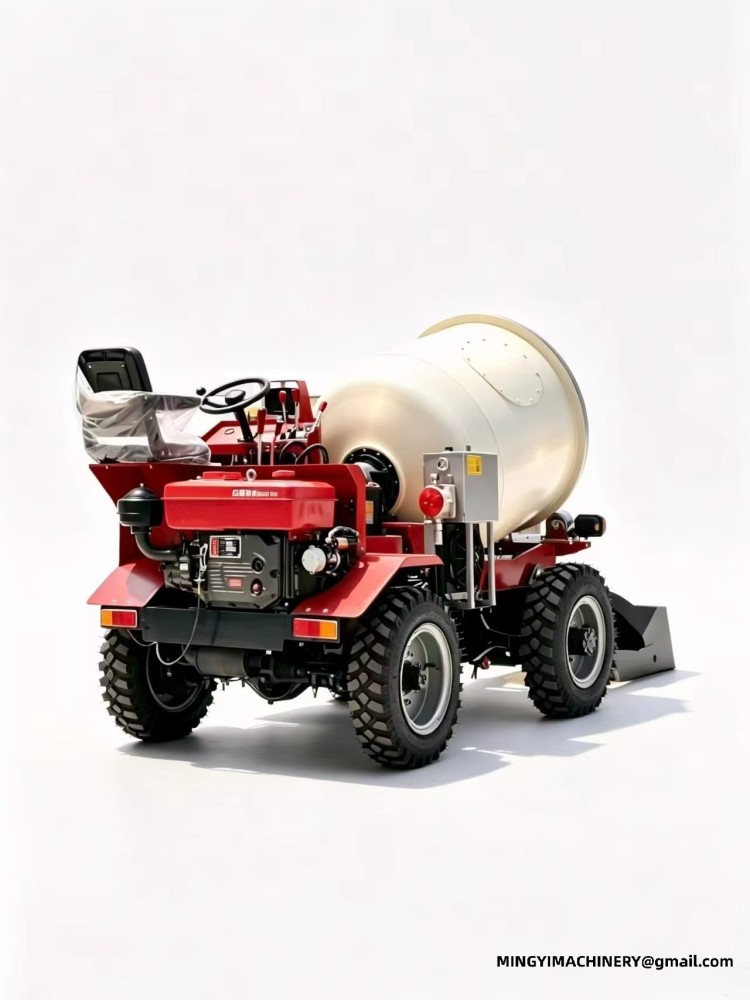
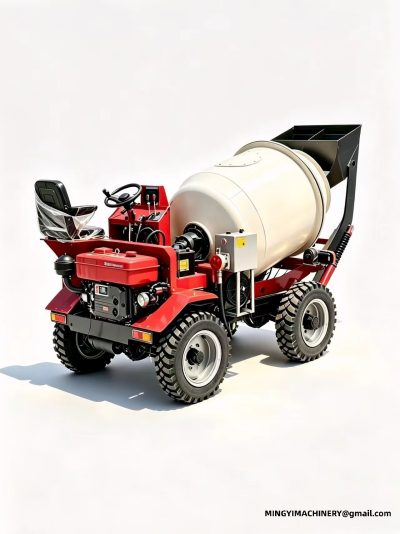
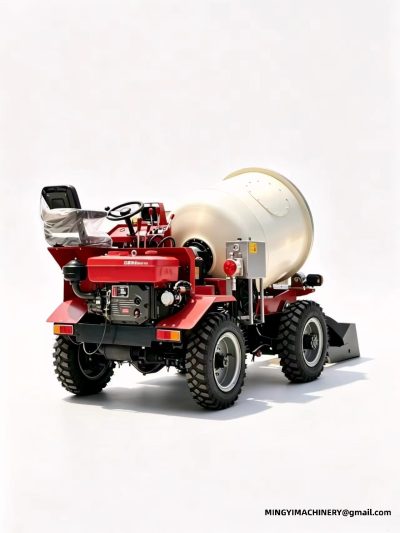
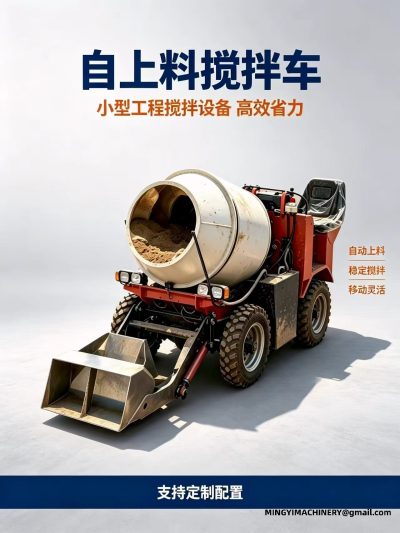
Every figure on the wheeled diesel self loading concrete mixer table earns its keep somewhere specific. The 0.8 m³ drum matters at the formwork; the 8.25-16 tyres matter halfway across a wet site; the 25 hp single-cylinder diesel matters at the fuel bowser and at the mechanic who knows it by heart. This page connects each published number to the moment on village projects a crew actually feels it.
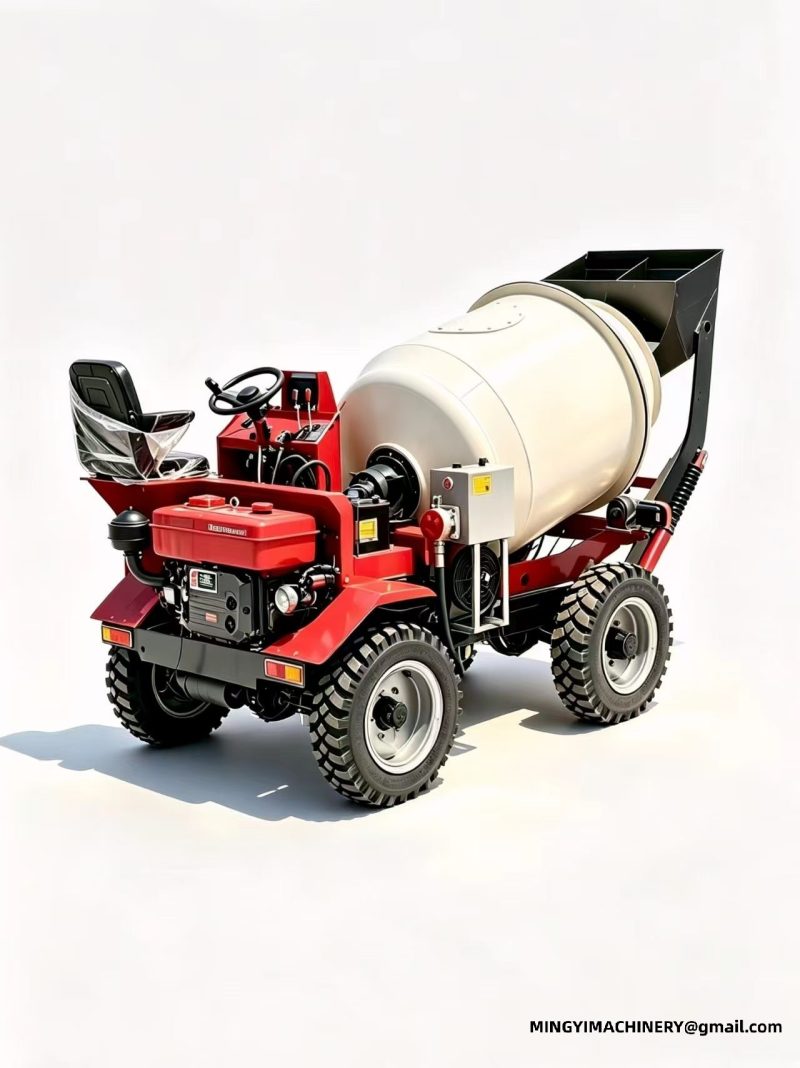
Engine oil and fuel, air restriction, hydraulic level, drum cleanliness, tyres and wheel nuts, lights and mirrors. That walk-round takes five minutes and catches nearly everything that becomes lengthy when missed.
Give the walk-round a fixed order and it becomes muscle memory — same start point, same direction, same finish at the drum. Crews that improvise the order skip items; crews that keep the order on village projects catch everything, every day.
A transit mixer delivers volume from a plant; this machine delivers independence from a plant. For large continuous pours the transit wins outright. For small pours beyond the plant's radius — on village projects where one machine serves several crews — the transit's minimum charges and queue time make it the dearer option.
Sizing honestly is the service a good supplier performs. Recommending this machine into pump-scale work, or plant-scale work into a village lane, fails the customer in opposite directions.
3,500 x 1,600 x 2,200 mm is the whole machine: short enough for a site trailer, narrow enough for a garden gate, low enough for a container without a top-loader's paperwork. Every one of those three numbers earns its place somewhere on village projects.
Inside a container, the machine anchors to the floor at four points and the shovel secures against a hardwood block — the shipping agent's standard practice, and worth confirming in the packing photos before the container doors close on village projects.
| Published build data — 0.8 m³ 4WD self-loading concrete mixer | |
|---|---|
| Rated load | 1,500 kg |
| Rated capacity | 0.8 m³ |
| Overall dimensions (L x W x H) | 3,500 x 1,600 x 2,200 mm |
| Front tyre size | 8.25-16 |
| Rear tyre size | 7.50-16 |
| Minimum ground clearance | 204 mm |
| Steering angle | 28° |
| Turning dimension (outer tyre) | 2,464 mm |
| Maximum travel speed | 24 km/h |
| Transmission | 4WD |
| Gears | 3 forward / 1 reverse + travel gear |
| Front axle | 130 drive axle |
| Rear axle | 212 selectable 4WD steering axle |
| Engine | single-cylinder diesel / 25 hp |
| Steering | hydraulic power steering |
Inside the drum, rotation does the mixing; reversed rotation with the drum tipped does the discharging. The geometry is old and proven, and on a machine with hydraulic control the operator sets drum angle and speed from the seat without leaving the cab position.
The failure mode is improvisation — an extra scoop here, a splash of water there. Batches of small structural and paving concrete mixed by eye vary, and the variation shows up as strength scatter in the finished work. A written recipe taped beside the controls takes nothing and fixes most of it.
The break-even between owning and hiring is the number of batch-days, not the specification tag. A contractor with steady small-pour work crosses it in weeks; a contractor with one trench a month never does. The machine suits the first profile and politely declines the second.
Buy a used one with the same eye: a drum true to its blades, axles dry at the seals, and hours that match the story. The three tells predict the next season's takes better than any salesman's.
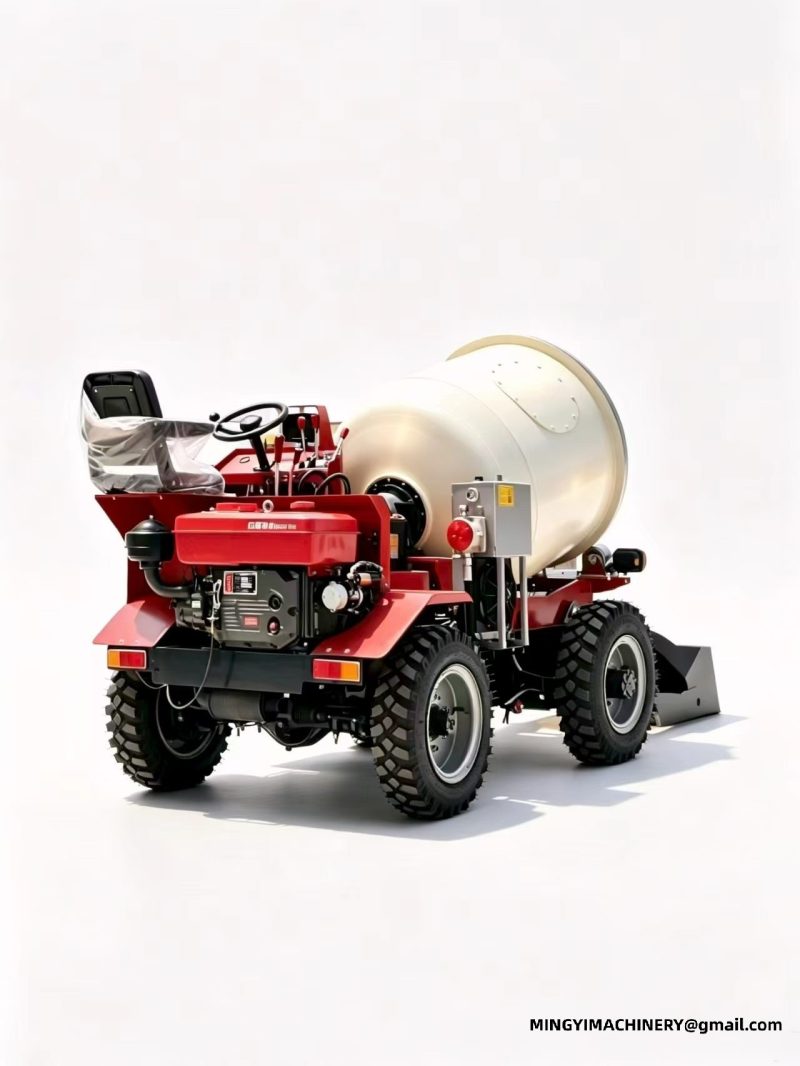
204 mm of clearance under the axles is the machine's ground rule. It clears ruts, rubble and standing water of that depth, and it does not clear more. The low build is what keeps the centre of gravity down under a raised drum, so the number is a design trade, not a deficiency.
Pressure discipline matters on soft ground. Tyres run too hard cut into wet surfaces and lose the footprint that floats the machine; run at correct pressure, the four contact patches plus 1,500 kg of payload stay within what most prepared sites bear.
The machine will reproduce whatever recipe it is given, faithfully and all day. That is its quality promise and its quality risk: a correct recipe repeated gives uniform strength, and a careless one repeated gives uniform trouble.
Cement count, aggregate count, water measure, drum time — four numbers per mix design, and every crew member should be able to recite them. The machine's repeatability turns those four numbers into strength rather than into hope.
The operator profile is one person, but the people around the machine change by the hour. The mixer serves a foundation crew, a masonry crew and a patching gang in sequence, each with the recipe it needs and the standing spot it wants. The single seat is the reason the machine suits small contractors who cannot spare a second hand.
The crew's skill matters more than its size. A crew that learns the recipe, the cycle and the wash-out keeps the machine busy; a crew that improvises keeps it stopped. The machine amplifies either habit.
The drum is recipe-agnostic: lean foundation mixes, richer masonry mixes, and paving batches all turn the same way and discharge the same way. The machine's contribution is uniformity, not chemistry — the recipe is the engineer's, the repetition is the drum's.
The machine's natural work is the small structural pour — bases, posts, beams, ties — and the non-structural one beside it: paths, kerbs, patching, linings. Both consume 0.8 m³ per batch in quantities the drum and the crew handle naturally.
The front tyres are 8.25-16 and carry the drive under a full drum; the rears are 7.50-16 and steer. The heavier front fitment matches the heavier front duty — drive torque plus a loaded drum sitting between the axles.
Tyres read like a logbook. Shoulder wear from kerb-cutting turns, centre wear from over-pressure, chunking from rock and rubble — each pattern names its cause. A five-minute look at the tread on village projects tells the operator more about the week's routes than any complaint from the crew.
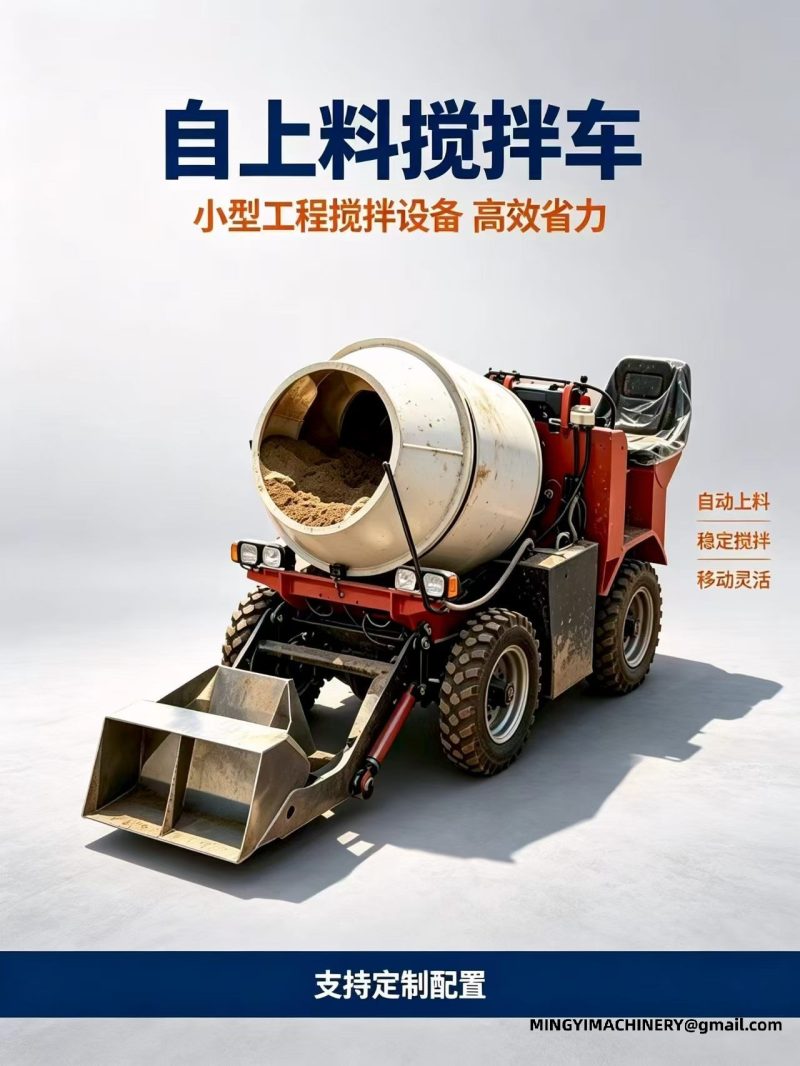
Drive goes to all four wheels — four-wheel drive through a 130 front drive axle, with the 212 rear axle selectable for four-wheel-drive steering. On firm ground two driven wheels would do, but site concrete rarely sits on firm ground. Wet spoil, sand, loose fill and grass all reward traction at every corner, which is what the 4WD transmission buys.
The front axle is a 130 drive axle; the rear is a 212 axle that steers and can be selected into four-wheel drive. The split is deliberate: the front pulls the loaded machine, the rear steers it through a 28° angle and adds drive when the surface turns soft.
A specification is a contract before it is a sales document, and this one is short enough to read in a minute. The first cluster — 0.8 m³ capacity, 1,500 kg rated load, the 3,500 x 1,600 x 2,200 mm envelope — describes what a batch is and where the machine can stand. The second — 4WD, the 130 and 212 axles, 204 mm clearance — describes whether it can reach the pour.
Bore, stroke and emission figures matter less than the parts supply behind them. Ask the supplier for the engine's own reference numbers, not just the mixer's, and the first filter change becomes a two-minute order rather than a search.
Self-loading is the whole idea. A front shovel scoops aggregate and sand from a stockpile, lifts it over the drum, and releases it — no separate loader, no second machine, no third pair of hands. One operator runs the entire chain from pile to pour.
On sites that move the pile daily, a plate or a spreader keeps the loading face flat, and the shovel thanks you for it. Flat faces give full scoops; full scoops give predictable batches and a drum that reaches 0.8 m³ without a second bite.
What axles does the wheeled diesel self loading concrete mixer run?
A 130 drive axle at the front and a 212 rear axle that steers and can be selected into four-wheel drive. The front pulls the load; the rear steers through a 28° angle.
How do you clean the wheeled diesel self loading concrete mixer drum?
Rinse and spin the drum with clean water after the last pour of the day, dump the wash-out away from the stockpile, and leave the blades clean. A drum washed daily keeps its full 0.8 m³.
Is the wheeled diesel self loading concrete mixer suitable for farm work?
Very much — post holes, shed bases, paths and small structures on village projects are exactly the small, distant batches the machine was drawn for.
What ground can the wheeled diesel self loading concrete mixer cross?
Prepared site ground, gravel, compacted fill and firm grass, at 204 mm of clearance with agricultural tyres and 4WD. Deep mud and boulder fields are the honest limits.
How long does a wheeled diesel self loading concrete mixer last?
With the daily wash-out kept and greasing on schedule, the chassis and drum outlast several sets of consumables, and the single-cylinder engine overhauls on parts stocked in most agricultural towns.
How many batches an hour can a wheeled diesel self loading concrete mixer do?
Whatever the cycle allows: load, mix, travel, discharge, return. Short hauls keep the drum busy; long carries make travel the constraint. Plan pours around the cycle, not the clock.
Can the wheeled diesel self loading concrete mixer use site sand and gravel straight from the ground?
From a clean stockpile on hardened standing, yes. Straight from contaminated ground, no — soil in the mix is the classic cause of weak site concrete.
Can a wheeled diesel self loading concrete mixer supply a full slab pour?
Only small slabs, and only with the pour broken into bays that match the drum's rhythm. Continuous large pours outrun 0.8 m³ per batch and belong to plant supply.
The figures above answer the questions buyers ask most; the daily habits answer the rest. Between them, they describe a machine that is deliberately simple and deliberately durable.
Packing, loading and shipment of Wheeled Diesel Self-Loading Mixer: Tyres and Traction
The paperwork matters as much as the packing. Serial numbers, dimensions and weights recorded for Wheeled Diesel Self-Loading Mixer: Tyres and Traction at loading are the same figures the destination needs, and a mismatch here loses more days than the voyage itself.
Planning the season around Wheeled Diesel Self-Loading Mixer: Tyres and Traction
Downtime is simplest when it is planned. Booking the service for Wheeled Diesel Self-Loading Mixer: Tyres and Traction in the quiet part of the season takes nothing from the schedule, while the same work in the busy weeks gives up a day of output every time.
Pre-delivery inspection before Wheeled Diesel Self-Loading Mixer: Tyres and Traction leaves the shop
What the customer sees on arrival is decided before departure. The walk-around given to Wheeled Diesel Self-Loading Mixer: Tyres and Traction covers the same points the operator will check on day one, so there are no surprises when the crate is opened at the destination.
Later additions and retrofits on Wheeled Diesel Self-Loading Mixer: Tyres and Traction
Most additions are easier to plan than to add. Hydraulic services, mounting brackets and electrical capacity on Wheeled Diesel Self-Loading Mixer: Tyres and Traction are build items, and deciding them at the specification stage is far easier than doing it later.
Storage and long idle periods for Wheeled Diesel Self-Loading Mixer: Tyres and Traction
The battery and the fuel are the first things to suffer in storage. Preparing Wheeled Diesel Self-Loading Mixer: Tyres and Traction properly at the start of the idle period avoids the flat battery and the contaminated tank that greet an unprepared machine.
Contact MINGYI Machinery for the current self-loading concrete mixer specification, export packing and a formal specification for your market. E-mail: sales@mingycn.com | LINE (ID): mingyicn
Self Loading Concrete Mixer Truck: From Pile to Pour · Large Self-Loading Mixer Batches: What 0.8 m³ Delivers · high ground clearance dumper for mining and quarry work · Mini Self-Loading Concrete Mixer









