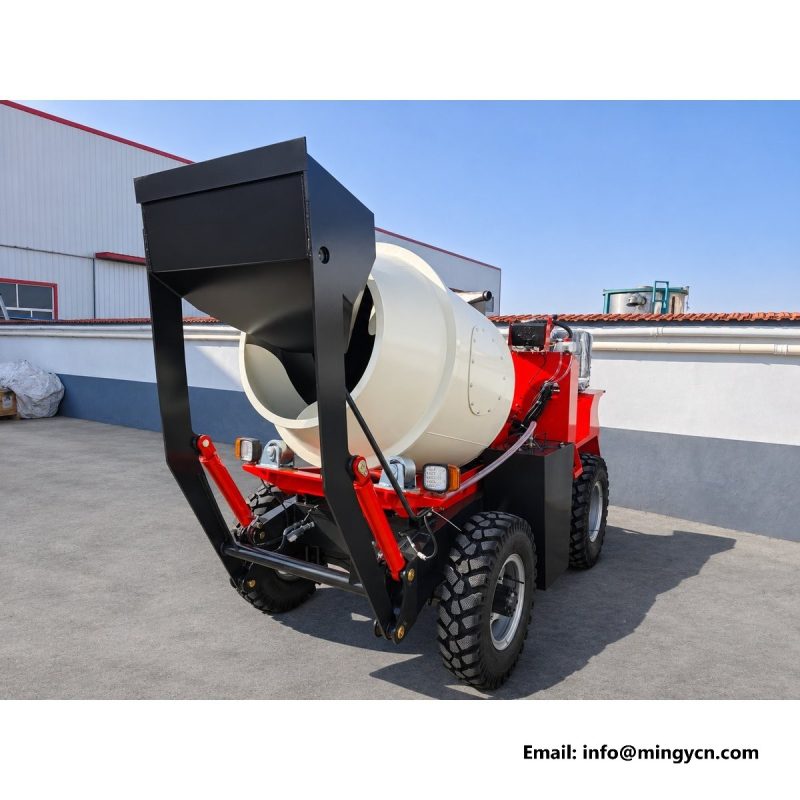

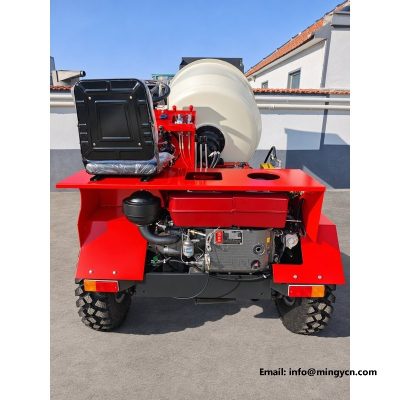
final walkaround: remaining angles
Every gallery has angles that never get published, usually because they are awkward to light or because they show the parts nobody was asked about. The final two frames close that gap. They are not the most attractive views of the machine, but they are the ones that confirm whether the impression built up by the earlier pages holds from the last remaining directions. This page explains what those angles add, how to read them alongside the rest of the set, and how a remote buyer can ask for a specific missing view without accepting a substitute that happened to be easier to shoot.
| Specification | 1.5 m³ self loading mixer |
|---|---|
| Operating weight | 1,900 kg |
| Overall dimensions (L x W x H) | 3,500 x 1,600 x 2,200 mm |
| Maximum travel speed | 24 km/h |
Most galleries stop when the flattering angles are covered, and that is exactly where a remote buyer begins to lose confidence. The last two frames exist to close the circle: one from behind and one from above the front, so that every face of the machine has been recorded at least once. Neither is likely to be used in a brochure. Both are the kind of view an inspector takes without thinking, because they show the parts that a three-quarter shot keeps out of sight. Read them last, with the earlier pages in mind, and ask whether the machine they show is the same machine described everywhere else. That comparison is the real purpose of a walkaround. A buyer who has followed the set from the front will find that the last views answer questions the first ones raised.
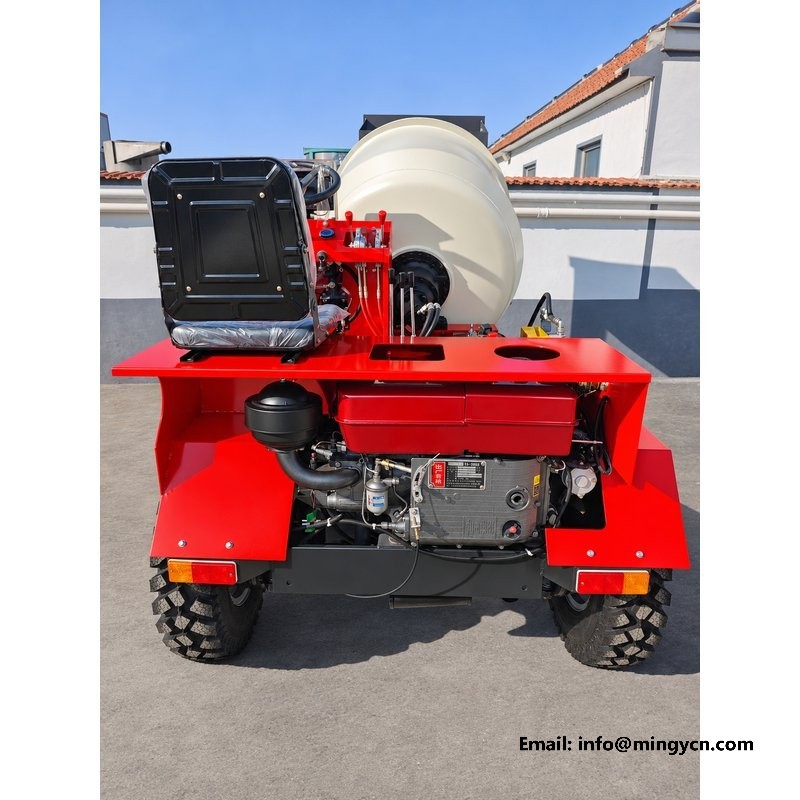
The rear of a self loading mixer is where the discharge end, the drum drive and the rear steering axle meet, and it is the side most often left out of a gallery. From this angle you can see whether the drum sits square between the rails, whether the rear axle is centred, and how the discharge arrangement is fixed. Look at the lights and the rear frame: a machine that works on a public road needs them protected rather than hanging off a bracket. Look at the paint behind the drum, where slurry collects and holds moisture against the steel. A rear frame that is clean and dry, with the axle visible and the plumbing clipped, tells you the machine has been finished rather than simply assembled.
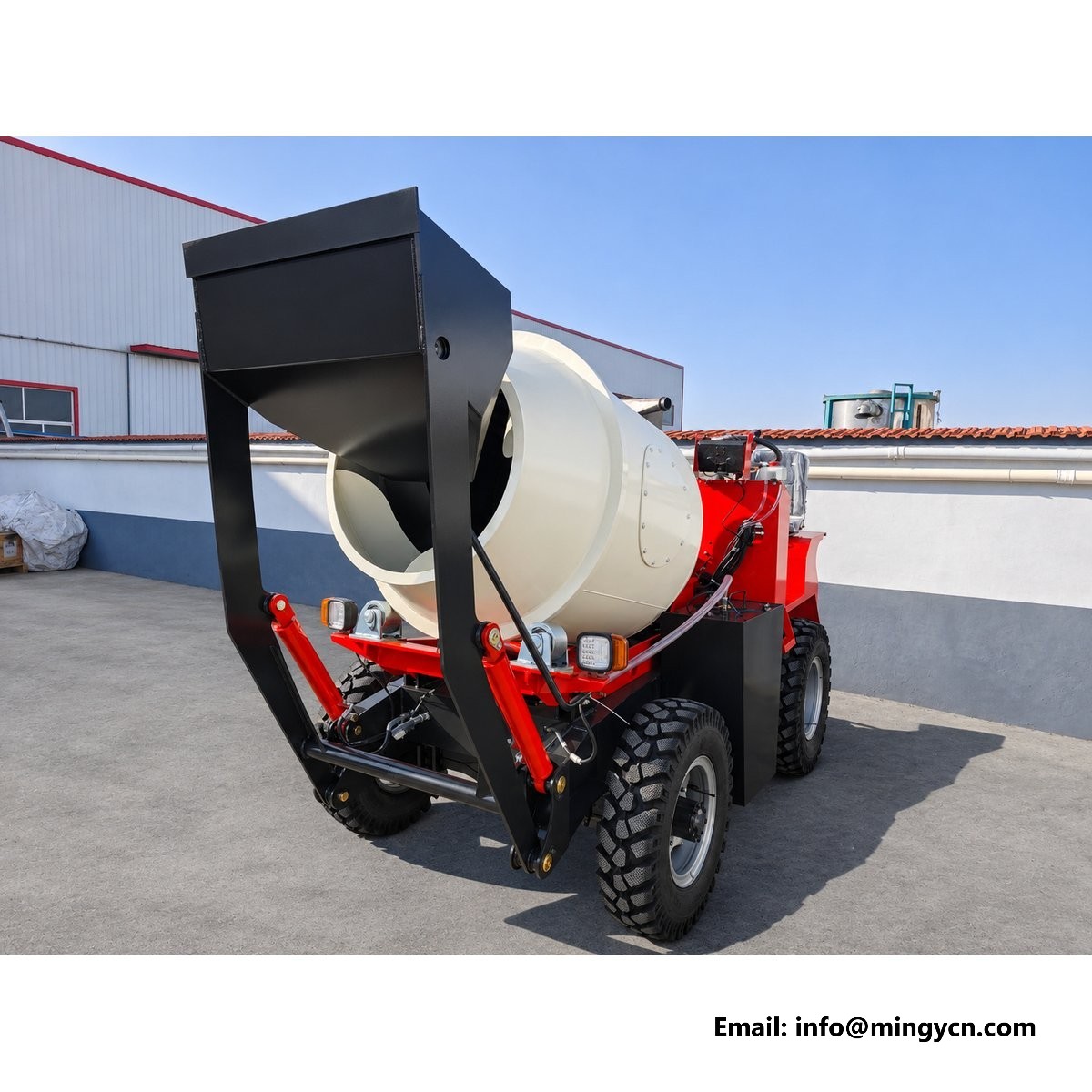
Seen from slightly above and in front, the machine shows its working layout: the hopper, the mouth of the drum, the engine bay and the route the operator takes to the seat. This is the angle that answers questions about access. Can a bag be lifted to the mouth without a ladder. Is the engine bay closed against dust. Does the hopper sit ahead of the front axle or over it. The answers are visible in the relationships rather than in any single feature. A high front frame also shows how the arm folds when fully lowered, and whether it sits within the width of the machine. An arm that stands proud of the tyres is an arm that will find every gatepost on a narrow site.
What a buyer is really judging at the end of a walkaround is coherence. A machine built as a single design has consistent hardware: the same bolt grade in similar joints, hoses of the same family, clamps at regular intervals, and paint applied over the same preparation everywhere. A machine assembled from parts has a mixture that is hard to describe and easy to see. Look along the frame for a bracket added after painting, a hose that takes an odd route to avoid a component, or a guard cut to clear something that should have been designed around. Each of those is a small compromise, and small compromises accumulate into the sort of machine that needs attention every month.
Operating weight is an abstract figure until it is seen standing on its tyres. At 1,900 kg this machine should sit with its wheels loaded evenly, the sidewalls bulging by the same amount on both sides, and the frame line level from front to rear. Look at the contact patch on flat ground: it should be a straight band, not a curve that shows the tyre is over-inflated for the load or under-inflated for the work. Look, too, at whether the machine sits level across both axles. A machine that leans on delivery has either been loaded badly, carries a damaged mount, or was built on a jig that was not square. Photograph it on level concrete before accepting it.
A buyer who cannot visit the yard needs a sequence rather than a gallery. Ask for a video walkaround that starts at the front left, moves clockwise at a steady pace, and pauses at each tyre, each fitting group and the drum mouth while the camera holds still for a few seconds. A continuous take is far more convincing than eight separate photographs, because nothing can be quietly swapped between frames. Ask for the serial plate to be shown at the start and again at the end. Then compare the video with the still set. If the stills are older, the comparison will show what has changed; if they were taken the same day, the light and the ground will match.
Requests for extra photographs work best when they are specific. Do not ask for more pictures of the machine; ask for one frame from the rear right, taken at the height of the drum centre, far enough back to include both tyres, in shade, with nothing cropped. Say what you want to see in it, such as the rear axle and the discharge end. A supplier who understands the purpose will take the frame properly; one who does not will send a snapshot from a phone at an angle that answers nothing. If a request is refused twice, that is information too. The cost of one extra frame is trivial, and a supplier who will not spend it is telling you how the after-sales conversation will go.
Photographs answer questions about condition, layout and finish. They do not answer questions about how a machine performs under load, how it has been maintained internally, or whether its paperwork matches its history. At some point a buyer has to decide where the photographs end and an inspection begins. For a machine at this value, a third-party inspection or a visit by someone trusted is cheap insurance, and it should happen before a deposit is paid rather than after. If neither is possible, write the conditions into the order: a video of the machine working under load, the serial number confirmed in writing, and a clear statement of what happens if the machine does not match the frames. That clause is worth more than any assurance given over the telephone.
Because they cover the surfaces that flattering angles hide. A rear view shows the axle, the discharge end and the paint behind the drum, where moisture collects. A high front view shows access to the mouth and how the arm sits when lowered. Neither is meant for a brochure. Both are the frames an inspector would take without thinking, and they are the ones that confirm whether the rest of the gallery is honest.
Ask for a continuous video walkaround plus the still set, and specify the route: front left, clockwise, pausing at each tyre, each fitting group and the drum mouth. Ask for the serial plate at the start and the end. That combination covers condition and identity. If the machine is expensive enough to warrant it, add a third-party inspection, and make the deposit conditional on the report matching what the frames show.
For the current specification, build options and a formal quotation for your market, contact MINGYI Machinery. E-mail: sales@mingycn.com | LINE (ID): mingyicn
1.5 m3 Self Loading Concrete Mixer: Full Specification and Walkaround · 1.5m3 Self Loading Mixer from Every Angle: A Yard Photo Reference · Loading Hopper and Lift Arm on the 1.5m3 Self Loading Mixer








