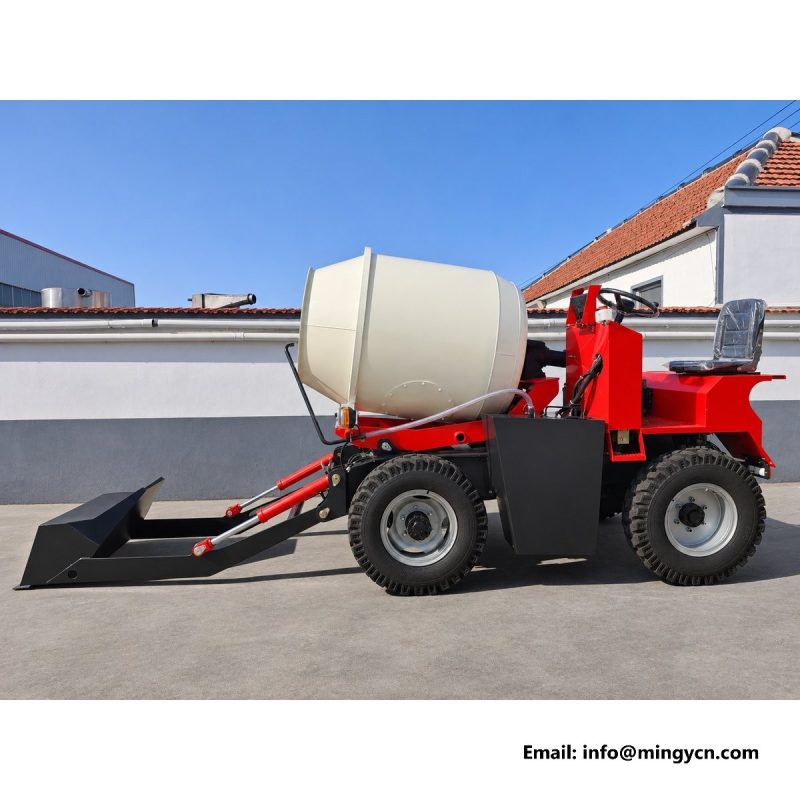

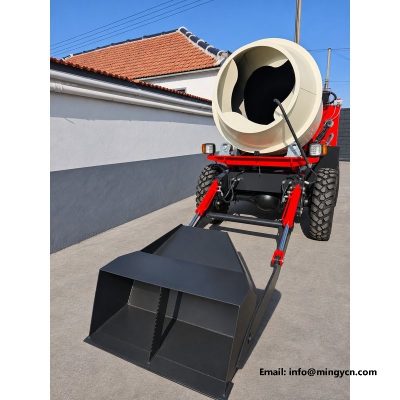
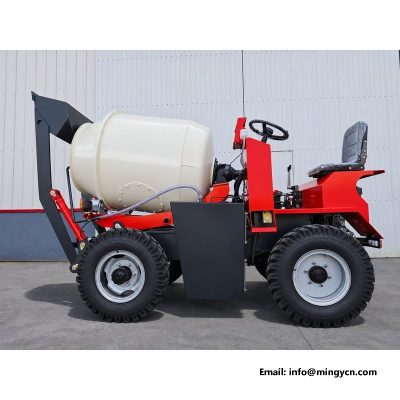
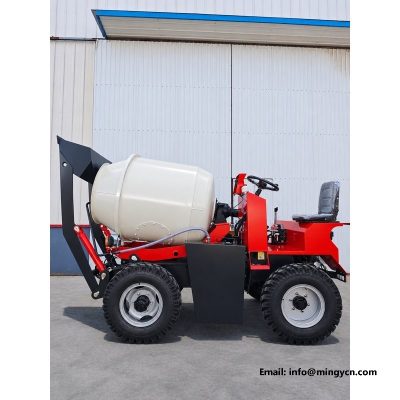
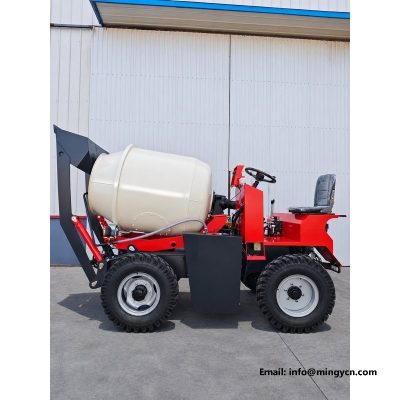
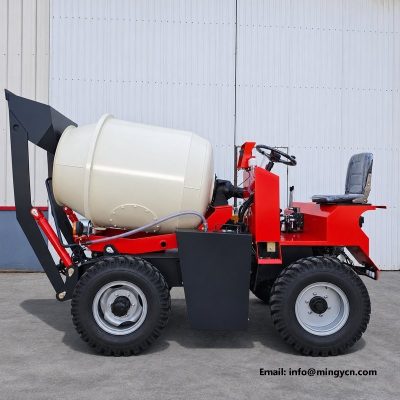
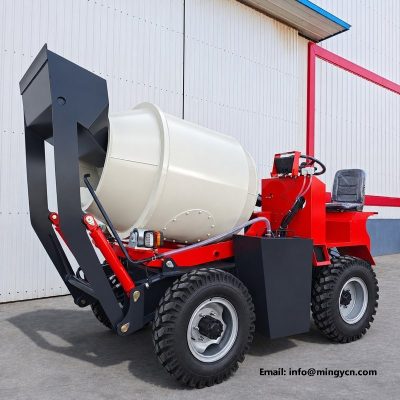
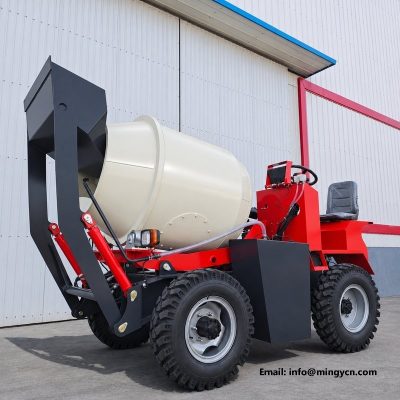
full lift: maximum hopper height and sight lines
Full lift is the position that sells machines in photographs and the one that deserves the most suspicion. At the top of the stroke the arm is extended, the cylinder is near its limit, and the load sits as far from the ground as the design allows. The frames here show that position with an empty bucket, which is the honest way to look at structure before adding mass. Read them for stability, for what the arm blocks in the operator's view, and for the stop that defines the end of travel. It is also the position most often photographed badly, from a low angle that hides the stop.
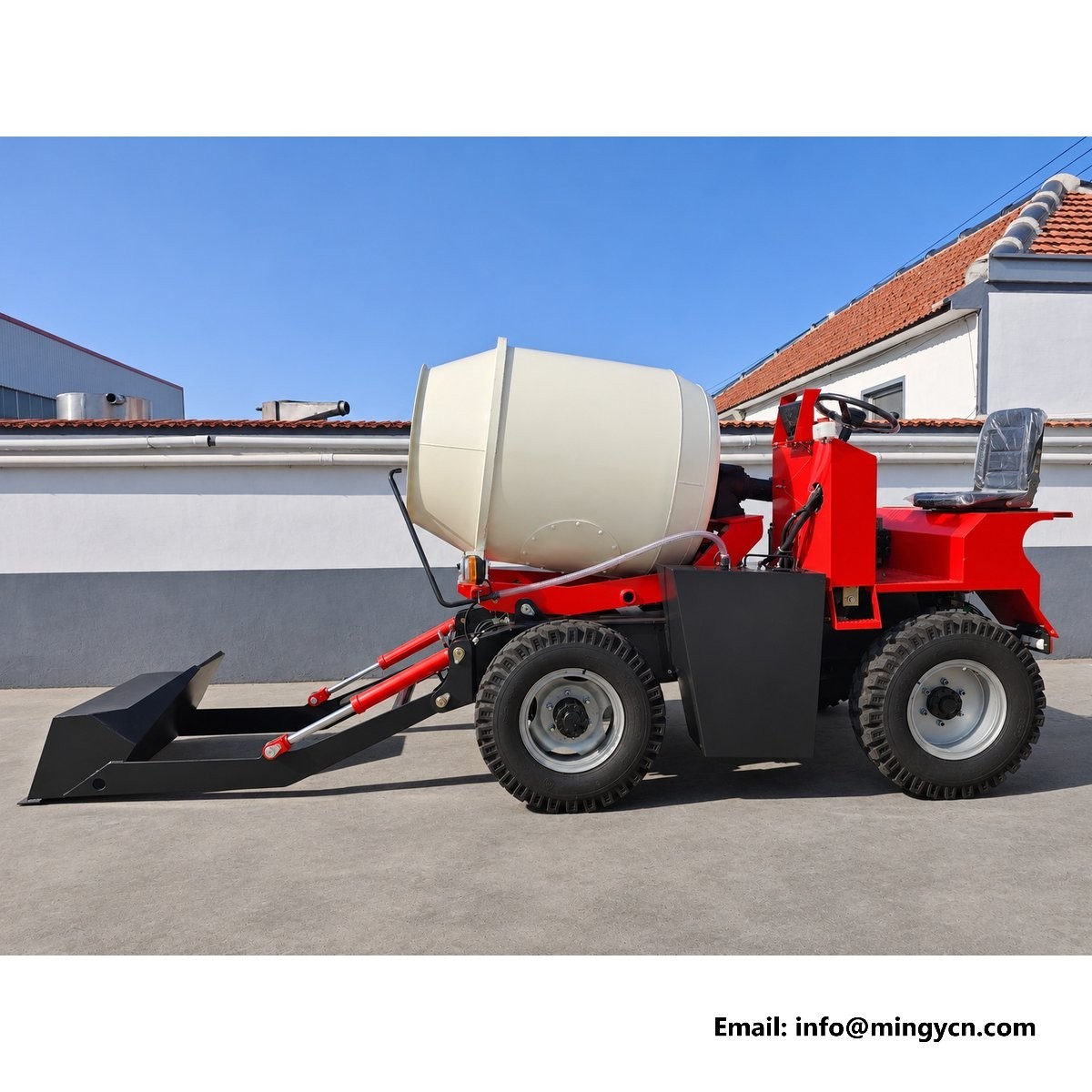
| Specification | 1.5 m³ self loading mixer |
|---|---|
| Rated load | 5,000 kg |
| Drum capacity | 1.5 m³ (1,500 L) |
| Overall dimensions (L x W x H) | 3,500 x 1,600 x 2,200 mm |
A photograph of the bucket at full height is usually taken to impress, but it is more useful as a test. At maximum lift the machine is at the limit of its geometry: the arm is fully extended, the cylinder is near the end of its stroke, and the load is as far from the ground as it will ever be. Everything that is marginal at rest becomes obvious here. In the frames on this page the arm is at the top of its travel with the bucket empty, which is the correct way to judge structure before adding a load. Read the machine as a stack of masses and ask which one has moved furthest from the centre. An empty bucket at full lift shows the structure; a full one shows the suspension, and they are different photographs.
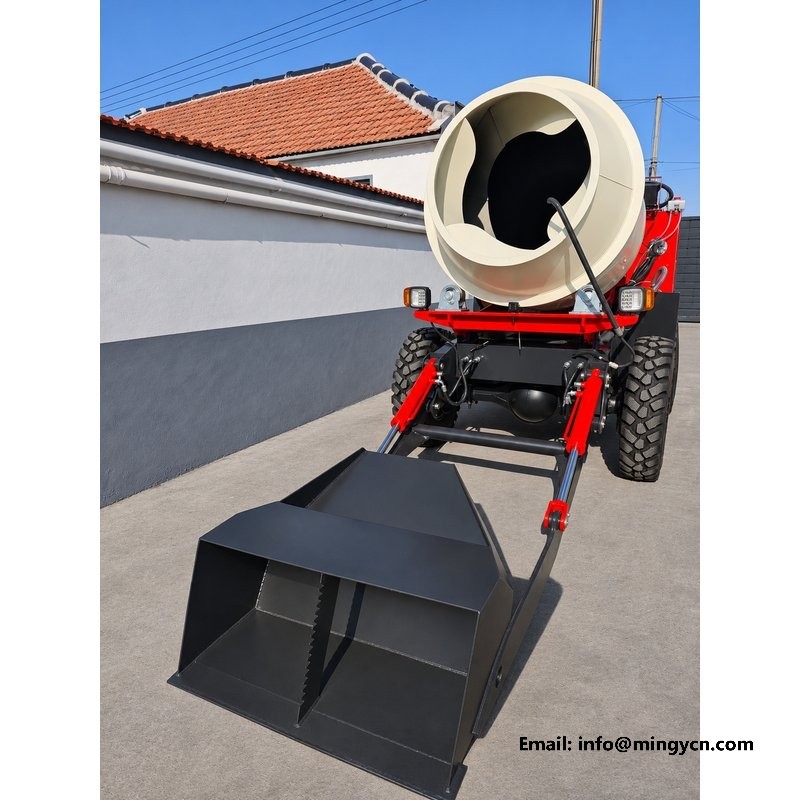
Raising a loaded bucket moves mass upward and forward at the same time, and both directions work against the machine. Upward raises the centre of gravity; forward moves it towards the front axle, which is already carrying the engine. The result is a machine that is stable at rest and less stable at height, especially on a slope or with a tyre partly deflated. In these frames the machine stands level with the arm raised, so the geometry can be read without the complication of a gradient. Photographs taken on a slope tell you less, because it becomes impossible to separate the effect of the arm from the effect of the ground. Watch the front tyres in a video of the lift, because sidewall deflection tells you where the mass has gone before the machine moves.
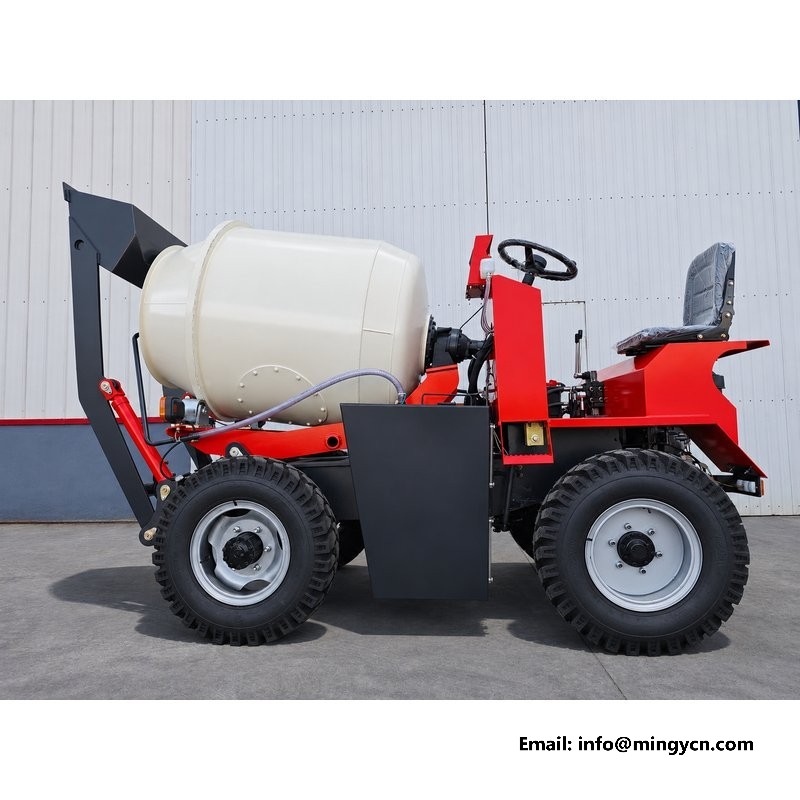
An operating weight of 1,900 kg is the counterweight in this argument. The machine resists the raised load with its own mass, and the further the load moves from the centre, the more of that mass is needed on the opposite side. That is why the engine, the fuel tank and the operator platform sit where they do, and why a machine with a light rear end feels nervous at full lift. In the photographs, look at how much of the machine sits behind the rear axle. That overhang is the lever that keeps the front down. A short rear overhang combined with a long arm calls for level ground. That overhang is also why a machine with a full drum feels different from one that is loaded at the front.
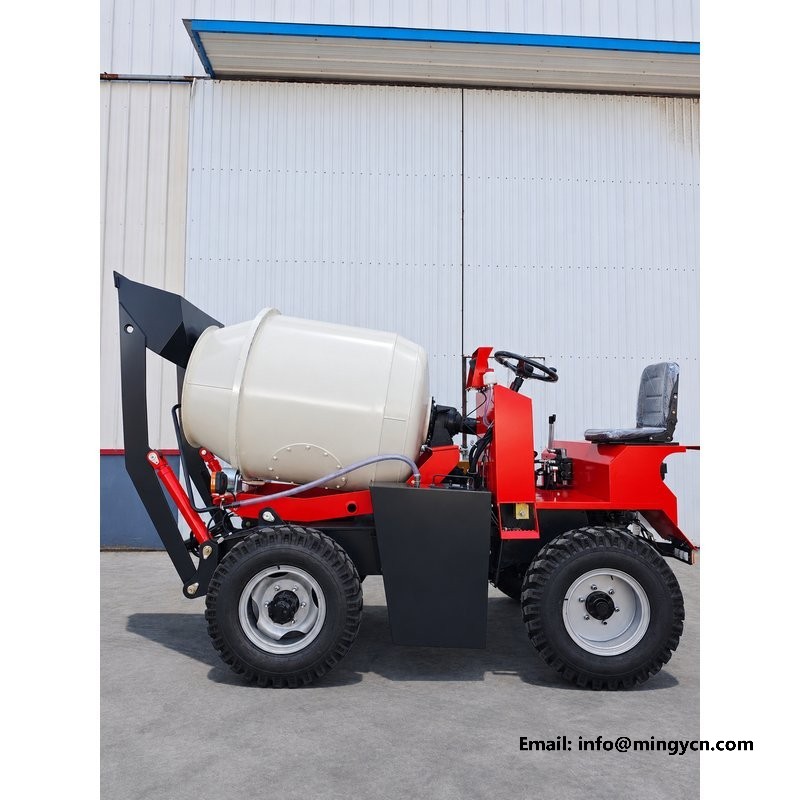
At full lift the bucket leaves the operator's forward view, and what replaces it is the underside of the arm and the cylinder. The useful sight line moves to the side of the arm, along the line where the bucket edge will reappear as it comes down. In the frames here the arm crosses the field of view at roughly the height of the horizon, which is exactly where an operator wants to see the stockpile. A machine with the arm set higher blocks more sky and less ground; one set lower blocks the working area. Sit in the seat if you can, and note what disappears before judging the layout from a photograph. Ask for a photograph from the seat at full lift. Very few suppliers publish one, and it is the view that decides the working method.
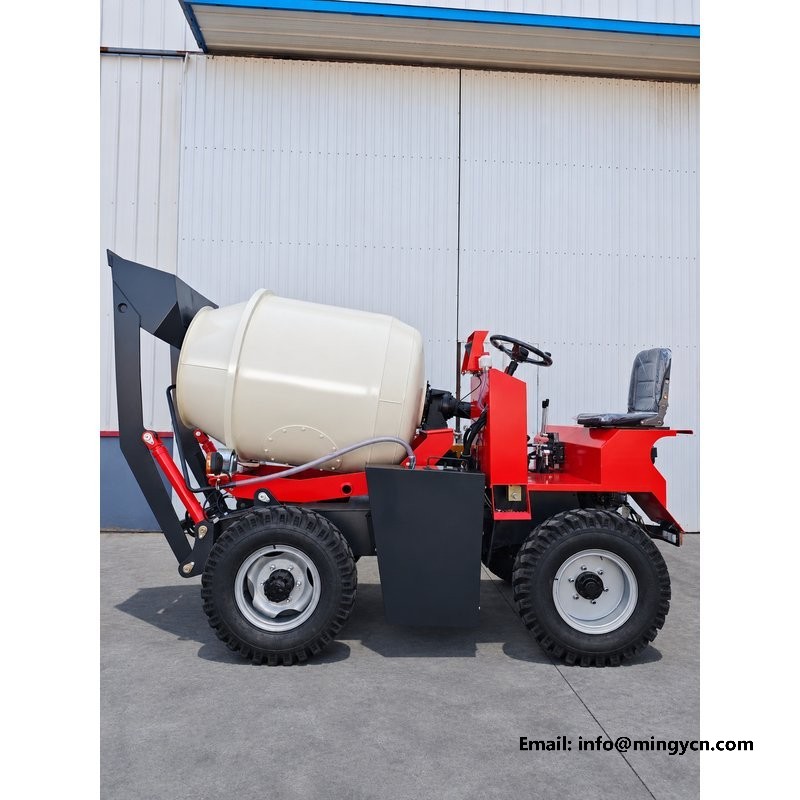
At height, the bucket is a sail. An empty bucket at full lift presents a large flat face to the wind, and a loaded bucket of dry material presents a surface that can be stripped by a gust. The machine itself is not at risk in ordinary conditions, but the load is: fines blow off the top of the bucket and land where they are not wanted, and the operator feels the arm load change as the wind presses on it. In these frames the bucket is empty, which is the condition in which wind effects are easiest to see and hardest to judge. On an exposed site, full lift belongs to the moment of transfer, not to travel. An empty bucket in wind is also the condition in which a raised arm can be pushed sideways with no load to steady it.
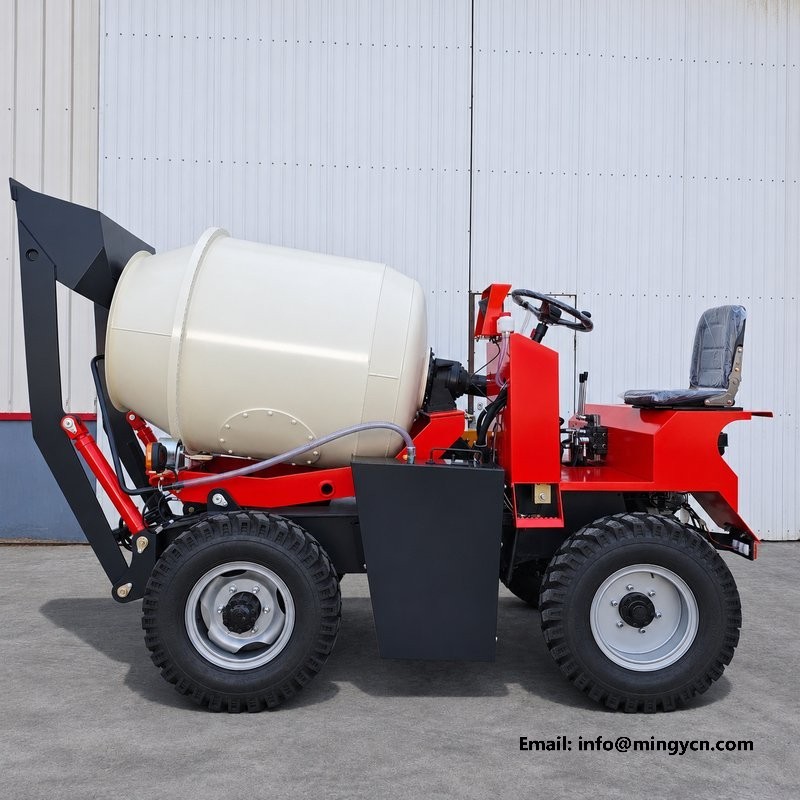
Every lift circuit needs a defined end, and there are two ways to provide it: a mechanical stop that the structure contacts, or a hydraulic relief that bypasses oil when pressure rises. A machine with only the second relies on the valve behaving correctly every time; a machine with the first has a positive limit that does not depend on a spring. In the photographs, look at the top of the arm travel for a pad or a lug that meets a stop on the frame. That contact point should be greased and should show a flat wear face rather than a battered corner. A hammered stop has been used as a brake. Ask whether the relief is set at the factory and whether it can be checked in the field without a gauge on the machine.
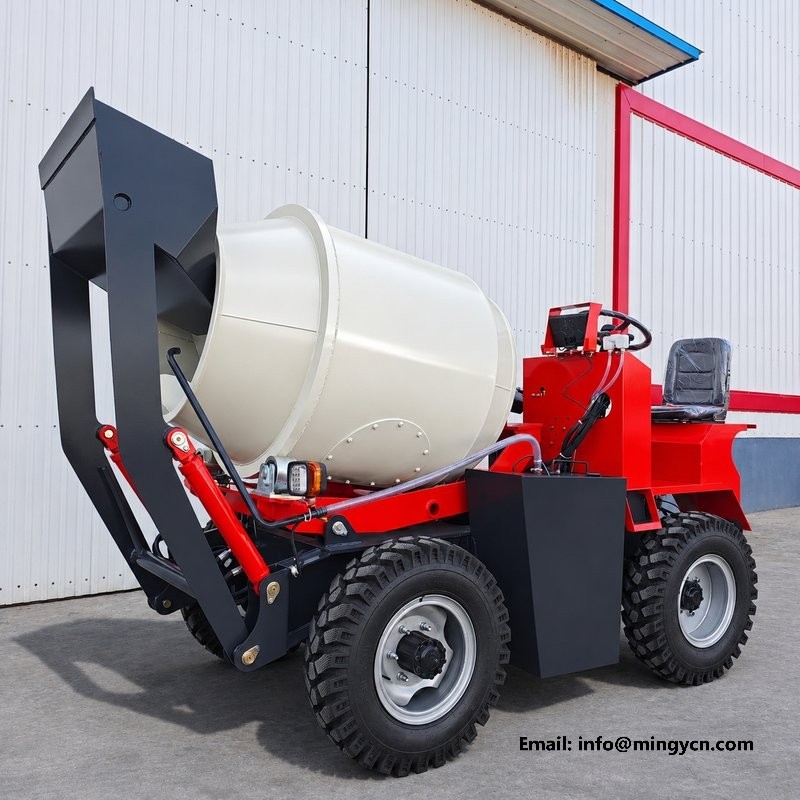
Coming down is not the reverse of going up. Gravity is helping, so the lever has to be moved gently and the descent metered rather than released. A bucket dropped from full height arrives with the whole machine behind it, and the shock goes into the tyres, the axle and the pivot in that order. In the frames here the arm is at the top, which is where a controlled descent starts: engine at working speed, lever eased back, bucket kept level. The operator should be watching the ground beside the machine rather than the bucket, because the bucket will arrive where the arm puts it and the ground is what changes. The last part of the descent is the part to slow down, because that is where the bucket meets the ground.
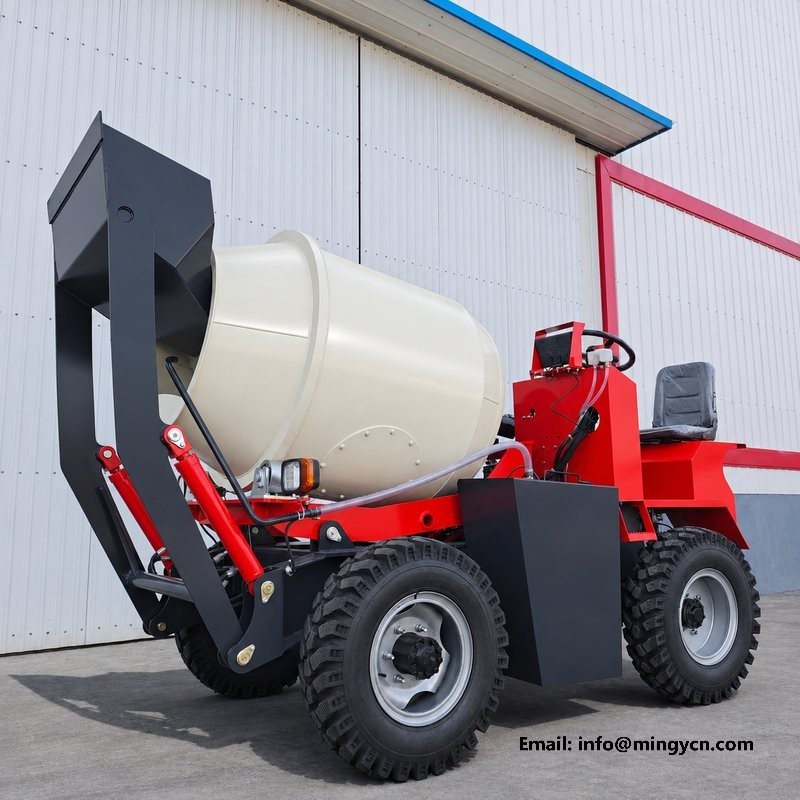
The tyres are the last part of the stability system, and at full lift they are working hardest. A 750-16 tyre at correct pressure has a footprint that spreads the load and a sidewall that resists roll; one that is soft lets the machine lean towards the load, which at height is the wrong direction. In these frames the tyres sit square with even sidewall deflection, and the ground beneath them is firm. On site, check the surface before raising: a soft patch under one front wheel is enough to put the machine at an angle the arm cannot compensate for. Full lift on firm level ground is a different operation from full lift on a building site. A tyre that looks soft at rest may be correct when warm, so check pressure cold and compare all of them.
Full lift is often needed where there is least room for error: beside a wall, under a roof edge, or near an overhead line. The machine's height with the arm down tells you nothing about its height with the arm up, and the difference is large. Before raising, look up and look sideways, and treat the arm's full envelope as a solid volume rather than a line. In the frames here the machine is in the open, which is the right place to learn what that envelope looks like. The photograph is a reference for the shape you are moving; the site is where you decide whether there is room for it. Anything overhead deserves a second look before the lever moves, whatever the drawing says.
Full lift is a transfer position, not a working position. It should be held for the seconds it takes to empty the bucket and then left. Carrying a raised bucket across a yard, holding it up while the machine turns, or parking with the arm at the top all put the machine in its least stable configuration for no benefit. In the frames here the arm is up because the photograph needed it up, and the bucket is empty for the same reason. That is an honest use of the position. A buyer should ask how long a normal cycle holds a load at height, because the answer describes the duty the structure was built for. A structure asked to hold a load at height for a few seconds a cycle will last longer than one asked to carry it.
No. Full lift is a transfer position, held for the seconds it takes to empty the bucket. Travelling with a raised load puts the mass high and forward, removes the bucket from the operator's forward view, and loads the front axle in the direction it is least able to resist. Lower the arm before moving, even for a short distance on a level yard.
Either a mechanical stop that the structure contacts, or hydraulic relief that bypasses oil when pressure rises, and preferably both. Look for a pad or lug at the top of the arm travel that meets a stop on the frame. It should be greased and show a flat wear face. A battered corner means the stop has been used as a brake rather than as a limit.
For the current specification, build options and a formal quotation for your market, contact MINGYI Machinery. E-mail: sales@mingycn.com | LINE (ID): mingyicn
Loading Hopper and Lift Arm on the 1.5m3 Self Loading Mixer · 1.5 m3 Self Loading Concrete Mixer: Full Specification and Walkaround · 1.5m3 Self Loading Mixer from Every Angle: A Yard Photo Reference








