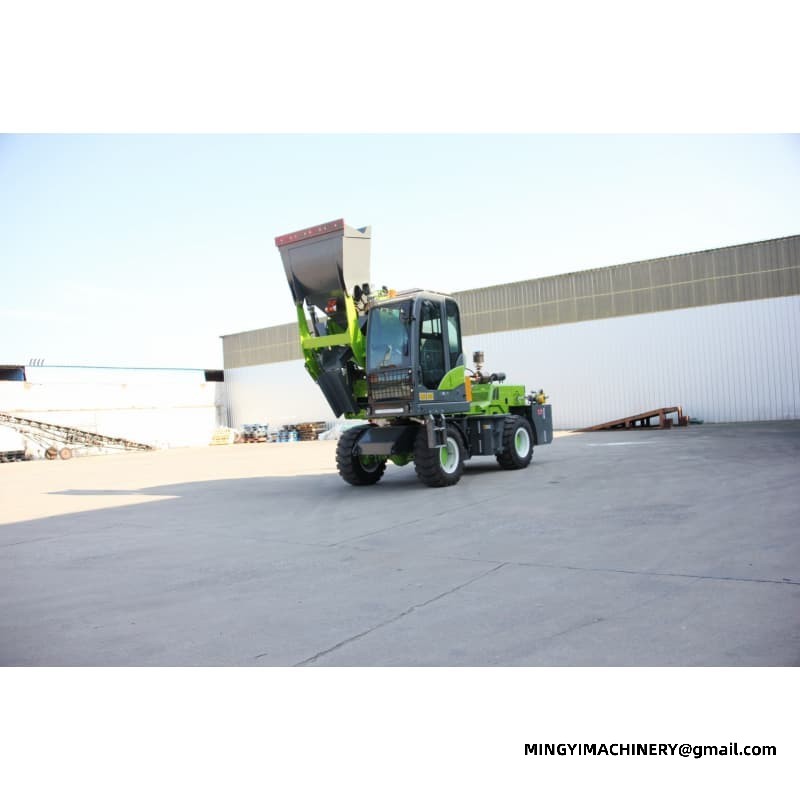
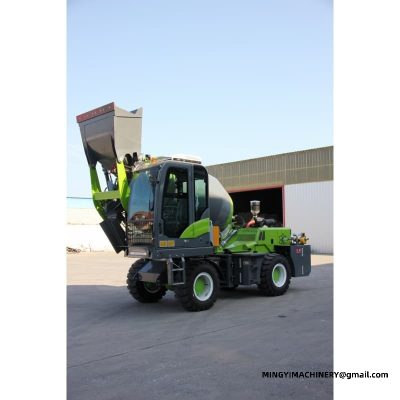
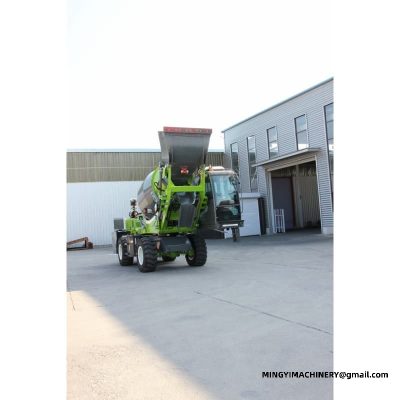
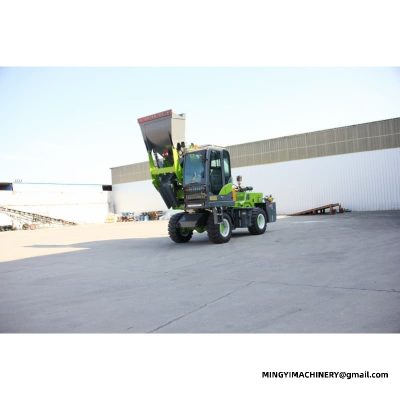
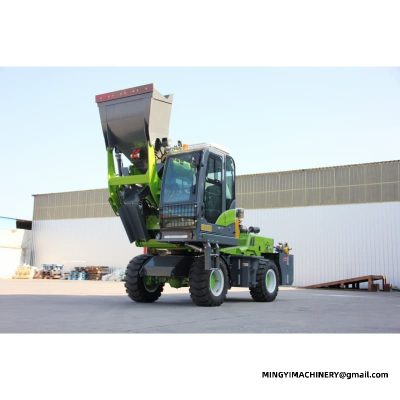
A self-loading mixer is bought for the distance between the aggregate pile and the pour. The 0.8 m³ drum, the 1,500 kg payload and the front shovel that feeds them answer one question — who mixes, and who carries? This page reads the published table as a self loading concrete mixer truck buyer meets it on pole lines: capacity first, then the drive and steering that decide where the machine can actually stand.
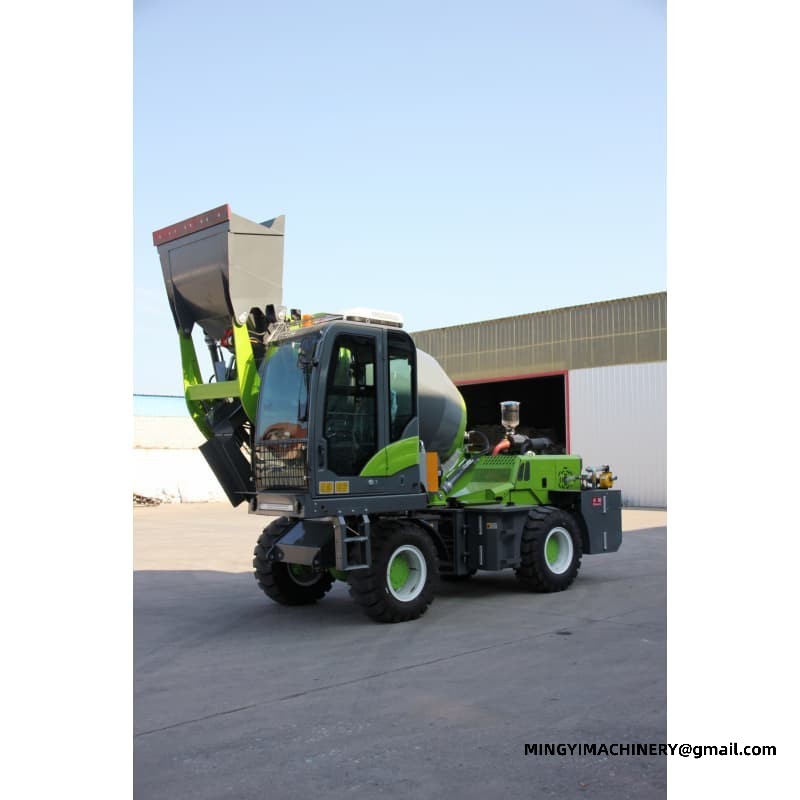
At 1,600 mm wide the machine threads standard double gates with room for its mirrors, which is the whole reason the envelope was drawn that way. Estate lanes, compound doors, orchard rows and basement entries all accept it where ordinary site trucks stop at the street.
Underground work adds one duty: ventilation for the single-cylinder diesel. Diesel exhaust in an enclosed space is an engineering problem before it is a comfort problem, and forced airflow belongs in the method statement, not in the operator's discretion.
The drum takes 0.8 m³ per batch, and the chassis carries 1,500 kg while doing it. Those two figures together describe the machine's whole working day: load, mix, move a short distance, discharge, and come back for the next batch. A crew that pours pole-setting concrete in small, frequent quantities is exactly the customer this size was drawn around.
Output is decided by the cycle, not the drum. Loading the shovel, mixing, travelling and discharging repeat, and the slowest of the four sets the rate. With 0.8 m³ per batch and a short haul, the drum rarely waits; with a long carry at 24 km/h, travel becomes the constraint and the arithmetic changes.
Engine oil and fuel, air restriction, hydraulic level, drum cleanliness, tyres and wheel nuts, lights and mirrors. That walk-round takes five minutes and catches nearly everything that becomes lengthy when missed.
Weekly: grease the shovel pins and the steering linkage, check belt tension, inspect hoses for chafe where the shovel flexes them. Monthly: engine and hydraulic oil sampling or change by the book, drum blade inspection, and a torque check on the wheel nuts and shovel mounting.
| Specification extract — 0.8 m³ 4WD self-loading concrete mixer | |
|---|---|
| Rated load | 1,500 kg |
| Rated capacity | 0.8 m³ |
| Overall dimensions (L x W x H) | 3,500 x 1,600 x 2,200 mm |
| Front tyre size | 8.25-16 |
| Rear tyre size | 7.50-16 |
| Minimum ground clearance | 204 mm |
| Steering angle | 28° |
| Turning dimension (outer tyre) | 2,464 mm |
| Maximum travel speed | 24 km/h |
| Transmission | 4WD |
| Gears | 3 forward / 1 reverse + travel gear |
| Front axle | 130 drive axle |
| Rear axle | 212 selectable 4WD steering axle |
| Engine | single-cylinder diesel / 25 hp |
| Steering | hydraulic power steering |
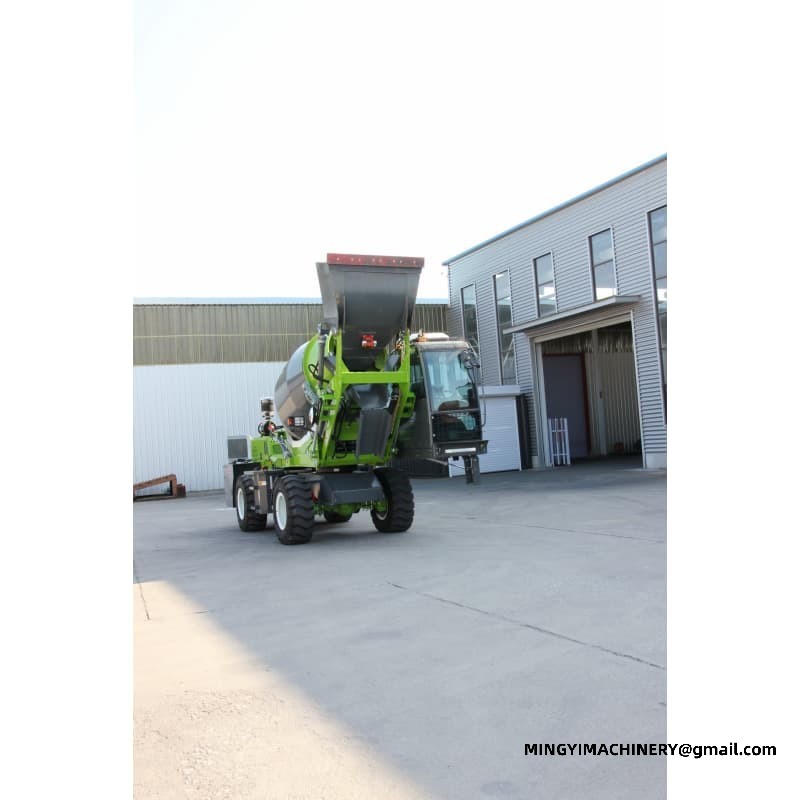
The break-even between owning and hiring is the number of batch-days, not the specification tag. A contractor with steady small-pour work crosses it in weeks; a contractor with one trench a month never does. The machine suits the first profile and politely declines the second.
The decision turns on continuity of work more than on specification. A contractor who pours most weeks owns with confidence; one who pours once a season hires with relief, and neither is wrong for the other's job.
The hydraulic circuit drives the power steering, the drum rotation and the shovel hydraulics from one pump off the single-cylinder diesel. Three consumers, one source — which is why the engine's health and the oil's cleanliness are the same subject on this machine.
Because the three consumers share one pump, they also share priorities: steering wins, then the drum, then the shovel. The machine is plumbed so that this happens naturally, and the operator notices it only as smoothness under combined loads.
The route decides the job before the mixer does. Walk it first: gateway width, height bar, the tightest turn inside the gate, the worst ground between stockpile and pour, and the discharge spot itself. The 2,464 mm turning circle and 204 mm clearance turn each measurement into a plain yes or no.
Stand the machine where the finishing crew already is, not where it would be convenient to park. A discharge point within barrow reach of the formwork is worth more than a flat, tidy spot fifty metres away, because the last metres are where hand-mixed batches lose their workability.
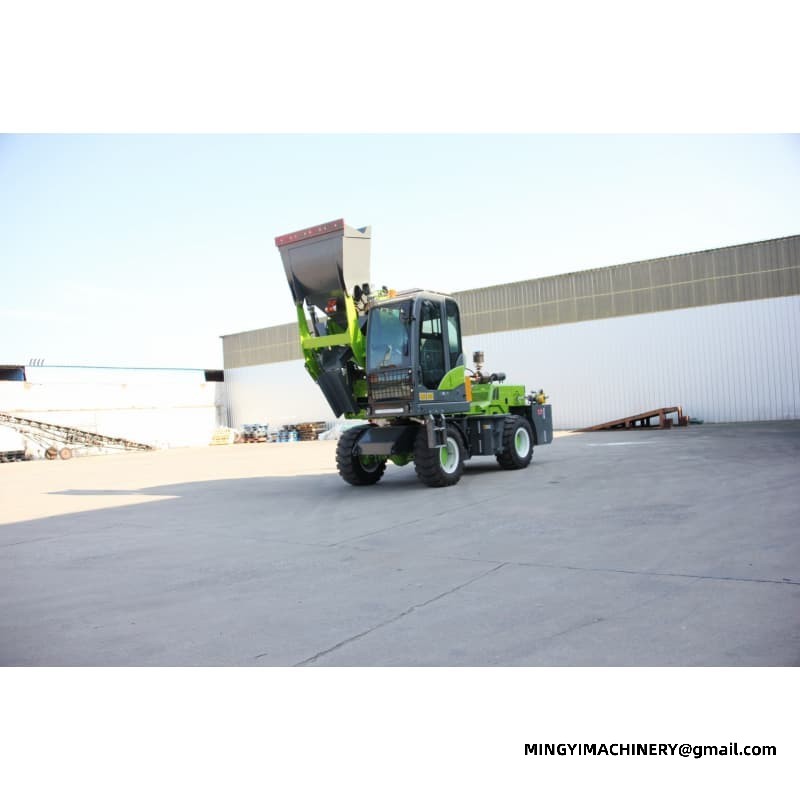
On a well-run machine the chassis and drum outlast several sets of consumables: shovel pins and bushings, drum blades, tyres, belts, hoses and filters are the renewal cycle. The single-cylinder diesel is the long-life heart, and its overhaul parts are stocked wherever single-cylinder diesels are common.
The drum's wear line is the inspection that predicts the machine's remaining economic life better than any other: a drum true to its blades and clean at the seam is a machine that has been loved, whatever its hours.
A specification is a contract before it is a sales document, and this one is short enough to read in a minute. The first cluster — 0.8 m³ capacity, 1,500 kg rated load, the 3,500 x 1,600 x 2,200 mm envelope — describes what a batch is and where the machine can stand. The second — 4WD, the 130 and 212 axles, 204 mm clearance — describes whether it can reach the pour.
The 130 front drive axle and 212 rear steering axle are named because they are standard agricultural patterns, and that naming is part of the durability case. Bearings, seals, hubs and crown wheels for both exist wherever tractors are sold.
Steering is hydraulic power steering acting with the 28° rear-axle steer. The wheel is light under a full drum, the steering response stays predictable at crawl speeds, and the machine holds a straight line under load without fighting the operator.
Measure the narrowest point on the route before the machine arrives on pole lines — the figure turns an access argument into a five-second check. Crews that skip the measurement discover the constraint with a full drum aboard, which is the lengthy way.
The drum is recipe-agnostic: lean foundation mixes, richer masonry mixes, and paving batches all turn the same way and discharge the same way. The machine's contribution is uniformity, not chemistry — the recipe is the engineer's, the repetition is the drum's.
The work it should refuse is the continuous slab and the high-volume pour, where plant supply wins outright. Saying so is the service, and the customer who hears it trusts the next recommendation more, not less.
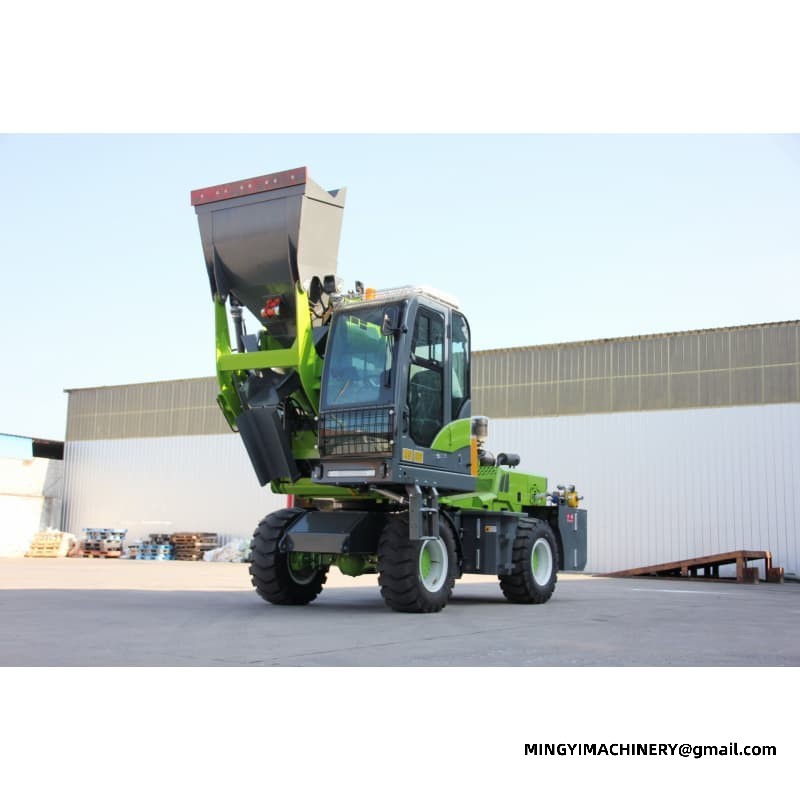
Self-loading is the whole idea. A front shovel scoops aggregate and sand from a stockpile, lifts it over the drum, and releases it — no separate loader, no second machine, no third pair of hands. One operator runs the entire chain from pile to pour.
The shovel is sized for this class of machine. It handles sand, gravel and coarse aggregate freely, and it will lift bagged cement if the crew breaks bags in first. It is not a demolition tool, and forcing it into compacted or oversized material shortens a working day quickly.
The machine-specific parts — drum blades, shovel pins, hydraulic seals — travel by shipment from the supplier, and the engine and axle patterns travel by the nearest agricultural network. Between them, little that breaks on this machine needs a wait measured in weeks.
Document the commissioning in the service book. The checklist protects the warranty and gives the next operator a known starting point, and the habit takes nothing the moment it is begun.
The gearbox gives three forward gears, one reverse and a separate travel gear, with a top speed of 24 km/h. On site the machine lives in first and second; the travel gear exists to move between jobs on a road without holding up traffic.
Shift on the move only between close ratios; come to rest for anything involving the travel gear. The gearbox is simple and strong, and the abuse that kills gearboxes — ramming selectors under load — is entirely avoidable on pole lines.
How do I get a specification for the self loading concrete mixer truck?
E-mail sales@mingycn.com or add LINE (ID): mingyicn with your market and intended work; the reply covers the specification, optional items and freight to your port.
How is the self loading concrete mixer truck drum driven?
Hydraulically, from the same circuit as the steering and shovel. Rotation one way mixes; reverse with the drum tipped discharges over the front.
Why does my self loading concrete mixer truck lose traction on wet ground?
Check tyre pressures first, then whether rear four-wheel drive is actually engaged. The 212 axle must be selected in — running two-wheel on soft ground is the usual cause.
Do I need a concrete pump with a self loading concrete mixer truck?
Usually not. The machine drives to the pour and discharges over the front on pole lines; a barrow stage covers the last few metres where wheels cannot stand.
How do you keep batches consistent in a self loading concrete mixer truck?
A fixed recipe: the same scoop count, the same measured water, the same mixing time. The machine repeats whatever routine it is given, on pole lines included.
Does the self loading concrete mixer truck need a driving licence?
Depends on your market's rules for site plant versus road use. Where it works inside private sites, site-operator rules apply; regular road travel changes the question.
Can a self loading concrete mixer truck work underground or in tunnels?
At 2,200 mm high it fits low-clearance work a transit mixer cannot enter. Enclosed spaces also require planned ventilation for the diesel exhaust — put it in the method statement.
How many self loading concrete mixer truck machines fit in a container?
That depends on the container and the packing format, so confirm the loading plan at specification. The 3,500 x 1,600 x 2,200 mm envelope is what makes the packing conversation easy.
Worked on pole lines, the machine pays for itself in the batches it keeps on schedule and the crews it frees from barrow chains. The specification above is the whole story — short, honest and enough to size the decision.
Commissioning Self Loading Concrete Mixer Truck: From Pile to Pour on site
The machine should be introduced to the site as well as the operator. Walking the route Self Loading Concrete Mixer Truck: From Pile to Pour will take, noting the soft spots and the turns, prevents the kind of first-day incident that has nothing to do with the machine.
Cold weather and winter care for Self Loading Concrete Mixer Truck: From Pile to Pour
Winter is hard on rubber and on seals as much as on the engine. Parking Self Loading Concrete Mixer Truck: From Pile to Pour under cover, keeping the tracks or tyres off standing water and checking the hoses for cracking are all part of the season.
Later additions and retrofits on Self Loading Concrete Mixer Truck: From Pile to Pour
Later changes are easier when they were anticipated. Asking for the extra hydraulic circuit or the heavier mounting plate on Self Loading Concrete Mixer Truck: From Pile to Pour at build time adds little and leaves the option open.
Packing, loading and shipment of Self Loading Concrete Mixer Truck: From Pile to Pour
Export packing is part of the machine, not an afterthought. Self Loading Concrete Mixer Truck: From Pile to Pour is blocked and braced inside the container so that it arrives in the same condition it left, and the load plan is decided by the dimensions rather than by what fits loosely.
Pre-delivery inspection before Self Loading Concrete Mixer Truck: From Pile to Pour leaves the shop
A machine should be inspected while it is still on our floor rather than after it lands. For Self Loading Concrete Mixer Truck: From Pile to Pour that means the engine is run to temperature, the hydraulics are cycled through full travel, and every function is checked against the build sheet before the crate is closed.
Contact MINGYI Machinery for the current self-loading concrete mixer specification, export packing and a formal specification for your market. E-mail: sales@mingycn.com | LINE (ID): mingyicn
Large Self-Loading Mixer Batches: What 0.8 m³ Delivers · Self-Loading Drum Mixer vs Pan Mixer: Which Suits the Job · heavy load 4x4 dumper for mining and quarry work · Mini Self-Loading Concrete Mixer









