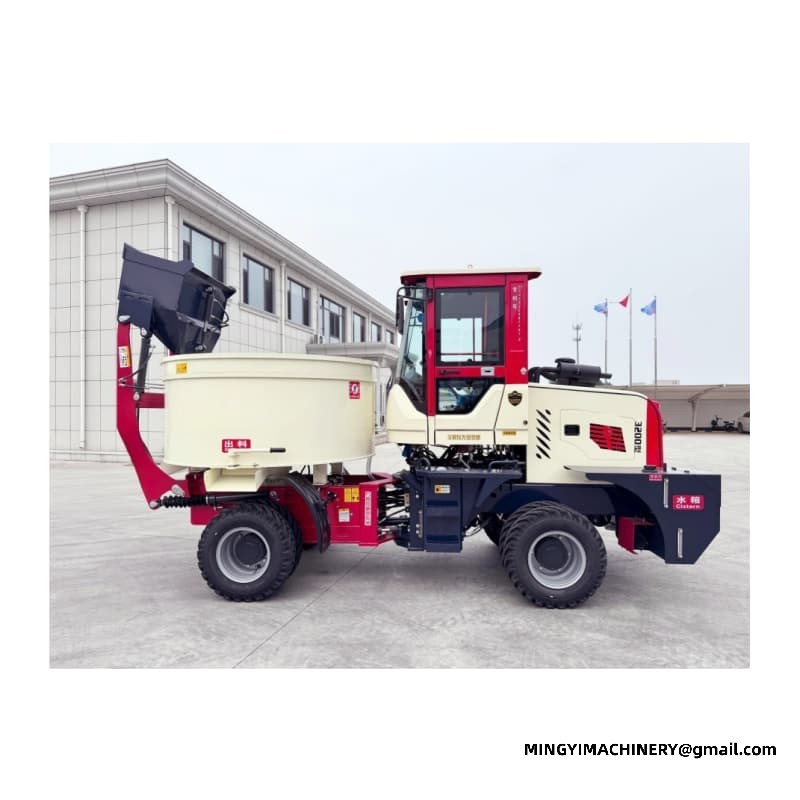
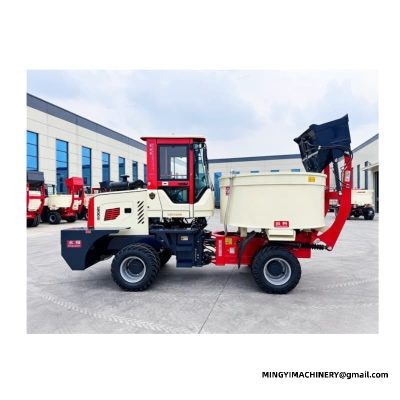
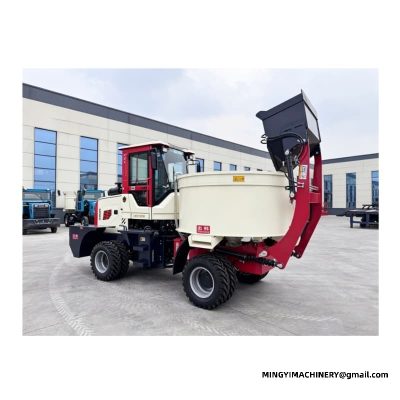
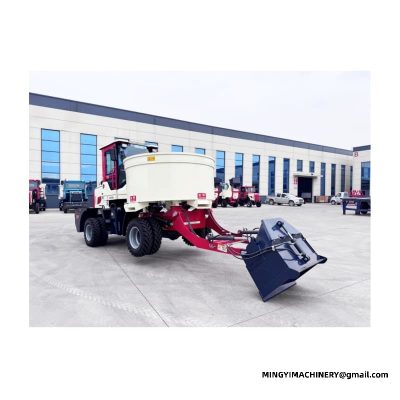
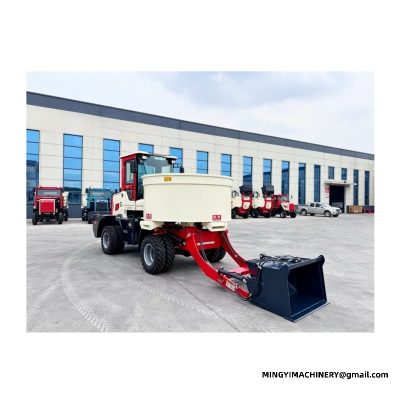
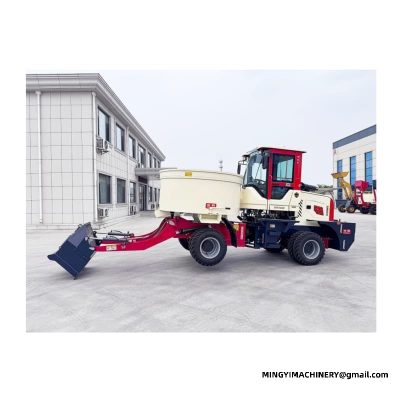
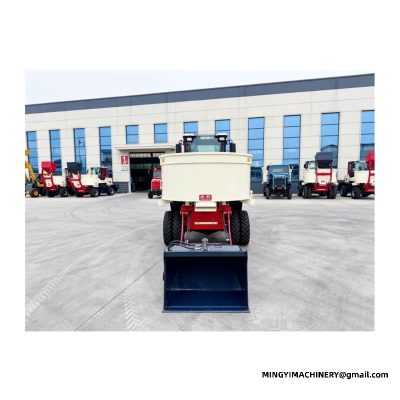
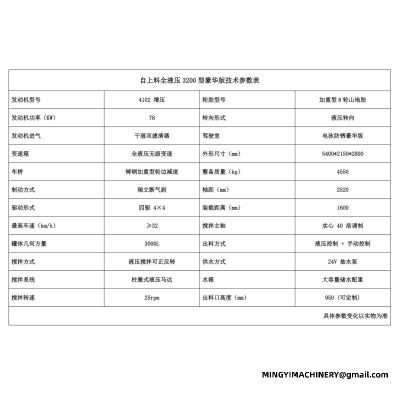
Concrete waits for nobody, and distance kills it. The self loading concrete pan mixer self-loading mixer exists for pours that happen too far from a batching plant for ready-mix to answer — on a building site feeding foundations one hopper at a time. At 0.8 m³ per batch and 24 km/h of travel speed, the machine keeps the supply chain inside the site gate, and this page explains the published figures that make that work.
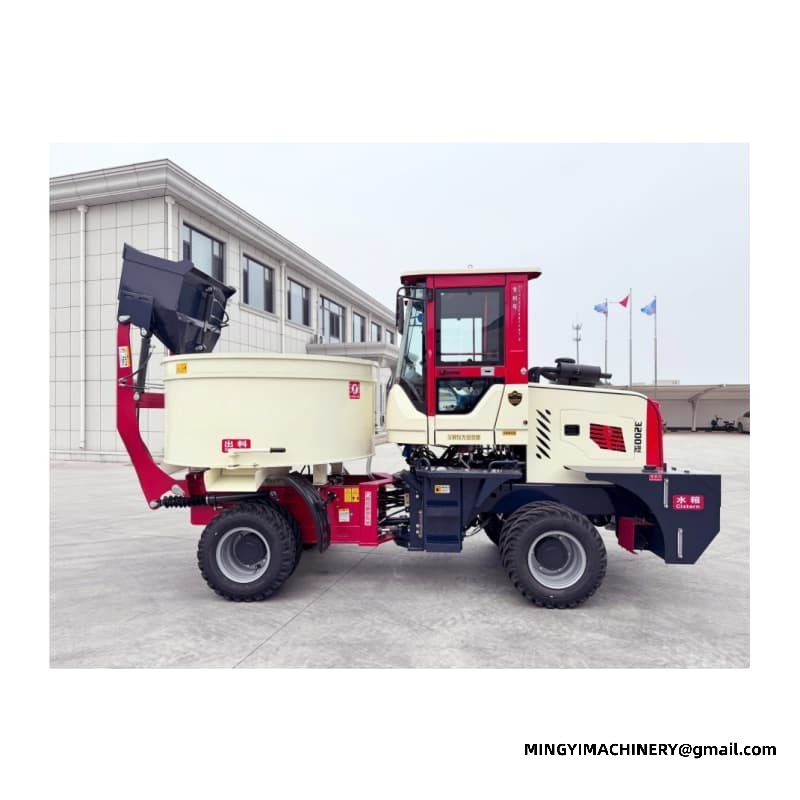
Confirm the specification in writing against the published table: 0.8 m³ capacity, 1,500 kg rated load, 4WD transmission, 25 hp single-cylinder diesel, the 130 front axle and 212 rear steering axle, and hydraulic power steering. Ask what is standard and what is optional in the build you are buying.
Check the machine against its own plate on arrival — serial number, axle stamps, drum casting — and photograph everything before signing the carrier's release. Transit claims have deadlines, and they are shorter than anyone expects.
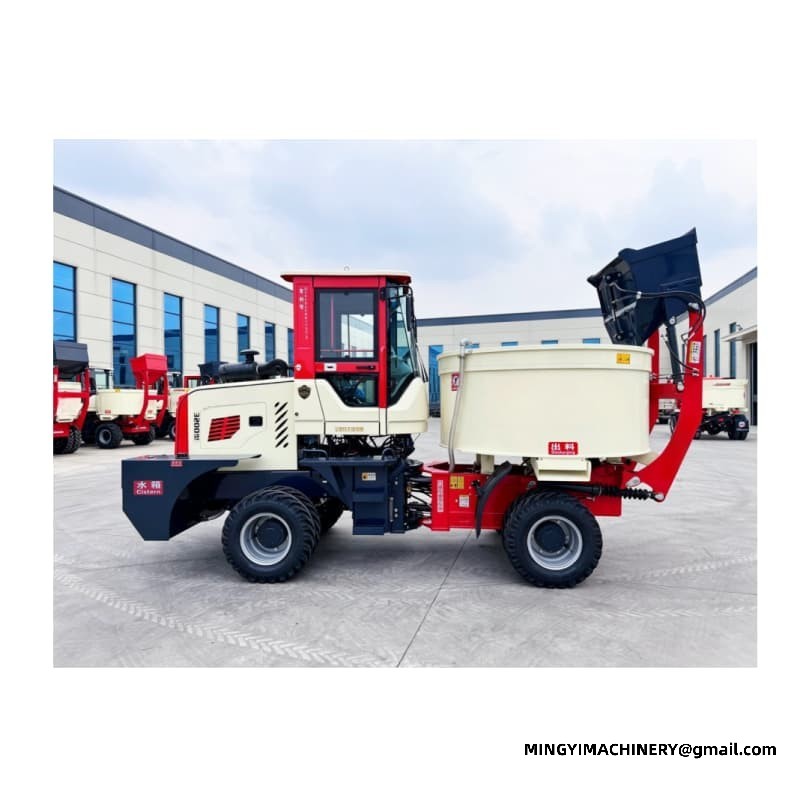
The drum takes 0.8 m³ per batch, and the chassis carries 1,500 kg while doing it. Those two figures together describe the machine's whole working day: load, mix, move a short distance, discharge, and come back for the next batch. A crew that pours foundation and plinth concrete in small, frequent quantities is exactly the customer this size was drawn around.
The practical advice is to plan pours around the cycle rather than around the clock. A crew that knows each batch of foundation and plinth concrete takes a predictable interval can keep formwork continuously fed, which matters more on cold joints than raw volume ever does.
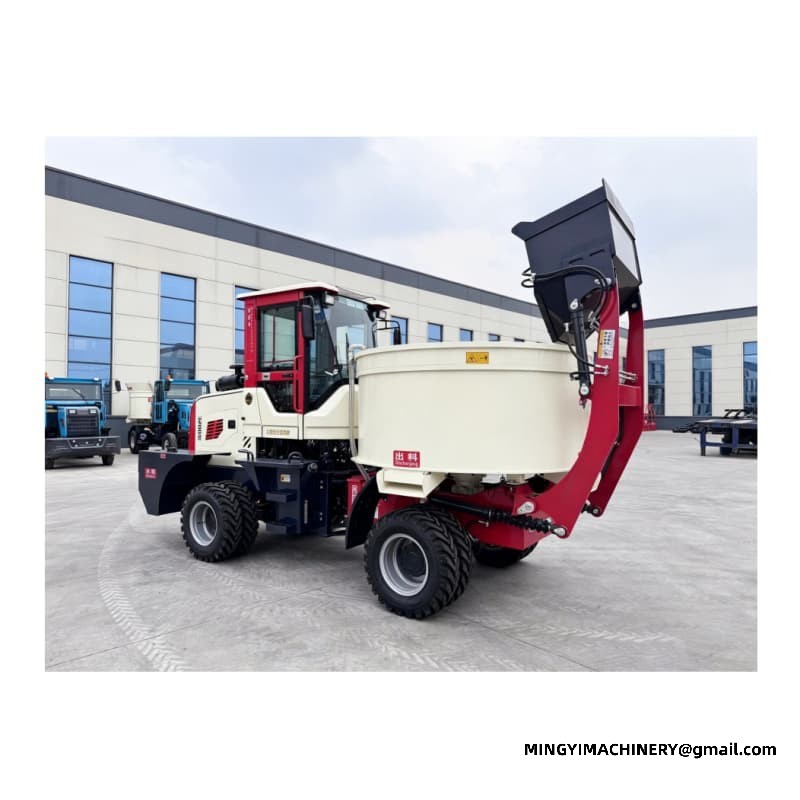
3,500 x 1,600 x 2,200 mm is the whole machine: short enough for a site trailer, narrow enough for a garden gate, low enough for a container without a top-loader's paperwork. Every one of those three numbers earns its place somewhere on a building site.
Shovel-up travel is the one posture that moves weight forward sharply. The operator carries the shovel low and the drum level, on a building site, and the machine handles exactly as the geometry promises.
| Published build data — 0.8 m³ 4WD self-loading concrete mixer | |
|---|---|
| Rated load | 1,500 kg |
| Rated capacity | 0.8 m³ |
| Overall dimensions (L x W x H) | 3,500 x 1,600 x 2,200 mm |
| Front tyre size | 8.25-16 |
| Rear tyre size | 7.50-16 |
| Minimum ground clearance | 204 mm |
| Steering angle | 28° |
| Turning dimension (outer tyre) | 2,464 mm |
| Maximum travel speed | 24 km/h |
| Transmission | 4WD |
| Gears | 3 forward / 1 reverse + travel gear |
| Front axle | 130 drive axle |
| Rear axle | 212 selectable 4WD steering axle |
| Engine | single-cylinder diesel / 25 hp |
| Steering | hydraulic power steering |
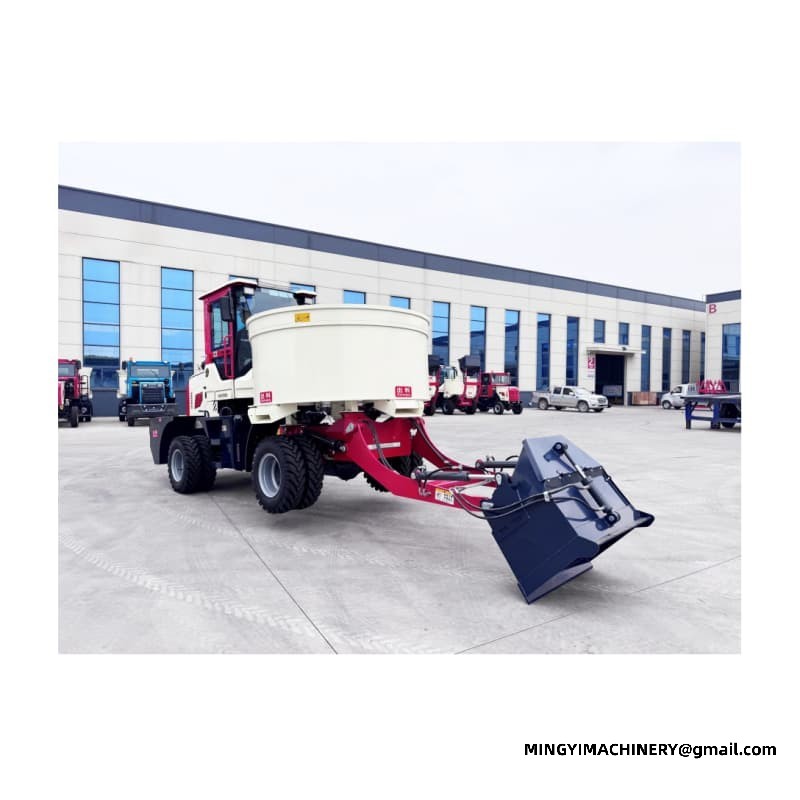
Drive goes to all four wheels — four-wheel drive through a 130 front drive axle, with the 212 rear axle selectable for four-wheel-drive steering. On firm ground two driven wheels would do, but site concrete rarely sits on firm ground. Wet spoil, sand, loose fill and grass all reward traction at every corner, which is what the 4WD transmission buys.
Both axle patterns are agricultural standards, which matters more than any performance figure: seals, bearings and crown wheels for the 130 and 212 patterns are stocked wherever farm machinery is sold, and that is everywhere this machine works.
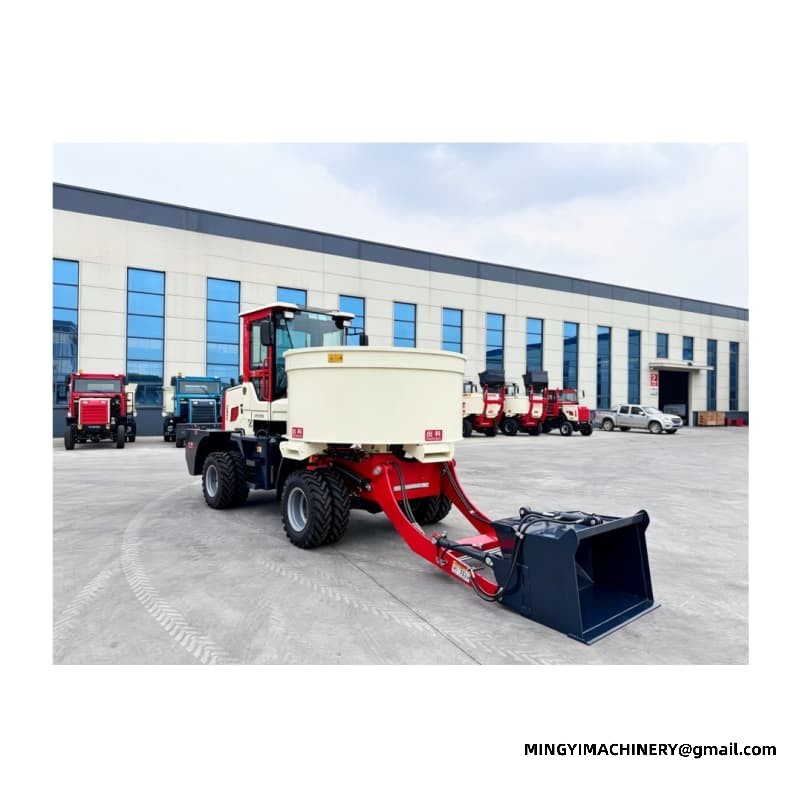
Measure the machine in hours, not in days. A drum that cycles every few minutes earns more in a short shift than a machine that waits between batches, and the hour meter is the honest tally of both. The published speed and gears exist to keep the cycle tight, not to make the machine fast.
Cut the waiting, not the machine. Sequence the day by geography and recipe, keep inputs stocked, and the same 3,500 x 1,600 x 2,200 mm chassis turns a low-utilisation week into a working one without spending a coin on capacity.
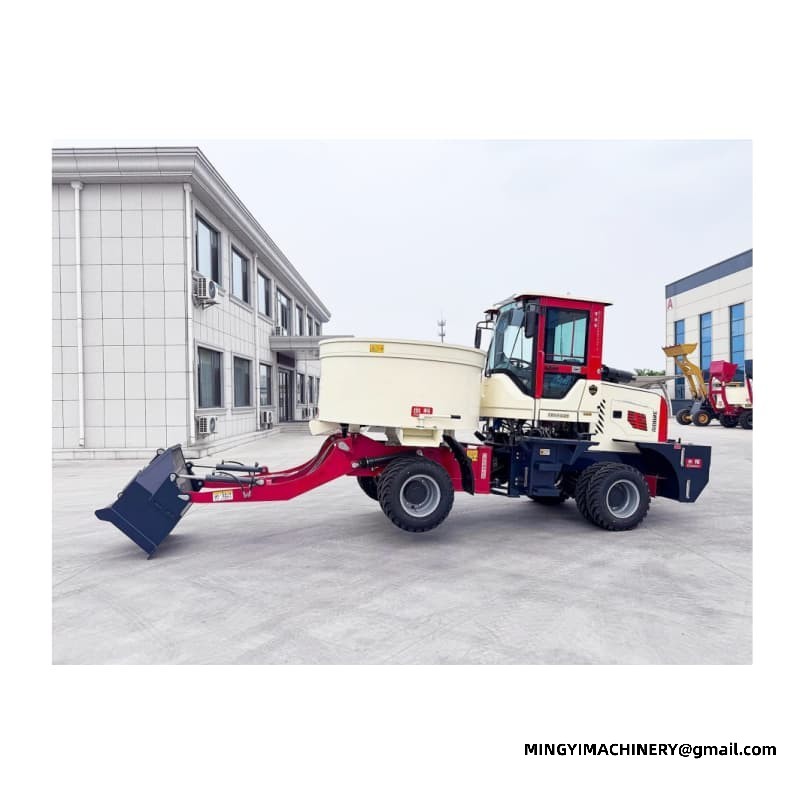
The machine will reproduce whatever recipe it is given, faithfully and all day. That is its quality promise and its quality risk: a correct recipe repeated gives uniform strength, and a careless one repeated gives uniform trouble.
Where a sloped or awkward pour tempts the crew to loosen the mix, the better answer is placement help — a shorter chute position, a barrow stage, a wetter-but-specified mix designed for the job — not an unmeasured splash from the hose.
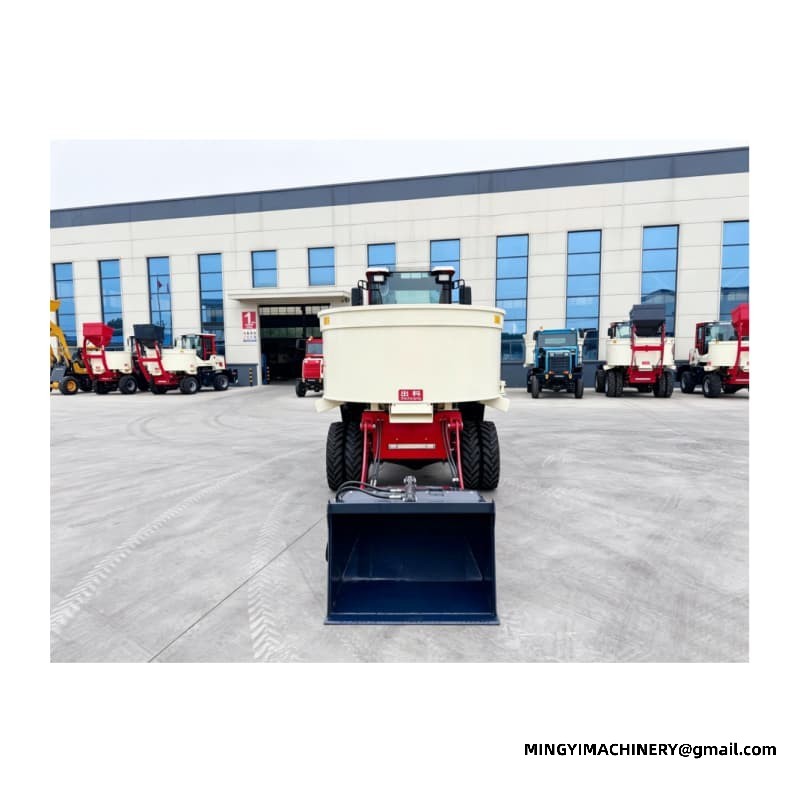
A specification is a contract before it is a sales document, and this one is short enough to read in a minute. The first cluster — 0.8 m³ capacity, 1,500 kg rated load, the 3,500 x 1,600 x 2,200 mm envelope — describes what a batch is and where the machine can stand. The second — 4WD, the 130 and 212 axles, 204 mm clearance — describes whether it can reach the pour.
List the axle numbers on the same sheet as the engine numbers. A machine whose running gear is stocked regionally is a machine that spends its life working instead of waiting, and the difference shows up in the uptime over a season on a building site.
The operator profile is one person, but the people around the machine change by the hour. The mixer serves a foundation crew, a masonry crew and a patching gang in sequence, each with the recipe it needs and the standing spot it wants. The single seat is the reason the machine suits small contractors who cannot spare a second hand.
For hire fleets, the machine is a starter asset: simple controls, one operator, a specification that fits on a single page and a resale market that is quick. The paperwork is as gentle as the machine — one service book, one engine pattern, one set of tyres to keep in stock.
The drum delivers 0.8 m³ at a rhythm, so the pour plan should be drawn in drum-sized bays: place, finish, move, repeat. Crews that lay out formwork to the machine's cycle pour all day without cold joints; crews that fight the rhythm chase stiffening edges by noon.
Concrete sets on its own clock, and weather resets it. Heat shortens the working time between drum and formwork; cold lengthens it and delays strength. On days with weather windows, the machine's speed of positioning — in, mix, tip, out — is what lets a crew use the window fully.
The machine-specific parts — drum blades, shovel pins, hydraulic seals — travel by shipment from the supplier, and the engine and axle patterns travel by the nearest agricultural network. Between them, little that breaks on this machine needs a wait measured in weeks.
Commission the machine properly and write it down. The checklist protects the warranty and gives the next operator a known starting point, and the habit takes nothing the moment it begins.
The control set is small — key start, gears, shovel levers, drum controls, steering — and a careful new operator works productively inside a day. The training that matters is judgement: slopes, loads, people, and the discipline of the wash-out.
Reinforce the habits with the machine itself: a marked water container lashed beside the seat, a laminate of the recipe in a sleeve on the splash board. Cues that live on the machine survive operator changes; cues in the site office do not.
Heat shortens everything: the workability window, the wait between batches, the time a finisher has. In hot seasons the drum works slightly smaller batches, water is measured colder and exactly, and aggregate stockpiles are kept shaded where possible so the mix does not start hot.
Starting aids the operator more than the engine: warm the hydraulics, cycle the drum gently, and let the first batch of the morning be the test batch. Machines wintered properly start on a building site without drama.
Wet concrete moves. Cornering hard, braking sharply or crossing a slope swings 0.8 m³ of liquid load to one side, and the machine's stability depends on the operator not inviting that. The low drum mount and the wide stance help; the operator's right foot finishes the job.
Reversing into position is the other hazard moment. A spotter behind the machine during the approach, every time, closes the last gap in the loop.
Who supports the self loading concrete pan mixer after delivery?
The supplier, by shipment of machine-specific parts and by guidance on the engine and axle pattern any local mechanic can service. E-mail sales@mingycn.com or LINE (ID): mingyicn and the conversation continues after the sale.
How is a self loading concrete pan mixer delivered and commissioned?
Containerised delivery, then a short commissioning: turn the engine by hand before first start, prime the hydraulics, and run the drum empty before the first batch.
Is a self loading concrete pan mixer the same as a pan mixer?
No. A pan mixer blends in a stationary vertical pan; this machine mixes in a rotating drum and carries the batch to the point of placement. For dispersed small pours, the drum type wins.
Does the self loading concrete pan mixer really load itself?
Yes. A front shovel scoops aggregate and sand from the stockpile and lifts it into the drum — no separate loader and no barrow chain. One operator runs load, mix, travel and discharge.
Is a bigger drum always better than a self loading concrete pan mixer?
No. Bigger drums ride on bigger chassis that lose the gateway, the low height and the single-operator economy. Size the drum to the pour, not to the brochure.
How is visibility from the self loading concrete pan mixer seat?
The open station sees the shovel, the drum lip and the discharge point directly — no camera dependence. A spotter still covers the reversing approach at busy pours.
What warranty does the self loading concrete pan mixer carry?
Warranty terms are stated with the contract, so get them in writing — scope, duration and the parts-and-service arrangement for your market. Keep the commissioning checklist; it protects the claim.
Does a self loading concrete pan mixer waste concrete?
Less than scheduled supply does. Batching stops when the pour stops, so there are no returned-load charges — the effort control hides in batching to demand.
Batched to demand, placed under its own power and maintained in five minutes a day, the machine replaces the small-plant overhead that most small pours never needed in the first place.
Keeping a service record for Self-Loading Drum Mixer vs Pan Mixer: Which Suits the Job
The record should follow the machine, not the owner. When Self-Loading Drum Mixer vs Pan Mixer: Which Suits the Job changes hands the service history travels with it, and a complete folder is often the difference between a quick sale and a long one.
Wear items and spares worth holding for Self-Loading Drum Mixer vs Pan Mixer: Which Suits the Job
A spares list should follow the duty cycle. A Self-Loading Drum Mixer vs Pan Mixer: Which Suits the Job working every day in abrasive dust consumes filters and cutting edges far faster than the same machine used once a week, and the shelf should be stocked for the harder case.
Packing, loading and shipment of Self-Loading Drum Mixer vs Pan Mixer: Which Suits the Job
Container loading is a planning exercise. The overall dimensions and the operating weight of Self-Loading Drum Mixer vs Pan Mixer: Which Suits the Job decide whether it ships whole, partly disassembled or with the attachment removed, and that decision is made before the booking.
Hot, humid and dusty conditions around Self-Loading Drum Mixer vs Pan Mixer: Which Suits the Job
Heat and dust shorten service intervals rather than machine life. In these conditions the filters on Self-Loading Drum Mixer vs Pan Mixer: Which Suits the Job need attention more often, and the cooling surfaces need to be kept clear to hold the working temperature.
Storage and long idle periods for Self-Loading Drum Mixer vs Pan Mixer: Which Suits the Job
Standing still is harder on a machine than working. Preparing Self-Loading Drum Mixer vs Pan Mixer: Which Suits the Job for a long idle period means clean fluids, a charged battery and protection for the exposed surfaces, because neglect is not the same as rest.
Contact MINGYI Machinery for the current self-loading concrete mixer specification, export packing and a formal specification for your market. E-mail: sales@mingycn.com | LINE (ID): mingyicn
Mobile Concrete Mixer Without a Pan: Carrying Batches to Place · Self Loading Concrete Mixer: The Complete Specification · all terrain cargo vehicle for mining and quarry work · Mini Self-Loading Concrete Mixer









