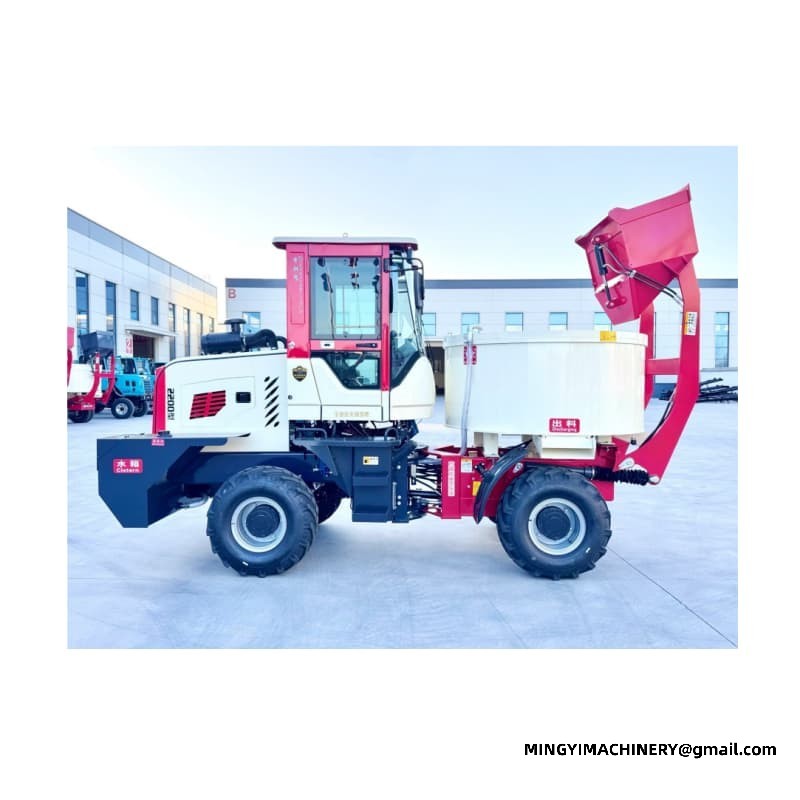
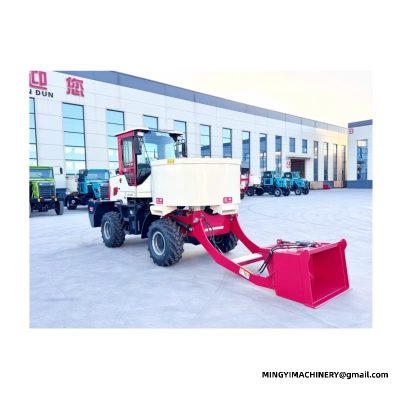
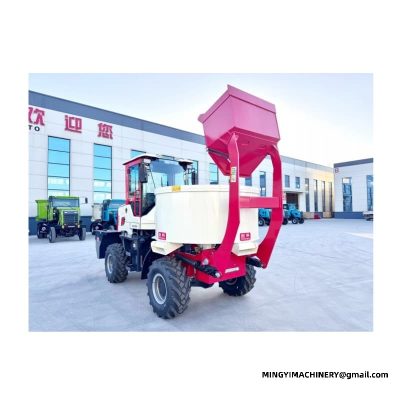
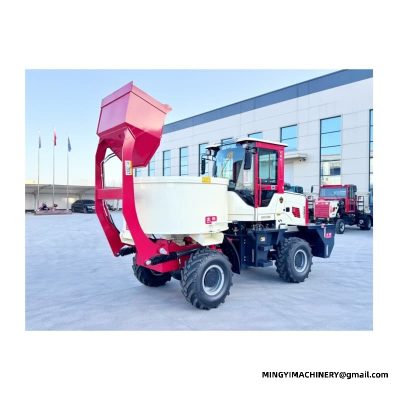
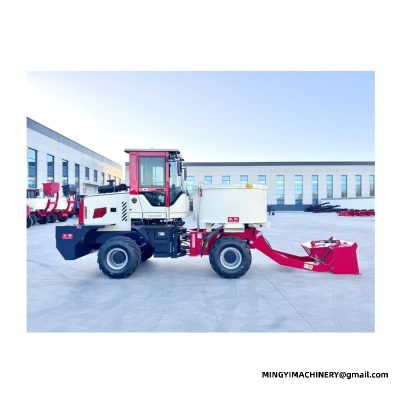
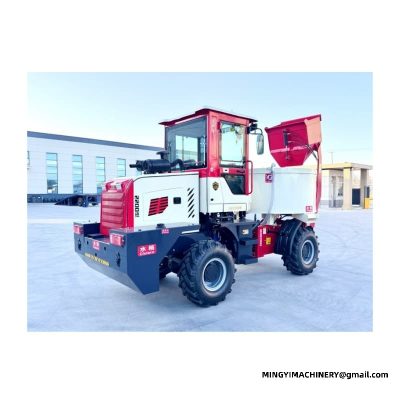
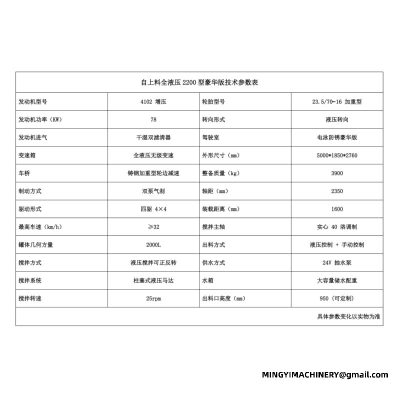
The published table on a mobile concrete pan mixer is short, and every line on it is a decision. 0.8 m³ capacity, 1,500 kg rated load, 3,500 x 1,600 x 2,200 mm overall, 4WD through a 130 axle with a 212 steering axle behind. This page takes those lines one at a time and reads them the way a crew meets them: loading, mixing, hauling and discharging on a building site.
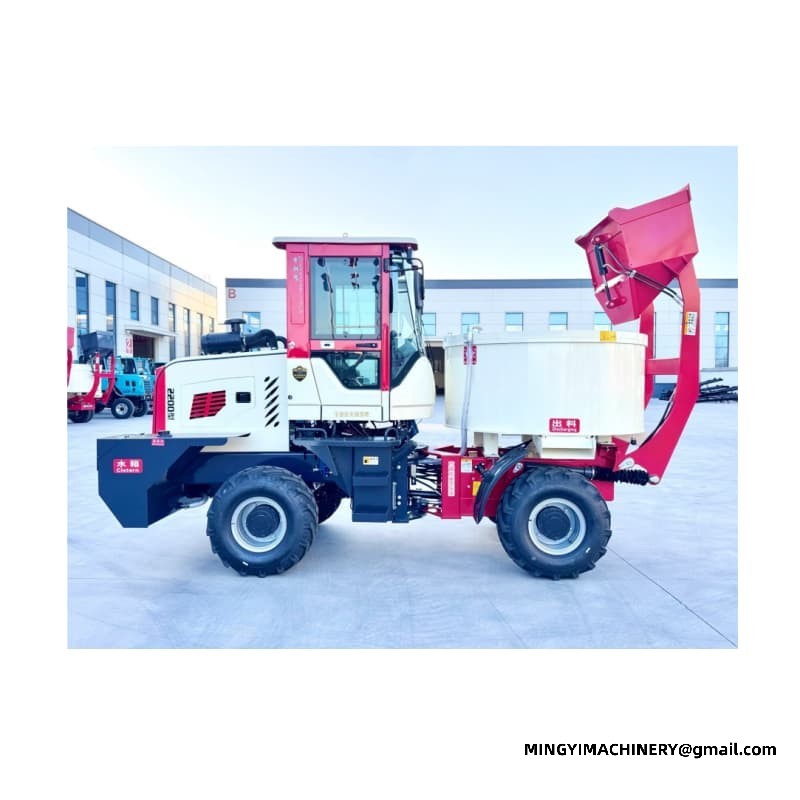
The discharge end is the natural place for add-ons: a short chute extension reaches past an obstacle, a tipping skip collects where a barrow cannot stand, and a measured water bowser rides the machine instead of trailing behind it. None of these change the drum; they change where its output lands.
Where weather or debris demands a screen, confirm what the supplier offers for your market before ordering, and weigh it against the access the open station buys. On most small sites the screen takes more in reachability than it returns in comfort.
Confirm the specification in writing against the published table: 0.8 m³ capacity, 1,500 kg rated load, 4WD transmission, 25 hp single-cylinder diesel, the 130 front axle and 212 rear steering axle, and hydraulic power steering. Ask what is standard and what is optional in the build you are buying.
A sensible first spares kit travels with the machine: filters for engine and hydraulics, a set of belts, hose clamps, a drum blade or two, shovel pins and bushings, and lamp bulbs. Everything on the list is small, simple and exactly what stops work on a building site when it fails unstocked.
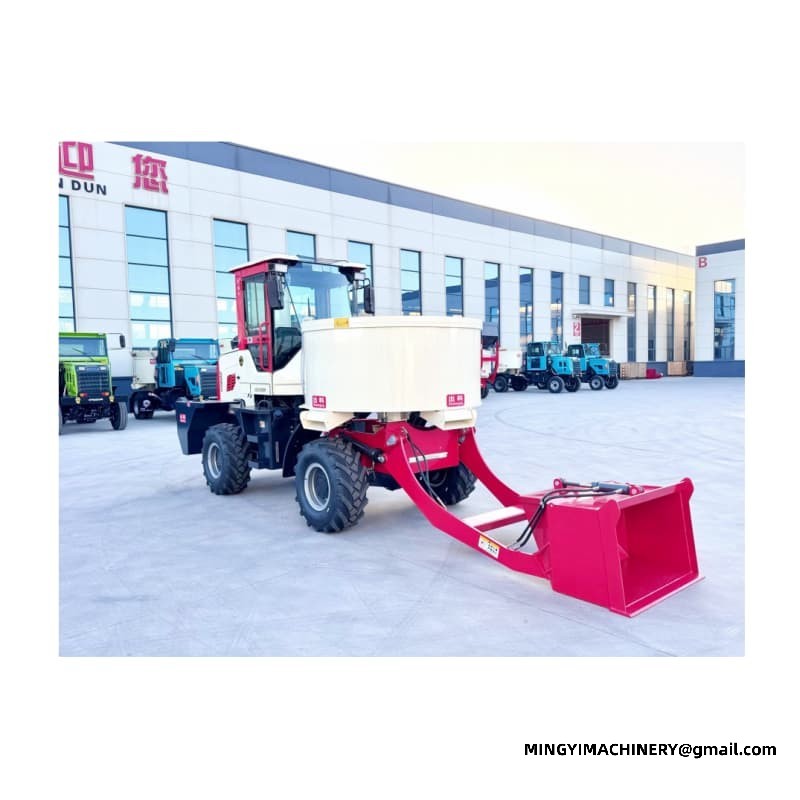
204 mm of clearance under the axles is the machine's ground rule. It clears ruts, rubble and standing water of that depth, and it does not clear more. The low build is what keeps the centre of gravity down under a raised drum, so the number is a design trade, not a deficiency.
A loaded drum raises the centre of gravity, and every slope question follows from that. The machine handles site ramps and graded ground at crawl speed in low gear; it is not a slope specialist, and cross-slopes with a full drum deserve a slower, straighter line than empty running.
| Specification extract — 0.8 m³ 4WD self-loading concrete mixer | |
|---|---|
| Rated load | 1,500 kg |
| Rated capacity | 0.8 m³ |
| Overall dimensions (L x W x H) | 3,500 x 1,600 x 2,200 mm |
| Front tyre size | 8.25-16 |
| Rear tyre size | 7.50-16 |
| Minimum ground clearance | 204 mm |
| Steering angle | 28° |
| Turning dimension (outer tyre) | 2,464 mm |
| Maximum travel speed | 24 km/h |
| Transmission | 4WD |
| Gears | 3 forward / 1 reverse + travel gear |
| Front axle | 130 drive axle |
| Rear axle | 212 selectable 4WD steering axle |
| Engine | single-cylinder diesel / 25 hp |
| Steering | hydraulic power steering |
On a well-run machine the chassis and drum outlast several sets of consumables: shovel pins and bushings, drum blades, tyres, belts, hoses and filters are the renewal cycle. The single-cylinder diesel is the long-life heart, and its overhaul parts are stocked wherever single-cylinder diesels are common.
Engine hours are the honest odometer. A machine with records, steady hours and its original axles holds value strongly in the second-hand market, because the next owner can see what they are buying.
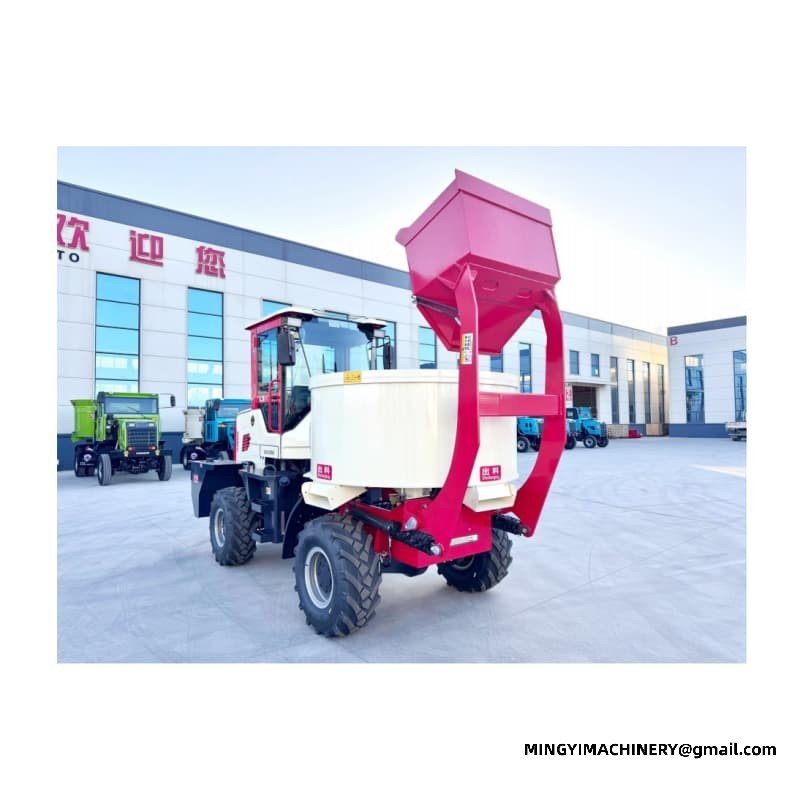
The machine will reproduce whatever recipe it is given, faithfully and all day. That is its quality promise and its quality risk: a correct recipe repeated gives uniform strength, and a careless one repeated gives uniform trouble.
Where workability genuinely must rise, change the mix design rather than the habit — plasticisers exist for exactly this reason, and a measured dose beats an unmeasured splash every time on a building site.
Wet concrete moves. Cornering hard, braking sharply or crossing a slope swings 0.8 m³ of liquid load to one side, and the machine's stability depends on the operator not inviting that. The low drum mount and the wide stance help; the operator's right foot finishes the job.
End-of-shift safety is part of the same discipline: shovel down, drum rinsed, keys out, parking brake set, and the machine parked where tomorrow's first light will show it to everyone. Most site strikes happen to parked plant, not working plant.
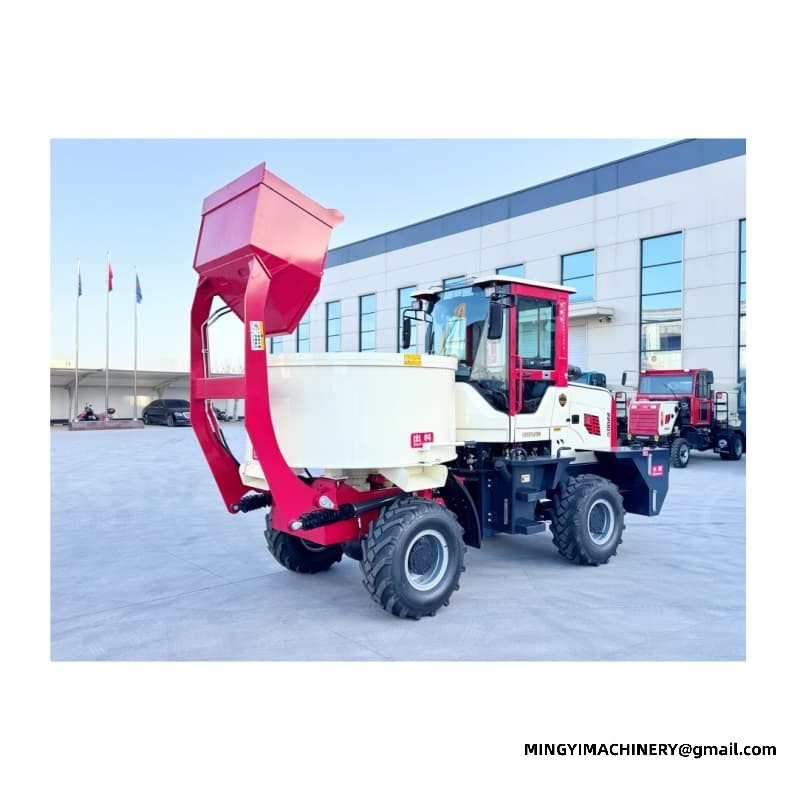
Heat shortens everything: the workability window, the wait between batches, the time a finisher has. In hot seasons the drum works slightly smaller batches, water is measured colder and exactly, and aggregate stockpiles are kept shaded where possible so the mix does not start hot.
Antifreeze discipline applies to the engine year-round in cold markets, and the drum benefits from the same thinking: a wash-out that leaves water pooled in a low point will freeze, and ice in a drum is a morning's chiselling.
The machine earns its place wherever concrete is needed in small, repeated batches away from a batching plant: on a building site keeping masonry crews supplied with mortar. The common thread is distance — too far from the plant for ready-mix to be economical, too continuous for hand mixing.
On compact projects the mixer becomes shared infrastructure: it serves the foundation crew in the morning, the masonry crew after lunch, and the patching gang at day's end. Ownership of the machine matters less than the batching discipline each crew inherits.
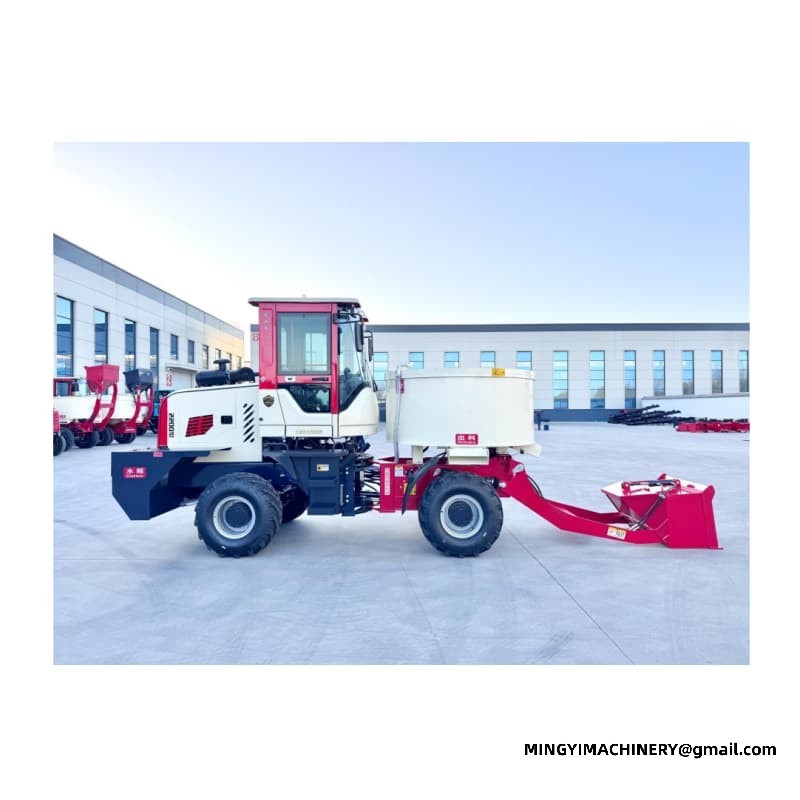
The control set is small — key start, gears, shovel levers, drum controls, steering — and a careful new operator works productively inside a day. The training that matters is judgement: slopes, loads, people, and the discipline of the wash-out.
Where the machine changes hands, the handover is a two-minute conversation with a written line: hours run, fuel state, anything odd heard or felt, wash-out done or not. The drum heel that one shift leaves is the next shift's complaint unless the note exists.
The drum is recipe-agnostic: lean foundation mixes, richer masonry mixes, and paving batches all turn the same way and discharge the same way. The machine's contribution is uniformity, not chemistry — the recipe is the engineer's, the repetition is the drum's.
The machine suits the small structural pour and the non-structural one beside it — bases, posts, paths, kerbs — all in 0.8 m³ batches the crew handles without a second plant. It should decline the continuous slab, where supply wins outright.
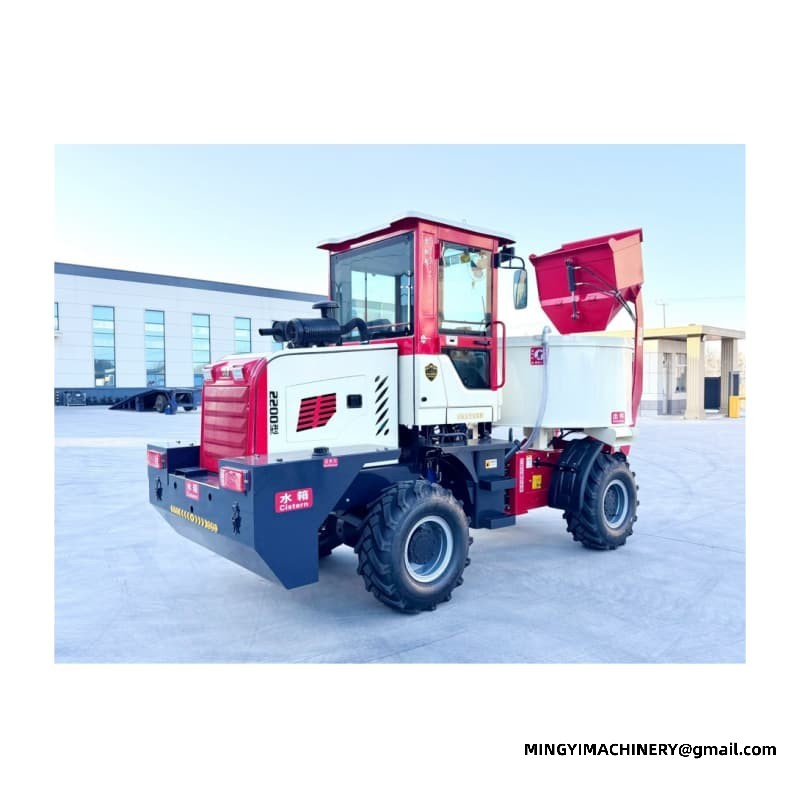
The drum takes 0.8 m³ per batch, and the chassis carries 1,500 kg while doing it. Those two figures together describe the machine's whole working day: load, mix, move a short distance, discharge, and come back for the next batch. A crew that pours mortar and screed batches in small, frequent quantities is exactly the customer this size was drawn around.
Crews that log batches for a week know their true rate, and the log is worth more than any brochure promise. The machine's contribution is regularity: the drum turns at the same speed whether it is the first batch of the morning or the fortieth, on a building site.
The break-even between owning and hiring is the number of batch-days, not the specification tag. A contractor with steady small-pour work crosses it in weeks; a contractor with one trench a month never does. The machine suits the first profile and politely declines the second.
Ownership's quiet effort is the inputs — cement, aggregate, water — that must be on hand before the drum can turn. plan them with the machine from day one, because an idle drum takes money while it earns nothing.
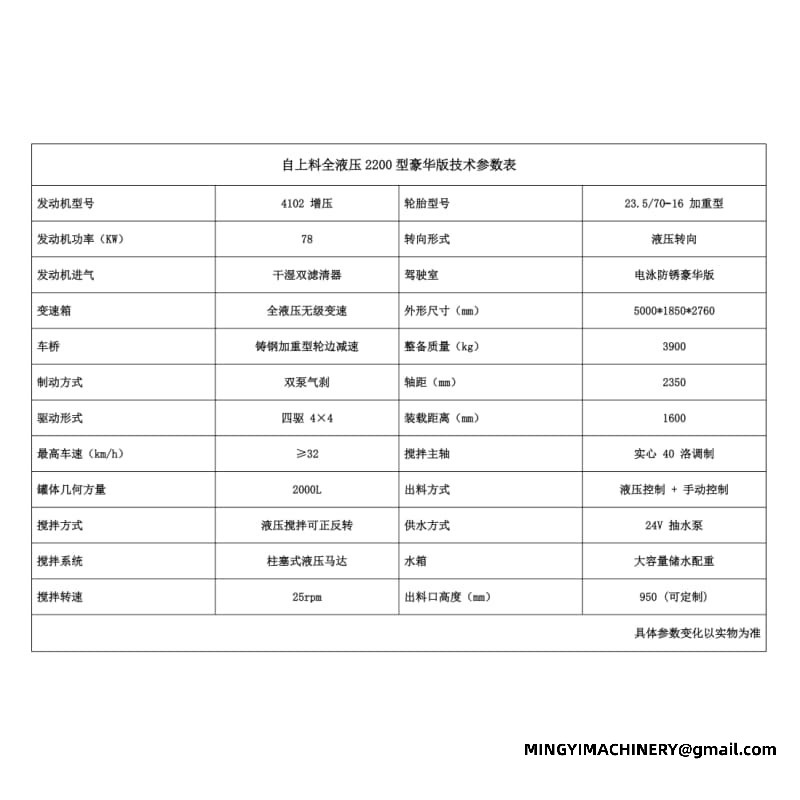
The route decides the job before the mixer does. Walk it first: gateway width, height bar, the tightest turn inside the gate, the worst ground between stockpile and pour, and the discharge spot itself. The 2,464 mm turning circle and 204 mm clearance turn each measurement into a plain yes or no.
The survey is not paperwork; it is the first batch. Measure the gate, the turn and the ground while the machine is still on the truck, and the 2,464 mm turning circle and 204 mm clearance become numbers you have already checked rather than surprises you meet with a full drum.
What ground can the mobile concrete pan mixer cross?
Prepared site ground, gravel, compacted fill and firm grass, at 204 mm of clearance with agricultural tyres and 4WD. Deep mud and boulder fields are the honest limits.
How much does a mobile concrete pan mixer effort?
Specification depends on market, options and freight, so it is stated rather than published. E-mail sales@mingycn.com or LINE (ID): mingyicnfor a formal specification for your port.
Does a mobile concrete pan mixer hold its value?
Well-kept machines resell quickly to small contractors. Hours and a service book carry more weight at resale than appearance.
Can a mobile concrete pan mixer replace ready-mix concrete?
For small, repeated pours beyond a plant's economical radius, yes — batching on site avoids minimum-load charges and part-load waste. Large continuous pours still belong to ready-mix.
Is a second-hand mobile concrete pan mixer a good buy?
A machine with hours, records and an honest drum beats a simple one with neither. Check for a heel in the drum, worn shovel pins and cracked hoses — three tells that predict the next season's takes.
Where should the mobile concrete pan mixer stand during a pour?
On a rehearsed standing spot with the discharge arc clear and a spoken stop signal agreed. Ten minutes of positioning planning saves an hour of manoeuvring on a building site.
How do I check quality without a lab when using a mobile concrete pan mixer?
Slump by eye against an agreed target, batch weight against the recipe, and a chalkboard record of what each pour received. Structural work still deserves proper cube tests.
What tyres does the mobile concrete pan mixer use?
8.25-16 at the front and 7.50-16 at the rear, agricultural-pattern tyres that grip soft ground and shrug off stones on a building site.
Small pours, distant sites and awkward access are exactly where this machine was drawn to work. Where the job matches that shape, the published table is all the sales argument needed.
A second operator for the concrete mixer
Training is simpler than repair. An hour spent with a new operator on this class of machine, covering the limits and the awkward cases, is the least lengthy hour in the whole ownership.
Moving the unit in daily use between sites
A machine that works on one site still has to reach the next. The overall dimensions and the operating weight of a machine of this size decide what trailer or truck is needed, and that decision belongs before the job is booked.
Pre-delivery inspection before the equipment on site leaves the shop
The last hour before packing is the best time to find a fault. Running the machine itself through its full working cycle, checking for leaks under load and confirming that the controls match the specification avoids a conversation across time zones later.
Commissioning the model in question on site
Transport shakes things loose. A short check of the machine in that duty after the crate is opened, covering the same points the pre-delivery inspection covered, is the most useful insurance available on delivery day.
Later additions and retrofits on the unit on the job
Retrofitting is limited by the base machine. Before anything is added to a machine built for the work the hydraulic flow, the mounting interface and the stability allowance have to be checked, because those limits are what decide what is sensible.
Hot, humid and dusty conditions around the equipment in service
Tropical operation is a specification question as much as a maintenance one. The cooling capacity, the sealing and the corrosion protection fitted to the concrete mixer are what make the difference once the ambient temperature rises.
Contact MINGYI Machinery for the current self-loading concrete mixer specification, export packing and a formal specification for your market. E-mail: sales@mingycn.com | LINE (ID): mingyicn
Self Loading Concrete Mixer: The Complete Specification · Mini Self Loading Mixer, Compact by Design: 1,600 mm Wide · strong traction 4WD transport vehicle for mining and quarry work · Mini Self-Loading Concrete Mixer









