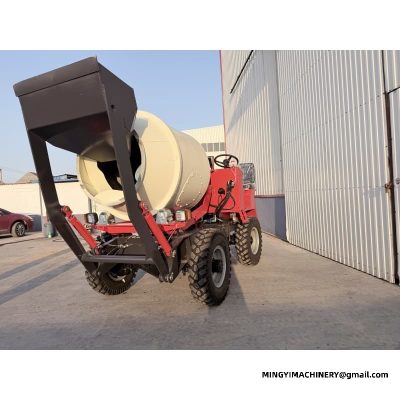
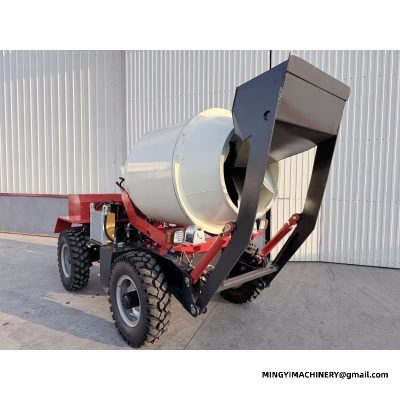
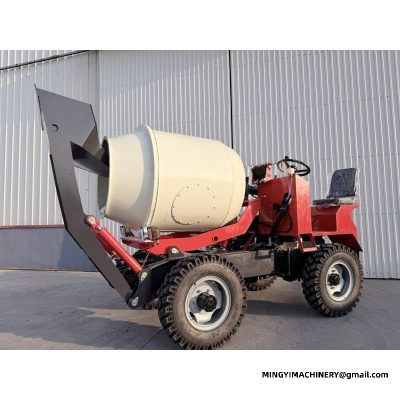
Keywords: Self Loading Concrete Mixer, Mini Self-Loading Truck, Self Loader
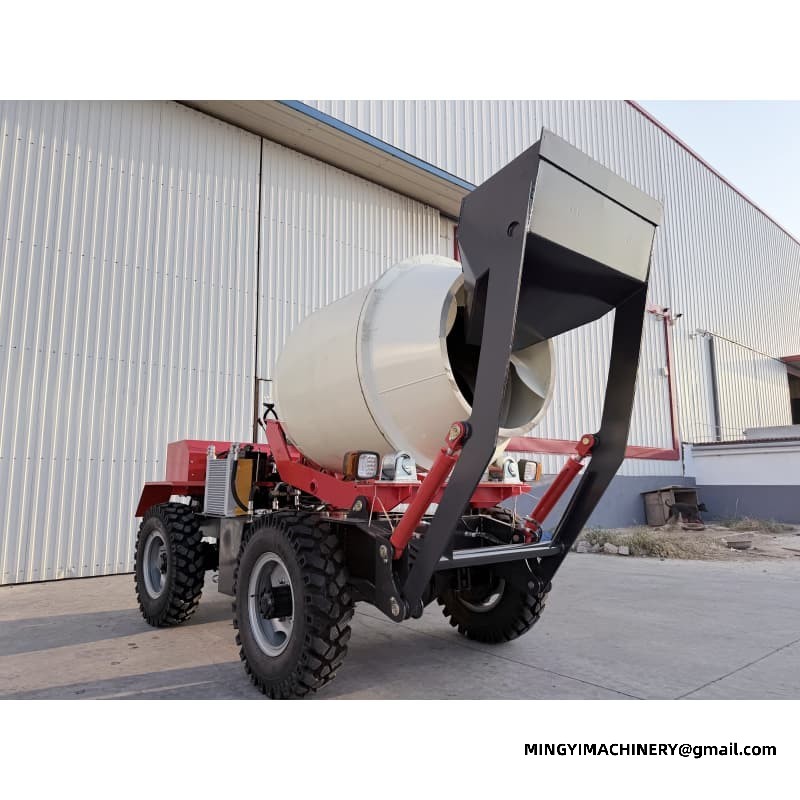
Access decides concrete work before capacity does. A transit mixer that cannot reach the pour is a plant on the street; a self loading concrete mixer at 3,500 x 1,600 x 2,200 mm overall and 2,464 mm of turning circle drives to where the formwork is. This page follows the machine on rural road work from the stockpile to the discharge point and reads each published figure along the way.
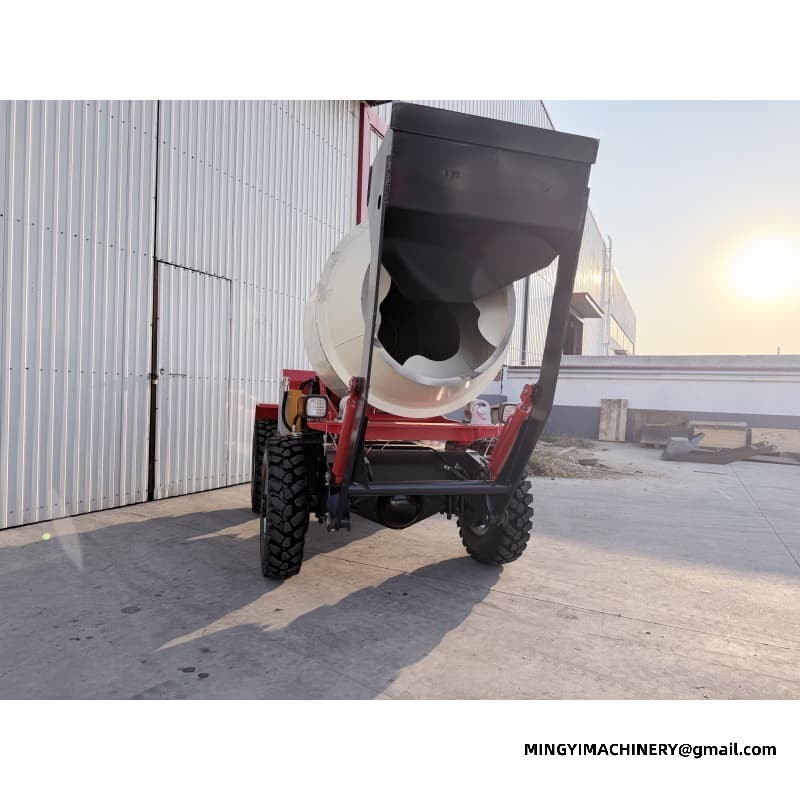
The discharge end is the natural place for add-ons: a short chute extension reaches past an obstacle, a tipping skip collects where a barrow cannot stand, and a measured water bowser rides the machine instead of trailing behind it. None of these change the drum; they change where its output lands.
The caution is the same as for every small machine: extra structure changes the load case the 3,500 x 1,600 x 2,200 mm envelope was drawn for. A raised cab, a heavy counterweight or a wide attachment redistributes stress the chassis never agreed to carry, and the fault shows up later, elsewhere.
The drum takes 0.8 m³ per batch, and the chassis carries 1,500 kg while doing it. Those two figures together describe the machine's whole working day: load, mix, move a short distance, discharge, and come back for the next batch. A crew that pours culvert, kerb and patching concrete in small, frequent quantities is exactly the customer this size was drawn around.
Small structural work — columns, bases, tie beams, garden retaining walls — consumes concrete in units close to 0.8 m³, which is why the drum size and the common pour size match so well. Large slabs are a different animal and want continuous supply; a single machine cannot hold that rhythm alone.
Engine oil and fuel, air restriction, hydraulic level, drum cleanliness, tyres and wheel nuts, lights and mirrors. That walk-round takes five minutes and catches nearly everything that becomes lengthy when missed.
None of it needs a workshop. Every item is reachable with the hand tools that travel on the machine, which is the quiet advantage of a design drawn for places without garages.
| Reference specification — 0.8 m³ 4WD self-loading concrete mixer | |
|---|---|
| Rated load | 1,500 kg |
| Rated capacity | 0.8 m³ |
| Overall dimensions (L x W x H) | 3,500 x 1,600 x 2,200 mm |
| Front tyre size | 8.25-16 |
| Rear tyre size | 7.50-16 |
| Minimum ground clearance | 204 mm |
| Steering angle | 28° |
| Turning dimension (outer tyre) | 2,464 mm |
| Maximum travel speed | 24 km/h |
| Transmission | 4WD |
| Gears | 3 forward / 1 reverse + travel gear |
| Front axle | 130 drive axle |
| Rear axle | 212 selectable 4WD steering axle |
| Engine | single-cylinder diesel / 25 hp |
| Steering | hydraulic power steering |
Load, mix, drive, discharge, return — one person runs the entire loop, and the controls are arranged so the sequence needs no second pair of hands. On small crews that is not a luxury; it is the difference between pouring today and waiting for a bigger gang.
Those manual moments are short and scheduled, which is why one operator can absorb them. What the machine removes is the continuous heavy labour — shovelling aggregate, turning a drum by handle, barrowing every litre on rural road work.
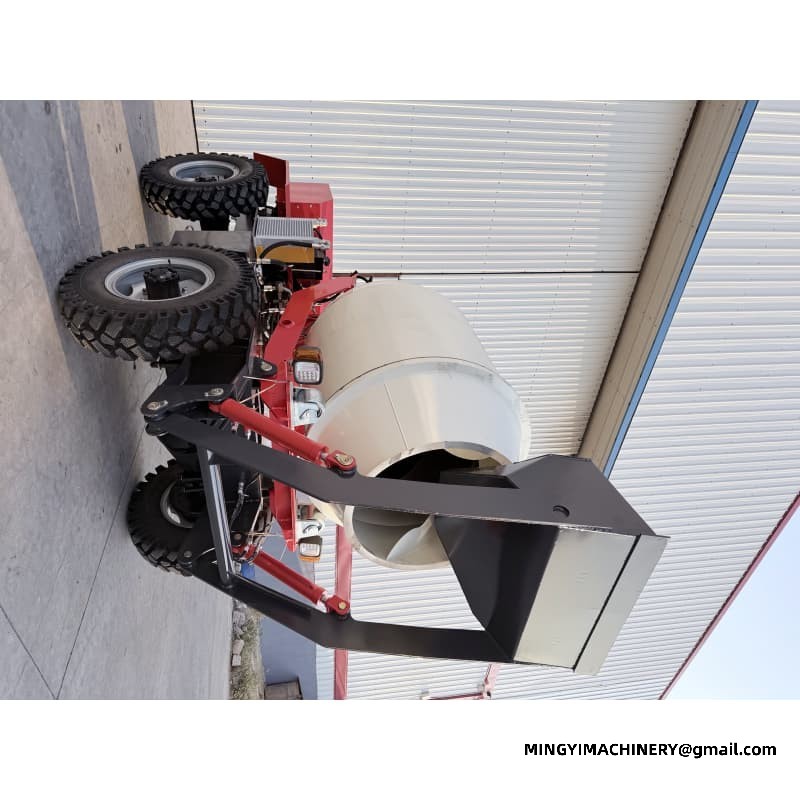
Power comes from a single-cylinder diesel rated at 25 hp. It drives the transmission, the drum and the hydraulics, and it does so with the mechanical directness that makes small site machines easy to keep alive: no electronics to fail, no dealership lock-out, one cylinder to know by heart.
Fuel quality is the one consumable worth policing. Dirty or wet diesel is the single biggest cause of injector trouble in engines of this pattern, and a simple water separator in the fuel line is simpler than one injector on rural road work.
Hire saves the capital and the storage; ownership saves the weekly rate and the waiting. For the user whose on rural road work pouring culverts and kerbs between villages recurs, the owned machine is usually the simpler one by the second season.
Ownership's real takes are the visible ones: the machine, the spares kit, the fuel, and the operator's time. None is hidden, none is large, and all survive a spreadsheet. The effort that surprises new owners is the working capital tied in stockpiled aggregate and cement — the inputs, not the machine.
Measure the machine in hours, not in days. A drum that cycles every few minutes earns more in a short shift than a machine that waits between batches, and the hour meter is the honest tally of both. The published speed and gears exist to keep the cycle tight, not to make the machine fast.
Where one machine cannot keep up, the answer is usually two at lower utilisation, not one pushed past its rhythm. Two machines serve two pours; one machine pushed past its cycle serves neither well and arrives at the next service early.
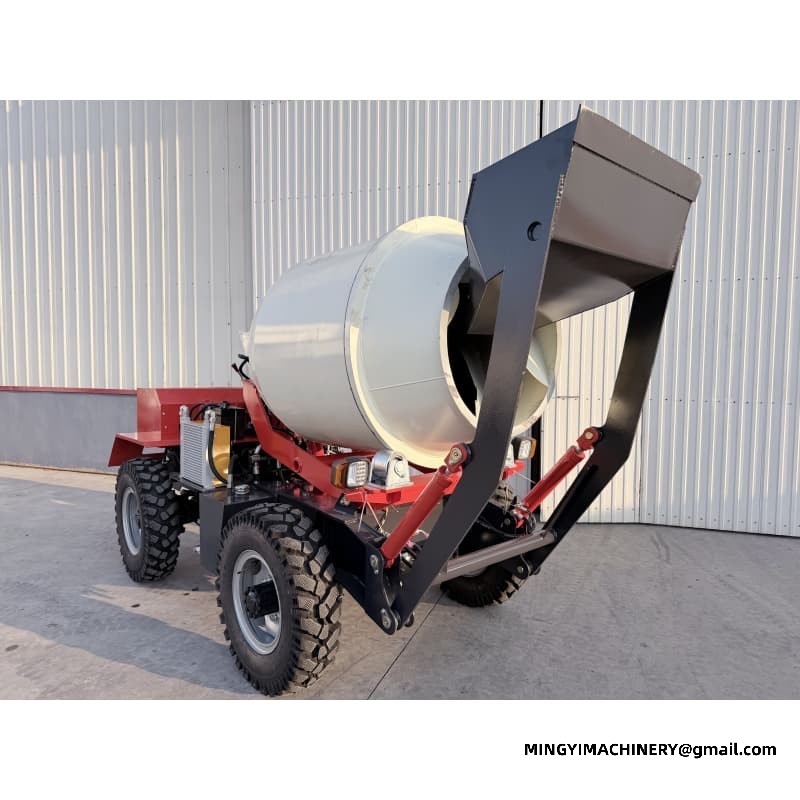
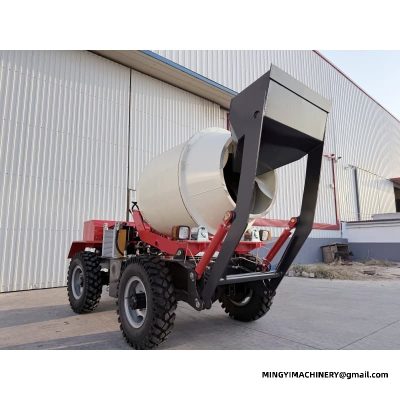
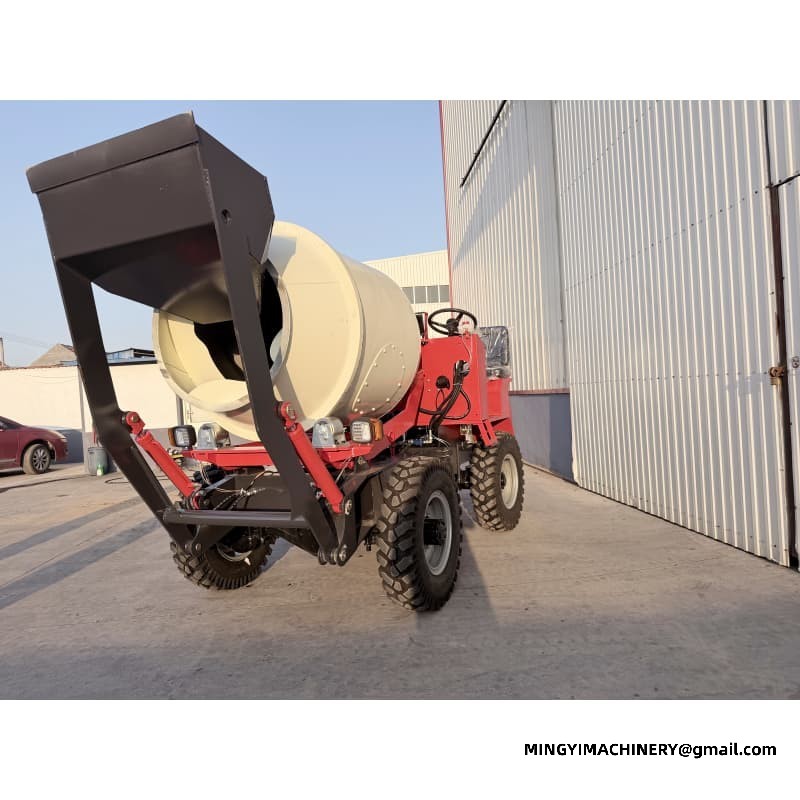
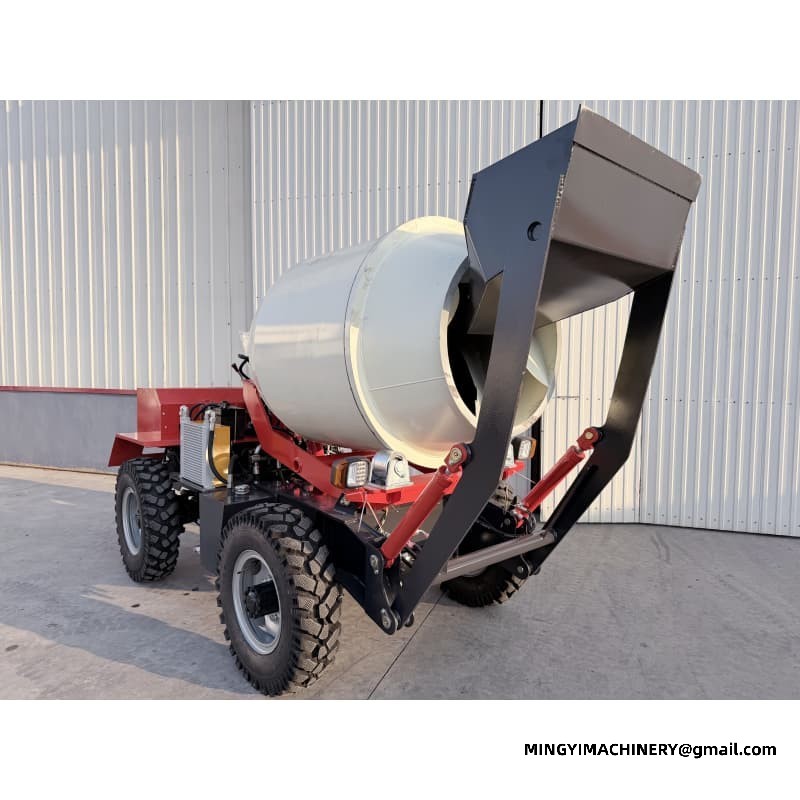
Self-loading is the whole idea. A front shovel scoops aggregate and sand from a stockpile, lifts it over the drum, and releases it — no separate loader, no second machine, no third pair of hands. One operator runs the entire chain from pile to pour.
The discipline that keeps it healthy: scoop shallow, drop into the drum rather than onto its rim, and keep the shovel clean before park-up. Operators who treat it gently on rural road work get years from it; operators who use it as a dozer replace pins and bushings far sooner.
The rules are short: slow through turns, gentle on the stops, drum level in transit and nobody riding on a machine built for one. Every accident report on mixers of this class starts with one of those rules broken.
Seat position is part of the safety case: the open station puts the operator's eyes at drum height, with the shovel arc and the discharge point both in view. Machines that hide their own working parts invite the guesses that cause injuries.
The gearbox gives three forward gears, one reverse and a separate travel gear, with a top speed of 24 km/h. On site the machine lives in first and second; the travel gear exists to move between jobs on a road without holding up traffic.
Because discharge happens over the front, the natural approach is to back in: reverse toward the formwork, stop square, tip, and drive away forward without a second manoeuvre. One reverse gear is all this needs, and the 28° rear steer makes the approach line easy to correct.
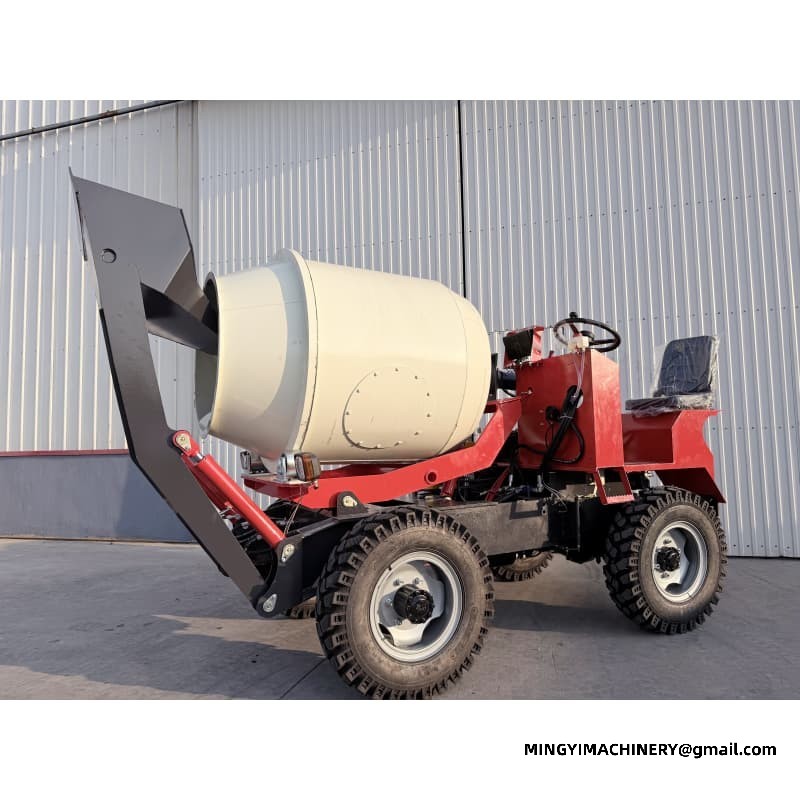
Confirm the specification in writing against the published table: 0.8 m³ capacity, 1,500 kg rated load, 4WD transmission, 25 hp single-cylinder diesel, the 130 front axle and 212 rear steering axle, and hydraulic power steering. Ask what is standard and what is optional in the build you are buying.
Buying the kit with the machine also proves the supply chain before it is needed. Ask the supplier to specification parts by the same reference numbers as the manual, so the second order places itself.
A transit mixer delivers volume from a plant; this machine delivers independence from a plant. For large continuous pours the transit wins outright. For small pours beyond the plant's radius — on rural road work pouring culverts and kerbs between villages — the transit's minimum charges and queue time make it the dearer option.
Between those poles sits the question worth asking any supplier: what does this pour actually consume per hour? A supplier who answers with the cycle arithmetic — 0.8 m³ per batch, travel time, placing rate — is a supplier worth keeping.
Where the mix changes through a day — a lean base, a richer top — the machine carries the change as easily as the material, provided the crew keeps the recipe card current. Switching batches is a scoop count and a water measure, not a machine adjustment.
Wet seasons ask for drier batches and firmer ground; dry seasons ask for the opposite, plus shaded stockpiles so the mix does not start hot. The machine adapts through its recipe and its route, and neither asks anything of the drum but consistent turning.
Is the self loading concrete mixer four-wheel drive?
Yes. Transmission is 4WD — four-wheel drive through a 130 front drive axle, with the 212 rear axle selectable for four-wheel-drive steering. Rear drive is selectable, so the machine runs light on hard standing and engages all four wheels when the ground turns soft.
How do I get a specification for the self loading concrete mixer?
E-mail sales@mingycn.com or add LINE (ID): mingyicn with your market and intended work; the reply covers the specification, optional items and freight to your port.
How does the self loading concrete mixer discharge the concrete?
The drum reverses and tips hydraulically, discharging over the front to a barrow, bucket or straight into formwork. The operator aims the pour from the seat.
What gears does the self loading concrete mixer have?
Three forward, one reverse, plus a travel gear for road moves between sites. First and second cover loading and hauling on rural road work.
Why does my self loading concrete mixer drum hold less than it used to?
Almost always a hardened heel of paste inside the drum, built up by late wash-outs. Chip it out, return to daily rinsing, and the full 0.8 m³ comes back.
Can the self loading concrete mixer run on finished slabs without damaging them?
Fresh slabs take wheel loads only when cured enough — protect with boards or route around, the same as any plant. The agricultural tyres are kinder than steel tracks but not kind to green concrete.
How much does a self loading concrete mixer effort?
Specification depends on market, options and freight, so it is stated rather than published. E-mail sales@mingycn.com or LINE (ID): mingyicnfor a formal specification for your port.
How is the self loading concrete mixer shipped?
At 3,500 x 1,600 x 2,200 mm it loads into a standard container with lashing alone. On arrival, check drum and shovel for transit damage and run the drum empty before the first batch.
Measure the gateway, time the cycle, write the recipe — three small exercises that turn the published specification into a working plan for your site.
Moving Self Loading Concrete Mixer: The Complete Specification between sites
Securing the load is not optional. Lashing Self Loading Concrete Mixer: The Complete Specification at the points intended for it, checking the tension before the vehicle moves and rechecking after the first kilometres is standard practice rather than extra care.
Wear items and spares worth holding for Self Loading Concrete Mixer: The Complete Specification
Holding spares is about downtime rather than the shelf itself. The question for Self Loading Concrete Mixer: The Complete Specification is not how large the part is but how long the machine sits while it is found, and a small shelf answers that better than a fast courier.
Planning the season around Self Loading Concrete Mixer: The Complete Specification
Downtime is simplest when it is planned. Booking the service for Self Loading Concrete Mixer: The Complete Specification in the quiet part of the season takes nothing from the schedule, while the same work in the busy weeks gives up a day of output every time.
Later additions and retrofits on Self Loading Concrete Mixer: The Complete Specification
An added function should pay for itself quickly. Whether Self Loading Concrete Mixer: The Complete Specification gains a different bucket, a hydraulic service or a protection package, the test is the number of days a year it is actually used.
Fuel, oil and fluid quality for Self Loading Concrete Mixer: The Complete Specification
The specification for oil is written for a reason. Using the grade and the change interval set for Self Loading Concrete Mixer: The Complete Specification keeps the engine and the hydraulic system inside the range they were designed for.
Contact MINGYI Machinery for the current self-loading concrete mixer specification, export packing and a formal specification for your market. E-mail: sales@mingycn.com | LINE (ID): mingyicn
Mini Self Loading Mixer, Compact by Design: 1,600 mm Wide · Rough Terrain Concrete Mixer: 4WD and 204 mm Clearance · low speed high torque dumper for mining and quarry work · Mini Self-Loading Concrete Mixer









