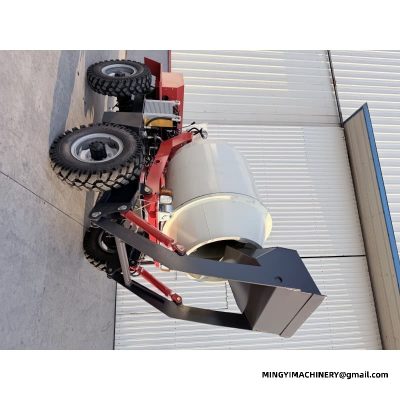
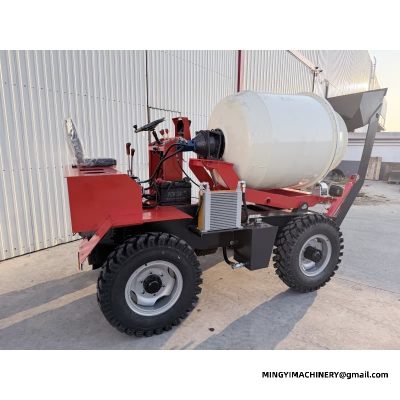
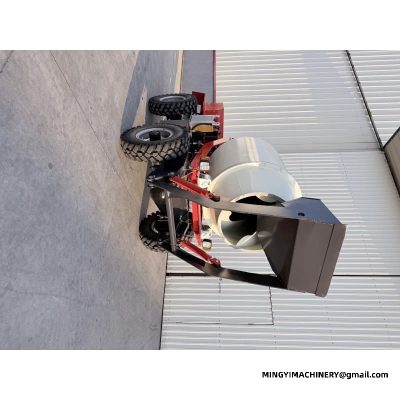
Mini Self Loading Concrete Mixer, Small Self Loader, Compact Mixer
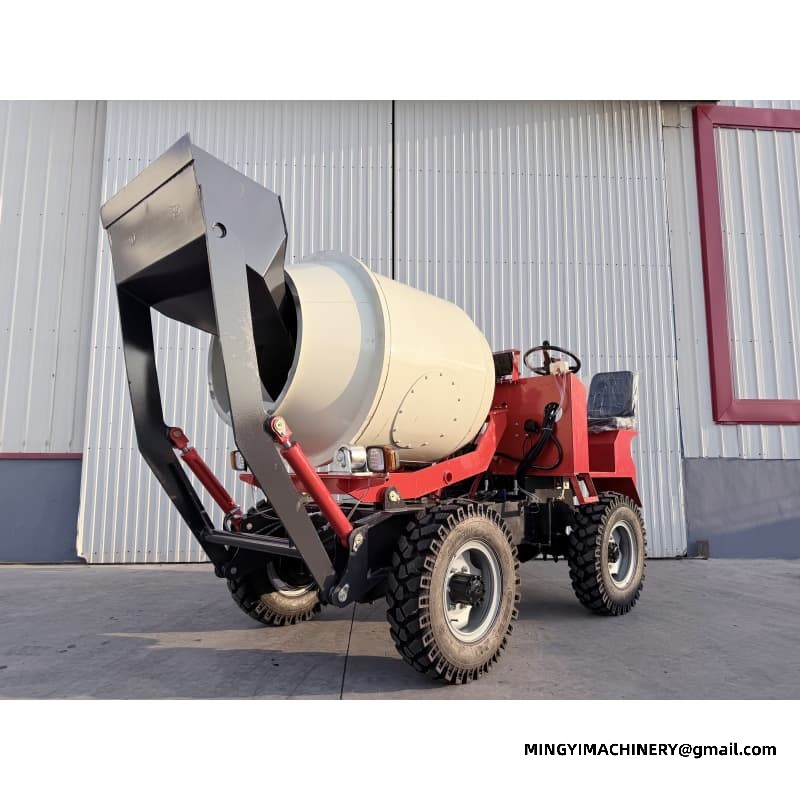
Small pours, repeated all day, are a logistics problem. The mini self loading concrete mixer compact answers it with a 0.8 m³ drum, a front shovel and four driven wheels — four-wheel drive through a 130 drive axle with a 212 steering axle behind. This page reads the specification the way an estimator would: what each batch contains, what the cycle takes in time, and where the machine's limits honestly sit.
Ready-mix is the simpler source per cubic metre when a plant is close and the pour is large. Beyond that radius, minimum-load charges, queue time and the stiffening in the drum flip the arithmetic, and batching on canal work from stockpiled aggregate wins.
Depreciation favours the machine too, because the 3,500 x 1,600 x 2,200 mm envelope keeps transport takes between jobs near nothing. The biggest single effort of plant is often moving it; this one rides a tag trailer behind a pickup.
3,500 x 1,600 x 2,200 mm is the whole machine: short enough for a site trailer, narrow enough for a garden gate, low enough for a container without a top-loader's paperwork. Every one of those three numbers earns its place somewhere on canal work.
The frame's load path is short and visible: drum to subframe to chassis rails to axles, with no outriggers and no overhang to manage. That simplicity is why the machine tolerates rough hauls on canal work and why its frame rarely fatigues.
Measure the machine in hours, not in days. A drum that cycles every few minutes earns more in a short shift than a machine that waits between batches, and the hour meter is the honest tally of both. The published speed and gears exist to keep the cycle tight, not to make the machine fast.
The 4WD chassis and the simple engine both tolerate steady work better than they tolerate abuse, and the crews who respect the cycle get a machine that reaches its resale value intact.
| Published build data — 0.8 m³ 4WD self-loading concrete mixer | |
|---|---|
| Rated load | 1,500 kg |
| Rated capacity | 0.8 m³ |
| Overall dimensions (L x W x H) | 3,500 x 1,600 x 2,200 mm |
| Front tyre size | 8.25-16 |
| Rear tyre size | 7.50-16 |
| Minimum ground clearance | 204 mm |
| Steering angle | 28° |
| Turning dimension (outer tyre) | 2,464 mm |
| Maximum travel speed | 24 km/h |
| Transmission | 4WD |
| Gears | 3 forward / 1 reverse + travel gear |
| Front axle | 130 drive axle |
| Rear axle | 212 selectable 4WD steering axle |
| Engine | single-cylinder diesel / 25 hp |
| Steering | hydraulic power steering |
The route decides the job before the mixer does. Walk it first: gateway width, height bar, the tightest turn inside the gate, the worst ground between stockpile and pour, and the discharge spot itself. The 2,464 mm turning circle and 204 mm clearance turn each measurement into a plain yes or no.
Mark the discharge point before the pour, not during it. A standing spot within barrow reach of the formwork is worth more than a tidy spot metres away, because the last metres are where batches lose their workability.
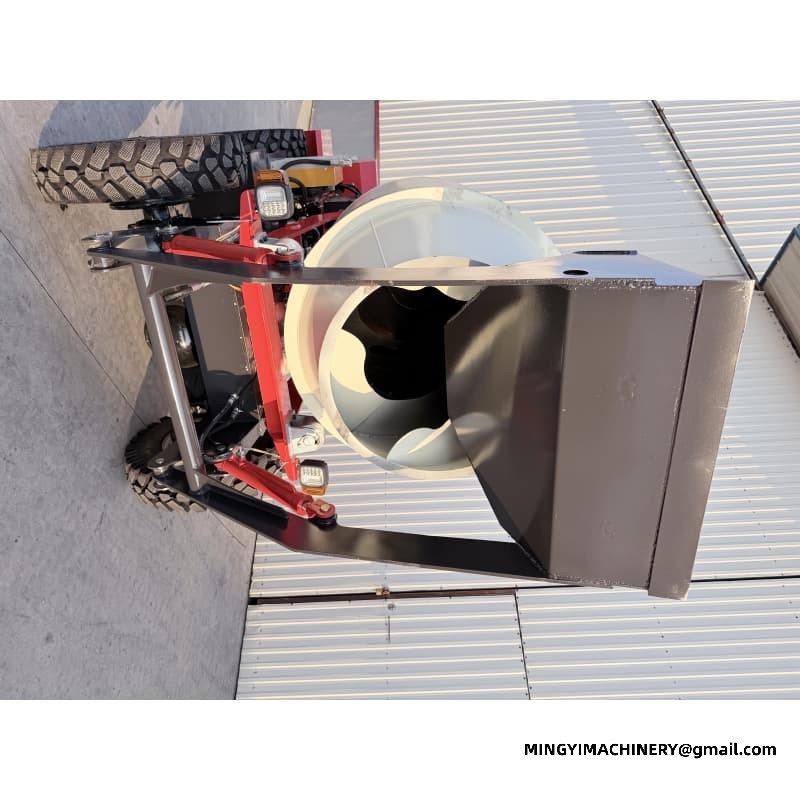
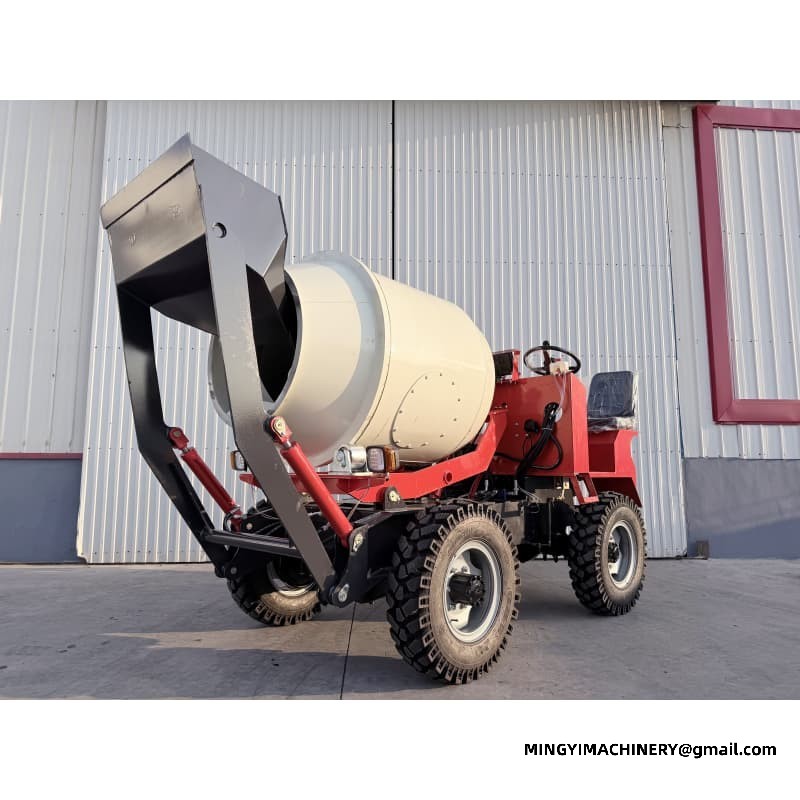
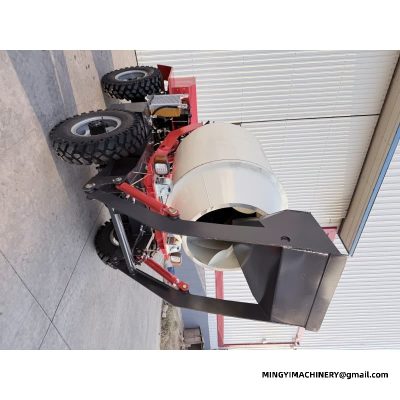
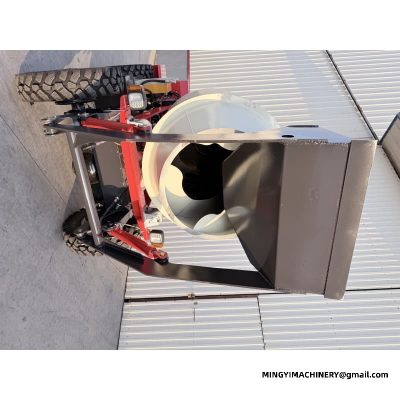
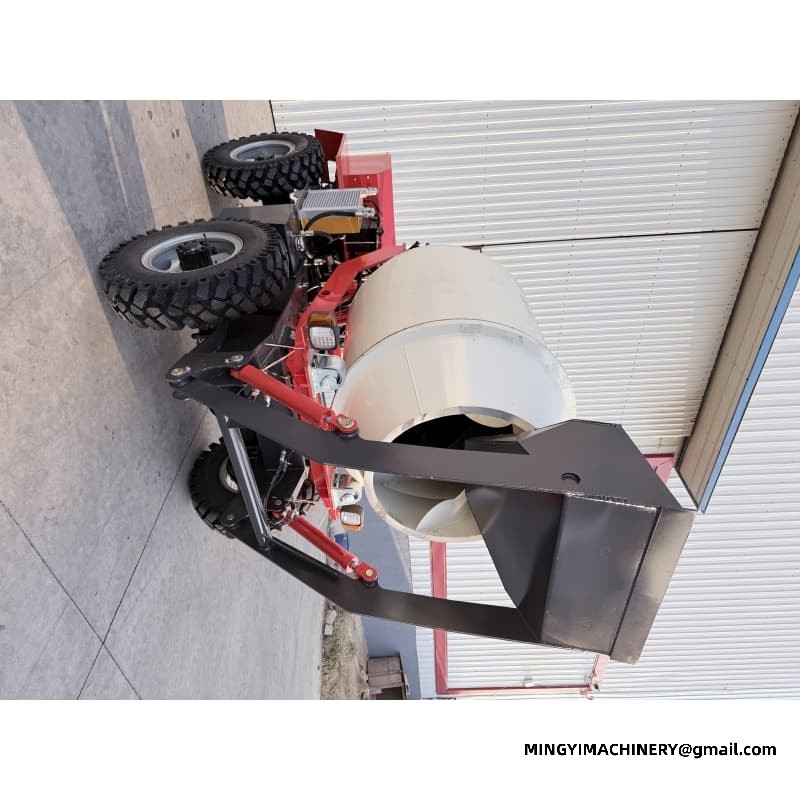
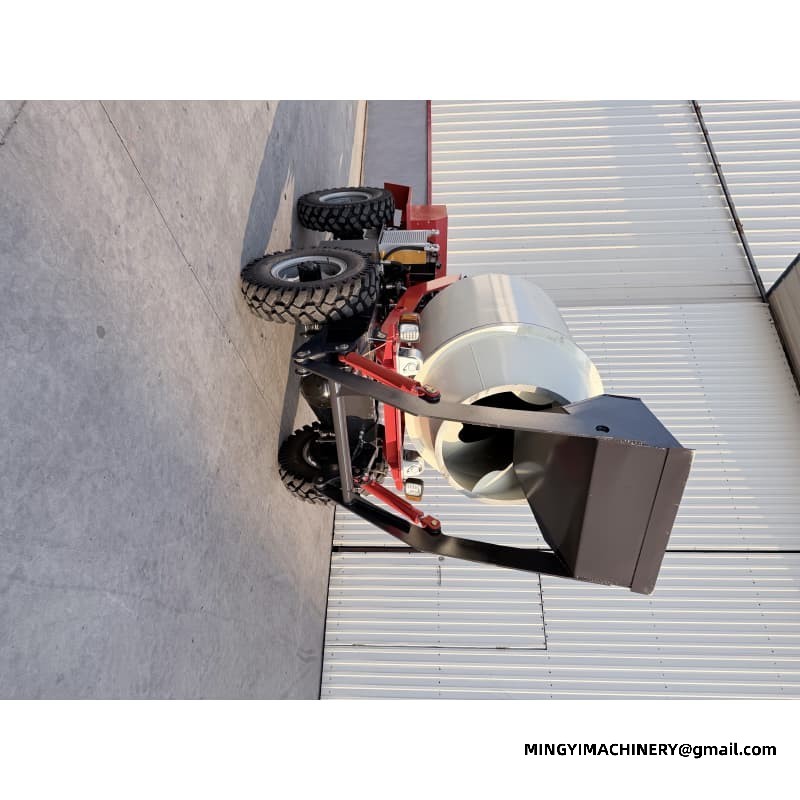
Self-loading is the whole idea. A front shovel scoops aggregate and sand from a stockpile, lifts it over the drum, and releases it — no separate loader, no second machine, no third pair of hands. One operator runs the entire chain from pile to pour.
Inspection is a two-minute weekly job: pins, teeth or cutting edge, and the two hoses that flex with every lift. Caught early, a weeping fitting or a worn bushing is a teatime repair; left alone, it becomes a pour-day stoppage on canal work.
The drum delivers 0.8 m³ at a rhythm, so the pour plan should be drawn in drum-sized bays: place, finish, move, repeat. Crews that lay out formwork to the machine's cycle pour all day without cold joints; crews that fight the rhythm chase stiffening edges by noon.
On canal work, the practical habit is to batch slightly smaller in heat, slightly larger in cold, and never to batch ahead of the formwork by more than one drum. The machine makes that kind of just-in-time batching possible; the pour plan should use it.
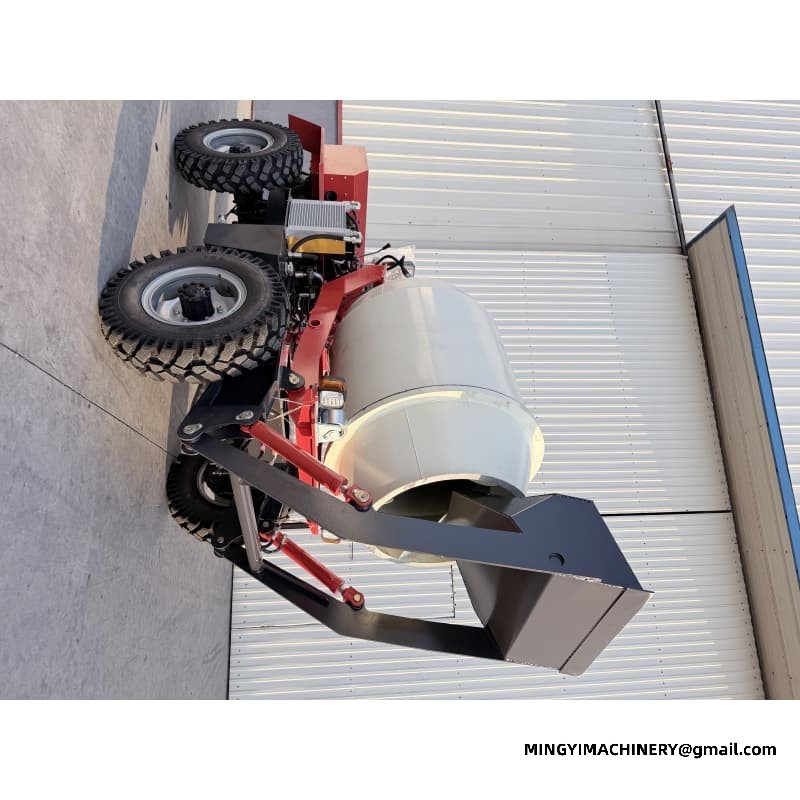
The machine earns its place wherever concrete is needed in small, repeated batches away from a batching plant: on canal work placing lining concrete along the channel. The common thread is distance — too far from the plant for ready-mix to be economical, too continuous for hand mixing.
On canal work, that sharing is where the machine pays for itself fastest. Three crews hand-mixing effort more in labour every week than the machine takes across a season, and they produce a less consistent batch while doing it.
The gearbox gives three forward gears, one reverse and a separate travel gear, with a top speed of 24 km/h. On site the machine lives in first and second; the travel gear exists to move between jobs on a road without holding up traffic.
Plan the standing spot before the first batch, not after. A machine that has rehearsed its approach discharges in a minute; a machine improvising each approach spends more time manoeuvring than mixing over a shift.
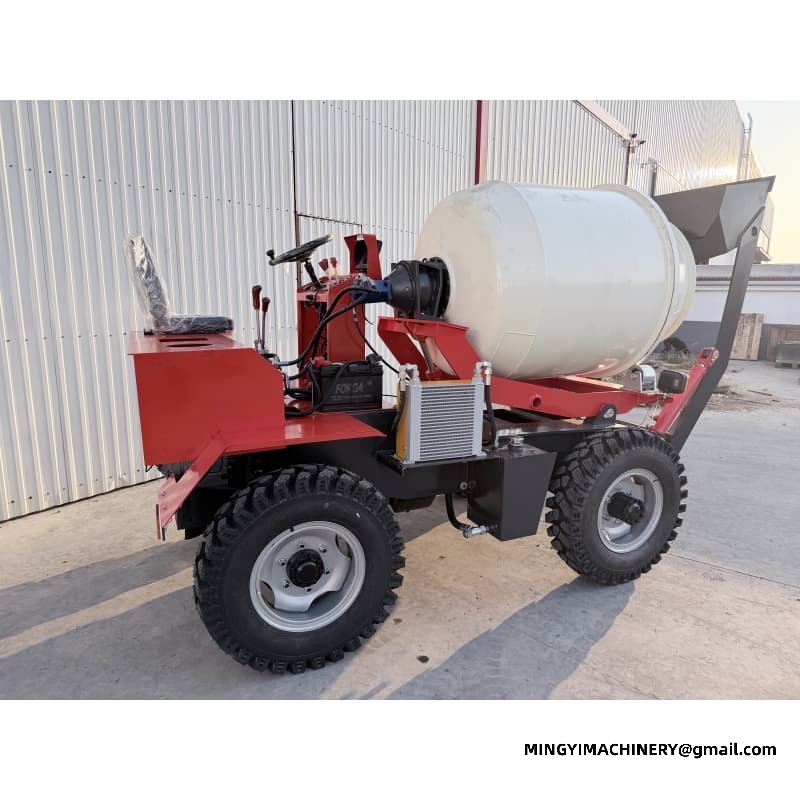
The control set is small — key start, gears, shovel levers, drum controls, steering — and a careful new operator works productively inside a day. The training that matters is judgement: slopes, loads, people, and the discipline of the wash-out.
Fleets that run a small logbook on the machine solve most inter-crew friction before it starts, and the record doubles as the service history the resale market will one day ask for.
The front tyres are 8.25-16 and carry the drive under a full drum; the rears are 7.50-16 and steer. The heavier front fitment matches the heavier front duty — drive torque plus a loaded drum sitting between the axles.
Rotate fronts left-to-right when wear diverges, and keep the spare mounted and pressured rather than buried in the yard. A flat tyre takes minutes; a flat tyre with no spare takes a pour on canal work.
Keep the parts book and the order history together. The second order, placed a year later for a blade or a seal, is a two-minute email when the reference numbers are at hand and a half-day search when they are not.
A supplier worth keeping answers the cycle question — 0.8 m³ per batch, travel time, placing rate — rather than quoting a discount. The relationship that outlasts the warranty is the one built on specification and parts, not on specification alone.
204 mm of clearance under the axles is the machine's ground rule. It clears ruts, rubble and standing water of that depth, and it does not clear more. The low build is what keeps the centre of gravity down under a raised drum, so the number is a design trade, not a deficiency.
The rules that keep it upright are old ones: straight up, straight down, no turning across a loaded slope, and no sudden stops with 0.8 m³ of wet concrete shifting in the drum. None of them takes the crew any time worth measuring.
Drive goes to all four wheels — four-wheel drive through a 130 front drive axle, with the 212 rear axle selectable for four-wheel-drive steering. On firm ground two driven wheels would do, but site concrete rarely sits on firm ground. Wet spoil, sand, loose fill and grass all reward traction at every corner, which is what the 4WD transmission buys.
A 28° steering angle on the rear axle turns the machine inside a 2,464 mm circle measured at the outer tyre. Village lanes, orchard rows, basement ramps and gateways all live inside that radius.
Can the mini self loading concrete mixer compact do canal lining work?
Yes. It runs along the towpath inside a 2,464 mm turning circle, batching lining concrete as it goes from section to section.
Does the mini self loading concrete mixer compact have a chute?
Discharge is by tipped drum over the front, aimed by the operator. Where the pour needs a longer reach, a barrow stage or a locally made chute extension covers the gap — ask the supplier what is offered.
Can the mini self loading concrete mixer compact run on finished slabs without damaging them?
Fresh slabs take wheel loads only when cured enough — protect with boards or route around, the same as any plant. The agricultural tyres are kinder than steel tracks but not kind to green concrete.
Can the mini self loading concrete mixer compact charge a concrete bucket or skip?
Yes, where the skip sits within the discharge arc at %s height discipline allows. The drum pours into barrows, buckets or formwork without a second handling.
Can the mini self loading concrete mixer compact drive on public roads?
It travels at 24 km/h in the road gear between sites. Registration and lighting requirements differ by market, so confirm local rules before regular road use.
Does the mini self loading concrete mixer compact drum rust out?
Not if it is washed daily and left clean. The drum that dies young is the drum that sleeps with concrete in it — the heel holds moisture against the steel all season.
How long does it take to train a mini self loading concrete mixer compact operator?
A careful new operator works productively within a day. The controls are few; the judgement worth training is slopes, loads and the wash-out habit.
When does a mini self loading concrete mixer compact stop making sense?
Where ready-mix is close and pours are large, where access is narrower than the machine, or where work happens at height or reach no wheeled mixer can serve. Other tools win those.
The machine's arithmetic is short: 0.8 m³ per batch, 1,500 kg of payload, four driven wheels and one operator. Weighed against the labour it replaces and the ready-mix charges it avoids, the purchase decision is the smallest line on the page.
Moving the concrete mixer between sites
A machine that works on one site still has to reach the next. The overall dimensions and the operating weight of this class of machine decide what trailer or truck is needed, and that decision belongs before the job is booked.
Documents that travel with the unit in daily use
A clear parts book saves more time than any other document. When a machine of this size needs a replacement, the illustration and the part number are what turn a phone call into a shipment instead of a description.
Keeping a service record for the equipment on site
Patterns show up in the record before they show up in the machine. Rising oil consumption or a filter that keeps blocking on the machine itself is obvious on paper long before it becomes a failure on site.
Pre-delivery inspection before the model in question leaves the shop
The last hour before packing is the best time to find a fault. Running the machine in that duty through its full working cycle, checking for leaks under load and confirming that the controls match the specification avoids a conversation across time zones later.
Handover and getting familiar with the unit on the job
Familiarisation is not the same as reading the manual. Sitting on a machine built for the work, working through the controls at low speed and learning where the machine balances takes an hour, and that hour is what keeps the first week uneventful.
Reading the early symptoms on the equipment in service
Machines rarely fail without warning. A change in sound, a slower function or a new leak on the concrete mixer is the machine saying something early, and listening then takes a fraction of the time that waiting does.
Contact MINGYI Machinery for the current self-loading concrete mixer specification, export packing and a formal specification for your market. E-mail: sales@mingycn.com | LINE (ID): mingyicn
Rough Terrain Concrete Mixer: 4WD and 204 mm Clearance · Diesel Self Loading Concrete Truck: Between Sites at 24 km/h · customized 4x4 dumper for mining and quarry work · Mini Self-Loading Concrete Mixer









