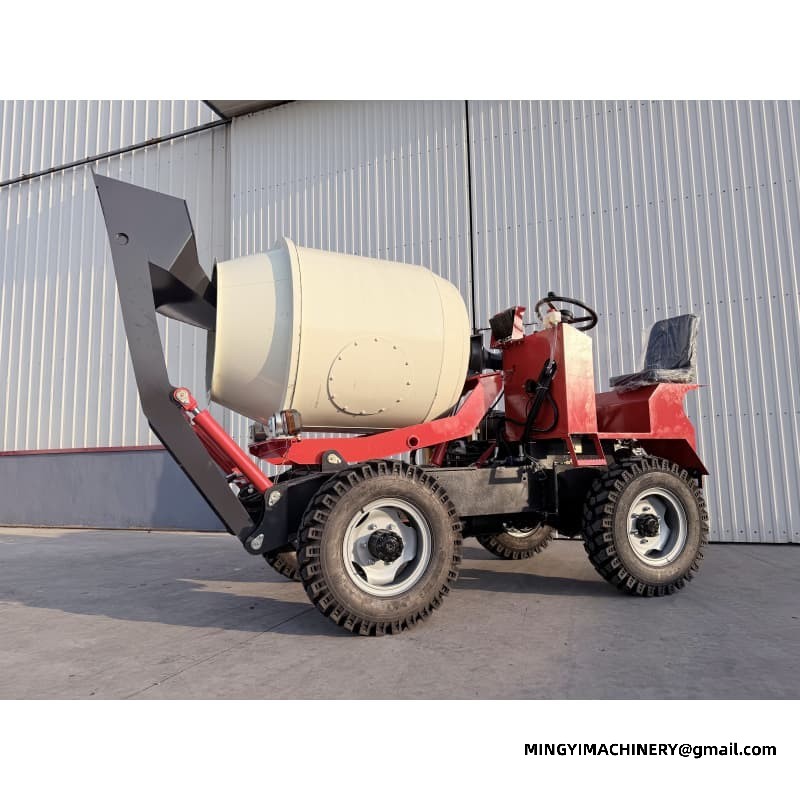
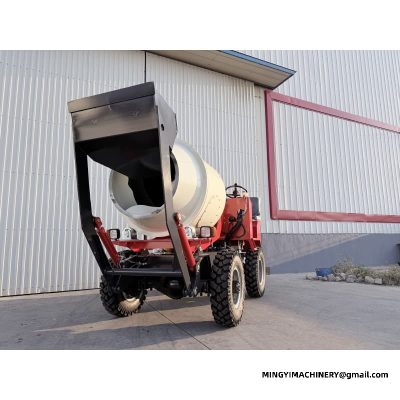
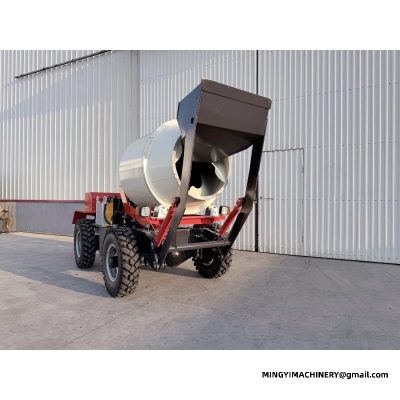
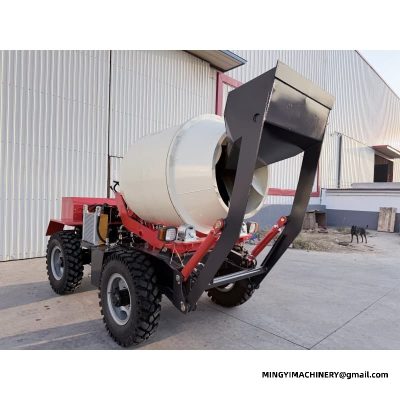
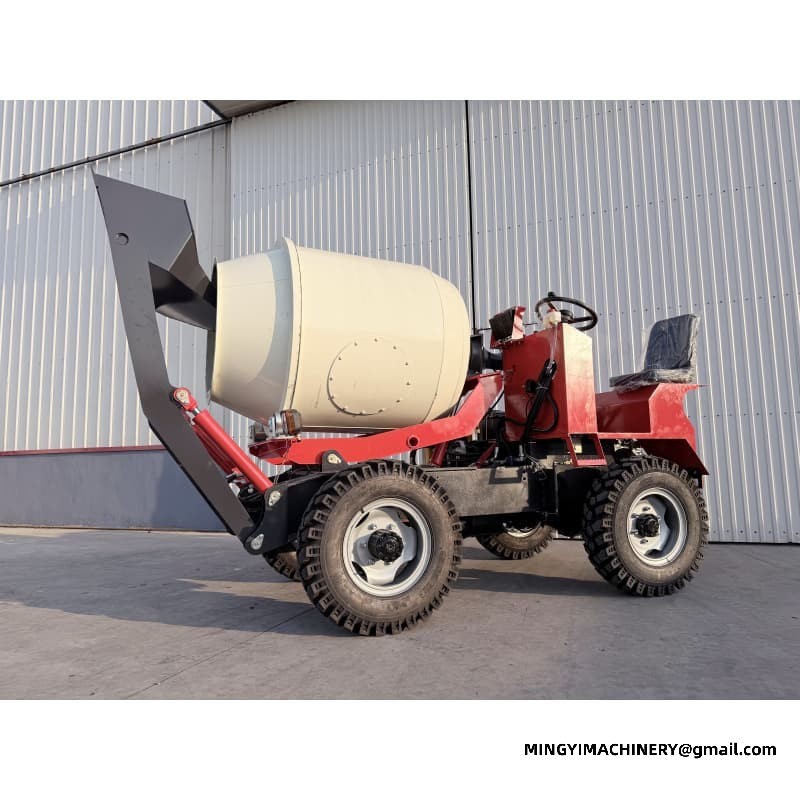
Diesel Self Loading Concrete Truck, Diesel Powered Mixer, Mobile Digger
Every figure on the diesel self loading concrete truck table earns its keep somewhere specific. The 0.8 m³ drum matters at the formwork; the 8.25-16 tyres matter halfway across a wet site; the 25 hp single-cylinder diesel matters at the fuel bowser and at the mechanic who knows it by heart. This page connects each published number to the moment in orchard pathways a crew actually feels it.
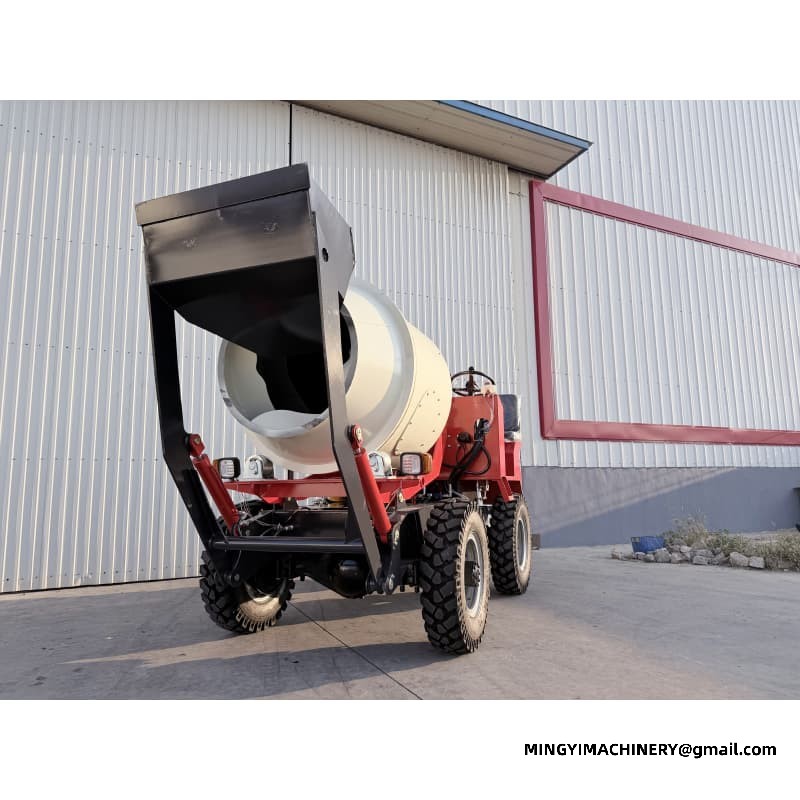
Engine oil and fuel, air restriction, hydraulic level, drum cleanliness, tyres and wheel nuts, lights and mirrors. That walk-round takes five minutes and catches nearly everything that becomes lengthy when missed.
The monthly drum inspection matters more than it sounds: blades wear, and a worn blade mixes slowly and mixes badly. Replacing blades at the wear line keeps 0.8 m³ truly equal to 0.8 m³.
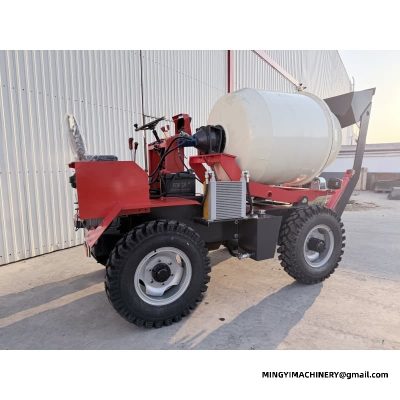
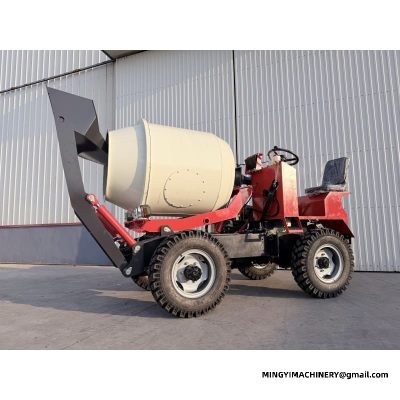
Power comes from a single-cylinder diesel rated at 25 hp. It drives the transmission, the drum and the hydraulics, and it does so with the mechanical directness that makes small site machines easy to keep alive: no electronics to fail, no dealership lock-out, one cylinder to know by heart.
Daily care is a two-minute walk-round: oil, fuel, air restriction, belt, and a check that the radiator front is not blinded by dust. Machines worked in dry conditions in orchard pathways need that filter check more often than the book says.
Write the survey down and compare it with the published envelope before committing. Crews that skip this step discover the constraint with a full drum aboard, in orchard pathways — the lengthy way to learn a number.
Most sites need a little ground work before the machine earns its keep: grade the haul, fill the ruts, gravel the standing spots, and protect any services in the working line. An hour with a shovel and a bag of hardcore keeps the 4WD honest and the drum moving.
| Reference specification — 0.8 m³ 4WD self-loading concrete mixer | |
|---|---|
| Rated load | 1,500 kg |
| Rated capacity | 0.8 m³ |
| Overall dimensions (L x W x H) | 3,500 x 1,600 x 2,200 mm |
| Front tyre size | 8.25-16 |
| Rear tyre size | 7.50-16 |
| Minimum ground clearance | 204 mm |
| Steering angle | 28° |
| Turning dimension (outer tyre) | 2,464 mm |
| Maximum travel speed | 24 km/h |
| Transmission | 4WD |
| Gears | 3 forward / 1 reverse + travel gear |
| Front axle | 130 drive axle |
| Rear axle | 212 selectable 4WD steering axle |
| Engine | single-cylinder diesel / 25 hp |
| Steering | hydraulic power steering |
On a well-run machine the chassis and drum outlast several sets of consumables: shovel pins and bushings, drum blades, tyres, belts, hoses and filters are the renewal cycle. The single-cylinder diesel is the long-life heart, and its overhaul parts are stocked wherever single-cylinder diesels are common.
Second owners buy the same habits the first owner had — the wash-out record, the greased pins, the straight shovel. Machines change hands quickly in this class precisely because so much of their condition is visible at a walk-round.
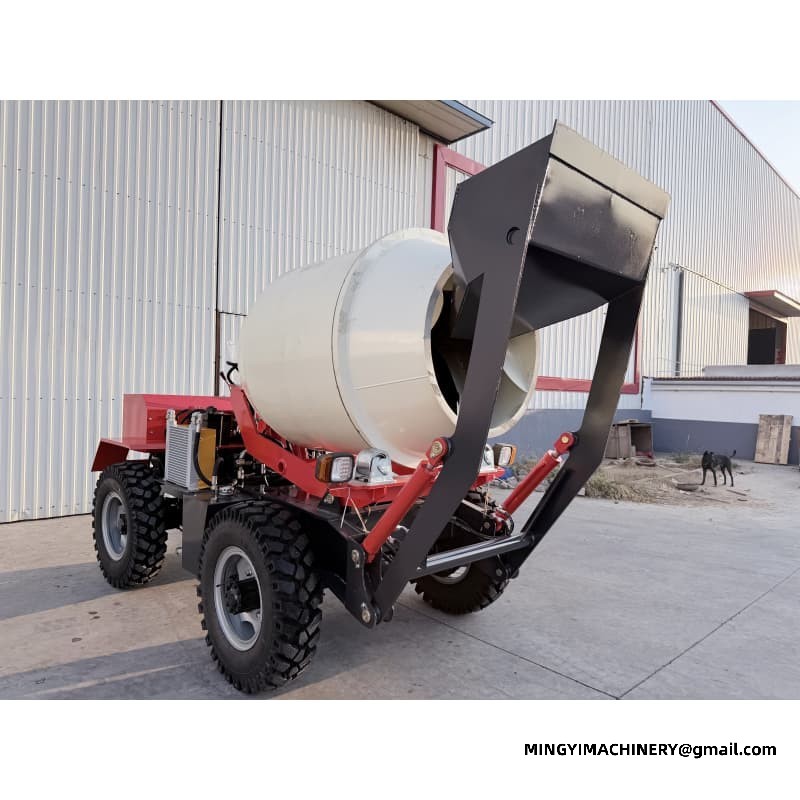
In orchard pathways, that single-operator loop is the economic argument. Labour is the biggest recurring effort on small concrete work, and the shovel removes most of it. Cement, water and aggregate are the only inputs the crew still handles by hand.
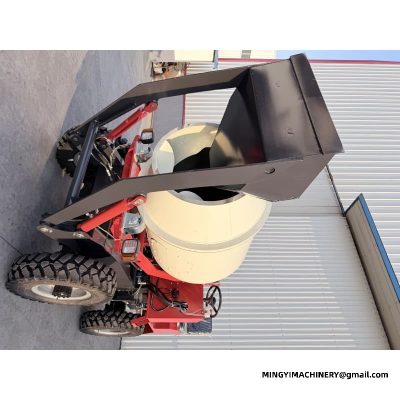
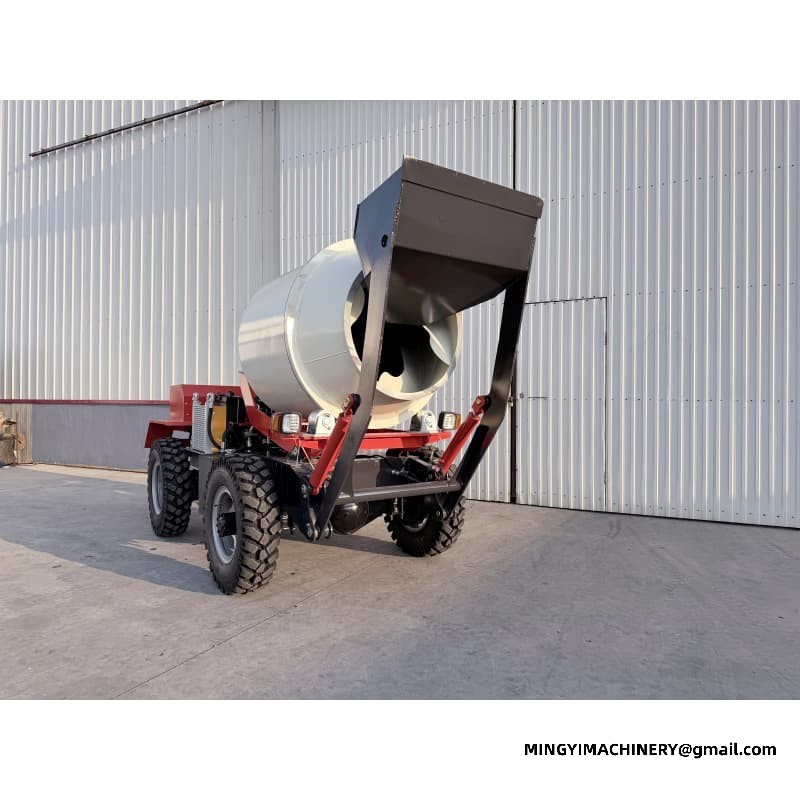
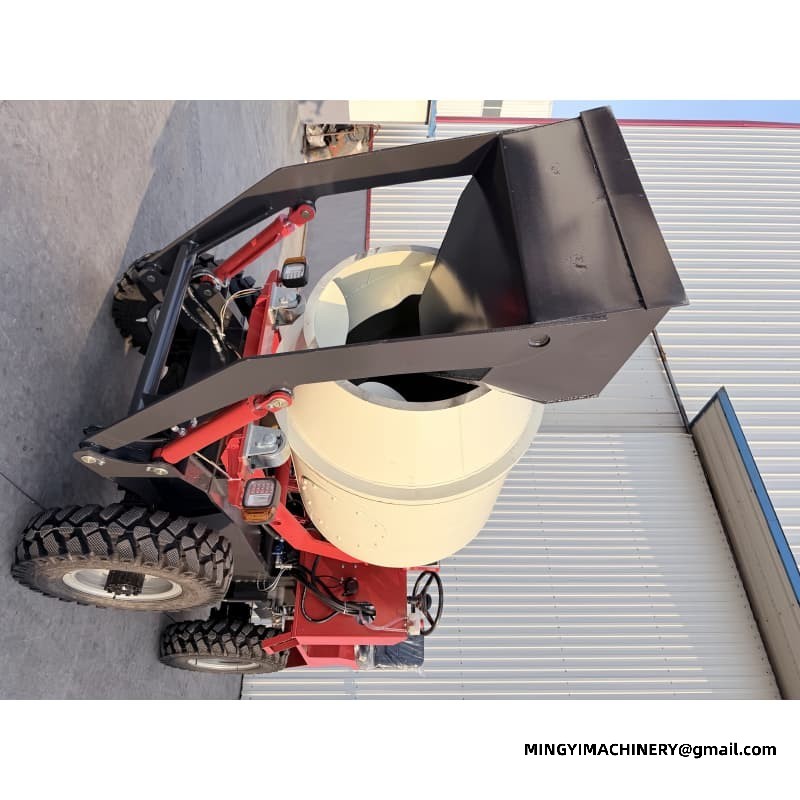
The shovel's geometry deserves a sentence of its own: it loads from in front of the drum, so the machine stands facing its stockpile and drives away facing the pour. No reversing into position, no second alignment, and the whole cycle in orchard pathways keeps one direction of travel.
A specification is a contract before it is a sales document, and this one is short enough to read in a minute. The first cluster — 0.8 m³ capacity, 1,500 kg rated load, the 3,500 x 1,600 x 2,200 mm envelope — describes what a batch is and where the machine can stand. The second — 4WD, the 130 and 212 axles, 204 mm clearance — describes whether it can reach the pour.
A line worth pausing on is the gear set — 3 forward, 1 reverse and a travel gear — because it tells you how the machine splits slow, strong work from the road run between sites. The travel gear is not for the load; it is for the empty road, and the distinction keeps the box alive.
The operator profile is one person, but the people around the machine change by the hour. The mixer serves a foundation crew, a masonry crew and a patching gang in sequence, each with the recipe it needs and the standing spot it wants. The single seat is the reason the machine suits small contractors who cannot spare a second hand.
Fleets that standardise on a small number of such machines report lower training overhead and fewer breakdown escalations than mixed fleets of larger, more complex plant. The simplicity is the business case, not a compromise.
Heat shortens everything: the workability window, the wait between batches, the time a finisher has. In hot seasons the drum works slightly smaller batches, water is measured colder and exactly, and aggregate stockpiles are kept shaded where possible so the mix does not start hot.
Four-wheel drive and the 28° steering keep it moving where two-wheel machines stop, but no tyre argues with deep mud under a loaded drum. The crews who win wet seasons are the ones who maintain their haul routes like part of the pour.
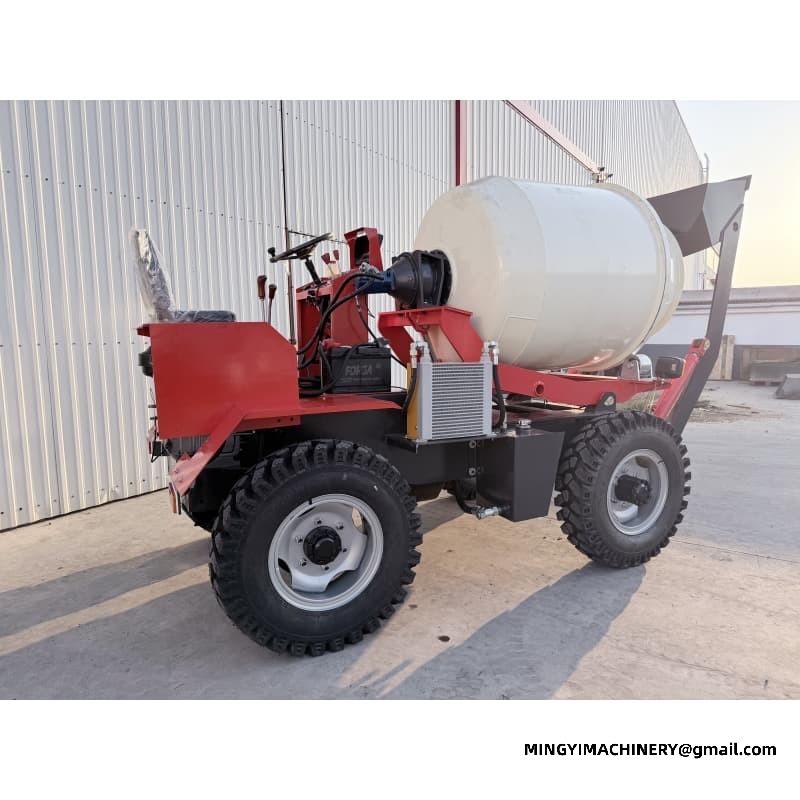
The machine earns its place wherever concrete is needed in small, repeated batches away from a batching plant: in orchard pathways where a full-size truck cannot turn. The common thread is distance — too far from the plant for ready-mix to be economical, too continuous for hand mixing.
A simple booking sheet settles the sharing question before it becomes an argument: which crew, which hours, which recipe. The machine serves whoever plans for it; it punishes whoever assumes it will be waiting, full and clean.
Steering is hydraulic power steering acting with the 28° rear-axle steer. The wheel is light under a full drum, the steering response stays predictable at crawl speeds, and the machine holds a straight line under load without fighting the operator.
2,464 mm is measured at the outer tyre, so walls and posts at body height are the real constraint — the machine's shoulders swing wider than its tyres. Crews that remember this stop clipping mirrors and handrails in orchard pathways.
Where the mix changes through a day — a lean base, a richer top — the machine carries the change as easily as the material, provided the crew keeps the recipe card current. Switching batches is a scoop count and a water measure, not a machine adjustment.
The machine's natural work is the small structural pour — bases, posts, beams, ties — and the non-structural one beside it: paths, kerbs, patching, linings. Both consume 0.8 m³ per batch in quantities the drum and the crew handle naturally.
The width is the number that opens the most doors. At 1,600 mm the machine goes through standard double gates and between formwork lines that stop wider equipment, and it does so with a full drum because the drum sits inside the envelope, not above it.
The height figure hides a detail worth checking on hire fleets and after modifications: the envelope assumes the shovel down and the drum level. A raised shovel adds materially to the length, and crews loading onto trailers should measure in travel order.
The drum delivers 0.8 m³ at a rhythm, so the pour plan should be drawn in drum-sized bays: place, finish, move, repeat. Crews that lay out formwork to the machine's cycle pour all day without cold joints; crews that fight the rhythm chase stiffening edges by noon.
Wind deserves a mention in the schedule too: it stiffens exposed surfaces and steals workability on the run. Batching slightly wetter within the design, placing tighter to the drum, and covering between loads keep the pour honest on exposed sites.
Can the diesel self loading concrete truck do canal lining work?
Yes. It runs along the towpath inside a 2,464 mm turning circle, batching lining concrete as it goes from section to section.
How is the diesel self loading concrete truck drum driven?
Hydraulically, from the same circuit as the steering and shovel. Rotation one way mixes; reverse with the drum tipped discharges over the front.
Is the diesel self loading concrete truck suitable for farm work?
Very much — post holes, shed bases, paths and small structures in orchard pathways are exactly the small, distant batches the machine was drawn for.
What hydraulic oil does the diesel self loading concrete truck take?
The grade specified in the manual, kept clean and changed by the hour meter. Wipe every filler cap before opening it — dust, not hours, kills most site hydraulics.
What paperwork comes with a diesel self loading concrete truck shipment?
Commercial invoice, packing list, and the shipping documents your market requires — confirm the exact set at specification so customs clears without surprises.
How close can the diesel self loading concrete truck pour to an edge or trench?
The discharge reaches the edge; the wheels should not. Keep the standing spot back from any face, trench or excavation by more than the machine's allowance, and let the drum do the reaching.
Why do diesel self loading concrete truck wheel nuts need checking?
Rough ground loosens them. The daily walk-round includes a nut check for the same reason it checks the drum — small things caught early never become pour-day failures.
Can the diesel self loading concrete truck work in the rain?
The machine tolerates rain; the route is usually the limit. At 204 mm of clearance with agricultural tyres and 4WD it crosses wet ground that stops two-wheel machines — provided the standing spots hold.
The figures above answer the questions buyers ask most; the daily habits answer the rest. Between them, they describe a machine that is deliberately simple and deliberately durable.
Keeping a service record for the concrete mixer
The record should follow the machine, not the owner. When this class of machine changes hands the service history travels with it, and a complete folder is often the difference between a quick sale and a long one.
Packing, loading and shipment of the unit in daily use
Export packing is part of the machine, not an afterthought. A machine of this size is blocked and braced inside the container so that it arrives in the same condition it left, and the load plan is decided by the dimensions rather than by what fits loosely.
A second operator for the equipment on site
Shared machines need shared habits. Two operators on the machine itself should do the same daily checks in the same order, because the check that one person skips is the check that eventually matters.
Hot, humid and dusty conditions around the model in question
Heat and dust shorten service intervals rather than machine life. In these conditions the filters on the machine in that duty need attention more often, and the cooling surfaces need to be kept clear to hold the working temperature.
Planning the season around the unit on the job
The calendar decides more than the specification does. Planning when a machine built for the work will be working, when it will be serviced and when it can be spared keeps the maintenance out of the weeks that matter.
Fuel, oil and fluid quality for the equipment in service
Most engine trouble starts with what went into the tank. Clean fuel, stored properly and filtered before it reaches the concrete mixer, prevents more downtime than any other single habit an owner can adopt.
Contact MINGYI Machinery for the current self-loading concrete mixer specification, export packing and a formal specification for your market. E-mail: sales@mingycn.com | LINE (ID): mingyicn
Front Loading Concrete Mixer: The Shovel Does the Loading · Mobile Concrete Batching on a Single Chassis: 0.8 m³ per Drum · OEM 4WD transport vehicle for mining and quarry work · Mini Self-Loading Concrete Mixer









