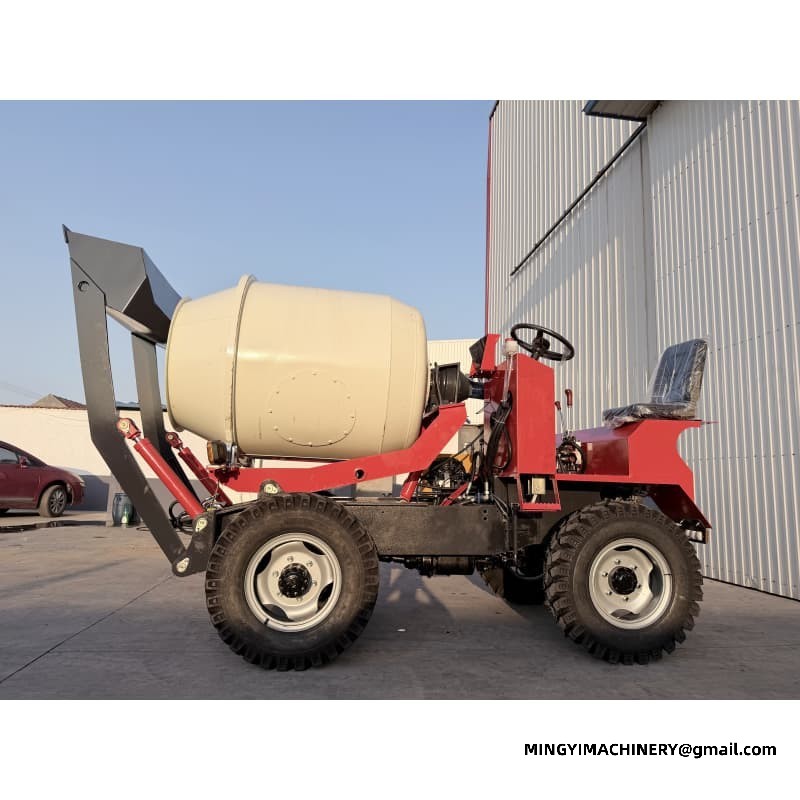
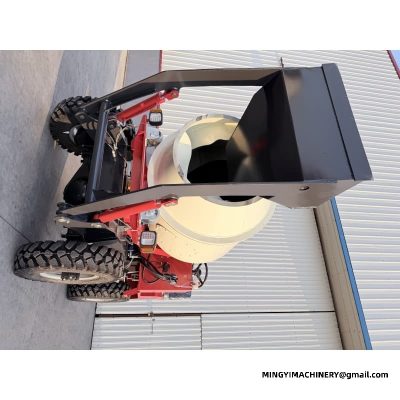
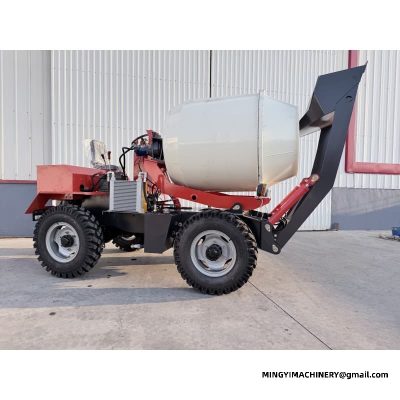
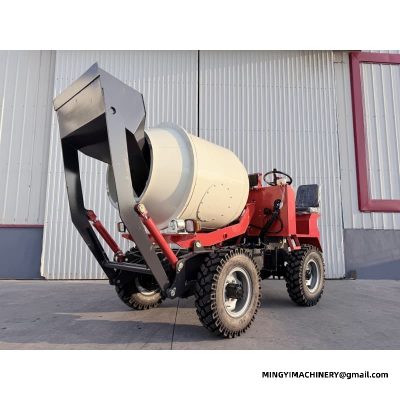
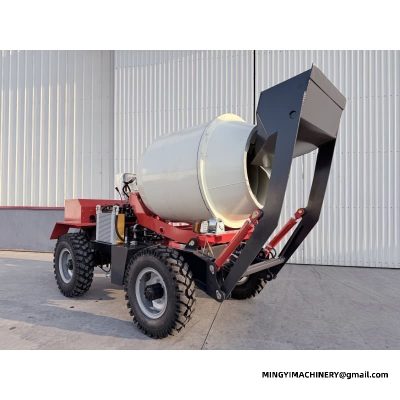
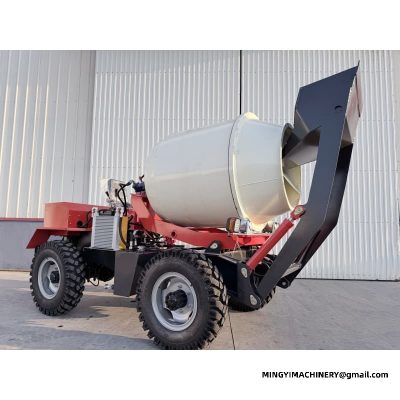
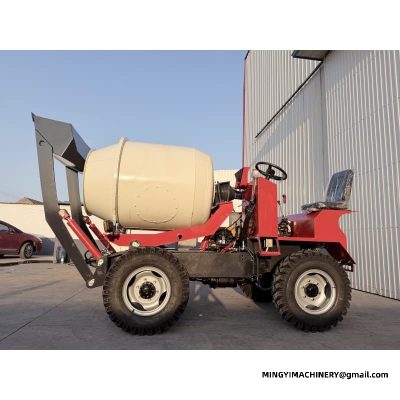
Mobile Concrete Batching Truck, Portable Cement Mixer, On-Site Batching
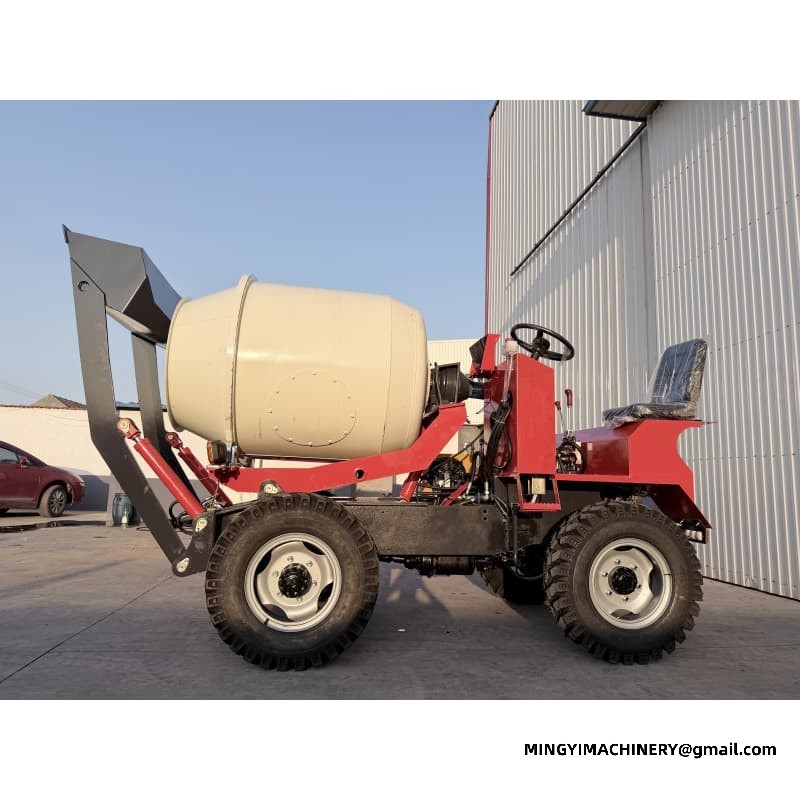
One operator, one drum, one shovel — that is the whole machine. Conventional site concreting splits the job across a loader, a mixer and a barrow chain; the mobile concrete batching truck folds it into a single 25 hp 4WD chassis. This page works through what the published specification means in practice on village projects, starting with the shovel and ending at the discharge.
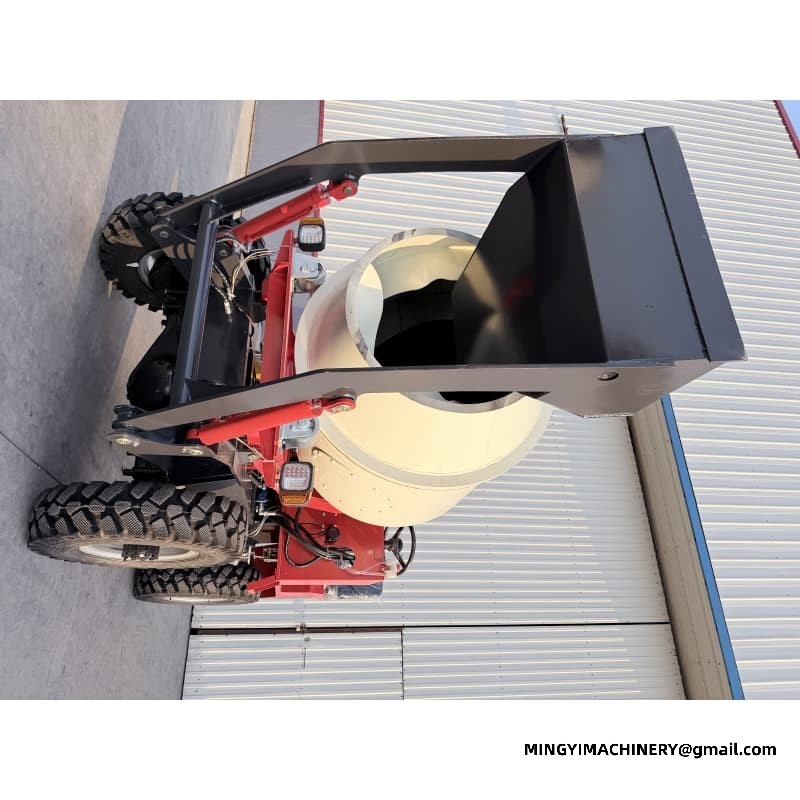
The discharge end is the natural place for add-ons: a short chute extension reaches past an obstacle, a tipping skip collects where a barrow cannot stand, and a measured water bowser rides the machine instead of trailing behind it. None of these change the drum; they change where its output lands.
Discharge aids only earn their place if they keep the drum's output where the crew already is. A chute that lands the concrete two metres closer to the formwork saves more time than a longer chute that lands it in the wrong place.
0.8 m³ is not a big drum by transit-mixer standards, and that is the point. Batches this size stay workable from drum to formwork without additives or rush, on village projects, where the distance from mixing point to pour is measured in metres rather than kilometres.
Put the two figures side by side and the machine's day writes itself: 0.8 m³ mixed, 1,500 kg carried, repeated until the pour is fed. Nothing in the specification is bigger than the job needs, and nothing the job needs is missing from the specification.
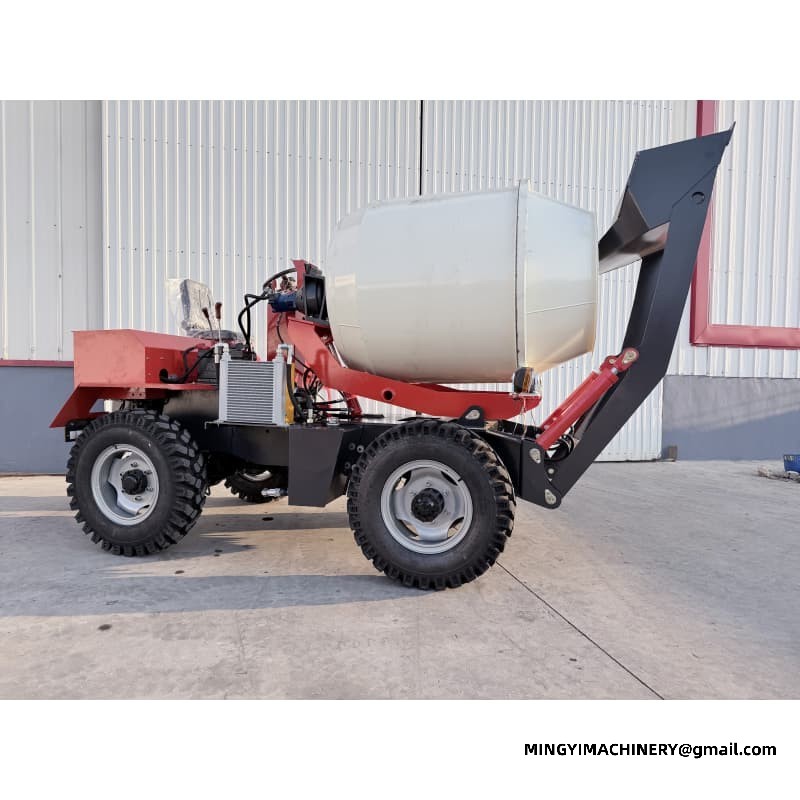
Many fleets run both: transit for the big slabs near town, self-loader for the long tail of small work everywhere else. The two machines rarely compete for the same batch.
Against a hand-fed drum mixer, the comparison is labour: the self-loader replaces the shovel line that feeds the small mixer, and it moves the batch to the pour under its own power. One operator does what a barrow chain of four or five does, with fewer batches lost to delay.
| Specification extract — 0.8 m³ 4WD self-loading concrete mixer | |
|---|---|
| Rated load | 1,500 kg |
| Rated capacity | 0.8 m³ |
| Overall dimensions (L x W x H) | 3,500 x 1,600 x 2,200 mm |
| Front tyre size | 8.25-16 |
| Rear tyre size | 7.50-16 |
| Minimum ground clearance | 204 mm |
| Steering angle | 28° |
| Turning dimension (outer tyre) | 2,464 mm |
| Maximum travel speed | 24 km/h |
| Transmission | 4WD |
| Gears | 3 forward / 1 reverse + travel gear |
| Front axle | 130 drive axle |
| Rear axle | 212 selectable 4WD steering axle |
| Engine | single-cylinder diesel / 25 hp |
| Steering | hydraulic power steering |
The width is the number that opens the most doors. At 1,600 mm the machine goes through standard double gates and between formwork lines that stop wider equipment, and it does so with a full drum because the drum sits inside the envelope, not above it.
At 3,500 x 1,600 x 2,200 mm, the machine loads onto a tag trailer behind a light truck or ships one per small container. For plant hire fleets and export buyers that footprint is money: no escort, no low-loader, no special port handling.
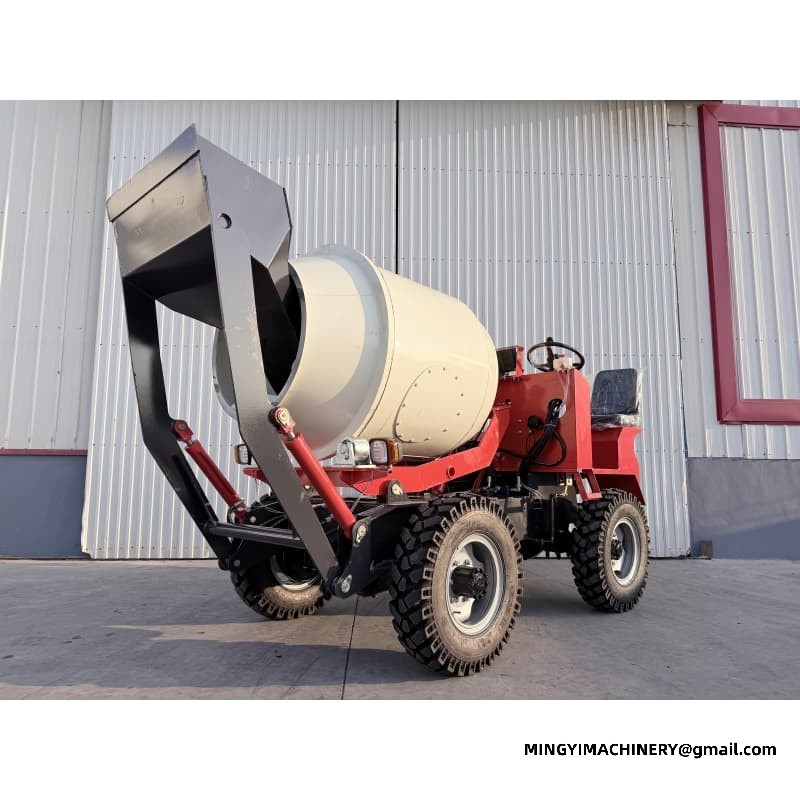
25 hp is modest by highway standards and exactly right for this duty. The machine's work is short, heavy efforts — loading, climbing, tipping — and a small diesel spends most of its day loafing between them, which is where fuel economy and engine life both come from.
Single-cylinder engines also teach their operators. The rhythm of a healthy 25 hp unit — exhaust note, vibration, smoke colour — tells an attentive operator more than a dashboard of warning lamps, and small deviations get fixed small.
The hydraulic circuit drives the power steering, the drum rotation and the shovel hydraulics from one pump off the single-cylinder diesel. Three consumers, one source — which is why the engine's health and the oil's cleanliness are the same subject on this machine.
Keep the filler breather and the reservoir cap clean enough to eat from. On dusty sites on village projects, more hydraulic systems are killed by a dirty funnel than by a thousand hard hours.
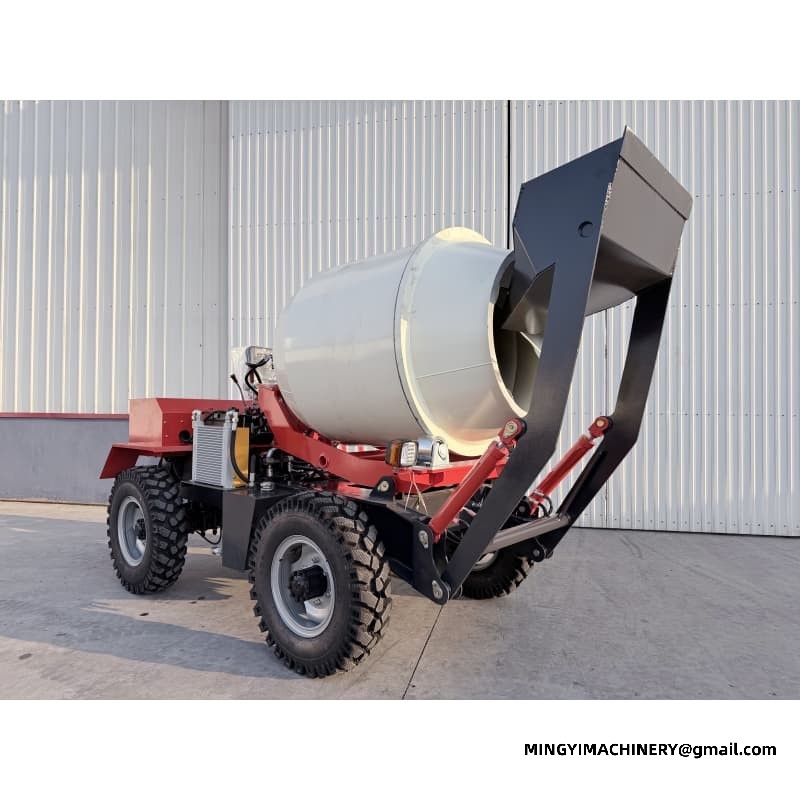
The operator profile is one person, but the people around the machine change by the hour. The mixer serves a foundation crew, a masonry crew and a patching gang in sequence, each with the recipe it needs and the standing spot it wants. The single seat is the reason the machine suits small contractors who cannot spare a second hand.
On sites where the machine is the only powered plant, its operator becomes the pace-setter for everyone else. Crews learn to time their work to the drum, and the site finds its rhythm around one machine rather than fighting several.
The rules are short: slow through turns, gentle on the stops, drum level in transit and nobody riding on a machine built for one. Every accident report on mixers of this class starts with one of those rules broken.
A lifting shovel commands a exclusion zone whether or not the site paints one. Nobody stands within the shovel's arc; nobody rides a load; nobody walks under a raised bucket — even briefly, even empty.
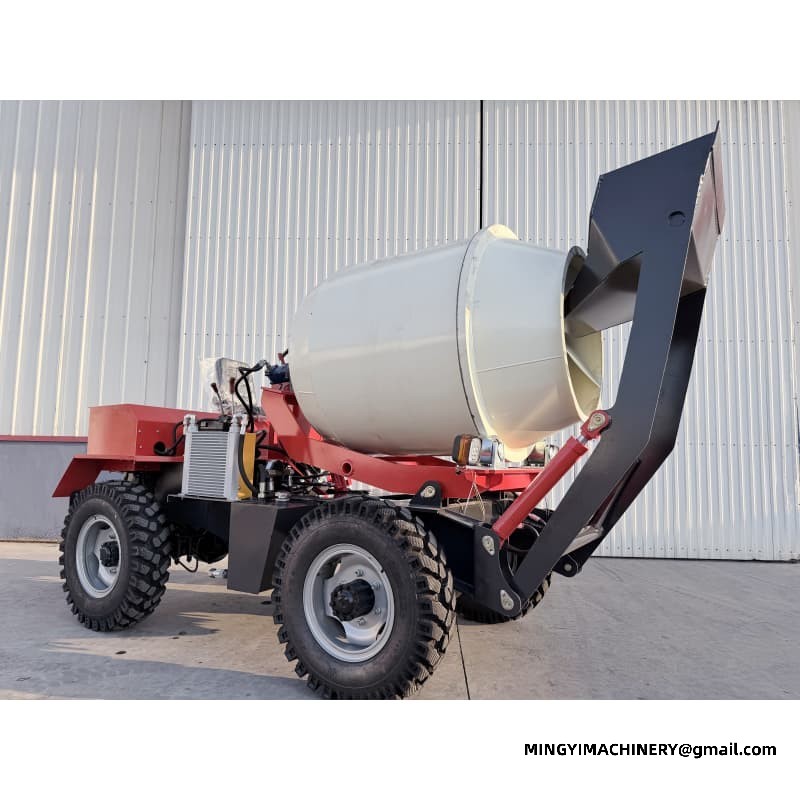
The control set is small — key start, gears, shovel levers, drum controls, steering — and a careful new operator works productively inside a day. The training that matters is judgement: slopes, loads, people, and the discipline of the wash-out.
One entry per shift is enough for the log — hours, batches, anything heard, wash-out done. The discipline takes a pencil's worth of effort and returns a machine whose history answers questions before they are asked on village projects.
Steering is hydraulic power steering acting with the 28° rear-axle steer. The wheel is light under a full drum, the steering response stays predictable at crawl speeds, and the machine holds a straight line under load without fighting the operator.
Every machine has edges, and pretending otherwise sells it badly. The 2,464 mm circle does not fit a footpath squeeze half its width; the 204 mm clearance does not ride over boulders; the drum does not deliver up a ladder. The honest answer to those jobs is barrows, pumps or a bigger machine.
Write the survey down and compare it with the published envelope before committing. Crews that skip this step discover the constraint with a full drum aboard, on village projects — the lengthy way to learn a number.
Board over exposed ducts and mark headroom limits. The machine crosses most ground on village projects; it crosses a buried cable only once, and the second time is a strike.
Inside the drum, rotation does the mixing; reversed rotation with the drum tipped does the discharging. The geometry is old and proven, and on a machine with hydraulic control the operator sets drum angle and speed from the seat without leaving the cab position.
Keep a dedicated bucket or bowl for the wash-out water and the routine stays tidy even on sites without drainage. The ten litres of sloppy grout that set inside a drum overnight effort a chisel day; the same grout washed out takes nothing.
Hire saves the capital and the storage; ownership saves the weekly rate and the waiting. For the user whose on village projects where one machine serves several crews recurs, the owned machine is usually the simpler one by the second season.
The machine's resale case is its simplicity: a buyer can see the drum, the axles and the engine in a walk-round, and the service book tells the rest. Machines with records, straight shovels and clean drums sell within days in most markets.
Read the two clusters against your site, not against the brochure. The figure that decides the sale is usually the smallest one: turning circle, clearance or width, whichever your worst gateway on village projects happens to be. The big numbers sell the machine; the small ones qualify it.
The engine line — single-cylinder diesel, 25 hp — is a maintainability statement more than a performance one. Single-cylinder diesel of this pattern is serviced anywhere, started by a mechanic who has seen one before, and rebuilt on a bench. A higher number would not help a machine that works where dealerships are days away.
What axles does the mobile concrete batching truck run?
A 130 drive axle at the front and a 212 rear axle that steers and can be selected into four-wheel drive. The front pulls the load; the rear steers through a 28° angle.
How much ground clearance does the mobile concrete batching truck have?
204 mm under the axles. That clears ruts, rubble and standing water of that depth, and the low build is deliberate — it keeps the centre of gravity down under a raised drum.
Can two mobile concrete batching truck machines work one pour?
Yes, with separated standing spots and staggered cycles — it is the standard answer for pours that outrun one drum but still sit below plant scale.
Does the mobile concrete batching truck come with a manual?
Ask for the operator and parts manuals with the machine, in your language where available, and check the parts references match what you will be ordering later.
Do I need a concrete pump with a mobile concrete batching truck?
Usually not. The machine drives to the pour and discharges over the front on village projects; a barrow stage covers the last few metres where wheels cannot stand.
Is the mobile concrete batching truck stable on slopes?
Within site-ramp grades, driven slowly and straight. Cross-slopes with a full drum deserve a straighter line than empty running, and no turning across a loaded slope.
Does a mobile concrete batching truck waste concrete?
Less than scheduled supply does. Batching stops when the pour stops, so there are no returned-load charges — the effort control hides in batching to demand.
Why choose a mobile concrete batching truck over more labour?
Because wages recur weekly and the machine does not. One operator with the shovel-and-drum loop replaces a barrow chain, and the batches come out more consistent than hand mixing ever was.
Nothing on this page is complicated, and that is the point: a 0.8 m³ drum, a shovel, four driven wheels and a routine. Crews that keep the routine keep the machine earning on village projects for years.
Later additions and retrofits on Mobile Concrete Batching on a Single Chassis: 0.8 m³ per Drum
Most additions are easier to plan than to add. Hydraulic services, mounting brackets and electrical capacity on Mobile Concrete Batching on a Single Chassis: 0.8 m³ per Drum are build items, and deciding them at the specification stage is far easier than doing it later.
Packing, loading and shipment of Mobile Concrete Batching on a Single Chassis: 0.8 m³ per Drum
Container loading is a planning exercise. The overall dimensions and the operating weight of Mobile Concrete Batching on a Single Chassis: 0.8 m³ per Drum decide whether it ships whole, partly disassembled or with the attachment removed, and that decision is made before the booking.
Cold weather and winter care for Mobile Concrete Batching on a Single Chassis: 0.8 m³ per Drum
Starting is only the first problem. Until Mobile Concrete Batching on a Single Chassis: 0.8 m³ per Drum reaches working temperature the hydraulic response is slower and the seals are stiffer, and warming the machine before asking for full output avoids unnecessary strain.
Commissioning Mobile Concrete Batching on a Single Chassis: 0.8 m³ per Drum on site
The machine should be introduced to the site as well as the operator. Walking the route Mobile Concrete Batching on a Single Chassis: 0.8 m³ per Drum will take, noting the soft spots and the turns, prevents the kind of first-day incident that has nothing to do with the machine.
Wear items and spares worth holding for Mobile Concrete Batching on a Single Chassis: 0.8 m³ per Drum
Holding spares is about downtime rather than the shelf itself. The question for Mobile Concrete Batching on a Single Chassis: 0.8 m³ per Drum is not how large the part is but how long the machine sits while it is found, and a small shelf answers that better than a fast courier.
Contact MINGYI Machinery for the current self-loading concrete mixer specification, export packing and a formal specification for your market. E-mail: sales@mingycn.com | LINE (ID): mingyicn
Hydraulic Tipping Concrete Mixer: Discharge Where Aimed · Small Road Construction Mixer: Culverts, Kerbs and Patching · tailor made 4WD cargo vehicle for mining and quarry work · Mini Self-Loading Concrete Mixer









