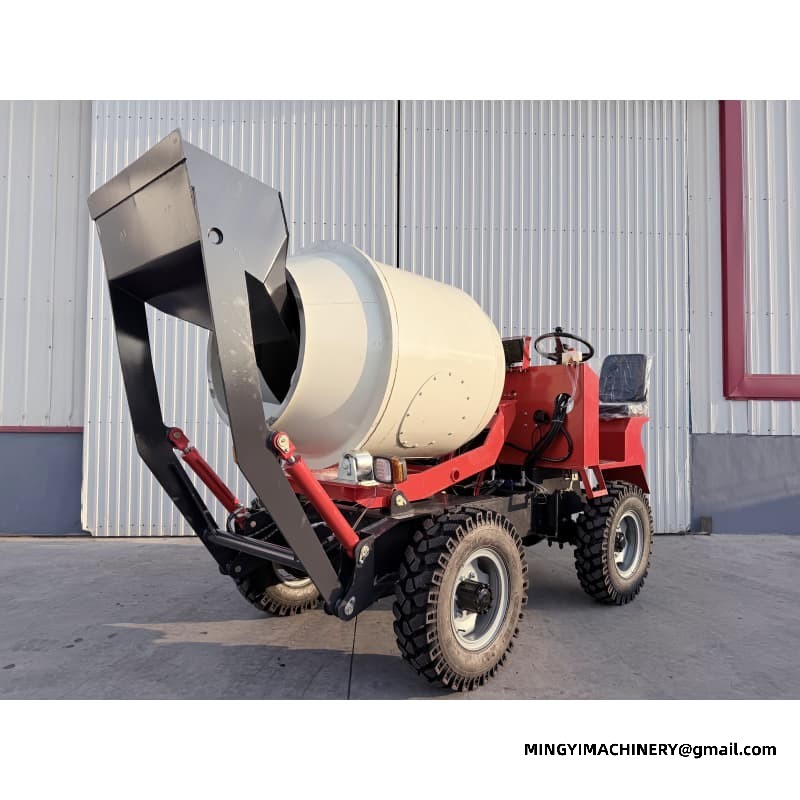
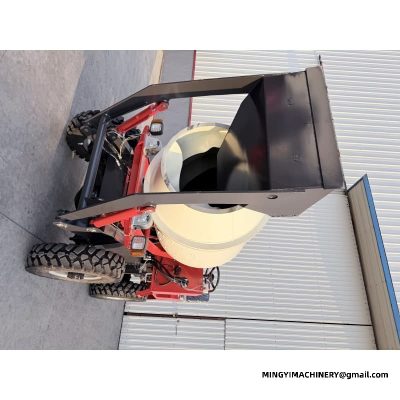
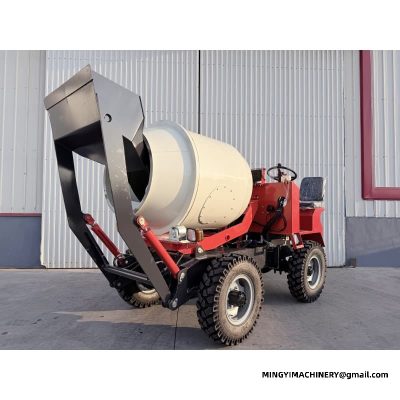
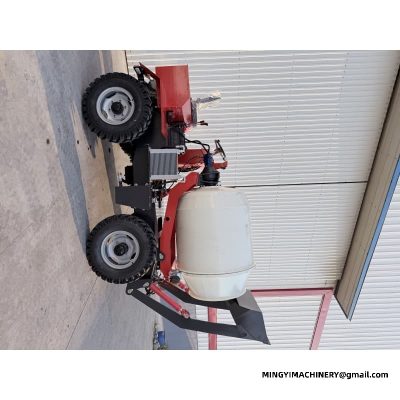
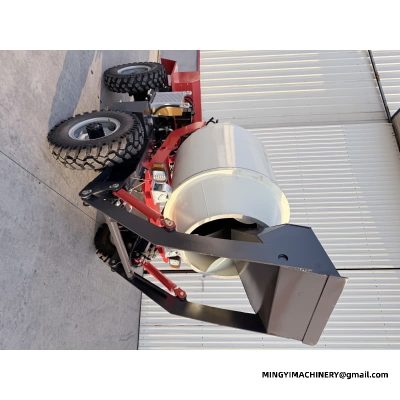
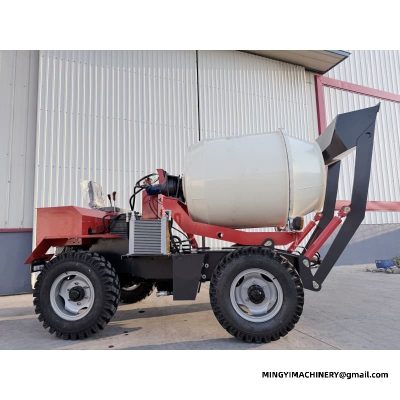
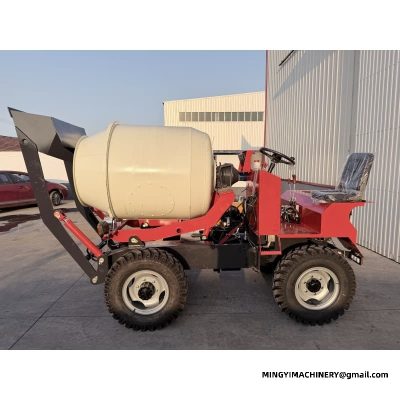
Hydraulic Tipping Concrete Mixer, Discharge Mixer Truck, Self Unloading
Concrete waits for nobody, and distance kills it. The hydraulic tipping concrete mixer self-loading mixer exists for pours that happen too far from a batching plant for ready-mix to answer — on pole lines moving from hole to hole along the route. At 0.8 m³ per batch and 24 km/h of travel speed, the machine keeps the supply chain inside the site gate, and this page explains the published figures that make that work.
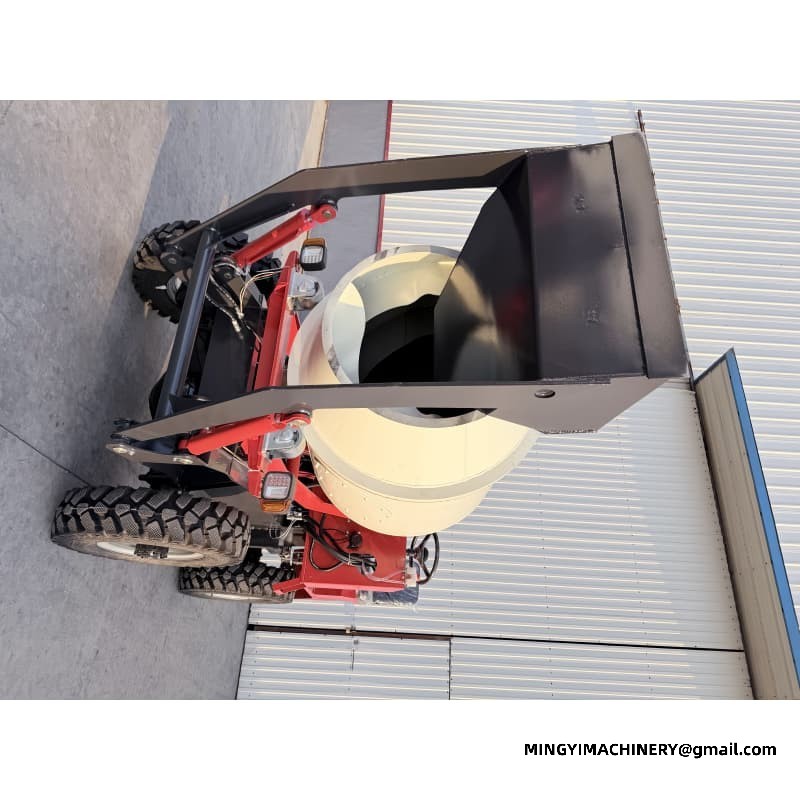
The discharge end is the natural place for add-ons: a short chute extension reaches past an obstacle, a tipping skip collects where a barrow cannot stand, and a measured water bowser rides the machine instead of trailing behind it. None of these change the drum; they change where its output lands.
Keep any fitted extra inside the machine's stated figures. The 1,500 kg rating still applies once a skip or a bowser is aboard, and the chassis was drawn for the load it was sold with, not the one a modification imagines.
The width is the number that opens the most doors. At 1,600 mm the machine goes through standard double gates and between formwork lines that stop wider equipment, and it does so with a full drum because the drum sits inside the envelope, not above it.
Tie it down at the chassis for transport, chock the wheels, and note that the shovel adds length when raised. The published envelope describes the machine in travel order; a few minutes of folding and lashing keeps it true.
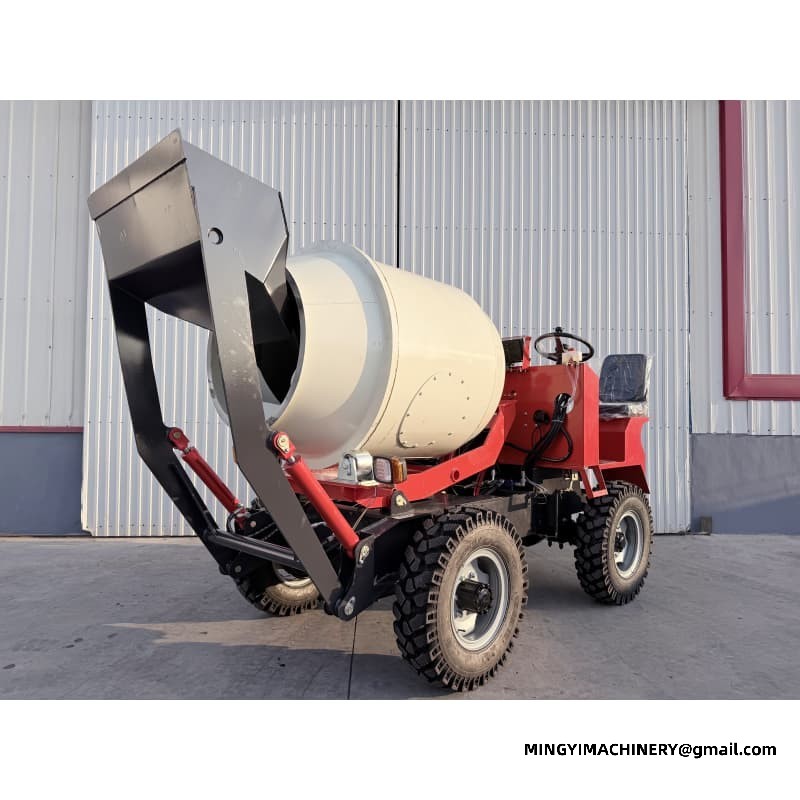
Discharge lands where the operator aims it. That single fact shapes the whole workflow on pole lines: the drum pours into a barrow, a bucket or straight to formwork, and the crew never moves concrete twice.
Because rotation and tilt are hydraulic, the operator can hold a partial discharge — trickle into a barrow, stop, move, resume — which no hand-cranked drum offers. That control is worth as much as the 0.8 m³ itself on pours with fussy geometry.
| Reference specification — 0.8 m³ 4WD self-loading concrete mixer | |
|---|---|
| Rated load | 1,500 kg |
| Rated capacity | 0.8 m³ |
| Overall dimensions (L x W x H) | 3,500 x 1,600 x 2,200 mm |
| Front tyre size | 8.25-16 |
| Rear tyre size | 7.50-16 |
| Minimum ground clearance | 204 mm |
| Steering angle | 28° |
| Turning dimension (outer tyre) | 2,464 mm |
| Maximum travel speed | 24 km/h |
| Transmission | 4WD |
| Gears | 3 forward / 1 reverse + travel gear |
| Front axle | 130 drive axle |
| Rear axle | 212 selectable 4WD steering axle |
| Engine | single-cylinder diesel / 25 hp |
| Steering | hydraulic power steering |
Hire saves the capital and the storage; ownership saves the weekly rate and the waiting. For the user whose on pole lines moving from hole to hole along the route recurs, the owned machine is usually the simpler one by the second season.
Buy a used one with the same eye: a drum true to its blades, axles dry at the seals, and hours that match the story. The three tells predict the next season's takes better than any salesman's.
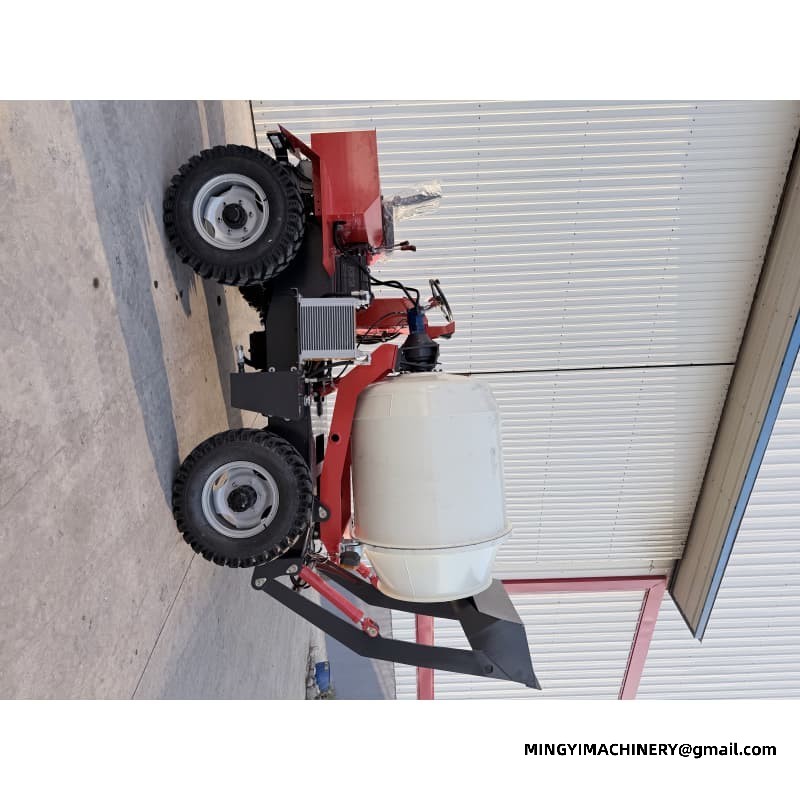
Drive goes to all four wheels — four-wheel drive through a 130 front drive axle, with the 212 rear axle selectable for four-wheel-drive steering. On firm ground two driven wheels would do, but site concrete rarely sits on firm ground. Wet spoil, sand, loose fill and grass all reward traction at every corner, which is what the 4WD transmission buys.
Practise the turn once in an open area and the 28° rear steer becomes instinct: the rear follows a tighter path than the front, so obstacles at the inside of the turn deserve the operator's eye. A minute of practice prevents the only dent this machine commonly gets.
Read the ground before the first trip of the day on pole lines. A route that crossed easily yesterday may have a new trench, a spoil heap or a flooded patch overnight, and 204 mm gives the operator a plain number to judge it against.
Front tyres are 8.25-16, rears are 7.50-16 — agricultural-pattern tyres with a tread that grips soft ground and shrugs off stones. Combined with four-wheel drive they carry a full drum across ground that stops two-wheel-drive machines.
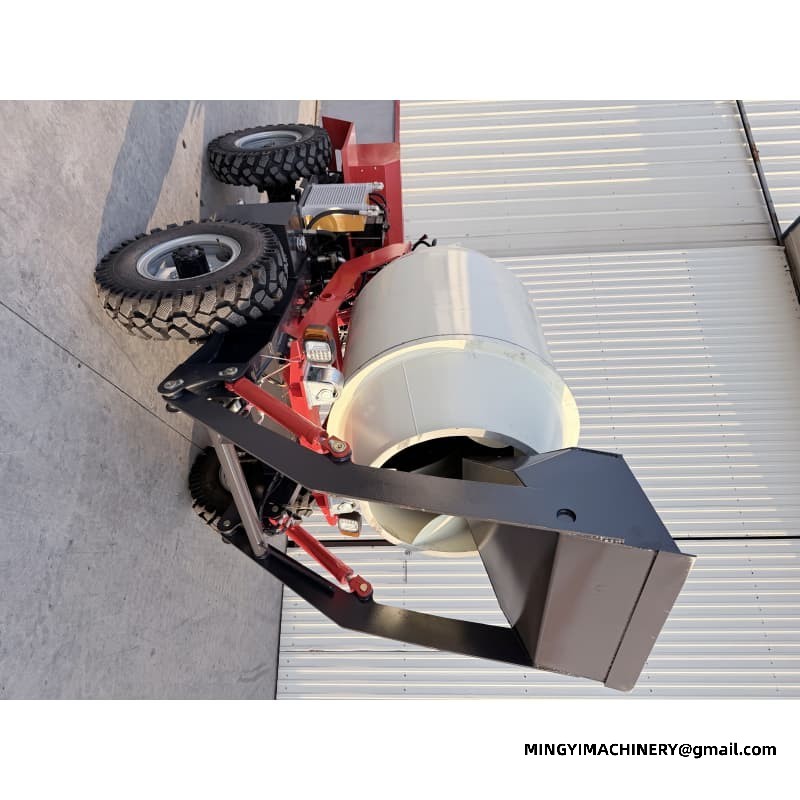
Measure the machine in hours, not in days. A drum that cycles every few minutes earns more in a short shift than a machine that waits between batches, and the hour meter is the honest tally of both. The published speed and gears exist to keep the cycle tight, not to make the machine fast.
The hour meter is the honest tally, not the calendar. A drum that cycles every few minutes in a short shift earns more than a machine that waits between batches, and the meter says which one yours was.
Write the survey down and compare it with the published envelope before committing. Crews that skip this step discover the constraint with a full drum aboard, on pole lines — the lengthy way to learn a number.
Stand the machine where the finishing crew already is, not where it would be convenient to park. A discharge point within barrow reach of the formwork is worth more than a flat, tidy spot fifty metres away, because the last metres are where hand-mixed batches lose their workability.
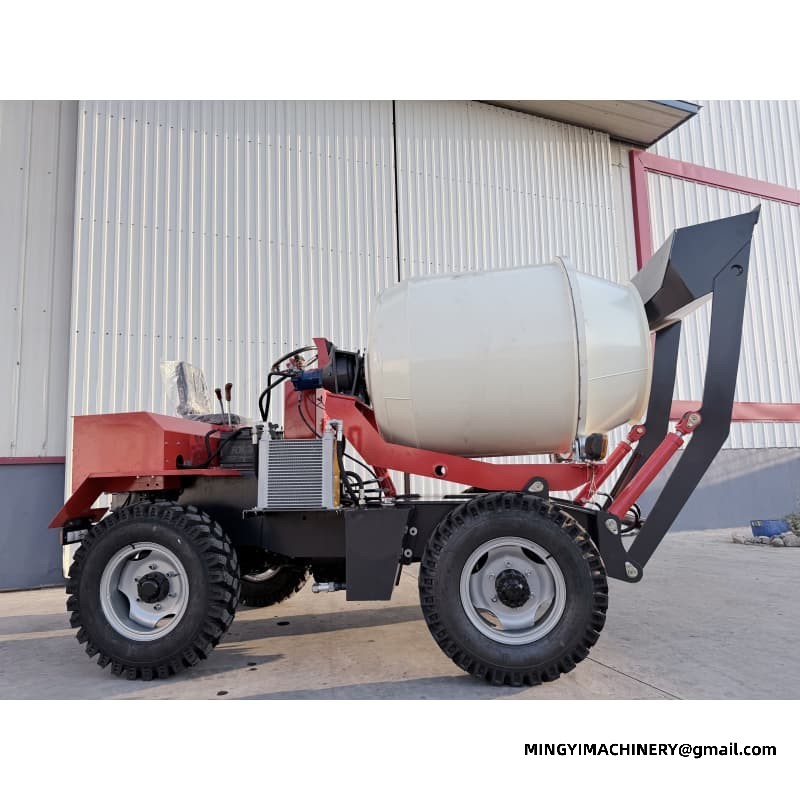
On a well-run machine the chassis and drum outlast several sets of consumables: shovel pins and bushings, drum blades, tyres, belts, hoses and filters are the renewal cycle. The single-cylinder diesel is the long-life heart, and its overhaul parts are stocked wherever single-cylinder diesels are common.
Spread across a working life, the machine's takes sort into three piles: purchase, consumables and labour saved. The third pile dwarfs the other two wherever hand-mixing was the alternative, which is why owners replace these machines with the same machine.
The rules are short: slow through turns, gentle on the stops, drum level in transit and nobody riding on a machine built for one. Every accident report on mixers of this class starts with one of those rules broken.
On pole lines, where paths cross the machine's working circle, the operator stops loading until the path is clear. The five seconds of waiting are simpler than every alternative, and the habit takes nothing by the end of a week.
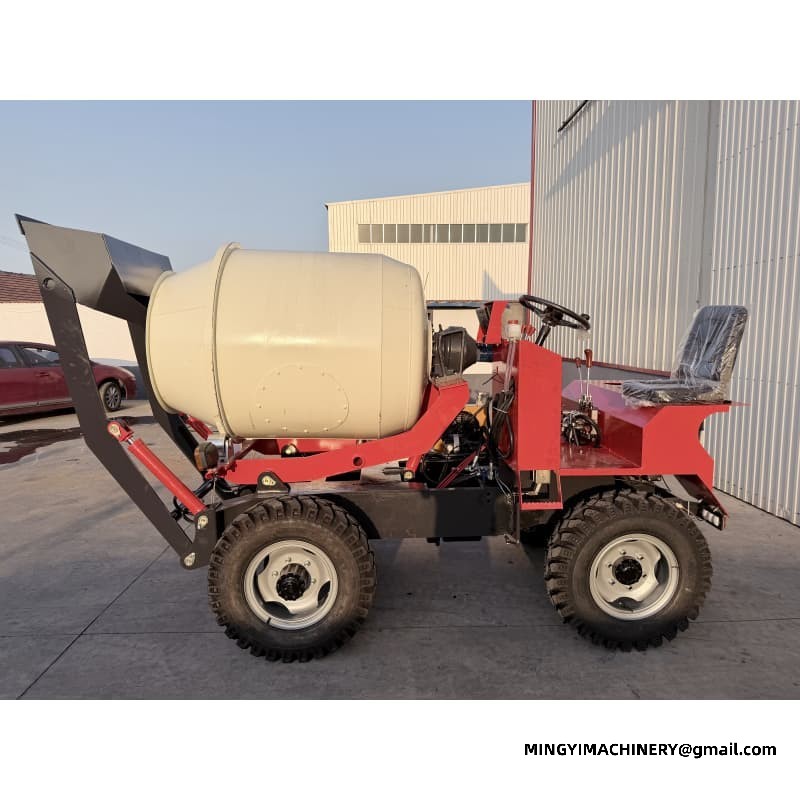
0.8 m³ is not a big drum by transit-mixer standards, and that is the point. Batches this size stay workable from drum to formwork without additives or rush, on pole lines, where the distance from mixing point to pour is measured in metres rather than kilometres.
Output is decided by the cycle, not the drum. Loading the shovel, mixing, travelling and discharging repeat, and the slowest of the four sets the rate. With 0.8 m³ per batch and a short haul, the drum rarely waits; with a long carry at 24 km/h, travel becomes the constraint and the arithmetic changes.
The machine will reproduce whatever recipe it is given, faithfully and all day. That is its quality promise and its quality risk: a correct recipe repeated gives uniform strength, and a careless one repeated gives uniform trouble.
Small jobs rarely cube-test, but simple checks still work: slump by the side-collapse eye, batch weight against the recipe, and a note of what each pour received. Crews that keep a chalkboard of batches trace a weak patch to its cause instead of guessing.
On pole lines, that single-operator loop is the economic argument. Labour is the biggest recurring effort on small concrete work, and the shovel removes most of it. Cement, water and aggregate are the only inputs the crew still handles by hand.
The shovel reaches a pile close to the front wheels, so the stockpile layout decides how fast a batch assembles. Keep aggregate and sand within a shovel's reach of the machine's standing position and the drum fills in seconds rather than minutes.
24 km/h is not fast and should not be. The machine carries 1,500 kg of wet concrete high on a short wheelbase, and the gearing keeps those loads sedate. Crews that respect the speed keep the concrete in the drum and the machine on its wheels.
The gear pattern also gives the machine its manners: low gears hold back a loaded drum on descents without riding the brakes, and the travel gear keeps engine speed economical on road sections. Good gearing is invisible until it is missing.
What engine does the hydraulic tipping concrete mixer use?
A single-cylinder diesel rated at 25 hp. It drives the transmission, drum and hydraulics, and it services with filters and oil a general mechanic already stocks.
Is the hydraulic tipping concrete mixer fuel-hungry?
No. A 25 hp diesel works in short heavy efforts and loafs between them, which is where its economy comes from. Idle time, not work, wastes its fuel.
Is the hydraulic tipping concrete mixer electric start?
Yes — key electric start, with a decompression lever as the manual fallback. Healthy battery practice keeps the starting method reliable across seasons.
How is a hydraulic tipping concrete mixer delivered and commissioned?
Containerised delivery, then a short commissioning: turn the engine by hand before first start, prime the hydraulics, and run the drum empty before the first batch.
Can the hydraulic tipping concrete mixer charge a concrete bucket or skip?
Yes, where the skip sits within the discharge arc at %s height discipline allows. The drum pours into barrows, buckets or formwork without a second handling.
How should a hydraulic tipping concrete mixer be stored between jobs?
Washed, fueled, drum cracked to drain, battery tended, tyres off bare ground if the stand is long. The machine that is stored properly starts on pole lines without a service call.
Can a hydraulic tipping concrete mixer work underground or in tunnels?
At 2,200 mm high it fits low-clearance work a transit mixer cannot enter. Enclosed spaces also require planned ventilation for the diesel exhaust — put it in the method statement.
What tyres does the hydraulic tipping concrete mixer use?
8.25-16 at the front and 7.50-16 at the rear, agricultural-pattern tyres that grip soft ground and shrug off stones on pole lines.
Batched to demand, placed under its own power and maintained in five minutes a day, the machine replaces the small-plant overhead that most small pours never needed in the first place.
Moving Hydraulic Tipping Concrete Mixer: Discharge Where Aimed between sites
Travel time is not working time, and it should be planned as its own item. The hours spent moving Hydraulic Tipping Concrete Mixer: Discharge Where Aimed between jobs are hours not worked, and a trailer that matches the machine reduces them every single trip.
A second operator for Hydraulic Tipping Concrete Mixer: Discharge Where Aimed
Training is simpler than repair. An hour spent with a new operator on Hydraulic Tipping Concrete Mixer: Discharge Where Aimed, covering the limits and the awkward cases, is the least lengthy hour in the whole ownership.
Hot, humid and dusty conditions around Hydraulic Tipping Concrete Mixer: Discharge Where Aimed
Dust is the enemy of every rotating joint. Keeping the radiator and the air intake of Hydraulic Tipping Concrete Mixer: Discharge Where Aimed clean, and cleaning them before they are blocked rather than after, is what separates a machine that lasts from one that overheats.
Commissioning Hydraulic Tipping Concrete Mixer: Discharge Where Aimed on site
The machine should be introduced to the site as well as the operator. Walking the route Hydraulic Tipping Concrete Mixer: Discharge Where Aimed will take, noting the soft spots and the turns, prevents the kind of first-day incident that has nothing to do with the machine.
Cold weather and winter care for Hydraulic Tipping Concrete Mixer: Discharge Where Aimed
Winter is hard on rubber and on seals as much as on the engine. Parking Hydraulic Tipping Concrete Mixer: Discharge Where Aimed under cover, keeping the tracks or tyres off standing water and checking the hoses for cracking are all part of the season.
Contact MINGYI Machinery for the current self-loading concrete mixer specification, export packing and a formal specification for your market. E-mail: sales@mingycn.com | LINE (ID): mingyicn
Small Road Construction Mixer: Culverts, Kerbs and Patching · Self Loading Cement Mixer: What Automatic Really Means Here · 4x4 Mini Dumper for mining and quarry work - export and delivery notes · Mini Self-Loading Concrete Mixer









