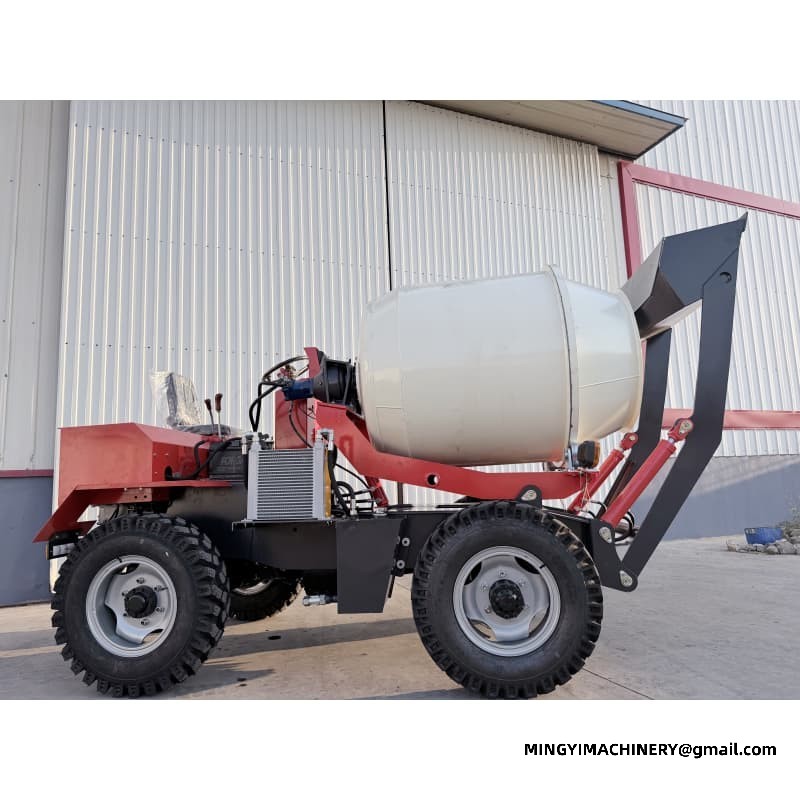
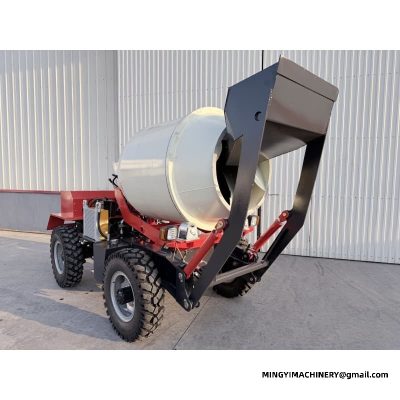
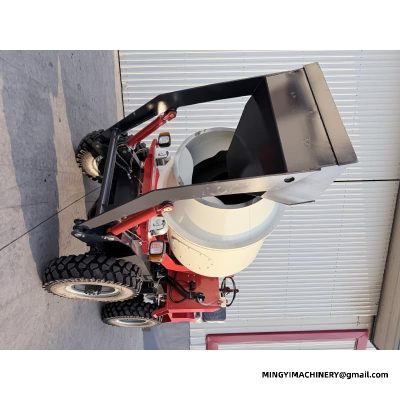
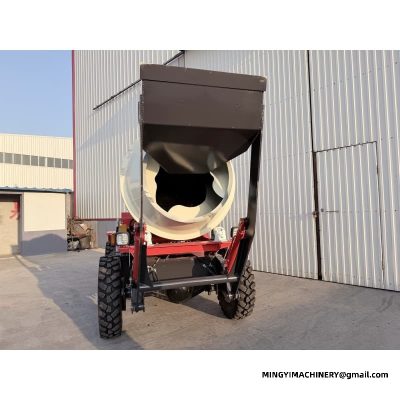
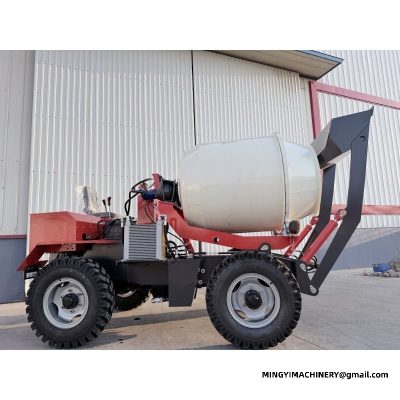
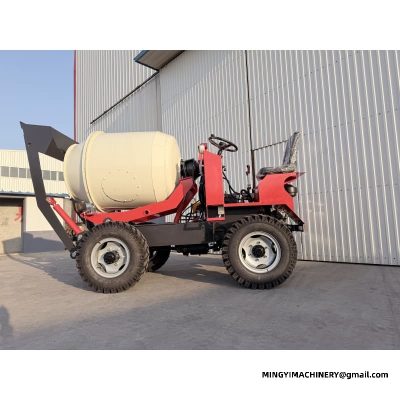
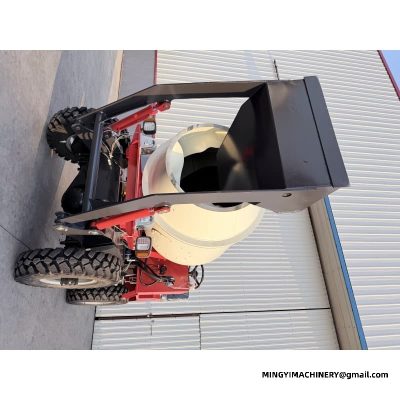
Front Loading Concrete Mixer, Bucket Loader Mixer, Front Shovel Truck
A self-loading mixer is bought for the distance between the aggregate pile and the pour. The 0.8 m³ drum, the 1,500 kg payload and the front shovel that feeds them answer one question — who mixes, and who carries? This page reads the published table as a front loading concrete mixer buyer meets it in tunnel work: capacity first, then the drive and steering that decide where the machine can actually stand.
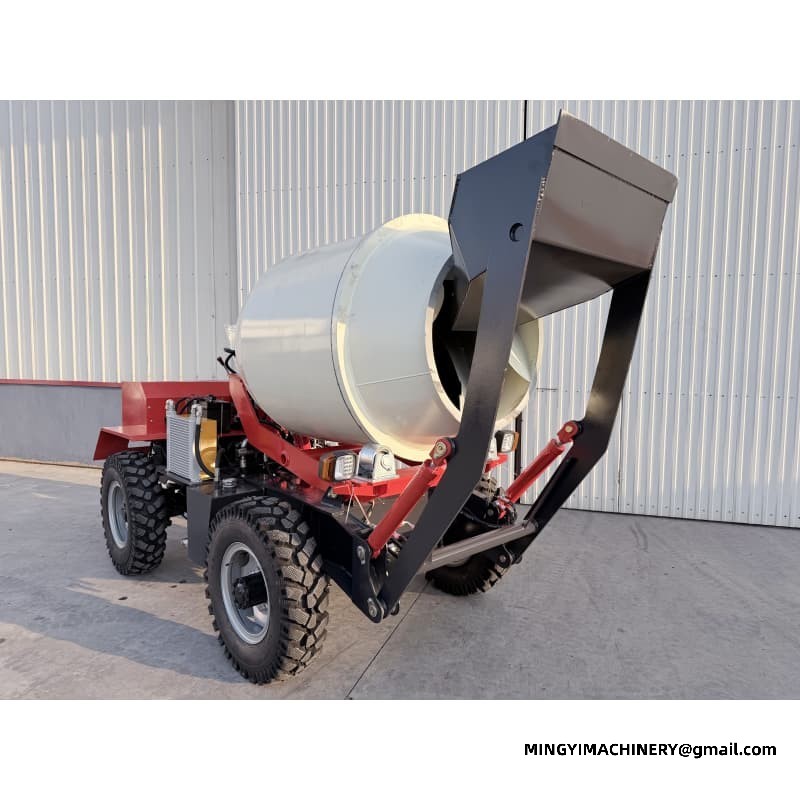
The discharge end is the natural place for add-ons: a short chute extension reaches past an obstacle, a tipping skip collects where a barrow cannot stand, and a measured water bowser rides the machine instead of trailing behind it. None of these change the drum; they change where its output lands.
If the job genuinely needs more machine, the answer is a larger model, not a modified small one. The published figures describe a 1,500 kg machine; they do not describe one that has been altered, and no safety judgement survives the alteration.
Ready-mix is the simpler source per cubic metre when a plant is close and the pour is large. Beyond that radius, minimum-load charges, queue time and the stiffening in the drum flip the arithmetic, and batching in tunnel work from stockpiled aggregate wins.
The wash-out discipline from the drum section doubles as an effort control: washed aggregate and water are simple, hardened drum heels and wasted returns are not. Batching to demand is the quiet economic argument for the whole machine class.
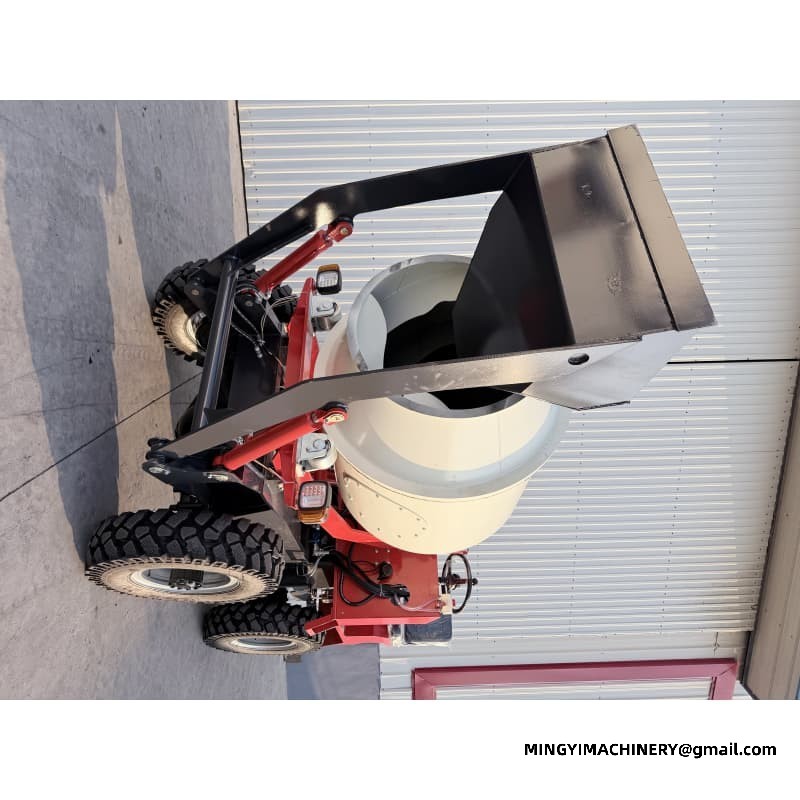
The drum takes 0.8 m³ per batch, and the chassis carries 1,500 kg while doing it. Those two figures together describe the machine's whole working day: load, mix, move a short distance, discharge, and come back for the next batch. A crew that pours low-clearance lining concrete in small, frequent quantities is exactly the customer this size was drawn around.
Where a pour sits between the two — big for one machine, small for a plant — the answer is scheduling rather than hardware: bays, joints and timing turn a 0.8 m³ drum into a continuous supply. The 1,500 kg chassis makes the repeated trips practical in fuel and in wear.
| Published build data — 0.8 m³ 4WD self-loading concrete mixer | |
|---|---|
| Rated load | 1,500 kg |
| Rated capacity | 0.8 m³ |
| Overall dimensions (L x W x H) | 3,500 x 1,600 x 2,200 mm |
| Front tyre size | 8.25-16 |
| Rear tyre size | 7.50-16 |
| Minimum ground clearance | 204 mm |
| Steering angle | 28° |
| Turning dimension (outer tyre) | 2,464 mm |
| Maximum travel speed | 24 km/h |
| Transmission | 4WD |
| Gears | 3 forward / 1 reverse + travel gear |
| Front axle | 130 drive axle |
| Rear axle | 212 selectable 4WD steering axle |
| Engine | single-cylinder diesel / 25 hp |
| Steering | hydraulic power steering |
Engine oil and fuel, air restriction, hydraulic level, drum cleanliness, tyres and wheel nuts, lights and mirrors. That walk-round takes five minutes and catches nearly everything that becomes lengthy when missed.
A service book that travels with the machine is worth money at resale and hours at breakdown — the mechanic who knows what was replaced and when diagnoses twice as fast. Keep the receipts, note the hours, and record the wash-out habit honestly.
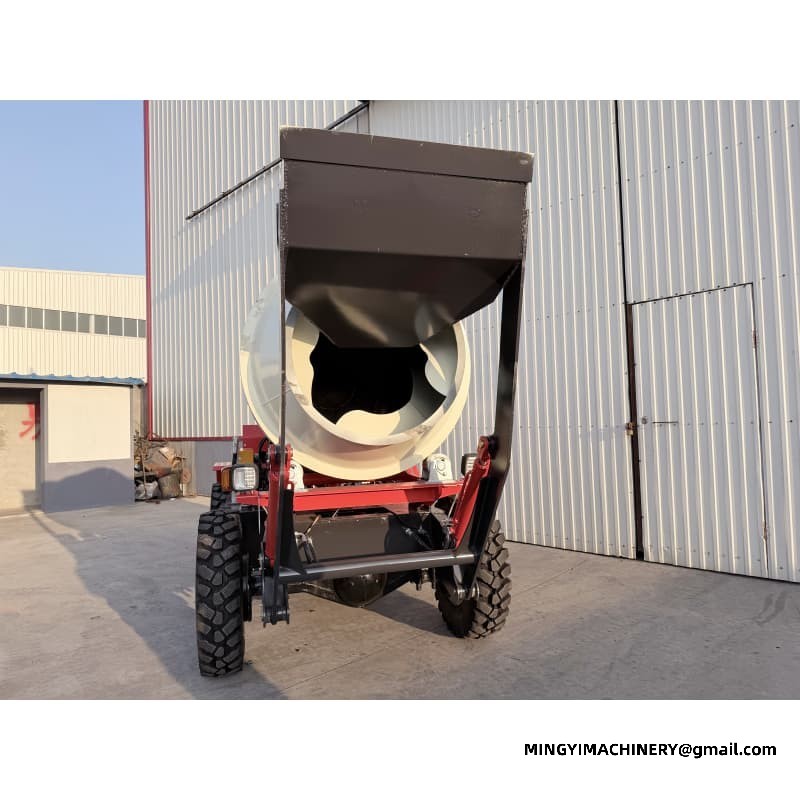
Load, mix, drive, discharge, return — one person runs the entire loop, and the controls are arranged so the sequence needs no second pair of hands. On small crews that is not a luxury; it is the difference between pouring today and waiting for a bigger gang.
Cement storage is the manual task that deserves organisation: a dry raised platform, bags rotated oldest-first, and a knife that lives with the machine. Damp cement is the raw material no drum can rescue.
Read the ground before the first trip of the day in tunnel work. A route that crossed easily yesterday may have a new trench, a spoil heap or a flooded patch overnight, and 204 mm gives the operator a plain number to judge it against.
204 mm also sets the maintenance floor: axle drain plugs, the gearbox sump and the hydraulic filter all live above that line, and none of them wants to meet a rock. The clearance is a working figure, not a styling choice.
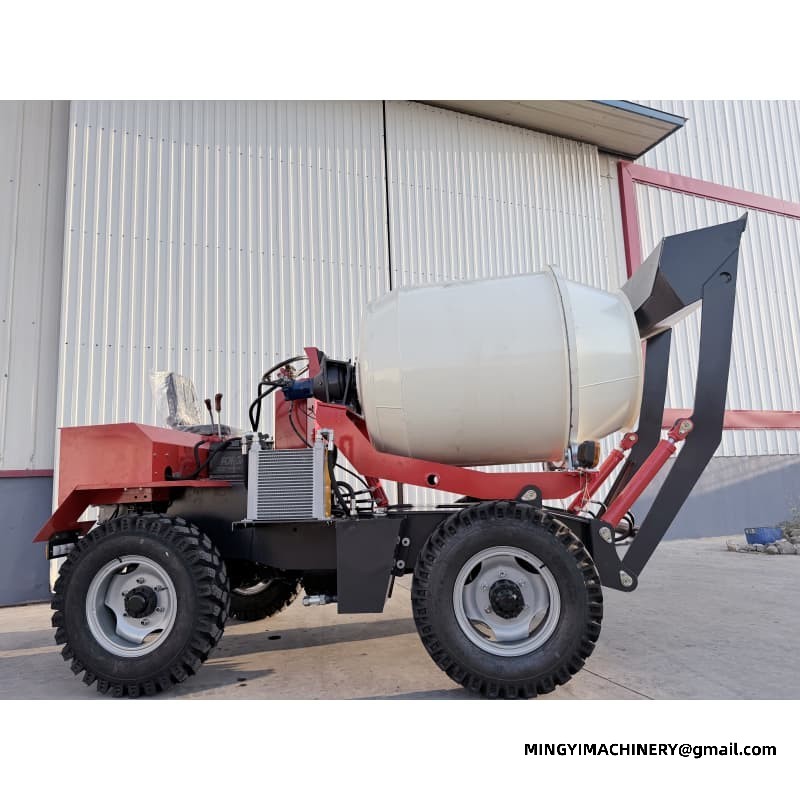
A specification is a contract before it is a sales document, and this one is short enough to read in a minute. The first cluster — 0.8 m³ capacity, 1,500 kg rated load, the 3,500 x 1,600 x 2,200 mm envelope — describes what a batch is and where the machine can stand. The second — 4WD, the 130 and 212 axles, 204 mm clearance — describes whether it can reach the pour.
Read the rated load and the rated capacity together, never one without the other. The 1,500 kg rating is what the chassis and tyres are built to carry; the 0.8 m³ is what the drum actually holds per cycle, and the honest pour lives in the gap between the two.
The arithmetic is simple enough for a whiteboard — batches per bay, cycles per hour, and the standing spot for each. Ten minutes of planning in tunnel work buys a full day of continuous placement.
Build the plan around the standing spot rather than the drum: a machine that parks once and serves a bay from one position outserves a machine that shuttles. Positioning time is the only time the drum spends doing nothing.
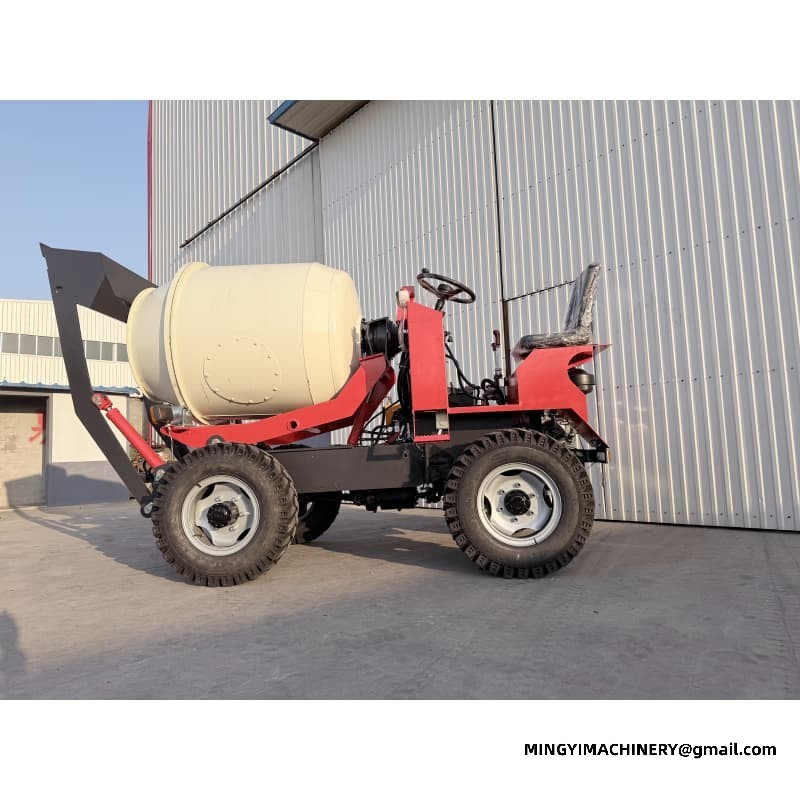
Keep the parts book and the order history together. The second order, placed a year later for a blade or a seal, is a two-minute email when the reference numbers are at hand and a half-day search when they are not.
Report faults honestly and in time. A small hydraulic weep described in a photograph reaches the right seal before it becomes a failed hose on a pour day, and crews that communicate get parts that fit the first time.
Where the mix changes through a day — a lean base, a richer top — the machine carries the change as easily as the material, provided the crew keeps the recipe card current. Switching batches is a scoop count and a water measure, not a machine adjustment.
The work it should refuse is the continuous slab and the high-volume pour, where plant supply wins outright. Saying so is the service, and the customer who hears it trusts the next recommendation more, not less.
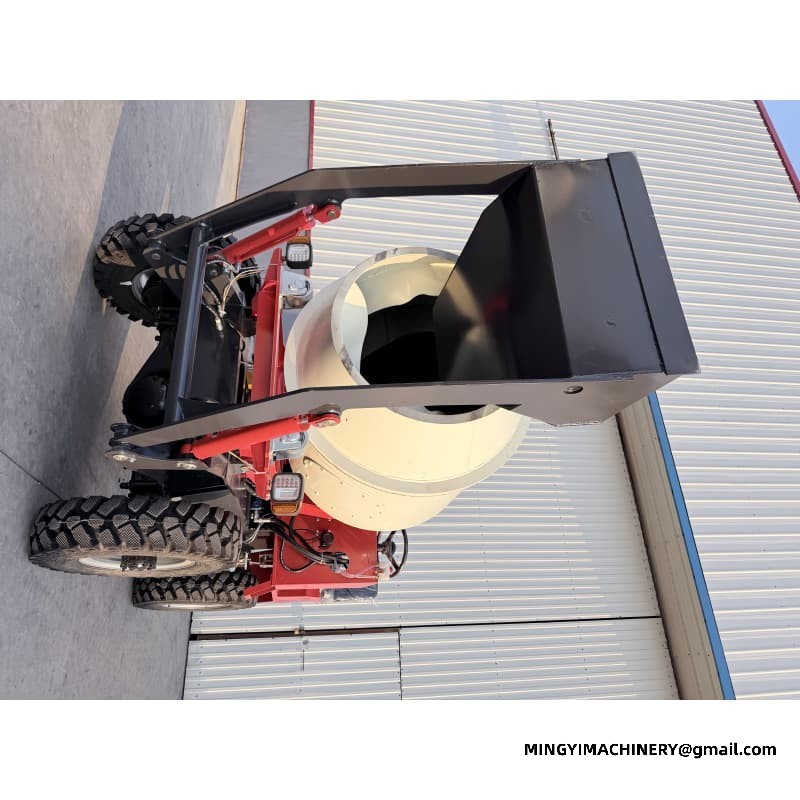
Power comes from a single-cylinder diesel rated at 25 hp. It drives the transmission, the drum and the hydraulics, and it does so with the mechanical directness that makes small site machines easy to keep alive: no electronics to fail, no dealership lock-out, one cylinder to know by heart.
Oil changes by the hour meter, not by the calendar — a machine that idles through wet weeks still accumulates hours on the oil. Operators who log the meter at each change in tunnel work never guess when the next one is due.
Hire saves the capital and the storage; ownership saves the weekly rate and the waiting. For the user whose in tunnel work under clearance a transit mixer cannot enter recurs, the owned machine is usually the simpler one by the second season.
plan the inputs with the machine, not after it. A drum that sits idle because the cement ran out is a drum that takes money while earning none, and the discipline of stocking ahead is part of owning well.
Inside the drum, rotation does the mixing; reversed rotation with the drum tipped does the discharging. The geometry is old and proven, and on a machine with hydraulic control the operator sets drum angle and speed from the seat without leaving the cab position.
A drum cleaned daily lasts the machine's life; a drum cleaned weekly builds a heel of hardened paste that permanently cuts capacity below 0.8 m³ and unbalances the blades. The five minutes after the last pour are the simplest maintenance the machine ever gets.
Can the front loading concrete mixer be shipped knocked down?
Ask at specification — packing format is a commercial option, and the answer depends on your market's import rules and your assembly capability. Confirm what is stated before the deposit.
What gears does the front loading concrete mixer have?
Three forward, one reverse, plus a travel gear for road moves between sites. First and second cover loading and hauling in tunnel work.
Who supports the front loading concrete mixer after delivery?
The supplier, by shipment of machine-specific parts and by guidance on the engine and axle pattern any local mechanic can service. E-mail sales@mingycn.com or LINE (ID): mingyicn and the conversation continues after the sale.
How close can the front loading concrete mixer pour to an edge or trench?
The discharge reaches the edge; the wheels should not. Keep the standing spot back from any face, trench or excavation by more than the machine's allowance, and let the drum do the reaching.
What records should a front loading concrete mixer keep?
Service receipts, engine hours and a small logbook for handovers. The record doubles as the service history the resale market pays for.
How many batches an hour can a front loading concrete mixer do?
Whatever the cycle allows: load, mix, travel, discharge, return. Short hauls keep the drum busy; long carries make travel the constraint. Plan pours around the cycle, not the clock.
What is the turning circle of the front loading concrete mixer?
2,464 mm at the outer tyre, from the 28° steering angle. Measure your tightest gateway against that figure before the machine arrives.
What tyre pressures should a front loading concrete mixer run?
The pressures in the manual, kept even left to right. Too hard cuts into wet ground and shrinks the footprint; too soft overheats the sidewall under a full drum.
Worked in tunnel work, the machine pays for itself in the batches it keeps on schedule and the crews it frees from barrow chains. The specification above is the whole story — short, honest and enough to size the decision.
Planning the season around the concrete mixer
Downtime is simplest when it is planned. Booking the service for this class of machine in the quiet part of the season takes nothing from the schedule, while the same work in the busy weeks gives up a day of output every time.
Moving the unit in daily use between sites
A machine that works on one site still has to reach the next. The overall dimensions and the operating weight of a machine of this size decide what trailer or truck is needed, and that decision belongs before the job is booked.
Packing, loading and shipment of the equipment on site
Export packing is part of the machine, not an afterthought. The machine itself is blocked and braced inside the container so that it arrives in the same condition it left, and the load plan is decided by the dimensions rather than by what fits loosely.
Fuel, oil and fluid quality for the model in question
Contamination is easier to prevent than to cure. Keeping the filler caps sealed, the funnels clean and the containers closed around the machine in that duty is unglamorous work that shows up as reliability later.
Hot, humid and dusty conditions around the unit on the job
Tropical operation is a specification question as much as a maintenance one. The cooling capacity, the sealing and the corrosion protection fitted to a machine built for the work are what make the difference once the ambient temperature rises.
Later additions and retrofits on the equipment in service
An added function should pay for itself quickly. Whether the concrete mixer gains a different bucket, a hydraulic service or a protection package, the test is the number of days a year it is actually used.
Contact MINGYI Machinery for the current self-loading concrete mixer specification, export packing and a formal specification for your market. E-mail: sales@mingycn.com | LINE (ID): mingyicn
Mobile Concrete Batching on a Single Chassis: 0.8 m³ per Drum · Hydraulic Tipping Concrete Mixer: Discharge Where Aimed · factory direct 4x4 dumper for mining and quarry work · Mini Self-Loading Concrete Mixer









