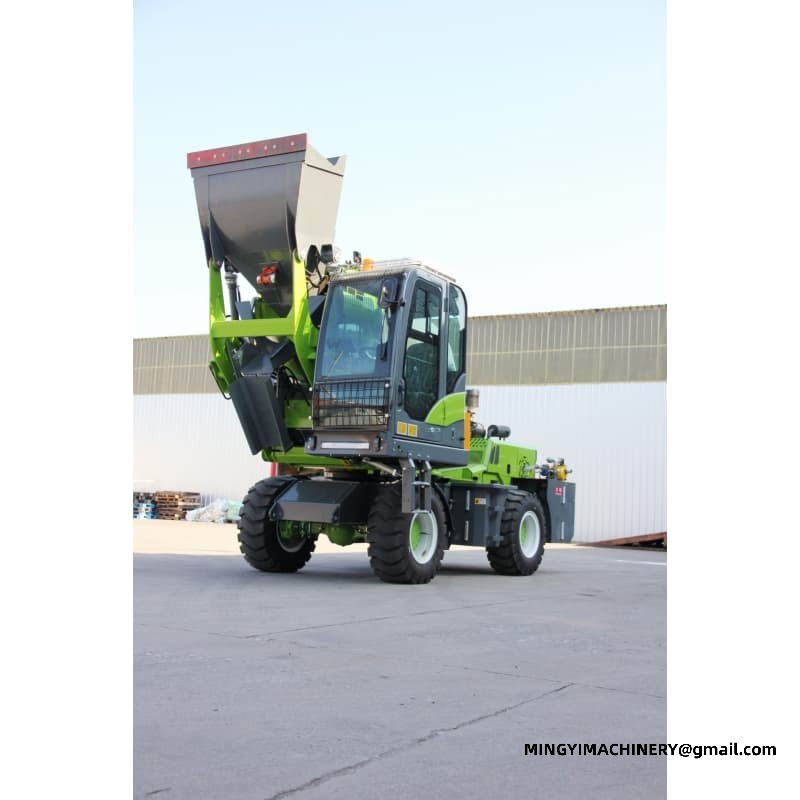
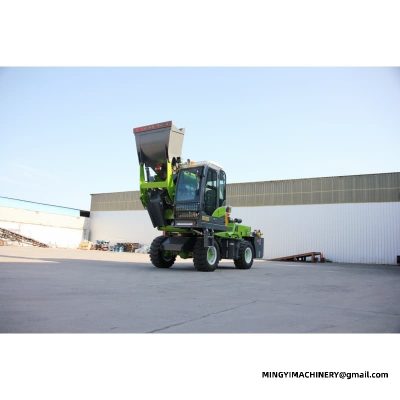
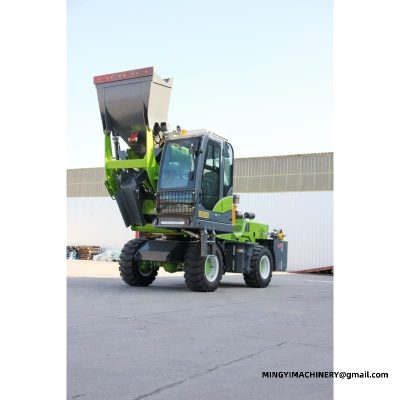
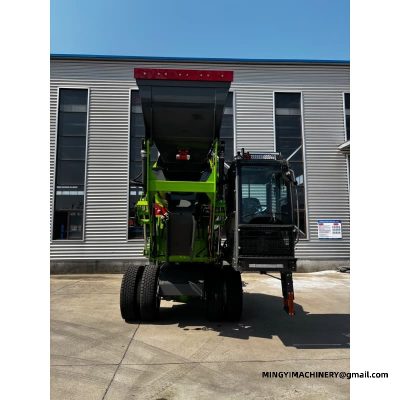
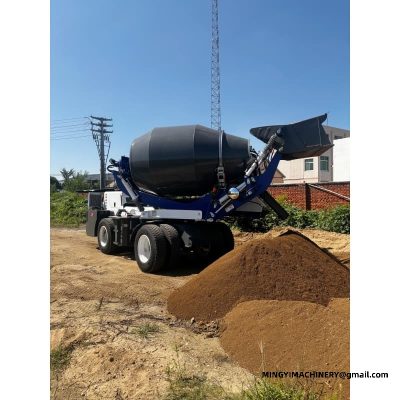
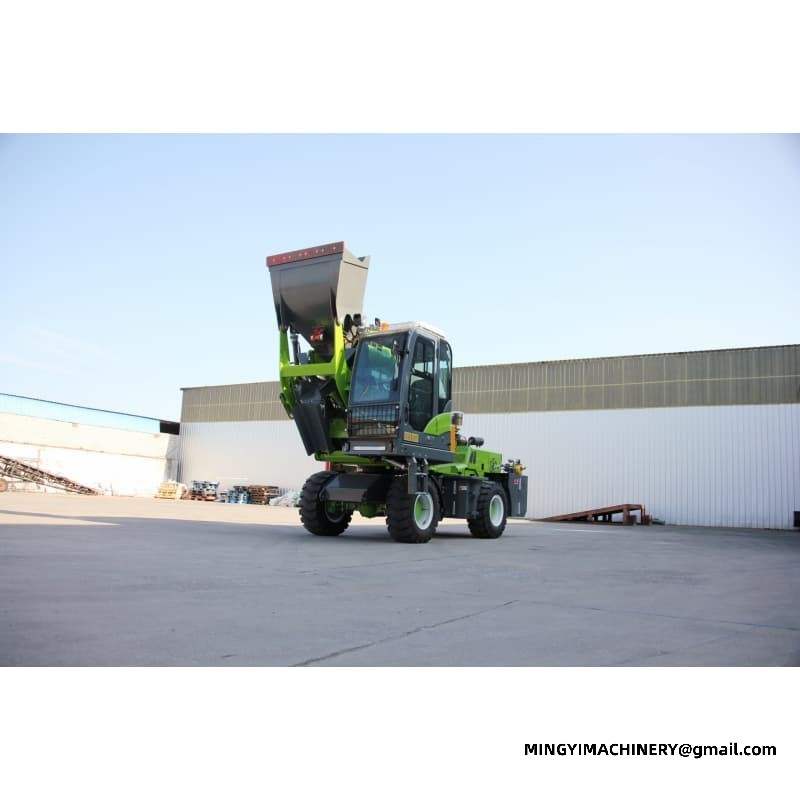
One operator, one drum, one shovel — that is the whole machine. Conventional site concreting splits the job across a loader, a mixer and a barrow chain; the large self loading concrete mixer truck folds it into a single 25 hp 4WD chassis. This page works through what the published specification means in practice in a small precast yard, starting with the shovel and ending at the discharge.
Ready-mix is the simpler source per cubic metre when a plant is close and the pour is large. Beyond that radius, minimum-load charges, queue time and the stiffening in the drum flip the arithmetic, and batching in a small precast yard from stockpiled aggregate wins.
Crews that specification work this way stop comparing the machine with a bigger drum and start comparing it with the wages of the people it replaces. Over a season, the comparison is not close.
Load, mix, drive, discharge, return — one person runs the entire loop, and the controls are arranged so the sequence needs no second pair of hands. On small crews that is not a luxury; it is the difference between pouring today and waiting for a bigger gang.
Honesty about the manual share keeps expectations right. Cement still goes in by bag, water by measure, and the discharge end may need a spotter with a barrow when the pour cannot take the drum's output directly.
Inside the drum, rotation does the mixing; reversed rotation with the drum tipped does the discharging. The geometry is old and proven, and on a machine with hydraulic control the operator sets drum angle and speed from the seat without leaving the cab position.
Aggregate quality feeds consistency too. Graded pile, clean stock, dry cement storage — the drum can only mix what it is given, and crews that protect their materials in a small precast yard find the machine generous in return.
| Reference specification — 0.8 m³ 4WD self-loading concrete mixer | |
|---|---|
| Rated load | 1,500 kg |
| Rated capacity | 0.8 m³ |
| Overall dimensions (L x W x H) | 3,500 x 1,600 x 2,200 mm |
| Front tyre size | 8.25-16 |
| Rear tyre size | 7.50-16 |
| Minimum ground clearance | 204 mm |
| Steering angle | 28° |
| Turning dimension (outer tyre) | 2,464 mm |
| Maximum travel speed | 24 km/h |
| Transmission | 4WD |
| Gears | 3 forward / 1 reverse + travel gear |
| Front axle | 130 drive axle |
| Rear axle | 212 selectable 4WD steering axle |
| Engine | single-cylinder diesel / 25 hp |
| Steering | hydraulic power steering |
Power comes from a single-cylinder diesel rated at 25 hp. It drives the transmission, the drum and the hydraulics, and it does so with the mechanical directness that makes small site machines easy to keep alive: no electronics to fail, no dealership lock-out, one cylinder to know by heart.
The spares argument is the strongest one. Injector, nozzle, liners, bearings — parts for engines of this pattern are stocked in every agricultural town on several continents. A mixer that waits a week for a part is a mixer that has stopped being useful.
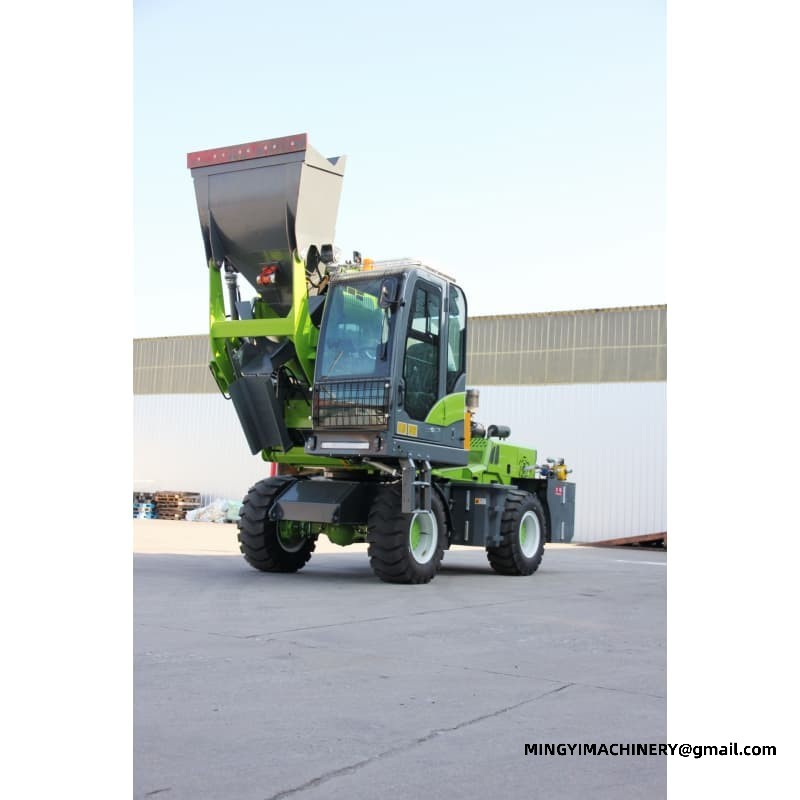
Drive goes to all four wheels — four-wheel drive through a 130 front drive axle, with the 212 rear axle selectable for four-wheel-drive steering. On firm ground two driven wheels would do, but site concrete rarely sits on firm ground. Wet spoil, sand, loose fill and grass all reward traction at every corner, which is what the 4WD transmission buys.
Selectable rear drive means the operator runs two-wheel steering on hard standing and engages full 4WD when the ground degrades. The machine spends most of its life in the lighter mode and keeps the heavy mode for the mornings it is needed.
The hydraulic circuit drives the power steering, the drum rotation and the shovel hydraulics from one pump off the single-cylinder diesel. Three consumers, one source — which is why the engine's health and the oil's cleanliness are the same subject on this machine.
Hydraulic oil is the system's blood, and dust is its disease. Sites in a small precast yard are hard on breathers and quick couplings, so the daily check includes oil level, breather condition and a glance for weeping fittings before dust welds itself into the film.
The route decides the job before the mixer does. Walk it first: gateway width, height bar, the tightest turn inside the gate, the worst ground between stockpile and pour, and the discharge spot itself. The 2,464 mm turning circle and 204 mm clearance turn each measurement into a plain yes or no.
Agree the standing spot and the stop signal with the crew before the first batch. Ten minutes of positioning planning beats an hour of manoeuvring once the pouring starts.
Heat shortens everything: the workability window, the wait between batches, the time a finisher has. In hot seasons the drum works slightly smaller batches, water is measured colder and exactly, and aggregate stockpiles are kept shaded where possible so the mix does not start hot.
Cold slows hydration, and concrete placed cold needs protection more than it needs heat. Batch normally, place before mid-afternoon, and cover the work — the machine's role is to keep the pour moving before the light goes.
The machine-specific parts — drum blades, shovel pins, hydraulic seals — travel by shipment from the supplier, and the engine and axle patterns travel by the nearest agricultural network. Between them, little that breaks on this machine needs a wait measured in weeks.
Keep the order history with the parts book. The second order — a blade, a seal, a hose — placed a year later is a two-minute email when the references are at hand, and a half-day search when they are not.
The front tyres are 8.25-16 and carry the drive under a full drum; the rears are 7.50-16 and steer. The heavier front fitment matches the heavier front duty — drive torque plus a loaded drum sitting between the axles.
Catch the patterns early and the fix is pressure, route or habit. Catch them late and the fix is four new tyres plus the downtime to fit them.
204 mm of clearance under the axles is the machine's ground rule. It clears ruts, rubble and standing water of that depth, and it does not clear more. The low build is what keeps the centre of gravity down under a raised drum, so the number is a design trade, not a deficiency.
Watch the rears on rough going — steering axles take sideways knocks that fronts never see. A five-minute look at both pairs after the first day on new ground in a small precast yard catches the stones and the cuts before they become failures.
The machine will reproduce whatever recipe it is given, faithfully and all day. That is its quality promise and its quality risk: a correct recipe repeated gives uniform strength, and a careless one repeated gives uniform trouble.
Water is where site-mixed concrete usually dies. Extra water makes a stiff mix easy and weak; the drum will happily hide the sin until the cube test does not. A measured water container and a workability target agreed with the crew solve most of it.
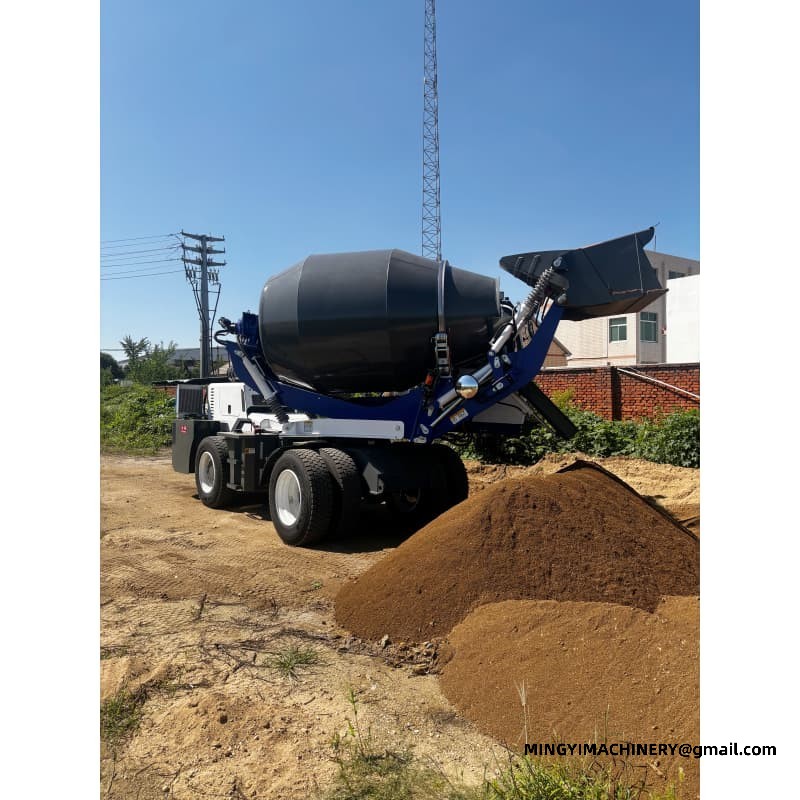
3,500 x 1,600 x 2,200 mm is the whole machine: short enough for a site trailer, narrow enough for a garden gate, low enough for a container without a top-loader's paperwork. Every one of those three numbers earns its place somewhere in a small precast yard.
The frame carries 1,500 kg of payload over a short, wide stance, with the drum mounted low and between the axles rather than overhanging. That geometry is why a machine this size can carry wet concrete at all: the load stays inside the wheelbase where the chassis was drawn to take it.
The drum is recipe-agnostic: lean foundation mixes, richer masonry mixes, and paving batches all turn the same way and discharge the same way. The machine's contribution is uniformity, not chemistry — the recipe is the engineer's, the repetition is the drum's.
Lean foundation mixes and richer masonry mixes turn the same way and discharge the same way; the drum's job is uniformity, not chemistry. The recipe stays the engineer's, and the repetition stays the drum's.
How long do large self loading concrete mixer truck belts last?
By condition, not calendar: cracks, glazing or flutter say replace. A spare set travels in the first spares kit for good reason.
Can two large self loading concrete mixer truck machines work one pour?
Yes, with separated standing spots and staggered cycles — it is the standard answer for pours that outrun one drum but still sit below plant scale.
How big is the large self loading concrete mixer truck?
3,500 x 1,600 x 2,200 mm overall — short enough for a site trailer, narrow enough for a standard double gate, low enough to containerise without special handling.
Is the large self loading concrete mixer truck fuel-hungry?
No. A 25 hp diesel works in short heavy efforts and loafs between them, which is where its economy comes from. Idle time, not work, wastes its fuel.
Can I inspect my large self loading concrete mixer truck before it ships?
Ask for photographs and a running video of your actual unit with its serial plate, or a third-party pre-shipment inspection. Suppliers who refuse the request are answering it.
What should I confirm before ordering a large self loading concrete mixer truck?
The specification against the published table — 0.8 m³ capacity, 1,500 kg load, 4WD, 25 hp engine, the 130 and 212 axles — plus what is standard versus optional in your build.
Is 24 km/h fast enough for a large self loading concrete mixer truck?
For the job, yes — the machine carries wet concrete high on a short wheelbase, and the gearing keeps those loads sedate. Road moves between sites use the travel gear.
What tyre pressures should a large self loading concrete mixer truck run?
The pressures in the manual, kept even left to right. Too hard cuts into wet ground and shrinks the footprint; too soft overheats the sidewall under a full drum.
Nothing on this page is complicated, and that is the point: a 0.8 m³ drum, a shovel, four driven wheels and a routine. Crews that keep the routine keep the machine earning in a small precast yard for years.
Keeping a service record for Large Self-Loading Mixer Batches: What 0.8 m³ Delivers
The record should follow the machine, not the owner. When Large Self-Loading Mixer Batches: What 0.8 m³ Delivers changes hands the service history travels with it, and a complete folder is often the difference between a quick sale and a long one.
Cold weather and winter care for Large Self-Loading Mixer Batches: What 0.8 m³ Delivers
A cold start is easier when the machine is prepared the night before. The routine that keeps Large Self-Loading Mixer Batches: What 0.8 m³ Delivers working through winter is mostly a matter of fuel, battery and patience in the first ten minutes of the day.
Packing, loading and shipment of Large Self-Loading Mixer Batches: What 0.8 m³ Delivers
The paperwork matters as much as the packing. Serial numbers, dimensions and weights recorded for Large Self-Loading Mixer Batches: What 0.8 m³ Delivers at loading are the same figures the destination needs, and a mismatch here loses more days than the voyage itself.
Wear items and spares worth holding for Large Self-Loading Mixer Batches: What 0.8 m³ Delivers
A spares list should follow the duty cycle. A Large Self-Loading Mixer Batches: What 0.8 m³ Delivers working every day in abrasive dust consumes filters and cutting edges far faster than the same machine used once a week, and the shelf should be stocked for the harder case.
Fuel, oil and fluid quality for Large Self-Loading Mixer Batches: What 0.8 m³ Delivers
Contamination is easier to prevent than to cure. Keeping the filler caps sealed, the funnels clean and the containers closed around Large Self-Loading Mixer Batches: What 0.8 m³ Delivers is unglamorous work that shows up as reliability later.
Contact MINGYI Machinery for the current self-loading concrete mixer specification, export packing and a formal specification for your market. E-mail: sales@mingycn.com | LINE (ID): mingyicn
Self-Loading Drum Mixer vs Pan Mixer: Which Suits the Job · Mobile Concrete Mixer Without a Pan: Carrying Batches to Place · high torque diesel dumper for mining and quarry work · Mini Self-Loading Concrete Mixer









