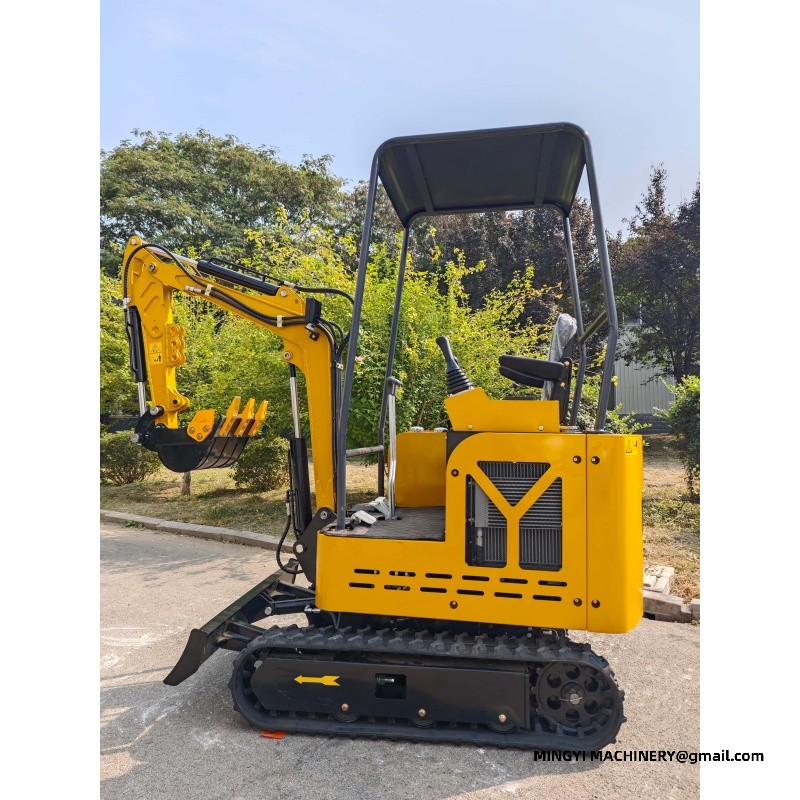
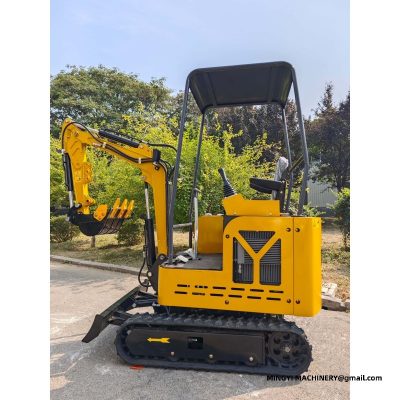
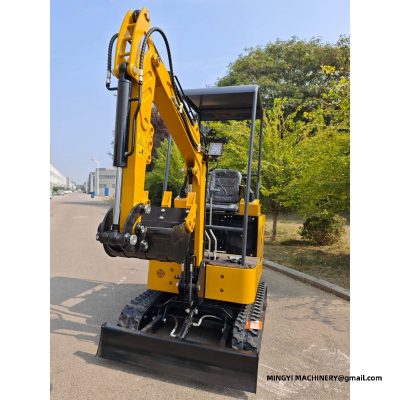
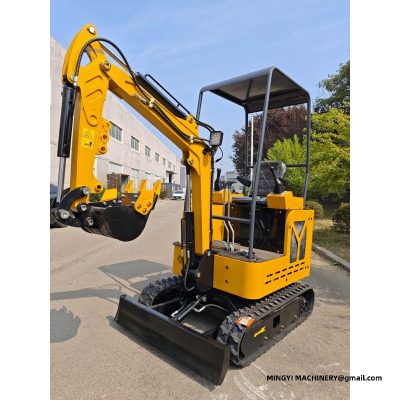
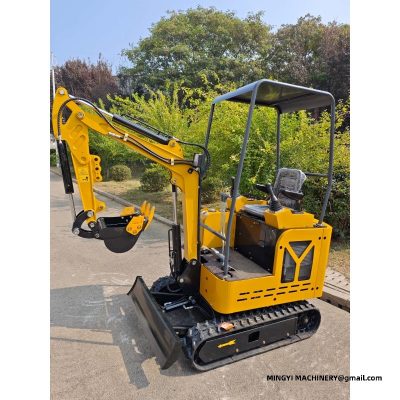
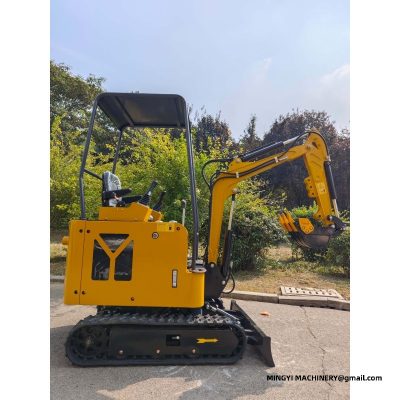
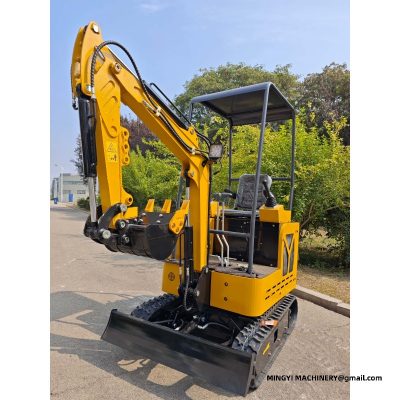
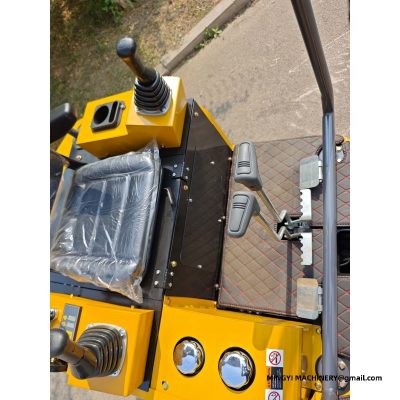
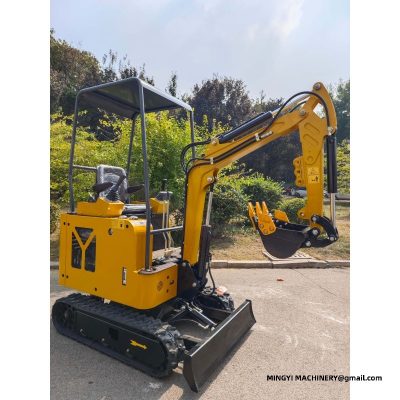
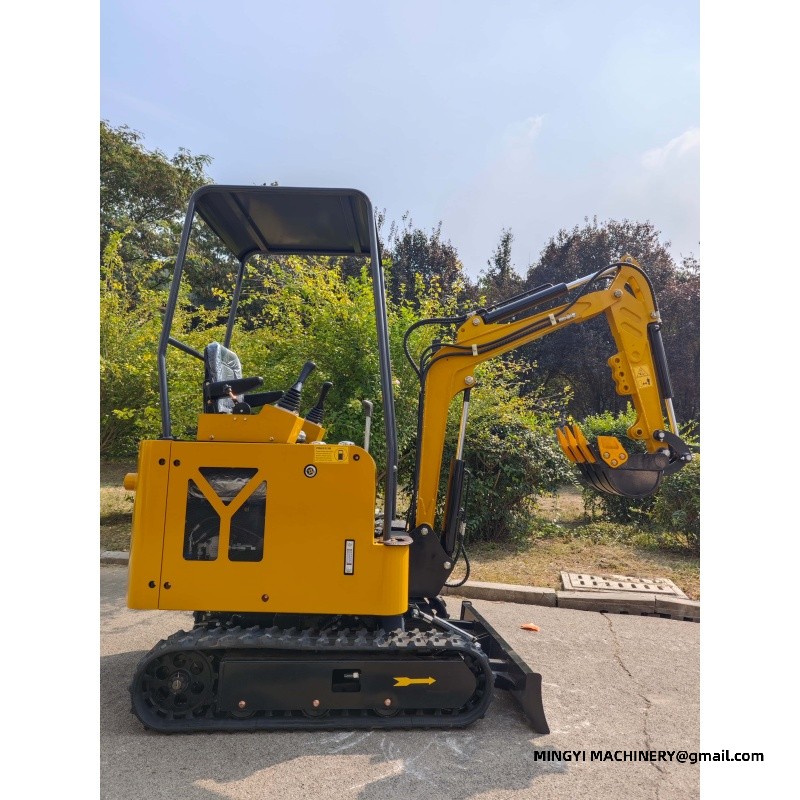
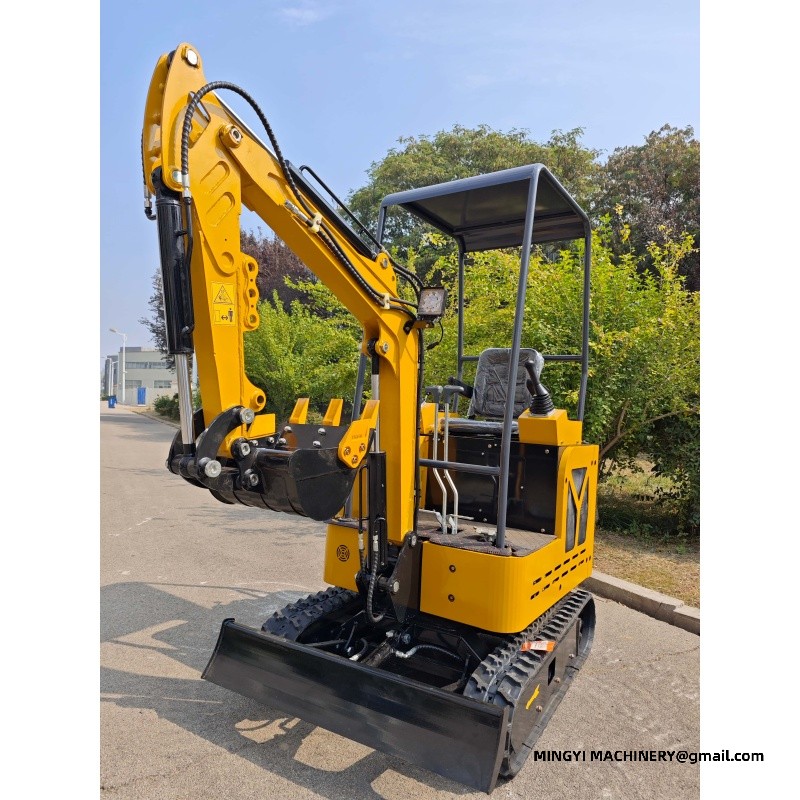
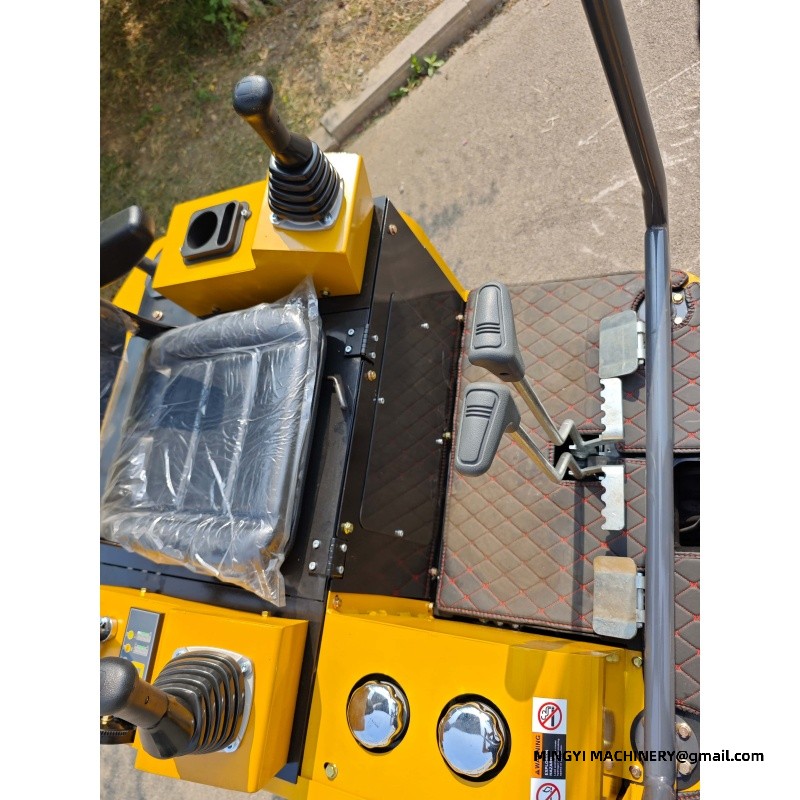
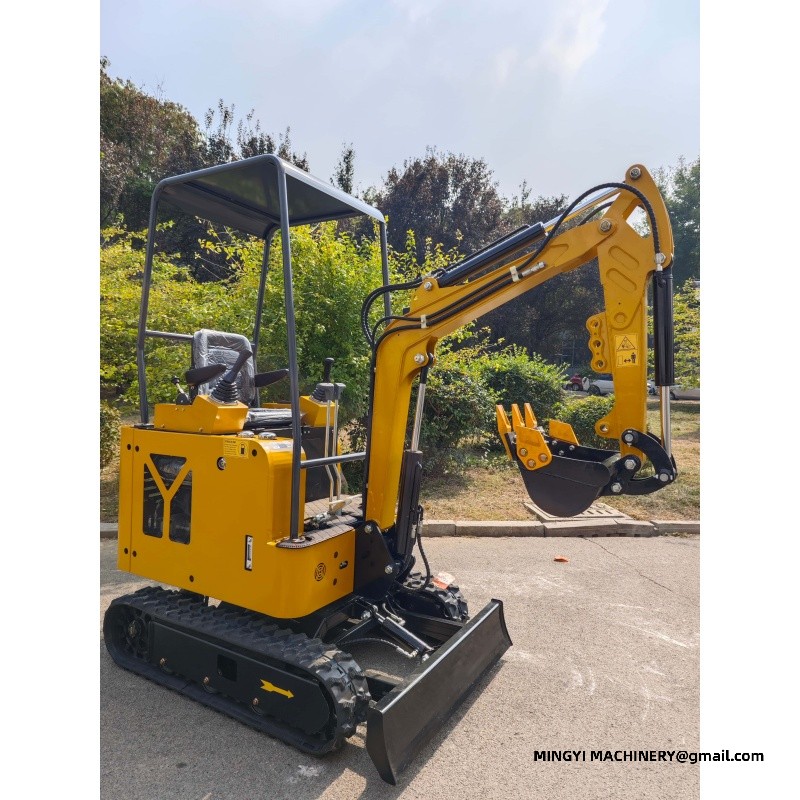
The 08 model is the smallest carrier in the MINGYI compact range, and it is chosen where access decides the job rather than digging volume.
At this size the machine can be moved on a light trailer, taken through a garden gate, and used indoors or on paving without a crane or a loading ramp.
Working in gardens and tight access with the 08 model
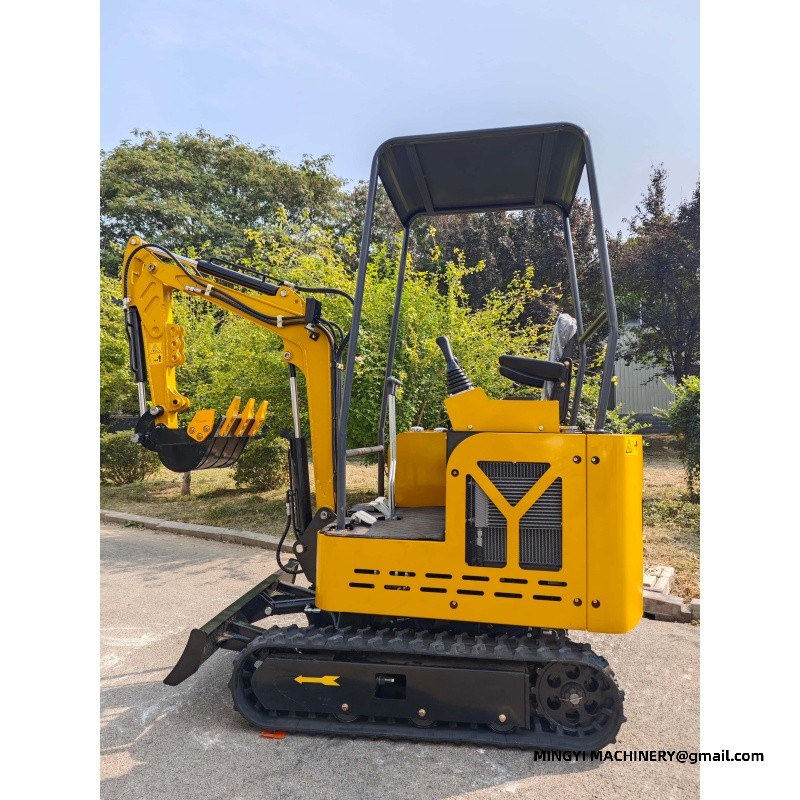
Back garden excavations, pond work, fence post holes and short footing runs are the kind of jobs that suit a machine of this class.
A retractable undercarriage narrows the tracks for a gateway and widens them again for work, and rubber tracks keep the finish on paving and turf intact.
Attachments sized for the 08 model
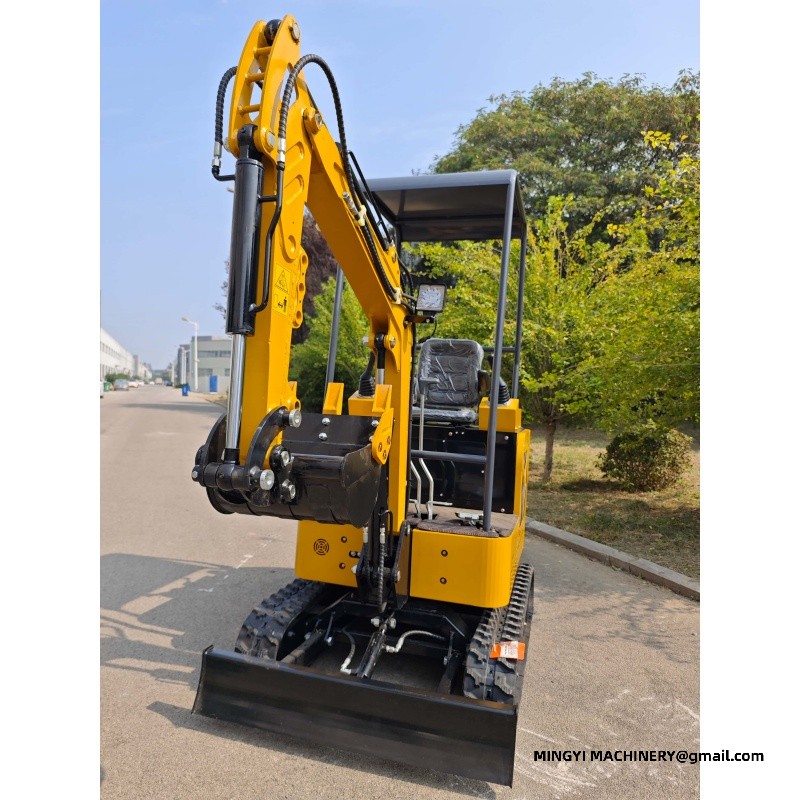
The smaller carrier takes a narrow digging bucket, an auger, a breaker hammer and a compacting attachment, all on the same quick coupler.
Because the machine is built to order, the buyer names the attachments at the same time as the engine and the track option, so the coupling and the hydraulic lines are right.
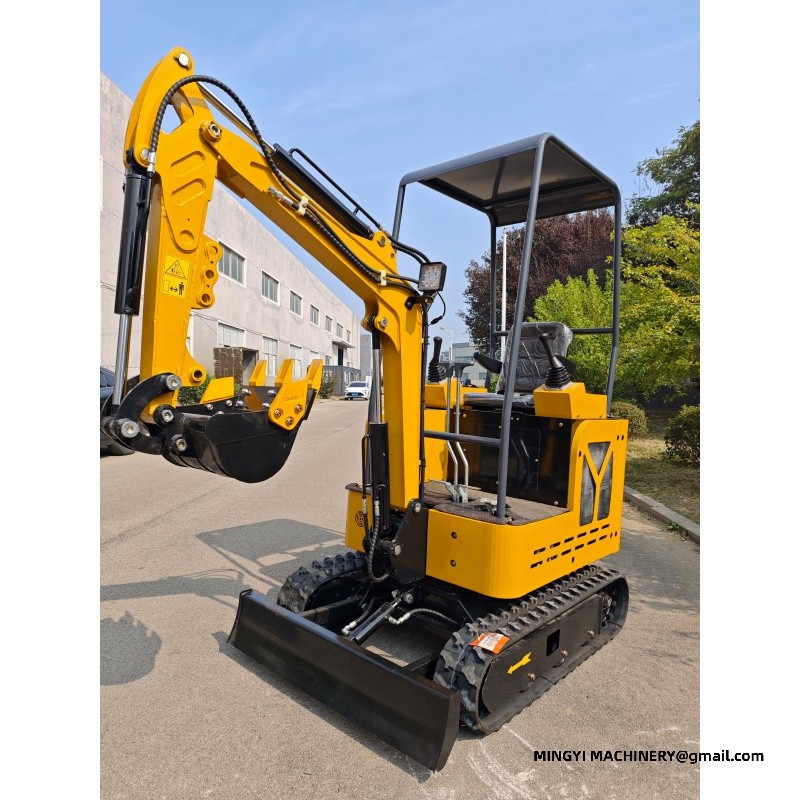
For hire yards and one-operator businesses, the 08 model is ordered as a small, complete unit with the attachments it is expected to use most often. The machine is supplied with spare parts and service information so the owner can keep it working.
Hiring versus owning a 0.8 tonne mini excavator The choice follows the hours. Work that fills a few weeks a year is usually better hired, while the excavator that would be on site most weeks starts to justify ownership once the transport and booking time is counted. Ownership brings obligations that hiring does not. Storage, servicing, insurance and an operator are the items to set against the hire rate before deciding which way this class of machine should be supplied. Orchard, vineyard and farm use of 0.8 tonne mini excavator Ditching, fertilising and drainage on farmland suit the unit in daily use because the work is spread over a large area in short bursts. The machine travels behind a pickup and works where it stops. Farms also use a machine of this size for general maintenance - clearing a watercourse, repairing a track, loading a spreader. One carrier with a few attachments covers most of the jobs that would otherwise wait for a contractor. OEM and fleet customisation of 0.8 tonne mini excavator Customisation also covers the specification sheet. A fleet buyer may want every machine itself delivered with the same coupler, the same engine and the same tool kit so training and parts stock stay simple. Documentation can be prepared to suit the importer. Manuals, parts books and decal sets for the equipment on site can be supplied with the buyer's own branding where the order size justifies it. Track choice for 0.8 tonne mini excavator Rubber tracks suit paved and landscaped ground because they spread the machine weight and leave the surface intact. Steel tracks with rubber blocks are specified where the ground is rougher or the working day is longer, and the choice can be made per machine rather than accepted as a factory default. Track type changes what the machine can cross and what it leaves behind. Buyers specify rubber for lawns, driveways and municipal work, and steel with rubber blocks for sites where sharp material would cut a rubber belt in a week. Lifting and material handling with a 0.8 tonne mini excavator Lifting with a machine built to dig needs a plan. The load, the radius and the ground under the machine in that duty all matter, and the safe figure is the one on the chart rather than the one that looks possible. Stability changes with reach. A load the model in question handles close in becomes a different proposition at full extension, so the working radius belongs in the plan before the lift rather than during it. Working near live services with 0.8 tonne mini excavator Digging near water, gas and cable is a precision job. The unit on the job is used here because the operator can work in short controlled cuts and because the machine can be positioned without driving over the run being exposed. The risk on utility work is not machine power but machine placement. A machine built for the work that fits the working width leaves the surrounding ground undisturbed, which keeps the trench stable and the reinstatement small. Boom configuration for the equipment in service A swing boom lets the machine dig parallel to its tracks without repositioning, which is what makes trenching beside a wall or a fence practical. On the excavator this is often the option that decides whether a job is possible at all. Extended and offset boom configurations change reach and working range. This class of machine with a longer arm reaches further but lifts less at full extension, so the specification is set against the deepest and furthest point on the job list. Matching the unit in daily use to ground conditions Soft ground is a flotation problem, not a power problem. A machine of this size on wide rubber tracks crosses lawn, sand and cultivated soil that would stop a narrower machine or a wheeled unit of the same capacity. Hard and abrasive ground reverses the specification. On rock, demolition rubble or sharp gravel, steel tracks with rubber blocks on the equipment on site survive conditions that cut a rubber belt quickly. Trailering and moving the machine itself Transport weight and width decide whether a machine needs a specialist haulier. The model in question sized to travel on a standard plant trailer behind a suitable vehicle moves with the crew rather than on a scheduled low loader. Loading practice matters as much as the numbers. The machine in that duty is driven up ramps under its own power with the boom lowered and the tracks aligned, and secured at the points the manufacturer specifies. Running the unit on the job in a rental fleet The specification that rents best is usually the simplest one to explain at the counter. A machine built for the work with rubber tracks, a canopy and a coupler covers the majority of weekend and short-term hires. Fleet buyers also weigh transport. The equipment in service that a customer can tow on a normal licence and a standard trailer is a hire that does not need a delivery truck, which changes how often it goes out. Interior and light demolition with the excavator Interior demolition is an access and a weight question. This class of machine that fits through a doorway and works on a suspended floor does jobs that would otherwise be done by hand or by a larger machine that cannot enter. Dust, debris clearance and floor loading all argue for a compact machine indoors. The unit in daily use spreads its weight over a wider track footprint than a wheeled machine of similar capacity. Attachments that turn a machine of this size into several machines Attachment lists are best written before delivery. Specifying the equipment on site with the tools the job list needs avoids the work and delay of adding hydraulics later, and a quick coupler makes the swap a few minutes instead of a workshop job. Most of the daily variety on the machine itself comes from the attachment rack rather than from the machine itself. Bucket, breaker, auger, ripper, rake and grab cover the large majority of the work a contractor will see. Export packing and shipping of the model in question Machines leave the factory prepared for container or flat rack shipment. The machine in that duty is normally shipped with the attachment set and the spare parts list agreed in advance so the container is planned once. Export documentation, decals and paint are settled before packing. Asking for them with the unit on the job order avoids a second handling session and keeps the machine on the booked vessel. Specification data for a machine built for the work The figures below are the factory figures for the models most often matched to the equipment in service. They are the numbers to check against the site: the depth the work needs, the reach from one position, and the width of the narrowest point on the route in. These are the reference figures for the excavator. MINGYI confirms the final build sheet, including engine and attachment choices, against the destination and the job list before production. Weather decides which days are productive. Rain turns some ground unusable and cold changes how this class of machine starts and warms up, so planning the wet months around maintenance is more useful than planning around output. Seasonal planning smooths the workload. Machines that are busy for a few months and idle for the rest benefit from a service slot in the quiet period, and the unit in daily use prepared in the off-season starts the busy months reliably.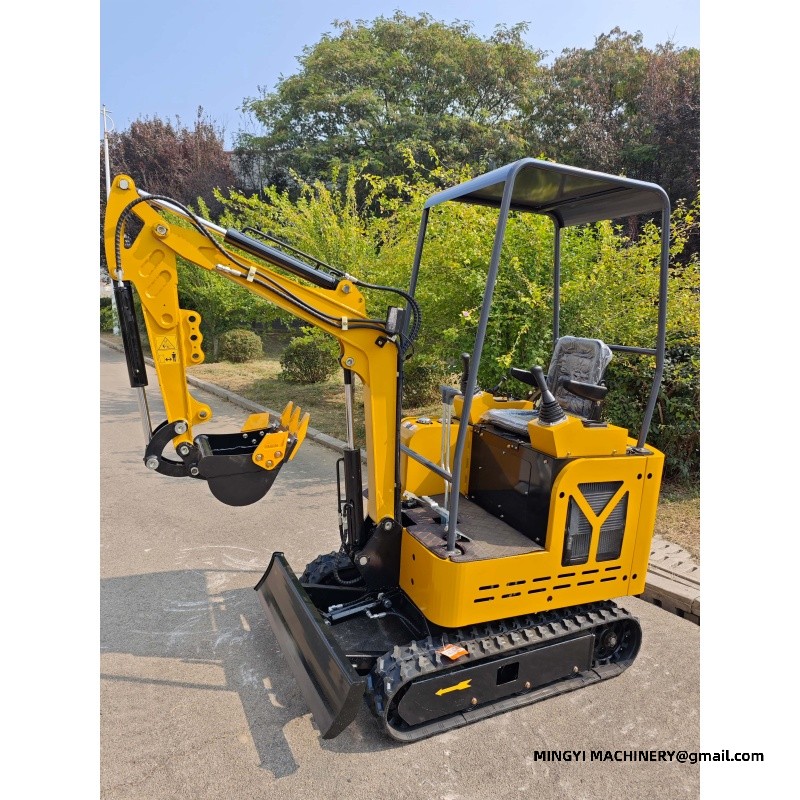
Reference specification — mini excavator range 20-1W 20-3W 09L 15L Operating weight 1800 kg (3968.32 lb) 1900 kg (4188.78 lb) 1100 kg (2425.08 lb) 1400 kg (3086.47 lb) Transport size (L×W×H) 2550 × 1100 × 2200 mm 2550 × 1100 × 2200 mm 2300 × 720 × 1870 mm 2200 × 930 × 2250 mm Max digging depth 1800 mm (70.87 in) 1800 mm (70.87 in) 1400 mm (55.12 in) 1700 mm (66.93 in) Max digging height 2820 mm (111.02 in) 2820 mm (111.02 in) 2800 mm (110.24 in) 2750 mm (108.27 in) Max dumping height 2050 mm (80.71 in) 2050 mm (80.71 in) 1880 mm (74.02 in) 1960 mm (77.17 in) Max digging radius 3050 mm (120.08 in) 3050 mm (120.08 in) 2490 mm (98.03 in) 2900 mm (114.17 in) Max digging distance 2300 mm (90.55 in) 2300 mm (90.55 in) 2000 mm (78.74 in) 2300 mm (90.55 in) Minimum turning radius 1450 mm (57.09 in) 1450 mm (57.09 in) 1400 mm (55.12 in) 1450 mm (57.09 in) Travel speed 5 km/h (3.11 mph) 5 km/h (3.11 mph) 3 km/h (1.86 mph) 3 km/h (1.86 mph) Gradeability 30° 30° 30° 30° Fuel consumption 2-3 L/h (0.528—0.793 gal) 2-3 L/h (0.528—0.793 gal) 1-1.3 L/h (0.264—0.343 gal) 1-1.3 L/h (0.264—0.343 gal) Fuel tank capacity 16 L (4.23 gal) 16 L (4.23 gal) 8 L (2.11 gal) 10 L (2.64 gal) Hydraulic oil tank 18 L (4.76 gal) 18 L (4.76 gal) 16 L (4.23 gal) 16 L (4.23 gal) Dozer blade lift height 180 mm (7.09 in) 180 mm (7.09 in) 180 mm (7.09 in) 180 mm (7.09 in) Dozer blade drop depth 210 mm (8.27 in) 210 mm (8.27 in) 210 mm (8.27 in) 210 mm (8.27 in)
Q. What is a machine of this size?
A. The class sets the trade: access on one side, reach and lift on the other, and every compact buyer picks their point on that line. Tracks, cabs and attachments are common across the range, so the size decision is mostly about where the machine must fit and what it must lift. The equipment on site is one of the pages buyers land on when comparing machines for 0.8 tonne class, and the factory treats it as a specification conversation rather than a catalogue line.
Q. Is a bigger class always more machine?
A. Only where the site lets it work: a class too big for the access spends the day waiting outside the gate. Match the class to the job list, not to the brochure - the factory confirms the pairing before the build sheet is cut.
Q. Can I see the machine before it ships?
A. Inspection is arranged at the factory, in person or by a scheduled video walk-around - the same session covers paint, decals and attachment fitment for the 0.8 tonne class specification, so the machine inspected is the machine that ships.
Documents that travel with the machine itself
The machine is only half of what arrives. The parts book, the service schedule and the declarations that come with the model in question are what let the owner register, insure and maintain it without a second round of emails.
Hot, humid and dusty conditions around the machine in that duty
Humidity attacks the parts that are not used. Storage in a damp climate means the unit on the job needs the exposed metal protected and the machine run regularly, because standing still does more damage than working.
E-mail : sales@mingycn.com
LINE ( ID ): mingyicn
Related pages
two tonne mini excavator · two tonne mini excavator for trenching · Wheel Loader Series: Reliable Builds from Entry to Medium Frame · Mini Excavators









