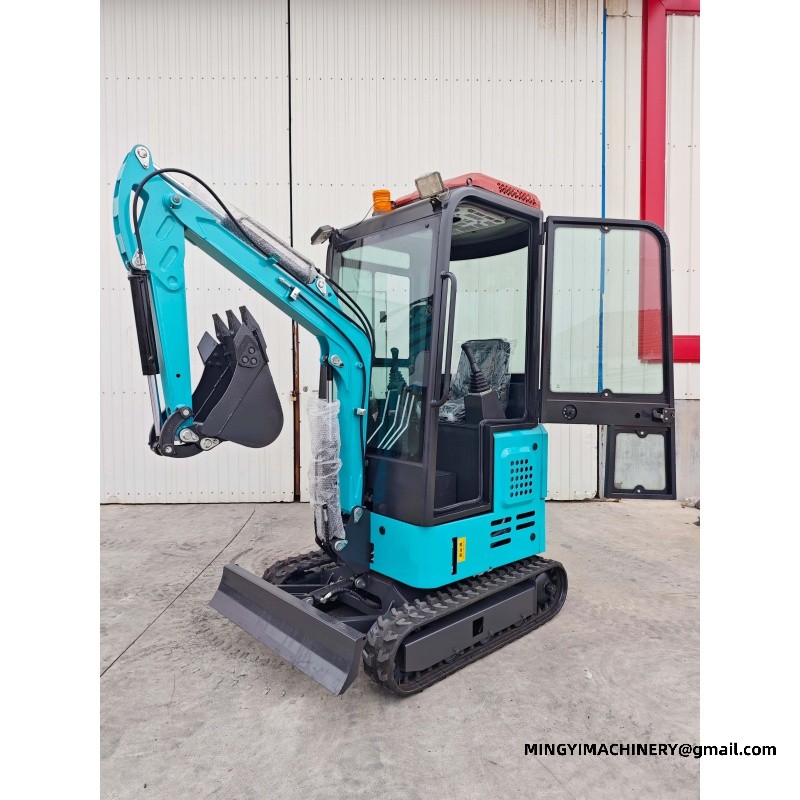
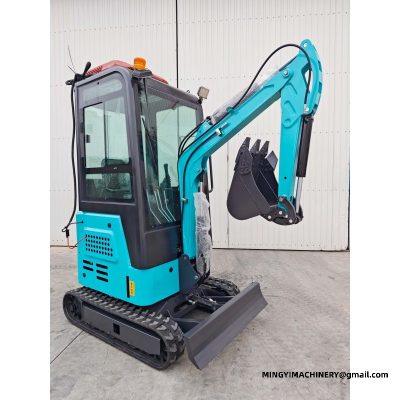
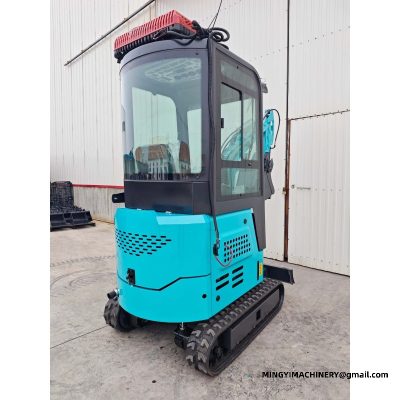
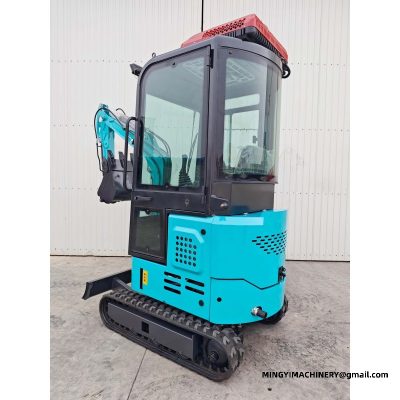
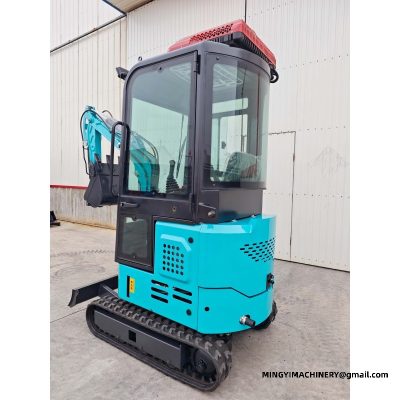
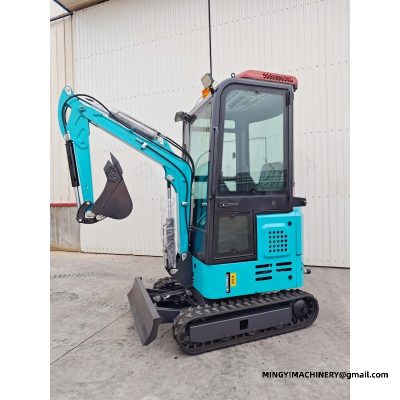
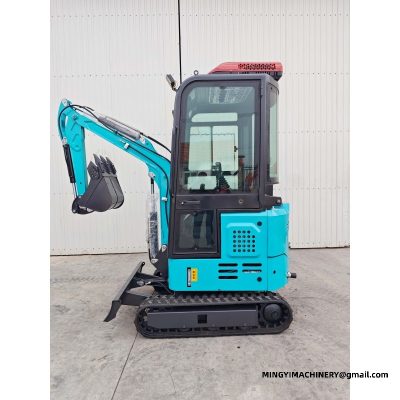
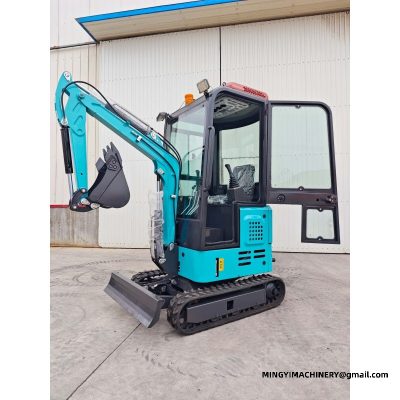
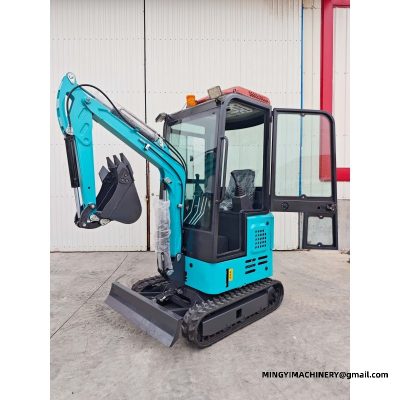
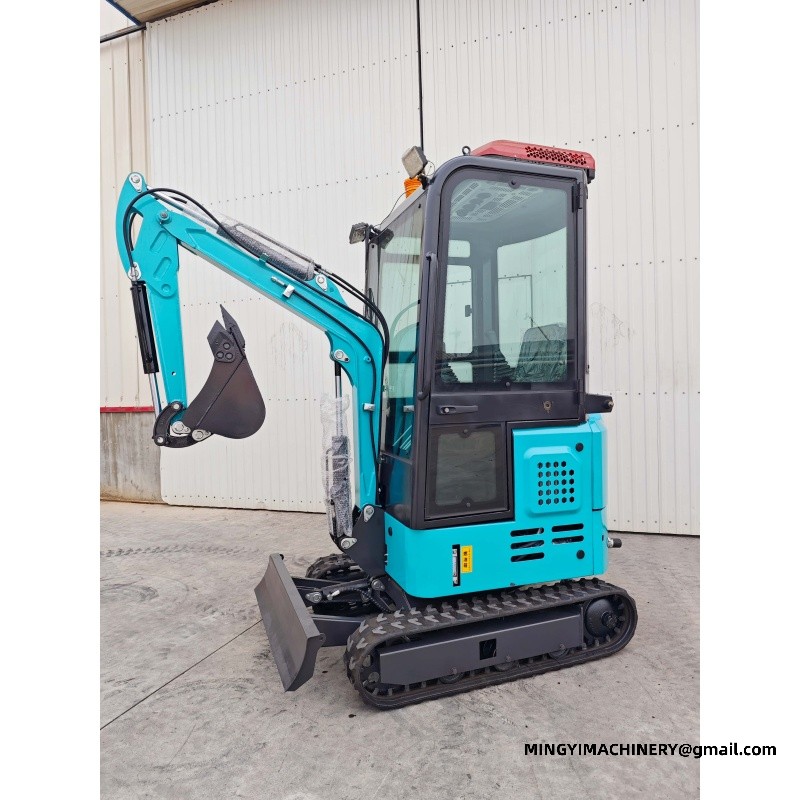
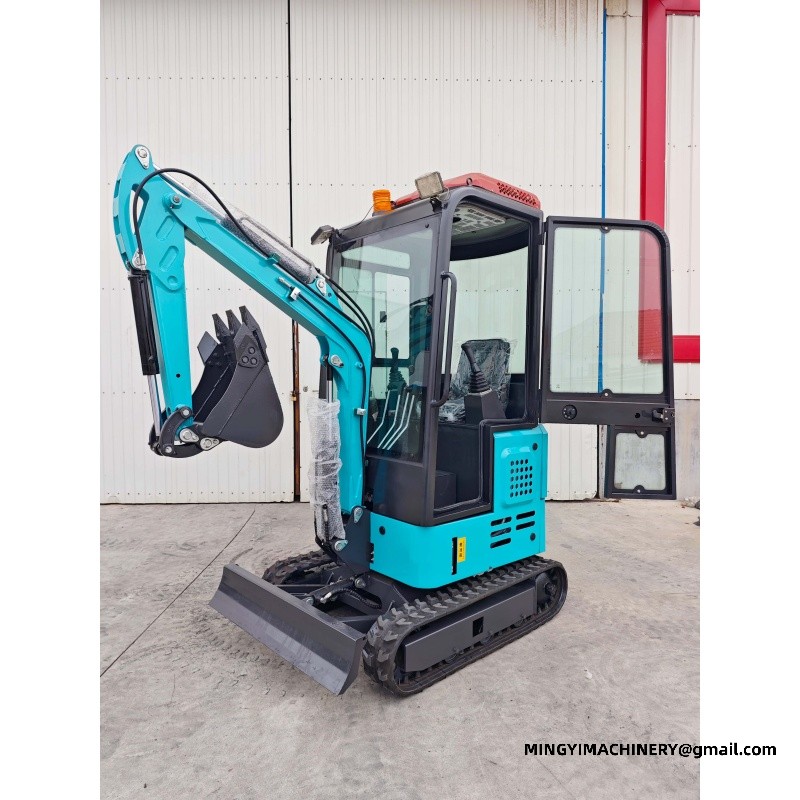
A photograph of a machine in working position says more about its layout than a list of features. The stance on the ground, the relationship between the tracks and the trench, and the position of the cab all show how the unit behaves in real conditions.
The pages in this section show MINGYI compact excavators on site across the range, from small units in confined work to larger models in open ground. Each machine illustrated is built to order, with its configuration chosen for the work it is photographed doing.
What the working positions show about layout
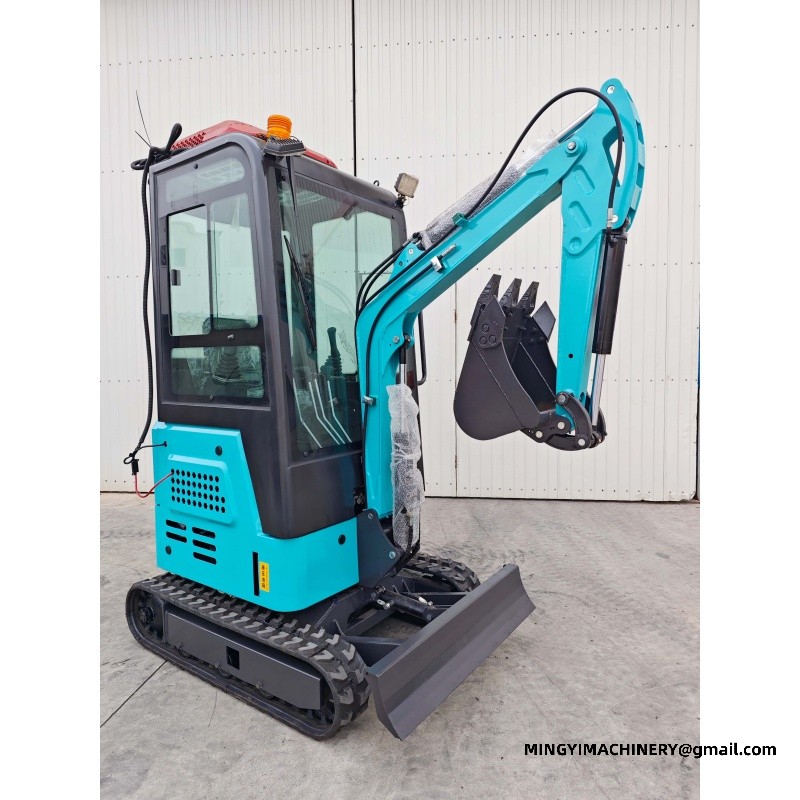
A machine standing alongside a trench with the boom offset demonstrates the point of that geometry without any further explanation. Where the tracks sit relative to the excavation edge shows how much of the load the operator is keeping on solid ground.
Photographs of attachment work are equally direct. A breaker hammer, an auger or a rake on the end of the arm shows the reach the machine has in that configuration and the surface the tracks are travelling over at the same time.
Reading a machine from how it is set up
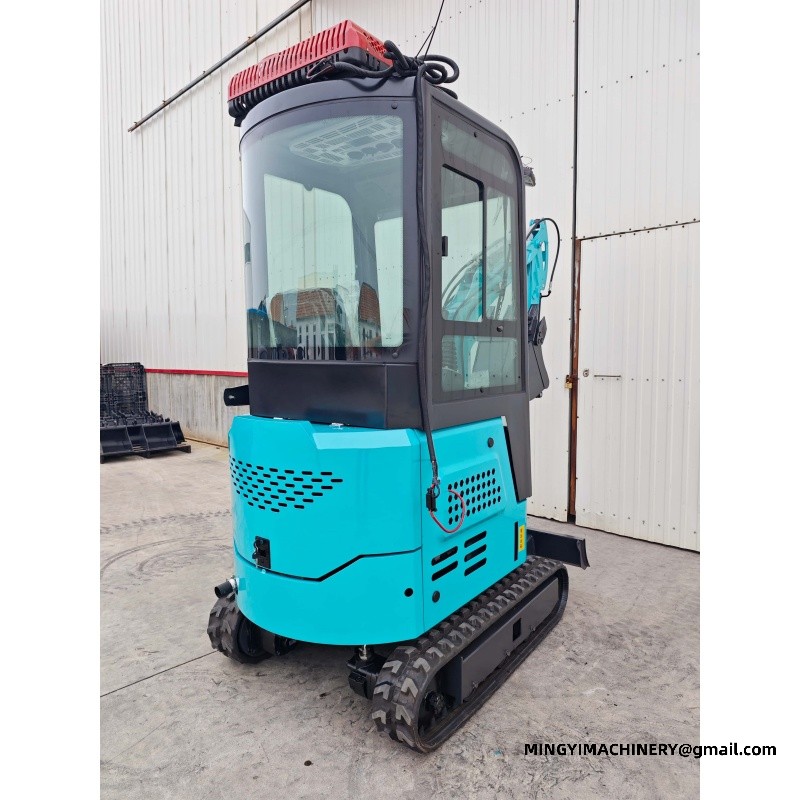
Cab or canopy, rubber or steel tracks, and the presence of a quick coupler are all visible in a working image, and each of them corresponds to a decision a buyer has to make. Seeing them in use is a quicker way to judge which combination suits a particular contract.
The same machine appears in different roles because it is the attachments and the set-up that change, not the carrier. Buyers comparing units are usually comparing those decisions rather than the base machine.
Working images are a practical reference for a buyer choosing a compact excavator. Seen in position on site, the machine's track footprint, tail swing and working reach can be judged against the conditions the buyer actually faces.
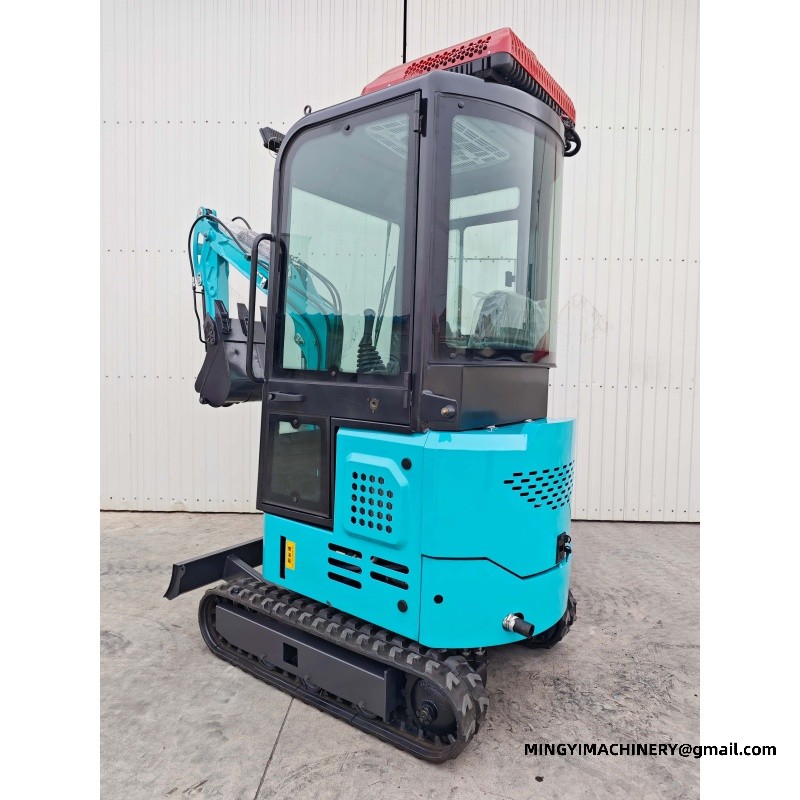
Municipal and public works with compact excavator at work on site Drainage repair, tree planting, footway reconstruction and cemetery work are all within the range of the excavator. The jobs are small individually and continuous across the year. Noise and surface protection matter on public work. This class of machine on rubber tracks across paving, with a sealed cab for the operator, suits the conditions better than a larger tracked machine. Trailering and moving compact excavator at work on site Transport weight and width decide whether a machine needs a specialist haulier. The unit in daily use sized to travel on a standard plant trailer behind a suitable vehicle moves with the crew rather than on a scheduled low loader. Detachable components reduce transport length. A machine of this size built with a removable arm section or a folding step fits a shorter trailer and may avoid an oversize movement permit. Boom configuration for compact excavator at work on site Extended and offset boom configurations change reach and working range. The equipment on site with a longer arm reaches further but lifts less at full extension, so the specification is set against the deepest and furthest point on the job list. Detachable boom sections are used where transport length matters. The machine itself that has to travel on a standard trailer can be built so the arm comes off for the road and goes back on at the site. Attachments that turn compact excavator at work on site into several machines The base machine is a carrier; the tool on the end of the arm decides the task. The model in question fitted with a toothed bucket digs, and the same machine with a breaker, an auger or a grab does work that would otherwise need a second unit on site. Attachment lists are best written before delivery. Specifying the machine in that duty with the tools the job list needs avoids the work and delay of adding hydraulics later, and a quick coupler makes the swap a few minutes instead of a workshop job. Working on slopes and uneven ground with compact excavator at work on site Slope work is a stability question before it is a traction question. Knowing the gradient the unit on the job is rated for, and working across rather than straight up where the ground allows, removes most of the risk. Ground that looks level often is not. A machine built for the work crossing a filled trench, a soft edge or a hidden void behaves differently from one on undisturbed ground, and those are the places worth walking before driving. Hiring versus owning a compact excavator at work on site The choice follows the hours. Work that fills a few weeks a year is usually better hired, while the equipment in service that would be on site most weeks starts to justify ownership once the transport and booking time is counted. Ownership brings obligations that hiring does not. Storage, servicing, insurance and an operator are the items to set against the hire rate before deciding which way the excavator should be supplied. Engine options behind this class of machine Power unit selection is settled against the service network the buyer already uses. MINGYI offers Kubota D722, Kubota D902, YANMAR, Changchai, Laidong, Runtong, YARMAX, Youpu 2V80 and Youpu 195, so a fleet running one brand of engine can keep the same filters, the same parts supplier and the same mechanic. Engine choice is also an emissions and documentation question for some markets. Listing the available units with the unit in daily use enquiry lets the factory confirm what can be supplied and documented for the destination country. Hydraulic circuits on a machine of this size Auxiliary hydraulic lines are what let a machine drive a tool rather than only a bucket. The equipment on site specified with the right circuits and flow runs a breaker or an auger without an add-on power pack bolted to the frame. Hydraulic specification is easier to settle at build time than to correct later. The machine itself delivered without auxiliary lines can still dig, but every additional tool becomes a retrofit project. Daily checks and maintenance on the model in question Daily maintenance on the machine in that duty is a short list: engine oil level, coolant, track tension, hydraulic oil level and a look at the hoses. Ten minutes at the start of the shift prevents most of the failures that stop a machine. Greasing is the second item. The slew ring, the boom and arm pins and the bucket linkage on the unit on the job take grease daily in dusty work, and the intervals shorten further when the machine is used in water or mud. Acceptance checks when a machine built for the work arrives A function check before the machine goes to work is worth the hour. Running through the controls, the travel and the attachment circuit on the equipment in service confirms it is set up as specified and ready for the site. Documentation should arrive with the machine. Parts list, service schedule and any certificates for the excavator are what the workshop needs later, and they are much easier to obtain at delivery than in month six. Specifying this class of machine against a job list The practical way to specify is to write the job list first: the narrowest access, the deepest trench, the heaviest tool and the surfaces the machine must cross. The unit in daily use is then matched to those four numbers. Useful information to send with an enquiry includes working width, required digging depth, ground conditions and the attachment set. Those four items let the factory specify a machine of this size that fits rather than a generic build. Specification data for the equipment on site Where the machine itself is being specified for a job list, the table below gives the factory figures that matter most: what the machine weighs, how deep and how far it works, and what it measures on a trailer. Figures are factory figures and are confirmed on the build sheet for the model in question. Where a job sits between two models, the larger machine usually takes less time than the smaller one spends on rework. Hard and abrasive ground reverses the specification. On rock, demolition rubble or sharp gravel, steel tracks with rubber blocks on the machine in that duty survive conditions that cut a rubber belt quickly. Mixed sites are common and argue for a compromise specification. Most buyers choose rubber for the unit on the job and accept the wear, unless the majority of the work is on material that will damage it.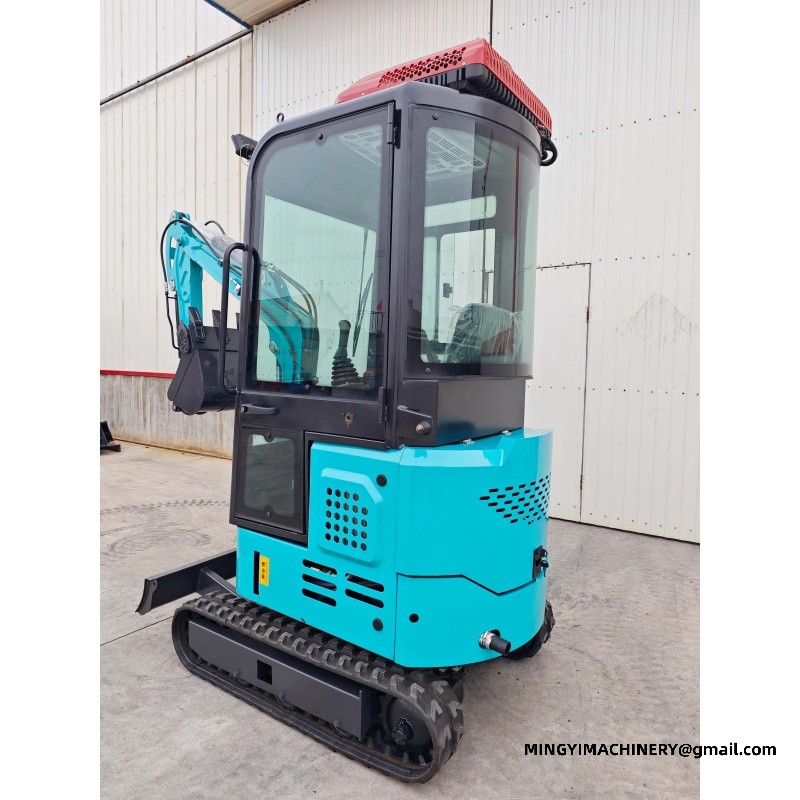
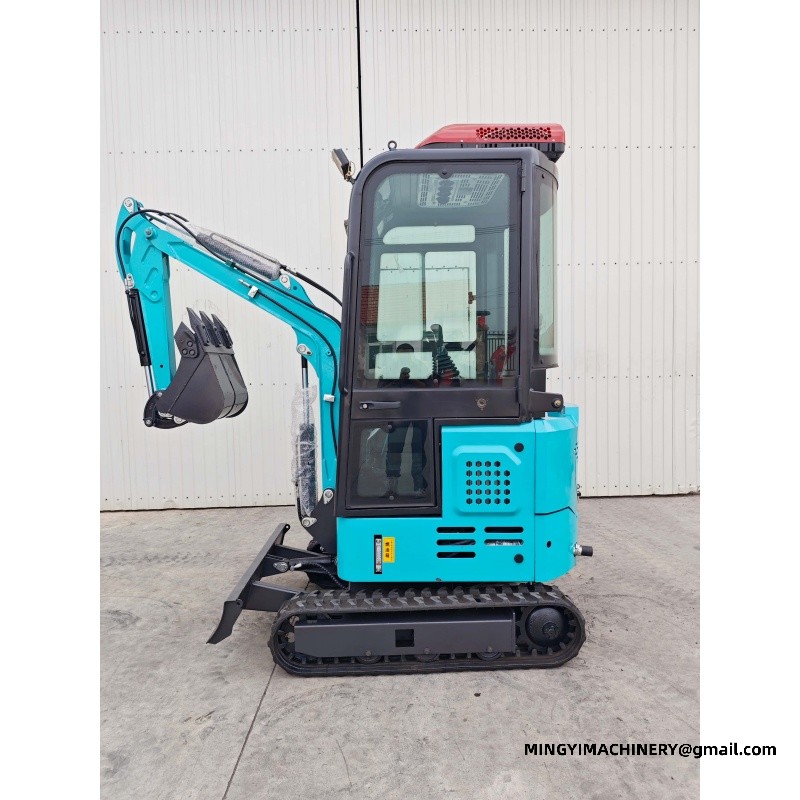
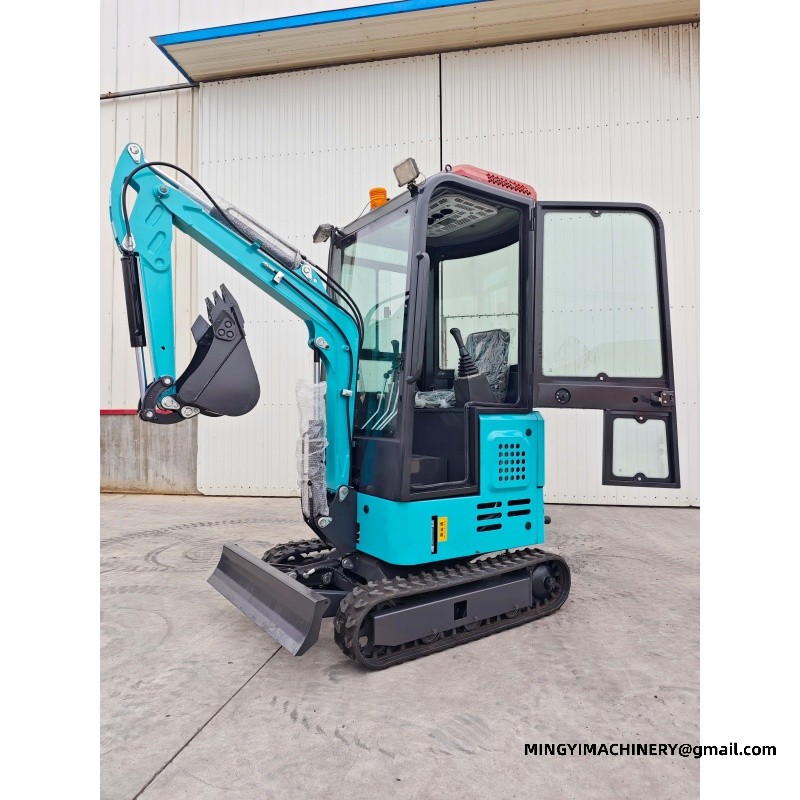
Reference specification — mini excavator range 30-1W 30-2W 09L 25L Operating weight 2900 kg (6393.41 lb) 2700 kg (5952.48 lb) 1100 kg (2425.08 lb) 2200 kg (4850.17 lb) Transport size (L×W×H) 3000 × 1250 × 2780 mm 3000 × 1100 × 2700 mm 2300 × 720 × 1870 mm 3000 × 1300 × 2700 mm Max digging depth 2200 mm (86.61 in) 2200 mm (86.61 in) 1400 mm (55.12 in) 2300 mm (90.55 in) Max digging height 3400 mm (133.86 in) 3000 mm (118.11 in) 2800 mm (110.24 in) 3100 mm (122.05 in) Max dumping height 2400 mm (94.49 in) 2000 mm (78.74 in) 1880 mm (74.02 in) 2050 mm (80.71 in) Max digging radius 4000 mm (157.48 in) 3800 mm (149.61 in) 2490 mm (98.03 in) 3900 mm (153.54 in) Max digging distance 2800 mm (110.24 in) 3050 mm (120.08 in) 2000 mm (78.74 in) 3100 mm (125.05 in) Minimum turning radius 2000 mm (78.74 in) 1750 mm (68.9 in) 1400 mm (55.12 in) 1800 mm (70.87 in) Travel speed 5 km/h (3.11 mph) 7 km/h (4.35 mph) 3 km/h (1.86 mph) 7 km/h (4.35 mph) Gradeability 30° 30° 30° 30° Fuel consumption 2-3 L/h (0.528—0.793 gal) 2-3 L/h (0.528—0.793 gal) 1-1.3 L/h (0.264—0.343 gal) 2-3 L/h (0.528—0.793 gal) Fuel tank capacity 16 L (4.23 gal) 16 L (4.23 gal) 8 L (2.11 gal) 16 L (4.23 gal) Hydraulic oil tank 20 L (5.28 gal) 20 L (5.28 gal) 16 L (4.23 gal) 18 L (4.76 gal) Dozer blade lift height 420 mm (16.54 in) 230 mm (9.06 in) 180 mm (7.09 in) 230 mm (9.06 in) Dozer blade drop depth 210 mm (8.27 in) 280 mm (11.02 in) 210 mm (8.27 in) 280 mm (11.02 in)
Q. Who chooses a machine built for the work?
A. One machine, one trailer, one operator and a full week of varied work is the whole idea behind the compact excavator class. Trenching on Monday, loading and grading through the week, fence posts and drainage to finish - the attachment set specifications the work. MINGYI builds the 08, 12 and 18 models covering the 0.8 to 6 tonne class, and the equipment in service is where that range meets at on site.
Q. What can I expect from a compact excavator in a normal week?
A. Trenching one day, loading and grading the next, fence posts and drainage through the rest - one machine, one trailer, one operator, and the attachment set specifications the work.
Q. Can I see the machine before it ships?
A. Inspection is arranged at the factory, in person or by a scheduled video walk-around - the same session covers paint, decals and attachment fitment for the at on site specification, so the machine inspected is the machine that ships.
A second operator for the excavator
A machine that only one person can use is a single point of failure. Training a second operator on this class of machine takes a day and removes the dependency that otherwise governs holidays, illness and busy weeks.
Moving the unit in daily use between sites
Travel time is not working time, and it should be planned as its own item. The hours spent moving a machine of this size between jobs are hours not worked, and a trailer that matches the machine reduces them every single trip.
E-mail : sales@mingycn.com
LINE ( ID ): mingyicn
Nameplate, serial number and documents for compact excavator at work on site
The serial plate is how the right parts book, the right manual and the right service bulletin are found, and it is worth photographing on delivery.
A record of modifications matters as well, since an added hydraulic circuit or a changed attachment mount changes what the manual describes.
Related pages
mini excavator attachment selection · mini excavator setup on site · Wheel Loader Manufacturer China: Range, Builds and Export Terms · Mini Excavators









