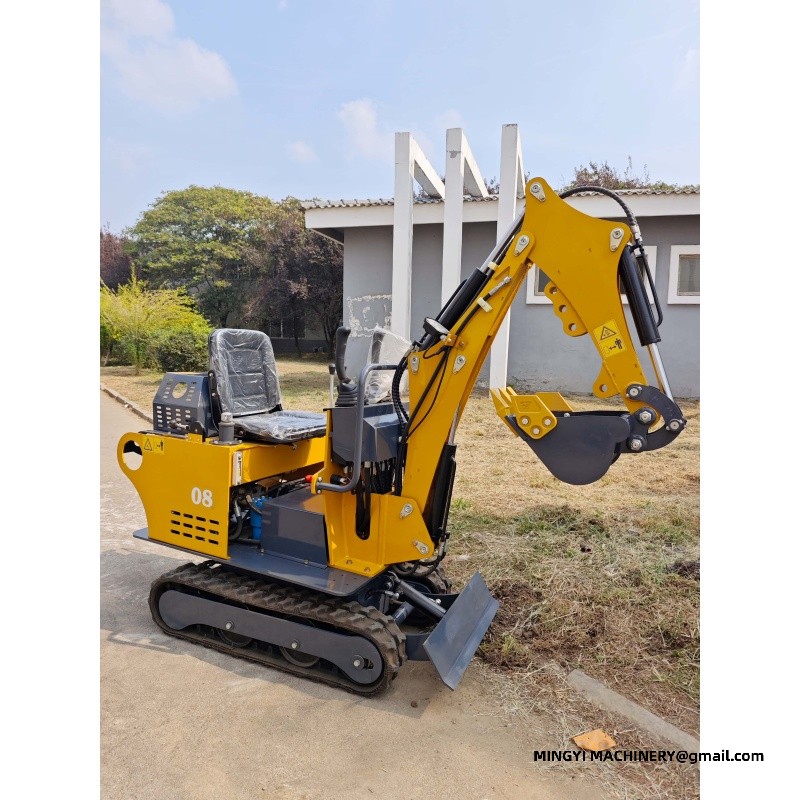
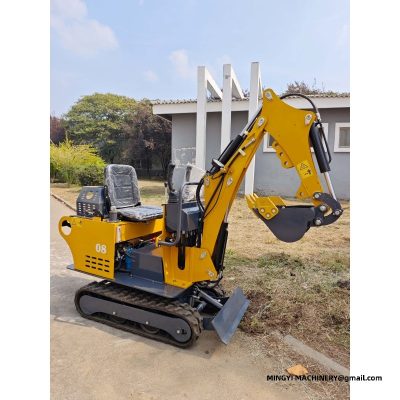
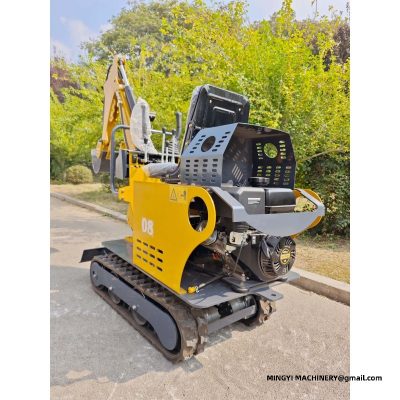
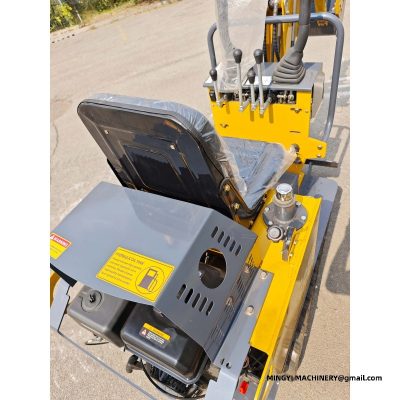
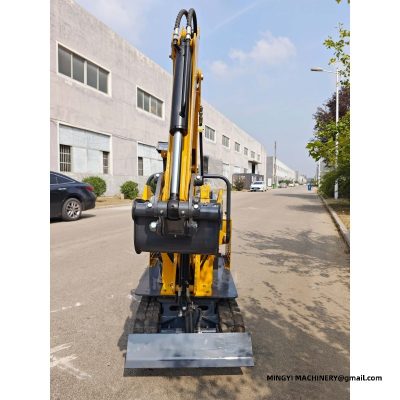
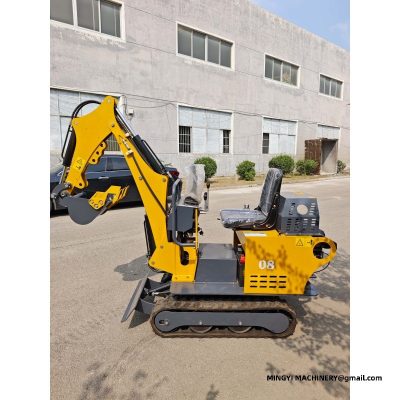
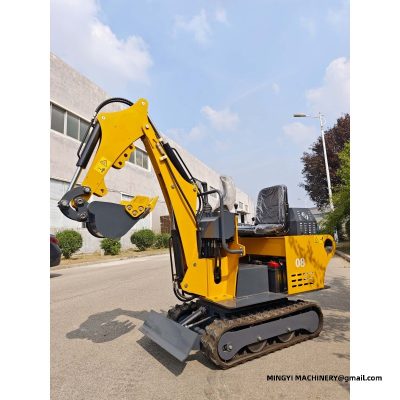
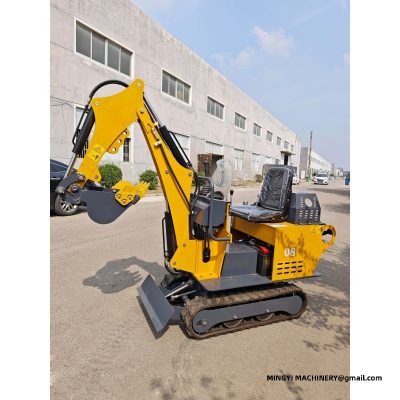
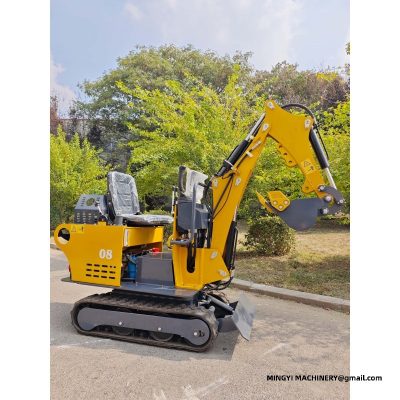
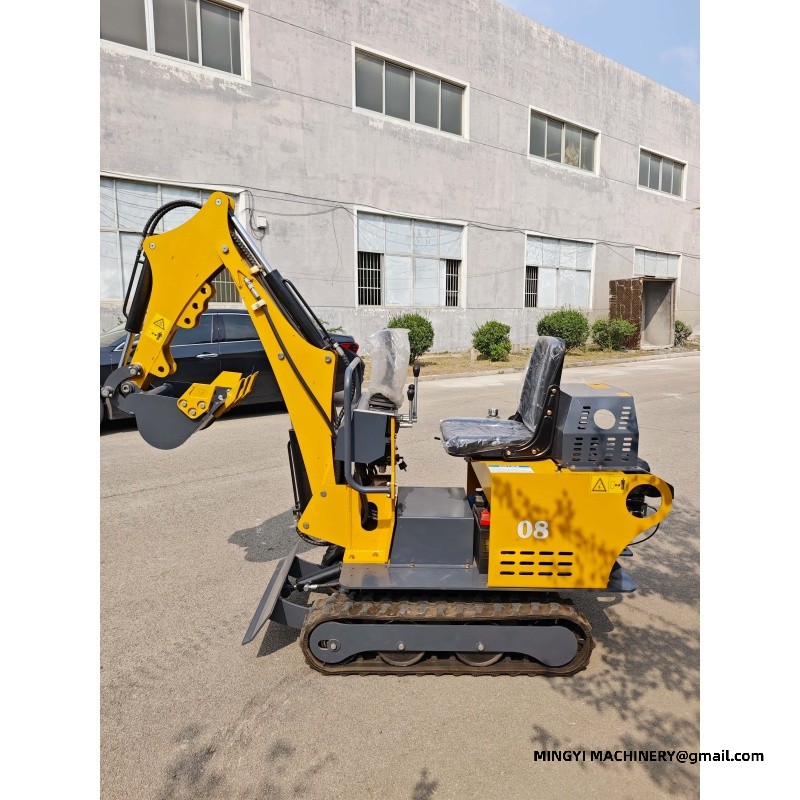
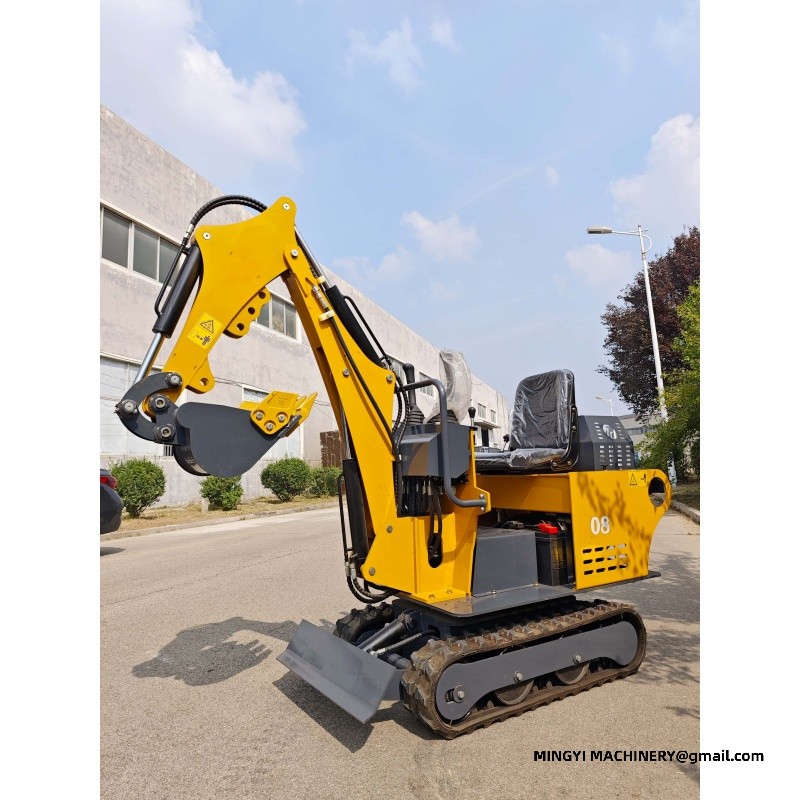
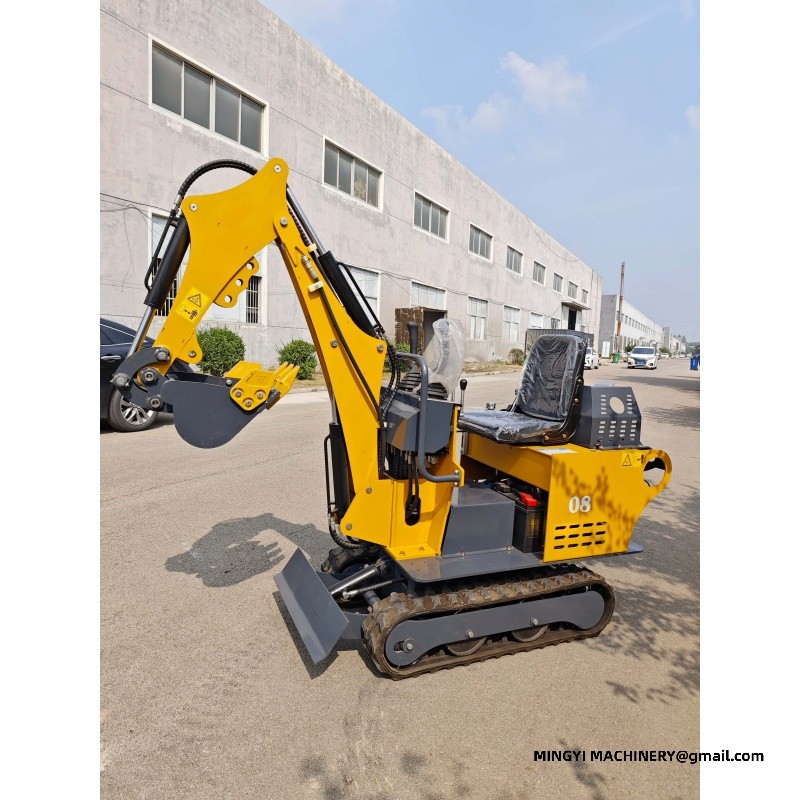
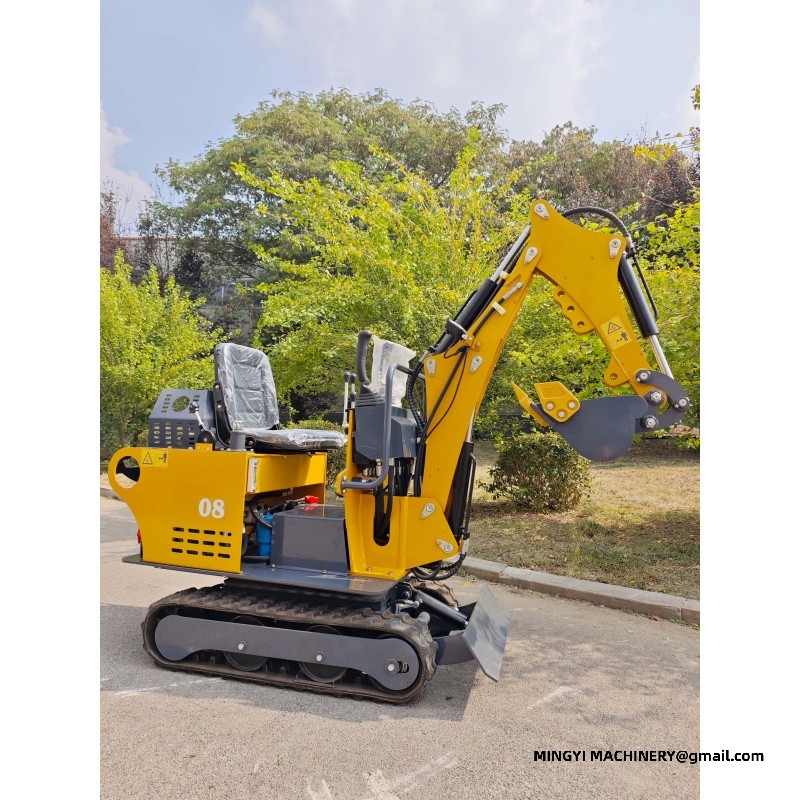
Shaft bases, machine rooms and elevator pits sit at the bottom of finished buildings where no normal digger can travel. MINGYI micro excavators in the sub tonne class are ordered for this work, small enough to pass through doorways and down ramps in sections.
The machine strips old pit floors, digs the recesses for door sills and levels the base for new installations, all inside a working room bounded by finished walls. The zero tail body swings within its own footprint through the work cycle.
Pit and machine room digging inside buildings
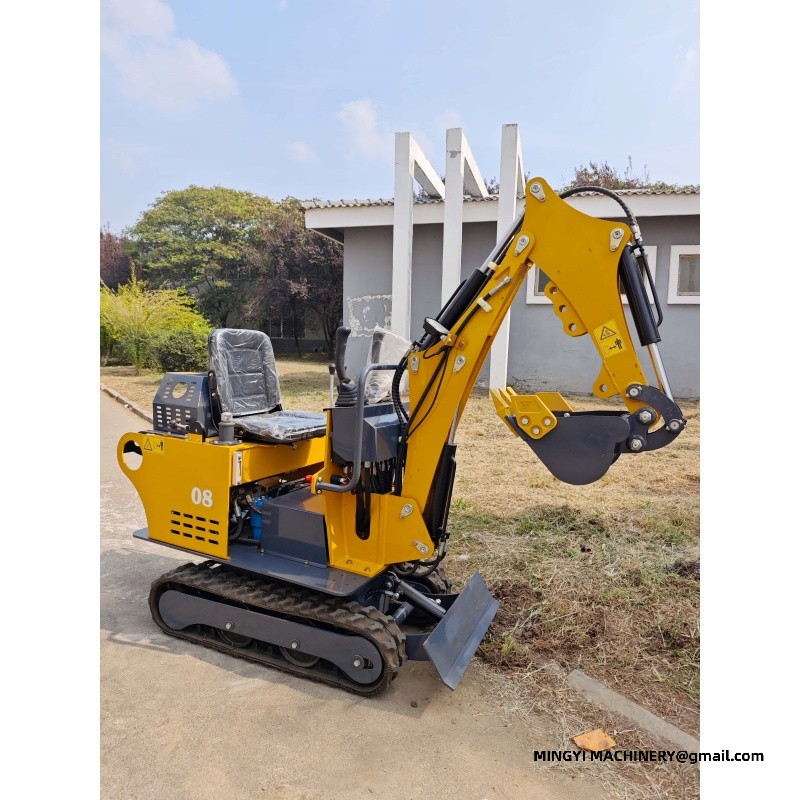
Elevator pits collect old concrete, silted drains and abandoned services that have to come out before modernisation. The micro unit breaks the floor with a small breaker hammer and lifts the debris into sacks or a barrow staged at the room door.
The working space is a finished room, so rubber tracks and careful hydraulics matter more than raw output. The machine digs the pit recess and sill trenches to line without clipping the surrounding structure with its body.
Ordering a micro unit for internal works
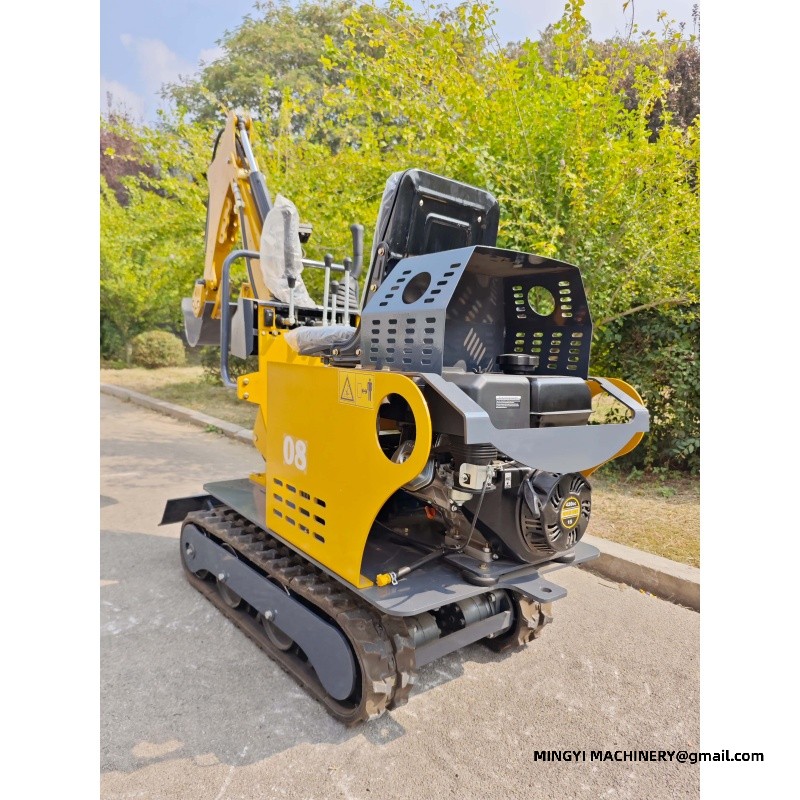
The doorway widths, corridor turns and any vertical movement into the room are confirmed at the ordering stage, and the machine configuration is recorded against the build. Contractors usually pair the micro carrier with a breaker, a narrow bucket and a tilting bucket for the finish.
Because these rooms are enclosed, exhaust routing and ventilation on site are part of the contractor's plan. MINGYI supplies the engine service information with the machine.
Elevator room modernisation is one of the few jobs where the machine has to arrive through the building rather than across a site. MINGYI checks the access route with the buyer and configures the micro excavator to the room it will work in.
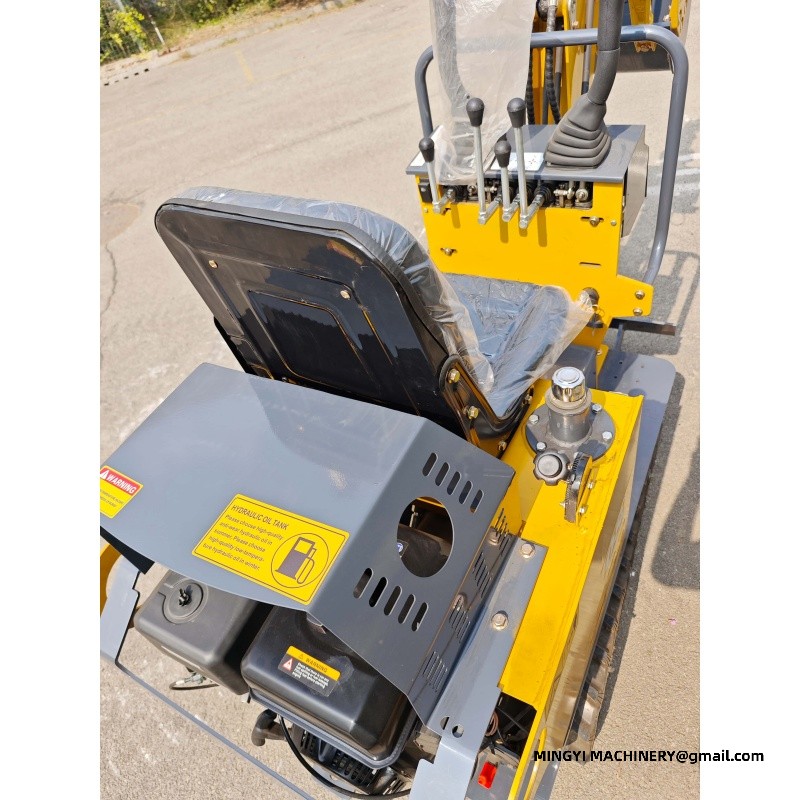
Canopy or enclosed cab on a micro excavator for elevator rooms The cab decision follows the climate and the hours. Operators working a full shift in the excavator benefit from a sealed cab with wipers and heating; operators stepping on and off every few minutes usually prefer the canopy for the visibility and the quick exit. Enclosure also changes noise and dust exposure. A sealed cab on this class of machine keeps dust out on dry sites and lets the machine work through weather that would otherwise stop a canopy machine for the day. Hiring versus owning a micro excavator for elevator rooms The choice follows the hours. Work that fills a few weeks a year is usually better hired, while the unit in daily use that would be on site most weeks starts to justify ownership once the transport and booking time is counted. Availability is part of the decision. Owning a machine of this size means it is there on the day the ground is ready; hiring means competing for the same machine at the same time as everyone else in the season. Daily checks and maintenance on micro excavator for elevator rooms Daily maintenance on the equipment on site is a short list: engine oil level, coolant, track tension, hydraulic oil level and a look at the hoses. Ten minutes at the start of the shift prevents most of the failures that stop a machine. Track tension is the item most often neglected. The machine itself run with slack tracks wears the undercarriage and can throw a track on a turn; run too tight, the same components wear from the other direction. Export packing and shipping of micro excavator for elevator rooms Export documentation, decals and paint are settled before packing. Asking for them with the machine in that duty order avoids a second handling session and keeps the machine on the booked vessel. Buyers who import regularly plan the spare parts with the machine. The model in question ordered with a wearing-parts kit arrives ready to work rather than ready to wait for the first service interval. Parts, service and support for micro excavator for elevator rooms Engine parts availability usually drives the engine choice. The unit on the job built with an engine the local network already carries is serviced from stock rather than from an international order. Remote support is handled by video. A machine built for the work fault can often be diagnosed on a walk-around call with the panel open, which is faster than waiting for a visit and avoids shipping a part that is not needed. Landscaping and ground care with micro excavator for elevator rooms Landscape contractors use the equipment in service for planting holes, pond excavation, grading and retaining work. The machine is light enough to cross finished lawn and narrow enough to work between established trees. On soft landscape work the surface is the constraint. The excavator on rubber tracks crosses turf without stripping it, which is why the same jobs are not given to a wheeled machine. Track choice for this class of machine Rubber tracks suit paved and landscaped ground because they spread the machine weight and leave the surface intact. Steel tracks with rubber blocks are specified where the ground is rougher or the working day is longer, and the choice can be made per machine rather than accepted as a factory default. Track type changes what the machine can cross and what it leaves behind. Buyers specify rubber for lawns, driveways and municipal work, and steel with rubber blocks for sites where sharp material would cut a rubber belt in a week. Matching the unit in daily use to ground conditions Soft ground is a flotation problem, not a power problem. A machine of this size on wide rubber tracks crosses lawn, sand and cultivated soil that would stop a narrower machine or a wheeled unit of the same capacity. Hard and abrasive ground reverses the specification. On rock, demolition rubble or sharp gravel, steel tracks with rubber blocks on the equipment on site survive conditions that cut a rubber belt quickly. Specifying the machine itself against a job list Buyers who skip this step either over-buy or under-buy. The model in question specified only from machine size tends to arrive without the coupler, the circuits or the track type the work actually needs. Useful information to send with an enquiry includes working width, required digging depth, ground conditions and the attachment set. Those four items let the factory specify the machine in that duty that fits rather than a generic build. Working near live services with the unit on the job Digging near water, gas and cable is a precision job. A machine built for the work is used here because the operator can work in short controlled cuts and because the machine can be positioned without driving over the run being exposed. The risk on utility work is not machine power but machine placement. The equipment in service that fits the working width leaves the surrounding ground undisturbed, which keeps the trench stable and the reinstatement small. Getting the excavator through a narrow gap Access decides the machine before output does. With this class of machine the limiting dimension is usually the widest point on the way in, so measuring the gate, the corridor and the turning space first saves a wasted delivery and a second visit. Contractors who buy the unit in daily use normally have one job in mind that nothing else reaches. The purchase order follows the access measurement, not the other way round, and the build sheet is then settled around it. Specification data for a machine of this size The figures below are the factory figures for the models most often matched to the equipment on site. They are the numbers to check against the site: the depth the work needs, the reach from one position, and the width of the narrowest point on the route in. Every value shown is as built for the machine itself; options such as cab, side swing or a telescopic undercarriage change the transport dimensions and are confirmed at order stage. Enclosure and machine condition both reduce noise. The model in question with intact panels, sound mounts and a maintained exhaust is measurably quieter than the same machine with loose guards, and the difference matters on restricted sites. Dust control is often part of the same conversation. Water, timing and work sequence reduce what leaves the site, and agreeing them in advance keeps the machine in that duty working rather than stopped after a complaint.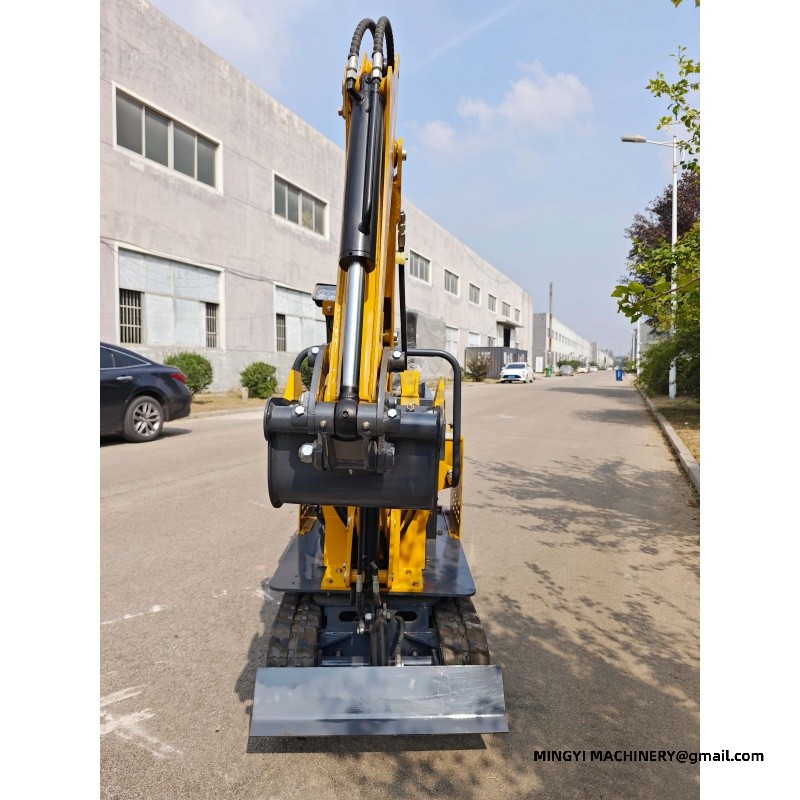
Reference specification — mini excavator range 15W 30-1W 30-2W 25L Operating weight 1400 kg (3086.47 lb) 2900 kg (6393.41 lb) 2700 kg (5952.48 lb) 2200 kg (4850.17 lb) Transport size (L×W×H) 2200 × 930 × 2250 mm 3000 × 1250 × 2780 mm 3000 × 1100 × 2700 mm 3000 × 1300 × 2700 mm Max digging depth 1630 mm (64.17 in) 2200 mm (86.61 in) 2200 mm (86.61 in) 2300 mm (90.55 in) Max digging height 2750 mm (108.27 in) 3400 mm (133.86 in) 3000 mm (118.11 in) 3100 mm (122.05 in) Max dumping height 1960 mm (77.17 in) 2400 mm (94.49 in) 2000 mm (78.74 in) 2050 mm (80.71 in) Max digging radius 2900 mm (114.17 in) 4000 mm (157.48 in) 3800 mm (149.61 in) 3900 mm (153.54 in) Max digging distance 2100 mm (82.68 in) 2800 mm (110.24 in) 3050 mm (120.08 in) 3100 mm (125.05 in) Minimum turning radius 1300 mm (51.18 in) 2000 mm (78.74 in) 1750 mm (68.9 in) 1800 mm (70.87 in) Travel speed 3 km/h (1.86 mph) 5 km/h (3.11 mph) 7 km/h (4.35 mph) 7 km/h (4.35 mph) Gradeability 30° 30° 30° 30° Fuel consumption 1-1.3 L/h (0.264—0.343 gal) 2-3 L/h (0.528—0.793 gal) 2-3 L/h (0.528—0.793 gal) 2-3 L/h (0.528—0.793 gal) Fuel tank capacity 10 L (2.64 gal) 16 L (4.23 gal) 16 L (4.23 gal) 16 L (4.23 gal) Hydraulic oil tank 16 L (4.23 gal) 20 L (5.28 gal) 20 L (5.28 gal) 18 L (4.76 gal) Dozer blade lift height 180 mm (7.09 in) 420 mm (16.54 in) 230 mm (9.06 in) 230 mm (9.06 in) Dozer blade drop depth 210 mm (8.27 in) 210 mm (8.27 in) 280 mm (11.02 in) 280 mm (11.02 in)
Q. What are the unit on the job?
A. The whole point of the smallest classes is presence - a digging machine that reaches work nothing bigger can enter. Retractable frames narrow for the passage then widen for stability, so nothing is given up once the machine is through. For elevator rooms applications the practical route is to send the job list to the factory and let the build sheet answer it - which is exactly what this page invites.
Q. What can such a small digger actually do?
A. More than its size suggests: inside a basement or behind a boundary it digs footings, breaks floors and grades the sub-base at rates hand digging cannot touch. The limit is reach and lift, not willingness.
Q. How do I get a specification?
A. Send the model, the destination and the attachment list by email or LINE - the channels listed just below this section. The reply covers the specification, lead time, packing and freight in one document, with the elevator rooms build sheet attached.
Pre-delivery inspection before a machine built for the work leaves the shop
Inspection is a list, not a glance. Before the equipment in service is released the fluid levels, belt tension, electrical connections and safety decals are each ticked off, and anything that fails stays in the shop rather than travelling with the machine.
Keeping a service record for the excavator
Service history also protects the warranty position. Evidence that this class of machine was maintained at the specified intervals and with the specified fluids settles questions that would otherwise be argued.
Planning the season around the unit in daily use
The calendar decides more than the specification does. Planning when a machine of this size will be working, when it will be serviced and when it can be spared keeps the maintenance out of the weeks that matter.
E-mail : sales@mingycn.com
LINE ( ID ): mingyicn
Heat and hydraulic temperature in micro excavator for elevator rooms
Oil that runs hotter than the design range loses its film strength, and the first symptom is usually slower, softer movement rather than a leak.
Related pages
mini excavator for interior strip-out · mini excavator for indoor demolition · Mining Wheel Loader: Cooling, Traction and Frame Specification · Mini Excavators









